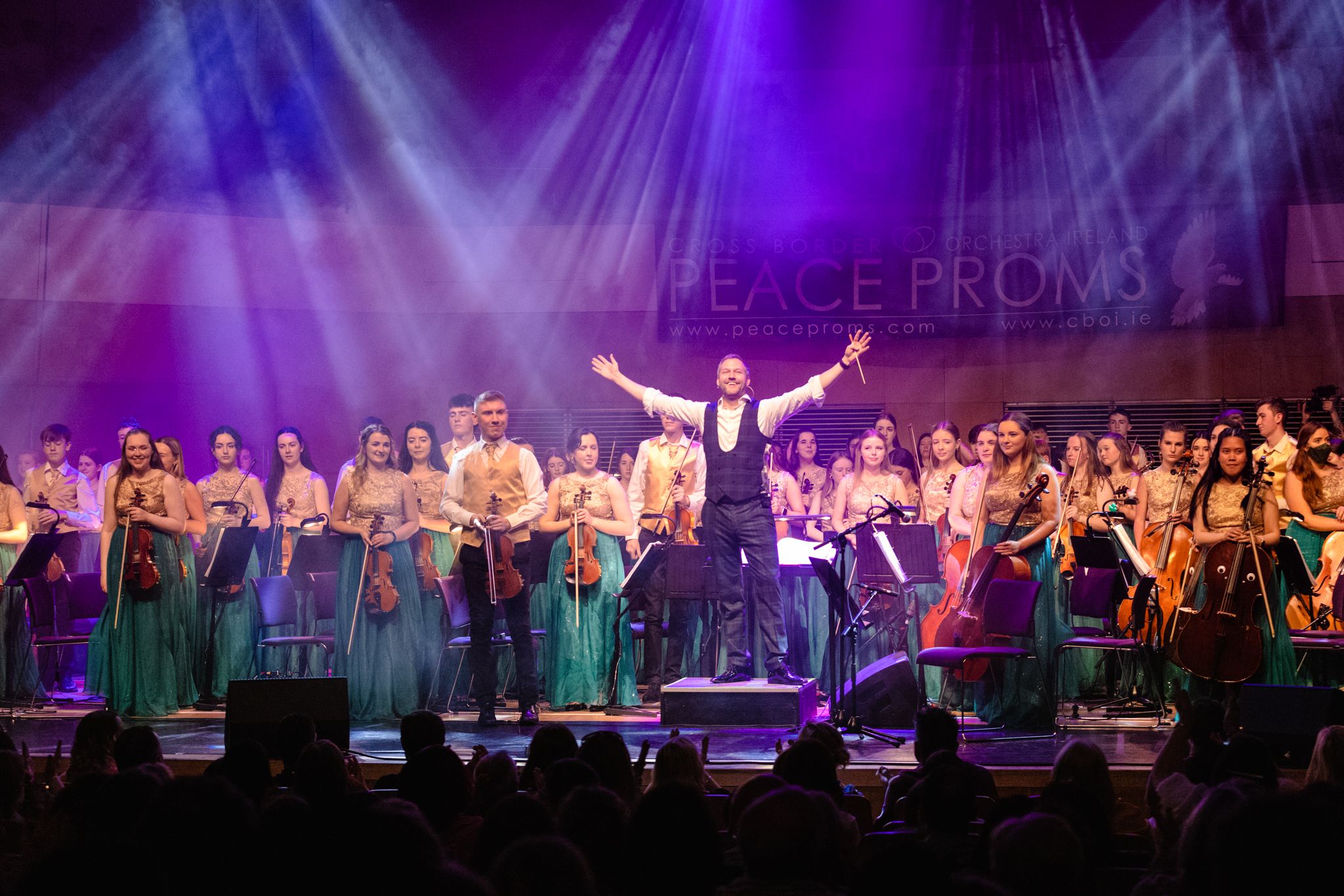
The Cross Border Orchestra of Ireland, which has been promoting peace since 1995, will again grace the Carnegie Hall stage Friday evening, March 17. The celebration St. Patrick’s Day concert marks the 25th anniversary of the Good Friday Agreement. Based in Dundalk, Co. Louth, the CBOI is composed of over 130 young musicians, from age 14 to 24, from all over Ireland and Northern Ireland. View their version of “Where the Streets have No Name,” filmed at locations across the island of Ireland, here:
DUP urged to restore powersharing institutions by US senate leader
By Gráinne Ní Aodha, PA in Washington DC
Today at 03:20
The DUP has been urged to restore power-sharing by the leader of the US senate at a gala dinner attended by senior political figures from Northern Ireland.
Among the high-profile guests at the dinner were former Irish president Mary Robinson, PSNI Chief Constable Simon Byrne and the US Special Envoy for Northern Ireland Joe Kennedy III.
Also in attendance were Sinn Fein president Mary Lou McDonald, her vice president Michelle O’Neill, DUP leader Sir Jeffrey Donaldson, UUP leader Doug Beattie, Alliance Party leader Naomi Long and SDLP leader Colum Eastwood.
Chuck Schumer praised the slow and “sometimes spluttering” progress made to achieve peace in Northern Ireland, before urging the Stormont institutions to be restored.
The US Senate Majority Leader also said he hoped the Windsor Framework “clears the way for the DUP to join Sinn Fein in a power-sharing agreement decided by the people of Northern Ireland in the last election, an amazing election.
“I say to all parties in the north, but especially the DUP, let’s get to the people’s business.”
Mr Schumer also referenced a group of Irish fishermen’s campaign to oust a Russian naval ship away from the Co Cork coast in 2021, quoted novelist James Joyce, and said Mayo would win the All Ireland Football Championship.
“I come from Ireland’s 33rd county – Brooklyn, New York!” he said.
He also praised the Irish rugby team – telling the congregation that if they had been sent to Ukraine, the war would be over within a week.
Republican Kevin McCarthy, the great grandson of a labourer from Co Cork, referenced the opposition that led to him eventually to becoming the Speaker of the House of Representatives – on the 15th ballot.
“A true Irishman never passes up a good fight,” he said. “But as an Irishman we also know when the fight’s over, you bring peace, you keep the peace, and that’s what we will do.”
During his address, Irish premier Leo Varadkar thanked the US for its response to the invasion of Ukraine, paid tribute to the late Congressman Brian Donnelly, and reflected on the upcoming 25th anniversary of the Good Friday Agreement.
He told guests: “This remarkable achievement took real political leadership – and a vision that was not afraid of compromise – and it allowed us to break the cycle of violence that had ravaged the island of Ireland for 30 years.
“A new generation of young people were given the freedom to dream big dreams for the first time.
“It would never have been possible without the support of our friends here in the United States, including some of the people in this room.
“In many ways, America is the thirds co-guarantor of the Agreement.”
The Taoiseach added: “Twenty-five years on, Northern Ireland is a very different place. It has its problems and has yet to live up to the full promise of Good Friday 1998 but it is unquestioningly a much better place than it was and there are so many opportunities available to young people that were unimaginable for too long.
“In this St Patrick’s week, let us remember that peace in Northern Ireland is one of the greatest and most significant success stories in American foreign policy.
“At critical junctures, the intervention of the United States drove the process forward.
“I believe the best way of celebrating a quarter of a century of peace on the island of Ireland, is by seizing this opportunity to make it a shining example to the world of what can be achieved when hope overcomes fear,” he said.
Irish, susceptible to disease, soon become a “remedy” among the community and a symbol of national pride.
IrishCentral Staff Writers
Mar 06, 2023
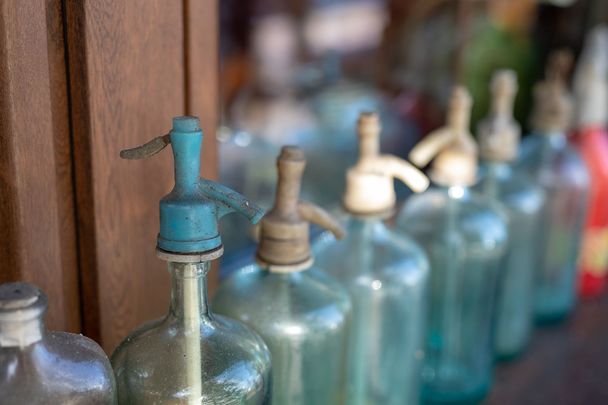
Soda water was the drink of choice for 19th-century Irish immigrants. GETTY
How soda water, Irish sounding-brand names and all, become a medical, emotional and spiritual part of the 19th-century community.
Today, sparkling water is a trendy alternative to sugary sodas in our health-conscious culture. From 2009 and 2014, the volume of carbonated bottle of water sold in the U.S. increased 56.4 percent. Nearly 800 million liters of soda water are expected to sell annually.
However, sparkling water isn’t anything new. According to researcher Meredith B. Linn, Irish famine immigrants in the 19th century were huge fans of the beverage.
Archaeologists have discovered numerous soda water bottles at the former dwellings of 19th-century Irish immigrants, Linn revealed in the paper Elixer of Emigration:Soda Water and the Making of Irish Americans in Nineteenth-Century New York City, published by the Society for Historical Archaeology. Her study focused on findings from Five Points, a working-class neighborhood in New York City during the 19th century.
A substantial number of these bottles were found at the site of two tenements inhabited almost exclusively by Irish immigrants and first-generation Irish Americans. The number of bottles found greatly exceeded the number of similar bottles found in association with German, German Jewish, and Polish immigrant residents at the same site and those found in association with Scottish, English and American-born families in Greenwich Village. This pattern was consistent with what was found in Irish immigrant-related sites in New Jersey and San Francisco around the same time period.
JSTOR Daily reports that Irish immigrants, who were “steeped in water remedy beliefs,” viewed soda water as a health-related drink.
Sign up to IrishCentral’s newsletter to stay up-to-date with everything Irish!Subscribe to IrishCentral
“Historical records and oral histories indicate that Irish people generally had faith in apothecaries that was equal to or exceeded that which they had in physicians,” says Linn.
Irish immigrant communities were susceptible to disease. In response to the potato famine, many immigrants survived crossings in filthy steerage compartments to come to the U.S. Their immune systems were depleted and many suffered from diseases such as tuberculosis, cholera, and anemia.
JSTOR Daily reports: “Soda water soon morphed into a symbol of national pride. In response to their new clientele, soda water bottlers began to sell water in bottles embossed with Irish-sounding brand names. These clever strategies meant that Irish people not only bought more water, but saved bottles for reuse at home, often filling them with homemade remedies when the soda water was gone. It became common to keep Irish-named soda bottles on display in the home and share soda water with visitors—a ritual that in turn ‘would have been absolutely critical for the survival of most immigrants and constituted a kind of social medicine.’”
Irish immigrants would come to have a medical, emotional, and spiritual connection to the sparkling drink.
According to Linn: “Soda water was a commodity that resonated with Irih immigrants on multiple levels, and one that they actively used to remedy physical, emotional, social, and economic ills resulting from diaspora and emigration.”
“GOD REST RITA O’HARE. GREAT WOMAN AND GREAT IRISH PATRIOT.”
I first met Rita O’Hare in interesting circumstances. In August 1974, I was home in Ireland on holiday from America. I was asked to visit one of the political prisoners in Portlaoise Prison, County Laois, Irish Republic.
It was shortly after the famous escape of 19 political prisoners from that prison.
When I arrived at the prison, the guard at the “front desk” said, ‘Well, Father, who are you here to see?” “Kevin Mallon,” I said with a smile. (Now, Mallon, a Tyrone man, would have been one of the best-known of the 19 escapees, and a famous Irish Republican). But fair play to the guard, without missing a beat to my cheeky response, said: “Ha, ha, Father, you better search the bogs of Ireland for him.”
NON-VIOLENT PRISON SIT-IN
Anyway, when I gave the name of the person I had really come to visit, I was told I had to see the “governor” or whatever the man in charge was called. I met with him and, although he was friendly and respectful, he told me I could not see the person. So, in an equally friendly and respectful manner, I told him I would not leave the prison and would stage a “nonviolent prison protest sit-in.”
I left his office and went back to the waiting room, which conveniently had a public telephone. I called the Irish Press in Dublin and told them about my ”sit-in.” (Later on, a reporter told me that phone had been removed!)
While there, a young redhead woman, with two young children, approached me to introduce herself: it was Rita O’Hare.
I told her I was doing a “ nonviolent sit-in,” and she immediately said: “Do you want me to join you?” I was impressed by her spontaneous willingness to help. But, I said, “ Ah, no, Rita, you have two little children with you. The guards will just carry me out and I will be fine.”
I never saw Rita again until years later she came to Washington as the Sinn Fein representative to the United States.
Ballymurphy Massacre Congressional Hearing
There is one thing, in particular, I am grateful for Rita doing. In December 2010, she brought leaders of the Ballymurphy Massacre Committee to meet with me so that I could arrange a Congressional Hearing on the Massacre, which I was proud to do. On March 16, 2011, the Chairman of the Committee, John Teggart— whose father was one of the eleven innocent civilians assassinated by the British Army in the Massacre—testified before Congress. I was proud of him. He was a powerful and most impressive witness. And I know John and his Ballymurphy Massacre Committee will share my sadness at Rita’s death.
All of this has flooded back into my mind when I heard of Rita O’Hare’s death. May God rest her noble Irish soul. She was a great woman and a great Irish Patriot.
As we approach the 25th anniversary of Good Friday Agreement, David Kerr, a former special adviser to David Trimble and director of communications for the Ulster Unionist Party during the talks leading up to the deal, reflects on the chaotic and violent events which marred the start of 1998. This led to the tragic and watershed moment in early March, with the murders of two best friends in a bar in Poyntzpass, Co Armagh
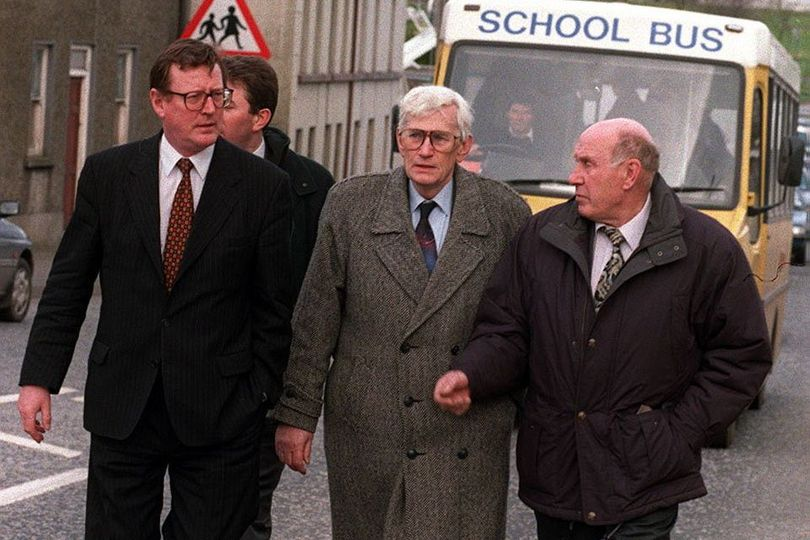
David Trimble and Seamus Mallon in Poyntzpass in March 1998 with Tommy Canavan, brother of Railway Bar owner.
Belfast Telegraph
Today at 01:00
They say history repeats itself. Sometimes it does, sometimes it doesn’t.
In the months before the Good Friday Agreement in 1998, it certainly felt like history was repeating itself, as we stumbled from one crisis to another in Northern Ireland.
Almost every day, there were vicious political arguments. We were supposed to have ceasefires, but it felt like the familiar cycles of violence and political stalemate that we had known all our lives.
Prior to Christmas 1997, loyalist prisoners in the Maze were already questioning the direction and purpose of the talks process. As the gunshots rang out in the prison yard, beside H-Block 6 on December 27, 1997, and LVF leader Billy Wright lay fatally wounded, a new and deadly series of events would unfold that threatened to derail the talks and the loyalist ceasefires.
By the end of January 1998, several people had been killed by loyalists in retaliation for Wright’s murder. Many more were injured and severely traumatised. The political representatives of the UFF, the UDP, decided to withdraw from the talks before being formally suspended. They were excluded for three weeks.
As if not wanting to miss out on the mayhem, in February, the IRA murdered a prominent loyalist in south Belfast.
They also brazenly murdered another man on the Lisburn Road in Belfast, yards from the police station. Based on intelligence assessments from the Chief Constable, Sinn Fein was then also suspended from the talks process for over two weeks.
So concerned was the UUP’s talks team about the fragility of the loyalist ceasefires, David Trimble proactively decided to meet with loyalist prisoners in the Maze to urge them to stick with the process and give it a chance.
If either the UVF-linked PUP, or UDA/UFF-linked UDP left the talks, the negotiations would have collapsed.
Under the rules of sufficient consensus governing the talks, and due to the fact that the UUP only had 46% of the unionist votes cast in the 1996 Forum election (and because the DUP had walked out), the UUP needed both of the small loyalist parties to ratify any potential political agreement.
David Trimble’s visit to the Maze was quickly followed by Secretary of State Mo Mowlam, and it appeared something resembling a sense of calm had been restored within the main loyalist paramilitary groups.
In parallel to this, despite the best efforts of the UK and Irish governments to relocate the multi-party talks for a week to London in January, and to Dublin in February 1998, there was no cohesion or political direction to the negotiations.
The UUP exited the London round of talks with Jeffrey Donaldson ripping up a copy of the 1995 Frameworks document and lambasting the Irish government for negligently publishing the home address of Sir Reg Empey on a document.
As if the political situation wasn’t complicated enough, it was clear there were organised terrorists on both sides, strategically determined to collapse the talks.
The LVF was totally opposed to the political negotiations and had no ceasefire in place.
The situation within the IRA was much more complex.
On February 23, 1998, we received a call that a large car bomb had detonated in the centre of Portadown, in the heart of David Trimble’s constituency. David and I were driven to the scene where we met our party colleague, Mark Neale, to assess the damage.
We had our suspicions that the attack and an identical bombing in Moira (the home of fellow UUP negotiator Jeffrey Donaldson) days earlier, had been very deliberate.
Even though there were no bilateral meetings between the UUP and Sinn Fein at any stage before Good Friday 1998, we knew there were many within the IRA who feared the constitutional outcome from a deal would be unsellable to their base.
While some within loyalism were paranoid about what might happen, we believed a lot of people within the IRA wanted the talks to collapse and the best way for this to happen, from their perspective, would be to force the UUP to walk out.
So, who better to put direct pressure onto, other than Trimble and Donaldson, by putting bombs in their constituencies?
As David Trimble finished a short press conference in front of the bomb scene in Portadown town centre, on that grim February afternoon, a number of people arrived, men who we knew to be linked to the LVF.
“Get out of them f***ing talks now!” shouted Mark ‘Swinger’ Fulton, the infamous LVF associate of Billy Wright. To his credit, David remained stoically composed. We were facing dangerous and extremely violent people on both sides. The only thing they had in common was a desire for the conflict to continue.
As we made our way back from Portadown to Stormont, we knew time was running out.
The talks chairman, US Senator George Mitchell, was exasperated. He told us that if there was no deal by April 9, the process would be over.
We couldn’t blame him. The negotiations had been running for almost two years and despite a skeleton ‘Heads of Agreement’ being agreed in January 1998, the talks were going nowhere. When the news broke on March 3, 1998, that two young men, Catholic Damien Trainor and his best mate Philip Allen, a Protestant, had been murdered by the LVF in a gun attack on a bar in Poyntzpass, I could sense, for the first time, David’s despair.
The attack had taken place in Seamus Mallon’s parish.
He was speaking to the media the following day at the scene when David arrived.
Seamus asked David to join him. He later explained what had happened to David’s biographer, Dean Godson. He said they went to Allen’s house and then David said: “I’ll walk to the next house (Trainor’s).”
Seamus replied: “Let’s walk together. People here will be glad to see us together.”
And they certainly were. As the two men spoke to the media side by side, in a hugely symbolic show of political and civic unity, David didn’t hold back.
He was visibly emotional.
“I am ashamed to think the perpetrators of this deed were Protestant. They were serving no cause and on behalf of the unionist community, I repudiate them,” he said.
As they left the scene, I would later realise something profound had happened that day. The SDLP’s Mark Durkan would point to the images of both men together as being the spark that created the idea for a first minister and deputy first minister. What I knew was that there was a new sense of determination and grit within the UUP and SDLP. This couldn’t go on. Something had to be done.
Within weeks, Trimble and Mallon would spearhead the negotiating teams of the UUP and SDLP respectively.
Against all odds, they would forge an agreement and personally take responsibility for leading a new Assembly as first minister and deputy first minster.
Together, they would take Northern Ireland into a transformed political dispensation, changing the course of history here forever.