As we approach the 25th anniversary of Good Friday Agreement, David Kerr, a former special adviser to David Trimble and director of communications for the Ulster Unionist Party during the talks leading up to the deal, reflects on the chaotic and violent events which marred the start of 1998. This led to the tragic and watershed moment in early March, with the murders of two best friends in a bar in Poyntzpass, Co Armagh
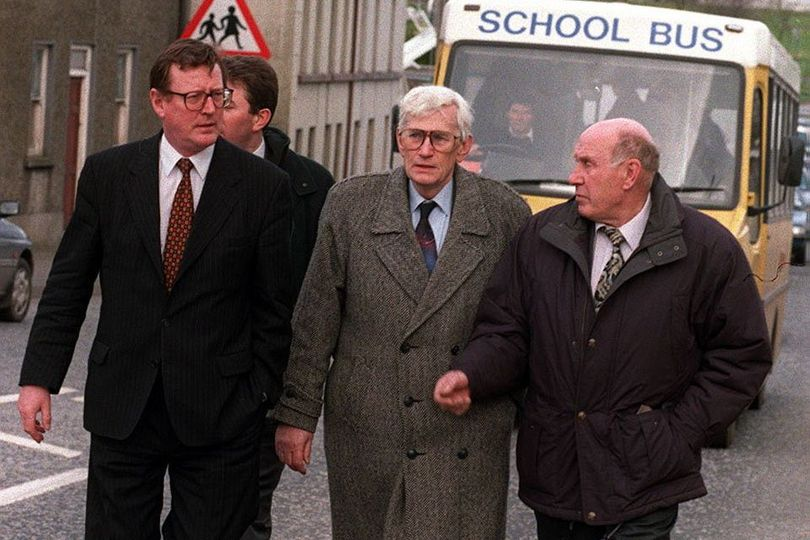
David Trimble and Seamus Mallon in Poyntzpass in March 1998 with Tommy Canavan, brother of Railway Bar owner.
Belfast Telegraph
Today at 01:00
They say history repeats itself. Sometimes it does, sometimes it doesn’t.
In the months before the Good Friday Agreement in 1998, it certainly felt like history was repeating itself, as we stumbled from one crisis to another in Northern Ireland.
Almost every day, there were vicious political arguments. We were supposed to have ceasefires, but it felt like the familiar cycles of violence and political stalemate that we had known all our lives.
Prior to Christmas 1997, loyalist prisoners in the Maze were already questioning the direction and purpose of the talks process. As the gunshots rang out in the prison yard, beside H-Block 6 on December 27, 1997, and LVF leader Billy Wright lay fatally wounded, a new and deadly series of events would unfold that threatened to derail the talks and the loyalist ceasefires.
By the end of January 1998, several people had been killed by loyalists in retaliation for Wright’s murder. Many more were injured and severely traumatised. The political representatives of the UFF, the UDP, decided to withdraw from the talks before being formally suspended. They were excluded for three weeks.
As if not wanting to miss out on the mayhem, in February, the IRA murdered a prominent loyalist in south Belfast.
They also brazenly murdered another man on the Lisburn Road in Belfast, yards from the police station. Based on intelligence assessments from the Chief Constable, Sinn Fein was then also suspended from the talks process for over two weeks.
So concerned was the UUP’s talks team about the fragility of the loyalist ceasefires, David Trimble proactively decided to meet with loyalist prisoners in the Maze to urge them to stick with the process and give it a chance.
If either the UVF-linked PUP, or UDA/UFF-linked UDP left the talks, the negotiations would have collapsed.
Under the rules of sufficient consensus governing the talks, and due to the fact that the UUP only had 46% of the unionist votes cast in the 1996 Forum election (and because the DUP had walked out), the UUP needed both of the small loyalist parties to ratify any potential political agreement.
David Trimble’s visit to the Maze was quickly followed by Secretary of State Mo Mowlam, and it appeared something resembling a sense of calm had been restored within the main loyalist paramilitary groups.
In parallel to this, despite the best efforts of the UK and Irish governments to relocate the multi-party talks for a week to London in January, and to Dublin in February 1998, there was no cohesion or political direction to the negotiations.
The UUP exited the London round of talks with Jeffrey Donaldson ripping up a copy of the 1995 Frameworks document and lambasting the Irish government for negligently publishing the home address of Sir Reg Empey on a document.
As if the political situation wasn’t complicated enough, it was clear there were organised terrorists on both sides, strategically determined to collapse the talks.
The LVF was totally opposed to the political negotiations and had no ceasefire in place.
The situation within the IRA was much more complex.
On February 23, 1998, we received a call that a large car bomb had detonated in the centre of Portadown, in the heart of David Trimble’s constituency. David and I were driven to the scene where we met our party colleague, Mark Neale, to assess the damage.
We had our suspicions that the attack and an identical bombing in Moira (the home of fellow UUP negotiator Jeffrey Donaldson) days earlier, had been very deliberate.
Even though there were no bilateral meetings between the UUP and Sinn Fein at any stage before Good Friday 1998, we knew there were many within the IRA who feared the constitutional outcome from a deal would be unsellable to their base.
While some within loyalism were paranoid about what might happen, we believed a lot of people within the IRA wanted the talks to collapse and the best way for this to happen, from their perspective, would be to force the UUP to walk out.
So, who better to put direct pressure onto, other than Trimble and Donaldson, by putting bombs in their constituencies?
As David Trimble finished a short press conference in front of the bomb scene in Portadown town centre, on that grim February afternoon, a number of people arrived, men who we knew to be linked to the LVF.
“Get out of them f***ing talks now!” shouted Mark ‘Swinger’ Fulton, the infamous LVF associate of Billy Wright. To his credit, David remained stoically composed. We were facing dangerous and extremely violent people on both sides. The only thing they had in common was a desire for the conflict to continue.
As we made our way back from Portadown to Stormont, we knew time was running out.
The talks chairman, US Senator George Mitchell, was exasperated. He told us that if there was no deal by April 9, the process would be over.
We couldn’t blame him. The negotiations had been running for almost two years and despite a skeleton ‘Heads of Agreement’ being agreed in January 1998, the talks were going nowhere. When the news broke on March 3, 1998, that two young men, Catholic Damien Trainor and his best mate Philip Allen, a Protestant, had been murdered by the LVF in a gun attack on a bar in Poyntzpass, I could sense, for the first time, David’s despair.
The attack had taken place in Seamus Mallon’s parish.
He was speaking to the media the following day at the scene when David arrived.
Seamus asked David to join him. He later explained what had happened to David’s biographer, Dean Godson. He said they went to Allen’s house and then David said: “I’ll walk to the next house (Trainor’s).”
Seamus replied: “Let’s walk together. People here will be glad to see us together.”
And they certainly were. As the two men spoke to the media side by side, in a hugely symbolic show of political and civic unity, David didn’t hold back.
He was visibly emotional.
“I am ashamed to think the perpetrators of this deed were Protestant. They were serving no cause and on behalf of the unionist community, I repudiate them,” he said.
As they left the scene, I would later realise something profound had happened that day. The SDLP’s Mark Durkan would point to the images of both men together as being the spark that created the idea for a first minister and deputy first minister. What I knew was that there was a new sense of determination and grit within the UUP and SDLP. This couldn’t go on. Something had to be done.
Within weeks, Trimble and Mallon would spearhead the negotiating teams of the UUP and SDLP respectively.
Against all odds, they would forge an agreement and personally take responsibility for leading a new Assembly as first minister and deputy first minster.
Together, they would take Northern Ireland into a transformed political dispensation, changing the course of history here forever.
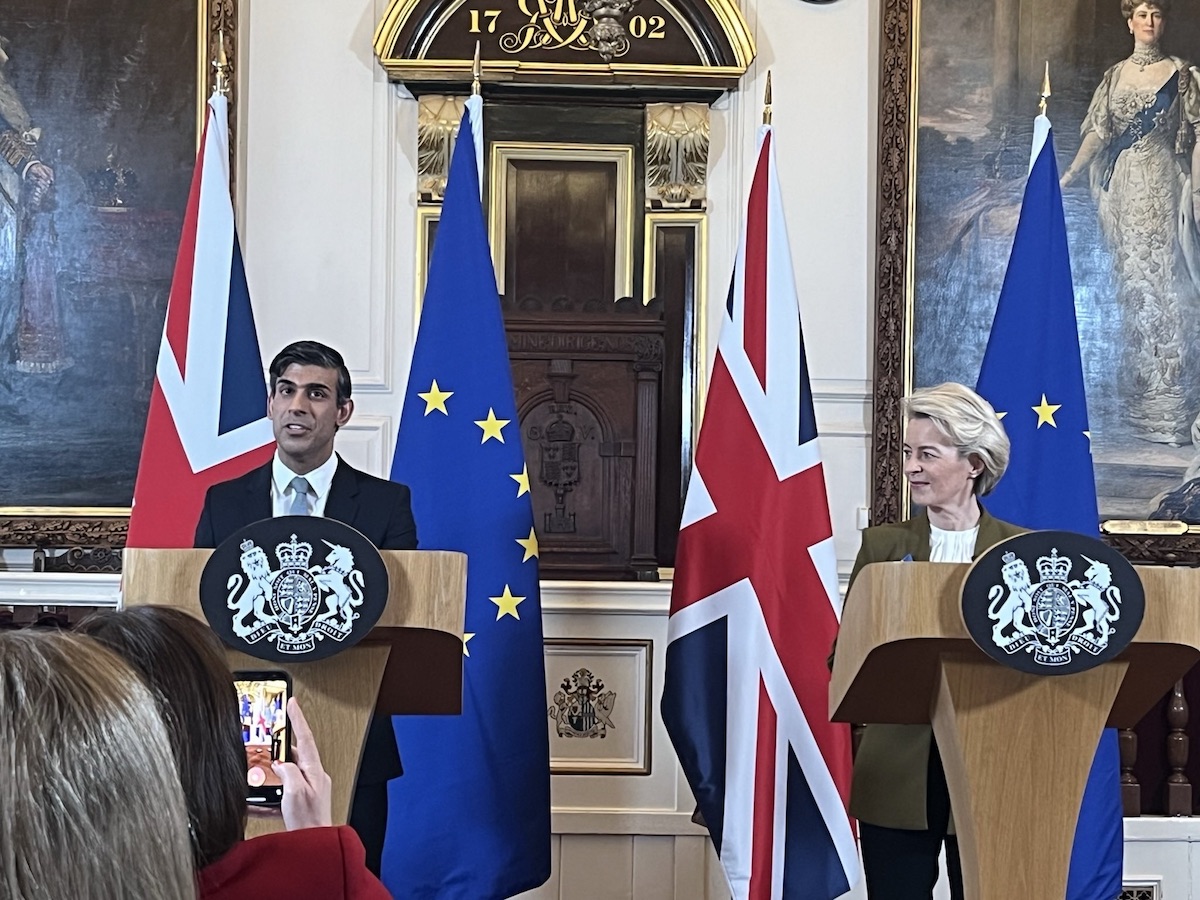
EU president Ursula Von Der Leyen and British prime minister Rishi Sunak have signed a long-awaited deal over post-Brexit trading arrangements for the north of Ireland.
Mr Sunak and Ms von der Leyen finalised the agreement to ease alleged trading issues created by the Irish Protocol of Brexit. A summit to finalise the deal was held at Windsor Castle in England on Monday.
Speaking at a press conference at Windsor, Sunak said today’s agreement marks a “decisive breakthrough” and a “new chapter” in London’s relationship with the EU.
He paid tribute to Von der Leyen and her “vision” that allowed a “new way forward”.
The deal, he says, will preserve the “delicate balance” in the 1998 Good Friday Agreement and protects the “aspirations and identity” of those living in the north of Ireland.
It will “end the uncertainty” for people in the North, he said, and deliver smooth-flowing trade “within the whole of the UK”. He said it protects the union of the north of Ireland to Britain and “safeguards sovereignty” (sic) for those living under British rule.
The European Commission president is due to have tea with England’s King Charles at Windsor Castle later. The meeting will be seen as a sign of reconciliation following a damaging three-year stand-off over Britain’s failure to abide by the treaties it negotiated in 2020.
Questions remain about the approval of the Democratic Unionist Party and the possible return of powersharing in the Six County Assembly at Stormont. DUP leader Jeffrey Donaldson said his party would take some time to examine the details of the deal before declaring its position. Sinn Fé and the other Stormont parties have also yet to comment on the outcome.
The position of extreme backbench Tory Brexit supporters remains unknown. However, arch-Brexiteer Steve Baker, reportedly on ‘resignation watch’ over being excluded from the talks, has strongly backed the deal. He said it was a “really fantastic” outcome.
Any vote at Westminster should have the support of the British Labour Party and, if called, will likely pass comfortably.
Labour leader Keir Starmer said the deal involved practical steps “that could have been taken 18 months, two years ago, but we’ve been stuck in an impasse”.
“The question will be whether the prime minister has got the strength to sell it to his backbenchers or not,” he said.
“Many people will be frustrated that this is the loop we’ve been stuck in for a very, very long time and it’s not something you would have with a Labour government because we don’t have those divisions in our party on this issue.”
The document encoding the changes runs to over 100 pages. It involves the creation of a ‘green channel’ and ‘red channel’ to obviate the need for trade, health and safety checks at ports. These had infuriated unionists who denounced them as amounting to an ‘Irish Sea border’.
The role of EU law in the implementation of the Protocol is also understood to have been all but eliminated in a significant concession to another key unionist demand.
Businesses in the north of Ireland will retain access to the EU single market and there will be no attempt to check goods crossing Britain’s line of partition. Another significant change will allow the free movement of pets throughout the two islands, according to reports.
The 26 County Tánaiste Micheál Martin said there has been “a genuine attempt” to resolve issues with the protocol raised by unionists and that the deal represents a chance to reset British-Irish relations.
“All of those issues that have been raised, I think people will find a genuine attempt at a response to those issues.
“I respect that this is a matter that the DUP would have to consider within its party.
“I would say that, genuinely, the European Union has listened to the concerns that have been articulated consistently by the DUP, the UUP and others in Northern Ireland in respect of the operation of the protocol.”
30 years later, first attack on WTC still etched in memories
Terrorists’ truck bomb carved six-story hole in the basement of one of the towers in 1993, killing six and injuring hundreds. A memorial service is set for Sunday. ap
By Larry Mcshane New York Daily News
The World Trade Center mantra — “Never forget” — began eight years before 9/11, on a dreary winter’s afternoon in lower Manhattan.
It was 12:18 p.m. on Feb. 26, 1993, when a rental van packed by terrorist plotters with 1,200 pounds of explosives detonated in a parking garage beneath one of the twin towers, killing six people and offering a harbinger of darker things to come.
On Sunday, a memorial service at Ground Zero will mark the 30th anniversary of the first attack on the 110-story buildings, with its details still fresh to those who were there.
Carla Bonacci, now assistant director for the Port Authority of New York and New Jersey’s major capital projects, was just across the street when the bomb went off that afternoon.
“I don’t think we’ll ever forget it,” recalled Bonacci. “People started pouring out, glass everywhere on the plaza. Smoke and soot everywhere, and eventually sirens and noise everywhere.”
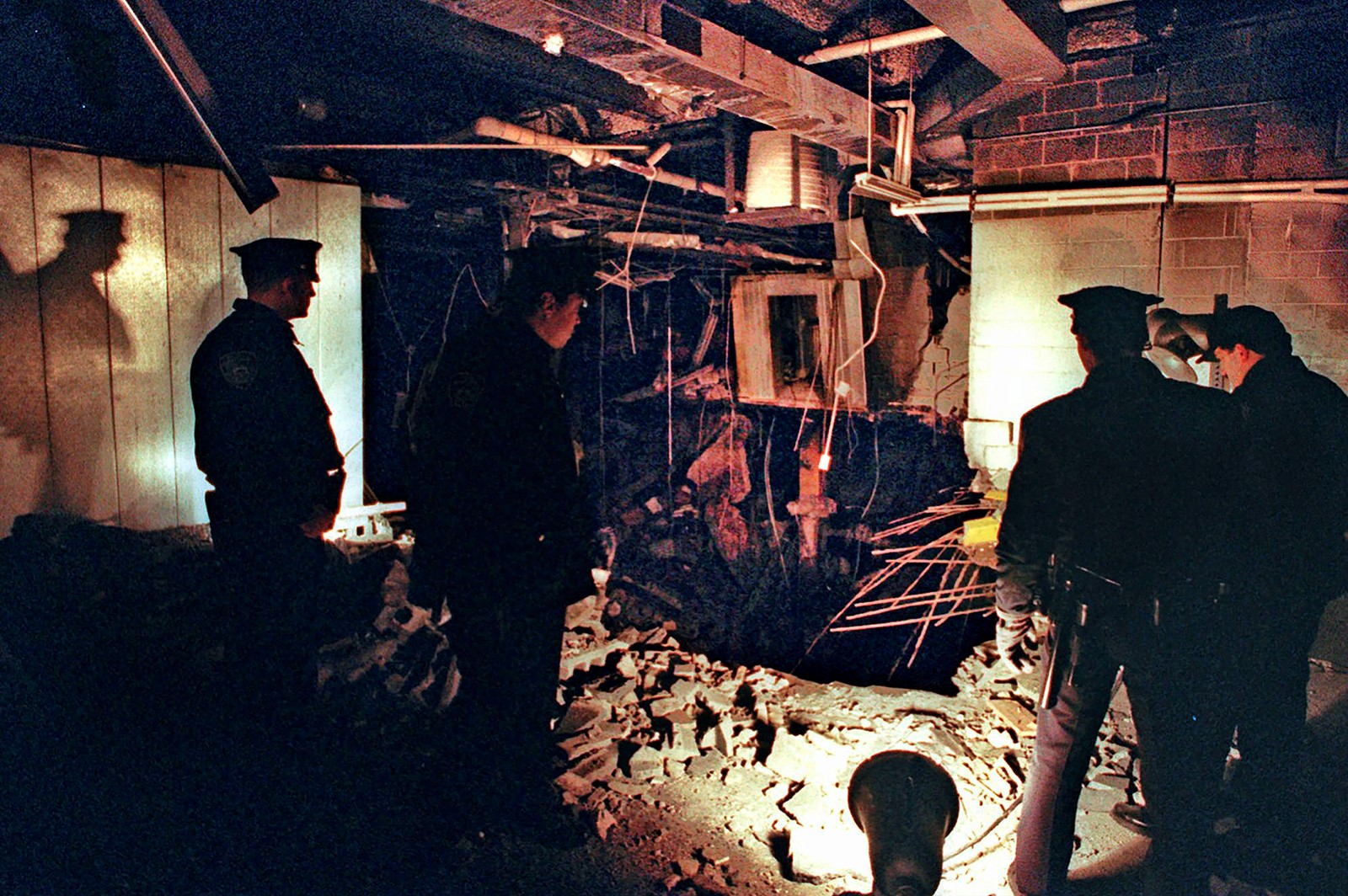
The attack literally shook the twin towers from top to bottom and rattled the neighborhood to its subterranean core, carving a hole six stories deep and half the size of a football field in the garage beneath the North Tower and the adjacent Vista International Hotel.
Then-NYPD Commissioner Ray Kelly remembers going into the pit to see the devastating scope of the damage: “That was an eye-opener. I was surprised more people weren’t killed … It was a huge hole, cars everywhere, part of cars, everything smoking.”
And he recalls the initial report of the bombing: Utility explosion at the World Trade Center with injuries.
The powerful blast left a tourist dining in the 107th floor Windows on the World restaurant staring in disbelief as a bowl of soup rattled on the table before his eyes. More than 1,000 people were injured in the aftermath of the blast, with many suffering from smoke inhalation.
It took until nearly midnight to empty trapped employees from the two buildings after the power went out, with the workers navigating the darkened stairs to the street.
This year’s annual anniversary of the terrorist attack will be observed with the 9/11 Memorial & Museum holding a 12:15 p.m. service on the plaza outside where the towers stood, followed by a 2 p.m. Mass held by the Port Authority at St. Peter’s Roman Catholic Church.
A Sunday moment of silence will be followed with a bell rung by the FDNY, followed by performances of “Amazing Grace” and the National Anthem.
“I don’t think we’ll ever forget it, or the people we lost,” said Bonacci of the three-decade old attack. “It’s our duty and responsibility to remember.”
The second attack actually destroyed a memorial created for the 1993 victims. Their names are now inscribed on a panel at the twin reflecting pools created after the Sept. 11, 2001, attack: John DiGiovanni, Robert Kirkpatrick, Stephen Knapp, Wilfredo Mercado, Port Authority mechanic William Macko and mom-to-be Monica Rodriguez Smith.
The city’s resilience, so evident after 9/11, was just as indelibly visible after the first attack: Shortly after darkness settled over a shaken city, Trade Center officials made sure the building lights were shining in the skyline above Manhattan.
Academy Award nominated producer Marc Smerling, who did a recent “Operation: Tradebomb” podcast tied to the 1993 attack, recounted the back story of chief plotter Ramzi Yousef.
The suspect used an alias to board a Pakistan-bound flight on the day of the bombing and was arrested in the same country just two weeks short of its second anniversary. Yousef — a hood over his head — was flown by authorities in a helicopter above the 110-story towers.
Authorities then removed the covering to let him see the buildings still standing.
“They would not be if [we] had enough money,” replied Yousef. The 2001 attack with two commercial airliners was then masterminded by his uncle Khalid Sheikh Mohamed.
“I don’t think a lot of people understand how inextricably these two crimes are connected and committed by two family members,” said Smerling of the diabolical terrorists. “They had the imagination to think of these plots when nobody had ever done it before.”
The 1993 investigation was fast and furious, with investigators recovering a vehicle identification number on a piece of the blown-up van. It was was quickly traced to plotter Mohammed Salameh, who rented the vehicle.
Salameh was arrested after returning to the Jersey City rental office to retrieve his $400 deposit on the van — tangible proof of Yousef’s claim. The driver, along with three of his co-defendants, were convicted in March 1994.
Kelly remembered sitting in the bomb-ravaged basement 30 years ago, speaking with a building engineer who was trapped in an Trade Center elevator until forcing his way out using only a key. And he’ll never forget what the man told him.
“He said, ‘This building will never come down, are you kidding me?’ ” said Kelly, who lived Downtown near the towers. “And I saw the building go down in 2001. The guy said it would never come down.”
Why Northern Ireland’s anti sectarianism is semi permanently stuck in “the crawler lane”…
Cillian McGrattan
Feb 15
In a couple of recent Belfast Telegraph articles Malachi O’Doherty has developed the idea that the core division in Northern Ireland is about more than sovereignty and divided loyalties to either Ireland or Great Britain.
‘We are divided territorially’, he argues. This includes education, schooling, residential segregation, sport, religion, cultural preferences, language ‘and whatever issue some councillors we’ve rarely heard from will choose to quarrel over next’.
That the British government has resiled from tackling that fundamental problem of sectarianism is something to be regretted. Amidst the furore over amnesty, the fact that the government had strengthened its language in that regard was largely overlooked.
For instance, the July 2021 Command Paper ‘Addressing the Legacy of Northern Ireland’s Past’ went beyond previous platitudes about tackling sectarianism to promoting ‘anti-sectarianism’. This more assertive tone was dropped in the subsequent Bill, though an amendment currently before the Lords requests that it be reinserted.
What is anti-sectarianism?
Part of the reason for the reversion to the idea of ‘reconciliation’ and promises to challenge sectarian division might be that it is difficult to imagine legislating for anti-sectarianism. It’s perhaps easier to see what anti-sectarianism is not rather than defining what it is.
Extrapolating from O’Doherty’s columns, anti-sectarianism really ought to be decoupled from reconciliation (which itself, is impossible to define being both a (transitive) verb and a noun – in short, a process and an event). Whereas the latter depends on a vague hope that the ‘two communities’ can come together on some imagined common ground, the former involves resisting and questioning the exclusivist ethno-religious assumptions that are the preserve of the ethnic blocs (and that are taken as a given by that two communities model or way of thinking).
It is difficult to underestimate the depth of that way of conceptualizing the ‘Northern Ireland problem’ and the extent to which it saturates the way politics are thought about and done here.
Arguably it operates as a fully fledged ideology: It describes the world (divided sovereignty, divided communities), it provides a roadmap for overcoming problems (reconciliation and moving forward), and, in the coinage of Michael Freeden, the doyen of ideology studies, it decontests meaning – it provides a common language and frame of reference for people to get the gist of understandings.
What it’s not
That ideology is epitomized in the work and ethos of the Community Relations Council. Companies Housereturns suggest that the CRC gets an annual budget of around £3m from the Executive, £2m of which it uses to fund various local projects. The CRC’s ‘vision’ goals are terms that are difficult to argue with but equally difficult to substantiate: ‘interconnectedness’, ‘diversity’, ‘equity and equality’, ‘respect and dignity’ and so on. But, on that point of substantiation, with the litany of incidences of sectarian division outlined above together with the fact that there has been an uptick of sectarian hate crime offences reported to the PSNI (2020-21: 1,067 reports), if the CRC did not exist would anyone notice?
Of course, in part, the answer to that is Yes: the middle-class do-gooders who subscribe to the ideology of two communities because it enables them to preach reconciliation while demarcating themselves as not part of the problem.
As O’Doherty says, this is a political issue for Alliance, all of whose most recent Assembly seats come from the unionist-dominated east of the Province – they can’t be seen as being too patronizing to their voters in case it will cost them transfers: to amend E.P. Thompson’s famous phrase, no one likes being subject to the enormous condescension of prosperity.
Knowing it when it’s seen
Sectarianism itself is never far from the Northern Irish Overton Window – thanks to ill-judged communal singing and malignant Twitter contributors. But anti-sectarianism resides as a kind of photo negative indirectly relating to a range of topics. It can be read, for instance, in Mick Fealty’s, allusion to the resilient moral compass of Patrick Kielty in disavowing Tommy Tiernan’s minimizing of rebel songs (‘That’s so harmless’): If the bloody follies of the last fifty years have taught us anything useful, it’s surely that forcing the matter is deeply counterproductive?
This could be described as anti-sectarianism in a positive form (positive implying change or intervention, rather than a value judgment): It is a refusal and a resistance to the idea of tolerating the banter and craic of ethnic sentimentality. This is the exact opposite of the type of nudging paternalism and wishful thinking behind the CRC and the two-communities-reconciled ideology.
A complementary negative form might look like the kind of self-educating that, in another recent and widely shared interview, Jarlath Burns spoke about unionist sensitivities and the need to respect cultural values simply because ‘[the GAA] can’t be our culture and nobody else’s’. There is a performative dimension to this – Burns is a school principal and is running to become the next GAA president. In other words, on the one hand one might expect him to say such things, but, on the other, he doesn’t necessarily need to.
Fealty quotes Trevor Ringland who also mentions ‘respect’ and frames it similarly in relation to stating hard truths and the avoidance of both whataboutery and the seemingly cultural constant of the politeness involved in not mentioning the elephant in the room. In his Newsletter article, Ringland highlights one of those hard truths: ‘There was always an alternative to the violence that involved cooperation while respecting differences’.
The notion alternatives is important because it points to the limits of respect – it is simply incommensurable to, for instance, Michelle O’Neill’s repeated claim that the ‘war … came to [republicans]’. The incommensurability means that, unlike Burns, O’Neill’s putative aspiration to try’ to find ways in which to ensure that those of a British identity feel protected’ falls flat: things are too far gone for that.
Getting there
Getting the history right is one way to challenge anti-sectarianism. It is a challenge to the contradictory hopes of republicans that, time out of mind, the conflict will be reframed as an inevitable civil rights struggle. And it is a pre-emptive corrective to the fundamental sectarian temptation to ‘remember the past not in order to get it right, but in order to get it wrong’.
Secondly, given that ethno-religious identities are not essentialist or essentializing, then they can be changed. If the government is serious about anti-sectarianism, then, it might begin by looking at the banal nationalism inculcated in our sectarian education system.
Finally, we need not be waiting to hear ‘from political leaders and others that this is what they want’. O’Doherty suggestion is caustic because the very structuring of Northern Irish politics around the two communities model means that sectarianism is precisely what politicians want and need; though, of course, they cannot say that.
Better to look to people and organizations that have been on the frontline of resisting sectarianism – trades unions, for instance, or the nonaligned groups who have traditionally be pushed to the margins of a society that valorizes conformity, sameness and exclusion.
The politics of dissent and resistance have as long a history on this island as those of sectarianism. These pages are another iteration of that history. These pages play a role in fostering change – in challenging the ideology that two communities and sectarianism are ubiquitous and inevitable.
In that regard, O’Doherty suggests that, 25 years after the 1998 Agreement, it might take us another quarter century to get beyond the two communities model. Beginning to imagine possibilities and potential beyond that model, in short, to take anti-sectarianism seriously would be a first step to shortening that timescale.
A Letter from Ireland The State of the Union a Chara, I am back in Ireland, and it’s good to be home. The sun is out. Snowdrops are blossoming, and daffodils are sprouting. I’m planning the next set of trips around St. Patrick’s week and Easter. While the seasons are changing, unionism remains frozen. The leaders of unionism joined together to take a case to the Supreme Court claiming that the agreement struck between the British Government and the EU, the Irish Protocol, was illegal. That challenge was lost this week. The unionists had claimed the protocol was “unconstitutional”, which is a strange claim to make as Britain has no constitution. The parliament elected by the people is sovereign and can make and change any law. The British government ultimately believes that it is bound by no law as it can always change the rules. That culture and that practice are not compatible with international law and agreements. So the British believe that it can make and break international agreements and laws. They believe that they can make and break agreements on Brexit. That elections can be canceled, suspended, or rescheduled to suit their political interests. That they can undermine the Good Friday Agreement and European Convention on Human Rights by denying families access to the courts, inquests, and judicial investigations into the killing of their loved ones in the past. While the British parliament is sovereign in its jurisdiction, it cannot unilaterally change the rules of international agreements. That is why the international community is crucial to safeguarding progress in Ireland. The EU and the Irish Government are signatories to agreements and have recourse to legal actions. The US acts to remind the British Government of its responsibilities. It is always better to resolve issues before they get to court. The Irish Government should make clear to the British Government that it should stop its proposals on the past and return to the previous agreements or face action by the Irish Government in the European Courts. The Irish government should be prepared to stand over the rights of Irish Citizens killed in the North of Ireland during the conflict. The Good Friday Agreement paved the way for a Bill of Rights which would protect the rights of citizens from parliamentary interference. These proposals have been objected to by the unionists with the support of the current British government. It appears unionists only want constitutional protections when it suits them. Have a great weekend. Is mise, Ciarán Ciarán Quinn is the Sinn Féin Representative to North America