Where we ‘doing the right thing’?: The Holy Cross story seen through the eyes of those who walked the gauntlet of hate
25 years on from loyalist blockade of girls’ primary school key figures open up about their role in the dark chapter in Northern Ireland’s troubled past
Share current article via EmailShare current article via FacebookShare current article via PinterestShare current article via TwitterShare current article via LinkedIn
The Holy Cross dispute in 2001 attracted worldwide attention
“It was absolutely terrifying… the scariest thing I ever did,” says Elaine Burns as she recalls walking to school with her children along the Ardoyne Road in the autumn of 2001.
What ordinarily was an everyday routine became the centre of global media attention, as young children and their parents walked a gauntlet of hate where they were subjected to sectarian abuse, pelted with missiles, including balloons filled with urine, and even had a blast bomb thrown at them.
The root causes of the Holy Cross protest, in which loyalists vociferously and violently objected to parents from nationalist Ardoyne escorting their children to school, are perhaps as complex as Northern Ireland’s history itself.
The school, by an accident of history and shifting demographics, is an outpost situated in the overwhelmingly Protestant Glenbryn area.
Throughout the Troubles, parents had taken their children to school, largely without incident. However, in the summer of 2001, three years after the signing of the Good Friday Agreement, tensions in the area escalated.
Mrs Burns, a former pupil at Holy Cross girls’ school and an advice worker in Ardoyne who served on the school’s board of governors, believes that already fraught community relations deteriorated noticeably with the arrival of families displaced from the Shankill during the UVF-UDA feud the previous year.
Before this influx, she says, Glenbryn’s population was ageing and many houses lay empty.
“People here shared all the same shops and the Post Office,” she says.
“I think there was a lack of understanding when they moved into an area which is very fluid, and schoolchildren come and go. They weren’t accustomed to living cheek by jowl with people from the other side.”
Professor Peter Shirlow, who was conducting research along the interface in the run-up to the dispute, also highlights the arrival of members of the UDA’s C-Company but he also recalls attacks on Protestant children in a playpark and incidents of verbal intimidation.
“The decline in nearby Protestant communities in Oldpark and Manor Street also led to a sense of being forced out and that Upper Ardoyne would be next,” he says.
Whereas the school had been attacked and burned on a number of occasions, and previously flags had been flown from lampposts and kerbstones painted nearby, in the run-up to the 2001 Twelfth, it was felt the actions of the loyalists became increasingly antagonistic.
Holy Cross Primary School principal Anne Tanney. PICTURE BY STEPHEN DAVISON
Nevertheless, there were ongoing mutual efforts to build and maintain relations with staff and pupils at nearby Wheatfield Primary School, while the Holy Cross’s educational ethos placed a strong emphasis on the Christian values of tolerance and respect.
Inside the entrance hall of the school a quote sourced from an old copy of Readers’ Digest is displayed: “If we’d been born where they were born, we’d believe what they believe.”
“We had done a lot of cross community work and believed that helped the situation but people whipped up hatred and fear, which is an awful shame,” says Mrs Tanney.
An incident in late June, prior to the summer holidays, in which it’s claimed a loyalist putting flags on lampposts was knocked off a ladder, is often cited as the trigger for what followed.
Over the coming days, loyalists blockaded the school and at night there were violent clashes on the interface, with petrol bombs hurled and shots fired.
For the final days of term, the fraction of children who went to school took a detour that involved crossing a playing field and entering the school at the rear through a gap cut in the perimeter fence.
Sinn Féin MLA Gerry Kelly acknowledges that the Glenbryn residents had some legitimate grievances, though not all related to their proximity to Ardoyne.
“But those grievances did not equate to or in any way give legitimacy to the actions that were taken,” he says.
“Nobody could have convinced me to protest outside a girls’ school. I just wouldn’t have. You would’ve just known straight away to catch yourself on.”
The veteran republican says there was a lack of leadership on the unionist side. Nigel Dodds had become the area’s MP weeks earlier, while other prominent politicians included Nelson McCausland of the DUP, who was a councillor at the time, then-Ulster Unionist MLA Fred Cobain, and Billy Hutchinson of the UVF-aligned Progressive Unionist Party.
“Without naming names, they didn’t lead; they were led by the emotional voice in the room,” Mr Kelly says.
Elaine Burns also identifies a leadership vacuum among the Glenbryn residents: “To take their frustration out on young children was not the right thing to do.
“There was a lack of leadership within their community that would’ve enabled them to articulate what their needs were and what was the best way to get those needs met.”
Fr Aidan Troy had arrived at the Holy Cross Monastery from Rome during the summer along with Fr Gary Donegan. He was elected chairman of the school’s board of governors a month before the protest resumed.
Throughout the school holidays, via existing cross-community channels, there were earnest but ultimately unsuccessful efforts to defuse tensions.
Ahead of the new term, the Passionist priest got the parents together and asked them what they wanted to happen on September 3. Their response was unambiguous.
“They said they wanted to go to school up the Ardoyne Road. Full stop,” says Fr Troy.
“They told me: ‘We’re not protesting; we’re not demonstrating; we’re not proving a point. It is a constitutional right to go to take your child to school.’”
At the time, Church of Ireland rector in Ardoyne Rev Stewart Heaney urged a “return to the status quo prior to June 19”, whereby the children would be allowed to go to school “without protest”.
“Christians cannot sit easily with that position,” he said of the blockade.
On the first day of the new term, and for some very young children, their first day at school, the attempted blockade resumed, with the RUC and British Army forcing a path through the protesters.
Visibly upset parents and children were verbally abused at close quarters, while bottles and stones rained down on them.
“I don’t think they envisaged how vicious it was going to be, so the policing wasn’t appropriate and it didn’t provide the level of protection to keep people safe going to school,” she says.
Fr Aidan Troy on the Ardoyne Road in 2001. PICTURE: HUGH RUSSELL
The RUC’s tactics were different the following day, with a cordon created up the middle of the road, with protestors at each side. A blast bomb was thrown from the crowd, which according to loyalists, was aimed at the police. However, the explosive device caused panic and fear among parents and children, some of whom were forced to retreat to safety rather than continue to the school gates.
“As a mummy, you questioned yourself every day over whether your were doing the right thing,” says Elaine Burns, who told her four-year-old daughter that the loud bang of the blast bomb was fireworks to mark her first days at school.
“You had to be also mindful of the trauma your child was going through but at the same time, you have to take a stance. It was our children’s primary school.”
Both Fr Troy and Gerry Kelly were separately asked to accompany the parents on the walk to school.
The Sinn Féin MLA recalls how the request presented him with a dilemma.
“I felt torn. I told them I’d be proud to walk up with them and it’d be a privilege, but I was honest with them in saying that I’d become the story. I was willing to do whatever they wanted but I didn’t want it to distract from what the innocent children and the parents were going through,” he says, adding that most parents understood his reservations.
“It haunted me a bit but I think it was the right decision.”
Fr Troy too was reluctant to walk with the parents, believing he’d become the focus of the protestors’ ire but agreed after a number of mothers stressed that he’d be their “insurance”.
“People think I was a big brave fella but I was terrified,” he recalls.
“The screaming and shouting … all the ‘Father Troy’s a paedophile’ stuff… everyone’s seen it.”
When the children made it to school, the crowd of protestors would disperse before returning at home time.
The priority inside for principal Anne Tanney and her staff was to ensure “everything was normal”.
“My idea was keep the routine as usual and don’t show the children that you’re afraid,” she says.
“Any child who seemed to be particularly afraid or whatever, we would’ve kept them in the morning and talked to them. We used to get bouquets of flowers and send the children around with these flowers to different classrooms and get them involved.
“Being a Catholic school and having very strong Christian principles, our idea was not to escalate anything but to help the children to deal with what was happening, and to make sure that we would have the reconciliation afterwards, and that some good would come of it – although it was an awful thing and you couldn’t imagine anything good coming out of it.”
Elaine Burns recalls how the protestors’ tactics varied as the weeks passed.
“At the beginning, they were very loud with shouting and klaxons but then they went into like an almost silent protest, while at other times they were dressed in Mexican hats. You were asking yourself: ‘What the hell?’.”
The walk to school, while far from routine, took on an air of predictability.
“After a while, it became like a play in the theatre,” recalls Mrs Burns.
“You’d get up the road and the Army would open the curtain and you walked on the stage, and there’d be the audience shouting abuse at you. It was pathetic.”
Girls from Holy Cross school are accompanied by their parents as protestors shout abuse
There were lighter moments too, for instance at Halloween when two fathers walked up dressed as Laurel and Hardy, joking with others about “the fine mess you’ve got us into”.
There were some on the Ardoyne side, though not that many, according to Gerry Kelly, who advocated a response from the IRA, which at this stage had been on ceasefire for four years.
He recalls at the early public meetings, people in the crowd shouting: “Where’s the IRA? You need to do something about this.”
“It’s was just the wrong thing but was it said? Yes, it was. In fairness, it was one or two people and I just talked it down. I brought them through what it would mean and all of that, and I said: ‘Look, that’s not going to happen’.”
Others called for counter protests, which were likewise “knocked back”.
“I found that the further you got away from an interface, the more militant people became, not less,” he says.
The plight of the pupils and their parents made international headlines, and they received support from across the world, with the school receiving thousands of cards with messages of good will. Among those who visited the school at the time was US civil rights campaigner Minnijean Brown-Trickey, one of the Little Rock Nine, a group of African American students who successfully challenged racial segregation at a school in Arkansas.
South African anti-apartheid campaigner Archbishop Desmond Tutu was also a visitor.
The global media focus dissipated due to events in New York on September 11, however, the ferocity of the protest prevailed with little prospect of an agreed resolution.
Walker Fergus Gains Words of Wisdom from Running Master Tom
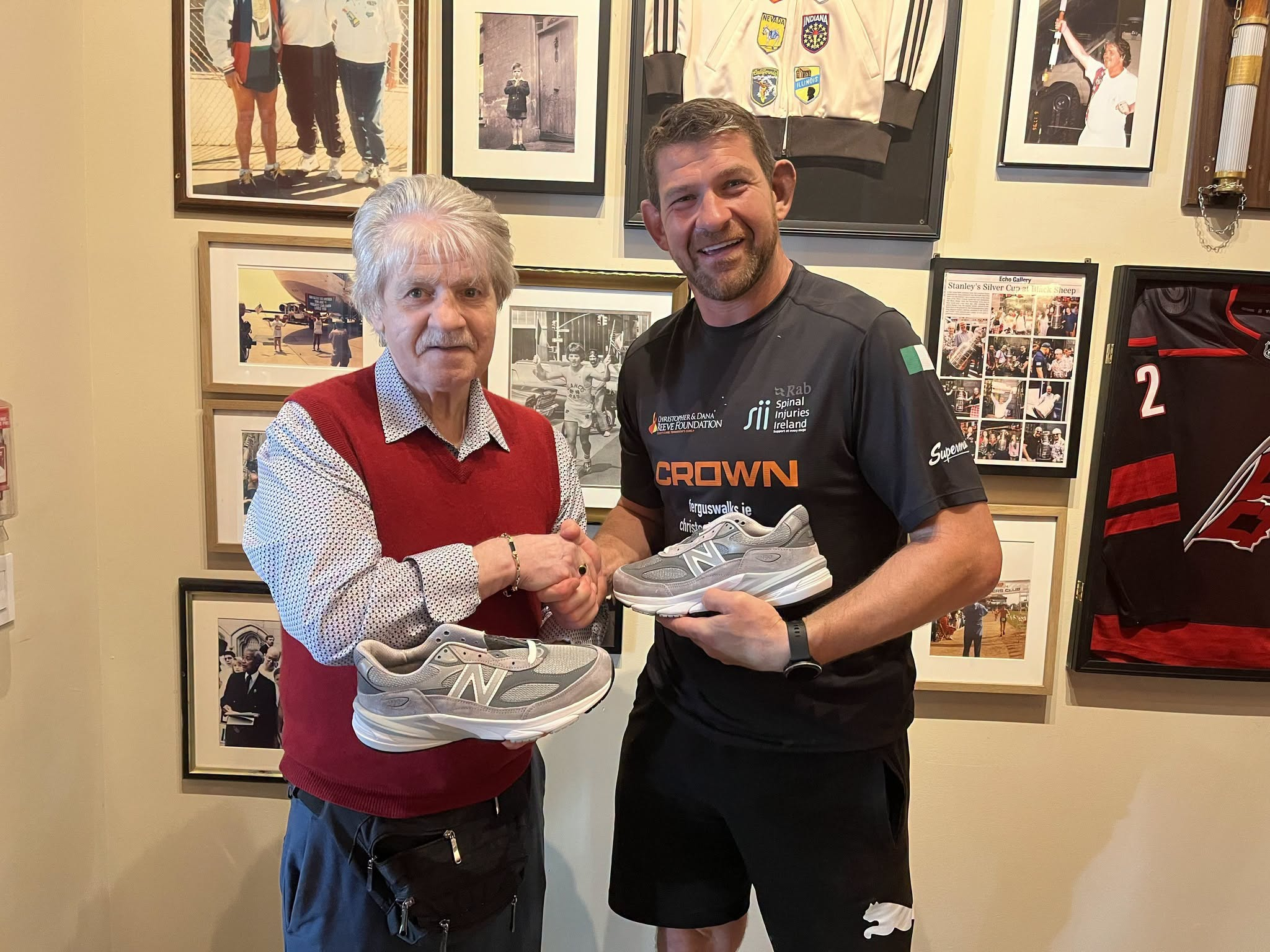
Tom McGrath, who lately appears in a New Balance commercial, presents Fergus Farrell with a pair of New Balance shoes at the Black Sheep in Manhattan. Irish Echo photo.
Walker Fergus Gains Words of Wisdom from Running Master Tom
If you want to learn at first hand – or perhaps at first foot – all there is to know about crossing America entirely under your own steam, then you beat a path to Tom McGrath’s door.
Tom is a world renowned super long distance runner and while his actual running days are now in the rear view mirror the Fermanagh man’s knowledge is yet immeasurable, his advice indispensable.
And so it was to that front door, specifically the one fronting the Black Sheep Bar & Restaurant on Third Avenue in Manhattan, that Fergus Farrell made tracks for as the days ticked down to the start of his walk across America.
Farrell and McGrath huddled for the better part of two hours in the Black Sheep on Wednesday discussing everything that could arise during Farrell’s upcoming walk from New York to Los Angeles.
Tom McGrath knows the way, or pretty close to it. He ran from New York to San Francisco in 1977.
Walking and running are essentially the same motion, Tom says.
And so his advice to Fergus, a good deal of it written on sheets of paper, the rest imparted verbally.
Suffice it to say there are more things to consider in a venture like this than the non-transcontinental walker/runner would ever come up with.
If ever there was a case for micro management and micro everything else this is it. And beyond the micro there is the macro – that walk, all 2800 miles of it.
Fergus, who is 47, is from Athenry in County Galway, and who played rugby for Connacht and Galwegians, is walking to raise awareness of spinal cord injury and funds for research. He is backed by the Christopher and Dana Reeve Foundation and Spinal Injuries Ireland.
And now, also, by Tom McGrath.
Fergus is scheduled to appear on ABC’s Good Morning America Friday morning at 8.30 a.m. His walk into the vastness of America will start on Saturday morning on the Manhattan side of the Brooklyn Bridge between 8.30 and 9 .a.m. He will pay his respects at the Great Hunger Memorial on Manhattan’s west side before taking a ferry over to New Jersey.
From there, Fergus will walk. And hopefully do so all the way to Los Angeles.
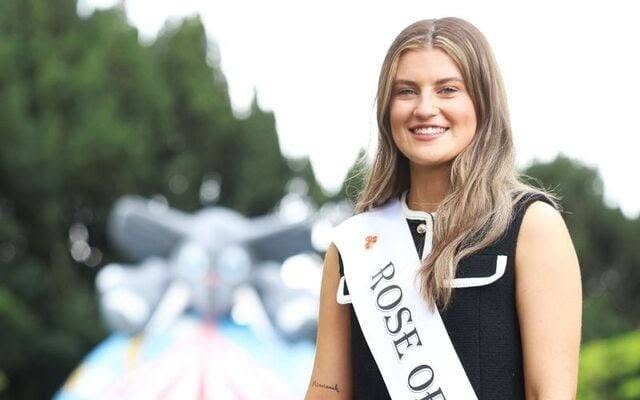
Westmeath Rose Caoilfhinn Ní Choiligh won this year’s Rose of Tralee festival after triumphing over 31 fellow Roses over the two-night event in Kerry. All photos: Dominick Walsh
Westmeath Rose Caoilfhinn Ní Choiligh has said she is still “on cloud nine” after being crowned the 2026 Rose of Tralee, describing herself as “so grateful and proud” to have had the experience.
The 25-year-old, who works in retail and is studying to become a wig maker, won over the audience and judges on Monday night when she opened up about living with alopecia.
Reflecting on the whirlwind of emotions since her win, Caoilfhinn told Morning Ireland on RTÉ Radio 1 on Wednesday: “I think I am on cloud nine a little bit floating through the emotions but I’m just so grateful and proud.”
But while becoming the Rose of Tralee may have been the culmination of the competition, Caoilfhinn said winning was never her main motivation for taking part.
“No. As much as that’s what this is all accumilating towards, I joined this whole experience to make friends. I honestly wanted to build my support network because that’s what gives me my strength, and being in my mid-twenties it can be so hard to do that.”
For Caoilfhinn, the appeal of the competition was the opportunity to meet other women and build lasting friendships. She said she had always admired the Roses and saw the experience as a chance to form a new support network.
“I was like, ‘Do you know what? The Rose of Tralee is something I’ve always admired. They are amazing women. Wouldn’t it be so cool to have 31 amazing new sisters and friends out of this experience?’ And that’s what I’ve really been enjoying out of it all.
“Obviously, this is a great plus too, but I’m absolutely delighted to be part of the 2026 class of Roses,” she added.
Opening up about removing her wig live on stage on Monday night, Caoilfhinn said being open about wearing a wig has always been important to her.
She explained that she has never felt the need to hide it and has often used everyday interactions as an opportunity to challenge people’s perceptions of wigs.
“It was something I was always very vocal about,” she said. “I never hid it and always told people I had it. If someone complimented my hair, I told them it was a wig, often to their surprise, because I wanted to show people that wigs are so much better than what they think and what they used to be, and how it’s okay to talk about it the way people talk about extensions, or they go to get their hair done.
“I wanted the same experience for people going through hair loss and for them to be able to talk about their wigs in that way and not feel like they had to hide.”
Caoilfhinn showcased her wigs live on TV on Monday night. Photo: Dominick Walsh
However, Caoilfhinn admitted that she had some reservations about how her experience with alopecia would be portrayed during the Rose of Tralee. She said she did not want her identity as a Rose to be overshadowed by her hair loss, while also recognising how much the experience had shaped her.
“So when it came to doing my piece, I was a bit apprehensive about being the Rose with the wigs. I didn’t want to be reduced down to that, but at the same time, I just wanted to own it because it is something that has really shaped who I am.”
She said that, more recently, she had come to recognise the power of embracing the things that make people different.
Caoilfhinn Ní Choiligh on stage with co-host Kathryn Thomas on Monday night in Tralee. Photo: Dominick Walsh
“I think it just got to a point recently where I kind of just realised that there’s such power in showcasing what makes us different, and we don’t really think about putting ourselves on a platform because we think we’ve nothing to say.
“But I honestly have been so surprised by how much I’ve impacted other people by just sharing the small little tips and tricks that I have when it comes to wearing a wig and embracing it.”
That realisation helped shape what she wanted to do on stage. Caoilfhinn said she wanted her appearance to offer encouragement to someone at the beginning of their own hair loss journey, and to show them that they could feel confident doing the same.
“So when it came to this experience, I was like, ‘Do you know what? Wouldn’t it be so cool to do something that, if I was younger, at the start of my hair loss journey, I would be like, ‘Oh my God, if she can do it, I can do it!’?”
Despite how open she has been about wearing a wig, Caoilfhinn said removing it in front of other people is something she rarely does.
“I don’t take my wig off day to day in front of people. I’ve only done it a handful of times. It’s only been in the last nine months my very close friends have only recently seen me without a wig on, so to do it on national television was definitely surreal.”
This year’s festival brought together 32 International Roses from communities across Ireland and around the world. Over five days, they enjoyed the hospitality of Tralee, along with street parades, music, and entertainment as part of the Féile Trá Lí celebrations.
With a new class of hopefuls ready to embark on their Rose of Tralee adventure, current Rose Katelyn Cummins has some advice for the 2026 winner.
Aug 17, 2026
Rose of Tralee 2025, Katelyn Cummins.
The Laois woman nabbed the title in 2025 and has had a whirlwind journey over the past 12 months, including a stint on “Dancing With The Stars”, which saw her lift the Glitterball trophy alongside partner Leonardo Lini.
Other highlights from her time in the spotlight include her charity work, but with a new winner on the horizon, Katelyn has some sage advice for the next Rose.
She told EVOKE that she carried out an incredible 257 engagements over the past 12 months but urges the 2026 Rose to follow their own path and not put themselves under pressure to say yes to everything.
The most important advice she can give is to pass on what the 2024 winner, Keely O’Grady from New Zealand, said to her, and that’s to make the role their own.
Speaking at the launch of the RTÉ Concert Orchestra Autumn/Winter schedule at the National Concert Hall, she said: ‘I think I will reciprocate what last year’s Rose of Tralee said to me: “Make the year your own and do whatever you can.
“You don’t have to say yes to absolutely everything, you don’t have to say no to absolutely everything, you can make the role your own, and you can do whatever you desire to do yourself.
“I think because of the opportunities I was given, I was able to say yes to so many, and that is what I set out to do from the moment I got selected.”
As for Katelyn, she admits that she’s feeling very emotional over the prospect of passing on her crown.
“I’m feeling very sentimental, and it’s very bittersweet. I’m really, really looking forward to seeing who the next girl will be and what she’s going to do with the opportunity and what she’s going to be faced with after winning.
“It’s definitely very emotional at this time of the year… I’ve met a lot of the girls, and the girls this year are incredible; there’s an amazing bunch of them.
“They are very supportive, very enthusiastic, so I’m excited to see them but definitely emotional about the whole thing coming to an end and not knowing what life is going to look like the week after.”
August marks the 110th anniversary since his death.
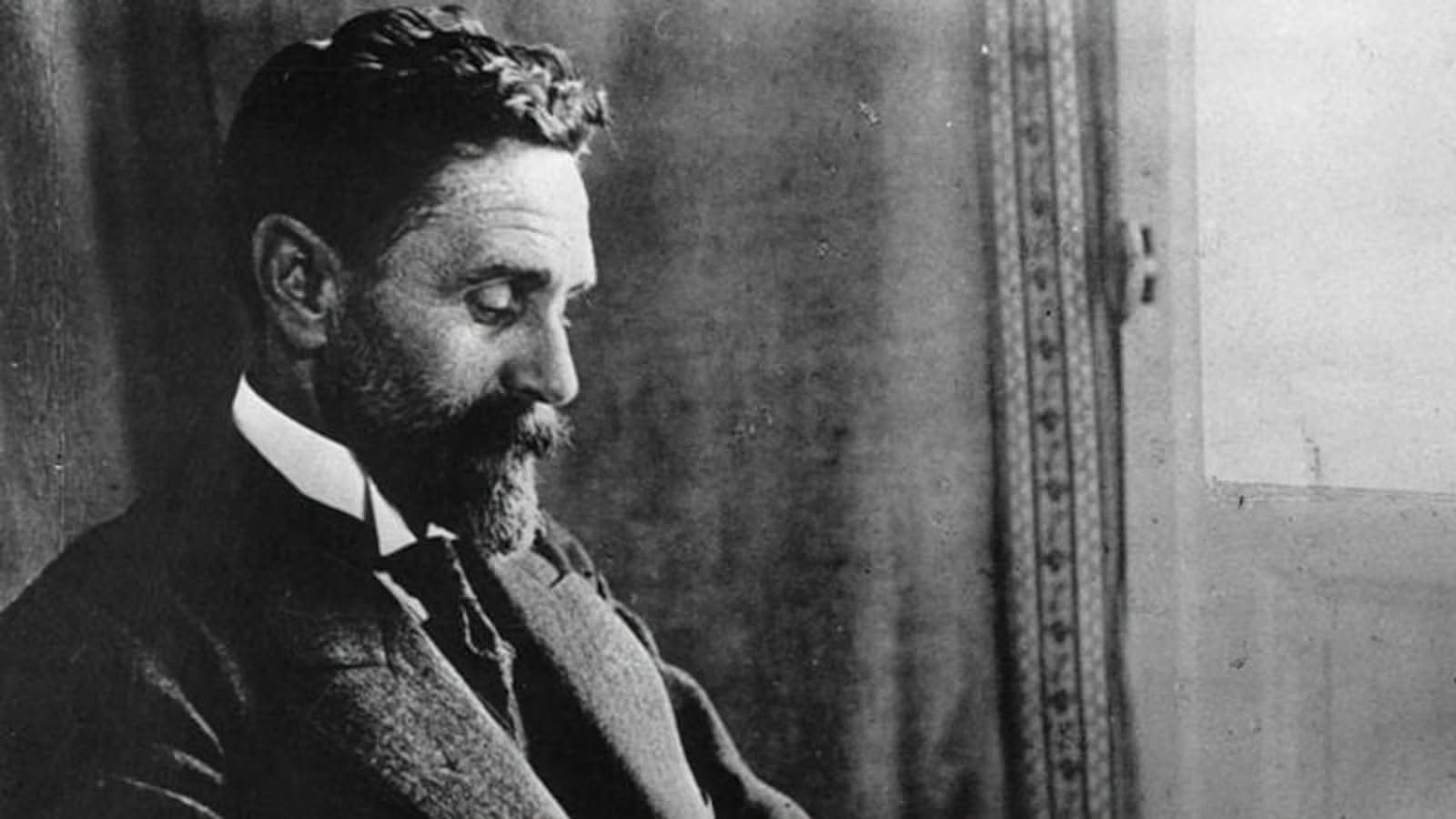
Roger Casement was executed in 1916
By Kirsty King
August 16, 2026 at 4:35pm BST
A group advocating for the remains of Roger Casement to be moved to Co Antrim has said a bloodline relative of the Easter Rising organiser has thrown his “full weight” behind the campaign.
Casement was executed on August 3, 1916 in London’s Pentonville Prison, after being found guilty of treason for his role in planning the rising.
One of the Co Dublin-born rebel’s last wishes, outlined in a letter to his cousin Elizabeth Bannister days before he was hanged, was to be buried at Murlough Bay on the north coast of Co Antrim, where he spent part of his childhood following the death of his father.
The diplomat and human rights pioneer wrote that the area, with its “great panorama of island and hill and swirling waters” was what “made me realise what Ireland was to me”.
Each August, to mark the anniversary of his death, the Roger Casement Commemoration and Re-Interment Association holds various commemorations around Ireland and England, including at Pentonville Prison, and Dublin’s Glasnevin Cemetery, where his remains were eventually laid to rest after being repatriated in 1965.
Formed in Andersonstown, west Belfast in 2013, the association has two objectives – to commemorate the life of Casement and to fulfil his request to be laid to rest at Murlough Bay.
Alan Daly, chairperson of the association said the ongoing campaign is making “baby steps” and gaining support, including from one of Casement’s own relatives.
“James Casement, a bloodline relative of Roger, who lives in Arizona, is the latest member to categorically put his full weight behind the campaign,” he said.
“Through the committee we made contact with him and he replied in October of last year. I had a conversation with him and he was delighted with who we are and what we are doing.”
Mr Daly said the campaign has the support of Phoenix Law and O’Neill’s Funeral Directors, who “approached us and wanted to come on board”.
He added: “It’s past time that Casement is allowed to rest easy at his request in Murlough Bay.
“The political climate has changed. There’s no reason why it shouldn’t happen, in our opinion.”
A wreath-laying ceremony to mark the 110th anniversary of Casement’s death will be held on Thursday, August 20 at Casement Social Club in Andersonstown.
Another commemoration event will take place at Murlough Bay on Saturday, August 22.