Easter Rising 1916: Six days of armed struggle that changed Irish and British history
Published 23 March 2016
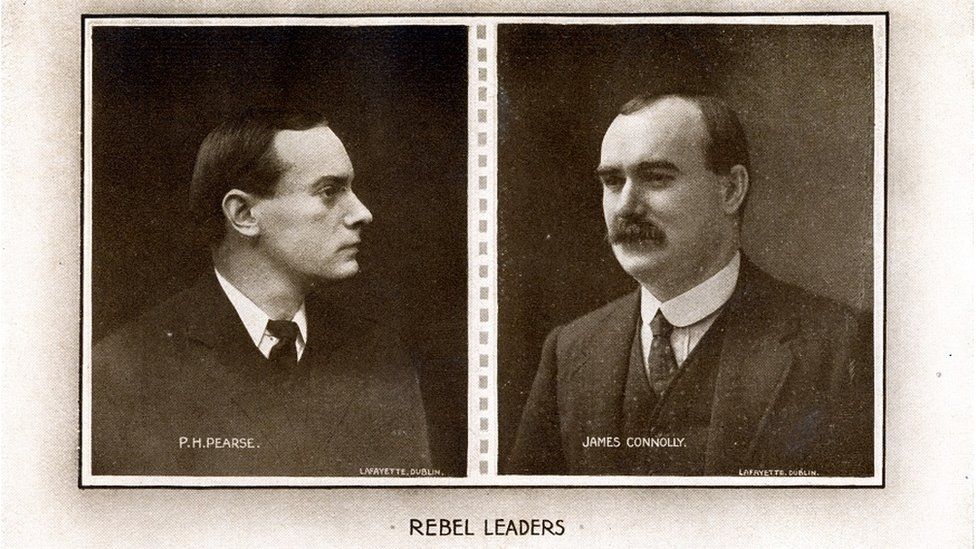
Image caption,Pádraig Pearse and James Connolly, two of the leaders of the military council
The years leading up to the rebellion against British rule in Ireland in April 1916 were marked by significant political, cultural and military developments in Ireland and throughout Europe.
The emergence of these forces undermined British rule in Ireland.
However, the possibility of violence in Ulster was averted by the outbreak of World War One.
The main party in favour of Home Rule, the Irish Parliamentary Party, agreed that attempts to secure self-governance should be postponed for the duration of the war.
Many Irishmen joined the call to arms and fought in western Europe.
However, others were angered by what they regarded as the Irish Parliamentary Party’s acquiescence to Westminster.
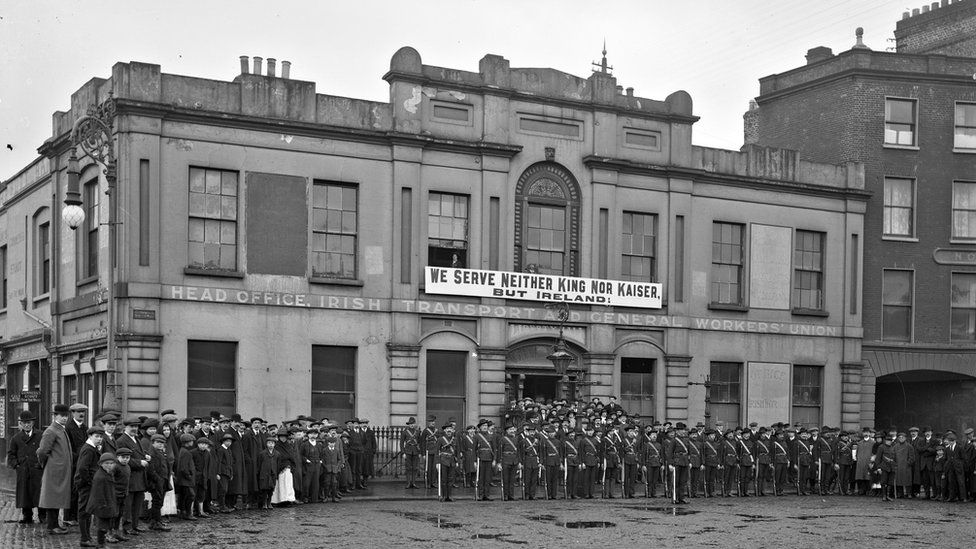
Image caption,The Irish Citizen Army, a socialist militia, led by James Connolly also played an important role in the rising
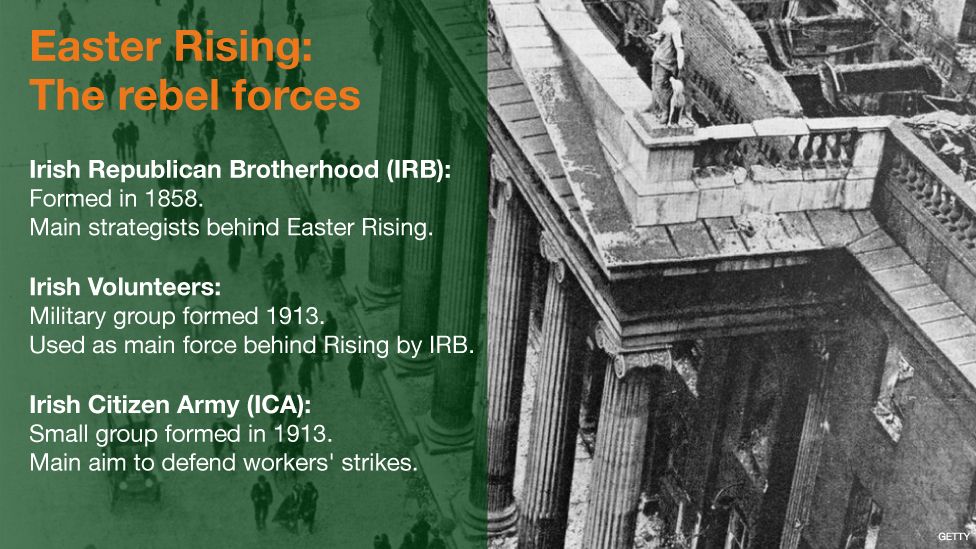
Three groups were behind the rising but the most important was the Irish Republican Brotherhood (IRB) which was formed in the mid-19th century.
Thomas Clarke and Seán Mac Diarmada were the key figures in the IRB.
The Irish Volunteers were a military group formed in 1913 and its members accounted for the largest number of men who were called out on Easter Monday.
The Irish Citizen Army, a socialist militia, led by James Connolly also played an important role.
The key group was a seven-man IRB military council, drawn from those three organisations, which planned the Easter Rising with complete secrecy.
The decision to rise was based on the traditional dictum that England’s difficulty was Ireland’s opportunity.
But it also reflected the military council’s fear that Irish nationalism was in decline, a concern reinforced by popular Irish nationalist support for the aims of the Irish Parliamentary Party and the British war effort.
On 23 April, the council agreed to proceed with the rising the next day, Easter Monday.
It decided that the proclamation should be read to the public outside Dublin’s General Post Office (GPO) by the president of the Provisional Government of the Irish Republic.
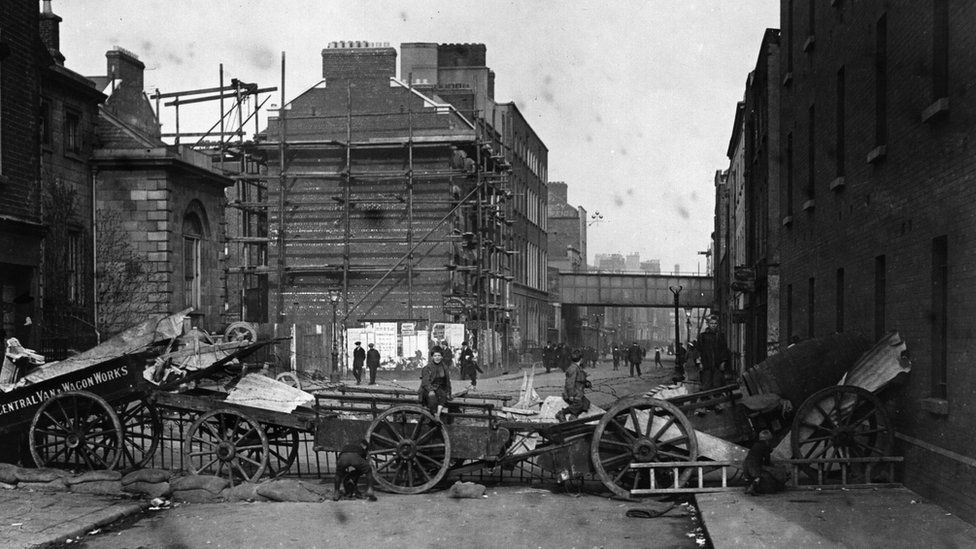
Image caption,Irish Volunteers barricade Townsend Street, Dublin, to slow down the advance of troops, during the Easter Rising
Despite Thomas Clarke’s seniority, it was agreed that Pádraig Pearse should act as president.
Shortly after noon on Easter Monday, Pearse accompanied by an armed guard, stood on the steps of the GPO and read the proclamation, signalling the beginning of the Easter Rising.
Ireland’s ‘national right to freedom and sovereignty’ was asserted.
The conflict that followed was largely confined to Dublin.
The British military onslaught, which the rebels had anticipated, did not at first materialise.
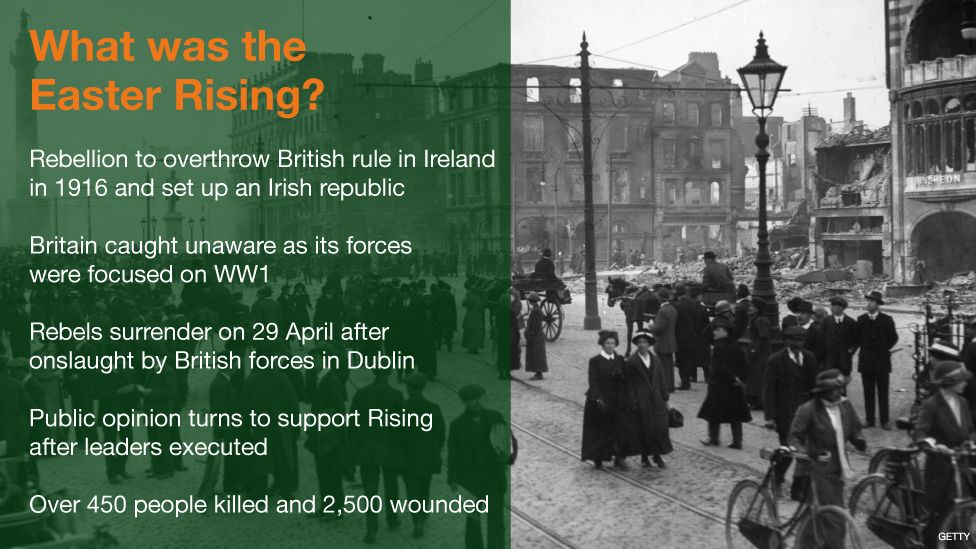
When the rising began, the authorities had just 400 troops to confront roughly 1,000 insurgents.
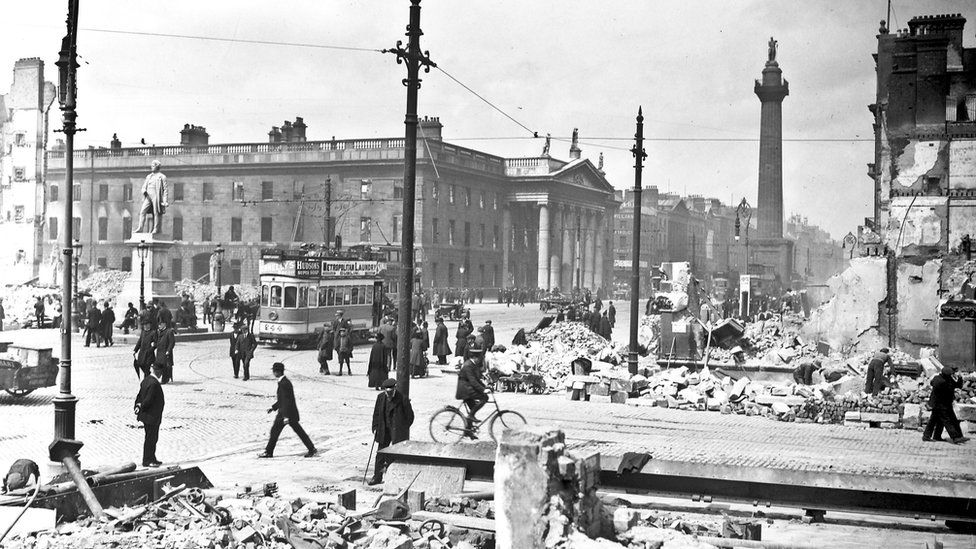
Image caption,Crowds in Sackville Street (now O’Connell Street) can be seen next to the General Post Office showing damage from shelling following the Easter Uprising
As the week progressed, the fighting in some areas became more intense, leading to several prolonged, fiercely contested street battles. Military casualties were highest at Mount Street Bridge.
By Friday 28 April, about 18-20,000 soldiers had been amassed in the capital against about 1,600 rebels while much of the city centre had been destroyed by British artillery fire.
The next day, Pearse surrendered unconditionally on behalf of the Volunteers and issued orders to this effect.
A total of 450 people were killed during the rebellion, among them 64 rebels. 2,614 were injured, and nine others were reported missing, almost all in Dublin.
The British capture of a shipment of German arms three days before the rebellion was partly responsible for the failure of the nationwide mobilisation.
Dr Fearghal McGarry, from Queen’s University Belfast, said although there was very little support for the rising at the time, it was enormously successful in terms of what the organisers of the rising wanted to achieve.
“They did not expect it to win power, what they planned was a spectacle, a gesture to transform public opinion,” he said.
“They knew they would not win, they knew some of them would die.”
He said that, in political terms, the rising achieved everything that the organisers thought it would.
“It destroyed the Irish Parliamentary Party’s credibility and it derailed Home Rule,” he said.
“It exposed the oppressive nature of British rule and it transformed public opinion by winning public support for republicanism.
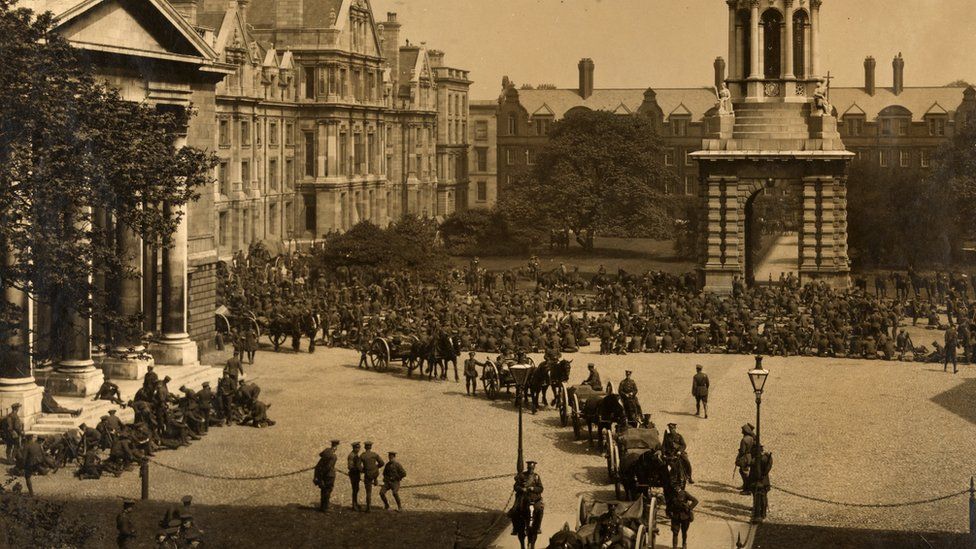
Image caption,British soldiers parading in front square of Trinity College Dublin in the aftermath of the Easter Rising
“What might have surprised the leaders was how quickly all this happened. Within a year and a half republicanism had become the most important movement in Ireland.”
Dr McGarry suggests that, for many Irish people, the significance of the rising lies less in the events of Easter week than in their longer term legacy.
“I think for most Irish, certainly people south of the border, the event’s significance is not primarily centred on the week-long violence that took place in Dublin,” he said.
“Rather it’s focused on the attainment of Irish sovereignty, self-determination.
“It’s bound up with national identity. In contrast, the rising’s significance for many northern nationalists over the past century reflects partition and the failure to achieve a united Irish Republic.
“In the south, the rising is increasingly seen as history, not politics.”
During his rousing speech in Ballina, County Mayo, President Biden paid homage to the many Irish who have fought and died for the United States down the generations,
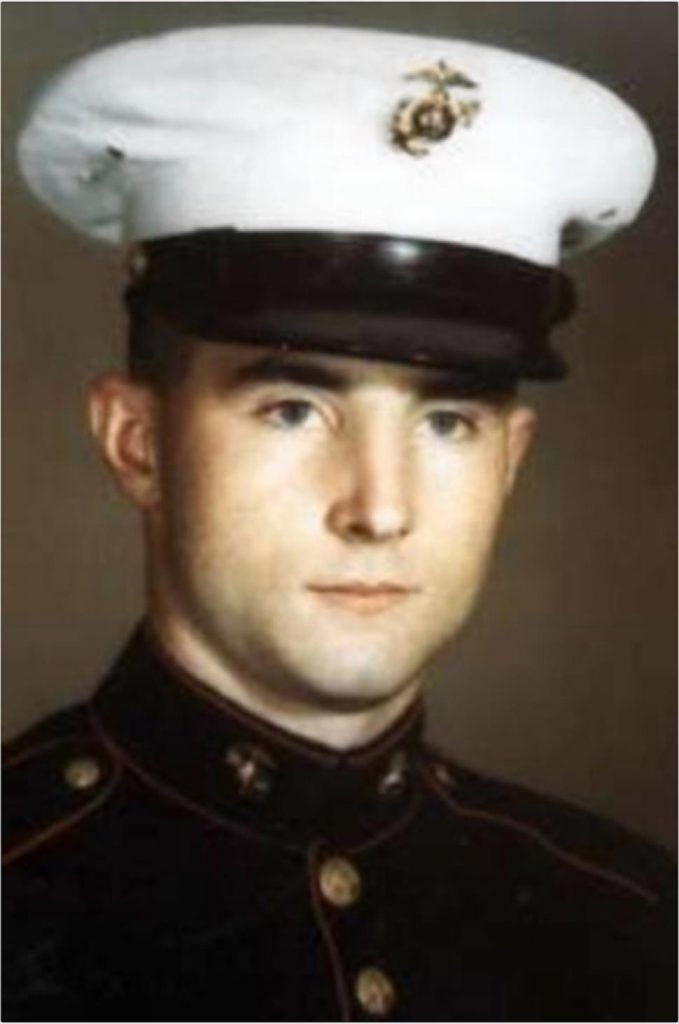
And he paid particular tribute to Mayo native Patrick Gallagher, in whose name and honor a U.S. Navy destroyer is currently under construction in Maine.
Said the president: “When one other Irish-Catholic President — only other one — John F. Kennedy, visited Ireland 60 years ago — and you can clap for him, man. He was something else. He presented your parliament with the flag of the regiment of that Irish Brigade, honoring Ireland’s great contributions to American freedom. It still hangs there to this day.
“It’s a legacy of faith and fidelity to freedom to one another that has been handed down generation to generation to generation.
“Today, the United States continues to honor that legacy, including that one of a Mayo-born Marine named Patrick Gallagher. Patrick immigrated to New York in 1962. He worked for the Senate campaign of one of my political heroes, Robert F. Kennedy.
“A few years later, when he wasn’t even a U.S. citizen, Patrick joined the United States Marine Corps and deployed to Vietnam. In 1966, Patrick’s team was attacked in an ambush.
When the enemy hurled a grenade at his team, Patrick threw himself on top of that grenade. He was willing to sacrifice his life to save his brothers-in-arms. He survived that attack, was awarded the Navy Cross for his bravery. Sadly, he was later killed in action.
But this year, his name will be honored in iron as the United States launches a new Navy destroyer, the USS Patrick Gallagher — from Mayo.”
At ninety George Mitchell rocked the house yesterday treating his audience to the wisdom, humour and realism no doubt honed over many years in American public life. For today, I’ll stick to his opening remarks (and a recurring theme here of renewal)…
On the evening the Agreement was reached I commended the men and women who wrote and signed it. But I also said that it would take other leaders in the future to safeguard and extend their work. And so it has. I am here, with many others, to sound that bell one more time.
Life is change: For every human being, for every family, for every government, for every society. All human beings, every single one of us, is fallible, as are all human organisations and institutions. In human affairs the answer to every problem contains within it the seeds of a new problem.
Today, a quarter century after the agreement, the people of Northern Ireland continue to wrestle with their doubts, their differences, their disagreements.This of course is only natural. They will continue to do so, no matter how successful their political leaders are.
The answer is not perfection, or permanence. It is now, as it was then, for the current and future leaders of Northern Ireland to act with courage and vision, as their predecessors did 25 years ago.
To find workable answers to the daily problems of the present. To preserve peace.To leave to the next generation peace, freedom, opportunity, and the hope of a better future for their children.
One of the strengths of democracy is the right of all citizens to publicly disagree with and to criticize their government officials and their policies. But all values, when carried to extremes, can become vices.
So, if there’s one bit of unsolicited advice I’d give to the people of Northern Ireland, it’s this, “Don’t always be so hard on yourselves”. At the same time, never ever give up on the belief that we all can do better and be better.
The future becomes the present in a heartbeat.
Perhaps the most poignant moment was when he called for a moment of silence, which he presaged with the following in which he highlights the full extent of the cost of our brutal and unnecessary war (in the frighteningly large number of its casualties):
According to the Northern Ireland Police Service and the Northern Ireland Statistics Agency, from the start of The Troubles until 1998, over three thousand and five hundred people were killed, and an estimated fifty thousand were injured in sectarian violence.
In the twenty-five years since the agreement was reached there have been about one hundred sixty-four security-related deaths. But don’t think of them just as numbers, because they are not.
Think of them as mothers and fathers, sons and daughters, whose lives were cut short, or were permanently impaired. Still, to this day their lives echo down the years.
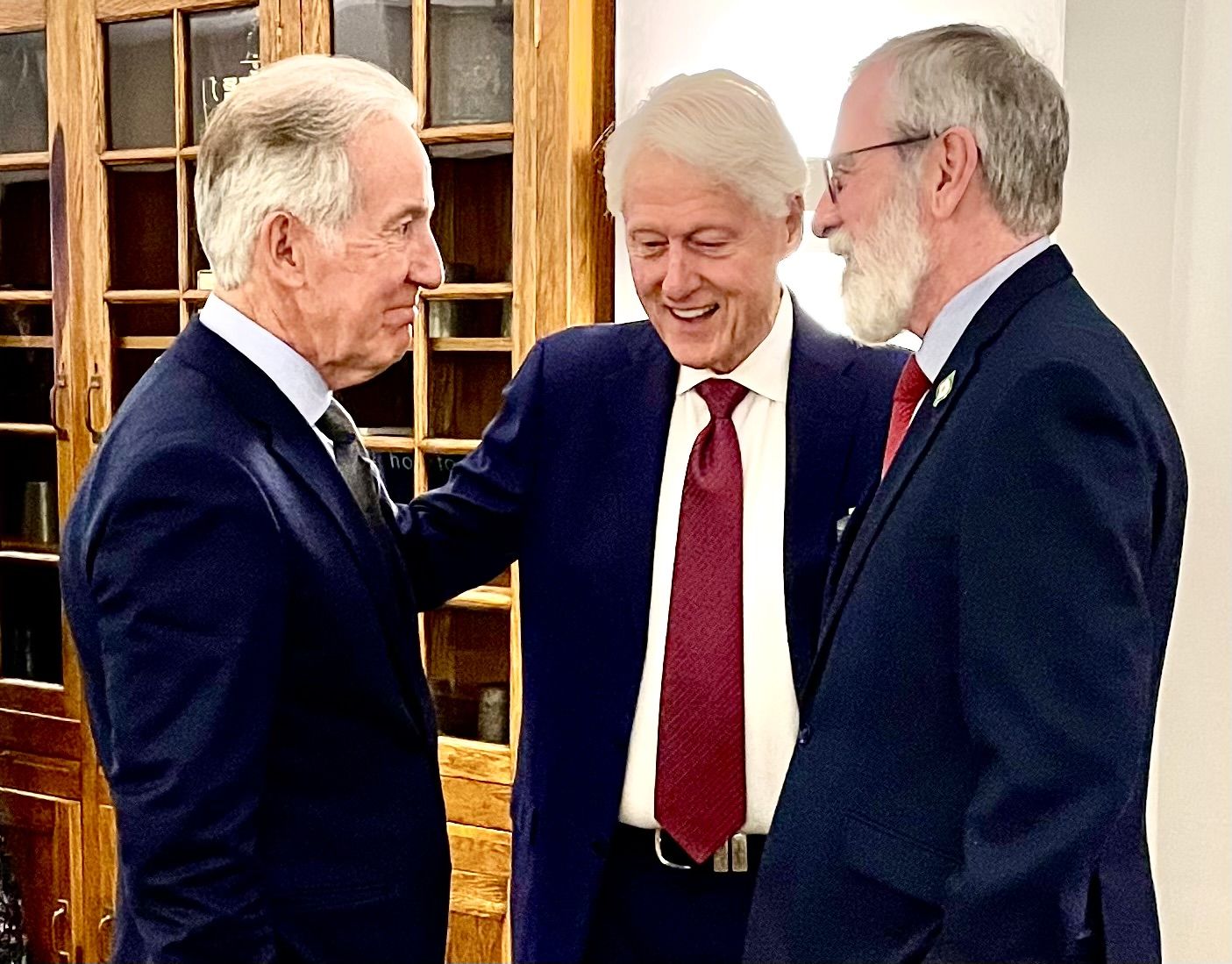
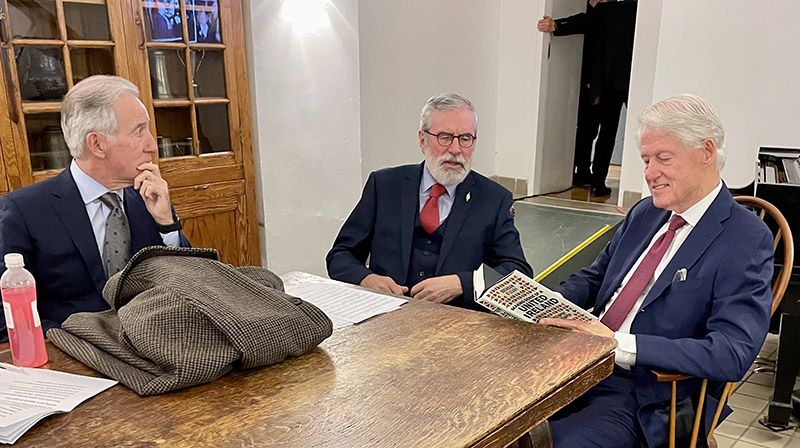
PART OF THE UNION: Richard Neal, Bill Clinton and Gerry Adams in New York
THE 25th anniversary of the Good Friday Agreement has attracted considerable national and international interest in recent weeks. Part of this involved me travelling last week once again to the USA. It must be four years since I was last there. While a lot has changed politically in that time both here and in the US, some things never change – among them the multiple stamping in red capitals of SSSS (Secondary Security Screening Selection) on our boarding passes and suitcase labels. It is explained as a random process whereby travellers are selected for ‘enhanced’ searches. I have been getting the SSSS stamp on every visit to and from the USA for over 20 years. Randomly routine.
But apart from that the visit was an opportunity to catch up with many old friends and thank them for the crucial role they played in 1998 and continue to play today. If Irish America ever had any doubt about its political strength it was evident last week in President Clinton’s presence at a Cooper Union event in New York, the visit by President Joe Biden to Ireland – North and South – this week and the expected presence of President Clinton and former Secretary of State Hillary Clinton at events in Belfast this weekend.
The Cooper Union event was hosted by seven Irish American organisations: The Irish-American Unity Conference; Friends of Sinn Féin; The Ancient Order of Hibernians; The Friendly Sons of St Patrick; Brehon Law Society; James Connolly Irish American Labor Coalition; and Ladies’ Ancient Order of Hibernians. President Clinton reminded the audience of the challenges he faced in engaging with the process, of the decisions he took, including giving me that first all-important 48-hour New York visa in January 1994 and his appointment of George Mitchell. He was forthright in his call for the Assembly and the Executive to be restored.
The following night I spoke at a dinner hosted by the Martin McGuinness Peace Foundation. Thanks to Marty Glennon and friends for their involvement in both events.
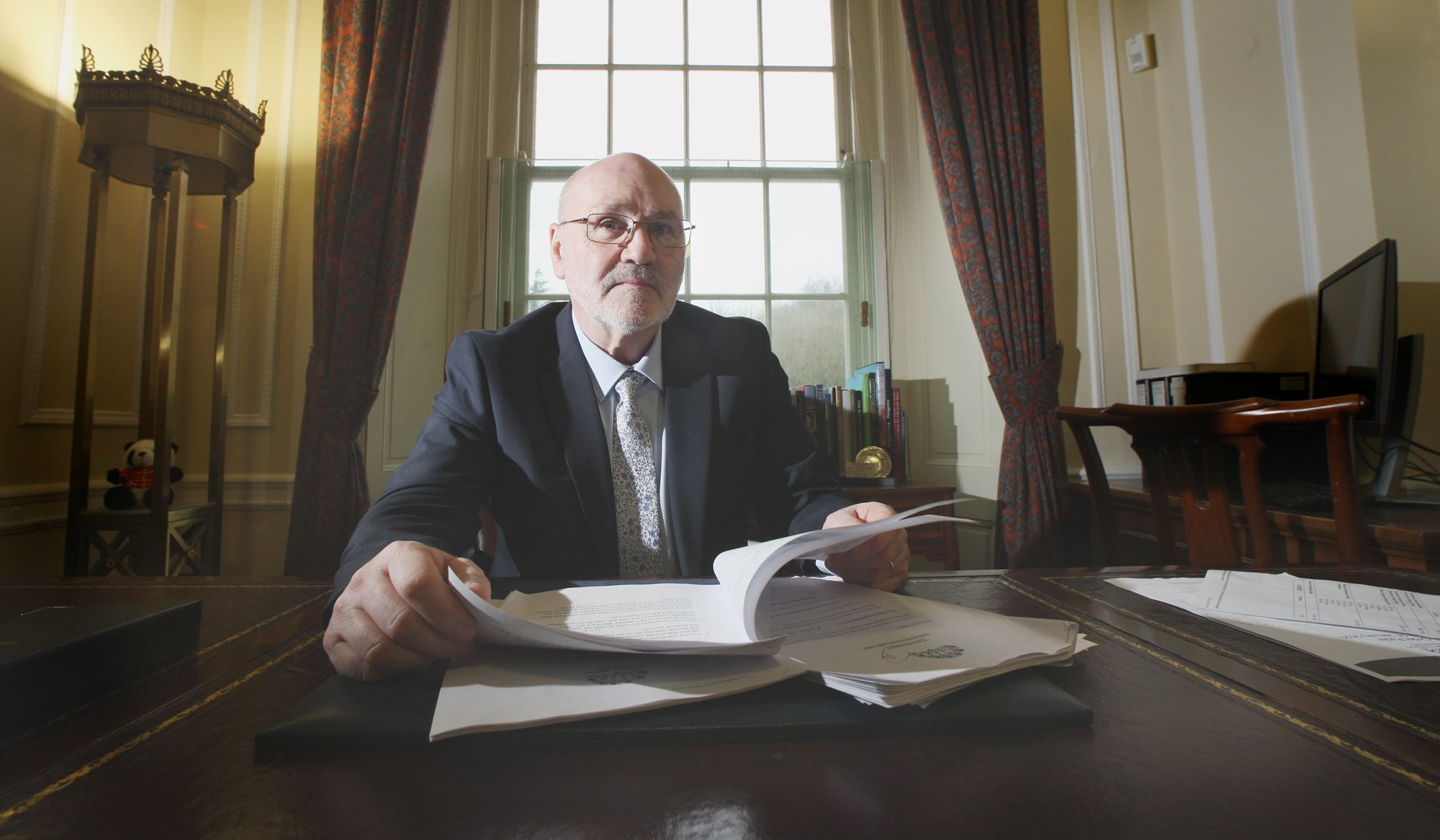
The day after I returned from the USA I was in Parliament Buildings. Assembly Speaker Alex Maskey had organised a really good ceremony to mark the 25th anniversary of the Agreement. Entitled ‘A New Beginning’, the event brought together many of those who had taken part in the negotiations to reflect on the process and its outcome.
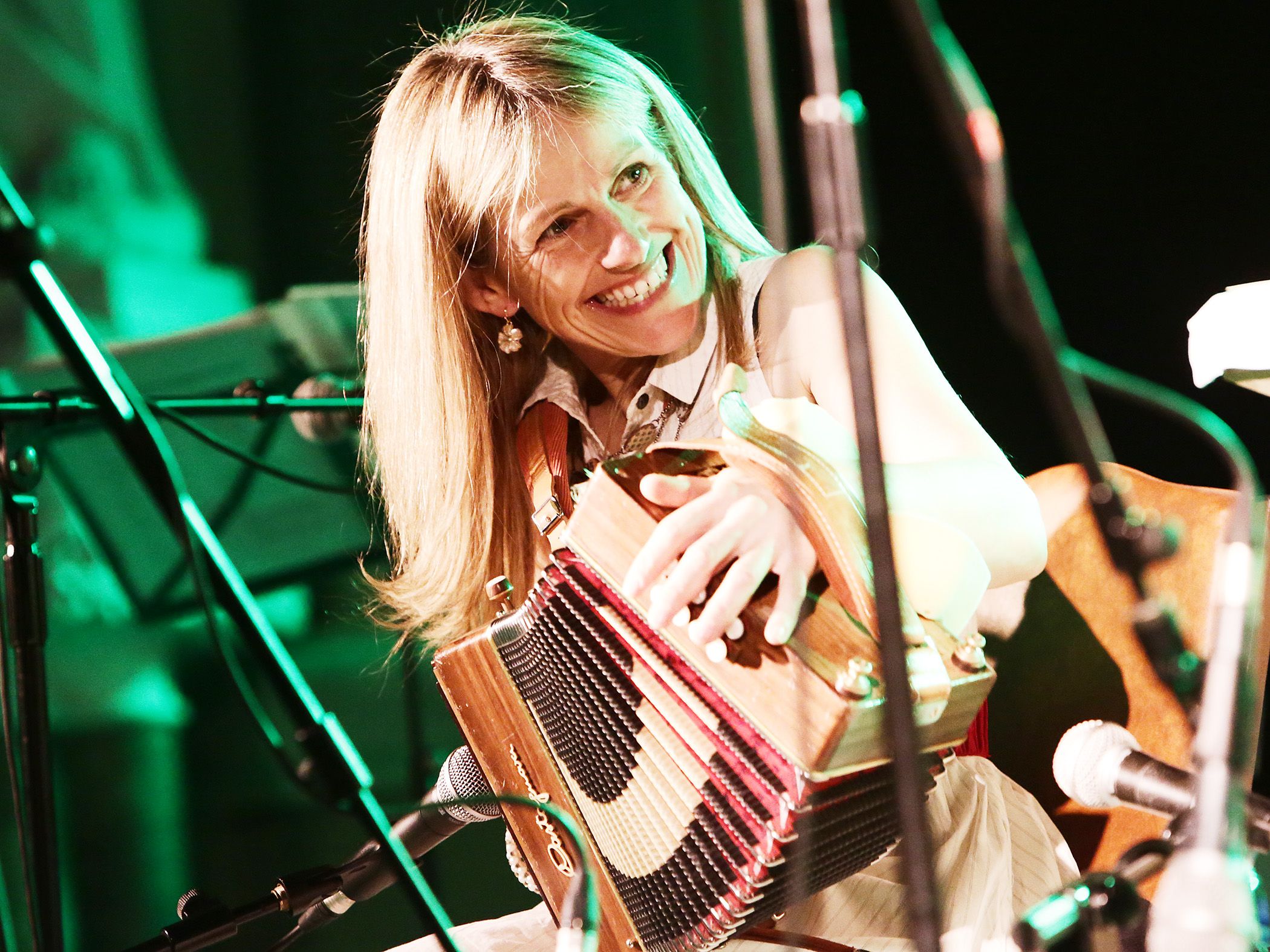
The choir of the Belfast School of Performing Arts were outstanding and the young people from the Youth Assembly who introduced each of the speakers were a reminder that the future we are building is an investment in them. Thanks also to Dana Masters for her songs.
I said that I believe Jeffrey Donaldson when he says that First Minister designate Michelle O’Neill taking up that office is not a problem for him. So when the DUP has concluded its internal processes all of us can look forward to a new phase of the northern Assembly. No other scenario is viable.
Of course that does not mean that everyone else should sit around twiddling their thumbs waiting for the DUP. The present English Government has no real investment in the Agreement. So there is a heavy onus on the Irish Government to use all the Good Friday Agreement mechanisms, including the British-Irish Intergovernmental Conference, to make progress. English direct rule is not an option.
Our responsibility is for the future. The past will take care of itself. Let’s plan for the day when we will all govern ourselves without the corrosive rule of London.
In the past 25 years we have fallen down many times. In fact we are very good at that. But we also are good at getting back up again. We are very successful at that. Let’s be successful once again.
Agreement talks very much a team effort
THIS week Alex Maskey shares his reflections on the negotiations for the Good Friday Agreement 25 years ago…
They say a week is a long time in politics. This month we mark the 25th anniversary of the Good Friday Agreement and we all should reflect on why it is that the Agreement is not yet fully implemented.
One thing is certain and that is that republicanism is stronger now across the island than it has been at any time in this past century, with the continuing growth of Sinn Féin and the emergence of civic United Irelanders while other progressives search for a political home, including within a new Ireland. I believe that the GFA itself remains a work in progress. However, I also believe passionately that it has successfully set the template for all of our politics since 1998.
I would say, however, with some frustration that many commentators often name-check a number of participants and leaders in the negotiations. I won’t take away from the contributions made by many in making the Agreement possible and effectively helping to end what had been the latest 30-year phase of conflict. But rarely do those same commentators get beyond citing Martin McGuinness or even Gerry Adams (on a good day) as architects of the GFA despite the critical role played by them both and many others. But that’s a discussion for another day.
Building the peace process through the mid-nineties was met with many challenges. However, progress was made, though perhaps with two steps forward and one step back until 1997 when all changed. In 1997 Sinn Féin was eventually formally admitted into the talks at Castle Buildings, Stormont.
As a member of our talks team I had the great pleasure to work closely on a day-to-day basis with our late and dear friend Siobhan O’Hanlon, who managed our administration with absolute professionalism and discipline. Part of my own work was to ensure that as many of our local party organisers and elected representatives could visit to either observe or participate in some element of the talks process in order to give as many as possible greater insight into the process of negotiations. For us, this was essential to underline to our members the premise that negotiations should always be much more than what goes on “in the room”. In the room or outside the room, as activists we all had to complement each other by campaigning, fighting elections, engaging with our communities and winning the arguments we faced daily.
At times as we moved closer to an Agreement the pace was frantic, which only served to keep our team even more focused on the job in hand. But I must say it was also at times nerve-racking because we all understood how pivotal and important, even historic, that an actual peace agreement could be reached under our watch.
Once agreement was reached on Good Friday under the brilliant leadership of US Senator George Mitchell, we knew that our work was only just beginning as we set about establishing a new Assembly and so on, but that the experience we had gained would serve us very well.
Me and my music
I LOVE music. All kinds of music. I listen to the radio a lot. I still have cassette tapes and vinyl from the 1970s. I play them also. And CDs. And an iPod. I also have music on my phone.
Every so often my devices organise my music into a Favourite Mix. For those of you who share my love for music here’s a sample of what my phone has selected for me. It includes Bruce Springsteen and James Taylor. The Byrds. Them. Sharon Shannon. John Spillane. Christy. Lisa O’Neill. The Bothy Band. Cormac Breathnach. The Animals. Mary Coughlan. Planxty. Liam O’Flynn. Frances and Mary Black. The Gloaming. Bob Dylan. John Prine. Pavoratti. Leonard Cohen. Cormac Begley. Ry Cooder. Altan. Willie Nelson. Paddy Glackin. John McCormack. Caitlín Maude. The Chieftains. Ray Charles. Pete Seeger. Sean O Sé. Clannad. The Saw Doctors. Luka Bloom. Muireann Nic Amhlaoibh. Joe Heaney. Simon and Garfunkel. The Rolling Stones. The Beatles. Skara Brae. Woody Guthrie. Van Morrison. Willie Nelson. Eileen Ivers.
Like books, dogs and children, it’s hard to pick a favourite song or musician. I love many, many more. Let the music keep your spirits high.
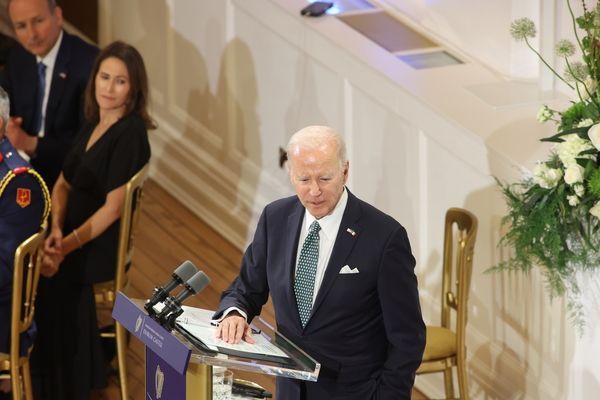
THE PRESIDENT: Well, Mom — (laughter) — you said it would happen. (Laughter.)
And, Margot, I apologize to you, little baby girl. The idea you’re subject to hearing a President of the United States have to deliver a policy speech — (laughter) — is as bad as my — all my children have had to been — been put through.
Speaking of my children, my son Hunter is with me. And my best friend in the world, my sister Valerie, is with me today. And I want to thank them. (Applause.)
As the proud son of Catherine Eugenia Finnegan Biden — well, you knew I’d be coming. (Laughs.)
Speaker, Chair, Taoiseachs all, and I — Deputy Prime Minister, TDs, senators, people of Ireland: It’s so good to be back in Ireland.
If you’ll forgive the poor attempt at Irish: Ta me sa bhaile. I’m at home. (Applause.) I’m at home.
I only wish I could stay longer. (Laughter.)
But I always have a little bit of Ireland close by, even when I’m in Washington. In the Oval Office, I have the rugby ball signed by the Irish rugby team — the ball the team played when they beat the All Blacks in Dublin in 2021. (Laughter and applause.)
And, by the way, my cousin, one of Ireland’s greatest rugby stars, Rob Kearney, brought it to D.C. on St. Patrick’s Day in 2022 to give me.
And I didn’t play rugby except when I was out of school — out of law school. And I didn’t play it very well. We played at a rugby club. But I did play American football and a few other sports.
But I realized that, you know, you guys are all nuts. (Laughter.) You know, but the interesting thing is I’d rather have my children playing rugby now, for health reasons, than I would have them playing football. Fewer people get hurt playing rugby. And you have no equipment, you have 280-pound guys like we do, and you just don’t hit each other in the head very often.
And — but at any rate, all kidding aside, I — in 2016, I came to Ireland as Vice President, bringing most of my family with me: my sister Valerie, my brother Jimmy, my daughter, and my five granddaughters — and grandchildren. And my granddaughters are crazy about me, I might add, because I talk to them every single day; I send them a note.
Together, we explored our family history, visiting the Cooley Peninsula — where the Finnegans’ ancestors earned their living on land and in sea — and walking the streets of Ballina, where my great-great-great-Grandfather Blewitt lived with his family before relocating in 1851, eventually settling in my hometown of Scranton, Pennsylvania.
Yesterday, I returned to County Louth, where I toured the Carlingford Castle, likely one of the last glimpses of Ireland my Finnegan ancestors saw as they gazed on their way out in what, in those days, was referred to as a “coffin ship.” And they sailed out of Newry in 1850.
I wasn’t going to say this, but I’ll say it anyway. The idea was — I later learned from the Irish Times — they did a little background check, and my good friend Barack Obama — and he is my good friend — his grandfather was a shoemaker like mine; sailed five weeks earlier from the same port. The idea they both sailed for a new life and thought their grandchildre- — their great-great-grandsons would both be President I think is really a little bit of Irish malarkey. But — (applause) — but it’s kind of interesting, isn’t it?
Tomorrow, I will also revisit County Mayo and remember the history and hope and the heartbreak my Blewitt ancestors must have felt leaving their beloved homeland to begin their new lives in America.
I say all this not to wax poetic about bygone days but because of the story of my family’s journey — and those who left and those who stayed — is emblematic of the stories of so many Irish and American families, not just Irish American families.
And these stories are the very heart of what binds Ireland and America together.
They speak to a history defined by our dreams. They speak to a present written by our shared responsibility. And they speak to a future poised for unlimited, shared possibilities.
So, today, I’d like to reflect on the enduring strength of the connections between Ireland and the United States, a partnership for the ages.
It begins in our shared history, dating back to the very founding of the United States.
The Irish hearts that helped kindle the torch of liberty in my country and fire its revolutionary spirit.
The Irish blood from across this island that was willingly given for my country’s independence.
The Irish hands that laid the foundations of a new kind of future, one from the bottom up and the middle out, one built on freedom.
You know, the great waves of immigration that brought our ancestors to the United States in succeeding decades carried millions more Irishmen across the sea. Most of them arrived with little more than with hope in their hearts and strength of their dreams and beautiful memories of an emerald green isle — a home they would never fully leave behind.
I’ve never met an Irishman in America who doesn’t think he — hope he can see Ireland someday.
You know, their sweet — or, excuse me, their sweat is soaked with the foundations of communities across the nation. All across America. You can’t go anywhere and not find it.
By the way, Tip O’Neill, the former Speaker of the House, used to say that he’d have a — he’d have a reception for all the Irish in the Congress, the House and the Senate, and all those who wished they were Irish. (Laughter.) And everybody showed up. (Laughter.)
Look, the journeys of our ancestors expanded our horizons and, literally, they excited our imaginations.
They became the untiring backbone of America’s progress as a nation, even as they endured discrimination and they were denied opportunity.
I’ll tell you a story. I was campaigning for President, and I was out in Colorado. And I was with a man whose family had been — he was a former senator — a man whose family had been in the United States since the conquistadors, for generations. And he kept — and there were a whole lot of people standing across the refurbished rail station in western — excuse me — in eastern Colorado. And there were literally 10,000 people on the other side of the track waiting to hear me speak.
And he kept saying, “Now, Joe, remember — remember, these people are not — these are my people. They’re Hispanics. They’re not used to being taken — you got to show respect and seri- –” I said, “I understand,” and kept — kept it up.
Finally, I turned — this is the God’s truth — this refurbished train station — okay? — it had, like, linen, kind of, wallpaper on it. And about every 20 feet, there was a brass plaque that’s saying, “No Irish Allowed.” I said, “I get it. I get it.”
But it’s history that speaks, above all, to the values that sustained these people throughout their hardships in their lives. Freedom. Equality. Dignity. Family. Courage.
My mom used to have an expression. She’d say, “Joey, courage is the greatest virtue of all, for without courage, you can’t love with abandon.” Without courage, you cannot love with abandon.
These are the values that were handed down generation-to-generation in my family, grafted onto the American character, tended as they transformed an entire nation.
Like so many countries around the world, though perhaps more than most, the United States was shaped by Ireland. And that’s not hyperbole; that’s a fact. And the values we share remain, to this day, the core of our historic partnership between our people and our governments.
As nations, we’ve known hardship and division, but we’ve also found solace and sympathy in one another.
And just four years before we issued our Declaration of Independence, Benjamin Franklin came to the Irish Parliament and declared — and described it as, I quote, “disposed to be friends of America.” End of quote.
In turn, the next Ireland — in turn, the text of Ireland’s 1916 Proclamation displayed mainly in the main foyer of this building draws on the support of Ireland’s “exiled children in America.” The quote. Draws on the support of “exiled children in America.”
We’re nations that know what it means to persevere for freedom, to brave a civil war, to toil in the vineyards of democracy. And that’s, again, not hyperbole; it’s a fact. It’s a fact. It’s not just the hope but the conviction that better days lie ahead that brought us along.
We have the power to build a better future.
Sixty years ago, as referenced, the first Irish Catholic President of the United States made a historic trip here, speaking to this assembly and capturing the imaginations of Irish and Irish American families alike.
When John Kennedy addressed parliament, he honored the more than 150,000 Irish immigrants who joined the Army of the North during America’s Civil War. And among them, one or two of them were my relatives as well.
They signed up in a new land to stand for old values, to defend freedom and the dignity of all people. Think about this. Name me another country, in whatever their language is, that use the word “dignity” as much as we Irish use the word “dignity.” It matters. My dad used to say, “Everybody, Joey — everybody…” — and he meant it — “…is entitled to be treated with dignity, no matter who they are.”
President Kennedy honored their courage and sacrifice by presenting to this body the flag of the Irish Brigade, which hangs out here to this very day.
Likewise, I was honored to receive an Irish flag from the Taoiseach during the recent St. Patrick’s Day celebration in Washington. It was flown to commemorate the Irish who first raised the Tricolour in Ireland 175 years ago and who suppose- — subsequently made his way to America where he led the Irish Brigade in that civil war — that civil war battle.
These like symbols, holding places of honor at Leinster House and the White House, embody a century of history between our countries — connections that irrevocably have shaped the understanding of the world and our hope that we put in it.
Our history reminds us — our history, ours — yours and mine — reminds us of the responsibilities we have to the president [sic] — excuse me, to the present, to the hopes of our ancestors, to the expectation of future generations.
Because you know what it means to fight for democracy. Today, Ireland and the United States are standing together to oppose Russia’s brutal aggression and support the brave people of Ukraine. (Applause.) I spent many days in Ukraine.
President Kennedy said 60 years ago, and I quote, “Ireland pursues an independent course in foreign policy, but it is not neutral between liberty and tyranny, and it never will be.” Thank you for that. (Applause.)
Over the past year, Ireland has proved him right. And the Speaker said Ireland has stood proudly with the United States and partners around the world for liberty, against tyranny.
Ireland has committed more than 170 million euros in non-lethal aid to Ukraine, inluding [sic] — including vital protective gear, medical equipment, humanitarian support, and aid to minimize the impacts of war on food insecurity and child malnutrition.
You don’t forget; you have memories that go deep.
And as a member of the European Union, Ireland is working together with the United States and other partners to hold Russia accountable for its actions, including through significant sanctions and export control.
I’ve known Putin for over 25 years. Putin thought the world would look the other way, was confident he would break NATO and the European Union; the unity of Western nations would fracture and would fall at the moment of testing.
That’s what he thought. But he was wrong. He was wrong on every point, on every front.
Today, we’re more united and more determined than ever to defend the values that make us strong. (Applause.)
And I want to sincerely thank you for Ireland’s vital leadership last year in the U.S. — in the U.N. Security Council.
Working together, Ireland and the United States helped change the way the U.N. sanctions are implemented to ensure they do not hamper humanitarian efforts.
The new humanitarian carveout will make sanctions more effective and save lives.
Ireland’s support for Ukraine is especially meaningful because you carry the moral authority with nations around the world.
Ireland — Ireland has always been a voice for liberty, global cooperation, and equality of all mankind.
Because Ireland remembers the terrible cost of war. You have built an international credibility as peacekeepers, stepping up continuously to serve in the U.N. peacekeeping missions since Ireland’s first development — since Ireland’s first deployment in 1958.
Because Ireland remembers what it means to have to flee home, leaving everything behind to begin again on foreign shores, the Irish people have generously opened their hearts, their homes, and you’ve welcomed, as you said, nearly 80,000 — nearly 80,000 Ukrainian refugees. I would argue the rest of the world has an obligation to help you maintain that as well.
Because Ireland remembers how painful hollows of the Great Hunger. And you’re today a global leader in food security as well.
Ireland has committed fully 20 percent of your aid budget to fighting global hunger.
And in a moment where people around the world are struggling with the economic fallout of the pandemic, Russia’s war in Ukraine, Ireland is growing its aid budget and expanding its commitment to help vulnerable people, especially partner nations across Africa.
I particularly want to thank you for stepping up alongside the United States to help UNICEF and the World Health Organization fight malnutrition and child wasting.
Ireland’s contribution of 50 million euros is helping prevent the — and treat wasting — child wasting — and supply ready-to-use therapeutic foods and reach a half a million children in Africa. A half a million children. You’re changing lives.
Ireland also remembers, as I do, that peace is indispensable.
Peace is the necessary foundation for progress, for vowth [sic] — for growth, for unlocking the enormous potential that exists in every part of this island.
This week marks a vital milestone for peace: 25 years ago, the Belfast/Good Friday Agreement. Twenty-five years ago.
One of my best friends in the Senate, and a great, great friend to this day, is George Mitchell. As he said, “There were 300 days of failure” — or “700 days of failure and one day of success.” But it was a success that one day. But more is to be done.
Yesterday, I was in Belfast to honor those who commit themselves to peace, to reiterate the enduring support of the United States for the Good Friday Agreement and Northern Ireland’s democratic institutions, and to help accelerate the enormous economic growth that is opening new futures for young people in Northern Ireland.
As I pointed out, there are literally hundreds of American corporations ready to come and invest — invest — but they’re cautious because the institutions are not in place.
We must never forget that peace, even as has become a lived reality for an entire generation of young people, peace is precious. It still needs its champions. It still needs to be nurtured.
The Good Friday Agreement didn’t change — just change lives for the better in Northern Ireland. It had significant positive impacts across the Republic of Ireland as well.
As the Taoiseach and I have discussed, including last month in Washington and again today, how Ireland and the United States can work together with the United Kingdom and the European Union to support the people of Northern Ireland.
I think — I think that the United Kingdom should be working closer with Ireland in this effort — in this endeavor.
Political violence must never again be allowed to take hold in this island. (Applause.)
Presumptuous of me to say from the United States, but that must be the goal which guides us in all our efforts.
Because the greatest peace dividend of the Good Friday Agreement is an entire generation of young people — an entire generation of young people whose hearts have been shaped not by grievances of the past, but by confidence that there are no checkpoints on their dreams. They’re writing a new future, a future of unlimited possibilities.
For too long, Ireland has talked about in the tas- — in the past tense. We tell old stories of days gone by because it is good to remember — stories of Irish grit and genius, saints and scholars, poets and politicians. And in the face of it — they’re good stories, on it’s face. Let’s face it.
But, as the poet Boland wrote in her poem “Mother Ireland,” she said:
“I[’ve] learned my name. I rise — I rose up. I remembered it. Now — now I could tell my story. It was different from the [stories] told about me.”
End of quote.
Today, Ireland’s story is no one’s to tell but its own.
But the United States will be your closest partner, your most dependable partner, and your most enthusiastic supporter of every step of the way, I promise you. We’ve always been — and we’ve been together.
And we’re going to continue to grow our enormous economic relationship as a foundation for both our nations’ prosperity.
We’re going to continue to strengthen our economies, building them from the bottom up and the middle out.
Yesterday and always — already Ireland draws a disproportionate amount of the foreign direct investment from the United States of America.
And the same is true for Ireland’s investment into the United States of America, which is the ninth sig- — most significant investment of any nation in the world in America.
You know, we share more than $1 trillion in bilateral trade and investment in 2021.
More than 950 American companies — international companies — have international ca- — headquarters in Ireland, supporting hundreds of thousands of jobs.
Seven hundred Irish companies located in 50 states employ more than 100,000 people in the United States of America.
And together, Ireland and the United States are building a future of greater economic dignity, one where rights of workers are respected and corporations pay their fair share. (Applause.)
The Global Minimum Tax will continue fair competition for investment while creating benefits for all our people.
And I have no doubt that the thriving economic relationship between our countries is going to continue to grow.
I’m grateful for Ireland’s partnership in delivering the game-changing — this game-changing international agreement.
Similarly, the deep connection that has always existed between our people and the land has translated into a commitment to fight climate crisis to preserve our planet for future generations.
The single existential threat to the world is climate change. We don’t have a lot of time, and that’s a fact. And even recognizing — finally, everyone is recognizing it in America.
I’ve flown over more territory in the United States since I’ve been President, in a helicopter, that has been burned to the ground than comprises the entire state of Maryland. The — equal to the entire state of Maryland.
Ireland’s famous 40 shades of green are being supplemented by green energy, green agriculture, green jobs.
And make no mistake, the entire world sees and is drawn to the opportunities that exist on this island: the skilled workers, the high-tech infrastructure, the innovators who are breaking barriers, the connection and kinship you share not just with the United States, but with the countries around the globe.
I know you all know it, but maybe sometimes we forget it. Ireland is a hotbed of cutting-edge science, research, and emerging technologies that’s going to influence so much of our shared future. For real.
Working in partnership with Ireland, the United States, together with the European Union and likeminded parties around the world, are going to ensure that those technologies are grounded in the same core values that we have championed for so long: democracy, human rights, freedom of opportunity for everyone — not just for some, for everyone.
You know, I hadn’t planned on running for President again in 2020. My son, Beau, who had just died of glio- — stage four glioblastoma after coming back from Iraq after a year. He was the Attorney General of Delaware. As a matter of fact, he should be the one standing here giving this speech to you.
But, you know, I started to write a book talking about how technology has always changed the world and we were at an inflection point in the world. And the technology was changing so rapidly and things were changing so significantly that it wasn’t so much who lead any country, it was the changes that are just happening at — at an incredible speed. Incredible speed.
Look what’s happening with artificial intelligence right now. It holds enormous promise and enormous concern.
Our — our world stands at an inflection point where the choices we make today are literally going to determine the future or the history of this world for the next four to five decades — literally, not figuratively. We’re at one of those points.
I had a professor at school who said, “An inflection point is when you’re riding down the highway at 60 miles an hour and you make a radical turn six degrees in one direction. You can never get back on the course you’re on.” That’s where we are as a world.
And as we meet these ageless struggles, they continue to cast a shadow on our world — the struggle between the rights of many and the desires of a few; between liberty and oppression; and I know I get criticized for saying this around the world but between democracy and autocracy. It is a competition that’s real.
And we’re called to this work just as every generation before us has been. In this moment, the world needs Ireland, and the United States, and our limitless imaginations.
I met more with Xi Jinping than any world leader has over the last 10 years. Over se- — excuse me, 91 hours of just one-on-one conversations — 68 in-person. I’ve traveled 17,000 miles with him through Asia primarily and through China.
He once asked me on the Tibetan Plateau — he said, “Can you define America for me?” This is the God’s truth. I said, “Yes, I can — in one word.” But if he asked me about Ireland, I could have said the same thing. “One word: possibilities.”
We believe anything is possible if we set our mind to it and we do it together. This is the United States of America and Ireland. There’s nothing beyond our capacity if we do it together. And we got to believe that. We got to know that because that’s the history of both our countries.
This is about defending the values handed down to us by our ancestors, keeping the flame of freedom we inherited — the beacon that’s going to guide our children and our grandchildren. It’s a struggle we have to — we’re fit to fight together.
Now, how is Ireland and the United States — now is their time to meet every challenge together. I really mean this.
To raise together — to rise up in our joys and our triumphs.
To preserve together and persevere through sorrows and setbacks.
To dream together over horizons we can’t see.
And to build together a future that may be, that doesn’t exist. A future that can be.
You know, as was mentioned, today is Seamus Heaney’s birthday. And I was always quoting Irish poetry in the United States Senate over my career. That’s a long career of 36 years. (Laughter.) And my colleagues always thought I did it because I was Irish. That’s not the reason. You’re the best poets in the world. That’s the reason I did it. (Laughter.)
And one of the best among them — (applause) — was your husband. And thank you for sending me that autographed copy. It was your husband. (Applause.)
And my favorite poem — my favorite poem was “The Cure at Troy.” And it goes — you all know the words. You know it — you just heard it so many times. He wrote:
“…don’t hope On this side of the grave. But then, once in a lifetime [That] longed-for tidal wave Of justice can rise up, And hope and history rhyme.”
It’s everything I’ve been taught. Rise up. We’ve, in the past, made hope and history rhyme.
So today, ladies and gentlemen, as we celebrate the enduring partnership between our nations, our shared past, our present, let’s set our eyes squarely on the future.
Let’s harness what’s best in us: our courage, our creativity, our loyalty, our tenacity, and our loyalty again.
Let’s once more, for our generation and generations to come, strive to make hope and history rhyme.
Because I’ve never been more optimistic about the future than I am today. And I’m at the end of my career, not the beginning.
The only thing I bring to this career after my aged — as you can see how old I am — (laughter) — but is a little bit of wisdom. I come to the job with more experience than any president in American history. It doesn’t make me better or worse, but it gives me few excuses. (Laughter.) (Applause.)
So, folks, this is one of the great honors of my career — got to be here today. And I mean it from the bottom of my heart.
You have no idea what this — my greatest regret, and I’m going to sound like a kid, but — because my mom is not here to hear it. My greatest regret, as my Grandfather Finnegan, who was an Irish American, whose grandfather was Owen Finnegan, who made the effort — and he was a great athlete and went to Santa Clara University. And he was a newspaper guy on the business side.
And I never understood what he meant when he said, “Joey, I worry about you.” He’d lean over. (Laughter.) I said, “Pop, what do you worry about?” He said, “You’re too much — you’re too much like that guy who led the revolution.”
He said of the guy who was a prime minister — he said, “You got to be less like the military guy. They shot him.” (Laughter.) “Be more like — be more like de Valera.” (Laughter.) Well, I’d never — (applause) —
But, folks, I really mean it: We can do so much. We really — God, we — we can.
And it doesn’t even break down in ideology. It breaks down in faith in ourselves, our values. Because no matter what party we belong to, our values are the same.
It’s about honesty and dignity, justice. And you all have every ingredient to make it work.
It’s an honor to be here. Thank you very much. (Applause).