Tom Kelly: Steve Bannon should butt out of Ireland with his toxic brand of politics.
The MAGA movement wants to extend its toxicity into Europe. It wants to destroy the EU and mold Europe in its image.
Former Trump adviser Steve Bannon has said he is working on a nationalist party in Ireland.
By Tom Kelly
January 05, 2026 at 6:34am GMT
THE recent passing of two SDLP veterans, Joe Byrne and Mary Bradley, served as a timely reminder that people who took part in peaceful political activism during the worst of times in Northern Ireland did so at great personal risk and sacrifice.
But they also did so without bitterness, rancor, or animosity towards those who were politically opposed to them.
It’s a quality so often missing from the toxicity of modern-day politics.
Politics isn’t for the faint of heart. It’s very much a blood sport.
I have witnessed the best of politics and the worst. The best is inspiring and galvanizing. The worst is depressing and demoralizing.
Joe Byrne and Mary Bradley were of a generational movement which rejected violence, promoted peace, and stood courageously on the front line, armed with nothing but their resilience and resolve.
They demonstrated bravery by owning their actions. They didn’t shy away from the difficult tasks or questions. They needed neither an armalite nor balaclava.
The SDLP had no monopoly on people like Mary or Joe – other parties had them too.
Jim and Joe Hendron (Alliance and SDLP respectively); Michelle Gildernew and Mitchel McLaughlin of Sinn Féin; the UUP’s Reg Empey and Sylvia Hermon; Sean Neeson and Eileen Bell of Alliance; or Robin Newton and Willie Hay in the DUP. The list is extensive.
The recent decision of Mike Nesbitt to stand down as leader of the Ulster Unionist Party (a move anticipated two weeks ago in this column) is further proof that being nice in politics takes its toll.
Those with the hide of a rhinoceros tend to fare better in longevity.
Nesbitt took charge of a party which was impossible to manage and gave it his all.
Politics — not just the UUP — will be poorer without him.
But deep rancour has seeped into our politics, and it’s imported.
The MAGA movement wants to extend its toxicity into Europe. It wants to destroy the EU and mould Europe in its image.
Ironically, the so-called British and Irish patriots who bang on about nationalism, purism, and sovereignty actually want to dissolve British and Irish sovereignty to become subsumed as satellites of the MAGA movement and Trumpism.
They want hand power to powerful financial elites and oligarchs who will profit from taking in the gullible.
Imperialist/Soviet expansionism or fervent nationalism has cost Europe dearly.
Over centuries there have been literally hundreds of wars over disputed borders and territories.
The Great War, the Second World War, and the Cold War nearly ruined Europe.
The EEC, now the EU, was a model for cooperation and lasting peace. It worked.
The Irish peace process itself, as articulated by the late John Hume, was a European model.
Last week, the rather reprehensible and offensive Steve Bannon — one of the architects of MAGA — said he is working to create a ‘national’ party in Ireland.
The last time that happened, it manifested in the Mussolini-light Blueshirts under Eoin O’Duffy.
Those patriots who now want to introduce a form of modern-day para-fascism in Ireland are deluded.
But they are being duped by wealthier, seemingly-respectable arch-conservatives and aging, cantankerous contrarians who are out to feather their own nests or re-create some kind of mythical neo-Catholic state — which even de Valera couldn’t fully achieve.
Bannon should butt out of Irish affairs. The MAGA movement under Trump and his cabinet zealots are out to subvert the Irish economic model and impoverish the nation.
Tom Kelly: Amid all the madness, Pope Leo can keep my glass half full for 2026Opens in new window
Just because the British Brexiters were daft enough to vote to leave the EU and stunt their countries’ economic growth, doesn’t mean Irish people should ape this and, lemming-like, jump off the cliff edge.
The Irish Government has said it will use its presidency influence in the EU to rein in social media excesses by banning anonymous online accounts.
This is overdue. Those who wish to have an opinion can still have it by owning it and not cowardly trolling behind false profiles.
Free speech comes with responsibilities.
If you have an opinion on the issues raised in this article and would like to submit a Letter to the Editor to be considered for publication
“Why did you spend all that money? That’s too much” “Why did you spend all that money? That’s too much”.
Forget Jesus and Santa – we all know that the miracle of Christmas comes down to just one person: the Irish mammy.
They’re the ones who somehow manage to juggle cooking dinner for the entire family, buying presents for everyone from the postman to your aunty Mary, and making sure the house is spick and span for the visitors.
And Christmas wouldn’t be Christmas without hearing your mammy come out with the following gems:
1. “You’re not wearing that to mass”
You may be happy to spend the day in your PJs but heaven help you if you try to leave the house in anything your mam deems ‘shabby.’
Christmas is a time for a nice rig out and your good coat.
2. “Why did you spend all that money? That’s too much”
Only an Irish mammy would give out to you for ‘wasting your money’ on expensive presents for them. That being so, try taking it back and see what happens!
3. “You could do SOMETHING to help”
You know better than to bother her when she’s cooking the dinner, but that doesn’t mean she’s going to suffer in silence. Not when she’s up to 90, and you’re lounging around watching Christmas movies.
4. “You’re doing it wrong… leave it, and I’ll do it”
It doesn’t matter that she’s asked you to help out – only she knows how to do it RIGHT. The truth is, she doesn’t really want you under her feet ‘helping,’ she just wants you to know how under pressure she is.
5. “Don’t leave your stuff all over the floor”
Leaving your opened presents under the tree is another big no-no, as everything has to be cleared away before the visitors come. She did not spend a week cleaning the house, only for you to mess it up again.
6. “Those biscuits are for the visitors”
Those fancy foil-wrapped biscuits are strictly for the visitors: don’t even bother trying to sneak one, as you will be murdered. You’ll just have to contend yourself with some USA biccies instead.
7. “I’m glad that’s all over…I can relax now”
Once all the dishes are cleared away, it’s your mam’s turn to enjoy Christmas. Which inevitably starts with a glass of wine as a reward for all her hard work and the phrase ‘that’s all over now for another year.’
Happy Christmas to all the Irish mammies out there!
*This article was originally published on Evoke.ie.
County Limerick-born priest Kelly is a hero to Brooklyn immigrants.
The District Three Immigration Services storefront in Bushwick.
County Limerick-born priest Kelly is a hero to Brooklyn immigrants
December 24, 2025 by Geoffrey Cobb
Msgr. James Kelly, the 87-year-old pastor emeritus of St. Brigid’s Parish in Bushwick, Brooklyn, got some long overdue attention in 2025. In May, Saint John’s University conferred an honorary degree on him and the Great Irish Fair named him as their Fr. Mychal Judge Award recipient; meanwhile, the New York Times did a feature article on the Adare, Co. Limerick-born priest. RTE and the Tablet have also covered Msrg. Kelly, who has served the people of Bushwick for an amazing 65 years.
Kelly’s biography is intertwined with Bushwick’s turbulent history. When Msgr. Kelly arrived in Bushwick in 1960 the area was vastly different. Bushwick was middle class and 90 percent Caucasian. St. Brigid’s parish was mostly German with some Sicilians. Kelly was assigned to the parish in part because of his fluency in the Italian and German languages. White flight, however, would totally transform the area in the late 1960s and ‘70s into an enclave of African Americans and Hispanics.
Monsignor Kelly became pastor of St. Brigid’s in 1977, the same year Bushwick made national headlines when a power blackout led to widespread looting of the area’s retailers. Arson soon became a common occurrence after the blackout, and the area became one of the most dangerous areas in the city, where gang violence and drug use became common. Kelly was even attacked inside his rectory by a robber whose punches left Msgr. Kelly with two facial fractures and his right eye swollen shut. ”I looked like I was in Mel Gibson’s ‘The Passion of the Christ,”’ Monsignor Kelly said. ”I was bloody all over.”
Limerick native Msgr. James Kelly qualified as a lawyer so he could better assist the foreign-born residents of Brooklyn.
The neighborhood today is home to Brooklyn’s largest Hispanic community and includes residents from Puerto Rico, the Dominican Republic, Mexico, and Ecuador. Monsignor Kelly learned Spanish and has become something of a celebrity in the area. Poverty is still common in Bushwick and Kelly’s ministry has been heavily involved with social justice for the underprivileged. Patrick Farrelly, a documentary filmmaker who has known him since the 1980’s called Msgr. Kelly, “the padre of the poor.”
Kelly’s work has extended beyond the walls of the church. He set up District 3 Immigration Services to help Bushwick’s massive immigrant population. Msgr. Kelly supported immigrants, often accompanying them to their court hearings for citizenship. He noted, however, that advocating for the immigrants without a law degree was a challenge. “Once you had your law degree, you could say whatever you like,” Msgr. Kelly said. “But without a law degree, the judge wouldn’t even listen to you.”
The priest earned his law degree from St. John’s in 1980, which enabled him to go to court and represent immigrants, largely pro bono clients. He has helped tens of thousands of people become legal residents of the United States. Though he has retired from his parish and no longer represents clients in court, Msgr. Kelly is still in his office six days a week. After the recent New York Times piece, many of the clients he helped contacted him and some sent donations. Some have become successful in medicine or law.
The monsignor notices a completely different climate for undocumented immigrants today. In his 65 years in the job, Kelly said this is the worst atmosphere he had known for undocumented immigrants. “When the Italians came in 1968, they were very benign to them,” he said, “because they were victims of an earthquake.” It was easy to adjust their status he said, as it was with the undocumented Irish. Some of the judges who judged Kelly’s cases had Irish surnames and were sympathetic to the plight of undocumented people.
Kelly works only with clients whose cases are likely to be approved, to avoid giving false hope. He said his office can charge less because he takes no salary, and his workers are not paid “top dollar,” and could make more money elsewhere. His office sees between 50 to 100 clients daily. Kelly noted that many of his clients live in fear of deportation.
Msgr. Kelly, an Irish speaker and former hurler, said he expects to continue helping people as long as he can. “If I’m alive,” he said with a chuckle, “I’m here.” Kelly has established a team to help him in his work. His 26-year-old assistant is Princess Reinoso, an Ecuadorian American whose parents Kelly helped to legalize their stay in the United States. Kelly praised Reinoso as “someone with an excellent legal mind.” The team members believe they will have plenty of work in the coming years. Team member Richard Reinoso, Princess’s brother, hopes to become a lawyer and continue Msgr. Kelly’s legacy. “He’s been doing this for as long as anyone can remember, and he has been doing it for the entire community,” Richard said. “I was born here, but I still understand how important it is to know our privileges, to check our rights, and then make sure that we give everybody the same opportunity for life, liberty, and happiness.”
When asked what the future held in store for undocumented immigrants Kelly replied, “Only God knows. God,” he said, “and Mr. Trump.”
The tale of Tír Na nÓg – the land of eternal youth Patrick Lynch
Tír Na nÓg, a paradise and supernatural realm of everlasting youth, beauty, health, abundance, and joy.
Once upon a time, many years ago, there lived a great warrior named Oisín, son of legendary Fionn Mac Cumhaill, or Finn MacCool in its English form. MacCool was the leader of Fianna – a group of great protectors who guarded the High King of Ireland –, and each day Oisín and Fianna explored the beautiful green hills of Ireland as they hunted the land.
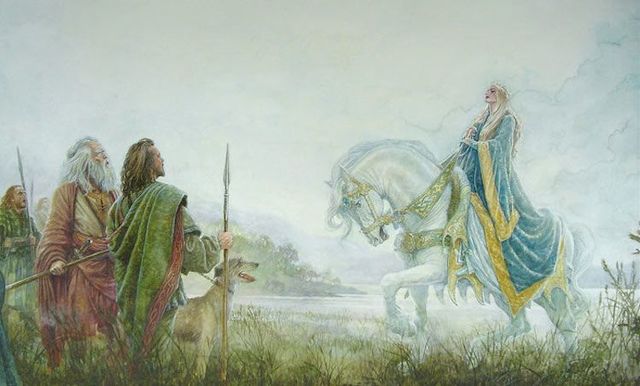
One day, Oisín and Fianna saw a beautiful white horse in the distance, and on its back was the most beautiful young woman they had ever seen. Her hair was the color of the sun and fell to her waist, and she wore a dress of palest blue studded with stars. A golden light surrounded her.
Sign up to IrishCentral’s newsletter to stay up-to-date with everything Irish!
As the beautiful woman and her horse drew nearer, all men stopped in their tracks, waiting to hear what she had to say. “My name is Niamh,” said the golden-haired maiden, “my father is King of the mystical land of Tír Na nÓg, a land that knows no sorrow and where nobody ever ages. I have heard wonderful things about a great warrior named Oisín, and I have come to take him with me back to the Land of Eternal Youth.”
Oisín immediately fell in love with Niamh, and although he was sad to be leaving his father and the Fianna, he agreed to ride with Niamh to Tír na nÓg, promising Finn Mac Cumhaill that he would return to Ireland to see him again soon.
The fine white horse galloped across silver seas into the magical land of Tír Na nÓg. As Niamh had promised, this was a land where nobody knew of sadness, and where nobody ever aged; everyone there lived forever.
Together, Niamh and Oisín spent many happy times together, although there was a small part of Oisín’s heart that was lonely. He missed his homeland, Ireland, and longed to see his father and Fianna again.
Oisín begged Niamh to let him return to Ireland, but she was reluctant. Although Oisín thought that only a few years had passed, it had been 300 years back in Ireland, since time slowed down in the land of Tír Na nÓg.
Eventually, Niamh saw how much Oisín missed his family. She agreed to let him return to Ireland to see them again. “Take my magical white horse,” she told him. “Do not get off this horse, and do not let your feet touch the ground, or else you will never be able to return to Tír Na nÓg again.”
Oisín set off across the seas on Niamh’s white horse and arrived in Ireland. When he got there, he could see that things had changed. The Fianna no longer hunted green hills, and the grand castle that once housed his family was crumbling and covered in ivy.
As he searched for someone familiar in the green hills, Oisín came across some old men who were struggling to move a huge rock. He leaned down from his horse to help them, but in doing so, he lost his balance and fell from the horse. The moment Oisín touched Irish soil, he immediately aged 300 years for the time he had missed in Ireland.
An old, frail man, he asked the men he had stopped to help about his father Finn MacCool, and they told him that Finn had died many years before. Broken-hearted and many hundred years old, Oisín died soon after, but not before he shared legends and stories of Fianna, his father, great Finn MacCool, and the magical land of eternal youth that is Tír Na nÓg. And even today in Ireland, these legends live on.
In her childhood, Virginia O’Hanlon penned a letter that would prove that meeting Santa is not the only way to determine if he is real. Her story even became a movie!
Sheila Langan
@SheiLangan
Dec 25, 2025
One September evening in 1897, eight-year-old Virginia O’Hanlon tearfully asked her father, \”Is Santa real?\”One September evening in 1897, eight-year-old Virginia O’Hanlon tearfully asked her father, “Is Santa real?” Getty
As a child, Virginia O’Hanlon wrote a letter that would prove that meeting Santa is not the only way to determine whether he is real. Her story even became a movie!
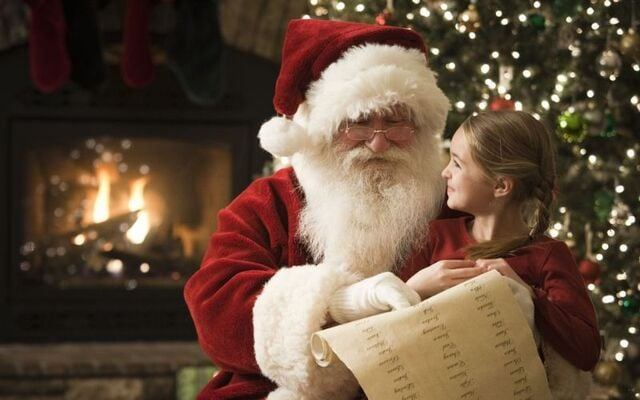
It’s the heavy question most of us come to at some point in our lives. After years of writing letters, leaving cookies out on Christmas Eve, and blissfully ignoring the sounds of last-minute wrapping paper echoing down the hallway early Christmas morning:
“Is Santa Claus real?”
One September evening in 1897, eight-year-old Virginia O’Hanlon tearfully asked her father this very question when he arrived home from work at their apartment on the Upper West Side of Manhattan.
Dr. Philip O’Hanlon’s answer was innovative, creative, and, perhaps, a way of buying himself some time: He told her to send her question to the New York Sun newspaper.
The next day, Virginia sent the following letter to the editor of the Sun:
Dear Editor,
I am 8 years old. Some of my little friends say there is no Santa Claus. Papa says, “If you see it in The Sun, it’s so.” Please tell me the truth, is there a Santa Claus?
Virginia O’Hanlon
119 w. 95th Street
The Sun replied on the editorial page of its September 21, 1897, edition. The response was not prominently featured; it ran in the seventh slot on the page, below editorials on local and state politics and even a piece about the recently invented chainless bicycle.
Nevertheless, it captured the hearts of New York City and would go on to become a Christmas letter for the ages.
Virginia,
Your little friends are wrong. They have been affected by the skepticism of a skeptical age. They do not believe except that which they see. They think that nothing can be which is not comprehensible by their little minds. All minds, Virginia, whether they be men’s or children’s, are little. In this great universe of ours, man is a mere insect, an ant, in his intellect as compared with the countless world about him, as measured by the intelligence capable of grasping the whole of truth and knowledge.
Yes, Virginia, there is a Santa Claus. He exists as certainly as love and generosity and devotion exist, and you know that they abound and give to your life its highest beauty and joy. Alas! How dreary would be the world if there were no Santa Claus! It would be as dreary as if there were no Virginias. There would be no childlike faith then, no poetry, no romance to make tolerable this existence. We should have no enjoyment, except in sense and sight. The eternal light with which childhood fills the world would be extinguished.
Not believe in Santa Claus! You might as well not believe in fairies. You might get your papa to have men to watch in all the chimneys on Christmas Eve to catch Santa Claus, but even if you did not see Santa Claus coming down, what would that prove? Nobody sees Santa Claus, but that is no sign that there is no Santa Claus. The most real things in the world are those that neither children nor men can see. Did you ever see fairies dancing on the lawn? Of course not, but that’s no proof that they are not there. Nobody can conceive or imagine all the wonders that are unseen and unseeable in the world.
You tear apart the baby’s rattle and see what makes the noise inside, but there is a veil covering the unseen world which the strongest men, nor even the united strength of all the strongest men that ever lived could tear apart. Only faith, poetry, love, romance, can push aside that curtain and view and picture the supernatural beauty and glory beyond. Is it all real? Ah, Virginia, in all this world there is nothing else real and abiding.
No Santa Claus!?
Thank God! He lives and lives forever.
A thousand years from now, Virginia, nay 10 times 10,000 years from now, he will continue to make glad the heart of childhood.
The Sun had a strict policy of not revealing its editorial writers, so it wasn’t until his death in 1906 that Francis Pharcellus Church became known as the author.
The letter becomes all the more moving after his identity is known. As a battlefield correspondent for the New York Times during the American Civil War, he had seen more than his share of suffering and strife. He went on to found the Army and Navy Magazine and Galaxy Magazine with his brother, William Conant Church. The latter later merged with Atlantic Monthly, and Francis became a lead editorial writer for The Sun.
According to his editor at the time, Edward P. Mitchell, Church did not leap to the task when Virginia’s letter came in. “At first he bristled and pooh-poohed the subject,” Mitchell later wrote, “but he took the letter and turned with an air of resignation to his desk.”
His response went down in history. It has been the subject of TV specials, cartoons, cantatas, and Christmas window displays.
As for Virginia, her full name was Laura Virginia O’Hanlon Douglas. She wed a man named Edward Douglas in 1910, but he deserted her just before their daughter Laura was born. This did not hold Virginia back whatsoever. She powered on to earn her degree from Hunter College, a Master’s in education from Columbia University, and her doctorate from Fordham. She was a New York City school teacher for over 20 years and eventually became principal before retiring in 1959.
Throughout her life, she continued to receive mail about the letter and responded diligently. She even had a specially printed copy of the editorial, which she included in all of her replies.
One of her letters, written when she herself was grown and published on the 40th anniversary of Church’s editorial, read:
“Is there a Santa Claus?’
Dear children of yesterday and today, when that question was asked, I, a little girl, was interested in finding out the answer just for myself. Now, grown up and a teacher, I want so much that all little children believe there really is a Santa Claus. For I understand how essential a belief in Santa Claus, and in fairies, too, is to a happy childhood.
Some little children doubt that Santa still lives because often their letters, for one reason or another, never seem to reach him. Nurses in hospitals know who some of these children are. Teachers in great city schools know others.
Dear children of yesterday, won’t you try to seek out these trusting children of today and make sure that their letters in some way may reach Santa Claus so that ‘he will continue to make glad the heart of childhood’? That, I believe, is the best way of proving there is a Santa Claus, for ourselves and for the children.
O’Hanlon died in 1971 at the age of 81, in a nursing home in upstate New York. Her legacy lives on and on.