What was it like to be a teenage girl in Belfast at the height of the Troubles?
Posted by Jim on January 25, 2026
Eimear O’Callaghan’s diary from 1972 offers a first-hand view into daily life during the Troubles.
Eimear O’Callaghan
Jan 18, 2026
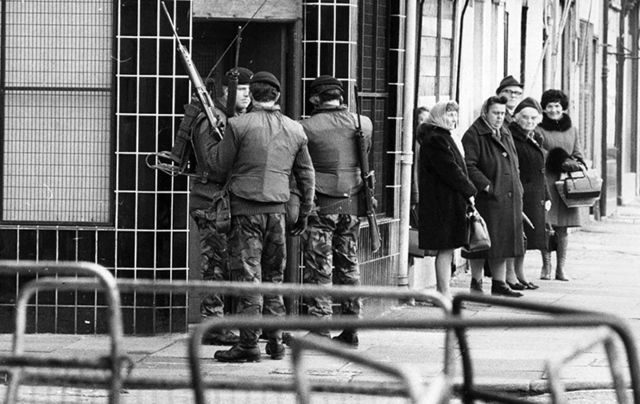
Street scene in Belfast during the Troubles. British soldiers stand next to a group of elderly ladies on a street corner. Getty
“Belfast Days” offers a view of 1972 Belfast from 16-year-old Eimear O’Callaghan’s perspective, as she intersperses her real personal diary entries from the time with her recollections from today.
When we look back at the 1970s in Northern Ireland from today’s vantage point, we remember the pivotal moments, not what it was like to live there day to day. O’Callaghan’s diary contains all of those big events, in addition to the more expected concerns of a teenage girl.
Her diary gives us a window into how these two intersect – at certain points, burning lorries become the normal backdrop, and something usually momentous like a best friend’s birthday becomes an afterthought in an entry about mourning those killed on Bloody Sunday.
At others, school exams take center stage, along with a teacher’s unfairness in not postponing the exam date in light of all the violence and missed school days. The following excerpt is published with permission of Irish Academic Press.
Chapter 2
“Sure there will be serious trouble”
I only ever saw my father cry once. A few months after internment was introduced, my aunt in Sligo asked him to send her a letter describing life in Belfast at that time. Kathleen, like the rest of my mother’s family, watched in horror from a safe distance in the Republic as the violence in the North escalated.
My father took up his usual position at the round, teak table in the corner of the living room where he liked to write when the younger ones had gone to bed. He wrote all evening, stopping only occasionally to relight his pipe or stretch his legs. When he finished, he pulled his armchair up in front of the fire, topped up his tobacco and began reading the letter aloud to my mother and me.
He read with passion, recounting in detail the destruction, disruption and unrest which were starting to envelop our lives. As he recalled how a defenseless teenager was snatched by soldiers just yards from our home on Internment Day, beaten severely around the head with batons, and then flung into the back of a Saracen armored car, my father broke down, unable to read any more. He was mortified. I was shocked. At sixteen, I had no idea how to deal with such raw adult emotion.
A few weeks later, on the bleak, last Sunday in January 1972, I tried to come to terms with seeing many adults cry as the violence of Bloody Sunday was visited upon the people of Derry.
Sun, Jan 30
Got up early because of everyone going to Cooley. I decided to stay at home with Jim and Aidan. Mammy and Daddy didn’t get going till late – there was a bomb on the M1 and it was closed. Stopped and searched four times. I spent afternoon supposed to be studying but couldn’t settle. Big NI Civil Rights Association demonstration and march planned for Derry – hoped it would go off ok. However, in tears, we saw the 6 o’clock news. Paratroopers shot 28 people at it – 13 DEAD including young boys. The army came on and told lie after lie, accused people of being bombers and gunmen.
Terrible pictures on TV – army bending down to take aim at men and boys fleeing from shooting, shooting them dead in the backs. Italian reporter called them murderers. Father and son fleeing, hands above head – both shot. Boy and girlfriend – shot girl, boy went to help her and they killed him.
I’ve never been so heartbroken and hopeless in my whole life before. Everyone full of hatred for army. Sure there will be serious trouble.
My mother and father entrusted me with the care of my 12-and 10-year-old brothers, Aidan and Jim, while they went to spend the afternoon with my grandparents across the border in Cooley. As the evening closed in around us, my brothers and I watched in frightened disbelief as the television news reported that the army had shot dead a number of people at an anti-internment march in Derry.
We watched marchers fleeing in terror, others tending to the dead and injured where they lay and the then Father Edward Daly waving a bloodied, white handkerchief as shots rang out in the background. By the time it was dark and the unofficial death toll reached thirteen, we were convinced that we would never see our parents again. We were terrified that the army might kill them too. All we could do was wait and peer anxiously through the darkness for their approaching headlights, praying for their safe and early return.
They refused to believe us at first when we ran out the front door as soon as the car pulled up and told them how many innocent people had been killed. ‘Calm down. Calm down. One at a time. Now, what’s happened?’ Reunited as a family, we gathered in front of the television and watched the harrowing scenes of bloodshed and grief.
Read more
Despite being only 75 miles away from Belfast, I had never been to Derry. My sense of it was of a poor, grey, grim-looking place where the Troubles had started. We had driven through it a few times en route to Donegal but had never stopped there: across Craigavon Bridge, over the River Foyle, out the Letterkenny Road, and minutes later, across the border into the Republic; ‘God’s Country.’ By the end of Bloody Sunday, the Bogside was being spoken of around the world.
Within hours of the six o’clock news, I – a young, relatively un-politicized nationalist – and thousands like me all over Ireland were sharing the disbelief, sorrow, and anger of the people living in those previously unfamiliar Derry places: Rossville Street, William Street, Glenfada Park, and Westland Street.
Six of the boys who were killed were just a few months older than me. The march they walked in was similar to the one which my father and uncle had joined four Sundays earlier. The Paras (Parachute Regiment), whose members gunned down the innocent men in Derry, were on duty in Belfast at that time too. I realized that being young and innocent afforded no protection. My father warned us grimly that there would be awful trouble after Bloody Sunday, worse than anything we had seen before.
Violence erupted in nationalist areas around Northern Ireland within hours of the Derry shootings, making me afraid to go to bed. My father refused to have any lights on upstairs because there were soldiers everywhere – in the gardens and on the street – and they’d be jittery, he warned us, after the day’s events.
I lay in my bedroom in the eerie darkness, listening to the gunfire outside, some of it in the distance but much of it very near. Ambulances and fire engines wailed through the night and an army helicopter droned on and on and on. Unable to sleep, I peeped out the side of the bedroom curtains and saw the orange glow of at least half a dozen huge fires lighting up the sky.
There were reports of protests and demonstrations in parts of England, New York, Norway, and Australia. I was scared.
However, I also knew that I was witnessing something tragic but momentous.
Mon, Jan 31
In a very tense atmosphere, went out to school. Normal till 11 a.m., then rumours of bombs etc. began and parents from Andersonstown came down to collect their daughters – because of the rioting and no buses.
School was in sheer chaos – almost everyone went home. Finally, at 1.45, Sr. Virgilius called Assembly and we were all sent home because fear of what was to come was so strong. At the hospital, hijacked lorry was in flames, so was Falls Road Co-op, and the Broadway cinema.
Not a sign of a soldier – all too scared. When we reached the barracks, we were greeted with jeers from the military of ‘Why did you have to walk girls? Ha, ha, ha!’ It took me all my time to restrain myself from saying something to those British bullies and thugs.
Hijacked lorries in Fruithill, barricades set up. We went over to see remains of Co-op, Lipton’s supermarket etc. Still smouldering – a terrible sight.
Tues, Feb 1
I was very doubtful as to whether or not I should venture into school. Finally, at a quarter to 10 I decided to go, after the four boys had been sent home and their schools closed, because of shooting. Got a lift down – no buses – only to find hardly anyone at all in. In my 3c class, 18 people were absent.
Buses came back on but two were hijacked and so, at 3.35, we set out walking. Frankie and Eleanor got lifts, Lizzie and I had to walk – and what a walk!
As we passed Beechmount, a hundred or so boys waited for the army, armed with bottles, stones, petrol bombs etc. and let fly as we passed because a Saracen had arrived. Soldiers jumped out and we fled up the road – Liz and I in front, followed by the rioters, then the soldiers!
At Donegall Road, lorry set on fire as we passed and then more Saracens. Dived for cover.
At Whiterock, everyone got free ice-cream from hijacked lorry, then we got a lift home. Shooting all night. Army up and down trying to dismantle barricades. One soldier killed.
Wed, Feb 2
NO SCHOOL – TAOISEACH DECLARES DAY OF NATIONAL MOURNING FOR 13 DEAD.
Really was mourning. Went to 10.00 Mass, the church was packed. Requiem Masses all over province. Listened to the funerals of the 13 dead on the radio and I just couldn’t restrain myself from weeping continuously as the 13 names were read out, giving ages – as young as 16, as old as 41, a father of seven children.
The weather suited the atmosphere – torrential rain all day, dark and stormy. On the radio even the reporter, who was also in tears, commented on how the sun broke through the clouds as the coffins were placed in the earth.
However, Andersonstown’s hooligans were soon at work. By 2 o’clock, army had been attacked several times, and Christie’s wallpaper shop had been burnt down. Caroline Records shop was burnt down last night. Man shot dead by the army in Ballymurphy, cars hijacked for barricades. Liz’s birthday – went up to her house for a while.
Dignified, respectful mourning turned to violent rage. Protesters in Dublin vented their fury by burning down the British Embassy. In Andersonstown and on the Falls, hordes of youths went on the rampage, attacking the army with anything they could lay their hands on, hijacking vehicles and laying waste to local businesses.
Soldiers stood on every street corner along a tense Falls Road as we made our way to school. Public transport was of course withdrawn. The roadway was strewn with riot debris and with the charred remains of makeshift barricades and burnt-out cars. An acrid smell hung in the air as shops, which had been set alight by petrol bombers a couple of days earlier, still smoldered along our route.
Within a mile of our home, rioters petrol-bombed shops, a cinema and supermarkets. ‘Caroline Records’, where my brother and I had bought our first music ‘singles’ two Saturdays earlier, after our parents purchased the family’s first record player, was burnt to the ground. Being a young romantic, I had bought ‘Softly Whispering I Love You’ by Congregation, while John opted for America’s ‘A Horse with No Name.’ It was our first and only opportunity to shop at the store.
Sign up to IrishCentral’s newsletter to stay up-to-date with everything Irish!Subscribe to IrishCentral
Thurs, Feb 3
Once again, there are no buses on the road. Walked to school and arrive late. A lot absent.
Reports came in of trouble up in Andersonstown again and shooting at Divis Street. Four gunmen were shot by the army, although apparently not dead.
Mammy and I walked round to the shops after school. Army Saracen pulled up beside us and in soldiers’ idea of a joke, poked their rifles at us through the slits in the side. Mammy nearly collapsed with fear.
Christie’s and Caroline Records both smouldering ruins and all other shops on that side are closed (except Brian’s) because the electricity supply had been affected by burnings. Using candles.
Most shops were open again after yesterday when there wasn’t even one sweet shop open. All had closed – and black flags hung from all houses.
Within the space of a week, the world we knew had begun to collapse around us but our exam date was immovable, despite our pleas for mercy. Belfast may have been burning, but the Troubles stopped at the entrance to the school.
The rate at which events were deteriorating meant that none of us could predict how and where we might be when our A-levels actually came around in a year’s time. We no longer had any interest in our ‘mocks’ and we resented our principal Sister Virgilius’ insistence on ‘business as normal.’
It seemed that the Dominican sisters, cloistered behind the solid red-brick walls of our nineteenth-century convent school, simply ‘refused to recognise’ the Troubles.
Every morning, we passed in single file through a narrow, black, wrought-iron gate in the six-foot-high stone wall which separated the school from the chaos on the Falls Road. A row of ancient, towering, horse chestnut, beech and sycamore trees shielded six hundred teenage girls, in maroon-colored uniforms, from the mayhem outside.
The wall enclosed our five-storey, red-brick school, its lawns and cherry-blossom trees, its tennis courts and hockey and camogie pitches. At lunchtime and after class, solitary nuns, in their cream Dominican habits, passed silently and serenely along the leafy corridor formed by the trees, fingering their rosary beads, and rapt in prayer. When we managed to arrive in time for morning assembly, the nuns appeared to show no interest in whether we might have had to walk a couple of miles to get to school that day.
They didn’t openly acknowledge that we had possibly run a gauntlet of rioters and burning vehicles on the way home the previous evening. They seemingly made no allowances for the impact that a night-time backdrop of shooting, bin-lid banging, sirens and army helicopters might have had on our studying, nor did they blink when dozens of girls were recorded as absent during the morning roll call.
Sometimes, when the ‘boom’ of an explosion shattered the soporific boredom of a lesson, the teacher would pause for a few seconds while we tried to work out the direction from which the sound had come; we would use any excuse to stop class. The girls nearest the windows might be given a moment to check for plumes of smoke but, almost immediately, our noses were back to the grindstone.
My schoolmates and I seized on the prevailing turmoil to try to escape the daily drudgery of classes, homework and revision, but we were granted no respite. The pressure to achieve academically was relentless and the staff – religious and lay– were unstinting in their commitment to the demands of both timetable and syllabus.
The regimented school day, the focus on exams and the insistence on full uniforms were the only constants in our otherwise turbulent lives. School provided us with a rare but secure anchor in a very unstable world, but the wisdom to see that eluded us in Lower Sixth.
Mother Laurentia, a severe but saintly old nun, who squinted out at us from under her wimple through round, wire glasses, repeatedly warned us that if we didn’t settle down and apply ourselves to our work we would ‘end up working on the buttons counter in Woolworths.’
Secretly I would have been happy to take a part-time job anywhere – even in Woolworths – if it helped me to get out of Belfast and away to France that summer.
Fri, Feb 4
Had to walk to school again today, still no buses and we’re unlikely to have any for quite a while.
Our first test is this afternoon. Eleanor, Oonagh etc. got hold of last year’s O-Level paper from which, they guessed, our essay would be taken. They prepared an essay during their free class and, sure enough, they got it on the paper. However, ‘muggins me’ decided to be honest to myself and as a result, found the exam to be very hard-going.
Walked home again after it – we’re getting great exercise these days thanks to the Catholic boys of
Falls Road and Andersonstown. Mrs McGlade is in a terrible state. Peter is arriving – with two English fellows – on the boat at 7 pm, to march in Newry.
Sat, Feb 5
Suzette was up banging at the door at 10.30 this morning while we were still in bed. Came up to see if I would go to the pictures this afternoon. Said I would. We went to see ‘Soldier Blue’. It was good but not to the extent that I had expected.
Mammy and Daddy went down town. This is the first time Mammy has ventured into town in months.
Still not worried about the tests, even after the disaster that Spanish was. Met the two ‘groovers’ Peter McGlade brought home. In spite of their unkempt and bedraggled appearance, they were both very nice fellas!
Sun, Feb 6
Daddy has almost definitely decided not to go to Newry march, although very reluctantly.
Huge number – 60,000 people – turned up. Not as much as one stone thrown, a massive display of union and discipline. A great success. However, 26 summonses have been issued to SDLP people and others who marched.
On the Frost Programme tonight, during an interview with Protestants on the Shankill, John McKeague says he calls ‘Bloody Sunday’ “Good Sunday”. One regret is that there weren’t twice as many killed!’
John McKeague’s comments stunned me, even though the loyalist leader was already well known for his extreme anti-Catholic views. I was incredulous that someone purporting to be a Christian could not only utter such venomous and sinister words but also revel in the deaths of so many innocent people.
It was the first occasion when I was directly exposed to such raw sectarianism. I was shocked to discover that the grief and outrage, which the murder of thirteen innocent people provoked in homes like mine, were not felt equally across Northern Ireland.
Mon, Feb 7
Didn’t get up until late due to the exams not beginning till 1.00. Today we have French. No one is in the slightest bit worried about these tests for some reason. As Sr. Virgilius told us last week, there is so much tragedy and despair around about us, irrelevant things are soon put from our minds. We are more concerned for our lives than for exams.
French was very difficult – made a mess of the paper but don’t really care.
Notices were distributed around school today telling us not to come in on Wednesday but to join in ‘D-Day’ i.e. Day of Disruption, or as it will be in Andersonstown, Day of Destruction!
Did some revision for English and RK tonight and I’ll be going to bed after writing this. No buses today.
P.S. Very important – internee escapes from long Kesh!!!
Tues, Feb 8
Buses still aren’t on the road yet, so had to walk to school for RK exam at 9.30. It was really funny – we couldn’t do it all and we couldn’t even ‘waffle’ the way we always do in RK tests.
Spent lunchtime trying to learn quotations out of ‘Antony and Cleopatra’. The result? Complete confusion when I tried to write them out during the test.
We tried to get Sister Virgilius to close the school tomorrow during the tests because of D for Disruption Day. Day of peaceful disruption. Schools were asked to close – but we didn’t.
On the way home, we were threatened by three boys, if we didn’t close! Therefore we all decided not to bother going in. Seem to be no definite plans for tomorrow’s disruption.
‘Intimidation’ was as good an excuse as any for taking a day off school. D-Day was organized as a peaceful protest against internment, with the organizers calling on the public to disrupt normal life as much as possible – by staying away from work and school, closing businesses, attending rallies and picketing RUC stations.
St Dominic’s kept its doors open, offering education as always, but I stayed home, wanting to be part of the new ‘excitement’ that was sweeping through our community.
There was a thrill about being warned to stay at home, even by a handful of teenagers the same age as ourselves. Children and teenagers, myself included, were excited to be playing their parts in what was by now a very adult ‘game.’ We all wanted to show our anger and register a protest – however minor – at what had happened in Derry. I was no longer complaining that I was bored.
Wed, Feb 9
D-Day.
Schoolchildren from St Malachy’s and Bearnaghea walked to City Hall. Other schools closed early. Aidan joined in a sit-down protest addressed by Paddy Devlin over at the Busy Bee.
Reports of people in Newry going to the GPO, tendering £10 notes to buy 1p stamps – and queuing up to find out if it was necessary to have a permit to grow gooseberries or keep a billy-goat!!
John said the people of Fruithill were traitors – we didn’t protest for the internees. He and Aidan blocked the doors of kitchen and living-room to protest against not being allowed to protest!
Rioting broke out in Turf Lodge. Boy of 14 shot (seriously ill) by army – said they fired ‘on a gunman.’ All shops on the road closed. At Rathcoole, a man was shot while shooting at policemen – seriously ill, too.
Did 7 hours revision tonight for Applied Maths. I feel as sick as anything. I’m dreading these Maths, sure I won’t do well. 3 nail-bomb explosions tonight, Falls Road. Chairman of Community Relations Board resigns – Maurice Hayes.
Thurs, Feb 10
Set out walking for school again, then got a lift with Mrs Gordon.
Did some more maths revision before school. Too late. Did the exam, I have definitely failed – only got one sum out of 6 done. However, I’m not the only one in that position. Walked home. Had hoped to go down town but no buses – and I’ve no intention of walking down that road again. Might tomorrow.
No tests tomorrow so I didn’t do a pick of revision. Watched Winter Olympics on TV and read for a while. Intend to go to concert in Methody tomorrow night – depending on situation. First time I’ll have been out in months.
Fri, Feb 11
No exams at all, therefore I’m off all day. Didn’t surface till about 11 o’clock. Walked round to the shops with Mammy and treated myself to a new mascara, 25p. Bought cream buns, just to get fat! Mammy went off to work. I was left alone in the house and for a change, I didn’t really mind. Washed my hair, Eleanor rang me and I rang Vera. Fixed heel on boots, darned school cardigan, washed few things and did other footery odds and ends.
At 6.30, Lizzie called down and we all met in Oonagh’s. Frankie, Vera, Lizzie, Oonagh and I went to Methody and waited for Eleanor, Mary- Clare and Peter – they’d been off having, as Eleanor said, ‘a wee drinkie-winkie.’ Eleanor was supposed to meet a friend of Peter’s but alas, he was sick. Concert was brilliant – a gorgeous fella there, all fancied him, called Gordon ‘X’?
Around that time, I was hanging by my fingertips to the edge of the ‘in’ crowd, the girls who – emboldened by the example of older brothers or sisters – weren’t as fearful as I was and acted and looked older than their sixteen or seventeen years. I listened with envy to tales of their romantic trysts.
I listened with a mixture of wonderment and disapproval as they boasted about their drinking exploits while my closest friends and I observed our Confirmation pledges to abstain from alcohol until we were 18.
As an only daughter, with no older trail-blazing siblings, I opted for the low-key, safer nights out and derived a vicarious thrill from hearing what the braver girls got up to. I could have counted on one hand the number of social outings I had during that winter but their rarity made me treasure them. We used to flock to the events which local schools occasionally organized: concerts where young aspiring rock musicians – usually the trendiest current or former pupils – flaunted their talents and impressed their peers. Such occasions gave sheltered girls like me a welcome excuse to ‘slap on’ some make-up and get dressed up.
My parents weren’t strict, commanding rather than insisting upon obedience. ‘I trust you,’ my father would say, shifting responsibility for proper behavior onto me. He and my mother left me in little doubt that, at 16, licensed premises were out of bounds. I wasn’t on my own. Hotels, pubs, clubs and restaurants had become popular targets for republican and loyalist bombers, with the result that many nervous adults avoided them too, both in the suburbs and in the city center.
Trips to ‘the pictures’ offered occasional diversions and early ‘home times,’ although we avoided the big city-centre cinemas because of the risk of car bombs. The growing number of bombings and night-time shootings meant that even the simplest outings – like a visit to a friend’s house – could be a logistical nightmare.
Every expedition had to be planned thoroughly, approved by parents and meticulously choreographed so that lifts to and from home were confirmed. A thousand questions accompanied every request to be allowed out for an evening: ‘Where are you going?’, ‘Who’s organizing it?’, ‘Who else is going?’, ‘How are you getting there?’, ‘What time is it over?’, How are you getting home?’, ‘Where are you going to stand to get your lift?’ Often it wasn’t worth the bother.
In early 1972, Queen’s University Students’ Union became our Mecca; the one place that promised the excitement, normality, and feeling of being grown up that I longed for. Being under age, we only gained admission a couple of times that year when ‘someone who knew someone’ signed us in. But it gave us a taste of what normal teenage life was surely like elsewhere and showed us what we were missing. It was only three miles away from West Belfast, but a world apart.
—
*Eimear O’Callaghan is a former BBC news editor with more than 30 years of experience in print and broadcast journalism, notably with the Irish News, Irish Times, RTÉ, BBC Radio 4, and BBC Radio Foyle. Click here for further information on “Belfast Days.”