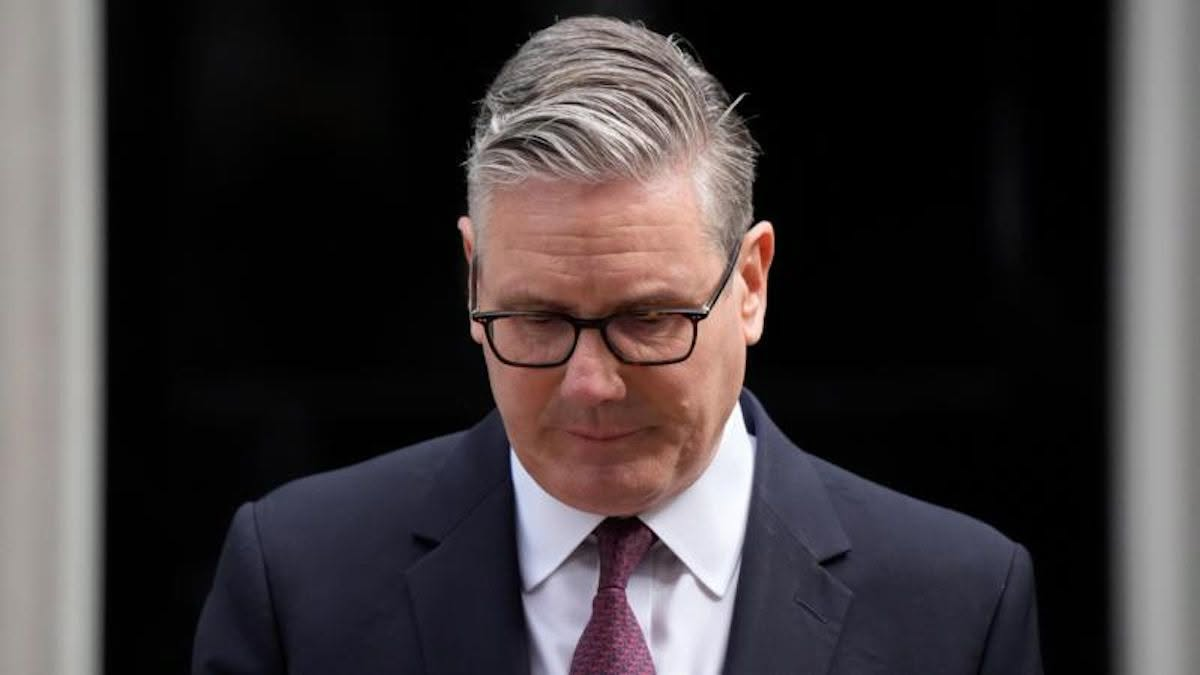
Keir Starmer has resigned as British Prime Minister and leader of the British Labour Party.
In a statement outside 10 Downing Street, Starmer said he will do everything he can to ensure an orderly handover of power, and will give his successor his full support.
He claimed every decision he made in office has been about “putting the country I love first”.
Starmer said that after leaving the “biggest job in the country” he will spend more time on “the most important job”.
“Being the best husband I can, to my fantastic wife Vic, who has been a rock by my side through good times and bad, and being the best dad that I can to my beautiful children, who are my pride and joy.”
Starmer led Labour to a landslide victory at the 2024 general election, with the largest Labour majority in a generation, ending fourteen years of Conservative government and becoming the first Labour prime minister since Gordon Brown.
But he will go down in history as statistically the worst ever British Prime Minister, his decline in public support making him the most unpopular since records began.
His reign was bracketed by two shocking acts which exposed the puppet-like nature of his administration — the appointment of his US ambassador, Peter Mandelson, for whom it emerged he had breached security protocols, despite being aware of his ties to an Israeli-run ‘elite’ paedophile ring.
The pre-announcement yesterday of his resignation by US President Donald Trump was a telling humiliation, the former host of ‘The Apprentice’ TV show appearing to deliver the final blow by offering his own obituary on Mandelson’s premiership.
In fact, Starmer’s resignation had been predicted since Labour’s disastrous result in the Gorton and Denton by-election in February, but it was another by-election that would ensure his departure – in Makerfield last week, his likely successor, Manchester Mayor Andy Burnham, was comfortably elected as an MP to allow him to take over the helm as British Prime Minister.
Long a supporter, Starmer’s unwavering defence of Israel was the primary reason for his downfall. His overt defence of the deliberate starvation of Palestinians, as well as his more secretive provision of RAF support for the physical bombardment of Gaza, will be examined in future investigations into the genocide. His imprisonment of Palestine activists as ‘terrorists’ has also wrecked British civil liberties and sharply contrasted with his previous employment as a human rights lawyer and barrister.
However, the collapse in support for his party has allowed for a major transformation in British politics and may offer his most enduring legacy. It has seen the rise of the Green Party to become the main contender on the left for the formation of the next British government, and has driven support for Scottish and Welsh nationalism to once again place the future of the union at the heart of British politics.
Sinn Féin has not yet commented on the development, but in a social media post, Matthew O’Toole, SDLP leader of the opposition at Stormont, noted there will have been seven British Prime Ministers in less than a decade.
“The UK is now a poorer and less stable country, which means conversations about constitutional change are not simply nationalist aspiration, but an understandable reaction to the real destabilisation of the British state,” he wrote.
“That instability and economic underperdormance affects so much that it is natural to explore change.”
Making journalism about the criminal justice system accessible to the people impacted by it is a core part of The Marshall Project’s mission. In our free print publication, News Inside, and our award-winning video series, Inside Story, both distributed to hundreds of prisons and jails across the U.S., we make our reporting available to incarcerated readers. But readers behind bars — and their loved ones — need more than just hard news. With features like Reader to Reader, a News Inside column built around advice and insights by and for justice-impacted people, we offer incarcerated readers a place to share peer-to-peer guidance on the challenges of prison life.
Now we’re bringing this forum for sharing knowledge and connection beyond News Inside, to a wider audience. This Father’s Day, The Marshall Project is launching “Sending Kites,” a new monthly column that explores different challenges faced by people with incarcerated loved ones. “Kites” is a prison term for letters or notes passed between people on the inside. Our newsroom corresponds with thousands of incarcerated people, many of whom share advice and reflections from their own lives. Every month, “Sending Kites” will draw from those experiences — and from families living these realities firsthand — to share practical ideas, creative solutions and guidance from inside prison walls.
Sending Kites: Parenting in Prison
We’re starting “Sending Kites” with the topic of parenting from prison. While this column is launching close to Father’s Day, it’s about the broader challenges mothers, fathers and other caregivers face when they try to stay present in their children’s lives from behind bars. As you’ll see in the responses, many parents behind bars fight to stay present. They call, write, pray and send artwork. They try to share and teach life lessons from their cells and find creative ways to guide their children through milestones and decisions from afar. Their experiences are about persistence as much as love, and finding ways to be there for their children, even when “being there” looks different for them.
“Sending Kites” will be published monthly on our website, where we’ll invite readers with personal experience of the criminal justice system to write in with their own experiences. You can also follow “Sending Kites” in your inbox; sign up today to get each edition as a monthly email newsletter.
W.B. Yeats’ “Lake Isle of Innisfree” reveals an unexpected American thread.
W. B. Yeats’ beloved poem is steeped in Irish nationalism, but its roots reach across the Atlantic to ideas of self-reliance, freedom, and cultural identity.
Maura Logue Contributor @IrishCentralJun 14, 2026
A young William Butler Yeats.
“The Lake Isle of Innisfree” may be one of the most memorized poems in the Irish canon, yet beneath its dreamy Irish landscape lies a striking connection to America. From Thoreau and Emerson to the Irish diaspora and Yeats’ own nationalist vision, the poem carries echoes of both sides of the Atlantic.
W. B. Yeats’ “The Lake Isle of Innisfree”: a poem so thoroughly Irish, yet with roots firmly planted in America. This poem about self-reliance, the beauty of nature, and the celebration of the land of Ireland seems simple — simple enough for generations of schoolchildren to memorize and recite. However, examining just one dimension of its nationalist theme reveals multiple connections to America. This poem shows unexpected, deep connections among the American experience, the Irish diaspora, natural and Celtic imagery, and Yeats’ nationalist ambitions for Ireland.
Before Ireland was officially its own country, when Irish immigrants in the United States were required to list “Great Britain” as their place of birth on passenger ship records and U.S. census reports, Yeats’ writings about Ireland had to be similarly nebulous. But this didn’t stop the young Yeats from pursuing his goal: expressing the values of Irish identity to help create the nation.
Among his earliest poems, “The Lake Isle of Innisfree” was printed in his 1893 volume The Rose. This poem was inspired by John Butler Yeats’ reading of Henry David Thoreau’s Walden to “Willie” when he was a young boy, and more immediately, by the tinkling of a fountain that the grown-up W. B. heard in a London shop window. The imagery in this poem is dreamy, twilit, and otherwise “Celtic,” yet other components of the poem make it stand out as a work that moves toward articulating a nascent national identity, parallel to the motives and ideas that animate the American experience.
First, we can’t ignore the title! Literally translated, the title island, in English, is “Island of Heather” (“Inish” = “Island,” “Fraoigh” = “Heather”); however, Yeats was certainly aware of a primarily Anglophone audience’s tendency to hear and see “free island” in the title.
Second, the poem’s rhythm and meter are natural and free, not adhering to standard, traditional guidelines for poetic form, as Jahan Ramazani notes. The poem flows naturally, as if spoken by someone who is aspirationally laying out his plans to return to nature, to an unspoiled life, unmarred by the dirtiness of modern civilization. Freedom in form, liberty in expression, expansive in imagination. Are we describing Ralph Waldo Emerson, Walt Whitman, and Langston Hughes — or Yeats?
Third, the retreatant speaking in the poem hopes to be self-sufficient on the island. And he has plans to make this happen! Today, we might say he’s avant-garde in his environmental awareness, desiring to build an eco-friendly abode and live on a sustainable microfarm, in harmony with the beans and the bees. Self-reliance is the name of the game; he will both go back to his roots and create something new.
Fourth, the speaker in the poem echoes the declaration of the Prodigal Son, in the well-known parable, “I will arise, and will go” (Luke 15:18), as the Innisfree speaker plans his homecoming to the island: “I will arise and go now.” The speaker’s resolve to “arise and go” appears twice in the poem: in the oft-recited first line, and in the first line of the final stanza. The poem ends with this individual giving us the most concrete reference yet to his placement on the pavement, as he “stand[s] on the roadway, or on the pavements grey.” The island is always present to him, but only in a dream. He cannot combine the real and imagined worlds; he must live in one and only long for the other.
I think it is significant to note that in the decades when this poem was written and first published, not only was the Irish cultural revival taking hold in Ireland itself, but its flames were being fanned by the Irish in America. Irish language classes and cultural societies had already gained a strong foothold by this time, following bold and grand schemes such as the Fenian Raids in Canada just a few years earlier. Perhaps Americans of Irish birth and descent would no longer be prodigal—the success of willing an Irish nation into existence would rely on buy-in from all its constituents, at home and abroad. Would they answer the call to arise and go?
Since this poem is based on a Walden-like notion, it is clear that the speaker seeks some sort of independence (the American impulse) and to forge his own path, in defiance of flawed contemporary conventions. The nationalistic references in this poem are coded, possibly because at this time, the nascent nation was so amorphous that being any more specific would have caused Yeats to fail in the expression of a universally Irish ideal.
But the seed was planted, and the bean rows would grow.
An American impulse, transformed by the Irish spirit. A masterful expression of the desire for freedom and a return to authenticity. Hopes and dreams, plans and action. The best of both sides of the Atlantic, all in a 12-line poem.
After 53 years of waiting, New York is finally a city of basketball champions again.
With a 94-90 win over the San Antonio Spurs in Game 5 of the NBA Finals, the New York Knicks secured the franchise’s third NBA championship and first since 1973.
A team that knocked on the door several times before burst onto the game’s biggest stage and took full advantage of its time in the spotlight. A collection of players who, in many cases, were cast aside, overlooked, undervalued or deemed expendable, found a home in Manhattan.
And now ring measurements are in order.
You know most of the stats about the drought. More than five decades passed between Knicks title runs, but let’s look deeper.
Here are some facts beyond the box score about the Knicks’ 2026 NBA title.
Mike Brown
Legendary former San Antonio Spurs coach Gregg Popovich spent 29 years building one of the most influential coaching trees in NBA history. In the end, he had to watch his franchise fall at the hands of one of his own proteges.
Knicks coach Mike Brown became the fourth coach who either played for or coached under Popovich to win an NBA championship as a head coach.
Brown served as an assistant under Popovich in San Antonio from 2000 to 2003. During those three seasons, the Spurs averaged 58.6 wins, reached two Western Conference finals and captured the 2003 championship.
The other championship-winning coach connections to Popovich are Steve Kerr, Mike Budenholzer and, loosely speaking, Doc Rivers. Kerr played under Popovich from 1999 to 2001 and again from 2002 to 2003 before going on to coach the Golden State Warriors to four championships. Budenholzer spent 17 seasons as Popovich’s top assistant before leading the Milwaukee Bucks to the 2021 NBA title.
Rivers spent two seasons playing with the Spurs from 1994 to 1996 while Popovich served as the team’s general manager. Rivers later coached the Boston Celtics to the 2008 championship.
The plays that defined the Knicks’ historic comeback
Esfandiar Baraheni
Jalen Brunson
New York’s captain was originally selected with the No. 33 pick in the second round of the 2018 NBA Draft by the Dallas Mavericks. Now, Brunson has become the fourth second-round pick in NBA history to be named NBA Finals MVP after averaging 32.6 points and 4.6 assists while leading New York to a 4-1 series victory.
The first player to accomplish the feat donned the same fabled blue and orange as Brunson. Knicks center Willis Reed was selected with the eighth overall pick in 1964, which was the first pick of the second round. He was named NBA Finals MVP in 1970 and 1973, the previous two times the Knicks won the championship.
In 1976, Pepperdine guard Dennis Johnson was selected in the second round at No. 29 by the Seattle SuperSonics. In 1979, Johnson averaged 22.6 points, six rebounds and six assists in a 4-1 NBA Finals series victory over the Washington Bullets. He took home finals MVP honors for his efforts. Moses Malone won NBA Finals honors in 1983 after being a third-round pick in the 1974 ABA Draft.
Arguably the most dominant second-round pick in NBA history was famously selected during a Taco Bell commercial. Denver Nuggets center Nikola Jokić was selected No. 41 in the 2014 NBA Draft and has since become a three-time league MVP. He won NBA Finals MVP in 2023 after averaging 30.2 points, 14 rebounds and 7.2 assists in a five-game series victory over the Miami Heat.
Jalen Brunson averaged 32.6 points and 4.6 assists against Wembanyama and the Spurs in his first career NBA Finals.Gregory Shamus / Getty Images
Villanova boys
Brunson and Mikal Bridges became the fourth pair of teammates to win multiple NCAA championships and at least one NBA Finals on the same team. Fellow Knicks teammate Josh Hart was only on the 2016 Villanova championship team and not the 2018 championship-winning team.
The other three title-heavy teammates were:
Bill Russell and K.C. Jones: (San Francisco – 1955, 1956; Boston Celtics – 1959, 1960, 1961, 1962, 1963, 1964, 1965, 1966)
Kareem Abdul-Jabbar and Lucius Allen (UCLA – 1967, 1968; Milwaukee Bucks – 1971)
Gail Goodrich and Keith Erickson (UCLA – 1964, 1965; Los Angeles Lakers – 1972)
The pair also became the 13th and 14th players in history to win multiple NCAA championships and at least one NBA championship.
Russell and Jones were the first, winning back-to-back NCAA titles at San Francisco before launching a decade of dominance with the Boston Celtics. A host of John Wooden’s UCLA alumni are also on the list, including Abdul-Jabbar, Goodrich, Erickson, Henry Bibby, Jamaal Wilkes and Bill Walton.
Nazr Mohammed won two national championships with Kentucky in the mid-1990s before capturing an NBA title under Popovich with the 2005 Spurs. A pair of Florida teammates, Al Horford and Corey Brewer, helped lead the Gators to back-to-back national championships in 2006 and 2007 before later winning NBA titles.