From IRA man to journalist and humanitarian: The remarkable life of Tony Meade.
Posted by Jim on August 1, 2026
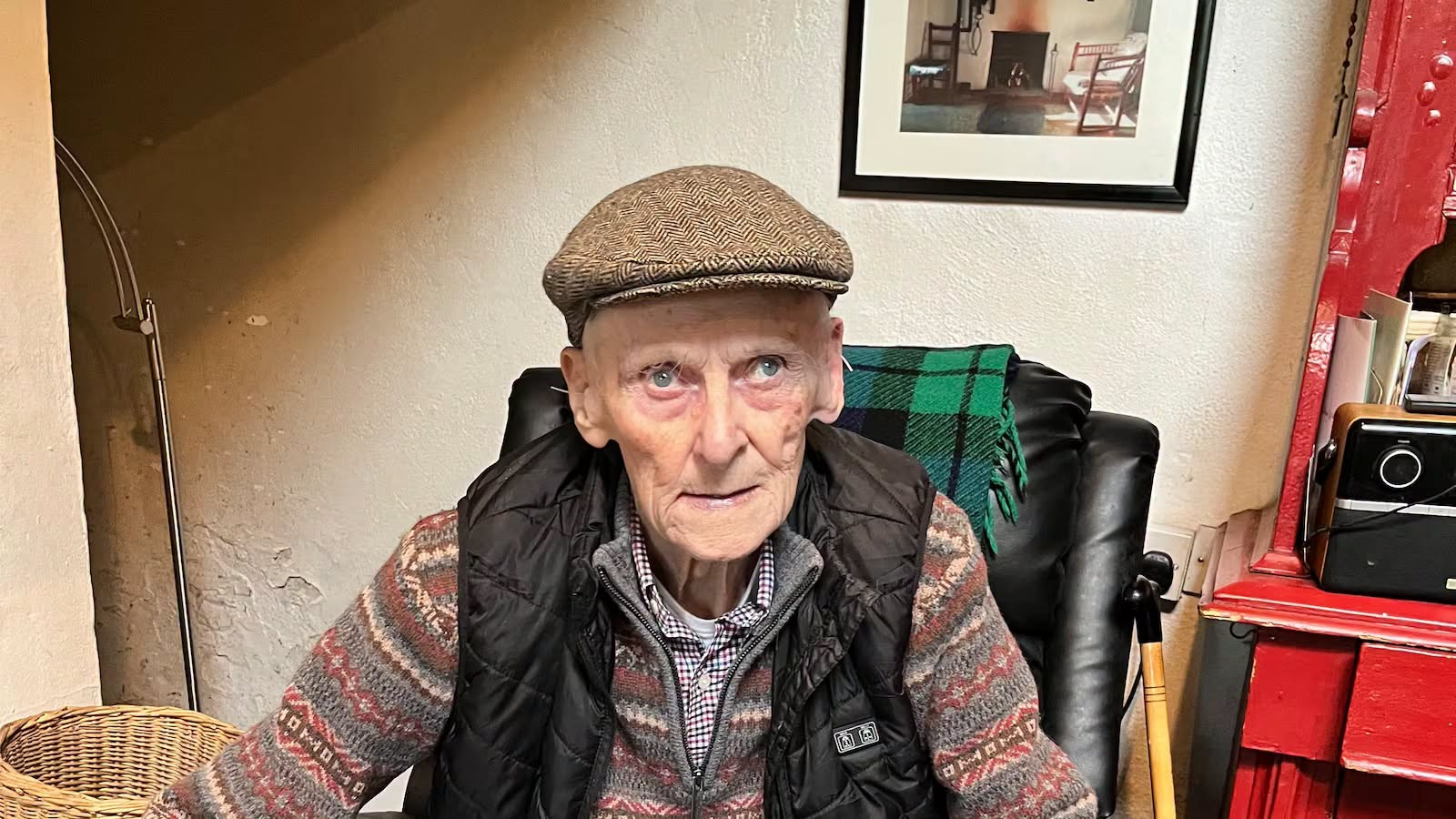
He persuaded Seán South to join the IRA, was arrested in a confession box in Armagh Cathedral, became an acclaimed journalist, and was deputy head of Trócaire and a close friend of Bishop Eamon Casey. Patrick Murphy visited 88-year-old Tony Meade to discuss his remarkable life.
Tony Meade at his home in Co Kerry
By Patrick Murphy
August 01, 2026 at 6:00am BST
THE threads of Irish history which link one generation to the next can usually be traced either through people or places.
In a remote farmhouse in Knockaneacoolteen in mid-Kerry, you can find a wonderful example of both.
The house played a significant role in the War for Independence and on the republican side in the Civil War.
The person in that house is 88-year-old Tony Meade, who took part in the IRA campaign of 1957-62 and who, through his journalism and international humanitarian work, later played a significant role in shaping modern Irish political opinion.
It is a place where you can almost taste the history.
Tony was born in 1937 in Limerick, “a hungry place”, he says, marked by widespread poverty.
His family were Labour Party supporters, but he joined the IRA in answer to a notice in the public library.
A “very close” friend who used to visit a family a few doors from Tony’s house was Jack South, later known as Seán Sabhat.
Tony persuaded him into the IRA too, adding: “Not that he took much persuading.”
Describing him as “an exceptional man”, Tony laughs at the idea that Seán held right-wing views.
Certainly, he says, Seán was an Irish language advocate. In the timber firm where he worked, the boss would speak to him in English and Seán made a point of answering in Irish.
When the IRA campaign began in December 1956, Tony was working in England and he came home to take part.
Seán had gone north with an active service unit, where he died with Monaghan man Fergal O’Hanlon in a raid on Brookeborough RUC station on January 1 1957.
Tony went on active service then too, but initially at least, it involved much inactivity.
He spent six months (including a Christmas) living in a dug-out in south Derry, buried six feet underground, covered by a henhouse.
There was room for two people – himself and Malachy McGurran from Lurgan.
“You could look out through the stones and see the ‘B’ Specials coming up to us and then [unknowingly] over us.”
The IRA men only came out under cover of darkness, but they were under orders not to attack the ‘B’ men.
In an age unrecognisable in the context of the recent Troubles, the IRA at that time observed the Geneva Convention.
They carried arms openly, wore recognisable uniforms or markings, and did nothing to endanger civilians or to foment sectarian division. The ‘B’ men were safe.
Bored during the day, he asked the farmer who owned the land for some books.
Next day he was presented, “with great ceremony,” with a bundle of back copies of the magazine Woman’s Way. Reading them brought a new meaning to the concept of suffering for Ireland.
Listening to RTÉ on a small radio, Tony would hear consumer queries such as: “I have spilled beetroot juice on a white tablecloth, what should I do?”
He would pen imaginary letters, asking: “I am in a dugout surrounded by hundreds of ’B’ men, what should I do?”
His activity in south Derry was a repeat of what Kerry’s Charlie Daly had been doing in 1920 in that same area and in Tyrone.
Daly took the republican side in the Civil War and was executed by Free State troops without charge or trial at Drumbo, Donegal in 1923.
Today, Tony Meade lives in Charlie’s house, having married Áine Casey, whom he met there during an IRA training camp.
She came from a family of committed republicans. She was the daughter of Susie Daly and Con Casey. Susie was Charlie Daly’s sister.
Con Casey was a senior member of the IRA’s Kerry Brigade and he was sentenced to death by the Free State and survived 45 days of hunger strike.
Áine’s uncle, Tom Daly, was on the IRA executive until 1936 and her Aunt May maintained a safe house for many years.
Apart from a wood-burning stove replacing an open fire, the house remains largely unchanged for over a century.
In March 1923, during the Civil War, Free State soldiers tied nine republican prisoners to a mine at nearby Ballyseedy. They detonated the mine, killing eight and badly injuring the other.
The injured survivor, Stephen Fuller, was taken to the house where Tony Meade now lives.
His blood-stained shirt remained there, where it was preserved with great care and respect in the house and was almost regarded as a holy relic. It is currently on loan to the Kerry Museum for preservation.
In 1958, Tony joined up with Denis Foley from Tralee and Willie Riley from Armagh.
They planned to blow up the RUC station in Irish Street, Armagh, by placing a bomb inside the sandbagged sentry post during the interval between one sentry leaving and another arriving.
Having placed the bomb, however, as they worked their way back around the barracks corner, the electrical wires connected to the device became entangled, even though they had been free the previous evening.
Abandoning their efforts, they went to Armagh Cathedral to be picked up as arranged and taken to a safe house.
Tony relates that “as so often happened”, the person to meet them did not show up, so they took refuge in the cathedral.
The police had the place flooded and as they were passing a confessional, its door creaked and there inside were the three IRA men.
Taken back to the police station they had just tried to destroy, they had to walk through a double line of RUC men.
“Not a hand was laid on us,” said Tony. “I thought they were very disciplined.”
The three men were held as internees “for ages” before being tried. They were later sentenced to 14 years each in Crumlin Road prison in Belfast.
At Christmas 1960, members of the Down team which had won the Sam Maguire that year brought the cup into the prison.
It was part of a concert for the inmates, all of whom gave the players a 15-minute ovation. Bridie Gallagher sang at the concert. It was a different world then.
Prison, he says, was a modus vivendi – a way of life.
He used his prison work as a book binder to send letters to his future wife, Áine.
He secreted them either between thin sheets which formed a book cover or, for larger volumes, inside the book spine.
A tick on page 41 of a book sent to an outside company meant that it contained a letter.
In more recent years he and Áine took a tour of Crumlin Road.
Philosophical about his time in jail, Tony recalls some of his fellow prisoners.
Tom Mitchell, abstentionist MP for Mid-Ulster, who was captured during the IRA raid on Omagh barracks, was “a great fellow”.
He speaks of how Seán Garland, who had led the Brookeborough raid, and John Kelly (he calls him “Johnny Kelly”) tried to escape.
Kelly would go on to help found the Provisional IRA and sit in Stormont as a Sinn Féin MLA, where I got to know him as a member of the Education Committee. Garland was a senior figure in the Official IRA.
After the IRA campaign ended in 1962, Tony was released the following year. A helpful RUC man gave him directions to John Kelly’s house.
After a short stint at home he went to Dublin to work for the United Irishman newspaper, then edited by Denis Foley.
Denis resigned in frustration after writing an editorial criticising the idea that all republican social and economic policy would have to wait until there was a united Ireland.
Tony took over on condition that Denis would join him, and the two worked well together.
However, Tony eventually left, simply because “they had no money to pay me”.
As newly-married man with three children, he had no choice. He proposed Seamus Ó Tuathail as his successor and drove him to the selection process.
Tony then applied for a job in The Kerryman newspaper in 1968, where he went on to become one of the most influential and informed columnists in the country, particularly on events in the north.
He had an infectious writing style. When you read one sentence, you immediately wanted to read the next one.
It was no surprise that he offered an accurate insight into the IRA split in 1969/70. After all, he knew most of the players on both sides.
He wrote that the north “has a way of battering at one’s conscience” and in that vein he produced a series of well-informed columns on events.
He produced what might be described as the definitive account of the civil rights march in Newry in February 1972, on the week following Bloody Sunday.
He concluded: “There is really no alternative at this time to the civil rights way of doing things.”
Two months later, as the violence increased, he asked: “Can Tone’s vision be realised by the destruction of some of the plain people of Ireland?”
He also carried out a series of interviews, under the heading “Old Heroes”, with many of those who had fought in the War for Independence: “They were tough men, all of them.”
Among those he interviewed was 73-year-old Dan Breen, who effectively started the war with the killing of two RIC men in the Soloheadbeg ambush in 1919. Breen made no apology for it.
He said: “Up to a certain stage [violence] is treason. Then it becomes respectable. Then the Church recognises it and you nearly get canonised if you live long enough.”
However he added: “Killing is a terrible thing. It is very difficult to shake it out of your system”.
On hearing that Kerry might have a new bishop in 1969, Tony travelled to England to interview the man who would become Bishop Eamon Casey. “It introduced him to the Kerry people.”
I ask if he stayed in touch with Casey when he arrived in Kerry. “Ah,” says Tony, “sure you couldn’t do otherwise”. It was the beginning of a close working relationship between the men.
When his brothers-in-law started The Drogheda Express newspaper in 1979, Tony worked there, but when it folded, he applied for a job as press and information officer for Trócaire. He soon progressed to deputy director, a job he “enjoyed very much”.
Tony makes the point that while charity begins at home, it does not necessarily end there and this is a logical extension of our concern for those who have less than we have ourselves.
His work took him to many former British colonies where independence had not significantly changed the lives of many who lived there.
Tea-pickers in Keyna, for example, earned 15 Kenyan shillings a day, but 2 kilos of meat cost 17 shillings.
Sending a child to secondary school cost a minimum of 1,500 shillings a year.
His republicanism had progressed from the national to international and he spent 20 years involved in development projects.
Bishop Casey, who it later emerged had fathered a child and would posthumously be accused of child sexual abuse, was chairman of the organisation and although the two men got on well together, Tony’s wife had less regard for the bishop. She just did not like him.
So, what was Casey like? “Casey? Ah, Casey was Casey” – which tells you everything and nothing in the same sentence.
Tony finally progressed from Trócaire to an educational organisation agency for schools, known as 80:20. It based on the fact that 80% of the world’s population live in the undeveloped world, while the richest 20% own the wealth of the rest of the world.
He is “more hopeful” now that a united Ireland is closer, but recognises unionist resistance to the idea. His grandchildren speak of the support for Sinn Féin in the south among young people.
Would he do it all again? “Of course, I would”.
When did he leave the IRA?
“One does not leave the IRA, one drifts. I drifted. I never fancied the Provos at all.”
In the quiet of an early summer evening, Tony Meade is at peace with the world in the company of his daughter Sadhbh and grandchildren Siún and Rafe.
Philosophical and still with that impish sense of humour, he is the link between the War for Independence and modern Ireland.
An Irish republican, an internationalist and a man of humanitarian care, he has not just seen Irish history in the making. He made a lot of it too.