Sam Mcbride’s article in last Saturday’s BelTel was a broad overview of just how screwed we are. From crumbling public services to ecological collapse, it made for depressing reading:
A veteran unionist politician recently said to me: “The whole place is an absolute mess.” Another MLA is for the first time seriously considering quitting politics.
One senior business figure phoned a week ago to lament how so much of Northern Ireland is falling apart.
He likened the situation to Libya – there, two warring leaders had fought while their infrastructure collapsed, killing thousands of people when two dams burst. Here, he said that the two sides were expending their energy on tribal disputes while critical infrastructure degrades around them.
The consequences might not come while these politicians and civil servants are in power, but come they surely will. He said that spending on roads had been almost £1bn short over the last nine years – a false economy because the more roads regress, the more expensive they become to maintain.
The civil service isn’t trusted by the Treasury, the Irish government or business to spend their money, he said, because the scandalous behaviour of cash for ash had not been addressed – despite what the head of the Civil Service claims.
Having sown the wind, we’re now reaping the whirlwind.
This day next week, Northern Ireland enters a critical period of electricity insecurity. Kilroot power station’s coal-fired units shut next Saturday evening, but the gas-fired generators which were meant to replace them are nowhere near ready.
Even when those generators come online some time early next year, they will not replace the lost capacity due to a gaffe by those overseeing the electricity system.
There will be a critical gap in generating capacity which means that on calm, cold days when problems develop at other plants there could be blackouts. Yet no one seems terribly exercised by this. There’s scant evidence of it being treated as a crisis.
Last year, a refugee fleeing the Ukrainian war came here for sanctuary. But when they needed an urgent operation the waiting list was so long that they considered returning to Ukraine for treatment. Now health faces a £470m shortfall.
The Department of Education is £382m short and admits that disabled children will experience “major negative impacts”. The infrastructure budget is £167m short. Officials there say all streetlights will have to be switched off and salting of the roads will end.
The subject was also debated on last night’s The View on BBC (clip below).
How bad is it all likely to get? Are we being too fatalistic or willfully ignoring the problems?
That centenary stone is looking more like a headstone every day.
The British government’s notorious cover-up legislation, which became law this week, has already been hit with several legal challenges, including over a dozen by victims of its war crimes in the north of Ireland.
The new legislation offers full legal impunity to those accused of killings during the conflict and will halt new court cases and inquests relating to events prior to 1998.
It is being opposed by a growing international justice and human rights campaign led by the families of the victims of its atrocities. Protests have been stepped up, and this week saw giant banners unveiled at the grounds of Celtic FC in Glasgow.
A so-called ‘Independent Commission for Reconciliation and Information Recovery (ICRIR)’, which is intended to supplant existing legal processes, is being set up. But calls for the body to be boycotted have grown louder following the installation of a former assistant chief of the murderous RUC police, Peter Sheridan, as its ‘Commissioner for Investigations’.
Christine Duffy’s 15-year-old brother Seamus was killed by a plastic bullet fired by an RUC officer in 1989. No one has ever been convicted of the killing.
“The person that was appointed this morning to investigate is an ex-RUC man – the same people that investigated my brother’s murder,” she said. “I had no confidence in them then, and I have no confidence in them now. It is the RUC investigating the RUC.”
The passage of the legislation into law was condemned at the United Nations. Its Human Rights office said it “deeply regretted” the move and expressed concern that it violates Britain’s international human rights obligations.
All the main parties in the north of Ireland oppose it, with Sinn Féin MP John Finucane, whose father was shot dead by a loyalist death squad, saying it was devastating for families, and DUP assembly member Emma-Little Pengelly describing it as “abhorrent”.
Several legal firms have already announced legal action over the legislation. They argued that the bill is “unconstitutional and unlawful” and applied for “emergency judicial intervention”.
They said it is in breach of Articles 2, 3, 6 and 14 of the European Convention on Human Rights. Niall Murphy and Setanta Marley, from KRW Law, said it “represents the most egregious breach of international human rights standards”.
One of those mounting a legal challenge is Billy Campbell, whose 19-year-old brother Tony was shot dead by the British Army in February 1973, one of six shot dead in the New Lodge area of north Belfast that day.
In February 2021 Attorney General Brenda King ordered a new inquest into Tony’s killing. But his family believes the government’s legacy bill will prevent the inquest being heard.
Mr Campbell said the death of his brother nearly killed his mother and still affects him.
“It just destroys you. Why is the British government deliberately rushing this through? The answer is, they are trying to hide their dirty war,” he said.
Mr Campbell said he believed the 26 County government had been slow to respond to the incoming legislation.
“They are saying they will think about bringing them (the British government) to court. This is the reason I am doing this (taking a High Court challenge), and other people are doing it, because they won’t move.
“What have Leo Varadkar and Micheal Martin done? Nothing. I want justice for my brother. The Americans are against this bill, the EU is against it, everybody is against it. The Irish Government should be doing more.”
Others taking cases being represented by KRW law are Liam Shannon, one of the Hooded Men who was tortured by the British Army after being interned in 1971; Gemma Gilvary, on behalf of her brother Maurice Gilvary, and Mary Braniff, on behalf of Anthony Braniff, both shot dead on the orders of Crown Force double agent Freddie Scappaticci in 1981; and Margaret McReynolds, a victim of the Ormeau Road Sean Graham bookmakers murders in 1992 which involved the collusion of the RUC police.
Madden and Finucane are taking cases on behalf Billy Thompson, son of innocent mother-of-six Kathleen Thompson, who was shot dead by the British Army in 1971; Jonathan McKerr, son of Gervaise McKerr, who was shot near Lurgan in 1982, and Teresa Jordan, mother of Pearse Jordan, shot in Belfast in 1992, both killed in shoot-to-kill ambushes by the RUC; and three cases involving the collusion of the Crown Forces with paramilitary death squads – Linda Hewitt, sister of Sam Marshall, who was murdered in Lurgan in 1990, and Eamon Cairns, father of Gerard and Rory Cairns who were shot in their home by the UVF in October 1993, and Una Eakin, widow of Gerard Casey, who was murdered by loyalist paramilitaries in 1989 in Rasharkin, north Antrim, using weapons and information supplied by British Army agents.
Three other families of victims are represented by HCC Lawyers: Annette McGavigan, a 14 year old schoolgirl, who was shot by the British Army in her school uniform on the 6th of September 1971; ex-serviceman Thomas Burns was shot by the British Army on the 12th of July 1972 in north Belfast; and Jim McCann, one of the New Lodge 6, shot in a massacre by the British Army on the 3rd of February 1973 in Belfast.
A number of inquests and other legal processes, including efforts to hold a public inquiry into the death-squad assassination of Belfast defence lawyer Pat Finucane and the investigations into the killings overseen by Britain’s double agents inside the IRA, have all been deliberately delayed ahead of the implementation of the new legislation.
Sinn Féin MP John Finucane, son of the murdered lawyer, said he supported the families’ action against the British government’s ‘cynical and cruel’ Legacy Bill.
He repeated calls for Dublin to take an interstate case against the British government.
“I support legal challenges at the Belfast High Court against the British government’s flawed and irredeemable Legacy Bill,” he said.
“It is absolutely cynical and cruel that the British government has forced through this bill despite clear opposition from victims, all the political parties in this island, human rights experts, churches, the US, UN, EU and the Irish government.
“I am calling on the Irish government to confront this denial of human rights and breach of international human rights law through an interstate case and international action against the British government.
“Sinn Féin will continue to stand with families in their campaigns for truth and justice, many of whom have been campaigning with dignity and determination for five decades.”
Not much unites our local parties, but they all agreed on their opposition to the Legacy Bill. Unfortunately, like most things, our views count for very little at the mother of parliaments. A bid by the House of Lords to amend the bill was voted down by 288 to 205. From the BBC:
The bill ends new Troubles-era cases and inquests and offers conditional amnesty to those accused of killings.
The Irish government is considering legal action against the UK over the bill which the Democratic Unionist Party said was “abhorrent”.
The bill will return to the Lords next week before going for royal assent.
It has been widely opposed by victims groups and all of Northern Ireland’s political parties.
The government has said the legislation, which applies to all former members of the security forces and ex-paramilitaries, is an attempt to draw a line under the events of the past.
Prosecutions that are currently ongoing will continue to conclusion.
Veterans groups – such as the Northern Ireland Veterans Movement – widely support the bill.
However, some other military veterans have criticised it.
On Tuesday, the Lords backed an amendment to give victims’ families a greater say in granting immunity from prosecution to offenders.
But the Conservative majority in the House of Commons rejected that on Wednesday, clearing the path for the legislation to be sent for royal assent.
Northern Ireland Secretary Chris Heaton-Harris told the House of Commons it was incumbent on the government to find a process that “can deliver positive outcomes for as many of those directly affected by the Troubles as possible”.
“We must be honest about what we can realistically deliver for people in circumstances where the prospects of achieving justice in the traditional sense are so vanishingly small,” he added.
Taoiseach (Irish prime minster) Leo Varadkar said it was “the wrong way to go about dealing with legacy issues in Northern Ireland”.
“There aren’t many things that all of the five main parties in Northern Ireland agree on but they all agreed this is wrong, and this is not victim-centred and not human-rights proofed,” Mr Varadkar told reporters in County Wicklow.
He said the Irish attorney general is preparing advice on whether the case could be taken to the European Court of Human Rights, “essentially saying that this bill, this act is not compliant with the European Convention on Human Rights, of which United Kingdom is a signatory”.
DUP assembly member Emma Little-Pengelly said the “abhorrent” passage of the bill represents a “dark day for innocent victims of the Troubles”.
Ms Little-Pengelly said the bill “plays into the hands of those who want to airbrush the past”.
SDLP leader Colum Eastwood said he was “angry and ashamed” at the outcome of the vote and called on the Irish government to intervene.
“The British Government doesn’t care about the rights of victims but the international human rights standards that we all enjoy must be defended,” he said.
Speaking before the debate, Sinn Féin MP John Finucane described the bill as devastating for families, adding it would unilaterally close the door on them getting truth and justice.
Mr Finucane’s father, solicitor Pat Finucane, was shot dead by loyalist gunmen at his home in Belfast in 1989.
Grainne Teggart, of Amnesty International UK, said it was a “dark day for justice” and that the law only absolves “those responsible for conflict-related abuses – and, shamefully, all under the guise of reconciliation”.
Victims’ rights campaigner Raymond McCord, whose son Raymond Jnr was murdered by loyalists in 1997, said the UK government had shown no compassion for victims.
“My next step is taking the government to court, [they] simply don’t care about truth and justice,” he said.
Kenny Donaldson, from victims’ organisation South East Fermanagh Foundation (SEFF), said the government had “effectively relinquished their responsibilities in overseeing justice”.
“It is regrettable that they were not willing to accept the very reasonable amendment which came from the House of Lords yesterday which would have ensured that victims and survivors could feel somewhat empowered.”
Meanwhile, the new shadow Shadow Secretary of State for Northern Ireland Hilary Benn said a Labour Government would repeal the law:
There are five 9/11 memorials in Ireland in tribute to all those, including many Irish and Irish Americans, who were killed on that tragic day in New York City.
Sheila Langan
Sep 07, 2023
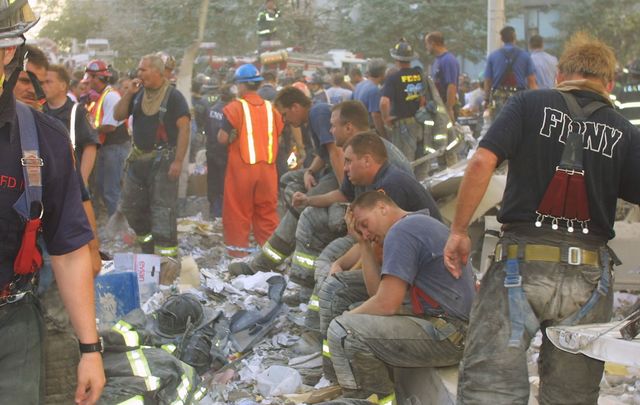
Exhausted 9/11 first responders at Ground Zero on Sept 11 2001, at the World Trade Center. GETTY
The victims of the September 11 attacks in New York City are remembered in memorials across Ireland.
In the years since the attacks on September 11, 2001, memorials both big and small have been built throughout the United States, as well as around the globe.
The most immediate ones were impromptu – garlands draped on a parked car it became clear no one would claim, notes and photographs taped to fences and walls around New York City, candles placed outside of Ladder Company firehouses.
Others came in time. With the realization that so many people would not be coming home, names were added to lists that grew longer and longer. Names of firefighters, of executives and their staff members, of police officers, of building workers, of airplane passengers, of Pentagon officials – 2,973 in total. Their names are now engraved and commemorated in hundreds of permanent memorials in the most directly devastated areas – New York, New Jersey, Washington, DC, and Pennsylvania – and in some less expected places, providing a lasting reminder of the global effect of the September 11th attacks.
At least five such memorials have been built in Ireland. At least 18 Irish citizens – 7 born on the island of Ireland – were killed on September 11, 2001, as did scores of other people of Irish descent – from many of the financial workers in the upper floors of the Twin Towers to a significant number of the brave FDNY and NYPD members who tried to rescue them.
Ireland’s National Memorial to the Fighting 69th and the Victims of September 11th – Co Sligo
Ireland’s national monument to the Fighting 69th, the most Irish of the US Army’s Infantry Regiments, serves as a tribute to the civilians who perished on 9/11, as well as to the soldiers of the 69th who were among the first military units to respond following the attacks, and who have served in the war in Iraq. Located in Ballymote, Co Sligo, the memorial was dedicated in August 2006 by New York City Mayor Michael Bloomberg and family members of Irish American victims of 9/11, including Jack Lynch, the father of Irish American firefighter Michael Lynch, who was killed during the collapse of Tower 2.
The monument consists of a copper cylinder, which is intertwined with steel donated from the wreckage of the World Trade Center. Etched images of Sligo native and Civil War Brigadier General Michael Corcoran, one of the commanders of the Fighting 69th, adorn the structure.
Donadea 9/11 Memorial – Co Kildare
4
Donadea 9/11 Memorial – Co Kildare.
In Donadea Forest Park, Co Kildare, a pair of scaled-down limestone replicas of the Twin Towers stand in a clearing surrounded by oak tree saplings. Officially presented on September 21, 2003, the memorial towers are engraved with the names of the 402 public officials who died during the attacks.
The inspiration for the memorial was Sean Tallon, a young fireman whose family had emigrated from Dondea to New York, who had frequently visited his grandparents in Dondea. At the ceremony, Kildare Mayor Michael Fitzpatrick said “We wanted to do something to remember Sean and his colleagues and all the other public officials who died that day. This wonderful memorial is the result.”
Glendalough Hermitage 9/11 Memorial – Co Wicklow
Glendalough, Co Wicklow, one of Ireland’s most well-known places of Christian pilgrimage, offers visitors a quiet space to contemplate the events and aftermath of 9/11. Part of the larger spiritual journey of the Glendalough Hermitage Centre’s meditation garden, Br. Joseph McNally’s sculpture of the towers “marks the tragedy and challenge to peace posed by this event and is located in the context of a path reflecting on the defining choices we make.”
Father Mychal Judge 9/11 Memorial – Co Leitrim
Those words could just as easily be applied to FDNY Chaplain Fr. Mychal Judge, whose defining choice to help those in need and to offer comfort in times of trouble ultimately lead to his death on the morning of September 11th. Two memorials in Ireland recognize his incredible journey and testify to his lasting influence.
The son of immigrants from Co Leitrim, Fr. Judge began his seminary training at age 15 and was ordained as a Roman Catholic priest thirteen years later, in 1961. A dedicated Franciscan, he was also one of the Order of the Friars Minor, and served at the Church of St. Francis of Assisi on West 31st Street, right across from the Engine Company 1/Ladder Company 4 firehouse.
4
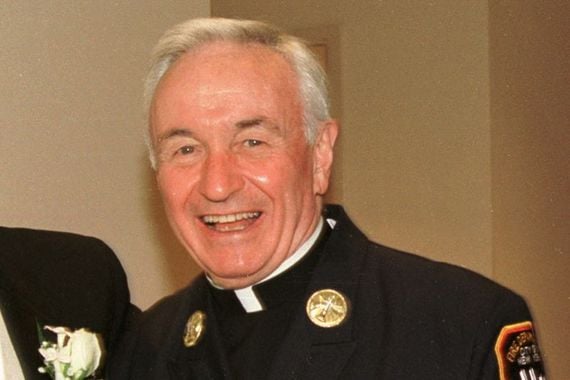
Father Mychal Judge.
In September 2001, Fr. Judge had been Chaplain of the FDNY for nine years – always there for victims, firefighters, and their families. He was in the lobby of the North Tower, delivering prayers and aid when he was crushed by debris from the collapse of the South Tower at 9:59 am. His body was recovered and was among the first to be carried out of Ground Zero, which made Fr. Judge, on the official record, victim 0001.
The people of Keshkerrigan, Co Leitrim, the town Fr. Judge’s father left in 1926, and which he had visited the year before, built a memorial in his honor and in remembrance of all those whose lives were lost. The Fr. Mychal Judge Peace Garden sits on land that belonged to the Judge family, on the shores of Kesh Lake, just outside the main village. Fr. Judge’s twin sister, Dymphna Jessich, traveled from New York for the inaugural commemoration ceremony on September 11, 2005, and donated the flag that covered Fr. Judge’s casket to the town of their father’s ancestors. The memorial was hailed by Michael Daly of the New York Daily News as “An Irish Tribute that Gets it Right.”
Ringfinnan Garden of Remembrance, also known as Kinsale 9/11 Garden of Remembrance – Co Cork
4
Ringfinnan Garden of Remembrance, also known as Kinsale 9/11 Garden of Remembrance – Co Cork
Across the island, in Kinsale, Co Cork, a second Irish memorial honors Fr. Judge, and the firefighters he both worked with and befriended. The Ringfinnan Garden of Remembrance contains 343 trees – one for each of the firefighters and first responders lost. It was initiated by Kathleen Murphy, a nurse in New York City who was born in Kinsale and whose family continues to live there. The first tree was planted just two months after 9/11, in November 2001, and the garden was officially dedicated on March 10, 2002.


![[Irish Republican News]](https://republican-news.org/graphics/title_gifs/rn.gif)
 Share
Share Tweet
Tweet![[Irish Republican News]](https://republican-news.org/graphics/title_gifs/harp.gif)