If Ireland is ever to be free, it must put country before party:
Posted by Jim on June 30, 2026
Opinion
One of the biggest impediments to progress on reunification is the tension between party politics
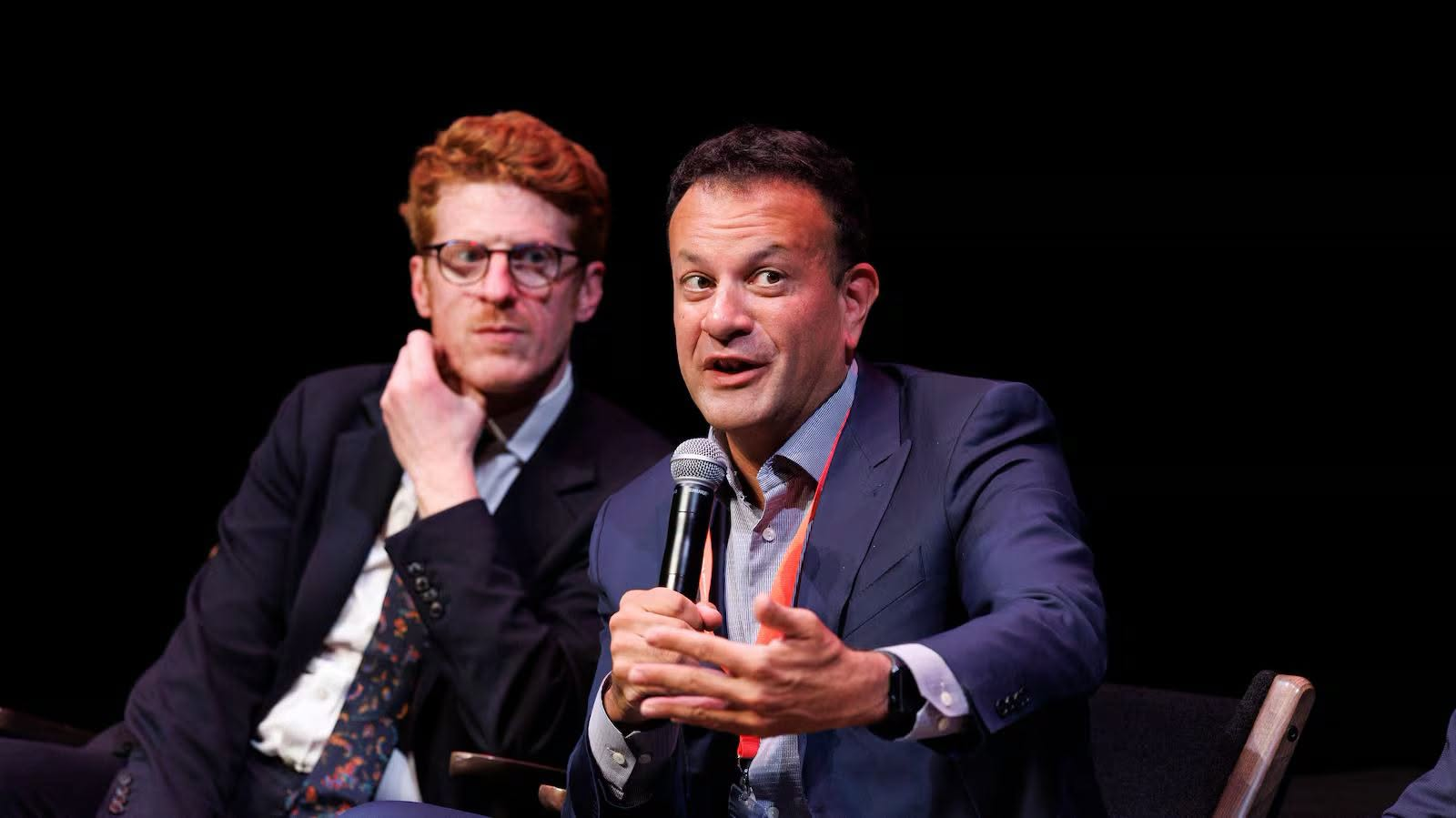
The SDLP’s Matthew O’Toole with former taoiseach Leo Varadkar during the conference The Future of These Islands: Preparing for Change.
By Tom Collins
June 30, 2026 at 6:00am BST
IN one room my wife was watching a documentary on the American War of Independence, while in another I was listening to Christy Moore singing his version of ‘Only Our Rivers Run Free’.
There must have been something in the ether – it was a night for contemplating self-determination.
Sensitised to the struggle for freedom, all I needed was a glass of whiskey and I’d be crying. There’s nothing as self-indulgent as a maudlin Saturday night.
But the whiskey stayed in its bottle as I needed to stay sober. I had to pick up my daughter later that evening, as she was returning broken but unbowed from three weeks in America with her football-mad Scottish boyfriend.
Like the Irish, the Scots are conditioned to having their hopes dashed on fields of dreams.
As readers will know, Moore has a way of loading songs with emotion.
The hyper-poetic opening of Michael McConnell’s lament softens you up.
But the line that strikes home is in the remarkable observation of Ireland’s political and cultural predicament. He sings of: “A land that has never known freedom, only her rivers run free.”
It shouldn’t have come as a surprise, I’ve been writing about the cause of Irish unity for decades, but it was the word ‘never’ that hit home.
We’ve allowed ourselves to be conditioned to believe that Irish sovereignty became a reality with our own War of Independence, and the establishment of the Irish Republic. But that is a faux reality.
The juxtaposition of TV documentary and folk song was striking. Two hundred and fifty years ago this week, the American colonies achieved their freedom; yet Britain’s broken empire still retains its grip on its nearest neighbour.
Ireland has never been free. Never. That’s a powerful word.
The consequences are clear to see. They are primarily economic – too many children in poverty, too many young people let down by educational underachievement, too many people denied proper healthcare, too many old people left lonely and isolated because the social care system is broken.
For much of the 20th century, Westminster failed to live up to its responsibilities for this place, turning a blind eye to gross abuses of human rights, allowing sectarianism to flourish – even at the heart of government – and forcing generations to emigrate in search of work which was denied to them back home.
My mother was among them, as were her father, two sisters and countless cousins.
For unionists, the uncomfortable truth is that while their political leaders were responsible in large part for the decline and fall of Northern Ireland, unionist voters were among those who suffered.
The collapse of manufacturing exposed appalling levels of educational underachievement in unionist areas, while the blind eye turned to loyalist paramilitaries by the RUC left whole communities vulnerable to the predations of gangsters.
Reunification – note, not unification – offers real benefits for all traditions here; not least by replacing a government in London which is essentially the equivalent of a 19th century absentee landlord with an Irish government focused on bettering the lives of everyone within this island.
Nobody, not even the most die-hard unionist, can pretend that the current dispensation is working in the interests of people here.
If anything, the evidence suggests that the psychodrama of English politics is having a negative impact on our ability to survive in an increasingly fractured world.
One of the biggest impediments to progress on reunification is the tension between party politics – the fighting for position between individual parties – and the cause of reunification.
Last week’s conference on The Future of These Islands was an encouraging sign that pro-reunification parties recognise that the imperative to build a new Ireland transcends party politics.
Putting country before party is easier said than done, particularly for politicians conditioned to look no further than the next election.
But ‘country before party’ is the only approach that will secure the outcome they all crave: the ability to effect real change that will better the lives of those they are elected to serve.
In that context, there is an obligation on the two governments to begin the urgent work needed to prepare the way for a border poll (an inevitability) which will allow the Irish people to make an informed choice about the future shape of a reunited Ireland.
An Ireland at peace with its neighbour, an Ireland which is an integral part of the European Union, and an Ireland which takes its place as a truly sovereign nation among the nations of the world.
In short, an Ireland where more than just the rivers run free