Law Society members ‘disgusted’ as CEO apologises for providing character reference for paedophile cousin William Lloyd-Lavery.
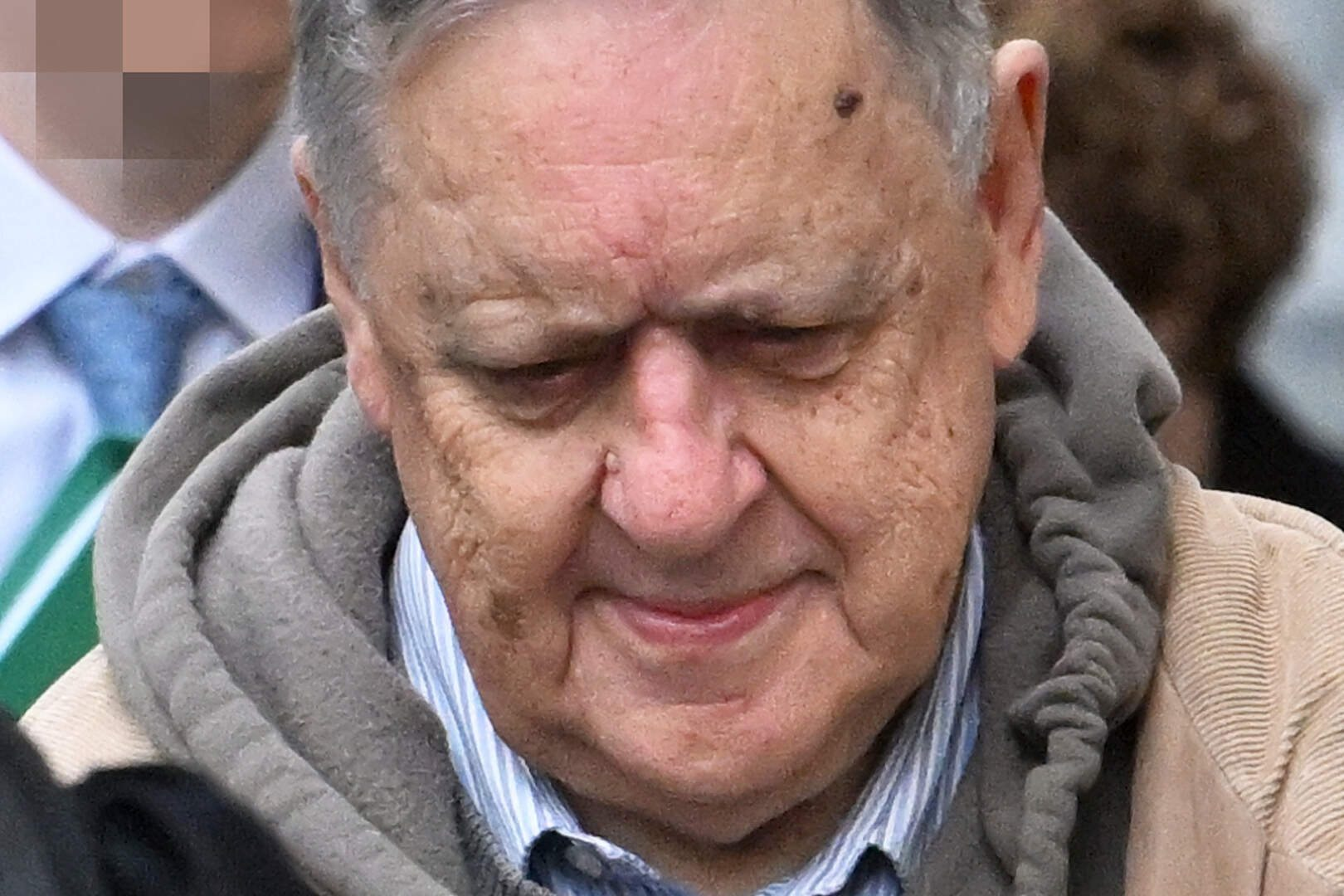
Convicted paedophile William Lloyd-Lavery at Belfast Crown Court on April 28
Brett Campbell
Reporter
11 May 2026 6:00 AM
Solicitors have expressed “disgust” after the chief executive of a professional body representing them provided a character reference for his paedophile cousin William Lloyd-Lavery.
Members of the Law Society for Northern Ireland were informed via email that its chief executive, David Lavery, had expressed remorse to its executive committee for telling a Crown court judge that the man convicted of abusing four schoolgirls in the 1970s was “a person of sound judgement and good character”.
An email seen by the Belfast Telegraph, and signed by the Law Society’s president Mark Borland, seeks to reassure members that the committee “considered this matter with deep concern and the gravity it requires” particularly in light of its “commitment to justice, equality, the rule of law and its advocacy on behalf of victims and survivors of sexual abuse”.
“David Lavery has apologised sincerely and unreservedly to council and has acknowledged that providing the reference was a serious error of judgement,” the correspondence states.
The executive committee welcomed the apology, but acknowledged the concern the matter had caused.
A number of Law Society members described the situation to the Belfast Telegraph as “disgusting” and said they were “appalled” by how it has been handled.
William Lloyd-Lavery, a former history teacher at Richmond Lodge in south Belfast, was handed a two-year sentence for indecently assaulting four female pupils, aged 13 and 14, between 1975 and 1979.
Sentencing the 77-year-old from Richmond Avenue in Lisburn, Judge Patrick Lynch referred to a character reference submitted by the defendant’s cousin, David Lavery, who explained that while related, he only got to know Lloyd-Lavery in later life.
“My impression of Mr Lloyd-Lavery was principally formed when I got to know him when he was working at Stormont,” the reference states.
“By that time, he was a middle aged man in his late 50s and early 60s and was happily married with two adult children.
“I knew that he had a Christian faith and attended Lisburn Cathedral.
“He appeared to me to be a settled, family man who wanted to contribute to society through his work on behalf of a number of elected representatives.
“I know that he was well respected in these circles and was viewed as a person of sound judgement and good character.”
A former chair of the Ulster Unionist Party and founding member of the Loyalist Communities Council also provided a character reference for the convicted child predator.
David Campbell, who served as a senior adviser to the late First Minister David Trimble, previously told this newspaper he does not regret doing so.
Law Society NI members have been told its executive committee has asked its personnel committee to oversee the development of a new protocol for “senior officers providing personal or professional references, including the reputational, ethical and governance considerations that apply in such circumstances”.
“This matter has also highlighted wider concerns around character references in cases involving sexual violence, abuse or serious harm,” the email concludes.
“The executive committee believes the society should engage with appropriate justice-sector partners to consider whether clearer guidance, policy change or legal reform is required in relation to the use of such references.
“The issues arising from this matter will be subject to further consideration, including by council. The matter will also be included on the agenda for discussion at the next council meeting.”
Forty-five years sounds and seems like a lifetime ago. I suppose it was. In 1981, in West Belfast, I turned thirteen and was in my second year in secondary school (high school). A defining time in all our lives. I once read that the music you discover at that age stays with you.
If that is true, then the 1981 Hunger Strike and its aftermath were the soundtrack to my teenage years.
This week marks the forty-fifth anniversary of the death on Hunger Strike of Bobby Sands. I had attended the protests and the funerals. A black flag was hung outside our house, and posters in support of the prisoners were in our windows. This would be no surprise as Grandfather, Father and uncles had all been jailed for their Irish Republican beliefs. One uncle was still in jail and on the blanket protest. It was all very real, and urgent.
I remember in later years asking my mother, herself a committed Irish Republican, how she managed with a husband who was an activist and two teenage sons. She confessed, “not very well.”
That is why I am not nostalgic for those days. As you grow up and have a family, you reflect on the sacrifice of the Hunger Strikers who left behind wives and children, the weight carried by grieving mothers and fathers, and the lives they could have lived.
But I do carry with great pride and awe those who faced down Margaret Thatcher and the British Government. Bobby Sands, brutalised, naked but for a blanket, denied sun and exercise for years, and yet would write that, “Our revenge will be the laughter of our children.”
I am thankful for the opportunity to get to know and to work with those who led the prison protests—those who recognised that the opportunity to move from resistance to securing a united Ireland.
So here we are, all of these years, a generation on from conflict, and desire for freedom and unity remains. A new generation is now driving our struggle.
Thatcher is gone, her Tory party and her union lies in tatters. Unionism no longer enjoys a political majority in North of Ireland. Sinn Féin is now the largest political party across Ireland.
The North of Ireland has irreversibly changed.
In 1981, the Irish Government refused to support the Hunger Strikers and even allowed Kieran Doherty, who was elected as a member of their parliament, to die.
Today, again, an Irish government led by Micheal Martin refuses to take the opportunity to do the right thing and promote the cause of Irish Unity.
I remember with pride those days and I am thankful that we now have a peaceful and democratic pathway to Irish Unity. I greive that loss but understand that were we are today is a product of all that went before us. We have further to travel and work to do to grasp the opportunity to build a new and united Ireland, that echoes with the laughter of all our children.
Have a great weekend.
Is mise,
Ciarán
Ciarán Quinn is the Sinn Féin Representative to North America
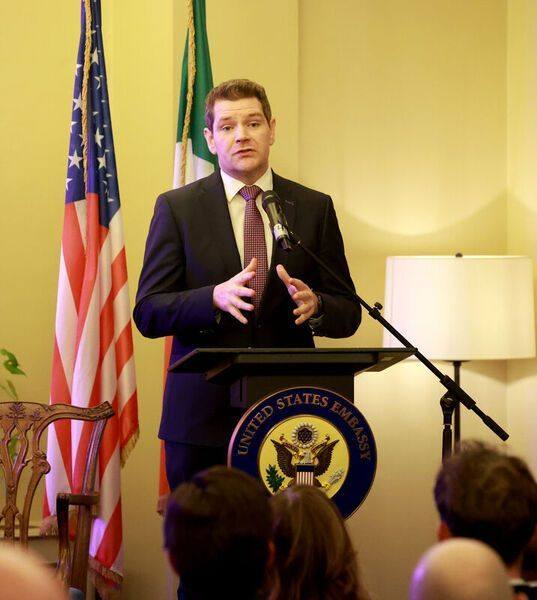
Minister Peter Burke speaking at a reception earlier this year at the residence of the U.S. Ambassador to Ireland Ed Walsh.
News May 07, 2026 by Irish Echo Staff
More than 50 Irish companies representing nine sectors traveled to the SelectUSA Investment Summit in Washington D.C. this week as part of an ongoing effort to accelerate investment, partnership and expansion across the United States.
And coinciding with the trade mission Enterprise Ireland launched a dedicated New York “Landing Pad” to accelerate the next generation of Irish companies entering and scaling in the U.S. Close to 100 Enterprise Ireland client companies established new U.S. presences in 2024 and 2025.
The Minister for Enterprise, Tourism and Employment Peter Burke led Enterprise the delegation of companies.
The more than fifty companies spanning nine sectors, from life sciences and technology to high-tech construction and climate tech, underscored what s release described as “Ireland’s deepening commercial partnership with the United States and the ambition of Irish enterprise to grow across America.”
Continued the release: “This mission builds directly on the momentum of St. Patrick’s Day engagements in Washington D.C. earlier this year, when Taoiseach Micheál Martin and Minister Burke held high-level meetings reaffirming Ireland’s commitment to the transatlantic economic relationship.
“That relationship has never been stronger: Ireland has rapidly ascended from the 9th to the 5th largest source of foreign direct investment into the United States, with Irish-origin cumulative investments now valued at a record $389 billion.
“On a per capita basis, Ireland is the single largest investor in the U.S. of any nation in the world. The top 10 Irish companies in the U.S. employ over 125,000 people and support hundreds of thousands of indirect jobs across the country, from rural manufacturing facilities in Kentucky and Arkansas to innovation hubs in New York, Boston, and San Francisco.
“The companies travelling to SelectUSA this week represent the next wave of that story; ambitious, innovative Irish firms ready to deepen their roots in the U.S. market.”
Minister Burke said: “The U.S. is one of Ireland’s most important economic partners, and the scale and quality of our delegation is a clear statement of intent. Ireland has earned its place as one of the largest foreign investors in the United States through decades of investment, partnership and delivery.
“The Irish companies at SelectUSA are either expanding existing operations, or entering the U.S. for the very first time, but they all share in common the talent, innovation and long-term ambition that have always defined Irish enterprise. I am proud to lead this record delegation and to demonstrate that Irish companies are committed, valuable and long-term partners for American growth.”
Jenny Melia, CEO of Enterprise Ireland, said: “The companies in this delegation are a remarkable reflection of the strength of Irish innovation. Manna Aero is delivering packages by drone in Texas, Aerogen’s technology is treating critically ill patients in 60% of America’s top hospitals, and Mbryonics is building the optical infrastructure for the next generation of satellite communications.
“Irish companies are trusted by leading U.S. firms, proven as resilient partners, and deeply embedded in the American supply chain, with the top ten Irish companies alone employing over 125,000 people in the U.S. SelectUSA is an important platform for identifying further opportunities to scale in the U.S., and our new Landing Pad initiative in New York is designed to give the next generation of Irish companies the accelerated in-market support they need to grow faster.”
Of the 50 Irish companies attending SelectUSA the largest represented were in the area of high-tech construction, digital technologies, life sciences, and enterprise solutions, reflecting the significant and growing opportunities these sectors present across the United States.
“The delegation includes global names CRH, Kerry Group, and Kingspan, which together employ nearly 40,000 people across the U.S. and have committed billions of dollars in future American investment. Many attending companies have existing U.S. presences and are using SelectUSA to scope further expansion, whether through new locations, deeper partnerships, or workforce growth. Others are making their first move into the American market, using the Summit as a launchpad to identify the right states and partners for their entry strategy.”
The New York Landing Pad is being described a “a flagship initiative to give Irish companies expanded infrastructure, networks, and expert in-market support they need to establish and scale U.S. operations quickly and effectively.:
Added the release: “The 12-week intensive programme focuses on accelerating go-to-market execution, expanding founders’ commercial networks, leveraging mentorship from experienced founders, and driving operational excellence on the ground, with the goal of eliminating the 18-month learning curve that typically accompanies U.S. market entry.
“The Landing Pad will be anchored at Enterprise Ireland’s New York office and supported by the agency’s existing U.S. offices in Boston, San Francisco, Austin, Chicago, and Seattle.
“The initiative reflects the scale of Irish ambition in the U.S.: America is a leading destination for Irish global expansion, accounting for 16% of all new global presences established by Enterprise Ireland client companies in 2024 and 2025, with close to 100 companies entering the market over the past two years. New York is the primary anchor hub, capturing more than 38% of all new U.S. market entries by Irish companies, while San Francisco, Austin, and Seattle collectively account for a further 44% of new Irish footprint across the country.”
As part of the trade mission Minister Burke will sign the Artemis Accords at NASA Headquarters on behalf of Ireland, joining more than 50 nations committed to the principles of safe, sustainable, and transparent civil space exploration.
“The signing reflects Ireland’s growing role in the global space economy, a sector in which Irish companies like Mbryonics are already playing a significant role, developing the photonic communications infrastructure that will underpin the next generation of satellite networks.
“Ireland’s membership of the European Space Agency has enabled Irish companies to begin large-scale production and global deployment of space technologies, creating high-value jobs and positioning Ireland in a rapidly growing industry.”
An all-island Presidential election for the first time
A Bill from Aontú to give presidential voting rights to Irish citizens in the north of Ireland passed its second stage this week, but it still under threat from the coalition government. Here the party’s deputy leader Gemma Brolly, who represents Derry East, explains why it would be a significant step for Ireland. (for the Irish Sun)
As an Irish citizen living in the North, I have always found it outrageous that I can hold an Irish passport and stand for the office of Irish president, yet I am denied a vote in choosing who holds it.
I can serve in the Irish Defence forces, but cannot vote for the president of Ireland.
More than one million Irish citizens are currently excluded from Ireland’s presidential election — despite the Good Friday Agreement affirming the right to Irish citizenship, with 700,000 exercising that right.
Aontú’s Bill to grant presidential voting rights to all citizens in the North has proceeded to the second stage in the Dáil, marking a critical moment in democratic unity.
This legislation arises from a motion announced at Aontú’s 1916 Easter commemoration in Arbour Hill last year.
It speaks directly to whether the Irish government is willing to align its democratic practice with its professed values.
It was later proposed by Sinn Féin in Stormont and carried by a majority of 46 to 25.
Aontú — as an all-Ireland political party — is constantly working to better the lives of every citizen across the whole island of Ireland.
We want to see working families thrive, not fight to survive. We want to build a society where people can afford to run their vehicles and heat their homes and at all times we will uphold the principles of democracy.
But the power to address this democratic deficit does not rest with Stormont, nor does it rest with Westminster. It rests solely with the Dáil.
One might ask, therefore, why the delay?
Simon Coveney, Tanáiste at the time, previously stated that the reason for the lack of progress on presidential voting rights was the fear among parties that it could aid in the election of a president with roots in Sinn Féin.
This theory has been widely acknowledged, especially in the last year.
As a proud Irish citizen, I am appalled not only by the restriction and inequality placed upon my rights, but also by the fact that such conditions have been permitted to exist at all.
I am equally disturbed by the deeply undemocratic culture that has been allowed to grow and take root over such a long period of time.
The idea that, regardless of who you are, who you are affiliated with, or where you live, anyone would seek to halt, stall or undermine or manipulate the democratic rights of citizens because the outcome may not align with their own preferences is disgraceful.
That such a mindset could exist within the structures of our society that are meant to uphold, protect and embody democratic principles is not only profoundly troubling, but an absolute insult to the concept of democracy itself.
The extension of voting rights would not advantage any single party by default.
But it would require all parties to engage seriously on a 32 county basis. It would extend voting rights to unionists who hold Irish citizenship.
As our bill advances to its next stage, the question facing the Dáil is not one of symbolism, but of responsibility — not one of kicking the can further down the road, but of action now.
If Ireland is serious about democracy and equality, then its laws must reflect that. The opportunity exists now to take a major practical, constitutional step forward.
The people of Ireland want this.
Has the government the courage and determination to do so?
A Bobby Sands statue in Twinbrook in west Belfast is “going nowhere, not now and not ever”, Sinn Féin Assembly member Danny Baker has said, as republicans across Ireland marked the 45th anniversary of the hunger striker’s death with large and determined commemorations.
The statement comes in the wake of a political controversy at Belfast City Council, where unionist parties, supported by Alliance, pushed through a motion to reconsider the presence of the memorial – erected last year in the Republican Memorial Garden without planning permission. A Sinn Féin amendment calling for equal scrutiny of all similar structures was rejected, while the SDLP abstained, a move that led to the resignation of one of its own councillors, who acknowledged the statue’s deep significance.
Despite these manoeuvres, the message from Twinbrook was unequivocal. Addressing a crowd gathered in Bobby Sands’ home community, Mr Baker said the attempt to challenge the memorial would fail just as previous efforts to suppress the republican struggle had failed.
“The spirit of the prisoners and our communities can never be broken,” he said.
“Our opponents were shook to their core last year and will continue to be because we are on a path, a path to Irish unity, based on equality and rights.
“There’s one very simple message I was asked to give today: the statue is going nowhere, not now and not ever.”
His colleague Pat Sheehan reinforced that position, describing Sands as “an icon and legend for freedom-loving people throughout the world” and condemning what he called ongoing efforts to distort or diminish his legacy.
Drawing a direct line between past and present, Sheehan compared current unionist opposition to the policies of Margaret Thatcher during the hunger strikes, stating that attempts to criminalise or erase Sands had failed then and would fail again.
“When all of us here today are gone, Bobby Sands will still be remembered,” he said. “He and his comrades will remain a beacon of light for freedom-loving people everywhere.”
The Twinbrook commemoration formed part of a series of events across the country.
In Dublin, activists and supporters of the Irish Republican Prisoners Welfare Association (IRPWA) gathered at Kilmainham Jail, paying tribute to Óglach Bobby Sands and reaffirming their support for republican prisoners.
Speakers emphasised that the issues at the heart of the hunger strike remain unresolved. IRPWA activist Brian Kenna told those assembled that “decades on from the Hunger Strikes, men and women remain incarcerated as a direct result of their involvement in the ongoing struggle for Irish liberation.”
He called for renewed determination, stating that the current generation “owe it to Bobby Sands” to continue the struggle.
Elsewhere in Dublin, the 1916 Societies, alongside Éirígí, held a vigil at O’Connell Bridge, joining republicans in remembering the courage and conviction shown by Sands and his comrades in the H-Blocks of Long Kesh.
Their commemoration placed particular emphasis on Sands’ writings, which continue to inspire. His words – written under the harshest conditions – were recalled as a testament to the unbreakable will of those who resisted British policy in Ireland.
And in Twinbrook, where that legacy is most keenly felt, the message was unmistakable – neither political pressure nor administrative challenge will remove the memory, or the monument, of Bobby Sands.
A white line picket organised by the IRPWA drew a strong turnout, with local people lining the road in a visible show of solidarity. An oration delivered at the statue highlighted Sands not only as a hunger striker, but as a community activist rooted in the life of his area.
IRPWA Belfast activist Séamus Fitzsimons underscored the continuity of the struggle, linking the sacrifice of the hunger strikers to the situation of present-day republican prisoners.
“Let us be clear about what Bobby and the ten (hunger strikers) died for, and what they did not die for,” he told those gathered.
“They did not die so that former Republicans could take their seats in Stormont and administer British rule. They did not die so that the struggle could be packaged up, sold off, and called a peace.
“Bobby Sands and the ten brave men did not give their lives so that former Republicans could usher in a capitalist united Ireland.
“That is not the Republic they died for. And it is not the Republic we will ever accept.”