THE IRISH NEWS
Posted by Jim on May 12, 2026
AOH Home of the Brooklyn Irish
Baile na nGael
Sunday, August 23, 2026
Posted by Jim on
IrishCentral Staff
May 07, 2026
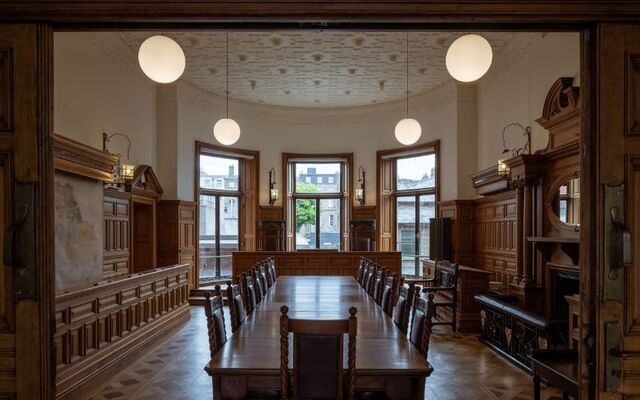
Inside No. 11 Parnell Square in Dublin. Ste Murray
Ireland’s President, Catherine Connolly, has officially opened No. 11 Parnell Square in Dublin, unveiling a newly restored cultural home for poetry, heritage, and public engagement in the heart of the city. The Georgian building, long steeped in Irish history, has been transformed through a €5.5 million conservation and restoration program that aims to secure its future while honoring its past.
The reopening marks a major milestone for Poetry Ireland and the Irish Heritage Trust, which now share the building with the Irish Landmark Trust. Backed by State support, philanthropy, and careful conservation work led by McCullough Mulvin Architects, the project has brought new life to one of Dublin’s most storied addresses.
Among the most significant additions is the Seamus Heaney Poetry Library, which will house the late poet’s private collection from his study, generously bequeathed by his family to Poetry Ireland. It will also include the Austin Clarke Poetry Collection and a broader contemporary poetry library gathered over the past five decades, creating a space intended for reading, study, inspiration, and connection.
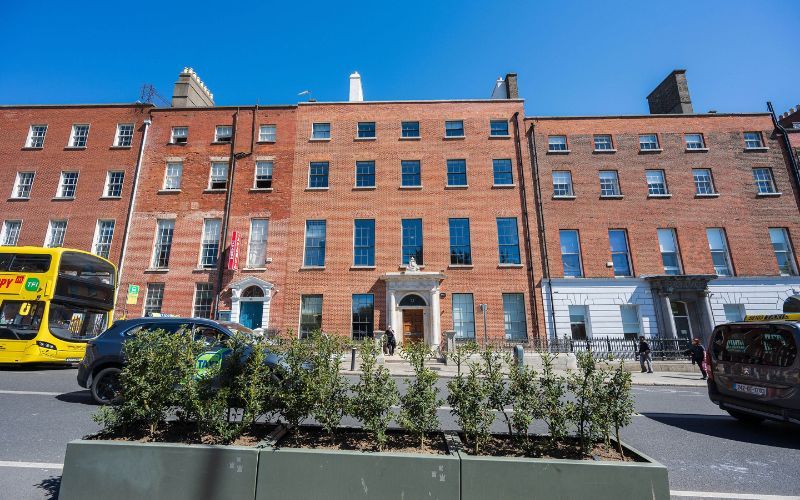
No. 11 Parnell Square in Dublin.
Speaking at the opening, President Connolly said, “It is an honour to officially open Number 11 Parnell Square as it becomes Ireland’s home for poetry and heritage.
As President of Ireland, I warmly welcome the new life which the Irish Heritage Trust and Poetry Ireland/Éigse Éireann will breathe into this beautifully restored Georgian building, one which already holds almost three centuries of history.
Arts and cultural organisations have so often in the past been marginalised and forced into peripheral and sometimes inaccessible spaces. I am particularly pleased that the newly restored building will over the decades to come be an inclusive space where local communities are welcomed, where stories are shared, and where our past and heritage are woven thoughtfully into the present and the future.”
The redevelopment was funded in large part through the Urban Regeneration and Development Fund under Project Ireland 2040, which contributed €3.9 million. An additional €1.55 million came from philanthropy and other sources. The work was completed within budget and included a full replacement of the roof, conservation of the Georgian façade, structural and safety upgrades, accessibility improvements, and energy efficiency measures that helped achieve an A3 Building Energy Rating.
James Browne TD, Minister for Housing, Local Government and Heritage, said the building sits at the center of Dublin’s Georgian core and described the project as a valuable addition to the city’s cultural and built heritage. “No. 11 Parnell Square East is at the heart of Dublin’s Georgian core, and I am proud that this redevelopment and refurbishment has been made possible through funding from my Department’s Urban Regeneration and Development Fund. This building’s conservation and the preservation of its architectural heritage represent a significant addition to the built and cultural heritage of this part of Dublin City. No 11 Parnell Square East has a storied past and through this renovation, it can now continue on with a renewed purpose. State support for this building through URDF funding is now also a part of its story, and I hope that No 11 Parnell Square East will serve as an exemplar to future projects under this scheme.”
Patrick O’Donovan TD, Minister for Culture, Communications and Sport, also welcomed the opening, calling the conservation of the building a meaningful investment in Ireland’s cultural infrastructure. He said the project would strengthen the cultural quarter around Parnell Square and praised the organizations behind it for their work on behalf of the public.
The Irish Heritage Trust said the restoration returns the property to the heart of Dublin’s north inner city and secures its long-term future. Its chair, Ger Aherne, said the organization was honored to serve as custodian of the building and thanked Fingal County Council for entrusting it with the site’s future.
For Poetry Ireland, the opening represents both a homecoming and a new beginning. John O’Donnell, chairperson of Poetry Ireland, said, “The opening of Ireland’s Home for Poetry and Heritage, No. 11 Parnell Square, marks a deeply significant moment for poetry in Ireland. This remarkable building, with its rich, layered past, is now transformed into a living, breathing home for poetry on this island. In partnership with the Irish Heritage Trust, we are proud to have shaped this space that brings poetry into the heart of civic life and will help us in our mission to connect poetry and people. With the establishment of The Seamus Heaney Poetry Library, we honour one of Ireland’s greatest poets, while creating a lasting resource for future generations of readers and writers.”
The building itself carries a layered past. Once leased by Richard Steele and later remodeled by John Butler MP, it became part of Dublin County Council’s civic history in the 20th century and was also the setting for James Joyce’s “Ivy Day in the Committee Room” in Dubliners. Its restored Council Chamber now holds archival maps and carefully conserved interiors, including parquet floors, ornate plasterwork, and period details that reflect the building’s changing life over more than 300 years.
Posted by Jim on
| Forty-five years sounds and seems like a lifetime ago. I suppose it was. In 1981, in West Belfast, I turned thirteen and was in my second year in secondary school (high school). A defining time in all our lives. I once read that the music you discover at that age stays with you. If that is true, then the 1981 Hunger Strike and its aftermath were the soundtrack to my teenage years. This week marks the forty-fifth anniversary of the death on Hunger Strike of Bobby Sands. I had attended the protests and the funerals. A black flag was hung outside our house, and posters in support of the prisoners were in our windows. This would be no surprise as Grandfather, Father and uncles had all been jailed for their Irish Republican beliefs. One uncle was still in jail and on the blanket protest. It was all very real, and urgent. I remember in later years asking my mother, herself a committed Irish Republican, how she managed with a husband who was an activist and two teenage sons. She confessed, “not very well.” That is why I am not nostalgic for those days. As you grow up and have a family, you reflect on the sacrifice of the Hunger Strikers who left behind wives and children, the weight carried by grieving mothers and fathers, and the lives they could have lived. But I do carry with great pride and awe those who faced down Margaret Thatcher and the British Government. Bobby Sands, brutalised, naked but for a blanket, denied sun and exercise for years, and yet would write that, “Our revenge will be the laughter of our children.” I am thankful for the opportunity to get to know and to work with those who led the prison protests—those who recognised that the opportunity to move from resistance to securing a united Ireland. So here we are, all of these years, a generation on from conflict, and desire for freedom and unity remains. A new generation is now driving our struggle. Thatcher is gone, her Tory party and her union lies in tatters. Unionism no longer enjoys a political majority in North of Ireland. Sinn Féin is now the largest political party across Ireland. The North of Ireland has irreversibly changed. In 1981, the Irish Government refused to support the Hunger Strikers and even allowed Kieran Doherty, who was elected as a member of their parliament, to die. Today, again, an Irish government led by Micheal Martin refuses to take the opportunity to do the right thing and promote the cause of Irish Unity. I remember with pride those days and I am thankful that we now have a peaceful and democratic pathway to Irish Unity. I greive that loss but understand that were we are today is a product of all that went before us. We have further to travel and work to do to grasp the opportunity to build a new and united Ireland, that echoes with the laughter of all our children. Have a great weekend. Is mise, Ciarán Ciarán Quinn is the Sinn Féin Representative to North America |
Posted by Jim on
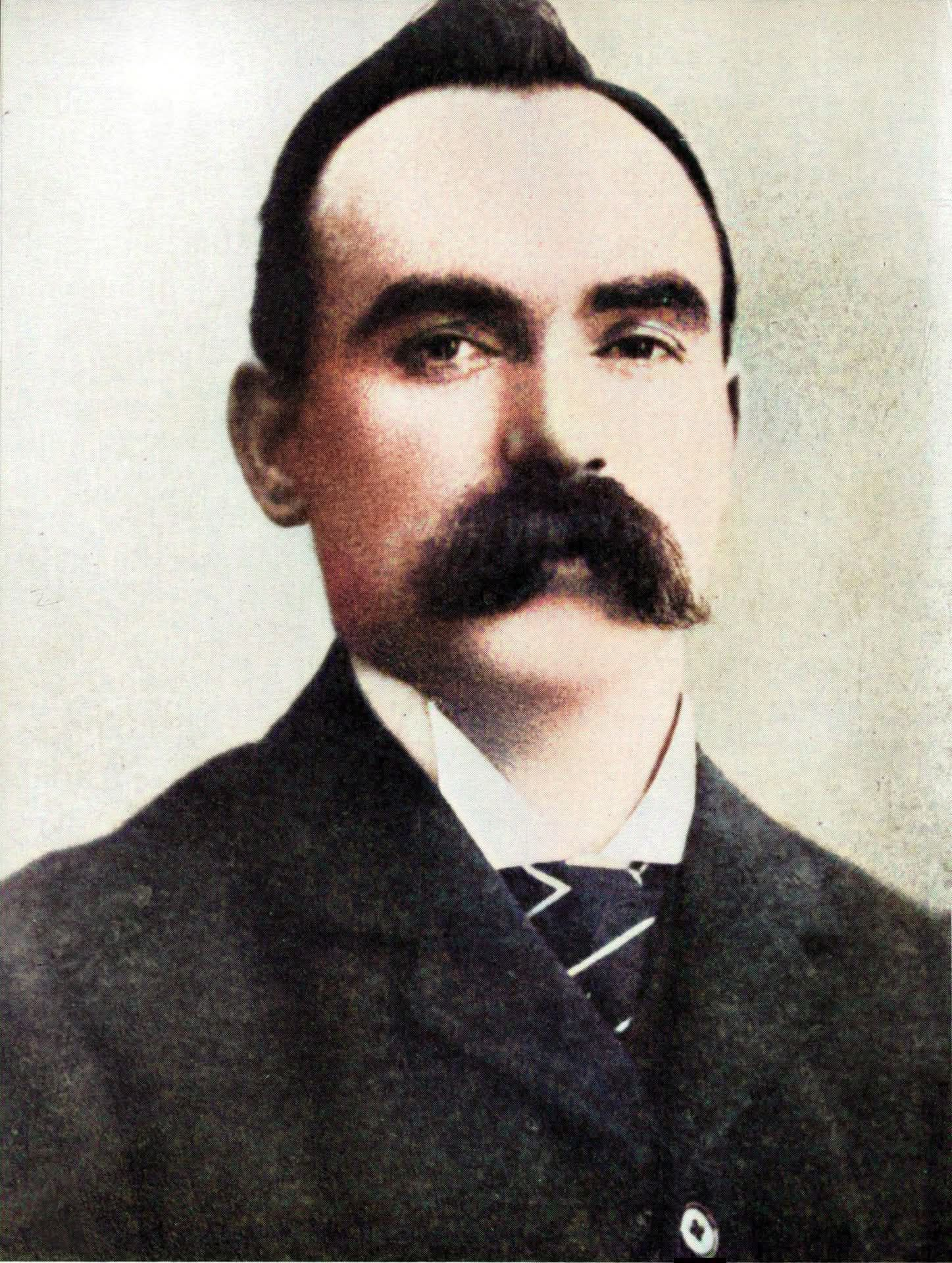
110 years ago today, James Connolly faced the firing squad of the British Empire with the same defiance and courage that had marked every step of his revolutionary life. Brutally wounded after the Easter Rising and unable to stand, Connolly was carried into the yard of Kilmainham Gaol and tied to a chair before British soldiers opened fire. Yet even in those final moments his spirit remained unbroken. Speaking to his wife Lillie before his execution, Connolly uttered words that have echoed through generations of Irish republicans ever since: “Wasn’t it a full life, Lillie, and isn’t this a good end?”
Connolly’s was a life wholly dedicated to the liberation of Ireland and the emancipation of the working class. He was no narrow nationalist. He understood that true freedom meant more than removing the Union Jack and the raising of the Tricolour. Connolly fought for a Workers’ Republic, an Ireland owned and controlled by the Irish people themselves, free from empire, capitalism and exploitation. As he famously declared, “The cause of Labour is the cause of Ireland, the cause of Ireland is the cause of Labour. They cannot be dissevered.”
The British executed Connolly believing they could crush the revolutionary spirit of Ireland through terror and bloodshed. Instead, they created one of the greatest martyrs in Irish history. His execution, carried out while he was strapped to a chair because his wounds were so severe, exposed the cruelty of British rule before the world and lit a fire in the hearts of countless Irish men and women determined to continue the struggle for national freedom.
Connolly warned that freedom without social justice would be no freedom at all,
“If you remove the English army tomorrow and hoist the green flag over Dublin Castle, unless you set about the organisation of the Socialist Republic your efforts would be in vain.”
More than a century later, his words remain a challenge to all who claim the republican tradition.
James Connolly died proudly for the Irish Republic proclaimed in 1916, but neither British bullets nor the passage of time could silence his ideals. His name, his courage and his revolutionary vision live on wherever Irish patriots continue the fight for a united, free and socialist Ireland.
Posted by Jim on May 11, 2026
Opinion
Constitutional change is firmly on the agenda in the UK and Ireland – The Irish News view

Sir Keir Starmer speaking to the media on Saturday
By The Irish News
May 11, 2026 at 6:00am BST
While many groups have worked strenuously but unsuccessfully for decades towards encouraging the final break-up of the United Kingdom through constitutional means, the latest set of British elections have brought them closer than ever to realising their aims.
It is hugely significant that the first ministers of not only Northern Ireland and Scotland but now almost definitely Wales as well are fully committed to independence, and have a mandate to push the debate forward during their present terms of office.
The era of two major parties, Labour and the Conservatives, dominating proceedings at Westminster also seems to be over, with the next British government likely to be an unusual coalition which may further undermine the unionist position.
Whether such an arrangement involves Nigel Farage remains to be seen, as, although his Reform UK group is relentlessly growing at present, much can change before the next British general election is due in 2029.
However, if Mr Farage does play a key role, unionists will undoubtedly recall his comment to The Irish Times in 2023 – “One day there will be a United Ireland. But it’s not on the horizon immediately.”
The DUP was previously prepared to put its full trust in another colourful English nationalist, Boris Johnson, before coming to bitterly regret the association, and can only regard the Reform UK leader with considerable suspicion.
It is also increasingly clear that the days of Keir Starmer, an instinctive unionist, as British prime minister are numbered, as he has stumbled from one crisis to another until his Labour Party performed pitifully across England, Scotland and Wales last week.
His successor may well have a much more open mind than Mr Starmer on independence issues, as do many Labour MPs, with a different phase emerging during the wider debate.
The level of nationalist support has traditionally been weaker in Wales than in Scotland, so the surge to power of Plaid Cymru, one hundred years after it was formed, deserves to be regarded as an historic moment.
Labour’s Welsh collapse has been dramatic, and all the evidence is that it will remain in disarray there for the foreseeable future, with Plaid having an outstanding opportunity to consolidate its grip on the Senedd.
The Scottish National Party has emerged from a prolonged period of upheaval to become stronger than ever, and is entitled to step up its efforts to secure a second and potentially decisive referendum on independence.
We are in a period when the old certainties are being swept away, and constitutional change has moved from a distant prospect to an increasingly viable option in Scotland, Wales and plainly Ireland.