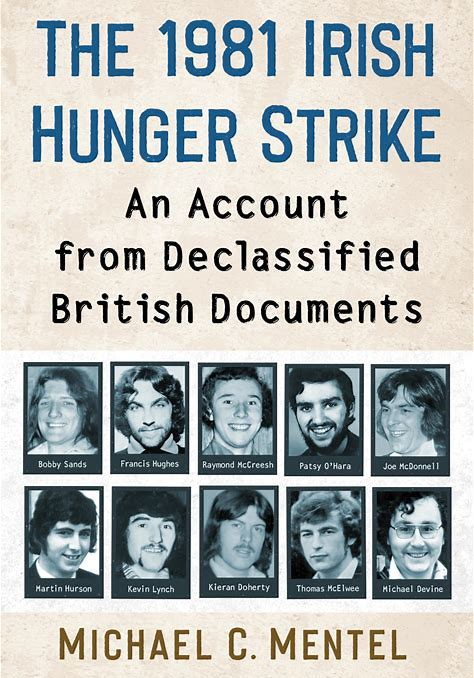
Memorial to 22 Irish Hunger Strikers Deaths Glasnevin Cemetery
Background
Raymond Peter McCreesh, the seventh in a family of eight children, was born in St Malachy’s Park, Camlough, on 25 February 1957.[6] He was born into a strong Irish republican family, and was active in the republican movement from the age of 16. McCreesh attended the local primary school in Camlough, St Malachy’s, and later attended St Colman’s College in Newry.[6] Raymond first joined Fianna Éireann, the IRA’s youth wing, in 1973, and later that year he progressed to join the Provisional IRA South Armagh Brigade.[6] McCreesh had worked for a short time as steelworker in a predominantly Protestant factory in Lisburn. However, as sectarian threats and violence escalated, he switched professions to work as a milk roundsman in his local area of South Armagh: an occupation which greatly increased his knowledge of the surrounding countryside, as well as enabling him to observe the movements of British Army patrols in the area.[6]
Arrest
On 25 June 1976, McCreesh (aged 19) and three other IRA volunteers attempted to ambush a British Army observation post (OP) in South Armagh.[6] It lay opposite the Mountain House Inn, on the Newry–Newtonhamilton Road.[6] As the armed, masked and uniformed IRA volunteers approached the OP, they were spotted by British paratroopers on a hillside. The paratroopers opened fire on the volunteers, who scattered. Two of them, McCreesh and Paddy Quinn, took cover in a nearby farmhouse. The paratroopers surrounded the house and fired a number of shots into the building.[6][7] After some time, McCreesh and Quinn surrendered and were taken to Bessbrook British Army base.[6] The third volunteer, Danny McGuinness, had taken cover in a disused quarry outhouse but was captured the next day.[6] The fourth member of the unit managed to escape despite being shot in the leg, arm and chest. Local Catholic priests facilitated their surrender.[6][8][9][10][11]
Imprisonment and hunger strike
On 2 March 1977, McCreesh and Quinn were sentenced to fourteen years in prison for the attempted murder of British soldiers, possession of a rifle and ammunition, and a further five years for IRA membership.[3][4] The rifle that McCreesh had in his possession when captured was one of those used in the Kingsmill massacre on 5 January 1976, when 10 Protestant civilians were shot dead.[12]
One of the soldiers who captured McCreesh, Lance Corporal David Jones, was later killed by Francis Hughes, who died during the same hunger strike.[6] Another Irish Republican Volunteer Patsy O’Hara died on the same day (21 May 1981) as McCreesh while on hunger strike in Maze Prison (Long Kesh).
Raymond McCreesh Park
A Newry playground was named after McCreesh after a motion led by Sinn Féin, SDLP and independent representatives on Newry and Mourne District Council was passed. Unionists were unhappy with this and appealed to the Equality Commission which called for an equality impact assessment in 2008. The council sub-committee responsible for the assessment decided that naming the park after McCreesh complies with their legal requirement to “promote equality of opportunity and good relations between persons of different religious belief and political opinion”.[14]
In 2013, it was announced that the decision to name the park after McCreesh would be formally investigated by the Equality Commission for Northern Ireland. It said its investigation would consider whether the council had failed to have due regard to the need to promote equality and good relations between people of different religious beliefs and political opinion.[12] Nothing came of the investigation.
Researching the Irish in the New Orleans, I discovered their huge role in the city’s history and culture, a role too large for one article — and that an article in two parts was required on the Crescent City Irish.
Like many American cities, the Big Easy has a massive St. Patrick’s Day, but its celebration incorporates many of the elements of Mardi Gras. The parade moves through the Irish Channel area and the Garden District, featuring marching bands, green clad participants and floats. Just like Mardi Gras, celebrants throw good luck souvenirs to the boisterous crowds lining the parade route including green beads, cabbages, carrots, and chocolate moon pies. The first St. Patrick’s Day parade in New Orleans dates way back to 1809, but the Irish presence there was even earlier.
The French, of course, settled New Orleans, but few people know that the city was once Spanish and governed by Irishman Alejandro O’Reilly, who served as the second Spanish governor of Louisiana from 1769 to 1770. One of the many Wild Geese who left Ireland to serve Catholics Monarchs on the continent, O’Reilly was born in 1722 in Baltrasna, Co. Meath. Known as “Bloody O’Reilly” for his violent punishment of rebels against the Spanish crown, he also reformed land ownership laws, built roads and levees and instituted a number of reforms. O’Reilly soon befriended one of the town’s richest merchants, another Irishman, Oliver Pollock, a native of Derry, whose warehouses supplied the Spanish garrison. Pollock profited from his friendship when O’Reilly named him as purchasing agent in New Orleans for the American rebels during the revolutionary war, a lucrative post that made Pollock even richer.
Under Napoleon, the city would revert back to French control, but in 1803, New Orleans became part of the United States when the Emperor sold it to the United States in the Louisiana Purchase. In 1813, the city’s Irish residents formed their own militia, the Republican Greens, who fought during the War of 1812 in one of their few victories when General Andrew Jackson, whose parents arrived in the U.S. from Carrickfergus, Co. Antrim, defeated the British army in the battle of New Orleans in 1815, making Jackson a hero and helping him get elected as America’s seventh president.
In the years before the Civil War, New Orleans grew wealthy as a transshipment point for the immensely profitable cotton crop, harvested by enslaved African Americans. Irishmen Daniel Clark, James Workman, and Kenneth Laverty became rich plantation owners and cotton traders. Tipperary man, Maunsell White, a veteran of the Battle of New Orleans, arrived in New Orleans as penniless teenager, but became a millionaire commodity trader and real estate investor who built himself a stately mansion on Julia Street and married into an elite French family, the Larondes.
The newly wealthy Irish did not forget their homeland. The Hibernian Society, the first Irish charitable and social club, was established four years later. In 1828, locals formed the Friends of Ireland and raised $1,500 to send to Daniel O’Connell, founder of the Catholic Association in Ireland, in support of his campaign for Catholic emancipation. By 1833, the Irish were wealthy and powerful enough to establish their own church, the beautiful St. Patrick’s, which still stands and is a national landmark.
Irish Americans from New York City, aware of the city’s wealthy port, arrived and quickly monopolized the waterfront as longshoremen and began the city’s first unions. In the 1850s, Irish steamboat workers staged a strike and shut down the port of New Orleans on several occasions, refusing to work or allow anyone else to cross the picket lines. Captains and cotton dealers were forced to negotiate with the strikers, and the strikers saw their higher wage demands met. The transplanted waterfront Irish Americans also left a fascinating linguistic legacy. The speech of New Orleans natives is much closer to Brooklynese speech than to the southern drawl thanks to these Yankee transplants. Natives still say “New Awlins,” work as “woik” and boil as “berl.”
Irish famine refugees, who began to arrive in the Crescent City in the late 1840s, found cheap passage to New Orleans on cotton ships returning from Liverpool. The Irish, though settled in a city, where housing was scarce and enslaved people did most skilled labor, making Irish labor unnecessary in a number of areas.
For many poor Irish immigrants, the only work open to them was dangerous work slave owners considered too risky for their valuable enslaved property. The Irish dug the city’s many canals, which went through dangerous, mosquito-infested malarial swamps. These poor Irish laborers settled in an area still called the Irish Channel, centered around Adele Street and stretching only two blocks from St. Thomas Street to Tchoupitoulas Street. The Irish poor lived in slums and were particularly susceptible to the epidemics that periodically swept the city. Many Irish labored on the New Basin Canal, a dangerous project that claimed thousands of lives. The first labor strike occurred in the 1830s, during the building of the New Basin Canal, when the Irish demanded and won better wages.
New Orleans was booming, though and many Irish workers pulled themselves and their families out of poverty. By 1850, the New Orleans census showed Irish males were represented in nearly every field—from medicine to education, to engineering. Increasingly becoming integrated into the city, New Orleans’s Irish community provided the largest number of recruits to the Confederate army when the Civil War erupted. The 6th Louisiana Infantry, “The Emeralds,” was Composed almost entirely of the city’s Irish dockworkers and fought heroically in major engagements including the First Battle of Manassas, Antietam, and Gettysburg. The famed Confederate “Louisiana Tigers” featured two Irish companies, “The Sarsfield Guards,” under Captain John O’Hara, and “The Southern Celts,” under chief of police, Stephen O’Leary.
By the start of the Civil War, the Irish had played a huge role in the development of New Orleans, but they would write more glorious chapters in the city’s later history.
Chaos in Westminster A letter from Ireland a Chara, Last week, in Britain, voters went to the polls, and the headlines have been dominated by questions about the future of British Prime Minister Keir Starmer after a disastrous set of results for his Labour Party.These were elections to local councils and to the devolved parliaments in Scotland and Wales.The parliaments in Scotland and Wales, like the Assembly in the North of Ireland, are not sovereign and only exercise powers within their jurisdictions that have been agreed by the Parliament at Westminster in London, which also holds the purse strings.In these elections, the British Labour Party lost a substantial number of council seats and, for the first time, lost control of the Senedd (Welsh Parliament) to the pro-independence party Plaid Cymru. The Scottish National Party consolidated its position as the largest party in its Parliament.Currently in the North of Ireland, Sinn Féin is the largest party, and the Government is led by its Vice President, Michelle O’Neill.The political map of Britain has changed, and the future of the “United Kingdom” is in doubt, as the governments in Northern Ireland, Wales, and Scotland are now firmly rooted in the concept of self-determination and independence.Neither Scotland nor Wales has a legal right to self-determination and are held in a “union” with no way out unless agreed by the predominantly English Parliament in London.The North of Ireland is different: under the Good Friday Agreement, we have both the right to self-determination and the mechanism, i.e., Unity Referendums. At any time, unity referendums can be triggered, and in a second caveat, they must be triggered when constitutional change is likely. On occasion, commentators have misread the provisions that a unity referendum can be called only when the governments believe change is likely.That is not the case, and in 2002, David Trimble, who negotiated the Agreement as leader of the Ulster Unionist party, called for a referendum to “consolidate the unionist vote.”It is important to clarify this position because the big election winners across England were Reform, the party of Nigel Farage, who led the Brexit campaign. Despite winning a significant number of seats in Scotland and Wales, Reform is at its heart an English Nationalist party.They have previously aligned with the extremes of Unionism in the North of Ireland and have little understanding of, and even less respect for, the Good Friday Agreement.It is entirely plausible that a future Farage government could spring a hasty unity referendum to try to consolidate unionist support and bin the Agreement’s provisions.A Reform Government is a real risk factor and yet the Irish Government refuses to plan or prepare for such a scenario.In 1962, Dean Acheson, the US Secretary of State, said that, ‘Great Britain had lost an Empire but not yet found a role.’ Today, we see that played out; Britain is no longer a global military, economic, or political player. Its empire is gone, its internal union is in tatters, and its politics are in freefall. There have been six British Prime Ministers since the 2016 Brexit referendum.Ireland cannot be spectators. Our national interest is served by planning, preparing, and advocating for unity. No part of our nation should be left to the chaos of Britain.Have a great weekend. Is mise,Ciarán Ciarán Quinn is the Sinn Féin Representative to North America
Memorial to 22 Irish Hunger Strikers Deaths Glasnevin Cemetery
Background
Raymond Peter McCreesh, the seventh in a family of eight children, was born in St Malachy’s Park, Camlough, on 25 February 1957.[6] He was born into a strong Irish republican family, and was active in the republican movement from the age of 16. McCreesh attended the local primary school in Camlough, St Malachy’s, and later attended St Colman’s College in Newry.[6] Raymond first joined Fianna Éireann, the IRA’s youth wing, in 1973, and later that year he progressed to join the Provisional IRA South Armagh Brigade.[6] McCreesh had worked for a short time as steelworker in a predominantly Protestant factory in Lisburn. However, as sectarian threats and violence escalated, he switched professions to work as a milk roundsman in his local area of South Armagh: an occupation which greatly increased his knowledge of the surrounding countryside, as well as enabling him to observe the movements of British Army patrols in the area.[6]
Arrest
On 25 June 1976, McCreesh (aged 19) and three other IRA volunteers attempted to ambush a British Army observation post (OP) in South Armagh.[6] It lay opposite the Mountain House Inn, on the Newry–Newtonhamilton Road.[6] As the armed, masked and uniformed IRA volunteers approached the OP, they were spotted by British paratroopers on a hillside. The paratroopers opened fire on the volunteers, who scattered. Two of them, McCreesh and Paddy Quinn, took cover in a nearby farmhouse. The paratroopers surrounded the house and fired a number of shots into the building.[6][7] After some time, McCreesh and Quinn surrendered and were taken to Bessbrook British Army base.[6] The third volunteer, Danny McGuinness, had taken cover in a disused quarry outhouse but was captured the next day.[6] The fourth member of the unit managed to escape despite being shot in the leg, arm and chest. Local Catholic priests facilitated their surrender.[6][8][9][10][11]
Imprisonment and hunger strike
On 2 March 1977, McCreesh and Quinn were sentenced to fourteen years in prison for the attempted murder of British soldiers, possession of a rifle and ammunition, and a further five years for IRA membership.[3][4] The rifle that McCreesh had in his possession when captured was one of those used in the Kingsmill massacre on 5 January 1976, when 10 Protestant civilians were shot dead.[12]
One of the soldiers who captured McCreesh, Lance Corporal David Jones, was later killed by Francis Hughes, who died during the same hunger strike.[6] Another Irish Republican Volunteer Patsy O’Hara died on the same day (21 May 1981) as McCreesh while on hunger strike in Maze Prison (Long Kesh).
Francis Hughes, born on 28 February 1956 in Bellaghy, County Londonderry, Northern Ireland, was a prominent Provisional IRA volunteer and one of the most wanted men in the region Wikipedia. He joined the IRA in the 1970s, initially with the Official IRA before moving to the Provisional IRA’s South Derry Brigade in 1973. Hughes was known for his guerrilla tactics, often moving up to 20 miles in a single night and carrying multiple weapons Wikipedia.
He became a fugitive after a gun battle on 16 March 1978 in which an undercover British soldier was killed. Hughes was seriously wounded and captured shortly after. He was sentenced to a total of 83 years’ imprisonment in February 1980 An Phoblacht.
On 12 May 1981, Hughes died after 59 days on hunger strike in HM Prison Maze (Long Kesh) An Phoblacht+1. His death came just seven days after Bobby Sands, marking the second fatality in the 1981 hunger strike campaign. Hughes’ sisters Noreen, Maria, Vera, and brother Roger were by his bedside when he passed away An Phoblacht.
His republican colleagues and political leaders, including Sinn Féin’s Gerry Adams, hailed him as one of the bravest soldiers of the armed struggle, while British authorities described him as “an absolute fanatic” An Phoblacht+1. His death was met with public mourning in Catholic areas of Northern Ireland, with protests and vigils marking the loss BBC News.
Hughes’ legacy endures in Bellaghy, where commemorations and memorials honor his life and sacrifice, and in the broader republican movement, where he is remembered for his courage and commitment to the cause