subscribe to the RSS Feed

Saturday, August 22, 2026

Martin Galvin’s Letter to the Irish News Editor published 12/16/13

Posted by Jim on December 17, 2013

EDITOR

IRISH NEWS

113-117 Donegal Street

Belfast, Northern Ireland

BTI 2GE                                        November 28, 2013

BELATED TRUTH ON MRF

 A chara

 Fergal Hallahan was more right than he imagines (25th November) about the derision accorded anyone with the temerity to accuse Britain of deploying a Military Reaction Force of plain-clothes British troopers who gunned down unarmed nationalists using non-military weapons.

During my years as both editor of the IRISH PEOPLE weekly American newspaper and National Director of Irish Northern Aid, I was tasked with presenting such facts to the American public and especially Congressmen.

The contention we Republicans repeatedly made was that the crown had sent out the MRF, and later wiped British fingerprints from their killings by shifting from the MRF to having the shots fired by loyalist proxies. This tactic had obvious advantages, including avoiding British Army casualties like those inflicted by the IRA at the Four Square Laundry. It allowed the British plausible deniability. Collusion in murders carried out by loyalists could be denied outright or blamed on a cadre of crown force bad apples, no matter how much targeting intelligence, agent control or safe passage the British had supplied.

Britain’s answer to these charges never changed. British officials would declare, self-righteously that “Her Majesty’s government” would never stoop to deploy such a unit. The British Army “yellow card” rules were sacrosanct, they scoffed, and this code was rigorously applied whenever British troopers opened fire. These sanctimonious British denials were believed by the public, politicians and journalists to the extent that this hand-picked death squad remained largely unknown to the public.

Panorama’s programme,”Britain’s Secret Terror Force” proves that Republicans were right about Britain’s deployment of a terror force, the MRF. It proves that those high-ranking British officials who denied that the crown would stoop to such tactics were either deliberately misled by the crown or deliberately misleading others on the crown’s behalf. Members of this British terror squad have no worries that they will face justice for killing unarmed Irish civilians like Daniel Rooney or Patrick McVeigh. They freely boast of their misdeeds, for the television cameras, confident that they enjoy a selective immunity and impunity, not granted Republicans like Gerry McGeough, Seamus Kearney or John Downey.

We Republicans were right about the MRF and just as right about Britain’s tactical shift from the MRF terror force to doing their ‘dirty war’ work through loyalist proxies. Must we await another Panorama documentary before people face the facts about Britain’s complicity with loyalist killers in collusion murders? Must we wait to see members of British forces who directed collusion murders congratulating themselves in televised interviews?

Slan,  MARTIN GALVIN

THE MURDER AND REPRESSION FORCE

Posted by Jim on November 25, 2013


A BBC Panorama documentary in which former plain-clothes British  soldiers admitted carrying out undercover gun attacks in nationalist  west Belfast has led to a public outcry and demands for an inquiry.    The details revealed in the broadcast have recalled traumatic and  appalling events which have always been refuted by the British  authorities.    Dozens of innocent civilians were injured or killed in attacks carried  out by the ‘Military Reaction Force’ (MRF), usually in machine-gun  blasts from an unmarked vehicle, and always the full sanction and  support of their British military bosses.    Reconstructions of events dating from 1971 onwards have hone a new light  on the actions of the secretive unit. The BBC’s John Ware interviewed  members of the MRF, who wore disguise but still spoke of their pride in  their murderous campaign.    The documentary recounted incidents when machine gun fire raked through  knots of people standing on street corners or heading home to the pub.  Others were chased through streets.    Those targeted were often standing in the vicinity of road barricades  erected by nationalist communities for their own safety 40 years ago.  All of the victims were forensically tested by the then RUC, but none  were found to have been in contact with firearms. No evidence was ever  presented that those who were shot were anything other than innocent  civilians.    It was argued in the broadcast that the unit was a prototype  counter-insurgency operation based on experiences in colonial conflicts,  and that military regulations or civil laws “did not apply”.    The unit included 40 hand-picked men from across the British Army who  always wore plain clothes.  When the men arrived at the specialised  enclosure in Palace Barracks, County Down, which still operates today,  the men dispensed with ranks, identification tags and surnames.    Some soldiers told the broadcaster they would drive by the barricades  and open fire, even if they did not see anybody brandishing a gun.    One said anyone standing in the vicinity of a barricade was potentially  an armed member of the IRA, and therefore a justifiable target. Another  said it was part of his mission to “draw out” the IRA in west Belfast.  “If they needed shooting they’d be shot,” he said.    Most admitted that they would shoot unarmed targets. One said: “We were  not there to act like an Army unit, we were there to act like a terror  group”.    MRF member Simon Cursey – not his real name – told a newspaper at the  weekend that originally they were told to shoot at anyone carrying a  weapon, but that the rules changed so that “groups manning barricades or  vigilantes patrolling late at night” were targets.    He admitted involvement in the attack in which father-of-six Patrick  McVeigh died. That attack, and another six weeks later, were both  carried out from an unmarked car using a privately-owned Thompson  submachine gun.     Key information was withheld from courts in the north of Ireland about   this unit’s activities, according to Panorama. Mr McVeigh’s daughter   Patricia said of the broadcast: “We want the truth. We don’t want to   stop until we get the truth.”    The MRF was ultimately replaced by the Force Research Unit, an equally  clandestine division of the British Army which operated in concert with  loyalist paramilitary death squads.    Sinn Fein leader Gerry Adams said the programme had shed light on one  aspect of Britain’s ‘Dirty War’ in Ireland, and said victims of the MRF  would be “disturbed” by the new information.    He called on the Dublin government to press the British to establish “a  truth recovery process that can provide support and closure for  survivors”.    “Sinn Fein has proposed that there be an international, independent  truth recovery process,” he said. “Others have different ideas and that  is fair enough, but we need to take this opportunity to move the process  forward in a way that looks after the victims but also builds the future  for the survivors.”

The Brooklyn Irish

Posted by Jim on November 15, 2013

Posted on November 4, 2013 by

Although Irishtown had been known as Brooklyn’s most recognizable, infamous waterfront neighborhood for Irish immigrants in the mid 1800s, it was the city’s long waterfront property that stretched both north and south of Irishtown that was heavily settled by the Famine Irish. In truth, Irishtown could only be seen as the capital amidst the long stretch of Brooklyn waterfront neighborhoods facing the East thp-merseyRiver and Manhattan.
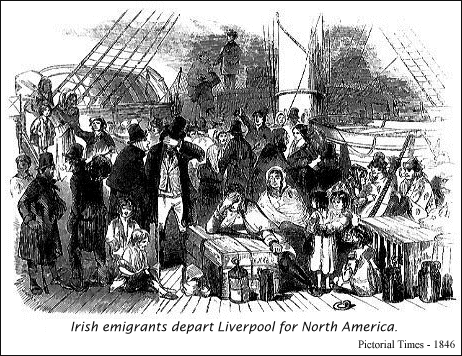
By the census year of 1855, the Irish already made up the largest foreign-born group in New York. This constituted a dramatic shift in the ethnic landscape of Brooklyn. In just ten years, the amount of Irish-born inhabitants had jumped from a minimal amount, to 56,753. Out of a total population in Brooklyn of 205,250, its newly arrived Irish-born inhabitants made up about 27.5%.

The impact of such a large amount of immigrants in a short period of time may be difficult to imagine, but it must be remembered that these newly-arrived were not only all from one ethnic background, but they were also terribly destitute, bony from intense starvation, malnourished, disease-ridden, uneducated and untrained people that came from an outdated medieval agrarian community. On top of all of this, at least half of them did not speak English and instead spoke Gaelic and were landing in a culture that was traditionally hostile to their form of religion: Catholicism.

digging for potato during famine

Famous sketch from the 1840s of an Irish mother digging with her children desperately to yield a crop in time to save their lives.

The Great Hunger in Ireland of 1845-1852, or what is commonly, if not erroneously called the “Potato Famine,” caused over 1.5 million (if not more) Irish tenant farmers to flee for lack of food.

“Few newcomers had the resources to go beyond New York and therefore stayed for negative reasons,” said Ronald H. Bayor and Thomas J. Meaghan in their book, The New York Irish. “Most… had no other options… The best capitalized Irish immigrants were those who did not linger in New York, but went elsewhere, making New York and other harbor cities somewhat atypical of the rest of Irish America.”

The waterfront neighborhoods of antebellum Brooklyn was such a place. These neighborhoods of mostly English Protestants and old Dutch aristocracy were quickly overwhelmed by these Catholic “invaders” crippled by diseases, starving and with a legacy of rebelliousness, secrecy, violence and faction fighting within their fiercely communal cooperations. In short, these great numbers of Brooklyn immigrants were in no way interested in assimilating into the incumbent Anglo-Protestant culture.

Since 1825 and the opening of the Erie Canal, Brooklyn had begun to boom as the New York Ports along the Hudson and East Rivers now had access to the great and rising cities in the midwest and beyond.
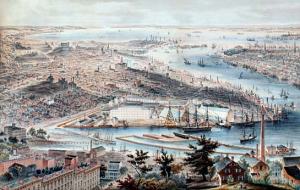
A color drawing from 1855 looking west toward Brooklyn's Navy Yard. Just beyond it in the area that looks shaded was "Irishtown." The New York Times described it in an 1866 editorial thusly, "Here homeless and vagabond children, ragged and dirty, wander about."

A color drawing from 1855 looking west toward Brooklyn’s Navy Yard. Just beyond it in the area that looks shaded was “Irishtown.” The New York Times described it in an 1866 editorial thusly, “Here homeless and vagabond children, ragged and dirty, wander about.”

Soon, New York become the busiest port city in the world. There was labor work to be had in Brooklyn, in the manufacturing and loading and unloading of goods to be sent around the country and around the world.

Brooklyn was broken down into wards at that time, and although much of the population lived along the waterfront, there were plenty of other neighborhoods inland that were heavily populated by the English and Dutch before the Great Hunger. But the newly arrived Irish immigrants did not go inland, they stayed along the waterfront where the labor and longshoremen jobs were.

One neighborhood in particular gained fame, though it is not as much known today as it was then:

Irishtown.

Fifth Ward

The Fifth Ward from an 1855 Fire Insurance Map, where Brooklyn’s Irishtown is located by the Navy Yard. It was called Vinegar Hill (from the 1798 rebellion in Ireland) even before the Great Hunger.

Located in the old Fifth Ward, Brooklyn’s Irishtown never gained the kind of infamous popularity that Manhattan’s Five Points garnered (as I previously wrote about in Code of Silence), it was nonetheless the center of the immigrant, working class slums and the brawling, closed-off culture of the wild Irish.

Located on one side next to Brooklyn’s Navy Yard that built ships and on the other side with the ferry companies connecting Brooklyn to Manhattan across the East River, Irishtown was centrally located.

Although Irishtown was the face of Brooklyn’s Irish community, it did not even have the distinction of having the most amount of Irish-born (which exclude American born of Irish stock) in it during the 1855 census. The dock and pier neighborhoods of Brooklyn were not just in the Fifth Ward, they were spread from the waterfront in Williamsburg north of Wallabout Bay all the way down to Red Hook and the Gowanus Canal.

During this time, there are three other wards that outnumber Irishtown in total Irish-born of the 1855 census. Cobble Hill, the Fulton Ferry Landing and southeast of the Navy Yard, north of Fort Greene Park. The brownstones of Brooklyn Heights are still considered mansions for the rich Brooklyn landowners at this time, but later will be divided and subdivided for the working class Irish.

The densest area of Irish-born is obviously from the Navy Yard, both  inland and on the water to the Fulton Ferry Landing, but surprising numbers existed in the north along the Williamsburg waterfront and south in Cobble Hill, Red Hook and the Gowanus Canal. In fact, 47.7% of the total population of Red Hook in 1855 is Irish-born.

  • *Census for the State of New York for 1855 (Ward#, area, Irish-born residents)
  • Ward 1 (Brooklyn Heights 2,227)
  • Ward 2 (now known as DUMBO 2,967) 
  • Ward 3 (East of Brooklyn Heights 1,964) 
  • Ward 4 (south of DUMBO 2,440) 
  • Ward 5 (Irishtown 5,629) 
  • Ward 6 (Fulton Ferry Landing 6,463) 
  • Ward 7 (Southeast of Navy Yard, north of Fort Greene Park 6,471) 
  • Ward 8 (Gowanus 1,717) 
  • Ward 10 (East of Cobble Hill 6,690) 
  • Ward 11 (West of Ft. Greene Park, south of Irishtown 4,985) 
  • Ward 12 (Red Hook 3,332) 
  • Ward 13 (East of Navy Yard where current Williamsburg Bridge is 2,036) 
  • Ward 14 (North of Williamsburg Bridge along waterfront 4,314) 
  • In these wards, Irish-born constituted 32% of Brooklyn’s total population

In fact it is Brooklyn’s most famous Irish-American toughs, the White Hand Gang that originated not in Irishtown, but in and around Warren Street in Cobble Hill and Red Hook at the beginning of the 20th Century.

So, it is right to assume that masses of Famine Irish landed and settled around the more famous neighborhood of Brooklyn’s Irishtown, but it is the general waterfront area from Williamsburg down to Gowanus, in the pier neighborhoods of the fastest growing port and industrial areas of the city where the majority of them settled. In fact, of the 56,753 Irish-born in Brooklyn in 1855, about 51,000 of them lived in the waterfront neighborhoods.

0002989

Long before Ellis Island took in immigrants, Southern Manhattan’s Battery Park did. After disembarking there, many Irish immigrants took the ferry to Brooklyn or moved from the slums of Manhattan to the Brooklyn waterfront for the jobs on the docks and piers there.

And they just kept coming, well after the famine ended. With connections in Brooklyn, Irish-born brought their extended families and friends to New York over the coming years, funding new passages to the city helping keep the Brooklyn working class Irish poor for many years to come.

By 1860, Brooklyn was the largest city in America with 279,122 residents, a large portion of which were either Irish-born or of Irish stock as it is still some years ahead of the considerable amounts of Jewish and Italian immigration to Brooklyn later in the century.

By the census of 1875, the population of Irish-born in Brooklyn jumps to 83,069. In 1880, the U.S. census, which counted both place of birth and parents’ birth place as well, estimated that one-third of all New Yorkers were of Irish parentage. By 1890 as Brooklyn neighborhoods were expanding east and south, the amount of people with Irish stock is at 196,372.

Analysis: The new criminalisation agenda

Posted by Jim on November 3, 2013

Sean Bresnahan warns that an attempt is being made to rewrite history,
with some victims of the conflict being targeted and discriminated
against, even in death.

What are we to make of the furore in Unionism surrounding the unveiling
of a plaque to Thomas Begley at the weekend in Ardoyne and what can it
tell us about the troublesome question that seems to have paralysed the
political process in the six-counties – what or who is a victim? Placed
against the backdrop of ‘Castlederg’ among other things, such as the
need to designate as living in Northern Ireland in order to get on the
electoral register, we can determine that much of this is the
outworkings of a cultural war designed to revise history and in doing so
legitimise the continuing, ongoing British partition and occupation of
Ireland.

For this to succeed then republicanism has to be labelled as the bad
guy, singularly intent on all manner of death and destruction, while the
state was merely an upholding agent of the law. The causes of conflict
that led to nearly 30 years of violent insurrection against that state
and its laws do not come into it and are to be minimised to the greatest
extent possible.

The IRA are to blame and this is to be the defining narrative, there can
be no equivocation between the Provo war and its resulting casualties
and that of the state and those who died or received injury at the hands
of the state. Thus commemorating dead IRA Volunteers is beyond what’s
socially acceptable while paying homage to the mass-murdering British
Army each November at the Cenotaph is something to be lauded and held in
an elevated esteem and as a source of pride. Those wretched Catholics
are still to be shown their place it seems in the supposedly all-new
‘bright and shiny Northern Ireland’.

Watching the Nolan show on Wednesday night past I have to admit to
feeling the calculated and sweeping bias that continues to infect
everything about this place in the way the programme was set up. It
wasn’t difficult to sense that the governing rationale behind this
so-called ‘debate’ on victimhood is to ensure the criminalisation of the
IRA and everything it stood and fought for. For the likes of not only
Nigel Dodds and many within his constituency but the British government
itself it seems the only true victims were those killed by the dastardly
Provisionals; everything else, from Ballymurphy to Bloody Sunday to
Malachy Boyle’s and Loughinisland, is secondary in the dubious context
that the IRA killed the most people during the conflict; as if that
somehow absolves the actions of the state and its paramilitary
off-shoots.


I don’t seek to detract here from the awful pain no doubt felt by those
who suffered as a result of the Shankill bombing, on which the programme
focused, but my wife and I wondered where were the survivors of Kennedy
Way, where was the in-depth coverage of these horrendous killings? The
short synopsis dedicated to the violence inflicted on the totally
innocent people of the sleepy Derry village of Greysteel, an attack some
hold to have involved the participation of a Special Branch informer,
smacked of an afterthought to avoid accusations of political bias. The
whole unseemly episode strikes me as indicative of a predetermined
agenda to separate the violence of Irish republicans from that of the
state and its agents through the construction of a hierarchy of victims.

Perhaps even more worrying is that Sinn Fein now appears to have at
least partially bought into this logic.

The decision to light up Belfast City Hall in the colour of the red
Poppy, the traditional emblem to remember not just those in Britain’s
armed forces who died in war but also those who served in those wars,
including those who participated in the most recent Irish troubles (such
as the SAS killers of Peter Cleary, Seamus McElwaine, Tony McBride,
Willy Price and many, many others), is surely yet another example of the
Sinn Fein leadership bending the knee and hoping for a few crumbs from
the master’s table. It seems they are required or obliged to continually
demonstrate their suitability for government, in the process further
legitimising British actions in Ireland and, importantly in terms of
attempts to create a hierarchy of victims and thus a monopoloy on the
legitimacy of the use of force, without a corresponding quid pro quo for
the actions of Irish republicans – sackcloth and ashes spring to mind.

John O’Dowd’s recent admission on the BBC that future republican
commemorations would have to be “looked at” in the context of the uproar
about Castlederg feeds further into this line of thought, a result no
doubt of the Tyrone Volunteers’ Day parade in that town provoking the
ire of Unionism. Indeed it was stated as one of the reasons for its
reneging on the redevelopment of the Long Kesh prison complex.

The reality is that both the British state and political Unionism are
intent on exploiting the dependence of Sinn Fein’s current strategy on
its need to be in government and its need to demonstrate continuing
electoral strength and relevance. They are under no political pressure
to provide any equivalence between the IRA’s campaign and that of the
British military and its paramilitary extensions and feel more than
comfortable in pushing the boundaries further and further, secure in the
knowledge that for Sinn Fein to attempt any sort of a walk-out at this
stage of the game spells lights out.

Because both the Brits and the Unionists are acutely aware that Sinn
Fein has lost the confidence of the republican community and now depend
on the middle classes to maintain their political position. Any return
to the radical street politics of old is simply a non-starter, despite
the ‘looking over the shoulder’ we now see in an attempt to claw back
the ground ceded to an emerging breed of republicans unwilling to
participate any further in this normalisation process. The bluff has
been called. It’s expected of Sinn Fein to cede the right of the British
side to honour its dead, indeed expectations are that not only should
this be tolerated but indeed actively facilitated. Meanwhile those on
our side are increasingly referred to as terrorists and criminals in a
type of language not heard in many years, though of course it has always
been there beneath the surface. It’s just that now they feel safe to
openly declare things so without jeopardising the continued
participation of republicans in the British political arrangements here.

But not everyone is prepared to sit back and allow this
counter-revolutionary narrative to embed itself to the point where it is
beyond challenge.

Hard as it may be for those directly affected to acknowledge, and
understandably so, neither Thomas Begley, Sean Kelly or indeed the
Provisional IRA itself intended the devastating, horrifying consequences
of the Shankill bombing. There will be those that argue there is no
excuse and can be no excuse but whether we like it or not we simply
can’t divorce this sad event in our history from the context in which it
took place – a 25 year terrorist war inflicted on the Irish people by
the British state in which men and women had little option but to defend
their communities from foreign aggression and attack.

Yes to an extent by the end of this terrible period in our history much
of the violence may have degenerated into a series of horrifying
incidents one after the other but that was certainly not the fault of
the IRA alone as they would have us believe. Indeed when it comes to
determining who was at fault for this the Provisionals are at the lower
end of the spectrum, ultimate blame lies with those who created and
sustained the conditions in which such barbarism flourished – the
British state and its occupation of the North. Had these conditions not
been there in the first place young men like Thomas Begley would not
have felt the need to join a paramilitary army and to undertake the
actions that they did.
This is the narrative that needs to be rubbed out as the battle over who
gets to write history is waged relentlessly by those on the British
side, with incidents such as the one in question to be manipulated and
exploited to maximum effect in pursuit of this agenda. The most recent
offering of the Nolan Show is no exception to this process.

At the finish of the thing it seems that both the British and Unionism
are more determined now than ever to use the advantageous strategic
position they have been gifted by the weakness of Sinn Fein and the
inadequacies of its political strategy to attain in times of peace what
they could never have achieved during the war – the criminalisation of
the indigenous resistance to Britain’s Irish policy.

Having secured for the Northern Ireland state a much greater degree of
legitimacy than would likely have been thought possible, by convincing
republicans to accept and normalise with the governing political

institutions and arrangements here, bound as they are within the
framework of the British sovereign claim once opposed by the armed
struggle of the Provisional IRA, all this has been made possible. The
current efforts to elevate victims of IRA actions to a morally superior
plateau than those who died at the hands of the British state and its
proxies are part and parcel of this renewed criminalisation offensive.

For Britain the war is not over and will not be so until republicans,
even if they do so only tacitly, acknowledge their total defeat and
subservience to the enemy. Achieving a disparity in legitimacy between
British state violence, which is to be seen as morally upright, and that
of those who resisted the British occupation, which is to be seen as
morally reprehensible, is the tool through which they hope to achieve
this long sought-after goal, in the process legitimising not only
British state terror but British rule and the British occupation itself.
They will not succeed.

Families face tense wait in Craigavon Two appeal

Posted by Jim on October 21, 2013


The Court of Appeal is to consider its judgement in the apparent
 miscarriage of justice for John Paul Wootton and Brendan McConville.
 
 PSNI policeman Stephen Carroll died in a Continuity IRA ambush in
 Craigavon in March 2009. Wootton and McConville were arrested amid a
 British ‘security’ backlash over his death and convicted by a special
 juryless court on the thinnest of grounds.
 
 McConville is serving at least a 25-year-sentence for the attack, while
 Wootton received a minimum 14-year term, but their cause has since been
 taken up by both Irish and international justice campaigners.
 
 Over the past two weeks, a devastating case has been presented to the
 Court of Appeal by the lawyers for Wootton and McConville calling for
 their convictions to be thrown out.
 
 A court heard on Thursday that the PSNI had deliberately subverted and
 manipulated earlier appeal proceedings and had been openly biased
 against the two men.
 
 Mr McConville’s barrister also argued that the weak case against him had
 been destroyed by an affidavit that a key prosecution witness, ‘Witness
 M’, was a compulsive liar.
 
 ABUSE OF PROCESS
 
 As the eight-day hearing drew to a close, the PSNI came under attack for
 arresting Witness M’s father after he supplied the affidavit, accusing
 his son of dishonesty.
 
 He was detained following a covert surveillance operation at his home
 before being released without charge.
 
 The PSNI suggested, without supporting their statement, that he had been
 coerced into testifying against his own son to favour the men’s appeal.
 
 Barry Macdonald QC, for McConville, said those claims had strengthened
 their concerns of an abuse of process.
 
 “Specifically his arrest, detention and interrogation represented a
 subversion of the appeal process,” he said.
 
 Dismissing the claim that the man had been abducted by gunmen, Mr
 Macdonald said the PSNI had blankly refused to consider the possibility
 that he supplied his affidavit voluntarily.
 
 “It’s not open to police to pre-empt appeals, no matter how important
 the case may be, by arresting a witness and then subjecting him to
 interrogation in police custody under threat that he’s liable to be
 charged with a serious criminal offence if he doesn’t withdraw his
 affidavit,” he said.
 
 “Their conduct clearly had a chilling effect both on (Witness M’s
 father) and on anyone else who might dare to come forward to give
 evidence which would not support the prosecution case.”
 
 According to Mr Macdonald, the father’s testimony “effectively destroys
 the evidence on which this entire prosecution hinged, the evidence of
 Witness M.”
 
 He said no attempt had been made to challenge core claims by the new
 witness that his son was “a dishonest fantasist who believed his own
 lies and was in many ways a pathetic character to be pitied rather than
 blamed”.
 
 MANIPULATION
 
 Scathing criticism was also directed at the PSNI for their failure to
 investigate the possibility that a note found in McConville’s remand
 cell in 2009 — with the car registration details of the Maghaberry
 Prison governor — had been planted by jail staff.
 
 When former prisoner ombudsman Pauline McCabe reached that conclusion,
 the PSNI blamed her for “clouding the waters” on the chances of
 successfully prosecuting McConville for the discovery, Mr Macdonald told
 the court.
 
 He said it reflected the PSNI’s attitude on the evidence in the murder
 inquiry.
 
 Urging the judges to quash the conviction, he concluded: “The net effect
 was that the police did manipulate this appeal in more ways than one.”
 
 The hearings were clearly upsetting and difficult for the families. The
 widow of the victim, Kate Carroll, was seen to comfort Brendan
 McConville’s mother after she became distressed during a hotly contested
 session on Wednesday evening.
 
 Following closing submissions Chief Justice Morgan said all material put
 before the court had to be considered before a verdict is reached. He
 said: “We will reserve our judgment but we will give it as soon as we
 can.”