Posted by Jim on November 1, 2015
A Thank You to All Signers of the Petition
Nov 1, 2015 — Dear Supporter of the Petition to Keep St. Patrick and Democracy in the NYC St. Patrick’s Day Parade
As you may be aware, the St. Patrick’s Day Inc. Board meeting for October 29th, in which changes to the bylaws were to be enacted that would fundamentally change the meaning of the NYC St. Patrick’s Day Parade, was canceled. This was because you and your fellow signers of the petition made clear that you want to keep the NYC St. Patrick’s Day Parade a celebration of our Patron Saint, our faith, our heritage and our patriotism. That the petition was able to garner over 4,000 signatures in less than a week shows the level of commitment the community has to this beloved institution. Your voice was loudly heard even behind the still closed doors of the St. Patrick’s Day Inc. boardroom. We sincerely thank you.
As important as this victory is, it is only a reprieve. We regret that Dr. Lahey and the Board still choose not to engage in dialogue with the Affiliated Organizations, but continue to engage in monologue through the media. Dr. Lahey bemoans “There is a lot of confusion and misinformation”. We agree, and for this sad state of affairs Dr. Lahey must shoulder the responsibility by holding meetings where representatives guaranteed by the By-Laws (a provision Dr. Lahey ironically cites to the press as an indication that Affiliated Organizations still have representation) are banned and meetings moved to new venues with no prior notice. The remedy for “confusion and misinformation” is transparency and two-way dialogue, an obvious solution that Dr. Lahey and the Board still choose not to embrace.
We expect that Dr. Lahey and the Board will now use parallel, on-going legal action as a reason for continuing to not engage the Affiliated Organizations directly. With nothing but past practice by Dr. Lahey and the Board to guide us, we anticipate that they may wait for public scrutiny to die down and then call a “lightning meeting” of the Board to pick up again the agenda of the canceled 10/29 meeting. We ask your continued support and please keep yourself aware of new developments by following our website http://www.changesaintpatricksnyc.com/ and friend our facebook page https://www.facebook.com/Change-Saint-Patricks-NYC-1621963641396942/?ref=hl .
Thank you again for taking the time to speak our to preserve and keep our faith and traditions alive.
Posted by Jim on October 29, 2015
Allison Morris. Irish News( Belfast). Thursday, October 29, 2015
The existence of collusion was for many years denied by those who sought to paint conflict here as a squalid little sectarian scrap when in reality differences between the two communities were always exploited by an unseen hand.
The vast scale of the investigation now being called for into murders either committed or ordered by the IRA agent known as Stakeknife has given context to just what lengths the state was willing to go to keep control of organisations it claimed to be fighting against.
While director of the Public Prosecution Service Barra McGrory refused to name the agent Stakeknife, he is said to be 69-year-old Freddie Scappaticci. Originally from the Markets area of Belfast and of Italian descent, the short, plump, middle aged man whose face is now so familiar â and who denies being Stakeknife â is an unlikely serial killer.
But sources put the number of killings allegedly carried out or ordered by Scappaticci at around 40, mainly members of his own community accused by the IRA of being informers.
He was the organisationâs head of internal security, a hunter of âtoutsâ[informers], feared as the man who gave either the thumbs up or down, an assassin with the power of life and death in his hands.
A look through the list of 23 initial victims expected to be investigated by police shows a pattern. Stakeknife was killing low level informants, what were known as £10 touts, in order to protect middle level informers while all the time he himself was the highest level agent on the books of British military intelligence. The jewel in the crown, the golden egg.
We know that any investigation into his activities would be a sham were it not to include the handlers and army officers who not only allowed him to kill with impunity but in many cases helped pinpoint targets.
Sacrificial lambs, singled out for murder when the IRA suspected a mole in the ranks. The individuals pinpointed were, it is now suspected, offered up in order to save more valuable assets.
Questions that now need answered centre around if these peopleâs lives could have been saved by the authorities.
What is the point of running agents if they are taking rather than saving lives? Whose agenda does it serve?
The former police ombudsman Nuala OâLoan exposed a murderous ring of informers at the centre of the Mount Vernon UVF headed up by agent Mark Haddock, currently in jail in England for trying to kill one of his former associates.
But in comparison to Stakeknife Haddock was a minion. His campaign of terror was centred on the sectarian murder of innocent Catholics or killing people who got in the way of his money-making drug empire. He headed up what was in effect an organised criminal gang. He was no threat to national security as such.
The IRA, at a time when they were flooring [destroying]parts of London, were of interest to Downing Street in a way the activities of loyalists would never have been.
The inference being that they not only controlled the activities of Stakeknife regarding internal matters within his own organisation but he also passed on information regarding IRA bomb attacks.
And yet as we know many of the attacks went ahead regardless, people were allowed to die and for what? And by whom?
In 2003 when Scappaticci was first outed as an agent there was a for a time an effort to contain, deny and manage the allegations by republicans and Sinn Féin at a high level.
Not because they believed them to be untrue but because the truth was just too damaging.
After all, collusion was between the British state and loyalist paramilitaries, right?
We now know that nothing could be further from the truth and that the hidden hand was playing both sides of the chess board while people were losing their lives needlessly in what were on occasions preventable incidents.
To what end and on whose orders?
Theyâre questions that should be answered by any future investigation into IRA collusion with the British state but will they be?
Will they heck, for the truth in the case of Stakeknife goes too high up the chain of power.
Posted by Jim on October 28, 2015
Friends: The late Senator Kennedy obviously played an important part in the Irish peace process albeit a limited and belated one. As a Kennedy acolyte I would expect Ms. Vargo to reinforce and embellish that role. I offer this letter not to diminish his contribution but to clarify its timing and his disinterest in earlier opportunities to ‘grasp the nettle.’
Mike
October 26, 2015
Letters Editor
IRISH ECHO
165 Madison Ave, Suite 302
New York, New York 10016
Dear Editor:
Ms. Trina Vargo’s commentary on the late Senator Kennedy’s role in the Irish peace process had an interesting spin. As the Senator’s aide, she depicted her role in that process and recorded her views for the Edward M. Kennedy Institute. His support of the 1998 pact as well as that of his sister, Ambassador Jean Kennedy was obviously helpful . He was, however, a latecomer, to serious peace efforts and usually limited his role to insufferable sanctimonious St. Patrick’s Day press releases.
What Senator Kennedy knew or wanted to know about the conflict was what the Department of State and the British government fed him. The British partitioned not only the geography of Ireland but the political thinking to achieve their purposes. Unfortunately that left out the voice and the grievances of a large segment of the Catholic Nationalist community. His Massachusetts constituents and Irish American leaders in 1988-1989 urged a role for the Senator in seeking a U. S. visa for Gerry Adams. Remember in 1988 Adams was then an elected Member of Parliament, a published author, the elected leader of the only party competing in all 32 counties, and had never been arrested or convicted of a crime!! He declined and refused to meet to discuss the issue with more informed leaders like Paul O’Dwyer. A lawsuit supported by Irish American leaders, journalists and civil rights advocates (the AOH, INA, IAUC, Niall O’Dowd, the ACLU) was rejected by the Court of Appeals (909 F. 2nd 643 (#89-903) in 1990 affirming Secretary of State Baker had the power to refuse Adams a visa and needn’t bother explaining or justifying his decision.
In failing to join or lend his voice to that visa appeal Kennedy contradicted all that he had stood for elsewhere in the U. S. and the world. Had the Senator made any effort to listen to the appeals of those interned or to the families of those murdered in Ballymurphy, to the victims of plastic bullets, or opened his eyes to the corruption of justice or read the documentation of the hundreds of Catholics murdered by UK collusion with loyalist death squads or joined that visa appeal, he could have changed the course of history and saved hundreds of lives. His subsequent stumbling through the peace process…like the refusal to meet Adams in 2005…simply exposed how the British were still dictating to him and his staff.
Contrary to Ms. Vargo’s assertion, history has NOT proven Kennedy correct on Northern Ireland but he did thankfully join the steam rolling peace process after dozens of more attentive Senators and Members of Congress from New York, Connecticut and Pennsylvania and President Clinton led the way.
Sincerely,
Michael J. Cummings
12 Marion Ave
Albany, New York 12203-1814
Posted by Jim on
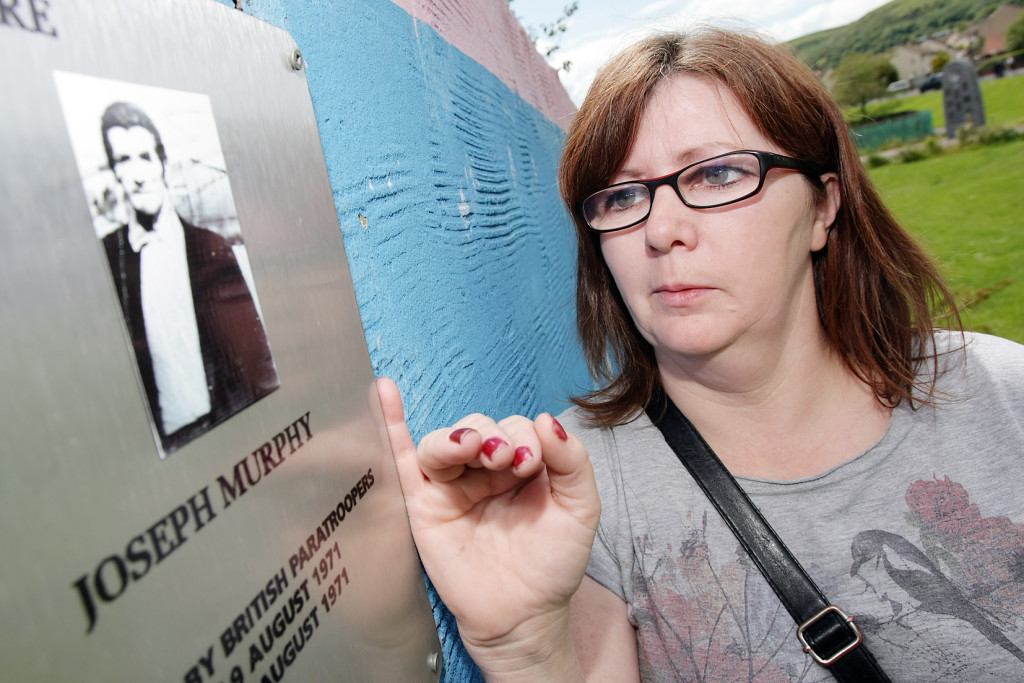
Janet Donnelly at the spot where her father, Joseph Murphy, was shot – she believes the family is getting closer to finding out the truth about his murder
By Staff Reporter
After yesterday’s sensational news that a bullet has been found lodged in the exhumed body of one of the victims of the Ballymurphy Massacre, the family of Joseph Murphy now face another wait for the forensic details of the newly-discovered round.
Relatives of the murdered father-of-12 took the decision to apply for yesterday’s exhumation on the back of their dying dad’s claim that he had been shot again by the British army while he lay wounded in the Henry Taggart base. That decision appears to have been vindicated by yesterday’s find, but it may be several weeks before the results of tests carried out on the bullet are made public.
Mr Murphy was shot once in the leg during the August 1971 rampage by the Parachute Regiment which claimed the lives of 11 people. He told his family before he died that he had been beaten by British soldiers and that a shot had been fired into the open wound in his leg.
Much rests on whether the bullet found in Mr Taggart’s body is a 7.62 standard NATO round from a British army-issue SLR rifle, or whether it is from a sidearm. Those killed by gunfire during the massacre were shot with the same rifles the same regiment used on Bloody Sunday, just six months later. It is possible – but unlikely – that a high-velocity SLR round lodged in Mr Murphy’s leg after he was shot on the street. The existence of a medical deposition referring to an entrance and exit wound in the victim’s leg also makes it unlikely that the bullet found yesterday was from an SLR. Should the bullet turn out to be a lower-calibre round from a handgun, that will have massive implications for the Ballymurphy families in their quest for justice.
This morning, Mr Murphy’s daughter, Janet Donnelly, told Daily Belfast she “cried tears of joy” when she was notified yesterday that a bullet had been found in her father’s body.
“The Ballymurphy families did everything we could to try and gather as much evidence as possible to build our case and the exhumation of my father’s body was the next step,” she said. “We did everything we could before we had to take this step. My father told my mother that when he was in the Henry Taggart he had been shot in the right thigh and beaten. Two years ago the Historical Enquiries Team found evidence to suggest a bullet hadn’t been removed and it was based on that that we decided to exhume his body. To find the bullet after all this time is massive for the Ballymurphy families and our case. What my daddy told my mummy was true after all these years. We have come a long way and the news on Tuesday just makes that point even clearer. Finding that evidence is brilliant for our case and I believe we are getting closer to finding out what happened.”
In March last year, Janet described to the Andersonstown News why the decision was made by her family to seek yesterday’s exhumation.
“We have information that only came to light in the past two years from a HET report that indicates there was a bullet left in daddy’s body.” she said. “A deposition – one that was never brought before a court – from a doctor who treated him said one bullet was left in daddy’s body but there was also an entrance and exit would from another bullet. My father always claimed that he had been taken to the Henry Taggart army base, was beaten and then shot into his open wound. Our only option now is to exhume the body and recover the evidence, the bullet.”
West Belfast MP Paul Maskey said the news was a significant step forward for the families.
“Joseph Murphy’s body was exhumed in the search for justice and it looks like a bullet has been found,” he said. “This is a significant step forward in the quest for justice for the Murphy and the other families of this massacre. The families have been campaigning for many years and hopefully the British government now do the honourable thing and grant them their inquiry. This is a very emotional time for the family but they have been very determined in their pursuit of truth and justice.”
Mark O’Connor, the family solicitor, said: “It is a great relief, it’s a day I think for the family of mixed emotions. It’s obviously a very solemn occasion, in the graveyard, it’s been a very difficult day for the family as well, but I think they’re happy that they’ve got the right result at the end of it.”
Posted by Jim on October 27, 2015
By Peter O’Rourke
In the autumn of 1920, at the height of the Tan War, republicans
imprisoned in camps and jails throughout the country intensified their
fight to be treated as prisoners of war.
By August, political status won by republican prisoners following the
death on hunger strike of Thomas Ashe in September 1917 and more
recently after the two-week-long mass hunger strike in Mountjoy Jail in
April 1920, which saw the release of many of those engaged in the fast,
was withdrawn by the British. From now on, republican prisoners were to
be treated as `criminals’.
On 11 August, a mass hunger strike began in Cork Jail when 60 IRA
Volunteers, most of them held without charge or trial, embarked on a
fast in support of their demand for political status and release. The
British government, whose attitude had hardened following the successful
hunger strike of the previous months, decided to risk the deaths of
prisoners rather than concede their demands.
During the weeks that followed, the British released or transferred many
of the hunger strikers until only eleven were left of the original 60.
On 12 August 1920, Terence MacSwiney, Lord Mayor of Cork, TD for
mid-Cork and O/C of the IRA No.1 Brigade and ten others were arrested
during a raid on the City Hall, Cork, and immediately joined the hunger
strike in Cork Jail, which had begun the previous day.
Those arrested with MacSwiney were released but on 16 August, he was
brought before a court-martial in Cork military barracks and charged
with possession of incriminating documents. MacSwiney was sentenced to
two years’ imprisonment but defiantly challenged the court: “I wish to
state that I will put a limit to the term of imprisonment you impose,
because of the action I will take. I have taken no food since Thursday,
therefore I will be free, alive or dead, in a month.”
He was deported that night to England and conveyed to Brixton Prison,
London, where his hunger strike continued.
During September and October 1920, as the hunger strikers in Cork Jail
deteriorated, crowds gathered daily outside the jail to pray and sing
hymns. World attention, however, was focused on MacSwiney’s lonely
struggle in Brixton Prison.
On Monday, 17 October 1920, having endured the agonies of hunger-strike
for 67 days, Michael Fitzgerald, one of the prisoners in Cork Jail,
died. The following Thursday, despite intimidation of mourners by
heavily armed British forces, thousands of people attended his funeral
in Fermoy.
The following Monday, 25 October, another of the Cork prisoners, Joseph
Murphy, died on his 76th day of hunger strike. His body, accompanied by
IRA Volunteers and members of Cumann na mBan, was brought through his
native Cork City and the following day he was buried in the Republican
Plot in St Finbarr’s Cemetery.
Several hours before Murphy’s death, MacSwiney, after 74 days on hunger
strike, died at 5.40am in Brixton Prison, London. His heroic struggle
had ended.
On Wednesday, 27 October, an inquest was held in the prison and that
night MacSwiney’s body was delivered to his relatives. The remains were
removed to Southwark Cathedral, where they were received by Archbishop
Mannix. Thousands filed past the coffin to pay their last respects. On
Thursday morning, thousands followed the cortege headed by IRA
Volunteers and members of Dail Eireann and Cork Corporation to Euston
Station, while thousands more lined the route.
The remains were taken by train to Hollyhead but the British government,
fearing the effects of MacSwiney’s body arriving in Dublin and
travelling down through the country to his native Cork, seized the body
and transferred it by sea directly to Cork.
Cork IRA Volunteers were out in force to meet the remains and
MacSwiney’s body was brought to the City Hall for a lying-in-state,
where thousands more filed past. On Sunday, 31 October, the funeral took
place to St Finbarr’s Cemetery, where MacSwiney was laid to rest in the
Republican Plot beside his friend and comrade Tomas Mac Curtain.
The hunger strike in Cork Jail continued for a further three weeks. At
the request of Arthur Griffith, acting President of the Irish Republic,
the remaining nine prisoners on hunger strike ended their fast on 12
November 1920.
Michael Fitzgerald, Joseph Murphy and Terence MacSwiney died on hunger
strike on 17 and 25 October 1920, respectively, 95 years ago.