Gerry Adams back in court as BBC libel case continues
Shane Phelan
Today at 09:38
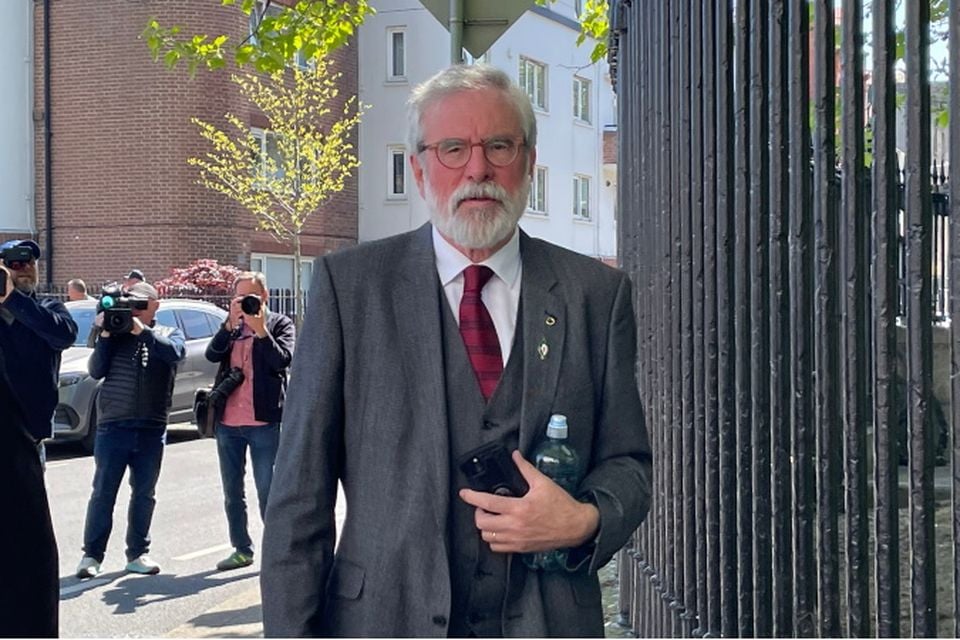
Former Sinn Féin leader Gerry Adams has denied under oath that he was the senior officer of the Provisional IRA released from internment as a precondition for talks with British officials about a ceasefire in the 1970s.
Mr Adams also told the High Court he had “no wish to speculate about who was or who wasn’t in charge of the IRA at any time”.
He made the comments during at times testy exchanges between him and former attorney general Paul Gallagher SC, who is representing the BBC.
Much of the questioning centred around Mr Adams’ alleged involvement in the IRA, something he has always denied.
Mr Adams accused Mr Gallagher of asking him to go on a fishing expedition as he was being cross examined on the fifth day of his defamation action against the BBC over a 2016 Spotlight programme.
The former Sinn Féin president claims he was defamed by the programme and a follow-up article on the BBC’s website.
Gerry Adams was continuing to give evidence in his defamation case against the BBC on Tuesday (Liam McBurney/PA)
Both contained claims by a man purported to have been former British spy within Sinn Féin and the IRA that Mr Adams sanctioned the murder of former party official Denis Donaldson.
Mr Donaldson, a former IRA man who went on to work as a Sinn Féin administrator in Stormont, was shot dead at a remote cottage in Glenties, Co Donegal in April 2006, four months after it was revealed he had been spying for police and MI5 since the 1980s.
Mr Adams has denied any knowledge or role in the killing.
The BBC denies defaming him and says the programme was put out in good faith and during the course of discussion on a subject of public and vital interest. It argues the broadcast and the subsequent online article were fair, reasonable and in the public interest.
During the second day of his cross-examination, Mr Adams was asked about talks with British officials in 1972, attended by him and senior IRA figure Daithí Ó Conaill.
Mr Gallagher put it to him that Philip Woodfield, the deputy under-secretary at the Northern Ireland Office, had believed he was dealing with representatives of the IRA at the meeting.
“That is a matter for him. I have made my position clear,” said Mr Adams.
“He was told myself and Daithí Ó Conaill were there in our capacity as Sinn Féin personnel.”
Mr Gallagher referred to a book, The Freedom Struggle, published by the IRA in the 1970s.
The book said that among the IRA’s preconditions for the 1972 meeting taking place was the immediate release of a senior officer of the IRA’s Belfast Brigade from internment.
“I suggest to you Mr Adams that is a reference to your release from internment for the purposes of the talks,” Mr Gallagher said.
Mr Adams replied: “Well it doesn’t say that. There may well have been a senior officer of the Belfast Brigade released at that time. It wasn’t me.”
Asked by Mr Gallagher who else the book might have been referring to if it wasn’t him, Mr Adams said: “I am not prepared to speculate about the status of IRA volunteers, senior or otherwise, released or otherwise.”
Mr Gallagher asked the question again.
“I am not asking you to speculate. I will ask you one final time. Do you know of any senior officer released from internment at that time for the purposes of those talks?” the barrister said.
“I have given you my answer,” Mr Adams responded.
“And is the answer ‘no’?” asked Mr Gallagher.
“Take me at my word. I am not prepared to speculate about membership of the IRA.”
Persevering in Hope with Easter’s light amid war, unrest and renewal.
Easter is a reminder to nurture the green shoots of reconciliation and peace, say the Archbishops of Armagh in a message for Holy Week and Easter
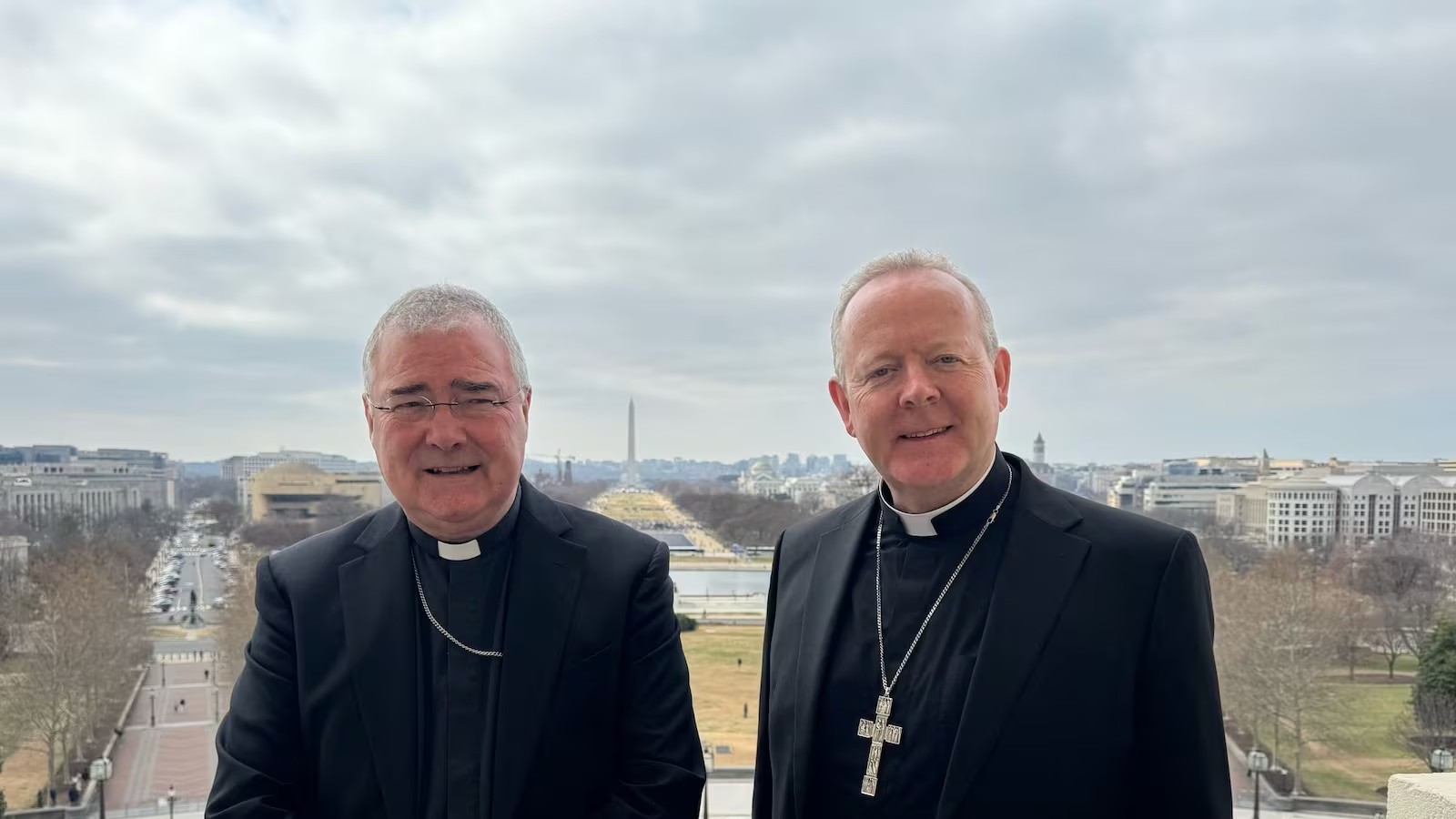
Archbishops of Armagh John McDowell (Church of Ireland), pictured left, and Eamon Martin (Catholic) in Washington DC for St Patrick’s Day
By Archbishop John McDowell and Archbishop Eamon Martin
April 17, 2025 at 6:00am BST.
In his gospel account of the resurrection, the evangelist St Luke tells us it was very early in the morning “at the first sign of dawn” when the women discovered that the stone had been rolled way from the tomb of Jesus.
Although they had left home in darkness and grief, by sunrise the women were witnessing with joy to the resurrection, and sharing the Good News, “Christòs anésti, Christ is risen!”
The recent warm spell has brought out the best in springtime and helped to raise our spirits in time for Easter. To see the trees bursting into life and the green shoots of spring flowers everywhere lifts our hearts, and reminds us of the promise and hope of new life after the dark sleep of winter.
Of course, even in the midst of spring, it is difficult to escape the reality that the world is currently experiencing a high level of instability and uncertainty. The darkness of war and violence continues to rage; countless families are displaced, and lasting peace seems elusive as more and more countries divert resources from welfare to warfare.
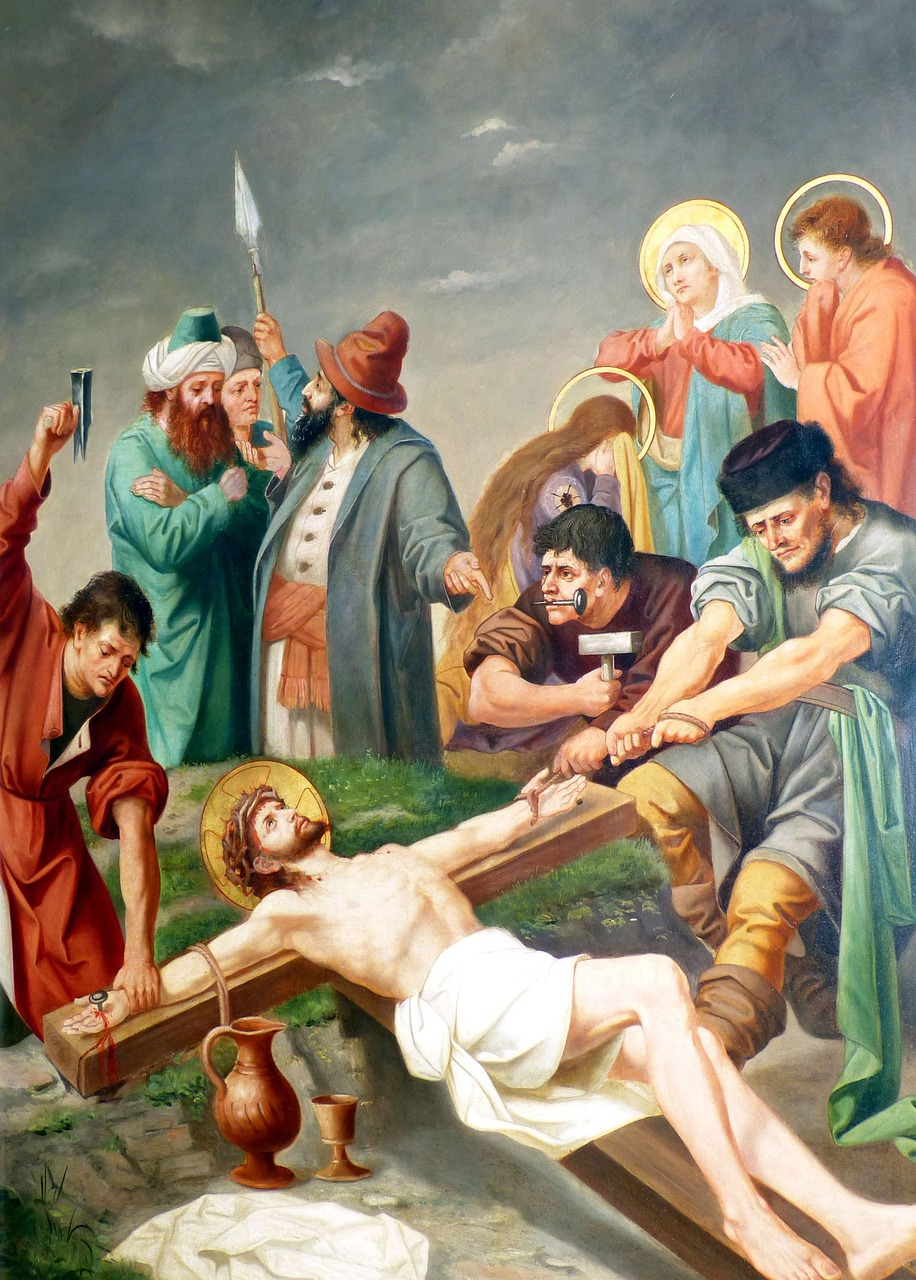
The journey to Calvary is a path that people everywhere are walking this Holy Week. However the knowledge that Jesus Christ walked that path before us, and continues to walk that path today, is central to the message of Holy Week and Easter. Whatever cross we carry, we do so with the strength of God upholding us; with Jesus by our side, we can truly overcome even the heaviest cross, the darkest situation.
During our recent St Patrick’s Day visits to the United States, we were honoured to speak together at a ‘Faith and Law’ event for Congress members and staff on Capitol Hill in Washington. We were asked to reflect on the impact of faith on the peace process here in the years that have followed the Belfast/Good Friday Agreement.
This opportunity allowed us to emphasise once again the importance of not giving up on hope, and of maintaining a strong Christian voice in the public square. We stressed the need to persevere along the road to deeper friendship, respect, tolerance and dialogue. Perhaps strangely, we were heartened by the fact that so many of the young adults we met on Capitol Hill had little knowledge of our Troubles; it reminded us both of how far our communities have come in terms of moving away from the darkness of violence, death and destruction.
The ongoing process towards a true and lasting peace here is offering renewed hope to our young people, many of whom have no recollection of the darkness of the past. Still, the work of peace-building is unfinished and there remains much to do.
Inspired by Easter Hope, St Paul once wrote to the Romans: “Our sufferings bring patience, as we know, and patience brings perseverance, and perseverance brings hope. And this hope does not disappoint, because the love of God has been poured into our hearts through the Holy Spirit who has been given to us” (Romans 5:3-5).
As Easter people, both here on the island of Ireland and around the world, we must continue to welcome the ‘dawn moments’, and nurture the green shoots of reconciliation and peace.
This year Christians everywhere are marking the 1,700th anniversary of the Council of Nicaea. Despite long-lasting tensions and divisions at that time between Christians of different traditions, the Council was able to find agreement on a common ‘Creed’, or statement of belief. They chose to begin that Creed by using for the first time the expression “We believe”, as a sign that all the Churches had found communion.
The anniversary of Nicaea is a reminder to all of us to persevere with Hope along the path to greater understanding and reconciliation. Interestingly, the Council of Nicaea also discussed the date of Easter – an issue that has sadly continued to prevent Christians in the West and in the East from celebrating Christ’s resurrection on the same day. But coincidentally, or perhaps providentially, this year Easter falls on a common date – April 20 – from East to West.
Persevering in Hope, in 2025 we can all truly acclaim together, “Christòs anésti, Christ is risen!”
The Most Revd John McDowell is the Church of Ireland Archbishop of Armagh and Primate of All Ireland; the Most Revd Eamon Martin is the Roman Catholic Archbishop of Armagh and Primate of All Ireland.
What are your 30 pieces of silver? Judas and the price of betrayal
What are your 30 pieces of silver? Judas and the price of betrayal
The tragic tale of Judas Iscariot and the good news of Easter
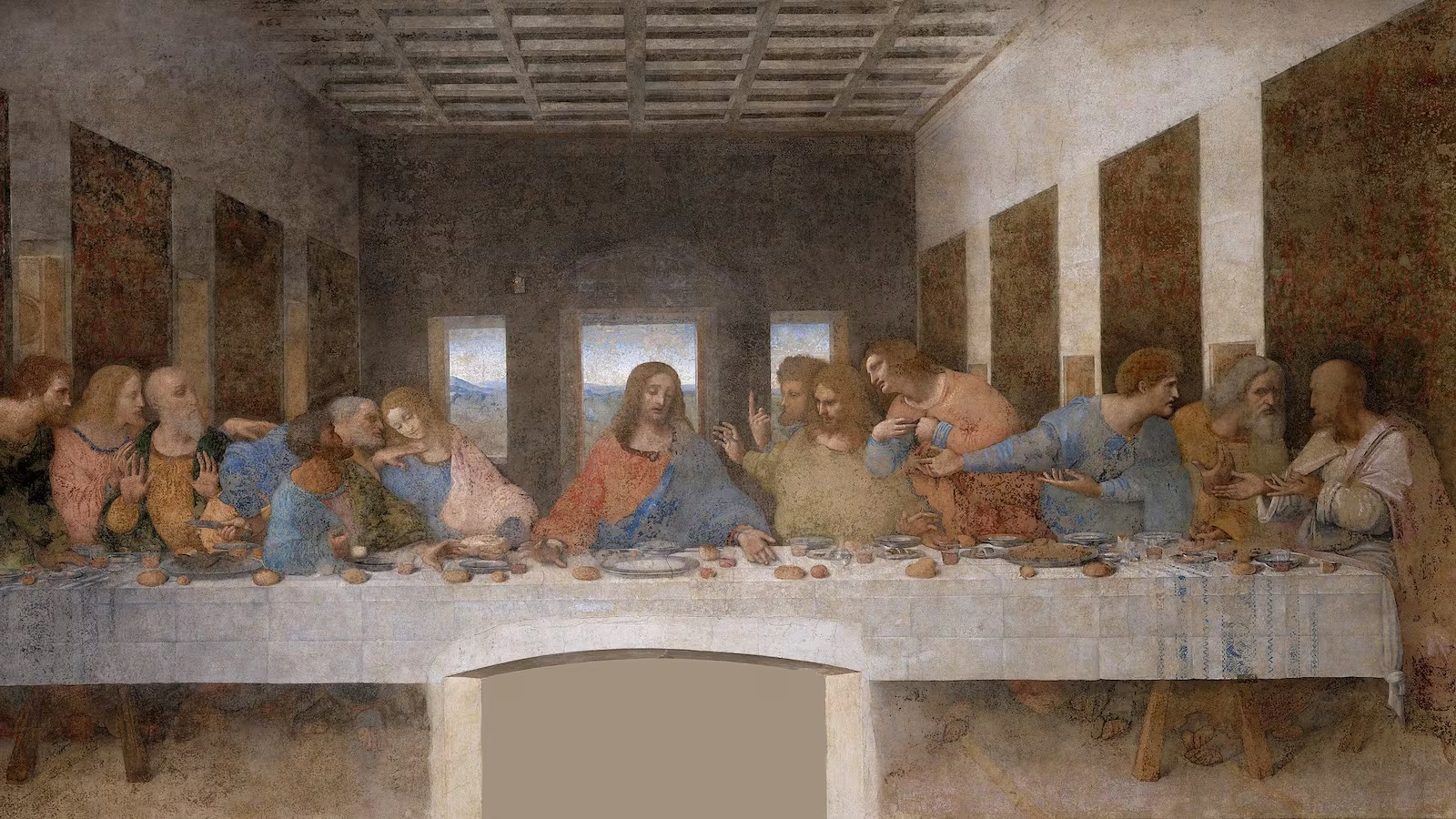
The Last Supper by Leonardo da Vinci depicts Judas Iscariot with a small bag, perhaps to hold the 30 pieces of silver he was paid to betray Jesus…
By Rev Andrew Watson
April 17, 2025 at 6:00am BST
One of the most tragic details of the Easter story is about a man called Judas Iscariot. His name is synonymous worldwide with treachery.
It’s tragic because in earlier days in Galilee Judas had gone out with the other disciples, proclaiming the Gospel, healing the sick and even driving out demons in Jesus’ name. He had actively participated in the kingdom of God.
But Judas had a conflict of interest. He liked money. Perhaps he thought that friendship with the Messiah was a means to financial gain.
As Jesus gained more enemies within the establishment did Judas become disillusioned? Dreams of worldly prestige seemed to be fading so he decided to cut his losses and famously betrayed his master for 30 pieces of silver.
I’m reminded of a scene in the movie Braveheart where the king bribes Scottish lords to withdraw support for William Wallace with promises of titles and land. I wonder could we be turned if offered something sufficiently enticing? What would be our own 30 pieces of silver?
Remarkably, Jesus didn’t appear angry with Judas, just deeply saddened. Knowing everything, the Lord still knelt and washed Judas’s feet with the rest of them and when asked to identify the betrayer Jesus did so by offering Judas a piece of bread.
Christ shared His bread in a final gesture of friendship and grace as if to say, “Satan may be tempting you to do something dishonourable but you don’t have to do it. You could still choose a better way.”
Dreams of worldly prestige seemed to be fading so Judas decided to cut his losses and famously betrayed his master for 30 pieces of silver
Judas made his choice and suffered for it.
But the Easter story is not all bad, far from it.
Even as Judas turned to the dark side others were turning to the light.
Like the Roman centurion who witnessed up close Jesus’ suffering and death. This man heard Christ forgive His executioners and die, not with a gasp of defeat but with a shout of triumph, and concluded: “This man really was the Son of God.”
Or what about Nicodemus who had previously arranged to meet Jesus secretly by night? Now he’s coming out of the shadows to go bravely with Joseph of Arimathea to seek permission to give Jesus a decent burial.
Then there was the dying criminal on the neighbouring cross who, with what little time he had left, acknowledged his sin and found assurance of mercy.
As this intense drama unfolds we might well, like Pontius Pilate, be left asking: “What shall I do then with Jesus who is called Christ?”
Pilate’s decision would determine what happened to Jesus in the next few hours.
Our response to the question will determine what happens to us for eternity.
The most difficult aspect of that experience, however, 90 miles north of the Twin Cities, was the feeling of being cut off from his parents and his sister and her family.
The New York-born seminarian — who’d joined the Society of Jesus in 1963 in Detroit, where his family had relocated in the late 1950s — called his parents from Cook County Jail in 1969. He was one of the Chicago 15, who on May 25 of that year had removed draft-board files from offices on the South Side and destroyed them. The protesters against the Vietnam War waited for the police to arrive and then surrendered.
After a month-long trial in 1970, he was sentenced to five years in prison and with another five years probation. He was released on parole in 1972.
Mulligan, who has recently published an eBook, “Luke: Intro to his Gospel and to Jesus’s Call to do Justice” (for a free copy, see below), was ordained a priest in 1973.
Joseph E. Mulligan S.J. speaking via Zoom to students at the University of Detroit Mercy in November 2023. See a link to it below.
Writes Bill O’Brien in an introduction to the eBook, “For 60 years as a Jesuit, he has lived the Gospel that calls us to struggle for justice, to welcome the stranger, to build and sustain community, to prioritize those who are marginalized and impoverished, to hope for and work for the coming of the Kingdom of God among the people. The Jesuits are very blessed indeed.”
Mulligan writes about “modern-day disciples” in his book and the Detroit resident O’Brien, the executive director of Strangers No Longer, was among those friends who encouraged him to have elements of his own biography in the telling, which includes the last 39 years “living and working in small Christian communities and among the disabled in Nicaragua.”
The author released the eBook initially as three volumes and in his introduction to the third, he wrote, it “will go from ‘Jesus’s Triumphal Entry into Jerusalem’ at Luke 19:28 to the end of this Gospel; then we will take a look at the early chapters of Acts of the Apostles, which is really the second volume of Luke’s literary work.
“Then, after looking at the Last Judgment passage in the Gospel of Matthew (25:31-46), we will meet some modern-day disciples who put what we have said in this book into practice.
“In the final section (‘Wrapping Up’), I will offer some reflections by me and others on important issues which come up in our study of Luke.”
Mulligan says, “It does not presume any acquaintance with the bible or theology. It’s especially useful for parish or community study groups or for theology teachers as an introduction to theology and to Scripture.”
“I could imagine doing a retreat, using Joe’s book as a guide to deepening my relationship to the historical Jesus,” writes O’Brien, who is married to Vicky Kovari and has two grown children. “Joe’s book is a spiritual guide, a look at his life and the lives of many others who are touched by Luke’s story of Jesus and develop their own relationship with the Lord.”
Mulligan has written: “As my own growth in understanding of the human Jesus has brought me to a deeper love for him and a more serious commitment to try to follow him, I hope that my reflections may help readers too to enjoy a more personal friendship with the Lord, to grow in their commitment to serve him in the poor and the outcast, and to struggle with him for a more just world.”
The Jesuit said, “I dabble also in making political/social and biblical videos, most in English, some in Spanish. My channel is youtube.com/josephmulligan1.
“Check out Bob O’Brien [brother of Bill] singing my new version of ‘How Great Thou Art,’ with one stanza axed for theological reasons and four more added by me.
“Speaking of films,” he said, “I declare that ‘Cabrini’ [the critically acclaimed movie released in 2024] is the best picture of all time and the one that inspired me the most.”
Mulligan added, “According to its maker, Angel Studios, ‘it is based on the rich, inspiring true story of Francesca Xavier Cabrini, the first American saint. The film represents the very real events of Cabrini’s life, her mission, and her service among the Italian immigrants of New York City.’”
The New York-born Jesuit himself has written, “I have always kept one foot and part of my mind and heart in the U.S., spending a month or two each year with relatives and friends, giving talks, raising funds, and otherwise keeping in touch with the reality of my homeland.”
Joseph E. Mulligan S.J.
Date of birth: June 20, 1943
Place of birth: Astoria, New York City (Our Lady of Mt. Carmel parish – the great class of 1957!)
Spouse: Jesus, I like to think.
Residence: Managua, Nicaragua
Published works: “The Nicaraguan Church and the Revolution,” 1991; “The Jesuit Martyrs of El Salvador: Celebrating the Anniversaries” (Catholic Worker Reprint), 2010; “Luke: Intro to his Gospel and to Jesus’s Call to do Justice.”
What is your writing routine? Are there ideal conditions?
I like to have a chunk of time of two-three hours. If I can keep at it regularly for some period of time, the words and ideas come more readily.
What advice do you have for aspiring writers?
Be a social prophet, motivating people to organize for social and political change.
Name three books that are memorable in terms of your reading pleasure.
Gospel of Luke; “Spiritual Exercises of St. Ignatius” (purpose of meditating on the gospels: I will “ask for an intimate knowledge of our Lord, who has become man for me, that I may love Him more and follow Him more closely”); “Hymn of the Universe,” by Pierre Teilhard de Chardin, SJ; “Beyond Vietnam: A Time to Break Silence,” 1967, and “Letter from a Birmingham Jail,” 1963, by Dr. Martin Luther King, Jr.
What book are you currently reading?
Gospel of Mark.
If you could meet one author, living or dead, who would it be?
Luke the Evangelist; Gandhi.
What book changed your life?
Documents of the Second Vatican Council (1962-65) – Pastoral Constitution on the Church in the Modern World “Gaudium et Spes.” See here. I entered the novitiate in 1963 in the midst of the Second Vatican Council, a movement of the Spirit which renewed the Church and opened it to the world. This Pastoral Constitution called for active involvement of Christians in the service of the needy and in transformation of the world. Also, “The Long Loneliness,” autobiography of Dorothy Day.
What is your favorite spot in Ireland?
Kilmihil, Co. Clare, where my maternal grandparents. John Lillis and Jane Melican, were born; my third cousins treated me royally (whoops!) on my visit; Kilmainham Gaol Museum, Dublin.
You’re Irish if… you remember the centuries of oppression of Ireland and continue the struggle against all forms of oppression today in whatever land — with a song in your heart, in the lilt of laughter, for a cause you proudly cherish, and with your spirits never down.