Memorial to 22 Irish Hunger Strikers Deaths Glasnevin Cemetery
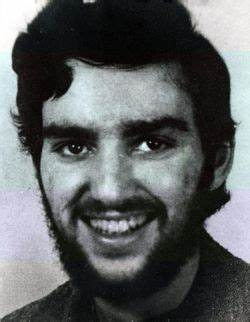
O’Hara was born in Bishop Street, Derry, Northern Ireland. He joined Official IRA-aligned faction of Na Fianna Éireann in 1970, and in 1971, one of his brothers Sean was interned in Long Kesh.[1] In early 1971 he joined the local Official Sinn Féin cumann in the Bogside.[3] In late 1971, at the age of 14, he was shot and wounded by a soldier while manning a barricade.[1][4] Due to his injuries, he was unable to attend the civil rights march on Bloody Sunday but watched it go by him in the Brandywell, and the events of the day had a lasting effect on him.[1]
In October 1974, O’Hara was interned in Long Kesh, and on his release in April 1975 he joined the Irish Republican Socialist Party (IRSP) and INLA.[4] He was arrested in Derry in June 1975 and held on remand for six months.[1] In September 1976, he was arrested again and once more held on remand for four months.[4]
On 10 May 1978, he was arrested on O’Connell Street, Dublin, Republic of Ireland under section 30 of the Offences Against the State Act, and was released 18 hours later.[4] He returned to Derry in January 1979 and was active in the INLA. On 14 May 1979, he was arrested and was convicted of possessing a hand grenade. He was sentenced to eight years in prison in January 1980.[4]
On Thursday, 21 May, at 11:29 pm, he died after 61 days on hunger strike, at the age of 23.[3][7] Despite a plea from his mother two days before his death, O’Hara expressed his desire not to receive the medical intervention needed to save his life.[7] His corpse was found to be mysteriously disfigured prior to its departure from prison and before the funeral, including signs of his face being beaten, a broken nose, and cigarette burns on his body.[3][5]Raymond McCreesh, a member of the Provisional IRA, also died on 21 May 1981 during the hunger strike.[3] Following his death, INLA member Kevin Lynch took his place on the hunger strike.[7]
O’Hara’s brother, Anthony O’Hara, was also a prisoner in Long Kesh[12] and stood as a candidate during the 1981 general election for the Dublin West constituency. He received 3,034 votes (6.49% of the vote) but failed to take a seat.[13][14]
His sister, Elizabeth O’Hara, took part in a tour in the United States by NORAID. Some in NORAID objected to O’Hara’s involvement stating her brother was a “communist” and that it would tarnish their image among Irish-Americans at the time. However, Malachy McCreesh and Seán Sand, relatives of other hunger strikers, refused to participate unless O’Hara was allowed to accompany them.[15][16] A meeting of the IRSP Ard-Chomhairle following the tour revealed that all the money collected was distributed to Provisional prisoners families, with none going to INLA prisoners families.[15] O’Hara also allowed filmmaker Mickey Rourke to use the story of her brother in a film to help NORAID, however Denis Donaldson disrupted this effort and ultimately the film ceased development.[17] She later married Kevin Kelly and became a multi-millionaire.[18]
THE THIRD of the resolutely determined IRA Volunteers to join the H-Block hunger strike for political status was twenty-four-year-old Raymond McCreesh, from Camlough in South Armagh: a quiet, shy and good-humoured republican, who although captured at the early age of nineteen, along with two other Volunteers in a British army ambush, had already almost three years active republican involvement behind him.
During those years he had established himself as one of the most dedicated and invaluable republican activists in that part of the six counties to which the Brits themselves have – half-fearfully, half-respectfully – given the name ‘bandit country’ and which has become a living legend in republican circles, during the present war, for the courage and resourcefulness of its Volunteers: the border land of South Armagh.
Raymond’s resolve to hunger strike to the death, to secure the prisoners’ five demands was indicated in a smuggled-out letter written by Paddy Quinn, an H-Block blanket man – who was later to embark on hunger strike himself – who was captured along with Raymond and who received the same fourteen year sentence: “I wrote Raymie a couple of letters before he went to the prison hospital. He wrote back and according to the letter he was in great spirits and very determined. A sign of that determination was the way he finished off by saying: Ta seans ann go mbeidh me abhaile rombat a chara’ which means: There is a chance that I’ll be home before you, my friend!”
Captured in June 1976, and sentenced in March 1977, when he refused to recognise the court, Raymond would have been due for release in about two years’ time had he not embarked on his principled protest for political status, which led him, ultimately, to hunger strike.
FAMILY
Raymond Peter McCreesh, the seventh in a family of eight children, was born in a small semi-detached house at St. Malachy’s Park, Camlough – where the family still live – on February 25th, 1957.
The McCreeshes, a nationalist family in a staunchly nationalist area, have been rooted in South Armagh for seven generations, and both Raymond’s parents – James aged 65, a retired local council worker, and Susan (whose maiden name is Quigley), aged 60 – come from the nearby townland of Dorsey.
Raymond was a quiet but very lively person, very good-natured and – like other members of his family – extremely witty. Not the sort of person who would push himself forward if he was in a crowd, and indeed often rather a shy person in his personal relationships until he got to know a person well. Nevertheless, in his republican capacity he was known as a capable, dedicated and totally committed Volunteer who could show leadership and aggression where necessary.
Among both his family and his republican associates, Raymond was renowned for his laughter and for “always having a wee smile on him”. His sense of humour remained even during his four-year incarceration in the H-Blocks, as well as during his hunger strike where he continued to insist that he was “just fine.”
SCHOOL
Raymond went first to Camlough primary school, and then to St. Coleman’s college in Newry. It was at St. Coleman’s that Raymond met Danny McGuinness, also from Camlough, and the two became steadfast friends. They later became republican comrades, and Danny too then a nineteen-year-old student who had just completed his ‘A’ levels was captured along with Raymond and Paddy Quinn, and is now in the H-Blocks.
At school, Raymond’s strongest interest was in Irish language and Irish history, and he read widely in those subjects. His understanding of Irish history led him to a fervently nationalist outlook, and he was regarded as a ‘hothead’ in his history classes, and as being generally “very conscious of his Irishness”.
He was also a sportsman, and played under-sixteen and Minor football for Carrickcruppin Gaelic football club as well as taking a keen interest in the local youth club where he played basketball and pool, and was regarded a good snooker player.
When he was fourteen years old, Raymond got a weekend job working on a milk round through the South Armagh border area, around Mullaghbawn and Dromintee. Later on, after leaving his job in Lisburn, he worked full-time on the milk round, where he would always stop and chat to customers. He became a great favourite amongst them and many enquired about him long after he left the round.
RESISTANCE
During the early ‘seventies, the South Armagh border area was the stamping ground of the British army’s Parachute regiment, operating out of Bessbrook camp less than two miles from Raymond’s home. Stories of their widespread brutality and harassment of local people abound, and built-up then a degree of resentment and resistance amongst most of the nationalist population that is seen to this day.
The SAS terror regiment began operating in this area in large numbers too, in a vain attempt to counter republican successes, and the high level of assassinations of local people on both sides of the South Armagh border, notably three members of the Reavey family in 1975, was believed locally to have been the work both of the SAS, and of UDR and RUC members holding dual membership with ‘illegal’ loyalist paramilitary organisations.
Given this scenario and Raymond’s understanding of Irish history, it is small wonder that he became involved in the republican struggle.
JOINED
He first of all joined na Fianna Eireann early in 1973 and towards the end of that year joined the Irish Republican Army’s 1st Battalion, South Armagh.
Even before joining the IRA, and despite his very young age, Raymond – with remarkable awareness and maturity – became one of the first Volunteers in the South Armagh area to adopt a very low, security conscious, republican profile.
He rarely drank, but if occasionally in a pub he would not discuss either politics or his own activities, and he rarely attended demonstrations or indeed anything which would have brought him to the attention of the enemy.
It was because of this remarkable self-discipline and discretion that during his years of intense republican involvement Raymond was never once arrested or even held for screening in the North, and only twice held briefly in the South.
Consequently, Raymond was never obliged to go ‘on the run’, continuing to live at home until the evening of his capture, and always careful not to cause his family any concern or alarm.
Fitted in with his republican activities Raymond would relax by going to dances or by going to watch football matches at weekends.
WORK
After leaving school he spent a year at Newry technical college studying fabrication engineering, and afterwards got a job at Gambler Simms (Steel) Ltd. in Lisburn. He had a conscientious approach to his craft but was obliged to leave after a year because of a fear of assassination.
Each day he travelled to work from Newry, in a bus along with four or five mates who had got jobs there too from the technical college, but the prevailing high level of sectarian assassinations, and the suspicion justifiably felt of the predominantly loyalist work-force at Gambler Simms, made Raymond, and many other nationalist workers, decide that travelling such a regular route through loyalist country side was simply too risky.
So, after leaving the Lisburn factory, Raymond began to work full-time as a milk roundsman, an occupation which would greatly have increased his knowledge of the surrounding countryside, as well as enabling him to observe the movements of British army patrols and any other untoward activity in the area.
ACTIVITY
Republican activity in that area during those years consisted largely of landmine attacks and ambushes on enemy patrols.
Raymond had the reputation of a republican who was very keen to suggest and take part in operations, almost invariably working in his own, extremely tight, active service unit, though occasionally, when requested – as he frequently was – assisting other units in neighbouring areas with specific operations. He would always carefully consider the pros and cons of any operation, and would never panic or lose his nerve.
In undertaking the hunger strike, Raymond gave the matter the same careful consideration he would have expended on a military operation, he undertook nothing either a rush, or for bluff.
CAPTURE
The operation which led to the capture of Raymond, his boyhood friend, Danny McGuiness, and Patrick Quinn, took place on June 25th, 1976.
An active service unit comprising these three and a fourth Volunteer arrived in a commandeered car at a farmyard in the town land of Sturgan a mile from Camlough – at about 9.25 p.m.
Their objective was to ambush a covert Brit observation post which they had located opposite the Mountain House Inn, on the main Newry – Newtonhamilton Road, half-a-mile away. They were not aware, however, that another covert British observation post, on a steep hillside half-a-mile away, had already spotted the four masked, uniformed and armed Volunteers, clearly visible below them, and that radioed helicopter reinforcements were already closing in.
As the fourth Volunteer drove the commandeered car down the road to the agreed ambush point, to act as a lure for the Brits, the other three moved down the hedgeline of the fields, into position. The fourth Volunteer, however, as he returned, as arranged, to rejoin his comrades, spotted the British Paratroopers on the hillside closing in on his unsuspecting friends and, although armed only with a short range Stengun, opened fire to warn the others.
Immediately, the Brits opened fire with SLRs and light machine-guns, churning up the ground around the Volunteers with hundreds of rounds, firing indiscriminately into the nearby farmhouse and two vehicles parked outside, and killing a grazing cow!
The fourth Volunteer was struck by three bullets, in the leg, arm and chest, but managed to crawl away and to elude the massive follow up search, escaping safely – though seriously injured – the following day.
Raymond and Paddy Quinn ran zig-zag across open fields to a nearby house, under fire all this time, intending to commandeer a car. Unfortunately, the car belonging to the occupants of the house was parked at a neighbour’s house several hundred yards away. Even then the pair might have escaped but that they delayed several minutes waiting for their comrade, Danny McGuinness, who however had got separated from them and had taken cover in a disused quarry outhouse (where he was captured in a follow-up operation the next day).
The house in which Raymond and Paddy took cover was immediately besieged by berserk Paratroopers who riddled the house with bullets. Even when the two Volunteers surrendered, after the arrival of a local priest, and came out through the front door with their hands up, the Paras opened fire again and the Pair were forced to retreat back into the house.
On the arrival of the RUC, the two Volunteers again surrendered and were taken to Bessbrook barracks where they were questioned and beaten for three days before being charged.
REMARKABLE
One remarkable aspect of the British ambush concerns the role of Lance-Corporal David Jones, a member of the 3rd Battalion, the Parachute regiment. According to Brit statements at the trial it was he who first opened up on the IRA active service unit from the hillside.
Nine months later, on March 16th, 1977 two IRA Volunteers encountered two Paratroopers (at the time seconded to the SAS) in a field outside Maghera in South Derry. In the ensuing gun battle, one SAS man was shot dead, and one IRA Volunteer was captured. The Volunteer’s name was Francis Hughes, the dead Brit was Lance-Corporal David Jones of the Parachute regiment.
In the eighteen months before going on hunger strike together neither Raymond McCreesh or Francis Hughes were aware of what would seem to have been an ironic but supremely fitting example of republican solidarity!
After nine months remand in Crumlin Road jail, Raymond was tried and convicted in March 1977, of attempting to kill Brits, possession of a Garand rifle and ammunition, and IRA membership. He received a fourteen-year sentence, and lesser concurrent sentences, after refusing to recognise the court.
In the H-Blocks he immediately joined the blanket protest, and so determined was his resistance to criminalisation that he refused to take his monthly visits for four years, right up until he informed his family of his decision to go on hunger strike on February 15th, this year. He also refused to send out monthly letters, writing only smuggled ‘communications’ to his family and friends.
The only member of his family to see him at all during those four years in Long Kesh two or three times – was his brother, Fr. Brian McCreesh, who occasionally says Mass in the H-Blocks.
HUNGER STRIKE
Like Francis Hughes, Raymond volunteered for the earlier hunger strike, and, when he was not chosen among the first seven, took part in the four-day hunger strike by thirty republicans until the hunger strike ended on December 18th, last year.
Speaking to his brother, Malachy, shortly after Bobby Sands death, Raymond said what a great loss had been felt by the other hunger strikers, but it had made them more determined than ever.
And still managing to keep his spirits up, when told of his brother, Fr. Brian, campaigning for him on rally platforms, Raymond joked: “He’ll probably get excommunicated for it.”
To Britain’s eternal shame, the sombre half-prediction made by Raymond to his friend Paddy Quinn – Ta seans ann go mbeid me abhaile rombat – became a grim reality. Bhi se. Raymond died at 2.11 a.m. on Thursday May 21st, 1981, after 61 days on hunger strike.
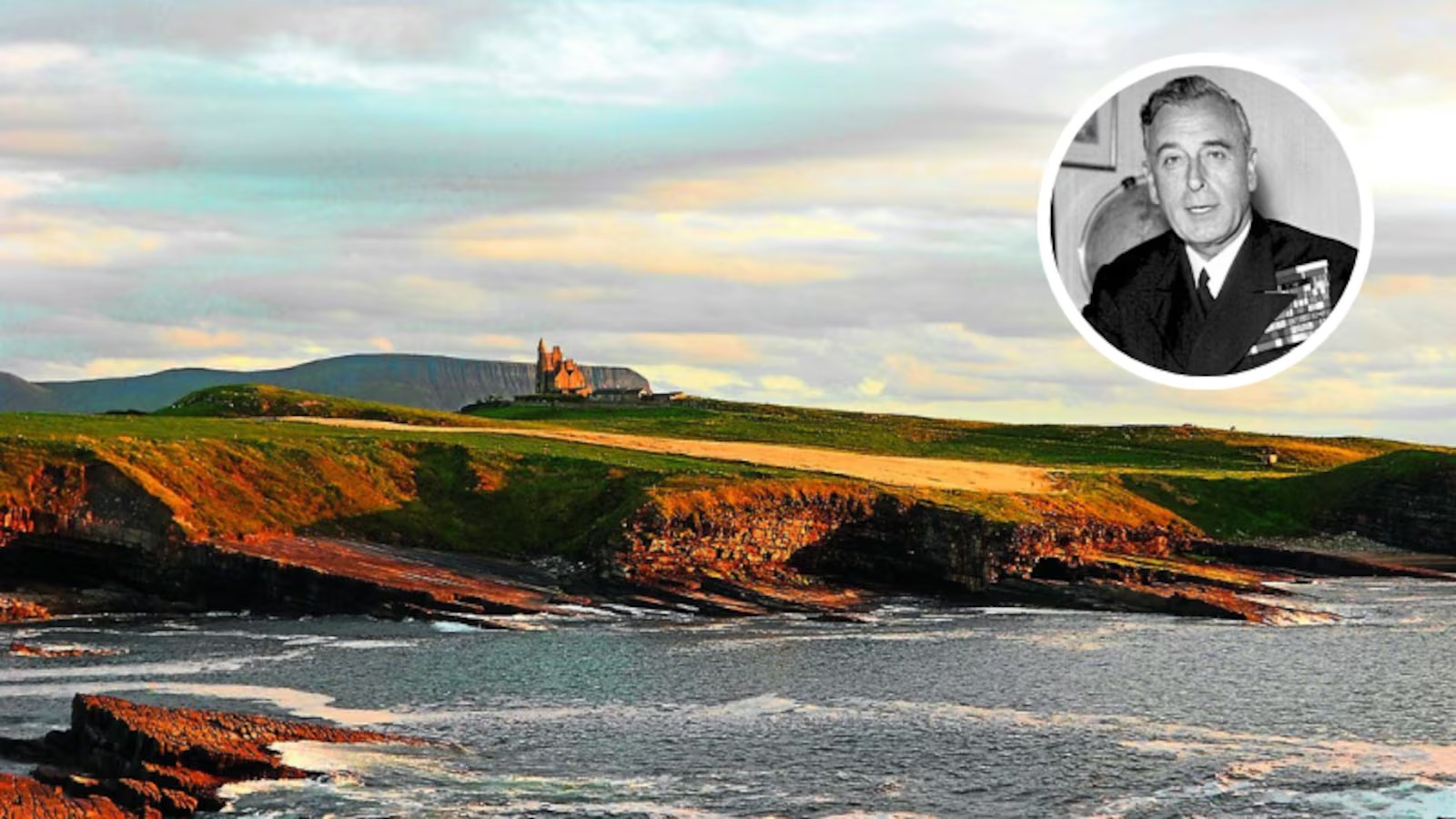
Lord Louis Mountbatten ‘abused children trafficked to his Mullaghmore estate’.
Fresh claims of British royal child abuse contained in new book
Lord Louis Mountbatten and his estate at Mullaghmore, Co Sligo
By Connla Young, Crime and Security Correspondent
May 16, 2025 at 6:00am BST
Lord Mountbatten abused children at his Mullaghmore estate, a new book reports.
Fresh claims have been made that the British royal, who was killed by the IRA, was involved in an MI5-linked paedophile ring involving children trafficked from Kincora Boys’ Home.
The details are contained in a new book by Belfast based investigative journalist Chris Moore.
In ‘Kincora, Britain’s Shame’, Mr Moore presents fresh information about the sexual depravities carried out by a nest of paedophile predators with links to a host of organisations including the loyalist paramilitary groups, the Orange Order, MI5, MI6 and the British royal family,
The book alleges that Mountbatten was involved in the sexual abuse of five children.
Three of his alleged victims have spoken to Mr Moore about their horrific experience, including rape, alleged to have been carried out by Mountbatten at his former residence at Classiebawn at Mullaghmore in Co Sligo.
Two of the child victims were resident at the notorious Kincora Boys’ Home in east Belfast.
The claims were dismissed by a Historical Institution Abuse (HIA) Inquiry, which took place between 2014-2016.
Mountbatten, a former Royal Navy officer, was a great uncle of the current British monarch, King Charles with the pair said to be close.
Mountbatten and three other people were killed, including two children, by an IRA bomb that exploded on a boat at Mullaghmore in August 1979.
In the years since his death, allegations about his alleged sexual deviancy have been reported.
It has previously emerged that the US Federal Bureau of Investigation (FBI) held files on the royal and include a report from American writer Elizabeth de la Poer Beresford.
Also known as Baroness Decies, who was close to former Queen Elizabeth and her grandmother Queen Mary, she told the FBI that in those circles Mountbatten and his wife, Edwina, were ‘considered persons of extremely low morals’.
She also told US authorities that Mountbatten ‘was known to be a homosexual with a perversion for young boys’.
In the past several witnesses have come forward to say they were sexually abused by Mountbatten at his Mullaghmore residence.
The new book suggests some victims were trafficked from Kincora to a hotel in Co Fermanagh before being collected by members of Mountbatten’s security team and taken on to Mullaghmore where they were abused.
One senior Kincora staff member is said to have taken pictures of naked boys which were then shown to potential “clients”.
In 2022 a former resident of Kincora Boys Home, Arthur Smyth, launched legal action over claims he was abused by Mountbatten.
Speaking to the Irish News, Mr Moore questioned the role of British intelligence agencies in the Mountbatten affair.
“If you were to look up the beginnings of the British secret services, it was in 1909, and one of their principle aims when they were established at that time was to protect the monarchy and the family of the monarch.”
And he asked: “Does that still apply today when they are looking at the royal family?
“Are the Mountbatten allegations of five boys, are they known to MI5 and are they protecting a member of the royal family?”
It is the highest level of support for reunification in a Six County poll on record, and is also the first time a poll has shown the demand for reunification to be higher in the north than the south.
The Amárach Research poll for the European Movement Ireland found 67% in the north and 62% in the south now support a United Ireland within the EU.
Opposition in the North to reunification within the EU was also at a record low of 27%, although still higher than in the 26 Counties, where it measured just 16%.
The data was collected between March 26-28 and has a margin of error of 2.5%.
Speaking in Dublin, Sinn Féin Senator Murphy said the poll “confirms what we are hearing more and more from communities across the north – people want change, and they want a future back in the European Union”.
He added: “These figures reflect a growing understanding that the cost of Brexit – economically, politically, and socially – has been detrimental for the north of Ireland.”
He said the poll pointed to the opportunities offered by reunification.
“The north of Ireland has been held back for too long by partition. But there is another way – one that sees the reunification of our island, the restoration of our full place in the EU, and the unleashing of our untapped potential as part of an all-Ireland economy.
“A new Ireland is not just possible – it is already being imagined and increasingly supported by the people. The Irish government must now take up its responsibilities under the Good Friday Agreement, step forward, and begin the necessary planning.
“That means convening a Citizens’ Assembly and preparing for constitutional change in a way that is inclusive, respectful and forward-looking.
“This is a time of opportunity. Let us rise to meet it – together, democratically, and with the shared ambition of building a new Ireland that is united, prosperous and within the EU.”
Direct Rule British Minister Fleur Anderson recently suggested that such an opinion poll could be enough to trigger a referendum on unity, honouring a key element of the 1998 Good Friday Agreement However, there are still no signs of of moves recognising the national rights of those living under British rule
Twelve years since a constitutional convention in Dublin voted overwhelmingly in favour, and nine years since Fine Gael said it would hold a referendum to make the necessary changes to the constitution, voting rights in Presidential elections are still being denied to those living north of the border.
Last month, Aontú introduced a bill to allow Irish citizens living in the Six Counties to vote in Irish presidential elections.
That was followed by a vote in the Stormont Assembly to support a motion calling for Irish Presidential voting rights for Irish citizens living in the north.
A majority of MLAs backed Sinn Féin’s motion calling for all Irish citizens throughout the island to be entitled to vote in Irish presidential elections.
The motion, which required a simple majority, was carried by 46 to 25, with support coming from Sinn Féin and SDLP representatives, alongside 13 Alliance MLAs and People Before Profit’s Gerry Carroll. It was opposed by the DUP, who argued any change to the law could not be implemented before the election due in 2032.
Sinn Féin deputy leader and the North’s First Minister, Michelle O’Neill, has now written to Taoiseach Micheál Martin urging him to take action.
“It is a glaring anomaly that an Irish citizen living in the north can stand for election as President of Ireland, can be elected as President of Ireland but cannot vote to elect the President of Ireland,” said Ms O’Neill.
“The Assembly decisively voted in support of the right of citizens in the north to vote for the President of Ireland.
“The office of the President of Ireland is held in the highest regard and respect in Ireland, among the Irish diaspora and across the world. That regard and respect has a particular significance and immediacy for Irish citizens in the north who have historically been denied participation in the life of their own nation by the historic and undemocratic injustice of partition.”
She also welcomed the comments by Tánaiste and Fine Gael leader Simon Harris, after he indicated he was ‘supportive’ of the move.
Pearse Doherty, the Sinn Féin Finance Minister in the 26 Counties, said it is now “incumbent” on the Dublin government to act and give a clear timeline on when they will hold a referendum to make the necessary changes to the constitution, and noted there was no mention of extending voting rights in the most recent Programme for Government.
“That impasse cannot be allowed to continue. We should not be facing into a presidential election later this year where citizens in the North are again excluded. This must be the last time it ever happens.
“The government has a constitutional duty to uphold the citizenship rights of everybody born on the island of Ireland. This is about equality, recognition and democratic participation.
“So the time for excuses is over. The government must give a timeline and set a date for the referendum, and finally act on the 12-year-old commitment to extend voting rights in presidential elections to citizens in the North.”
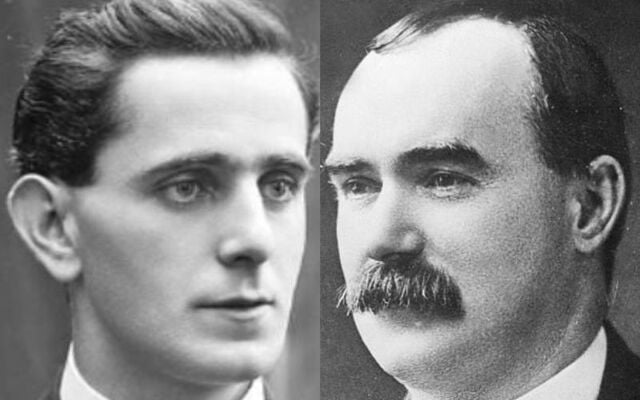
Seán MacDiarmada (L) and James Connolly (R). NLI Public Domain
Editor’s Note: The 1916 Easter Rising took place over the course of five days in Dublin and forever changed the course of Irish history. Writer and historian Dermot McEvoy produced 16 profiles of the Irish Rebel leaders who were executed and who, gradually, have come to be seen as heroes.
Between May 3 and 14, 1916, 15 leaders of the Rising were court-martialed by the British Army under General John Maxwell and convicted. IrishCentral looks at the leaders from James Connolly to Joseph Mary Plunkett and shares their stories.
Sign up to IrishCentral’s newsletter to stay up-to-date with everything Irish!Subscribe to IrishCentral
On May 11, 1916, there were no executions, but there were two significant developments.
In Dublin, according to the Irish Times, “The following results of trials, by Field General Court-martial, were announced at the Headquarters, Irish Command, Dublin: Sentenced to death, and sentence commuted to penal servitude by the General Officer, Commander-in-Chief, Éamon de Valera, penal servitude for life.
”Across the Irish Sea, there were fireworks in the House of Commons, courtesy of John Dillon, MP of the Irish Parliamentary Party, who stood up to lambast the British over their secret court-martial and executions:
“I say I am proud of their courage, and, if you were not so dense and so stupid, as some of you English people are, you would have had these men fighting for you, and they are men worth having. … ours is a fighting race … The fact of the matter is that what is poisoning the mind of Ireland, and rapidly poisoning it, is the secrecy of these trials and the continuance of these executions … enthusiasm and leadership.
“[The rebels showed] conduct beyond reproach as fighting men. I admit they were wrong; I know they were wrong, but they fought a clean fight, and they fought with superb bravery and skill, and no act of savagery or act against the usual customs of war that I know of has been brought home to any leader or any organized body of insurgents.
“[…] I do most earnestly appeal to the Prime Minister to stop these executions … it is not murderers who are being executed; it is insurgents who have fought a clean fight, a brave fight, however misguided, and it would be a damned good thing for you if your soldiers were able to put up as good a fight as did these men in Dublin—three thousand men against twenty thousand with machine-guns and artillery [Heckled and responds] … we have attempted to bring the masses of the Irish people into harmony with you, in this great effort at reconciliation—I say, we are entitled to every assistance from the Members of this House and this Government.”
The Last Two
Although Dillon’s words may have saved the lives of some rebels sentenced to death, they were too late for two of the most prominent leaders, James Connolly and Seán MacDiarmada. Their fates had been already determined because both had been signatories of the Proclamation and Prime Minister Asquith had already signed off on their shootings: “There are two other persons who are under sentence of death—a sentence which has been confirmed by the General [Maxwell]—both of whom signed the Proclamation and took an active part…in the actual rebellion in Dublin…in these two cases, the extreme penalty must be paid.”
The executions of Connolly and MacDiarmada would constitute a clean sweep of those who had put their names to Ireland’s Declaration of Independence.
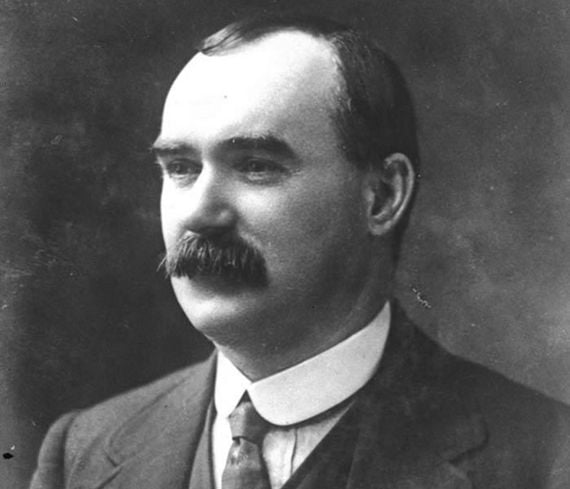
The Court-martials of James Connolly (Prisoner #90) and Seán MacDiarmada (Prisoner #91) at Richmond Barracks, May 9, 1916 – the two faced the same charges:
CHARGE: 1. Did an act to wit did take part in an armed rebellion and in the waging of war against His Majesty the King, such act being of such a nature as to be calculated to be prejudicial to the Defence to the Realm and being done with the intention and for the purpose of assisting the enemy”
2. “Did attempt to cause dissatisfaction among the civilian population of His Majesty”
PLEA: Not Guilty (both charges)
(The members of the court and witnesses were duly sworn in)
VERDICT: Guilty. Death (first charge): Not guilty (second charge)
2
James Connolly.
Epilogue
May 12 marked the last day, for now, of the execution of rebel leaders. In the space of nine days, the British had shot 15 insurgents—but they were not done yet. They still had one more to go—Sir Roger Casement, who would be hanged in London on August 3.
After the execution of the seven signatories of the Proclamation, the theme of “blood seeping from under a closed door” becomes prevalent among the Irish people. The British, in making their point that they would not stand for any more insurrection in Ireland, woke up the deep nationalism that dwells in every Irishman’s heart. The shootings guaranteed that Ireland would be a bloodbath for the next six years.
The only clear reason that can be given for any of the remaining non-signatory executions is revenge. Willie Pearse had basically nothing to do with the planning of the Rising and only held the rank of Staff Captain in the Irish Volunteers (the same rank as Michael Collins). The only reason he was shot was because he was the brother of Padraig.
John MacBride was also a revenge killing. He was shot because he had been a consistent thorn in the side of the British for over 20 years, going all the way back to the Boer War. He only joined the battle on Easter Monday when he accidentally ran into the Volunteers assembling on St. Stephen’s Green when he was on his way to his brother’s wedding reception. Also, the garrison at Jacob’s Biscuit Factory saw less action than almost any other outpost, so the order of execution had nothing to do with British casualties.
The execution of Seán Heuston was certainly a revenge shooting. It seemed that the British were embarrassed that he had out-soldiered them at the Mendicity Institution.
Con Colbert’s death is one of the oddest in that he wasn’t even in charge of the garrison at Marrowbone Lane.
Ned Daly, by all accounts, both Irish and English, did a brilliant military job at the Four Courts and environs. He caused many casualties among the British, but he and his men fought a clean fight. His biggest sin may have been that he was Thomas Clarke’s brother-in-law.
Micheál O’Hanrahan was the titular second-in-command at Jacob’s, but Major John MacBride was really in charge militarily. Also, this was one of the quietest outposts during Easter Week.
Thomas Kent in Cork was defending himself and his family from an onslaught by the RIC in Cork. He was not even active on Easter Monday as Cork remained quiet.
Michael Mallin was in charge of a small force at the College of Surgeons and St. Stephen’s Green but was not spectacularly successful as a military commander.
Roger Casement’s execution by rope was also a revenge killing because of what he symbolized—the utter hypocrisy of the British Empire. He had revealed them for what they were—exploiters of other people’s treasures.
What most of these men had in common is that they were known by the Special Branch detectives of the G-Division, the Intelligence Division, of the Dublin Metropolitan Police. All were picked out because they were known for their activities in the Irish Volunteers. This fact was not lost on Michael Collins. When Collins returned to Dublin from imprisonment in Wales, he made two things his top priorities: 1) Intelligence gathering; and 2) putting together an Active Service Unit—the Squad, AKA, “The Twelve Apostles”—to take care of Intelligence matters. This eventually led to Bloody Sunday 1920 when Collins’ Squad executed 14 British Secret Service agents in one morning. In the end, Collins’ intelligence-gathering was superior to that of the British Empire.
General Maxwell’s brag—“I am going to ensure that there will be no treason whispered for 100 years”—had turned into a match and with that match, he would light the fuse which would blast Britain out of most of Ireland after 700 years.
*Dermot McEvoy is the author of “The 13th Apostle: A Novel of Michael Collins and the Irish Uprising” and “Irish Miscellany: Everything You Always Wanted to Know about Ireland.” He may be reached at dermotmcevoy50@gmail.com and you can follow The 13th Apostle on Facebook here.
*Originally published in 2016, updated in May 2025.


![[Irish Republican News]](https://republican-news.org/graphics/title_gifs/rn.gif)
![[Irish Republican News]](https://republican-news.org/graphics/title_gifs/harp.gif)