Brigid’s Day, also known as Imbolc, is February 1 and marks the beginning of spring – learn more about St. Brigid’s Day traditions here!
Maireid Sullivan @IrishCentral Feb 01, 2026
Brigid\’s Holy Well in Co Kildare.Brigid’s Holy Well in Co Kildare. Ireland’s Content Pool The Feast of Brigid, also known as Imbolc, marks the arrival of longer, warmer days and the early signs of spring on February 1.
Imbolc is one of the four major “fire” festivals or quarter days, referred to in Irish mythology from medieval Irish texts. The other three festivals on the old Irish calendar are Beltane, Lughnasadh, and Samhain.
The word Imbolc means literally “in the belly” in the old Irish Neolithic language, referring to the pregnancy of ewes.
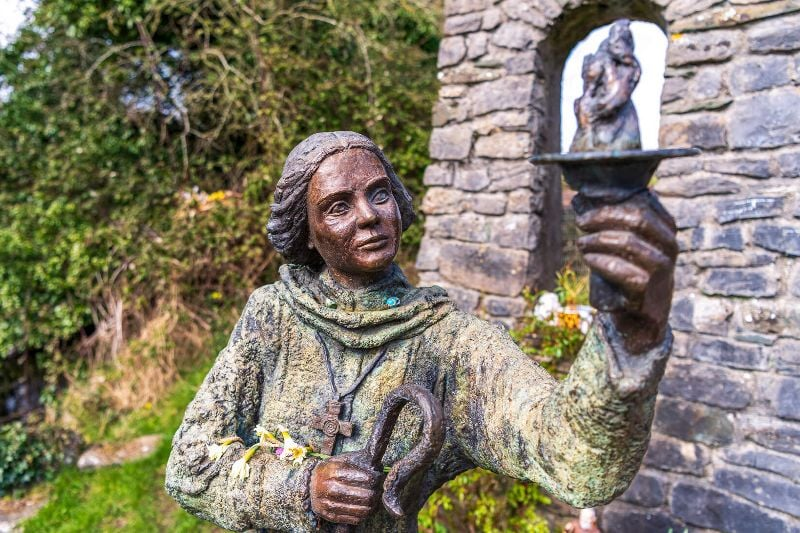
In ancient Irish mythology, Brigid was a fire goddess. Nowadays, her canonization is celebrated with a perpetual flame at her shrine in Co Kildare.
Celebrate the spirit of St. Brigid: Ireland’s festival of Spring What is St. Brigid the patron saint of?
St. Brigid is the patron saint of babies, blacksmiths, boatmen, cattle farmers, children whose parents are not married, children whose mothers are mistreated by the children’s fathers, Clan Douglas, dairymaids, dairy workers, fugitives, Ireland, Leinster, mariners, midwives, milkmaids, nuns, poets, the poor, poultry farmers, poultry raisers, printing presses, sailors, scholars, travelers, and watermen.
Here’s a busy saint!
St. Brigid’s Day traditions and customs One folk tradition that continues in some homes on St. Brigid’s Day (or Imbolc) is that of the Brigid’s Bed.
The girls and young unmarried women of the household or village create a corn dolly to represent Brigid, called the Brideog (“little Brigid” or “young Brigid”), adorning it with ribbons and baubles like shells or stones. They make a bed for the Brideog to lie in.
On St. Brigid’s Eve (January 31), the girls and young women gather together in one house to stay up all night with the Brideog, and are later visited by all the young men of the community who must ask permission to enter the home, and then treat them and the corn dolly with respect.
Brigid is said to walk the earth on Imbolc eve. Before going to bed, each member of the household may leave a piece of clothing or strip of cloth outside for Brigid to bless. The head of the household will smother (or “smoor”) the fire and rake the ashes smooth.
In the morning, they look for some kind of mark on the ashes, a sign that Brigid has passed that way in the night or morning. The clothes or strips of cloth are brought inside and believed to now have powers of healing and protection.
The following day, the girls carry the Brideog through the village or neighborhood, from house to house, where this representation of the saint/goddess is welcomed with great honor.
Adult women – those who are married or who run a household – stay home to welcome the Brigid procession, perhaps with an offering of coins or a snack. Since Brigid represents the light half of the year and the power that will bring people from the dark season of winter into spring, her presence is very important at this time of year.
Today’s Imbolc celebrations
Neopagans of diverse traditions observe this holiday in a variety of ways, celebrating Brigid’s divine femininity. As forms of neopaganism can be quite different and have very different origins, these representations can vary considerably despite the shared name.
Some celebrate in a manner as close as possible to how the ancient Celts are believed to have observed the festival, as well as how these customs have been maintained in the living Celtic cultures. Other neopagans observe the holiday with rituals taken from numerous other unrelated sources, Celtic cultures being only one of the sources used.
Imbolc is usually celebrated by modern Pagans on February 1 or 2 in the Northern Hemisphere, and August 1 or 2 in the Southern Hemisphere, or at the solar midpoint between the winter solstice and spring equinox, which now falls later in the first week or two of February.
As of February 2023, Ireland has a Bank Holiday to celebrate St. Brigid’s Day. The new Irish Bank Holiday will be observed on the first Monday in February, except where St Brigid’s Day, the first day of February, happens to fall on a Friday, in which case that Friday, February 1 will be a public holiday.
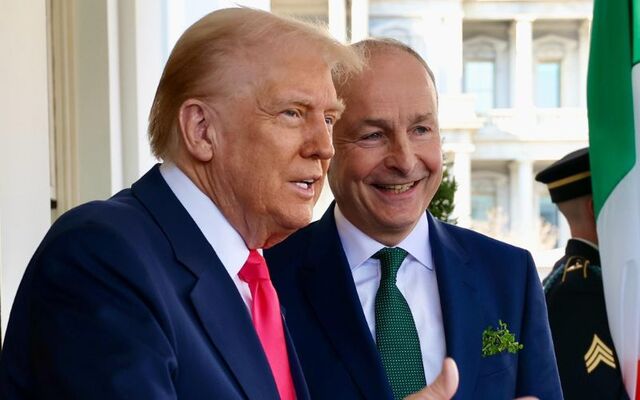
March 12, 2025: US President Donald Trump welcomes Ireland’s Taoiseach Micheal Martin to the White House as part of the annual St Patrick’s Day celebrations. RollingNews.ie
Ireland’s Taoiseach, Tánaiste, and representatives of the State will travel to more than 50 countries, including the US, this year as part of the Irish Government’s annual St. Patrick’s Day programme.
The mission of the programme, Ireland’s Department of Foreign Affairs and Trade said this week, is “to promote Ireland, Irish values, and Ireland’s interests across the world.”
Helen McEntee, Ireland’s Minister for Foreign Affairs and Trade, said: “St. Patrick’s Day provides an unparalleled opportunity to showcase Ireland on the global stage and to engage at the highest levels with political, business, civil society, cultural, and diaspora leaders.
“This year, 40 representatives of the State will carry Ireland’s message to cities across more than 50 countries worldwide.
“The theme for St. Patrick’s Day 2026 will highlight Ireland’s place in the world as a small, open trading economy. It will reflect our economic success, built on openness and strong partnerships, and Ireland’s long-standing commitment to multilateralism.”
The Department noted that, in line with the Government’s Action Plan on Market Diversification, the 2026 St. Patrick’s Day programme will place “a stronger emphasis on trade and investment. Ministers will promote trade, investment, tourism, and international research and education partnerships in priority locations, including high-value, new and emerging markets.”
US cities
Taoiseach Micheál Martin will be, as usual, visiting Washington DC, as well as Philadelphia, Pennsylvania, in March. A recent Amarach / Extra.ie poll found that a clear majority of the public believes the Taoiseach should not visit the White House for St. Patrick’s Day. The Taoiseach faced similar calls to boycott the annual visit last year.
Ireland’s Minister for Foreign Affairs and Trade and Minister for Defence Helen McEntee is set to visit Boston, Massachusetts, while Ireland’s Minister for Enterprise, Tourism and Employment Peter Burke will visit New York.
Ireland’s Minister for Culture, Communications and Sport Patrick O’Donovan is set to visit Atlanta and Savannah, both in Georgia, while Ireland’s Minister for Housing, Local Government and Heritage James Browne will visit Chicago, Illinois.
Heading to California are Ireland’s Ireland’s Minister for Agriculture, Food, Fisheries and the Marine Martin Heydon, who is going to San Francisco, and Ceann Comhairle Verona Murphy, who is due to visit Los Angeles.
Ireland’s Minister of State at the Department of Finance with special responsibility for Financial Services, Credit Unions and Insurance Robert Troy will be visiting Austin, Texas, and Ireland’s Minister of State at the Department of Enterprise, Tourism and Employment with special responsibility for Trade Promotion, Artificial Intelligence and Digital Transformation Niamh Smyth is set to visit Miami, Florida.
The Department noted how this year, the US will be marking the 250th anniversary of the signing of the Declaration of Independence, and that the St. Patrick’s Day programme “will provide a timely opportunity to highlight the significant contribution of Irish people to the founding of the United States, as well as to its political, economic, and social development over the past 250 years.”
Here is where Ireland will be represented around the world for St. Patrick’s Day 2026:
Taoiseach Micheál Martin – Washington and Philadelphia
Tánaiste and Minister for Finance Simon Harris – Paris, London
Minister for Foreign Affairs and Trade; and Minister for Defence Helen McEntee – Boston
Minister for Public Expenditure, Infrastructure, Public Service Reform and Digitalisation Jack Chambers – Senegal, Nigeria
Minister for Climate, Energy and the Environment; and Minister for Transport Darragh O’Brien – Brazil
Minister for Children, Disability and Equality Norma Foley – Italy, The Holy See
Minister for Education and Youth Hildegarde Naughton – Chile, Argentina
Minister for Enterprise, Tourism and Employment Peter Burke – New York
Minister for Social Protection; and Minister for Rural and Community Development and the Gaeltacht Dara Calleary – Ottawa and Toronto
Minister for Culture, Communications and Sport Patrick O’Donovan – Atlanta, Savannah
Minister for Health Jennifer Carroll MacNeill – Germany
Minister for Justice, Home Affairs and Migration Jim O’Callaghan – Greece and Cyprus
Minister for Housing, Local Government and Heritage James Browne – Chicago
Minister for Agriculture, Food, Fisheries and the Marine Martin Heydon – San Francisco
Minister for Further and Higher Education, Research, Innovation and Science James Lawless – Canberra, Melbourne and Sydney
Government Chief Whip and Minister of State at Department of Health with responsibility for Mental Health Mary Butler – Portugal and Spain
Attorney General Rossa Fanning SC – India
Ceann Comhairle Verona Murphy – Los Angeles
Minister of State at the Department of Children, Disability and Equality with responsibility for Disability Emer Higgins – Denmark and Sweden
Minister of State at the Department of Agriculture, Food, Fisheries and the Marine with responsibility for Food Promotion, New Markets, Research and Development Noel Grealish – New Zealand
Minister of State at the Department of Transport with responsibility for International and Road Transport, Logistics, Rail and Ports Sean Canney – Japan and Korea
Minister of State at the Department of the Taoiseach and the Department of Foreign Affairs and Trade with special responsibility for European Affairs and at the Department of Defence Thomas Byrne – Poland, Ukraine and Moldova
Minister of State at the Department of Education with special responsibility for Special Education and Inclusion Michael Moynihan – Croatia, Bosnia and Serbia
Minister of State at the Department of Culture, Communications and Sport with special responsibility for Sport and Postal Policy Charlie McConalogue – Thailand and Vietnam
Minister of State at the Department of Finance with special responsibility for Financial Services, Credit Unions and Insurance Robert Troy – Austin
Minister of State at the Department of Public Expenditure, Infrastructure, Public Service Reform and Digitalisation with responsibility for the Office of Public Works Kevin ‘Boxer’ Moran – Perth, Brisbane, Adelaide
Minister of State at the Department of Public Expenditure, Infrastructure, Public Service Reform and Digitalisation with special responsibility for Public Procurement, Digitalisation and eGovernment Frank Feighan – Philippines and Singapore
Minister of State at the Department of Health with special responsibility for Public Health, Wellbeing and the National Drugs Strategy Jennifer Murnane O’Connor – The Netherlands, Belgium and Luxembourg
Minister of State at the Department of Agriculture, Food and the Marine with special responsibility for Forestry, Farm Safety and Horticulture Michael Healy-Rae – Finland, Estonia, Latvia and Lithuania
Minister of State at the Department of Foreign Affairs with special responsibility for International Development and Diaspora Neale Richmond – South Africa, Mozambique and Jordan
Minister of State at the Department of Rural and Community Development and the Gaeltacht with special responsibility for Community Development and Charities; and Minister of State at the Department of Transport with special responsibility for Rural Transport Jerry Buttimer – China
Minister of State at the Department of Housing, Local Government and Heritage with special responsibility for Local Government and Planning John Cummins – Scotland and North of England
Minister of State at the Department of Housing, Local Government and Heritage with special responsibility for Nature, Heritage and Biodiversity Christopher O’Sullivan – Kenya and Tanzania
Minister of State at the Department of Health with special responsibility for Older People; and the Department of Housing, Local Government and Heritage with special responsibility for Housing: Kieran O’Donnell Kieran O’Donnell – Wales
Minister of State at the Department of Enterprise, Tourism and Employment with special responsibility for Trade Promotion, Artificial Intelligence and Digital Transformation Niamh Smyth – Miami
Minister of State at the Department of Enterprise, Trade and Employment with special responsibility for Small Businesses and Retail; and, Minister of State at the Department of the Environment, Climate and Communications with special responsibility for Circular Economy Alan Dillion – Mexico and Guatemala
Minister of State at the Department of Climate, Energy and the Environment with special responsibility for Fisheries and Minister of State at the Department of Agriculture, Food and the Marine with special responsibility for the Marine Timmy Dooley – Vancouver, Calgary and Edmonton
Minister of State at the Department of Justice with special responsibility for Migration Colm Brophy – Austria and Czechia
Minister of State at the Department of Further and Higher Education, Research, Innovation and Science with special responsibility for Further Education, Apprenticeship, Construction and Climate Skills Marian Harkin – France and Monaco
Minister of State at the Department of Justice with special responsibility for International Law, Law Reform and Youth Justice Niall Collins – Pakistan, Saudi Arabia, and UAE
Tom Collins: Time for us all to stand up to Trump and his ‘American Carnage’.
When Trump spoke of ‘American carnage’ in his first inauguration address, who knew he was exercising his gift of prophesy, for that is what we are seeing now.
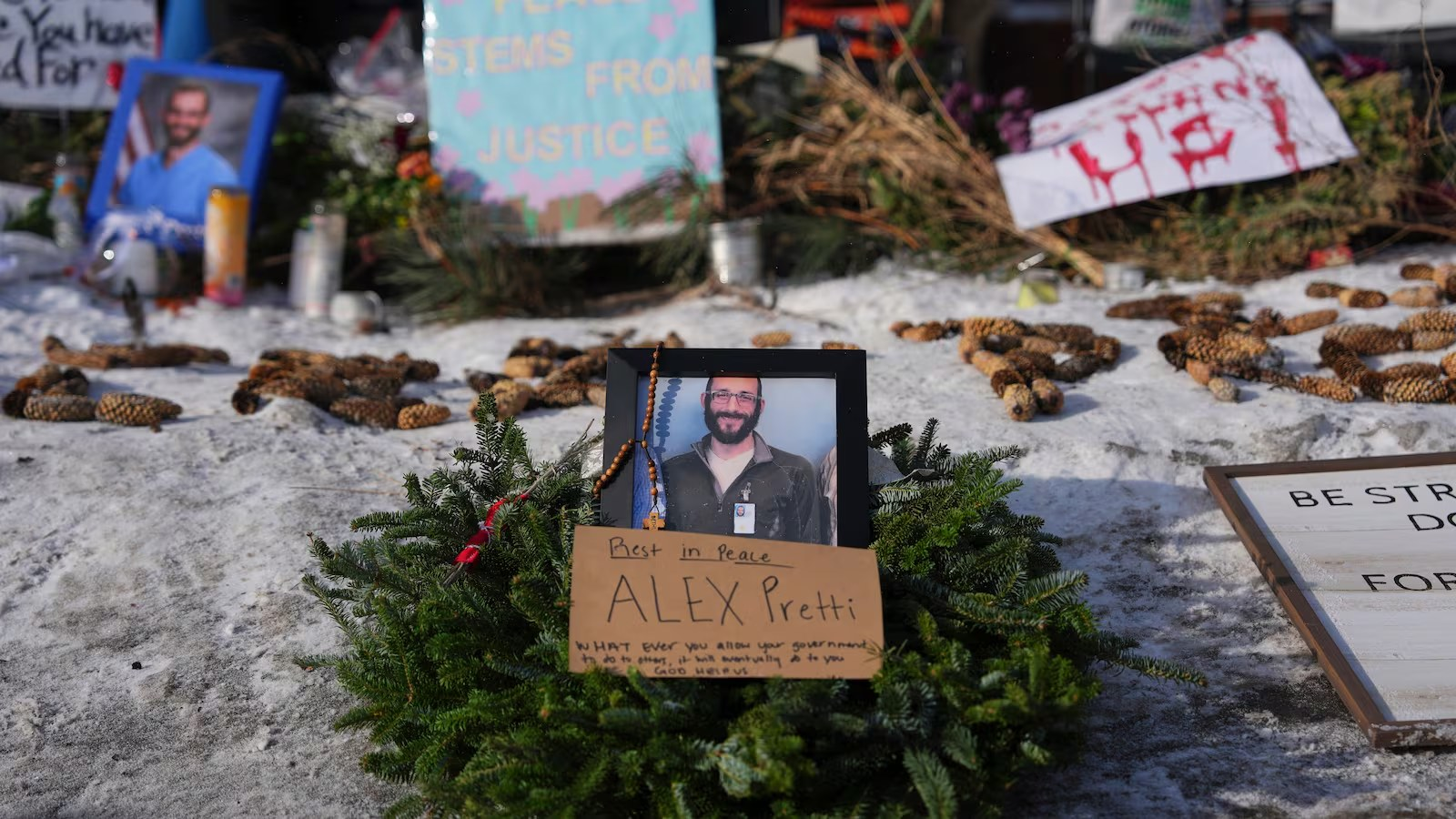
A makeshift memorial is placed where Alex Pretti was fatally shot by a US border patrol officer in Minneapolis
By Tom Collins
January 27, 2026 at 6:00am GMT
IN Irish culture, the seanchaí was revered. This keeper of tradition told stories – fabulous tales which took us into the spaces between our world and the world of Aos Sí (the term ‘fairy people’ does not do them justice).
These were stories of ancient battles and ill-fated love; and the history of our land, including tales passed down from ancestors who lived before history as we know it began. The tradition is hanging on by its fingertips, but hanging on it is.
Our need for stories is universal. Fact or fiction, they help us understand the world and to engage with one another.
Sometimes the stories which touch us are formed from facts assembled by a journalist and expressed in language shorn of linguistic decoration.
As for fiction, it is often anything but that. Many of the greats of literature revealed hidden truths: Joyce eviscerated an Ireland – ‘the old sow that eats her farrow’ – dominated by the Catholic Church; Edna O’Brien spoke up for women whose sense of being had been taken from them; like her, Colm Tóibin gets under the skin of Irish society.
Night-time stories are often a subtle way of teaching children life-lessons; and many stick in the memory.
As the horrors since Donald Trump was inaugurated for his second term have unfolded, one such story keeps coming to mind. You all know it. It’s The Emperor’s New Clothes by Hans Christian Andersen.
“So off went the Emperor in procession under his splendid canopy. Everyone said, ‘Oh, how fine are the Emperor’s new clothes’. No costume the Emperor had worn before was ever such a complete success.’
“Then a little boy piped up. ‘But he hasn’t got anything on’.”
This is now reality in the United States, where a self-proclaimed emperor – leader of a coup attempt in 2021, creator of fantasies about his role as a peacemaker and economic wizard – is being feted by his courtiers and many in the wider world.
In Andersen’s tale, the little boy performs a public service. In Trump’s America, he would be shot dead for daring to exercise his right to free speech.
That happened this weekend in Minneapolis where an intensive care nurse, Alex Pretti – remember his name – was shot dead by his government’s militiamen; and that is what happened to Renee Good, a poet and, more importantly, a mother, shot dead by ICE. The government desecrated her memory when it branded her a “domestic terrorist”.
When the crowd started laughing at his nakedness, “the Emperor shivered, for he suspected they were right. But he thought, ‘This procession has got to go on’. So he walked more proudly than ever, as his noblemen held high the train that wasn’t there at all.”
In our time these noblemen are people like Nato secretary general Mark Rutte; Keir Starmer, the fawning prime minister of Little Britain; war crimes suspects Benjamin Netanyahu and Vladimir Putin; a string of dictators in the Middle East; human rights abusers like Alexander Lukashenko; and Tony Blair – I rest my case.
Since his assumption of power last year, and what can only be described as a reign of terror on the most vulnerable in the United States, the world’s approach to Trump has been to suck up to him.
Global organizations like FIFA have debased themselves. Even the winner of this year’s Nobel Peace Prize offered up her medal to Trump.
Meanwhile, Venezuela has been decapitated and its oil stolen; Ukraine has been left exposed to the predations of Russia; Greenland is under threat of occupation; and across the US, individual states – like Minnesota – are being invaded by the federal government and turned into killing grounds.
When Trump spoke of “American carnage” in his first inauguration address, who knew he was exercising his gift of prophesy, for that is what we are seeing now: American carnage in the United States itself, and American carnage across the globe.
Yes, America is powerful and Trump can do enormous damage from his gilt-lined office in the White House.
But the time has now come for the ordinary decent people of America to stand up to him – and increasingly people there are.
But more importantly the time has come for the world to untangle itself from the US and to forge new alliances – closer links between Canada and the European Union being a good starting point.
As a seanchaí would remind us: “Any man can lose his hat in a fairy wind.”
With St Patrick’s Day approaching, let us pray that the fairy wind brings misfortune to the current occupant of the White House and good fortune to a world which deserves better than he is offering.
If you have an opinion on the issues raised in this article and would like to submit a Letter to the Editor to be considered for publication
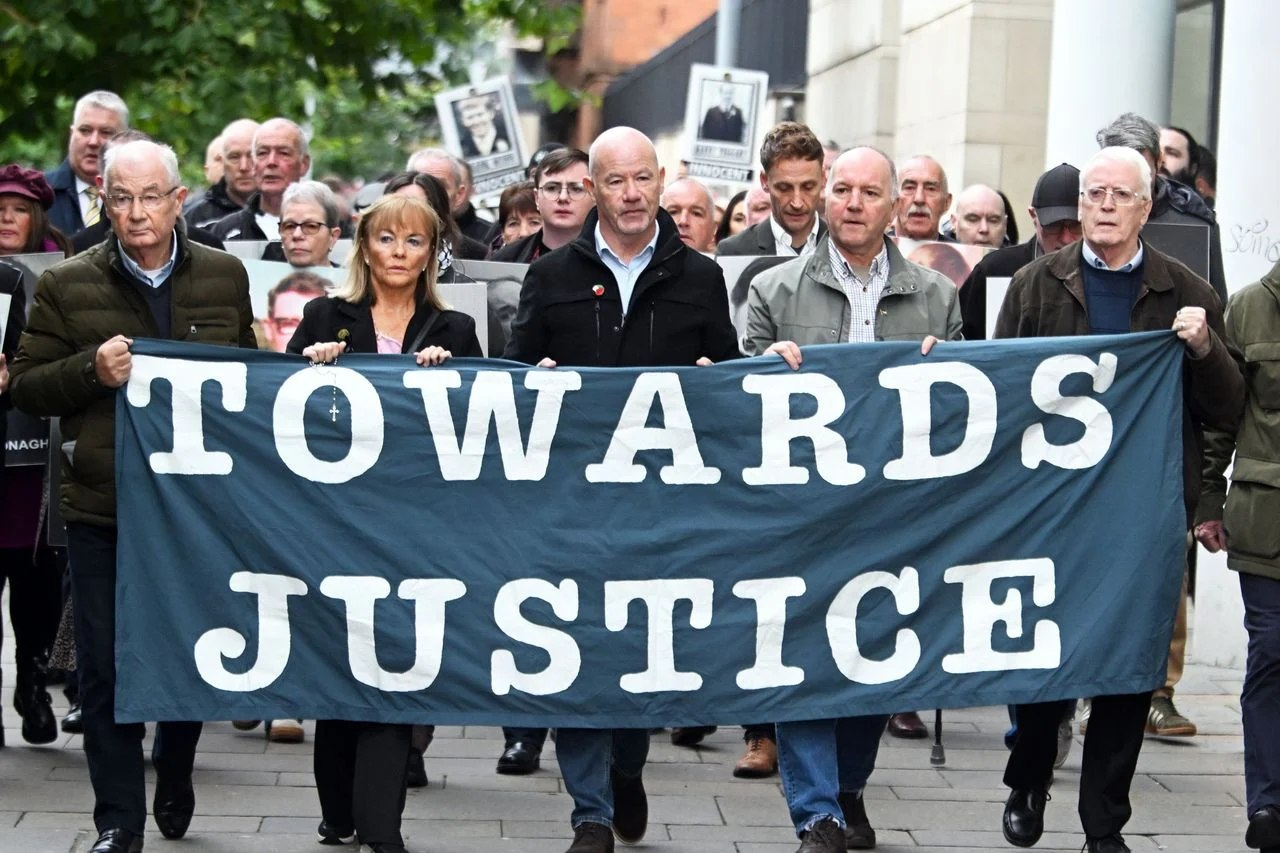
Bloody Sunday families express anger at PPS decision over soldiers who lied.
Bloody Sunday families and supporters in Belfast
Brett Campbell
Today at 07:20
The Bloody Sunday families have expressed anger after the Public Prosecution Service (PPS) said it would uphold a decision not to prosecute eight former soldiers who were investigated for perjury about the events of Bloody Sunday.
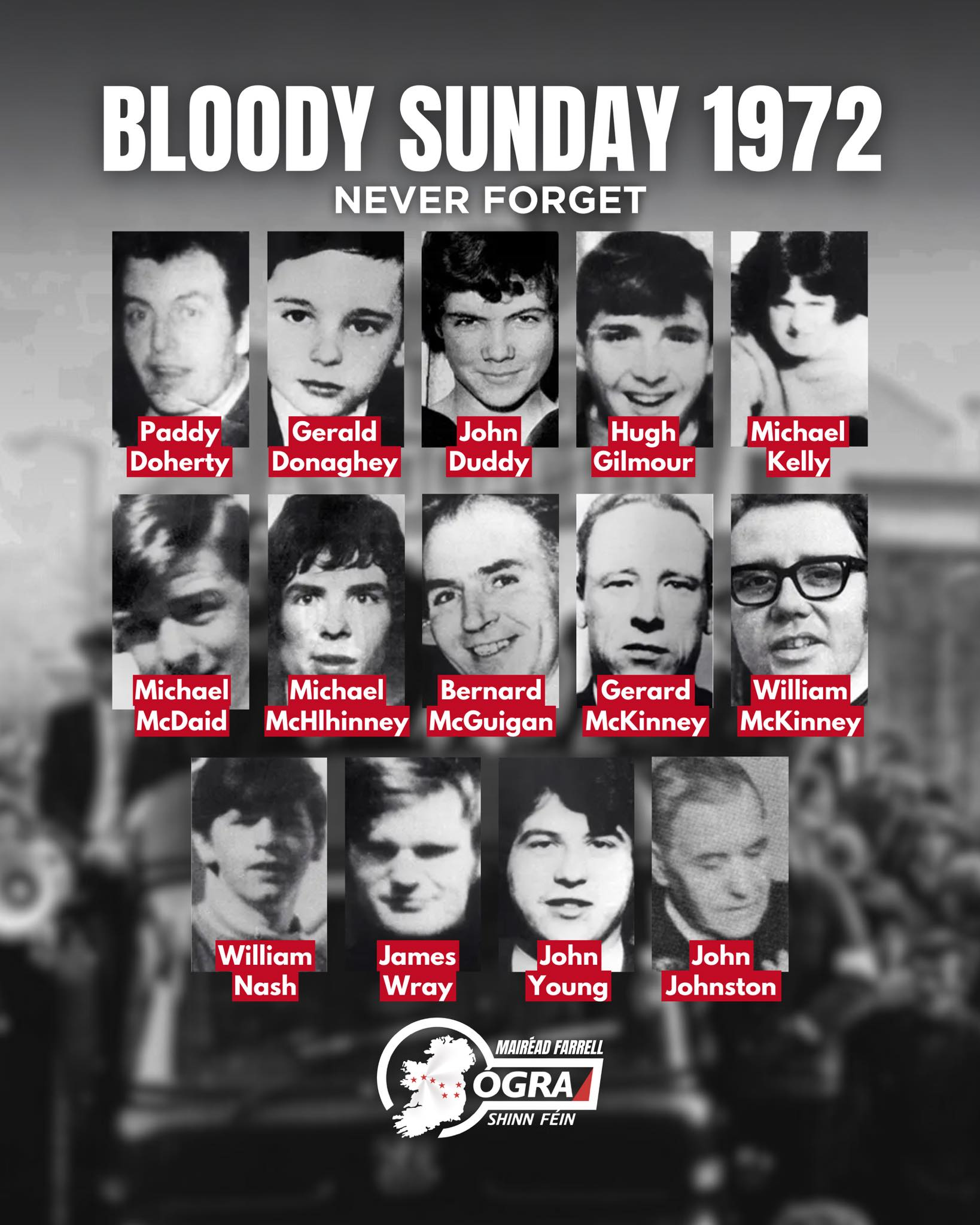
The individuals were investigated for giving false evidence about the events of January 30, 1972 when 13 innocent civilians were murdered and 15 others left injured.
Ciaran Shiels, solicitor for the Bloody Sunday Families and Wounded, said the move will allow ex-Parachute Regiment soldiers who “perverted the course of justice” to escape criminal prosecution.
“Former members of the British military have nothing to fear in relation being held accountable either for murders they committed with impunity in Ireland, or when they subsequently came to lie under oath when seeking to justify the unjustifiable, or when alleging that the innocent victims they murdered were engaged in criminal activity and that they effectively deserved to be shot,” he said in a statement.
Soldiers opened fire during the civil rights march in the Bogside area of the city.
An inquiry, known as the Widgery Tribunal, issued a report within weeks of the atrocity which exonerated the British Army and compounded the hurt felt by victims.
It wasn’t until 2010, following a lengthy campaign for justice amid claims of a cover-up, that all those shot dead were declared innocent.
The findings of the Saville Inquiry overturned the main findings of the Widgery report and outlined a damning account of how soldiers were unjustified in firing more than 100 rifle rounds at protesters who did not pose a threat.
“Despite the contrary evidence given by soldiers, we have concluded that none of them fired in response to attacks or threatened attacks by nail or petrol bombers,” Lord Saville concluded.
The distinguished judge rejected claims that no-one threw, or threatened to throw, nail or petrol bombs at soldiers.
In April 2024, the PPS decided not to prosecute a number of people in relation to allegations of false evidence given to the inquiry.
A PPS spokesperson said: “The review of this legally complex matter is now complete. After a careful analysis of all available evidence and the legal submissions made by the family legal representatives, it has been concluded that the evidential threshold to proceed with a prosecution has not been met.”
They added: “We would further emphasise that today’s decisions in no way diminish the findings by the Bloody Sunday Inquiry.
“A public inquiry and a criminal trial are very different processes and much of the material upon which the Inquiry could rely would not be available to the prosecution having regard to the rules of evidence that apply to criminal proceedings.”
Foyle MP Colum Eastwood expressed “deep disappointment that once again Bloody Sunday families have been let down by the state”.
The former SDLP leader referred to the trial of Soldier F in Belfast which concluded in Belfast last October with the ex-Paratrooper found not guilty of murdering James Wray (22) and William McKinney (26) and cleared of five charges of attempted murder.
At the end of the case, Mr Justice Lynch found that a number of soldiers had been “serially untruthful” about key events on Bloody Sunday and therefore had “committed perjury” before the Widgery and Saville Inquiries.
“It’s impossible to overstate the scale of the burden that has been placed on the families of the dead and injured on Bloody Sunday,” Mr Eastwood said.
“For more than fifty years, they have had to fight every conceivable institution of the state for truth, justice and accountability. Today, again, they have been badly let down by the incredible decision not to prosecute soldiers for perjury during the Widgery and Saville Inquiries.”
The elected representative described the PPS decision as “incredible” in light of the £4.3m taxpayer bill for the defence costs of Soldier F.
“It is not unreasonable to expect that there would be some consequence for those actions,” Mr Eastwood said.
“As I always have, and as the people of Derry always have, we will fully support the Bloody Sunday families in the days and weeks ahead.
“These families are leaving no stone unturned in their pursuit of justice and we’re with them every step of the way.”