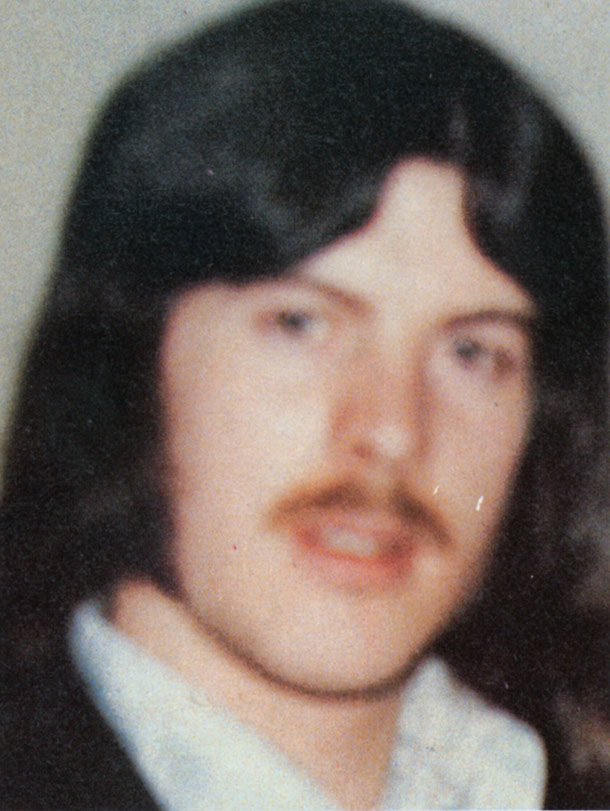
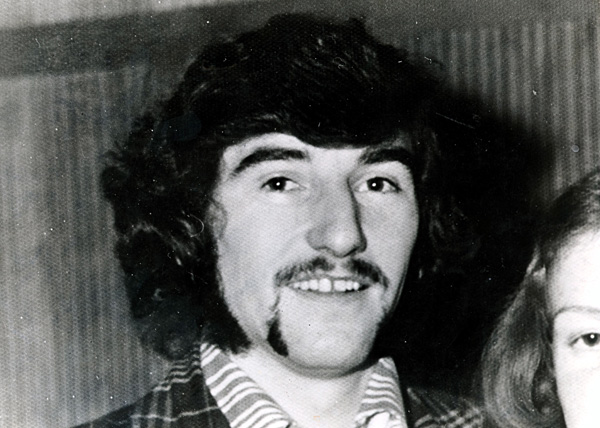
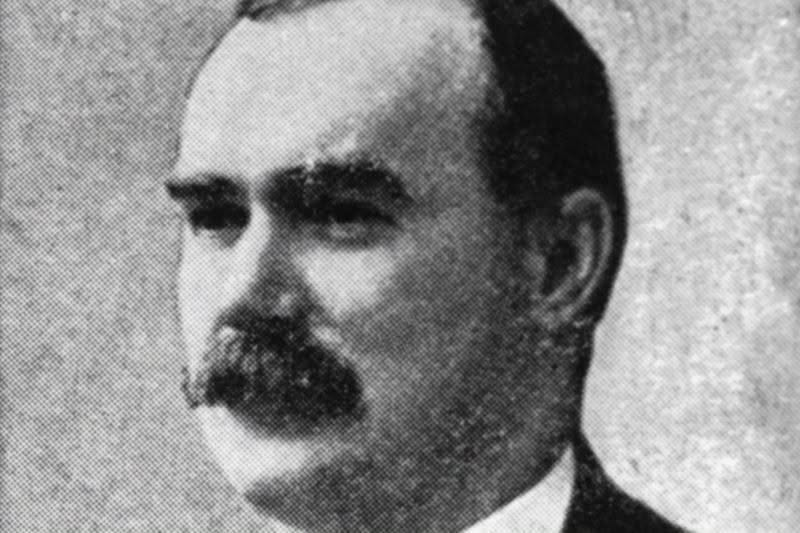
KIERAN DOHERTY, aged 25, was born in Andersonstown, west Belfast, on 16 October 1955.
Kieran was a teenage internee between February 1973 and November 1975. On his release he was an extremely active IRA Volunteer and was finally captured in August 1976. Kieran received an 18-year sentence in January 1978 for possession of weapons.
On 11 June 1981, Kieran was elected as TD for the Cavan/Monaghan constituency in the Dáil general election, receiving over 9,000 first-preference votes.
He spent 73 days on hunger strike from 22 May. He died on 2 August 1981.
Big Doc’s final journey
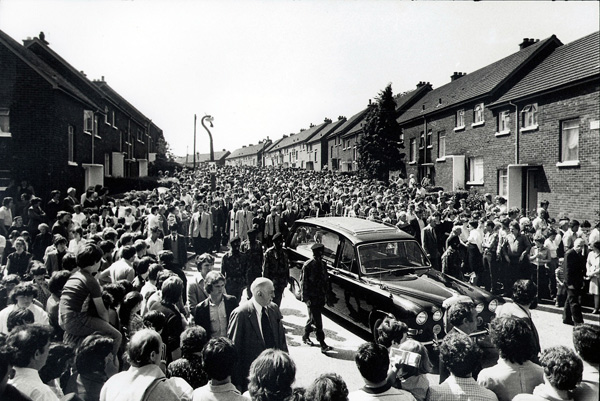
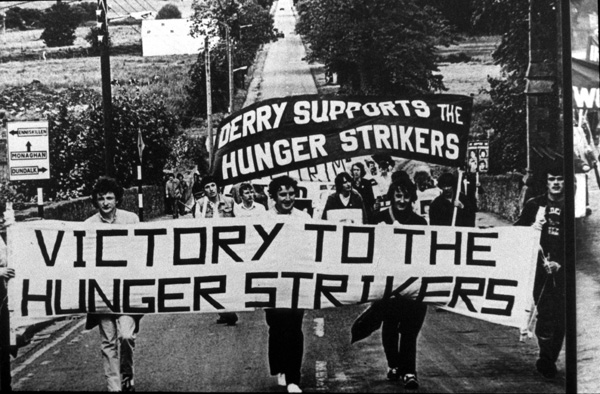
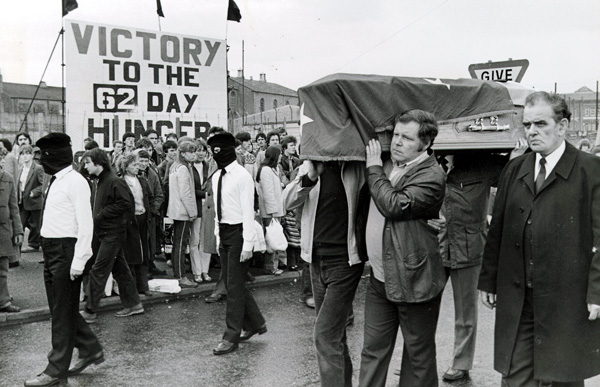
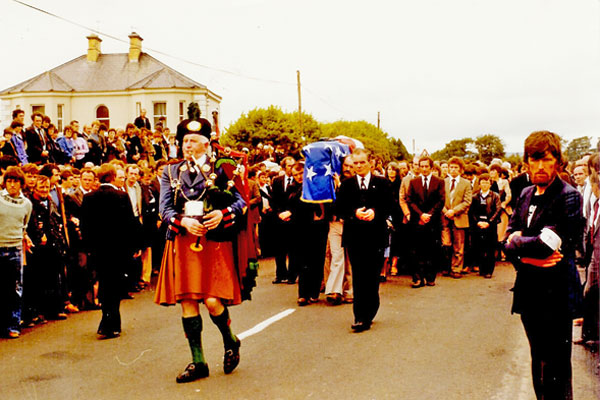
• The funeral of Kieran Doherty TD passes through west Belfast
IRA Volunteer Kieran Doherty, TD for Cavan/Monaghan, died at 7:15pm on Sunday 2 August 1981, the day after Kevin Lynch’s death. Kieran had joined the hunger strike one day before Kevin Lynch and survived one day longer.
Kieran Doherty embarked on his fast upon the death of Raymond McCreesh. He managed, with difficulty, to speak to his family almost to the end though his sight had almost completely gone. Kieran (or ‘Big Doc’ as his comrades affectionately called him) had a strong spirit of survival which kept him conscious for most of his 73 days on hunger strike.
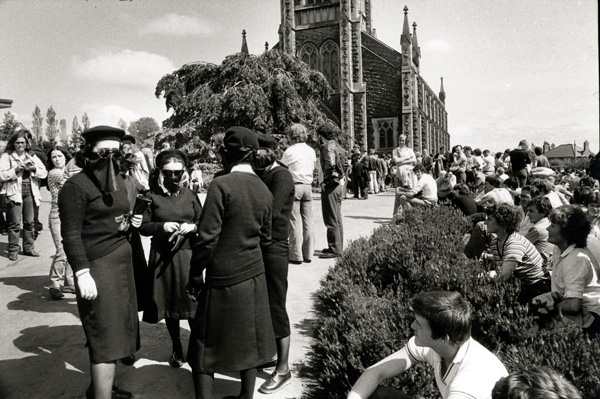
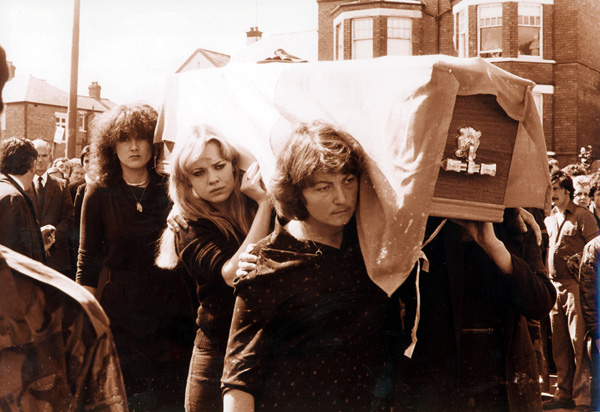
Kieran’s body was brought out of Long Kesh and through Andersonstown to his parents’ home in Commedagh Drive at two o’clock in the morning. About a thousand mourners accompanied the coffin and even larger crowds came out on Monday morning to pay their respects. The next day, hundreds of stewards took position on the funeral route as Kieran’s coffin was carried out of his parents’ house, escorted by an IRA guard of honour. An IRA firing party came out of the crowd and, lining the side of the coffin, fired a volley of shots. As British Army helicopters hovered overhead, the crowd cheered at the Brits’ inability to prevent the firing party from honouring their dead comrade.
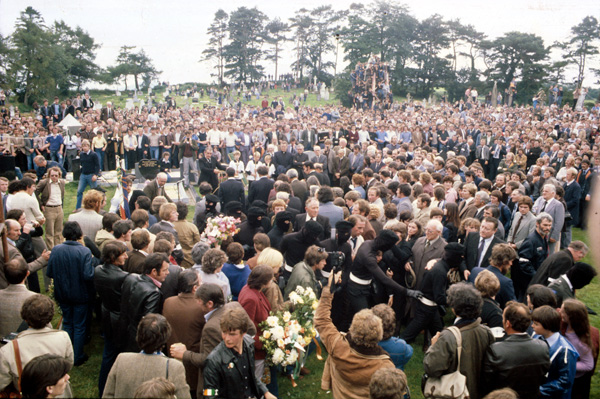
• Scene during the funeral Mass at St Theresa’s Church; (below) Kieran Doherty’s coffin is carried by his sister Mairéad (left) a family friend Siobhán McKenna (centre) and sister-in-law Betty Doherty (right)
The cortege then moved through Andersonstown, led by two pipers. It may be recalled that during the Hunger Strike some of the clergy had set out to undermine the prisoners’ protest. In contrast to the attitude of the priest celebrating Mass at Kevin Lynch’s funeral, Fr Hansen’s sermon demonstrated a fundamental understanding of the issues at the core of the Hunger Strikers’ protest. While the presiding priest at the Lynch funeral refused to wear his vestments at the graveside because of the presence of a firing party, the priest at Kieran’s funeral recalled having visited Doherty on the 13th day of his fast and remembered it to be a cheerful event. He went on to recount Kieran’s words when he asked him if he would consider coming off the hunger strike. Kieran replied:
“Look, Father, I could not give up. If I did I would go back to criminal status. I am not a criminal. I never was and never will be one.”
Recalling those words at the funeral of Kieran Doherty, the priest said:
“Basically, I had to agree with him.”
He finished off by saying:
“Kieran was very much his own man. He died quietly and very determined, serene and dignified.”
Fr Toner, who was criticised by Bobby Sands in his diary, was in the congregation, listening but apparently unmoved by Fr Hansen’s words.
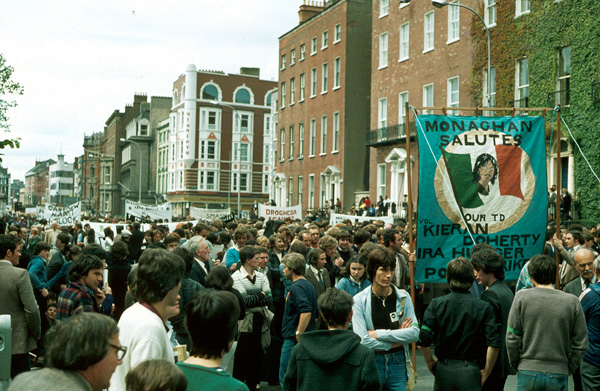
It was estimated that a crowd of about 20,000 attended Kieran’s funeral.
Chairing the event, Sinn Féin member Jimmy Drumm referred to the ongoing pursuit of the prisoners’ ‘Five Demands’.
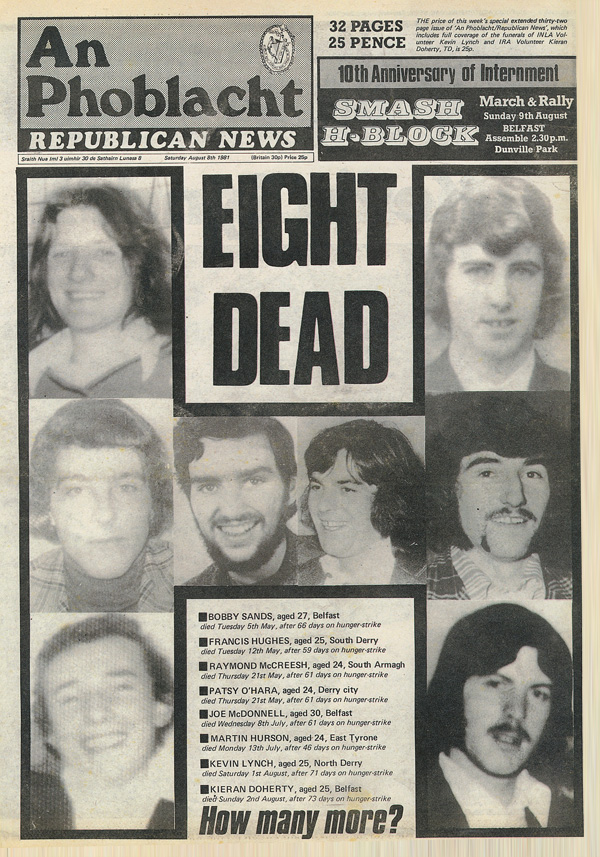
“The British Government needs to be moved on the issues of work, association and segregation.” He finished by saying that with the basis of a just settlement “then we and the families will be spared the anguish and suffering of such funerals as this, and the prisoners who have suffered so much will be able to live in tolerable conditions.” Kieran Doherty was the eighth man to die on hunger strike in 1981 and two more would follow.
The oration at Volunteer Doherty’s funeral was given by Caoimhghín Ó Caoláin, Kieran’s Director of Elections during the 1981 general election in the 26 Counties.
Ó Caoláin said that the people of Cavan/Monaghan had taken the 26-year-old to their hearts and that they were proud to elect him as their public representative. Ó Caoláin criticised the Irish Government’s handling of the Hunger Strike, saying:
“Their gamesmanship for petty political scores has been a major factor in the continuing deaths in Long Kesh. The people of Cavan/Monaghan hold the present coalition government directly responsible, through firstly their inactivity and afterwards their open support for pressure to be placed on the Hunger Strikers and their families.”
Ó Caoláin recalled all the other Irish hunger strikers who had died as a result of British intransigence, three of them elected representatives: Terence MacSwiney, Bobby Sands and Kieran Doherty. Again of Doherty, he added that Kieran had taken his place amongst all those who fought for the three tenets of republicanism: “Equality, as embodied by James Connolly, who struggled to achieve a classless society; liberty, the liberty of Patrick Pearse; and the fraternity of Wolfe Tone.”
KEVIN LYNCH, aged 25, was born in Park, north Derry, on 25 May 1956.
Kevin, an INLA Volunteer, was arrested in December 1976 and charged with conspiracy to obtain arms. He received a ten-year sentence in December 1977.
Kevin excelled at Gaelic games and had captained the under-16 Derry team which won an all-Ireland hurling trophy in 1972.
He stood as a H-Block/Armagh candidate in the Waterford constituency during the June 1981 general election in the South and polled extremely well despite missing out on election.
He spent 71 days on hunger strike from 23 May 1981. He died on 1 August 1981.
Kevin Lynch laid to rest in Dungiven
THE death of INLA Volunteer Kevin Lynch after 71 days on hunger strike occurred on 1 August 1981. It was followed the next day by that of IRA Volunteer Kieran Doherty.
They were the seventh and eighth men to die on the fast.
Kevin had been lapsing into frequent periods of unconsciousness in the last four days, having already lost his sight, hearing and speech. His family were at his bedside throughout the final days until he died in the early hours of Saturday morning.
His funeral took place the following Monday in his home town of Dungiven in County Derry. Between the return of his body to his home and the removal for Requiem Mass on Monday afternoon, a constant stream of mourners queued outside to pay their respects. The road was decorated with Tricolours and black flags, along with posters of Kevin Lynch.
The RUC and the Ulster Defence Regiment made every effort to disrupt the funeral, holding up cars and forcing buses to park outside of town so that the passengers would have to make their way on foot. Ulsterbus in Belfast cancelled bookings at the last minute. Nevertheless, mourners came in convoys of cars and black taxis.
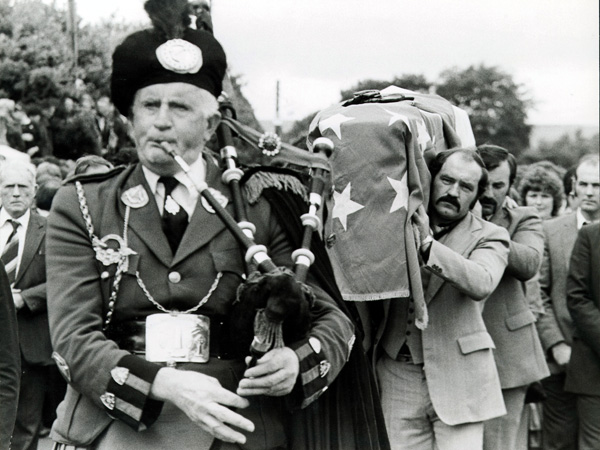
At mid-day, the coffin, bearing the Tricolour, Starry Plough, gloves and beret, was carried to the nearby church. The procession was led by a lone piper, followed by the Lynch family, relatives of other Hunger Strikers, and senior representatives of the IRSP and the broad republican movement, along with the National H-Block/Armagh Committee.
Five British Army helicopters flew overhead as the coffin entered the church grounds. Applause broke out momentarily as an 18-strong INLA guard of honour marched up to escort the coffin to the church door.
The priest who celebrated the Mass, Fr John Quinn, expressed outrage later when the INLA Volunteers escorting the coffin fired three volleys after it had left the church. So enraged was he that he refused to wear his vestments at the graveside.
This same priest had failed to refer to the suffering of the Hunger Strikers themselves and failed to condemn British intransigence. He tried to imply that the family had been opposed to the military funeral – an opinion later refuted by family members, who criticised the press and those who had made unsolicited comments on their behalf.
At the graveside, the piper played I’ll Wear No Convict’s Uniform. The Last Post was also played and wreaths were laid, including from both the INLA and IRA Army Councils.
• A lone piper leads the cortege; (below) The funeral of Kevin Lynch makes its way through Dungiven
A uniformed INLA Volunteer then read a statement on behalf of the INLA Army Council, stating regret at Kevin’s death and applauding his heroism.
“Kevin Lynch has made the greatest sacrifice, and he has done it in the face of the repressive machinery of British imperialism and in the wake of the greatest gesture of defiance against those who control the prisons and those who rule and ravage our country,” he said.
A short oration was given by Councillor Seán Flynn from Belfast, Vice-Chair of the IRSP:
“Kevin epitomised all that is good in a young Irishman. Playing our national sports of hurling and football, he excelled at both and in 1972 captained his native county to win an All-Ireland medal at hurling.”
He went on to contrast Lynch’s Gaelic spirit with the performance of the Gaelic Athletic Association leadership off the field.
“Yesterday, the Derry County Board and South Antrim County Board asked for a minute’s silence before the All-Ireland Hurling Semi-Final between Limerick and Galway. It was no surprise to me when Croke Park refused. President Mac Floinn last week declared that no clubs, grounds or units were to be used for H-Block activity as it contravenes Rule 7.”
He added that work would be done to encourage support for the prisoners’ ‘Five Demands’ amongst the GAA.
Of Kevin’s courage and determination, Seán said:
“It must be remembered that if Kevin had conformed to the British authority he would be a free man today; but to Kevin, Kieran Doherty, Patsy O’Hara, Bobby Sands, Francis Hughes, Raymond McCreesh, Joe McDonnell, Martin Hurson and the continuing Hunger Strikers, they knew if the political prisoners were criminalised then the British Government would attempt to criminalise the struggle on the outside.”
He added that Kevin Lynch knew the consequences of going on hunger strike.
“Deprived of every other means of defending his political integrity, he defended it with his life. Those who imply that he might have been ordered to do so, or could be ordered to cease to do so, fail to understand the depths or the personal integrity – the individual courage and the dedication to the principles he believed in – that made Kevin Lynch the person he was.”
KIERAN DOHERTY, aged 25, was born in Andersonstown, west Belfast, on 16 October 1955.
Kieran was a teenage internee between February 1973 and November 1975. On his release he was an extremely active IRA Volunteer and was finally captured in August 1976. Kieran received an 18-year sentence in January 1978 for possession of weapons.
On 11 June 1981, Kieran was elected as TD for the Cavan/Monaghan constituency in the Dáil general election, receiving over 9,000 first-preference votes.
He spent 73 days on hunger strike from 22 May. He died on 2 August 1981.
Big Doc’s final journey
• The funeral of Kieran Doherty TD passes through west Belfast
IRA Volunteer Kieran Doherty, TD for Cavan/Monaghan, died at 7:15pm on Sunday 2 August 1981, the day after Kevin Lynch’s death. Kieran had joined the hunger strike one day before Kevin Lynch and survived one day longer.
Kieran Doherty embarked on his fast upon the death of Raymond McCreesh. He managed, with difficulty, to speak to his family almost to the end though his sight had almost completely gone. Kieran (or ‘Big Doc’ as his comrades affectionately called him) had a strong spirit of survival which kept him conscious for most of his 73 days on hunger strike.
Kieran’s body was brought out of Long Kesh and through Andersonstown to his parents’ home in Commedagh Drive at two o’clock in the morning. About a thousand mourners accompanied the coffin and even larger crowds came out on Monday morning to pay their respects. The next day, hundreds of stewards took position on the funeral route as Kieran’s coffin was carried out of his parents’ house, escorted by an IRA guard of honour. An IRA firing party came out of the crowd and, lining the side of the coffin, fired a volley of shots. As British Army helicopters hovered overhead, the crowd cheered at the Brits’ inability to prevent the firing party from honouring their dead comrade.
• Scene during the funeral Mass at St Theresa’s Church; (below) Kieran Doherty’s coffin is carried by his sister Mairéad (left) a family friend Siobhán McKenna (centre) and sister-in-law Betty Doherty (right)
The cortege then moved through Andersonstown, led by two pipers. It may be recalled that during the Hunger Strike some of the clergy had set out to undermine the prisoners’ protest. In contrast to the attitude of the priest celebrating Mass at Kevin Lynch’s funeral, Fr Hansen’s sermon demonstrated a fundamental understanding of the issues at the core of the Hunger Strikers’ protest. While the presiding priest at the Lynch funeral refused to wear his vestments at the graveside because of the presence of a firing party, the priest at Kieran’s funeral recalled having visited Doherty on the 13th day of his fast and remembered it to be a cheerful event. He went on to recount Kieran’s words when he asked him if he would consider coming off the hunger strike. Kieran replied:
“Look, Father, I could not give up. If I did I would go back to criminal status. I am not a criminal. I never was and never will be one.”
Recalling those words at the funeral of Kieran Doherty, the priest said:
“Basically, I had to agree with him.”
He finished off by saying:
“Kieran was very much his own man. He died quietly and very determined, serene and dignified.”
Fr Toner, who was criticised by Bobby Sands in his diary, was in the congregation, listening but apparently unmoved by Fr Hansen’s words.
It was estimated that a crowd of about 20,000 attended Kieran’s funeral.
Chairing the event, Sinn Féin member Jimmy Drumm referred to the ongoing pursuit of the prisoners’ ‘Five Demands’.
“The British Government needs to be moved on the issues of work, association and segregation.” He finished by saying that with the basis of a just settlement “then we and the families will be spared the anguish and suffering of such funerals as this, and the prisoners who have suffered so much will be able to live in tolerable conditions.” Kieran Doherty was the eighth man to die on hunger strike in 1981 and two more would follow.
The oration at Volunteer Doherty’s funeral was given by Caoimhghín Ó Caoláin, Kieran’s Director of Elections during the 1981 general election in the 26 Counties.
Ó Caoláin said that the people of Cavan/Monaghan had taken the 26-year-old to their hearts and that they were proud to elect him as their public representative. Ó Caoláin criticised the Irish Government’s handling of the Hunger Strike, saying:
“Their gamesmanship for petty political scores has been a major factor in the continuing deaths in Long Kesh. The people of Cavan/Monaghan hold the present coalition government directly responsible, through firstly their inactivity and afterwards their open support for pressure to be placed on the Hunger Strikers and their families.”
Ó Caoláin recalled all the other Irish hunger strikers who had died as a result of British intransigence, three of them elected representatives: Terence MacSwiney, Bobby Sands and Kieran Doherty. Again of Doherty, he added that Kieran had taken his place amongst all those who fought for the three tenets of republicanism: “Equality, as embodied by James Connolly, who struggled to achieve a classless society; liberty, the liberty of Patrick Pearse; and the fraternity of Wolfe Tone.”
On the anniversary of her baptism in Cork, we look back at how the Irish-born labor icon shaped the radical politics of James Connolly and Jim Larkin.
Jane Walsh
@IrishCentral
Aug 01, 2026
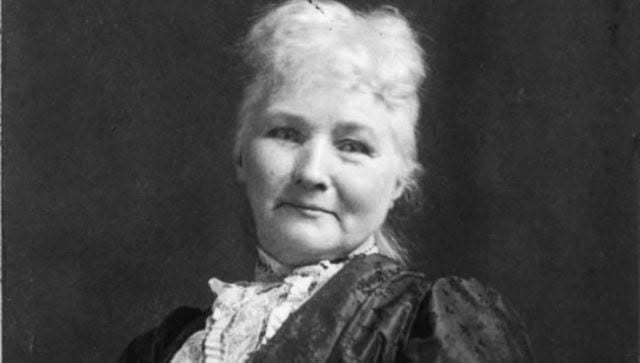
Mother Jones was baptized in Cork on August 1, 1837, before an early life marked by tragedy led her from famine-era Ireland to the front lines of the American labor movement. Decades later, her fearless organizing would leave a lasting mark on Irish republican and union leaders James Connolly and Jim Larkin.
Mother Jones was herself Irish; she was born Mary G. Harris in Shandon St. on the north side of Cork in 1837. While there’s some speculation as to her exact birth date, records show that she was baptized on August 1, 1837.
As a teenager, Harris emigrated to North America after surviving Ireland’s Great Hunger.
Jones lost her husband and children to yellow fever and her startup business to the Great Chicago Fire of 1871. She turned to the Knights of Labor and then rose to become a union organizer for the United Mine Workers of America, and marched with Coxey’s unemployed army in 1894.
Mother Jones and James Connolly
Speaking with the Irish Times, American labor historian Professor Rosemary Feurer said that James Connolly, aligned with syndicalism and the Industrial Workers of the World, was already well aware of Mother Jones before he went to the US, where he lived from 1905 until 1910.
Prof Feurer added that Jim Larkin was also familiar with Jones before he went to the United States in 1914.
Feurer was speaking with the Irish Times ahead of her appearance at the Mother Jones Festival in Cork, where she delivered a lecture entitled “Get off Your Knees – Connolly, Larkin and Mother Jones in the Fight for a Global Labor Movement.”
Feurer’s movie “Mother Jones, America’s Most Dangerous Woman” was also shown during the festival.
Feurer said, “James Connolly, Jim Larkin, and Mother Jones were leading transnational organizers who knew one another and considered themselves part of [a] broad radical workers movement.”
“Both men admired Mother Jones and called for an inclusive style of unionism that she helped shape, which crossed racial, gender, and ethnic barriers and sought to overcome divisions.”
According to Prof Feurer, Mother Jones met Connolly in New York, who revealed to her that he was planning to return to Ireland in 1910.
“Connolly and Jones took a similar path, moving from the Socialist Labor Party, the Socialist Party of America and the Industrial Workers of the World, so they were often crossing paths.”
“They were seeking a way to connect radical social transformation to the workers’ movement.”
She added that both Connolly and Larkin would have been proud of the role of the Irish diaspora, such as Mother Jones and her campaign against child labor.
“No correspondence exists between Connolly and Jones, but she certainly cheered the Irish rebellion and joined in hopes for a workers’ republic in Ireland and in the US and the world,” Feurer said.
“It is certain she would have mourned Connolly’s execution – though there is no public record of that, I can be certain she would have felt sadness and outrage based on other comments.”
Mother Jones’s legacy
Jones gained wide attention in 1903 by organizing the Mill Children’s march from Pennsylvania to President Roosevelt’s summer home. Hers was the only female presence at the founding of the Industrial Workers of the World in 1905, according to organizers.
Although called ‘Mother Jones’ by the miners in the union, a West Virginia District attorney named her “the most dangerous woman in America” at one of her many trials, speaking of her power over the unions. “She crooks her finger—twenty thousand contented men lay down.”
Jones was arrested and imprisoned for her union activities many times. She was also a supporter of the Mexican Revolution.