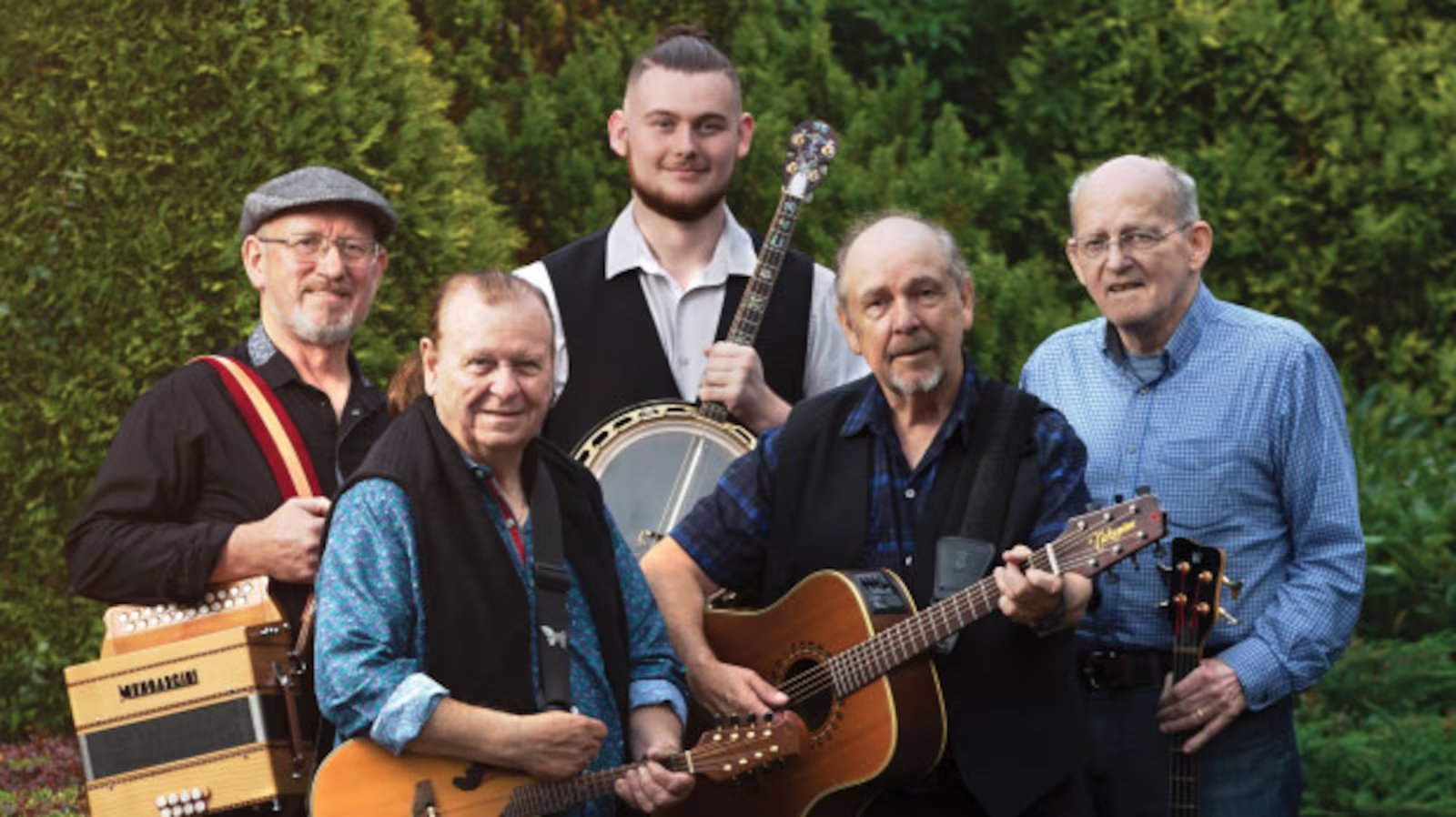
‘We had great times up there over the years’ – The Fureys prepare to bid a last farewell with Belfast and Derry gigs.
The revered folk band are retiring after 50 years on the road, writes Robert McMillen.
The Fureys and Davie Arthur were always a feature of musical life from the 60s onwards
By Robert McMillen
November 21, 2025 at 8:53am GMT
Speaking to George Furey of the famed Furey Brothers was a beginning and an end. A beginning in that George was doing an interview using Zoom for the first time, and an end as we were chatting about the last ever gigs the band will be playing in Belfast and in Derry.
They are both places the Fureys (and Davey Arthur) have fond memories of in 49 years of delighting audiences at home and around the world.
There is nothing nicer than a band singing a song, stopping, and letting the audience sing the rest, and the Fureys are masters of that
— Robert McMillen
“We had great times up there over the years,” says George.
“In the early years when we played in the Ulster Hall, which always had a great atmosphere in it – although we once had a fella who was used to performing in pubs in Dublin who was petrified at having audience members sitting on stage behind him!
“He was surrounded and didn’t know what to do,” says George.
There was, of course, no need, as a Fureys gig has all the feeling of a family get-together, band and audience.
There is nothing nicer than a band singing a song, stopping, and letting the audience sing the rest, and the Fureys are masters of that. So it’s no wonder 2026 will see George and the band celebrating their 50th year playing together. But of course, the story goes back to the parents, Ted and Nora. “Ah, they were great people,” George reminisces.
“They were great talkers. So many of the songs that were written for us over the years, particularly the one Phil Coulter wrote for us, The Old Man, are stories about our father and mother when we were growing up.
“I remember many years ago, we were away—1973—I went to Copenhagen with my father and he was playing in this fiddlers’ festival. There were all these fiddle players from Scandinavia and of course my father was invited over, and he asked would I come for company, and I stayed with him for most of my life playing music.”
While Ted Furey was pivotal in his sons’ musical direction, George says he can’t leave his mother out.
“Our mother was born in Tipperary town and she was always humming songs when she was doing the housework in the morning time, and that’s where we got the idea for Sweet Sixteen, because she used to hum it around the house.
“And we were asking her one time, we said, where did you get that song from? And she told this whole story about the man who wrote it, Jimmy Thornton – who also came from Tipperary and who emigrated off to Chicago, where he became a comedian and married his girlfriend Bonnie Thornton.
“And so my mother told us a whole lot. And I remember going into the studios one Sunday afternoon and recording Sweet Sixteen. It only took one take, which goes to show – you always listen to your mammy,” he laughs.
When they were young, there was little time for doing much else but play music, and as kids, they did a lot of busking.
“Our father used to have us at the football matches,” George recalls.
“We used to go to all the football matches and we’d busk. Not only on the train, there and back, but we’d go into the football ground and play.
“I remember in Croke Park, you could walk right around where there was a little place. We used to go over the wall, so we’d have the accordion going over the wall and then me over and my brother Paul, and we’d busk inside!”
When the Furey boys became of age, they went their own ways and, oddly enough, it was a car accident that brought them together.
“Yeah, myself and my brother Paul and Davey Arthur, we had the band called The Buskers. And we used to play an awful lot on the continent all the time. But I remember we were coming down from Hanover, and we were travelling down to Frankfurt, and as we were going along, we stopped at a set of traffic lights when a guy smacked into the back of us.
“Luckily enough, nothing really happened to us, but the news went around that we were all very hurt.
“The one who crashed into the back of us was heading off to see his wife in hospital, where she had just delivered her first child.”
So not only was a child born, but The Fureys and Davey Arthur were also born.
“We always said, if anything is going to happen to us, let us be all together there. At least we can look after each other,” says George.
While the Fureys are best known for their ballads and singalong favorites – I Will Love You, When You Were Sweet 16, Red Rose Café, Leaving Nancy, The Old Man, From Clare to Here – their influence goes way beyond that.
Did you know that legendary indie Radio 1 DJ John Peel made Her Father Didn’t Like Me Anyway – the song written for Eddie Furey by Gerry Rafferty of Baker Street fame – his single of the year in 1973?
Or that Dave Stewart of The Eurythmics has credited Eddie with teaching him his first chords on the guitar while still a teenager?
The band’s musical longevity is down to the fact that you’ll know a Fureys song from the moment you hear the first chord.
“Other bands, like The Dubliners, you knew it was them, and the Clancy Brothers especially were brilliant at what they did, and that’s the way we were – we wanted to do our own thing all the time, and people would identify us by that.
“But not only that, we always put our heart and soul into songs. They mean an awful lot to us and they come from the heart,” says George.
Inevitably, changes have occurred over the years. Their brother Paul died suddenly in June 2002, Finbar left the band in December 1996, and Davey took a stroke in March 2014. However, George and older brother Eddie have continued to delight audiences on their tours and releasing CDs.
But all good things come to an end, although George doesn’t recognise the word “retirement.”
“For me, retirement is giving it up. We were born into the music and I’ll probably end up with the music, that kind of way.”
The Fureys will say farewell to Belfast with their last ever concert in the city at the Waterfront Hall on Friday, January 2, while their final gig in the north will be at the Millennium Forum on Thursday, May 21, 2026.
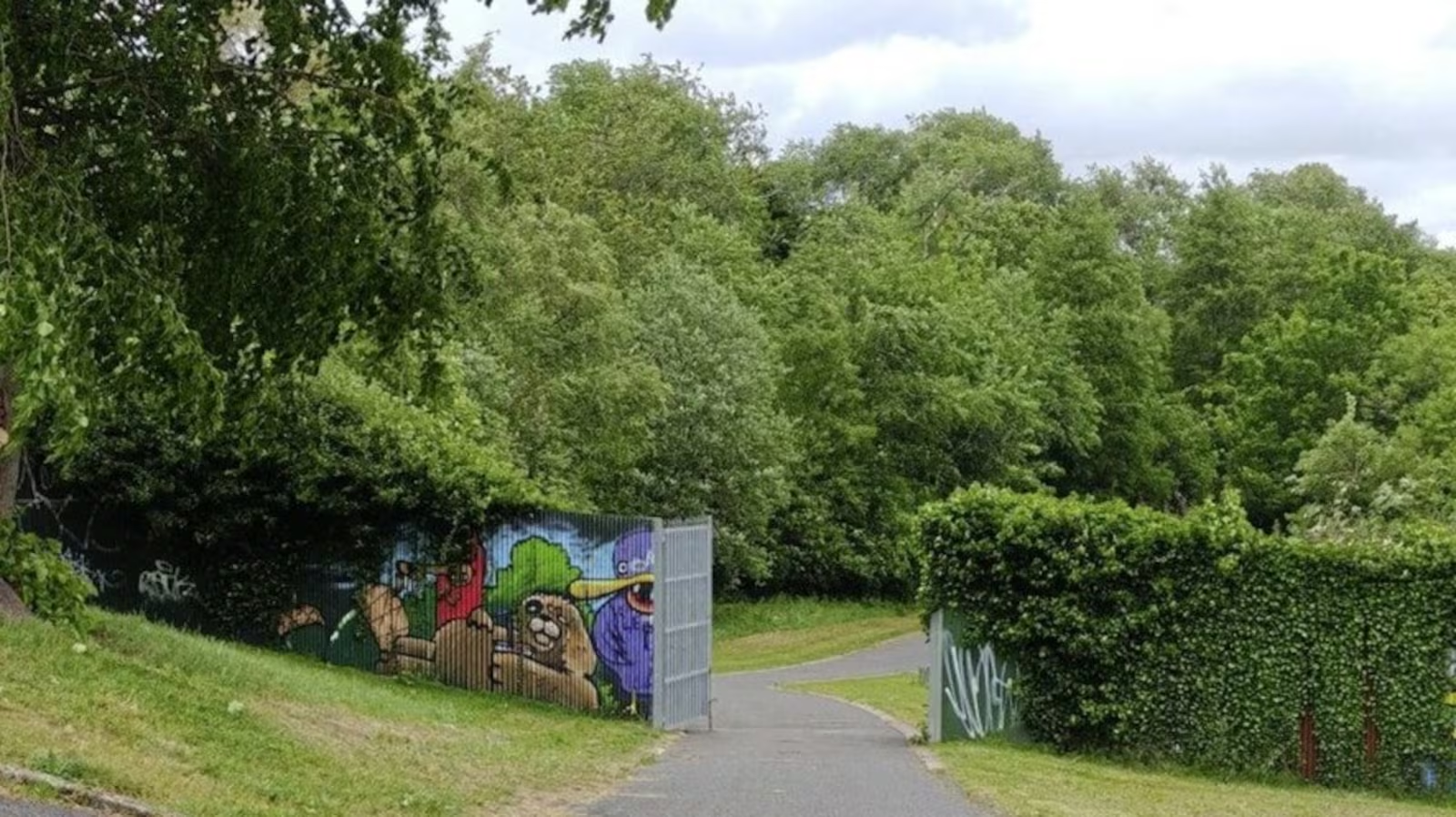
‘Conversation’ begins about potential removal of Alexandra Park peace wall. Structure dividing the north Belfast park will only be removed with residents’ consent.
The peace wall and gate at Alexandra Park in north Belfast.
By Michael Kenwood November 23, 2025 at 12:44pm GMT
A so-called peace wall that has dissected a north Belfast park for decades could be removed but only if nearby resident’s consent.
A Belfast City Council committee has agreed to a proposal to consult with locals before demolishing the barrier at Alexandra Park.
The wall has stood for more than 30 years, however, one councillor described the area, which last summer was the scene of rioting and ant-social behavior, as a “battleground”.
The park is managed by the council, while the wall belongs to the Department of Justice.
Alexandra Park is due to benefit from £12m investment through the European Peace plus programme that will see the provision of new sports and recreation facilities, as well as improving the connection to the nearby Waterworks.
The original proposal to remove the peace wall was tabled by Alliance representative Sam Nelson, who noted that Stormont’s Together: Building a United Community (T:BUC) strategy had aimed to remove all interface structures by 2023.
A Sinn Féin amendment, forwarded by Councilor Ryan Murphy, that “prioritises concerns of surrounding residents”, was accepted by Alliance.
Mr Nelson told last Friday’s meeting of the strategic policy and resources committee that the wall in Alexandra Park had stood for more than 30 years – “longer than the Berlin Wall stood”.
“The current plans are to re-image the wall but I don’t believe in 2025 we should be giving a facelift to division,” he said.
“It is something we should be showing leadership on, and this is the time to do it.”
Mr Murphy described the wall as “a blight” but said the Peaceplus funds presented an opportunity to have a “conversation” about the wall’s removal.
He said there was also an opportunity to provide much-needed “pitch provision”.
DUP councilor Fred Cobain said he was supportive of removing peace walls but that over recent years Alexandra Park had been a “battleground”.
“As far as I am concerned the most important part is the consultation of those who live in that area, and without their approval, obviously this thing is not going to go anywhere,” he said.
SDLP councilor Carl Whyte claimed the council had no authority to intervene and that responsibility lay with the Department of Justice.
“We would all like to see peace walls removed after engagement with local communities, but I question the decision by Alliance to bring this motion to Belfast City Council – a body with no power to intervene and remove this wall,” he said, indicating that responsibility lay with Alliance Justice Minister Naomi Long.
A Department of Justice (DoJ) spokesperson said officials were working with Belfast City Council and other partners on the redevelopment plans for Alexandra Park, including the potential changes to what was termed “the existing interface structure”.
“Community consent is a crucial consideration as part of any interface reduction or removal scheme,” the DoJ spokesperson said.
“The support and positive engagement of local political representatives is very welcome in helping to lead that conversation.”
According to DoJ, large portions of the wall are “redundant”.
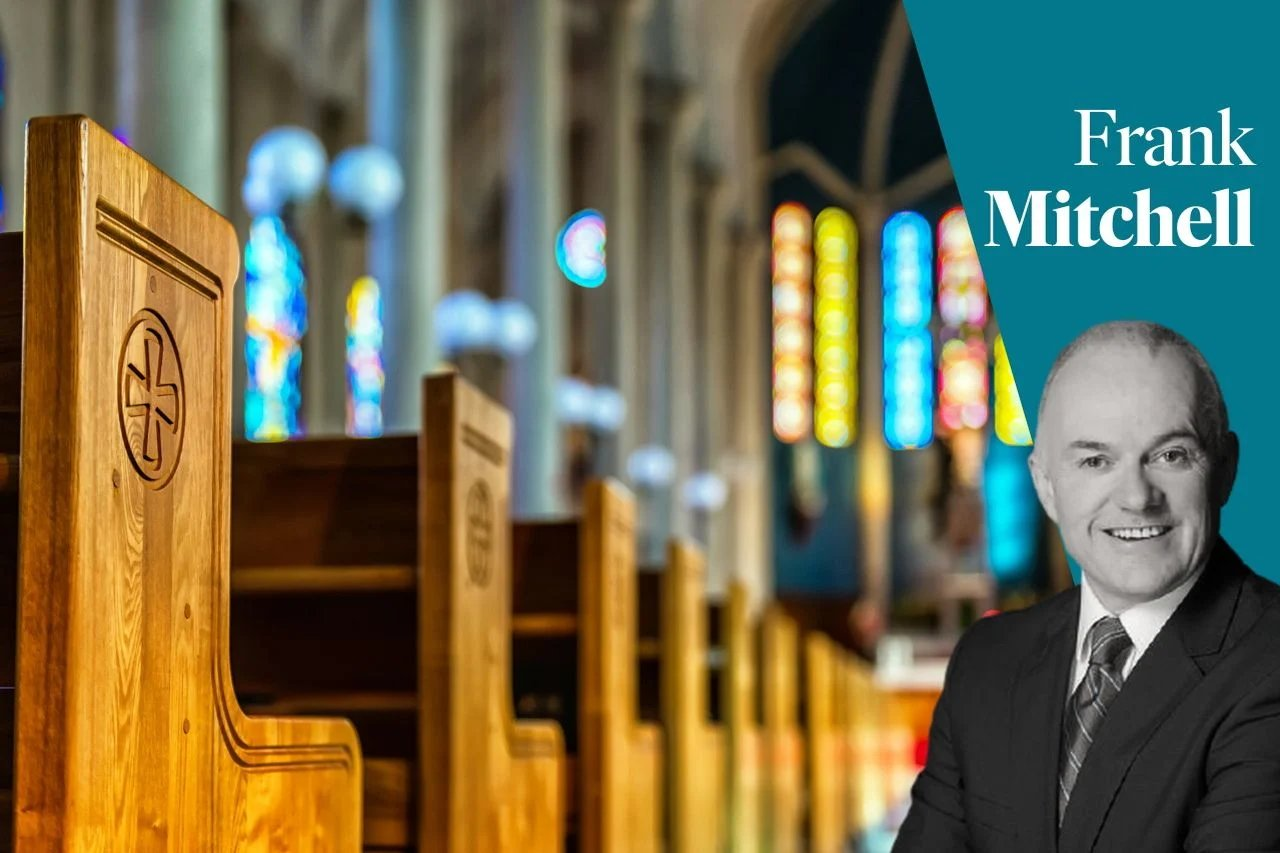
I’ve been invited to speak at mass… but I’m not sure if I can accept it.
Out of nowhere came an invitation to speak at mass
Frank Mitchell
Today at 07:30
I’ve pinned badges on scouts. I’ve placed sashes on winners and rosettes on losers. I’ve picked roses for Tralee and Marys for Dungloe. I’ve switched on lights, cut ribbons, unveiled plaques, abseiled off buildings and walked on hot coals. I’ve named the shortlisted and crowned the champions.
Throughout my career the invitations have been regular and varied and I thought I had done everything possible — that is, up until this week.
Out of nowhere came an invitation to speak at mass. This wasn’t from my local priest or any priest I know. Instead, the headed note paper belonged to a successful Ulster businessman with a great passion for the Pioneer Total Abstinence Association.
He is encouraging people in his community to stay off what the Reverend Ian Paisley used to call “the devil’s buttermilk”. Some Irish Catholics and Free Presbyterians are united in their dislike of alcohol and can be equally vocal on the dangers and impurities.
Quite early in the letter, the businessman reassured me I would not be expected to preach. Rather, he is hoping I can talk openly about life free from alcohol and how I managed to live some 60 years without it ever crossing my lips.
To be honest, I’m not sure if I can do this. I never had any desire to drink. Growing up, I was slightly afraid of people who were drunk. Neither of my parents were drinkers and there was never any alcohol in our house. When I did see people drinking at community events, they seemed loud and clumsy. For a child looking in, this was quite unnerving.
By the time I was old enough to be in the company of the underage drinkers, it never crossed my mind to join them. I was always able to have plenty of fun without any artificial stimulant, and I’m still like that today. Maybe it’s because I like to be in control of situations. Or am I possibly too afraid to start drinking in case I’m a latent alcoholic? I have no idea. I don’t need drink to boost my confidence, but I seem to be lacking the necessary self-belief to accept the invitation to speak at the mass where the pioneer members will be honoured with the special lapel pins which once were a common sight in Catholic Ireland but are now something of a rarity.
The Total Abstinence Association was a strong organization when I was a child. It was a genuine effort aimed at stopping Irish people from drinking themselves to death. Sadly, at that time, many were.
In more recent years, there has been a culture of social drinking with a continental sophistication adopted by many families. But sometimes that hides the demons of addiction and the health problems connected to alcohol.
Is it my job to encourage people to take the pledge and be teetotal? I don’t think so. Moderation is the best approach, but it’s not the approach of the Pioneer Total Abstinence Association. Is it possible to admire the moderate drinker and still applaud those who refrain completely from the temptation?
At some point the priest will interrupt the mass. I will be called forward and, from a marble lectern, deliver my testimony.
It is an honor to be invited, but will large swathes of the congregation feel uneasy, or even queasy, after a late night on the tiles? I can’t make up my mind. Should I accept or not? It’s a tough decision. There are times I think the pressure of choosing the right thing to do is enough to drive me to drink!
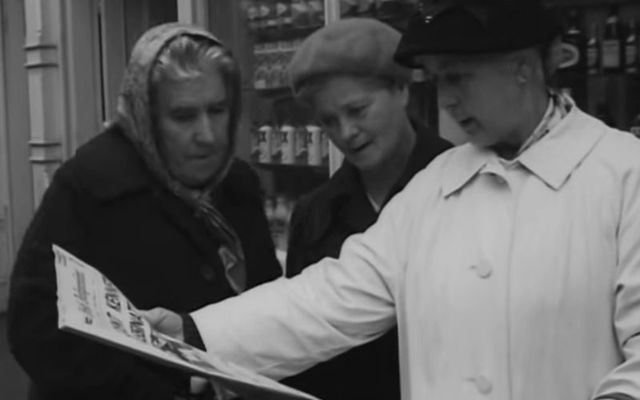
Three local New Ross women read the Irish Independent the day after President John F. Kennedy was assassinated. British Pathé YouTube
Locals in New Ross, Co. Wexford, were in a state of mourning the day after US President John F. Kennedy was assassinated in Dallas, Texas, on November 22, 1963.
President Kennedy was assassinated while driving through Dallas, just five months after visiting his ancestral homeland in New Ross, Co. Wexford.
Archive footage from British Pathé shows locals in New Ross as they react to the news of Kennedy’s death on November 23, 1963.
Sign up to IrishCentral’s newsletter to stay up-to-date with everything Irish!Subscribe to IrishCentral
Three women can be seen reading the Irish Independent bearing the headline “President Kennedy Assassinated – Shot While Driving,” while the flags of the Royal Hotel in the town are at half-mast as a mark of respect for the Irish American US President.
A separate headline notes that Kennedy’s death has caused “Shock to the Irish Nation.”
The footage also shows local children walking up the steps that Kennedy’s great-grandfather used to walk on his way to school before emigrating to the United States in the 1800s.
Just months before his assassination that shocked the world, John F. Kennedy became the first sitting US President to visit Ireland.
In June 1963, the Irish American US President spent four days in Ireland, visiting Dublin, Cork, Galway, and Limerick, as well as his ancestral home in New Ross.
As the first Roman Catholic President of the US and a proud Irish American, Kennedy was jubilantly received by the Irish people, particularly in New Ross.
On his last night in Ireland, Kennedy was the guest of President de Valera and his wife, Sinéad, an accomplished Irish writer, folklorist, and poet.
During the evening, she recited a poem of exile for the young president, who was so impressed that he wrote it down on his place card.
Over breakfast the next day, JFK memorized the poem and recited it in his last speech at Shannon as he departed.
On This Day: JFK, first Irish American Catholic President of the US, assassinated in Dallas
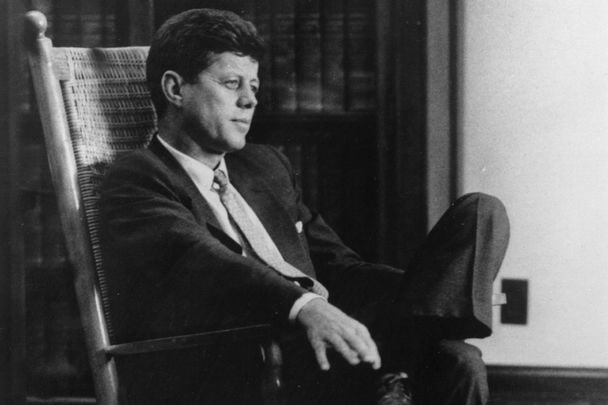
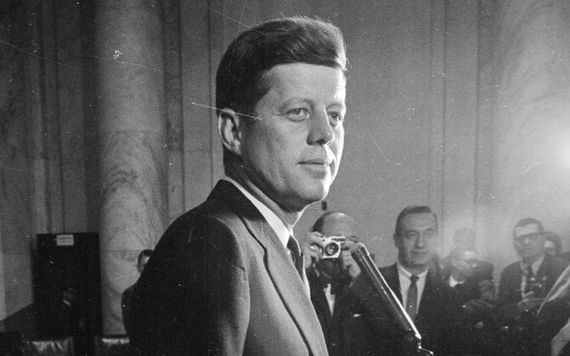
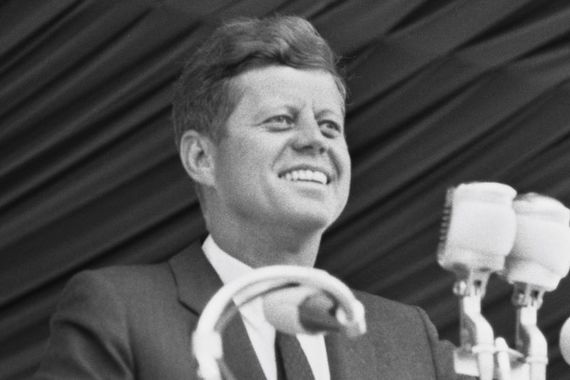
President John F. Kennedy was assassinated in Dallas, Texas on November 22, 1963. Here is a look at the life of the Irish American President that was tragically cut short.
On November 22, 1963, John F. Kennedy, the first Irish American Catholic President of the United States, was assassinated in Dallas, Texas.
John Fitzgerald Kennedy once said: “There are three things in life: God, human folly, and laughter. The first two are beyond our comprehension, we must make the best of the third.”
On November 22, 1963, the laughter died, not only for JFK but also for the United States of America.
For most baby boomers, there are two dates that stick out in their minds -November 22, 1963, and September 11, 2001. Both moments of unbelievable national tragedy.
But maybe 11/22/63 was a little tougher because all Americans knew the man. He barely won the 1960 election – although the following year over 60% of Americans said they voted for him – but, he brought something special to the White House – a beautiful young family, laughter, culture, and class.
Whatever you feel about John F. Kennedy, the rest of the world saw this man who represented the United States of America and what they felt was simple – hope.
3
John F. Kennedy in 1960. (Getty Images)
Sign up to IrishCentral’s newsletter to stay up-to-date with everything Irish!Subscribe to IrishCentral
Uniquely Irish
Kennedy was uniquely Irish. He was the great-grandchild of immigrants from Co Wexford. Thanks to his family’s great wealth he never suffered poverty or hard discrimination—save for those Boston Brahmins who thought him “Shanty Irish”—but in his gut, he was a Fenian.
In this day of draft-dodging political cowards—“Chickenhawk” is the perfect description—Kennedy used his father’s influence to get into the United States Navy during World War II.
As the skipper of the PT-109 in the hotly contested Solomon Islands, his plywood boat was cut in half by a Japanese destroyer during night action and he was violently flung back on the bridge, ruining his back for the rest of his life. He gathered his crew around him, saving a badly burnt crewmate by slipping a belt under his arms, putting the belt in his teeth, and towing the man to an island. For his valor, he was awarded the Navy and Marine Corps Medal and the Purple Heart.
That’s a far cry from recent presidents who were outright draft dodgers or hiding out in safe places like the Texas National Guard.
3
June 1963: President John F. Kennedy in Co Limerick, Ireland. (Getty Images)
A triumphant year
The last year of Kennedy’s life was a whirlwind. In October 1962, he faced down the Russians over missiles in Cuba. The generals wanted war, but the President, who knew war firsthand, managed a negotiated settlement which the world saw as a win for the young President.
The first half of 1963 brought unparalleled success to Kennedy. On June 11, 1963, he gave a nationally televised speech about Civil Rights where he called upon Americans to give equal rights to their fellow Negro citizens because “We are confronted primarily with a moral issue. It is as old as the Scriptures and is as clear as the American Constitution.”
In 1964, Lyndon B. Johnson would pass JFK’s Civil Rights Bill just as it was written by Kennedy.
On June 26, 1963, Kennedy gave his famous “Ich bin ein Berliner” speech in Berlin which built up the hopes of the population of Berlin while warning the Russians that their time would come.
Home to Ireland
Immediately after Berlin, Kennedy flew to Ireland, where he was greeted on the tarmac at Dublin Airport by President Éamon de Valera.
The RTE feed is one of unabashed pride as it reads: “Welcome Mr. President.”
Kennedy went on to address the Irish Parliament, the Dáil, but the thing that stands out on that Dublin visit is that he took the time to visit Arbour Hill where 14 of the 16 martyrs of the Easter Rebellion are buried in a mass grave.
It is poignant to see him reading the names of the patriots on the side of the grave as Taoiseach (Irish Prime Minister) Seán Lemass, who knew many of these men, walks at the President’s side.
Kennedy took pride in his Irishness as one can see from this clip when the Clancy Brothers and Tommy Makem sang “We Want No Irish Here” for the President. Liam Clancy’s cheeky introduction manages to elicit a huge smile out of the President.
JFK said goodbye to Ireland at Shannon Airport in County Clare, but promised “I’ll come back in the spring,” but he had already lived his last spring.
Tragedy strikes, then Dallas
August was to prove a momentous month for Kennedy. On August 5, 1963, he signed the Nuclear Test Ban Treaty, which made the world safer for every human being, but just four days later tragedy struck when his infant son, Patrick Bouvier Kennedy, died two days after his birth.
Jackie Kennedy disappeared for months but reemerged in November for a two-day political tour of the Texas cities of San Antonio, Houston, Fort Worth, and Dallas.
The President was greeted by fantastic crowds in the supposedly hostile territory. You can see the President obviously enjoying himself as he and the First Lady work the crowds. In his last speech, he issued a prescient warning saying we live in “a very dangerous and uncertain world.”
On the arrival of Air Force One at the ironically named Love Field in Dallas, the President and Mrs. Kennedy again worked the crowd, but, in the background there can be seen a Confederate flag stubbornly flying, reminding the world that not everyone approved of his Civil Rights agenda.
20 minutes later, the President was shot and a shocked nation listened to Walter Cronkite, in tears, give the terrible news of the assassination of the nation’s 35th president.
John F. Kennedy was President for less than three years, but in that short span of time, he pointed the nation toward the 21st century. He steered the nation to outer space and the moon explaining that “We do these things not because they are easy, but because they are hard.”
JFK set about fulfilling President Lincoln’s promise to the slaves at home and promoting peace abroad, sending American volunteers around the world to serve in the Peace Corps.
He was not without his faults. He was a man with a weakness for the flesh, but he did not blatantly brag about it. He tried to lift a nation and push it forward—and he succeeded. That’s why now, decades after his death, he is still fondly remembered around the world, especially in the small island nation that gave the world his family.
*Dermot McEvoy is the author of the “The 13th Apostle: A Novel of a Dublin Family, Michael Collins, and the Irish Uprising” and “Our Lady of Greenwich Village,” now available in paperback from Skyhorse Publishing. He may be reached at dermotmcevoy50@gmail.com. Follow him on his website or on Facebook.
*Originally published in 2016. Updated in November 2025.