The Anglo-Irish Agreement, signed on November 15, 1985, gave the Irish Government an advisory role in Northern Ireland’s Government and proved to be a stepping-stone in the peace process.
Irish Central Staff
@IrishCentral
Nov 15, 2025
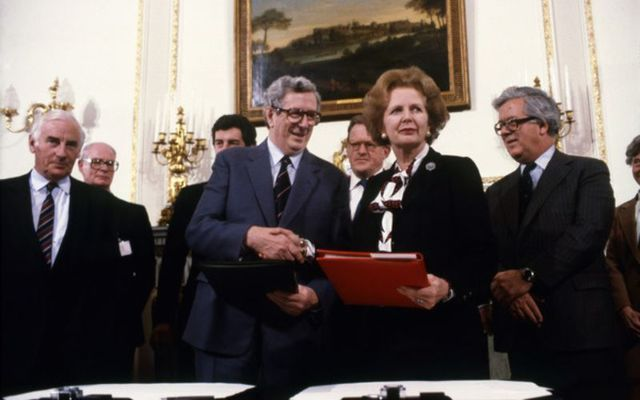
Taoiseach Garret Fitzgerald and British Prime Minister Margaret Thatcher after the signing of the Anglo-Irish Agreement in 1985.
Former Irish Prime Minister Garret FitzGerald appealed to Ronald Reagan’s sense of Irish history and neighborly pride to help broker the ground-breaking Anglo-Irish agreement, which was signed on November 15, 1985.
The Anglo-Irish Agreement, which aimed to bring the Troubles to an end, gave the Irish Government an advisory role in Northern Ireland’s Government while also confirming that there would be no change to the region’s constitutional position unless a majority of citizens agreed.
It additionally set out the conditions for a devolved power-sharing government in the region and proved to be a stepping-stone toward peace in the region.
The Agreement was signed by British Prime Minister Margaret Thatcher and Taoiseach Garret FitzGerald on November 15, 1985, at Hillsborough Castle in Northern Ireland.
In 2012, a summer school set up in honor of FitzGerald heard that former US President Ronald Reagan played a key role in brokering the deal between the Irish and British Governments.
The inaugural Garret FitzGerald Summer School in Killarney heard in 2012 how the FitzGeralds and the Reagans came from the same parish in south Tipperary.
The Irish Times reports that FitzGerald’s son Mark told the Summer School how the ancestral links between the two families helped to sway British Prime Minister Margaret Thatcher to back the agreement.
He said: “Mr. Reagan’s huge help to Ireland in that period, in the run-up to 1985 and the signing of the agreement, was not fully appreciated.”
Mark revealed how the FitzGeralds from Skeheenarinky and the Regans from Ballyporeen came from the same hillside.
“The families lived “3½ miles apart in south Tipperary, and the Fitzgerald’s and the Reagans had actually been godparents at each other’s christenings,” he revealed.
The paper reports that Dr. FitzGerald’s grandfather, Patrick FitzGerald, a laborer, emigrated to London in the 1850s or 1860s, while Mr Reagan’s great-grandfather had also left for London around this time, and afterward went to the US.
Dr. FitzGerald’s father, Desmond, Minister for External Affairs in the first Irish government after independence, was born in London.
Mark Fitzgerald added: “It is not widely known how influential Mr Reagan had been in working on my father’s and Ireland’s behalf in persuading Margaret Thatcher, then British prime minister, to come around to the terms of the Anglo-Irish Agreement.
“There were regular telephone calls and consultations between my father and Mr Reagan to help bring about the agreement, which laid the foundations for the Belfast Agreement 13 years later.
“Reagan was a huge help to us in persuading Thatcher to sign the Anglo-Irish Agreement. She’d agree to anything Reagan wanted. He helped Ireland in a big way.”
Speaking at the event organized by Young Fine Gael, Mark FitzGerald added: “Garret loved young people, he loved Fine Gael and politics but what would Garret say if he were here today?
“He would say the most important thing in politics is to have common high standards while embracing different views. He would say challenge people, be curious. He always said don’t complain – do something.”
Although the Anglo-Irish Agreement failed to bring the Troubles to an end, it did improve cooperation between the Irish and British Governments and was therefore a key initial step in the Northern Irish peace process.
By signing the Agreement, the British Government acknowledged the legitimate wishes of the Irish Government to have an interest in the affairs in Northern Ireland and also boosted the popularity of the peace-advocating SDLP among nationalist communities.
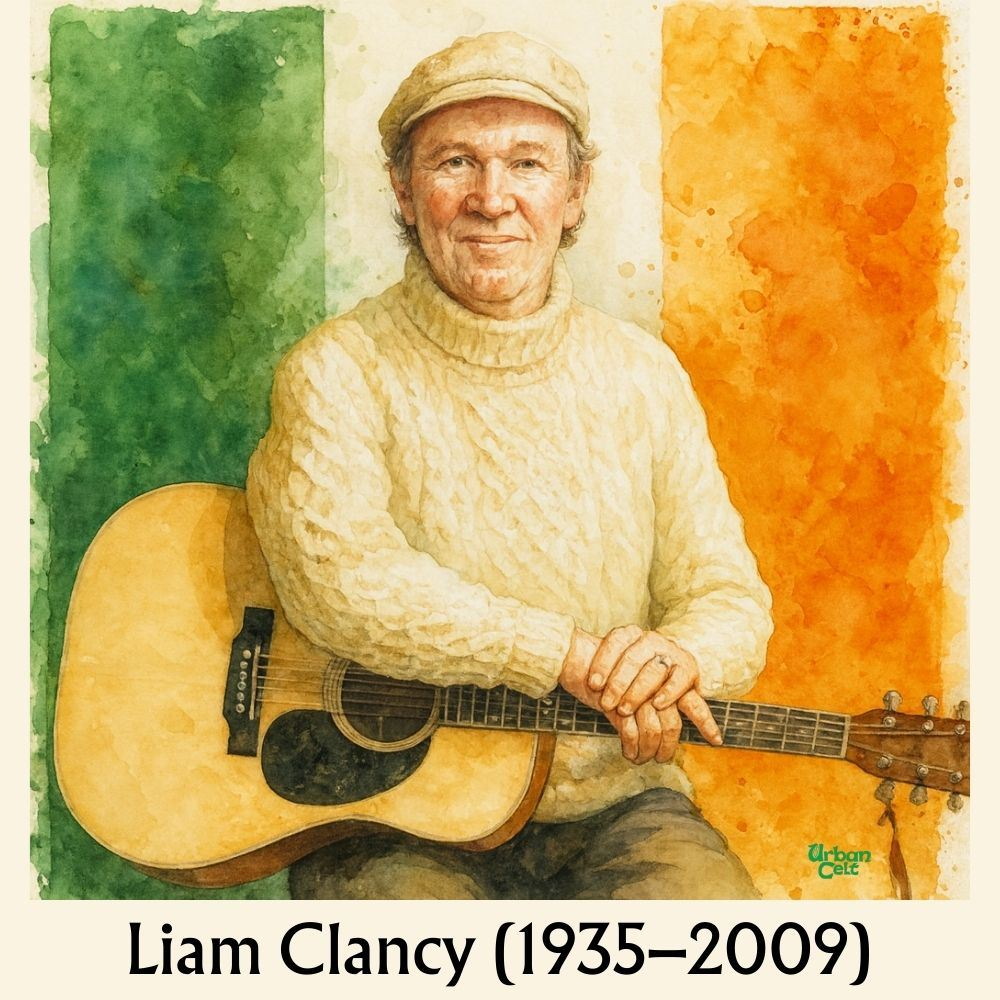
Liam Clancy was born in 1935 in Carrick-on-Suir, County Tipperary, and became one of Ireland’s most beloved folk singers before his death in 2009. As the youngest member of The Clancy Brothers, he helped the group achieve something remarkable—they became what many consider Ireland’s first true pop stars, reaching massive international fame during the 1960s.
Together with Tommy Makem, Liam and his brothers introduced Irish ballads to audiences around the world. They sold millions of records and filled prestigious venues like Carnegie Hall, captivating listeners with their powerful performances. Their breakthrough moment came with a famous 1961 appearance on The Ed Sullivan Show, which brought Irish folk music into American living rooms.
What set Liam apart was his extraordinarily rich, dramatic voice and his gift for storytelling through song. After his time with The Clancy Brothers, he went on to build an impressive solo career. He also reunited with Tommy Makem to perform as Makem and Clancy, continuing to shape how Irish ballads were interpreted and performed. His influence can still be heard in the work of folk artists today, making him a true giant of Irish traditional music
Why should ordinary people have to pay more for Britain’s ineptitude? – The Irish News view.
Chancellor’s budget will do nothing to ease pressure on many squeezed household incomes.
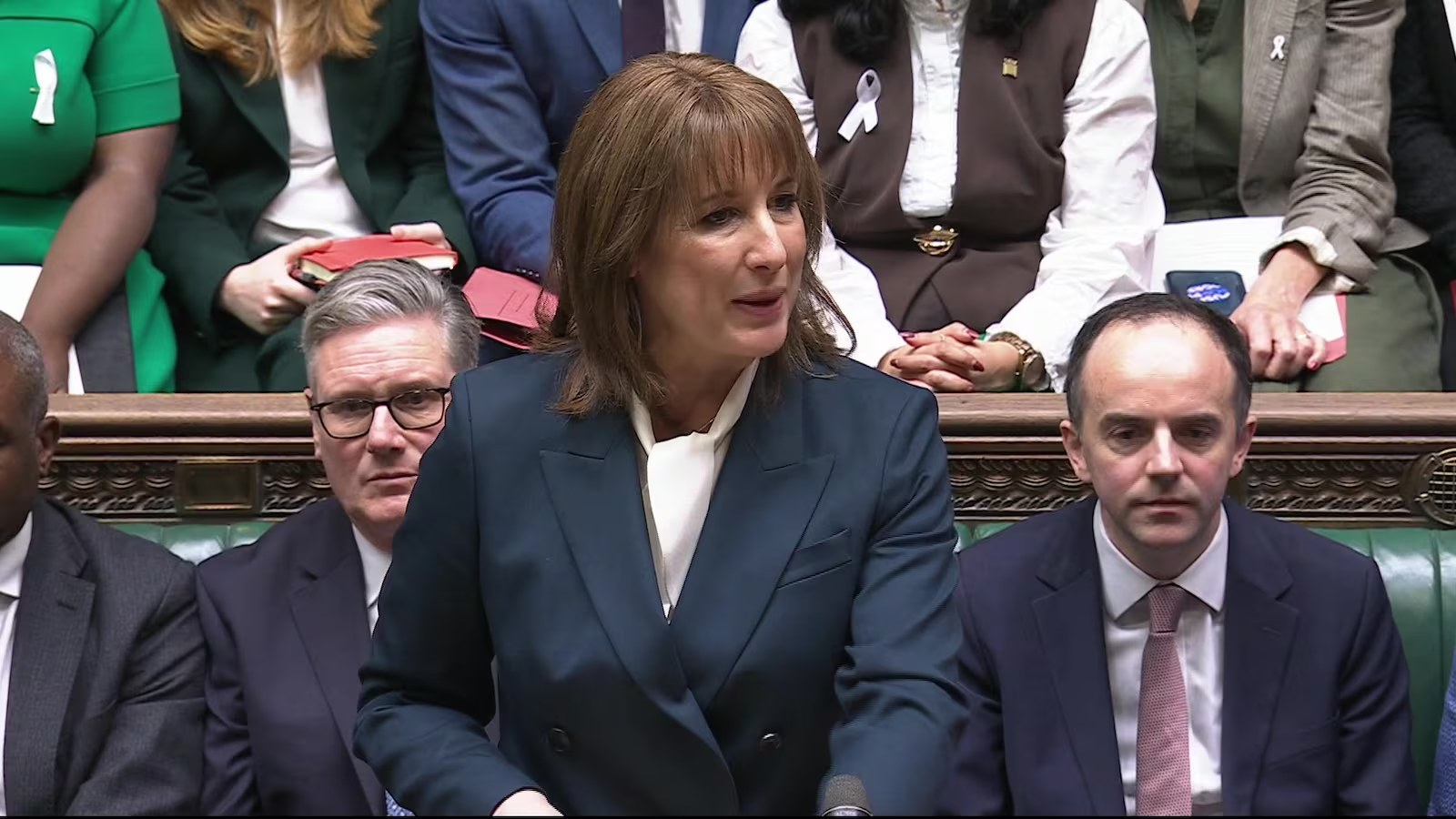
Rachel Reeves delivers her Budget in the House of Commons
By The Irish News
November 27, 2025 at 6:00am GMT
First, the good news. The Conservative government’s cruel decision almost a decade ago to limit some benefit entitlements to the first two children in a family is being scrapped.
The change will have a particularly big impact in Northern Ireland, where around one in five families have more than two children.
Campaigners say it could be transformative in tackling rising levels of child poverty. In fact, in a single budget announcement, the Labour government has probably achieved more than the entire contents of Stormont’s widely-criticised anti-poverty strategy.
Chancellor Rachel Reeves also said the Northern Ireland Executive would be given an additional £370m in block funding over the next three to four years.
This will certainly be welcomed but only go so far – ministers say they face a shortfall of at least £400m this year.
A small increase in the minimum wage will also mean a deserved pay rise for many workers.
But it was about there the good news ended, in what will be remembered as one of the most chaotic budgets in recent history.
Every family is acutely aware that the cost of living has risen sharply – it can be felt every time we visit a shop or pay for other services.
And the decision to freeze income tax and national insurance thresholds for a further three years will only further squeeze household incomes.
The number of taxpayers in Northern Ireland paying the 40% rate has already doubled in recent years and will now rise further – the very definition of a ‘stealth tax’.
The chancellor’s admission that she is asking “ordinary people to pay a little bit more” might be more convincing if the tax burden was not at its highest level in decades. People here will not even benefit from savings on energy or prescriptions in England.
A wide range of other taxes were also announced, targeting everyone from latte-drinkers to electric car owners, but conspicuous by its absence was a coherent plan to boost growth in the anemic British economy.
Yet again, the elephant at Westminster was the catastrophic impact of the UK’s kamikaze decision to turn its back on its biggest trading market.
Until Brexit is reversed, and with Stormont clearly unwilling or incapable of taking the tough decisions required for the economy and public services, the voices calling for a fundamental rethink of relationships on these islands will only grow louder.
If you have an opinion on the issues raised in this article and would like to submit a Letter to the Editor to be considered for publication
The Ancient Order of Hibernians has condemned a report out of London entitled “Peak Ireland? Ireland’s Diplomatic Challenges and the Lessons for the UK.”
The report has been released by the London-based Policy Exchange and includes a foreword by former U.S. National Security Advisor Robert C. O’Brien.
The AOH has labelled the report “a British polemic dressed in borrowed credentials with an American accent, designed to weaken U.S.–Irish relations.”
The report, according to an AOH statement, brands Ireland a “freeloader” that “sat out the fight against fascism,” while ignoring that Ireland aided the Allies through the Donegal Corridor, D-Day weather data from Blacksod Point, and cooperation with MI5 against German agents.
The AOH noted that disagreement is not disloyalty: Ireland’s UN record mirrors many NATO allies.
“The UK’s own recognition of Palestine proves friends can differ; Ireland is entitled to the same freedom — friendship should not be confused with fealty,” stated Neil Cosgrove, the AOH’s National Political Education Chair.
“This is a transparent attempt to undermine Ireland’s ‘special status’ in Washington in favor of the so-called ‘special relationship.'” wrote Cosgrove.
In his foreword to the report O’Brien stated: “Ireland has long enjoyed a privileged status in Washington, DC. This has served Dublin well through challenging times…But in an era in which the United States under President Trump is seeking to put the American interest first, the U.S. relationship with Ireland is coming under unprecedented scrutiny.”
“The Trump administration seeks to bring back jobs and production in critical sectors to the United States. But Ireland, a low-tax haven for international business, has gained a huge advantage for its own economy by offering sweetheart tax deals for American tech and pharmaceutical companies to leave our shores for theirs.”
“All the while, despite its professed neutrality, Ireland pursues an increasingly activist foreign policy that is marked by its divergence from everything the Trump administration stands for, particularly in the Middle East.”
“This Policy Exchange report brings together a wealth of information about the Irish model of economics and foreign policy in a dispassionate and forensic way. It should be required reading for American lawmakers, given the special status that Ireland continues to enjoy on the Hill…For strong believers in the Irish relationship, all is not lost. Importantly, this report shows that a growing number of voices in Ireland are worried about the consequences of such an approach.”
The AOH described the Policy Exchange as a “center-right London think tank with frequent engagement with the UK’s security and defense establishment. Though it is fronted by a foreword from former U.S. National Security Advisor Robert C. O’Brien, this is a UK publication dressed in borrowed American credentials.”
The AOH, in its statement, said it was “deeply disturbed that a publication seeking political traction in London and Washington, fronted by a former presidential advisor, would distort history to cast Ireland as cowardly, unreliable, and disloyal. The foreword claims Ireland ‘sat out the fight against fascism’ and calls it a ‘freeloader.’That is not analysis — it is propaganda posing as analysis, and it disrespects both Ireland’s historical record and its right as a sovereign democracy to chart its own course.
The AOH statement continued: “In 1939, Ireland as a nation was only 17 years old and one of the poorest countries in Europe. It was small and lightly armed: about 41,000 in the regular army at peak and fewer than 300 naval personnel manning a “navy” consisting of a World War I-era British gunboat used for fisheries patrol, a converted steam trawler adapted for minesweeping, and six small motor torpedo boats for coastal defense. The Air Corps had only a handful of obsolete biplanes and no radar.
“Joining the war would have brought bombardment and invasion Ireland could not resist. Neutrality was prudent pragmatism, not moral ambiguity. Yet Ireland still contributed to the Allied war effort, pushing at the boundaries of neutrality— facts Mr. O’Brien conveniently ignores: Donegal Corridor: Neutral Ireland allowed Allied flying boats vital access to the North Atlantic to protect convoys from U-boats (the Lough Erne Catalina that located Bismarck used this route)l Blacksod Point weather: As Europe’s westernmost station, Blacksod provided regular wartime observations that informed Allied Atlantic forecasts and the D-Day timing; Counter-espionage: Irish Military Intelligence (G2) worked with MI5, disrupting German operations and arresting agents such as Hermann Görtz; German airmen and sailors were strictly interned under the Hague Convention; while a benevolent blind eye was turned to Allied ‘escapes.’
“The report’s recycling of the well-worn ‘De Valera Hitler condolences’ chestnut is especially deplorable. It misrepresents a single act of diplomacy by a leader renowned for his fastidiousness in upholding neutrality to the letter, not an expression of sympathy or admiration. That talking point is propaganda by repetition — emotionally charged, historically empty, and meant to distract from Ireland’s quiet cooperation with the Allied cause.
“As a sovereign democracy, Ireland has both the right and a responsibility to its own people to set its own course, even when others may disagree. The attempt to portray Ireland’s United Nations voting record as evidence of disloyalty is misleading; Ireland’s positions have been broadly in line with those of other European democracies, including many NATO members and U.S. allies.
“Not marching in lockstep is not disloyalty — it is the mark of genuine democracy. The UK’s recognition of Palestine, which diverges from U.S. policy, shows that allies can differ on matters of conscience without weakening their friendship. Ireland is entitled to the same freedom; friendship should not be confused with fealty.
“Modern Ireland may be neutral, but it has never been isolationist. Since 2001, over two million U.S. troops have transited Shannon Airport on their way to and from theatres of service, and Irish peacekeepers continue to serve alongside American and allied forces in UN and EU missions worldwide. Ireland’s record is that of a nation committed to peace, partnership, and international responsibility — not of a ‘freeloader.’
“That a UK policy institute should accuse Ireland of “freeloading” when Britain’s own flagship aircraft carrier must embark a U.S. Marine Corps squadron to field a full air complement, and the U.S. Navy must screen it because Royal Navy destroyers spend more time in dry dock than at sea, is the height of hypocrisy.
“The Policy Exchange report substitutes insinuation for evidence. It frames disagreement as disloyalty, cherry-picks history and statistics, and ignores reforms underway in Ireland’s defense forces and economic policy. It omits Ireland’s compliance with the OECD 15 percent global minimum tax, its adoption of the Commission on the Defence Forces plan, and its decades of quiet cooperation with U.S. and British security through Shannon and intelligence channels. It relies on a borrowed American name to give a UK polemic borrowed credibility.
“Peak Ireland? is not a policy analysis — it is a British polemic dressed in borrowed credentials with an American accent, and an ‘O’ thrown in for good measure. Its intent is not to inform but to influence. That is made plain in Mr. O’Brien’s own statement that it ‘should be required reading for American lawmakers, given the special status that Ireland continues to enjoy on the Hill.’
“This is a transparent attempt to undermine Ireland’s ‘special status’ in Washington in favor of the so-called ‘special relationship.'”