Local elections – Voters seek out new political territory
A strong performance by the Alliance Party and the Greens is one of the major trends of the local elections in the Six Counties, according to first results this Friday. The overall unionist vote is down, thanks to a poor performance by fringe unionist groups, while on the nationalist side, independent republicans and newcomers Aontú have made a significant breakthrough. While all of the nationalist parties have expressed satisfaction with the result, perhaps the biggest story of the election so far is the success of three independent republicans in their first outing. Dan Kerr was elected on the first count in Torrent in Mid-Ulster, while Gavin Malone has reportedly topped the poll in Newry, taking the seat vacated by the resignation of veteran republican Davy Hyland. Mark Gibbons is also likely to take a surprise seat in nearby Crotlieve. Both Sinn Féin and the SDLP have expressed satisfaction at avoiding what could have been an even stronger protest vote against the political mainstream. A respectable first outing by Aontú and a strong performance by independent nationalists has ensured that the overall nationalist vote is holding up and may see a slight increase. Sinn Féin made a breakthrough by winning a seat on unionist-dominated Lisburn and Castlereagh Council, marking its electoral return to the area since Paul Butler first won a seat for the party in Lisburn Council in the late 1990s. Teenager Taylor McGrann was also elected as the first Sinn Féin councillor in the Macedon DEA to Antrim and Newtownabbey Borough Council. However, the party lost a seat in the Collin area of Belfast to the auspiciously-named young candidate, Micheal Collins of left-wing People Before Profit, and in the Derg DEA of Derry. There were also major concerns for Sinn Féin in Derry city, where Dr Anne McCloskey is likely to take a shock first seat for Aontú, while the SDLP are polling unusually strongly in republican areas. Elsewhere, the SDLP are seeing mixed results across the Six Counties, but have polled well enough in north Armagh to take a seat from the DUP in Craigavon. The DUP’s first openly gay candidate, Alison Bennington who is running in Newtownabbey Borough Council, has been elected in a development which may come as a shock to her own party, which remains opposed to marriage equality. First time Green candidate Aine Groogan’s poll-topping performance in Botanic in South Belfast was one of the headlines from the first day of counting. However, there were asterisks and health warnings: the hardline anti-Brexit DUP also made progress in the same area, with the party’s local MP Emma Little-Pengelly boasting that it had secured the highest vote there for the first time. Overall, the jump in first preference of Alliance and the Greens has been hailed by commentators as an indication of a long-sought shift away from the nationalist-unionist divide. Their successes, mainly at the expense of unionists and particularly in urban areas, have chimed with election results today in England as an anti-Brexit vote. Despite losing votes to Alliance, the DUP were not the victims of the count, soaking up votes and seats from a further decline by the Ulster Unionist Party and the decimation or absence of unionist groups such as the UK Independence Party, the Progressive Unionist Party and the Traditional Unionist Voice. Nevertheless, the overall transition from unionism to a ‘cross-community’ vote confirms that the days of a built-in unionist majority in the Six Counties are reaching an end. Counting continues tomorrow and we will publish completed results over the weekend. MAY TO CARRY ON DESPITE HISTORIC LOSS In England, where local elections are also taking place, the Liberal Democrats party are the big winners, with the party doubling its presence on local councils at the expense of the Tories, who have lost some 1,200 seats, its worst local election result in 25 years. As Tory losses rose above 1,000, Theresa May said she had been expecting a “difficult election” and admitted Brexit was “an added dimension” to that result. She said: “I think there has been a very clear message from people to both main parties that they want us to get on and deliver Brexit, so I welcome comments from [Labor leader] Jeremy Corbyn that he thinks we should be working to ensure we can deliver a deal.”
Raymond McCord, Sr. A victims campaigner has cleared the first stage in his High Court fight to secure an inquest into the loyalist murder of his son more than 21 years ago. Raymond McCord was formally granted leave to apply for a judicial review over claims the ongoing delay breaches human rights, his lawyers said. The 65-year-old Belfast man described it as a groundbreaking development which offers new hope to him and others bereaved during the Troubles in Northern Ireland. He said: “We victims stand together irrespective of religion or politics.” Raymond McCord Jnr, 22, was beaten to death before his body was dumped at a quarry outside north Belfast in November 1997. The killing was carried out by an Ulster Volunteer Force gang based in the Mount Vernon area of the city. Despite a series of preliminary hearings, an inquest has yet to get underway. Delays have been linked to investigations into paramilitary crime attributed to the UVF unit who operated in the Mount Vernon estate. Raymond McCord Jnr was murdered by the UVF in 1997. In 2007 a major Police Ombudsman investigation established Special Branch officers colluded with the gang behind Mr McCord Jr’s murder and a series of other killings. Lawyers for the victim’s father have issued judicial review proceedings against the PSNI, the Coroner’s Service and the Department of Justice. They are seeking a declaration that his human rights have been breached. Mr McCord’s solicitor, Ciaran O’Hare of McIvor Farrell, confirmed that leave to seek a judicial review was granted in court today. A full hearing has been listed for June. “This case is the first of its kind, and it will have systemic ramifications for other similar legacy cases,” Mr O’Hare said. Mr McCord added: “No family should have to endure such a delay on the murder of a loved one. “Delay after delay, adjournment after adjournment which only benefits the state in ensuring that truth and justice is hidden as a result of the collusion in my son’s murder. “A court will now have to litigate this for the first time in an open forum. It’s been a long time coming but I’m nearly there.” END.
Voting has closed in local elections in the Six Counties after a quiet campaign which was overshadowed by non-local issues, mainly the crisis over Brexit, the political stalemate, and recent rioting in Derry.
The North’s 1.3m eligible voters enjoyed mild weather for polling, and the overall turnout is expected to reach over 50%, slightly down on the last two elections. It would be a smaller drop than had been feared for an election which is being held in isolation this time out.
A financial scandal over the spending of social funds failed to energise politicians or voters in Belfast, which saw turnout figures in the east and south of the city not reach 40% by 9pm. However, reports also suggested a slightly higher turnout in rural areas, as well as in west and north Belfast.
A total of 819 candidates are running for 462 council seats across eleven different council areas, a decrease from the 893 candidates who sought election in 2014.
The Democratic Unionist Party are fielding 172, Sinn Fein 155, the Ulster Unionist Party 117, the SDLP (Social Democratic and Labour Party) 85, and Alliance 84.
Newcomer nationalist/republican party Aontú has 16 candidates in the first electoral test for Peadar Tóibín’s party since he left Sinn Féin last year. There are also six independent republicans in the running.
An informal ‘exit poll’ by a Belfast-based political scientist claimed to have measured an increase in the vote share for the Alliance Party. It also reported a decline for the SDLP, which is contesting the election for the first time on the heels of its recently announced partnership with the 26-County Fianna Fáil party.
Counting begins at 8am tomorrow and will continue through Saturday. The first results are expected to be announced on Friday afternoon.
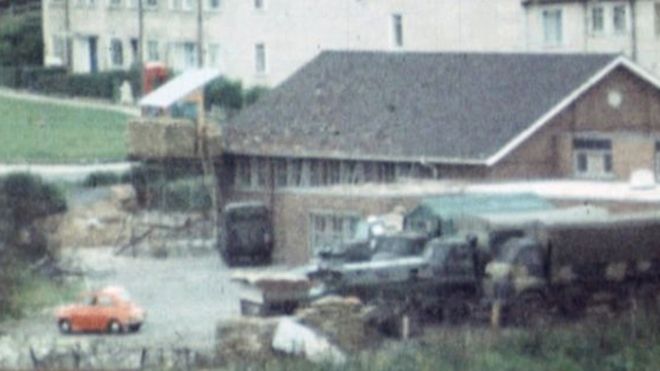
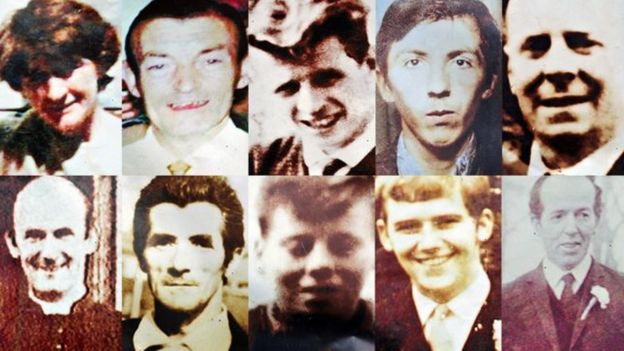
The inquest is looking into the shooting dead of 10 people in the Ballymurphy area of west Belfast in August 1971.
The shootings occurred amid disturbances sparked by the introduction of internment without trial in Northern Ireland.
M572 described shooting at the base coming from the surrounding area, beginning with a burst of four to five rounds from a Thompson submachine gun.
He said thought he saw smoke after that gunfire.
He said he thought Army sentries in sangars outside had returned fire at later shooting, and agreed that they would have been members of his platoon.
He was questioned at length why he did not remember the names of any of his fellow platoon members.
M572 said he had served several tours with many fellow soldiers, and had been new in the platoon at the time.
Later he was able to provide some extra names of soldiers he thought might have been present, to assist the coroner.
Image caption
Ten people were killed in the shootings at Ballymurphy in 1971
Later on 9 August 1971, he said, he went out alongside an armoured vehicle with about 10 soldiers on foot to recover the bodies of civilians lying in the manse area.
M572 said he was acting as lookout, and spent the time watching the surrounding area, without recovering any bodies himself.
He said that later, when back in the Henry Taggart base, he saw the body of a woman placed in a corridor to make room for casualties in the medical room.
‘Ashamed?’
Later M572 said he had suffered from PTSD after leaving the Army and had cut off all contacts with former colleagues and “tried to bury things”.
A barrister for the family of Joseph Murphy asked if the gaps in M572’s memory were because he was ashamed of what happened that night.
“I am not ashamed of anything, I’ve done nothing to be ashamed of,” M572 replied.
The barrister asked if he might be ashamed of what other paratroopers had done.
The former soldier said he did not believe they had, but added: “If they done anything reprehensible, then I would be ashamed.”
M572 added that he was anxious that his memories of several years of tours in Northern Ireland did not overlap and cause him to give false information to the inquest.