Counting has been completed in the local elections in the north, with Sinn Féin picking up last minute gains on Belfast City Council.
A historic six out of seven seats in the Black Mountain ward served as a reward for Sinn Féin’s renowned vote management skills and capped a battling performance in the city in the face of a surge in support for the smaller parties and independents.
It also helped it to an overall performance which is the best of the four largest parties, as it retained the same number of seats as it began the election.
Sinn Féin remains the largest party on Belfast council and the overall dynamics will remain largely the same, but with nationalism overall in a stronger position. On Derry and Strabane council, the SDLP and Sinn Féin are now at equal strength after Sinn Féin lost five seats.
Elsewhere, the rise of Alliance has weakened the traditional political alliances, particularly in unionist areas.
In a statement at counting was winding down this weekend, Sinn Féin leader Mary Lou McDonald said the election had been marked by the growth in support for progressive politics, inclusion, equality and change.
“There is an onus on all of the progressive parties to use their mandates in the coming talks to deliver equality, respect and the rights of all and re-establish genuine power-sharing and institutions operating to the highest standards,” she said.
“The people have spoken, a new and more progressive society is emerging. It is the responsibility of political leaders to reflect on these results and commit to resolve the outstanding issues in the coming talks.”
The following is the full result in terms of the number of seats (compared to 2014):
Democratic Unionist Party (DUP) 122 (-8) Sinn Féin (SF) 105 (-) Ulster Unionist Party (UUP) 75 (-13) Social Democratic & Labour Party (SDLP) 59 (-7) Alliance Party 53 (+21) Green 8 (+4) Traditional Unionist Voice (TUV) 6 (-7) People before Profit (PBP) 5 (+4) Progressive Unionist Party (PUP) 3 (-1) Aontú 1 (+1) Independent 25 (+10)
The following is the breakdown by council area (compared to 2014):
A contemporaneous account of the last-ditch efforts to save the life of IRA hunger striker Bobby Sands, who died this week 38 years ago.
On 5 May 1981 IRA Volunteer, Hunger Striker and Fermanagh South/Tyrone MP Bobby Sands died in the H-Block prison hospital at Long Kesh. He had endured 65 days without food, and had spent his last two days in a coma. Sands’ emaciated body, lying in state at his home in Belfast’s Twinbrook estate, told the story of the torment and suffering which he had endured.
Sands’ condition had deteriorated steadily until he finally fell into a coma the previous Sunday morning from which he never regained consciousness. Lying in another cell in the prison hospital, South Derry Hunger Striker, Francis Hughes was reported to be periodically slipping into unconsciousness also. And there was increasing fear that he too was close to death.
In the weeks and days before Bobby Sands died there were two major attempts to unconditionally end the Hunger Strike. The first was an intervention by the European Commission on Human Rights. This was supported by the Dublin Government and the SDLP as a way to alleviate nationalist pressure on them to take Britain to task by supporting the prisoners demands. The second was the visit to Sands from the Pope’s Private Secretary Fr John Magee. Both interventions ended in failure following re-affirmations to their relatives by Bobby Sands, Francis Hughes, Raymond McCressh and Patsy O’Hara that they would not settle for less than the Five Demands.
For over a week before his death Bobby Sands had been in a critical condition with death a possibility at any moment. Several times he had reported that he had felt himself slipping into unconsciousness but managed to pull himslef back.
His skin had become so thin that he was placed on a water bed to prevent his bones breaking through and a week before he died, he was so weak that his conversation with the Pope’s envoy, left him totally exhausted.
By Thursday he had lost all feeling in his mouth and gums and was having great difficulty talking. He was also suffering great pain and medical staff indicated that he was on the point of death.
Of all the interventions in the Hunger Strike, possibly the most despicable came from British Labour Party opposition spokesperson on the North Don Concannon who, on Friday, 1 May arrived in Ireland and went to the H-Block prison hospital where he told a dying Bobby Sands that he and his party did not support the huinger strikers’ demands.
Concannon’s ghoulish visit- to tell a dying man that he did not support him- caused consternation among elements of the British Labour party, 28 of whose MPs had signed a parliamentary motion calling on the British Government to negotiate with the prisoners.
By Saturday, Sands had lost his eyesight completely and had no feeling in one side of his face, and then in the early hours of Sunday morning even his powerful determination could no longer keep him conscious and he slipped into a coma.
From this point on Sands’ death could have come at any moment and his family remained constantly at his bedside. His breathing became more laboured as his body struggled to stay alive but finally at 1.17am on Tuesday, 5 May, Bobby Sands died.
However prepared people may have thought they were for Sands’s death, the news came as a profound shock to the Irish nation, outraging people North and South. It also caused a huge international reaction.
On the streets of the Six Counties crowds gathered and prayed while others built barricades or fought fierce running battles with the British army and RUC.
Thousands of people in the 26 counties reacted immediately to the news with widespread marches and vigils. Dublin’s O’Connell Street was brought to a standstill as hundreds gathered in silent vigil throughout the morning.
The body of Bobby Sands was brought to his Twinbrook home in Belfast on Tuesday evening where a steady stream of thousands of mourners filed past his open coffin which was alternatively flanked by guards of honour from Óglaigh na hÉireann, Na Fianna Éireann and Cumann na mBan.
On Wednesday Sands’ remains, flanked by an IRA Guard of Honour, made the short journey to St Luke’s chapel.
At around 2pm the following day, Thursday, the funeral set out for the four-mile journey to the cemetery. Men, women and youths wept as the cortege passed by. A piper played the tune of the H-Block song the words of which are:
“I’ll wear no convict’s uniform,
‘Nor meekly serve my time,
That Britain might call Ireland’s fight
Eight hundred years of crime.”
The funeral stopped close to the Busy Bee shopping centre and Sands’ coffin was removed from the hearse and placed on tressels.
Then, from among the crowd of people emerged three IRA Volunteers who fired three volleys from rifles over the coffin.
Sinn Féin’s Gerry Adams officiated at the graveside ceremony which began with the playing of the Last Post. The Tricolour was removed from the coffin, and along with a beret and gloves was presented to Sands’ mother.
The coffin was finally carried to the grave by the IRA Guard of Honour.
In poignant scenes Bobby Sands’ seven-year-old son Gerald helped to spade the soil that buried his father.
The funeral oration was delivered by Fermanagh republican Owen carron, who had been Bobby Sands’ election agent. During the course of the oration he said: “They tried to compromise Bobby Sands, they tried to compromise his supporters, but they failed. Around the world Bobby Sands has humiliated the British Government. In Bobby Sands’ death they have sown the seeds of their own destruction.”
It was later estimated that over 100,000 people attended what was the biggest IRA funeral since that of hunger-striker Terence McSwiney in 1920.
A Belfast woman has described looking out of her bedroom window as a British soldier shot two people as they lay on the ground during the Ballymurphy Massacre.
Ann Callaghan was 18 years old when four people were shot dead in an area facing her home close to the Henry Taggart army base in west Belfast in 1971.
They were Joan Connolly, Joseph Murphy, Noel Phillips and Daniel Teggart.
Ms Callaghan was giving evidence to the inquest into the deaths of 11 people in Ballymurphy in the days after the introduction of internment, when British soldiers sought to impose control in the area.
She said she watched a British soldier leave the base and cross the road to the entrance to the Manse field and shoot two people several times as they lay on the ground.
Ms Callaghan said the soldier used his rifle to fire at two figures, saying she recalled the barrel of the weapons being moved in a figure-of-eight motion, with the bodies jumping with each impact and their legs kicking in the air.
Another man told the inquest in Belfast that he stood at his bedroom window and watched his elder brother being shot by the British Army.
Robert Russell’s house overlooked the Manse field area and he said he was aware of shooting and screaming there when he looked out.
“My brother Gerard Russell was the last to leave the field. The soldier had his back to me. He shot my brother with a handgun. I think it was three times. I could see his body jerking,” he said. He was 12 or 13 years old at the time.
He said he had also watched another soldier walk over to a clump of felled trees in the field and use his rifle to shoot someone lying prone on the ground several times. He told the court that he did not see anyone in the field with a weapon or firing at the British Army.
The inquest also heard a statement by another local woman, Alice Harper who described going to the British army’s base three times to try and find her father, Daniel Teggart, asking if he had been arrested. She said one soldier at the base told her “We’ve no time for f-ing arresting, just killing.”
A journalist later took her to a morgue to identify her father’s body.
Relatives of people killed in the McGurk’s Bar bomb have called for an infamous British Army general to be questioned by an independent police force after evidence was unearthed that he was in charge of the brigade which disseminated the lie that the attack was an IRA ‘own goal’.
‘Dirty War’ mastermind General Frank Kitson was Commander of 39 Infantry Brigade when the unionist paramilitary UVF detonated a bomb in the North Queen Street bar in north Belfast in December 1971. Fifteen people were killed.
An entry in a log for the brigade a day after the bomb attack claimed that “the bomb in the pub was a bomb designed to be used elsewhere”. After this, the RUC police blamed the IRA for the bomb, but this was later shown to have been a lie.
Kitson, known for his military treatises on “low intensity operations”, was promoted to take charge of British military occupation in the Six Counties during the early 1970s. He was behind the deployment of the murderous Military Reaction Force against the nationalist population at that time.
The McGurk’s bar lie may have been an early example of ‘psy-ops‘ or psychological operations, which was one of the hallmarks of British military activity under Kitson.
Ciarán MacAirt, whose grandmother Kitty Irvine was killed in the bomb attack, has called for the former general to be arrested and questioned independently of the PSNI police.
“This is absolutely critical evidence relating to the genesis of the McGurk’s Bar lie which blamed our loved ones for the massacre and allowed mass-murderers to roam free and murder again,” he said.
“This archival evidence confirms our long-held suspicion that Kitson colluded with the RUC to cover-up the McGurk’s Bar massacre. We demand that General Sir Frank Kitson is arrested for questioning immediately by an independent police force as the PSNI has deliberately failed to investigate this high-level British Army and RUC conspiracy.
“The PSNI has proved yet again that it is more interested in covering up for a sectarian police force in the past rather than investigating the McGurk’s Bar Massacre fairly and upholding the basic human rights of citizens murdered, injured and bereaved in the attack.”
Mr MacAirt’s lawyer, Niall Ó Murchú, said the PSNI had “failed completely” to respond to several requests to deal with the matter.
“Collusion in the aftermath of the McGurk’s Bar massacre has long been established by Ciarán MacAirt’s discovery of many secret British State archives; but this is the very first document which shows that Kitson was personally involved in the atrocity,” he said.
“This new evidence has clearly passed the threshold required to justify Kitson’s immediate questioning under caution. Nevertheless, the PSNI should not be involved with this investigation for two reasons: firstly, as a matter of law, the PSNI is not independent when it comes to investigating legacy cases, following the recent Court of Appeal judgment in the McQuillan case; secondly, the PSNI’s treatment of these families in particular during the last 13 years has been utterly disgraceful and has done little except re-traumatise them and perpetuate the McGurk’s Bar cover-up.
“We have initiated this legal process because the Chief Constable has thus far failed to refer this matter to independent investigators, or even respond to us in any way.”
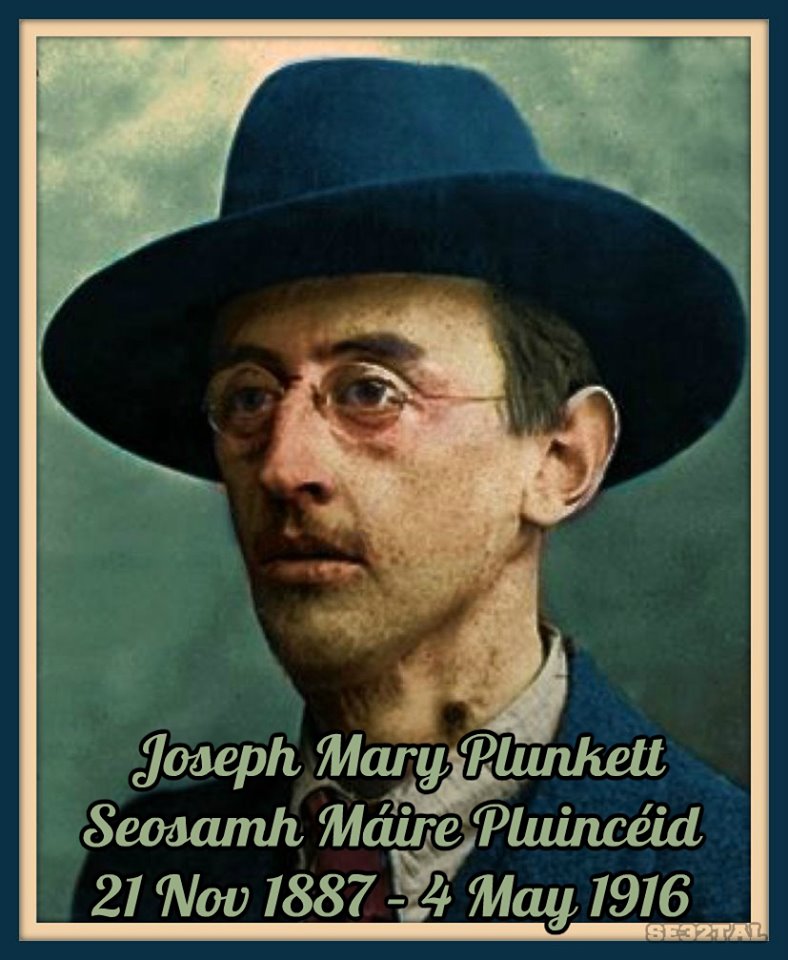
JOSEPH MARY PLUNKETT (1887-1916) Born in Dublin, he was the son of a papal count, George Noble Plunkett. Plunkett was educated by Jesuits at the Catholic University School, Belvedere College and Stonyhurst College in Lancashire, England. A gifted writer, he met Thomas MacDonagh when he was tutored by him in Irish in preparation for the University College, Dublin matriculation examinations. MacDonagh was to become a close friend, as both were interested in poetry, religion and mysticism. Plunkett graduated from UCD in 1909 but he contracted tuberculosis as a young man and spent periods in Italy, Algeria and Egypt in the years 1910-12. Plunkett edited the Irish Review, supported Arthur Griffith’s Sinn Féin and took the workers’ stand during the 1913 lock-out. Joseph Plunkett Joseph Plunkett relaxes with family at his home. Below left, the chapel at Kilmainham where he married Grace Gifford, right, the night before his execution (images courtesy of Kilmainham Gaol Along with MacDonagh and Edward Martyn, Plunkett also helped to establish an Irish national theatre. He was elected to the provisional committee of the Irish Volunteers in 1913 and later became a member of the IRB and fully committed to armed revolution. In April 1915 Plunkett went to Germany to assist Roger Casement in procuring arms and assistance for the Easter rebellion. Plunkett and Mac Diarmada are believed to have forged or at least “sexed-up” a document released on April 19, 1916, supposedly emanating from Dublin Castle, which suggested the authorities were about to crack down on Irish Volunteers and the rising nationalism. With James Connolly and Séan Mac Diarmada, Plunkett was involved in the military strategy for the insurrection and was the youngest signatory of the Proclamation. In poor health and recovering from an operation on his glands, Plunkett still joined other members of the Provisional Government in the GPO for the Rising. He married Grace Gifford — a sister-in-law of Thomas MacDonagh — at Kilmainham the night before he was executed. Just before he faced the firing squad, on May 4, 1916, he said: “I am very happy I am dying for the glory of God and the honour of Ireland.” The main railway station in Waterford city is named after him, as was the Joseph Plunkett Tower in Ballymun.