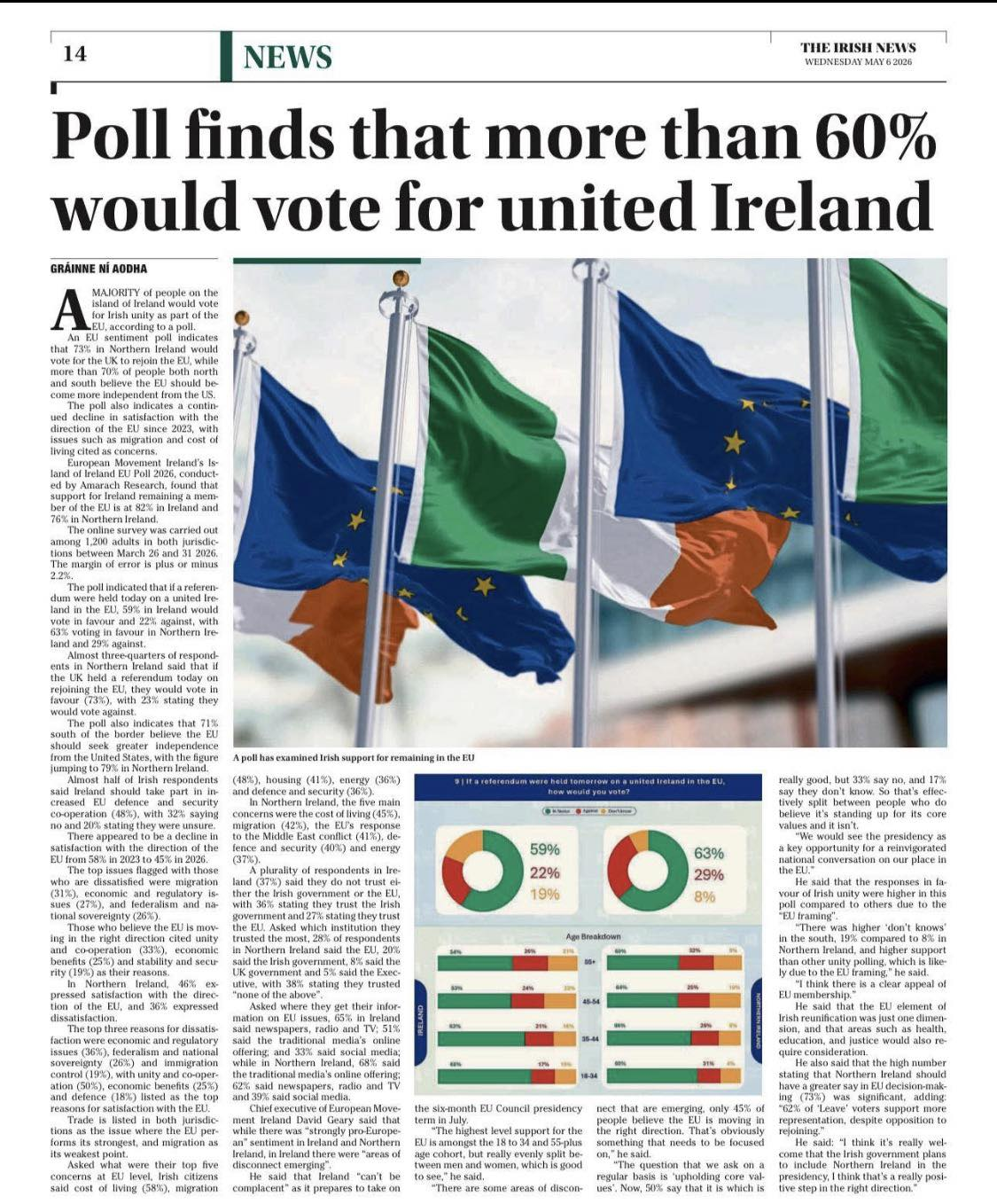
Chaos in Westminster A letter from Ireland a Chara, Last week, in Britain, voters went to the polls, and the headlines have been dominated by questions about the future of British Prime Minister Keir Starmer after a disastrous set of results for his Labour Party.These were elections to local councils and to the devolved parliaments in Scotland and Wales.The parliaments in Scotland and Wales, like the Assembly in the North of Ireland, are not sovereign and only exercise powers within their jurisdictions that have been agreed by the Parliament at Westminster in London, which also holds the purse strings.In these elections, the British Labour Party lost a substantial number of council seats and, for the first time, lost control of the Senedd (Welsh Parliament) to the pro-independence party Plaid Cymru. The Scottish National Party consolidated its position as the largest party in its Parliament.Currently in the North of Ireland, Sinn Féin is the largest party, and the Government is led by its Vice President, Michelle O’Neill.The political map of Britain has changed, and the future of the “United Kingdom” is in doubt, as the governments in Northern Ireland, Wales, and Scotland are now firmly rooted in the concept of self-determination and independence.Neither Scotland nor Wales has a legal right to self-determination and are held in a “union” with no way out unless agreed by the predominantly English Parliament in London.The North of Ireland is different: under the Good Friday Agreement, we have both the right to self-determination and the mechanism, i.e., Unity Referendums. At any time, unity referendums can be triggered, and in a second caveat, they must be triggered when constitutional change is likely. On occasion, commentators have misread the provisions that a unity referendum can be called only when the governments believe change is likely.That is not the case, and in 2002, David Trimble, who negotiated the Agreement as leader of the Ulster Unionist party, called for a referendum to “consolidate the unionist vote.”It is important to clarify this position because the big election winners across England were Reform, the party of Nigel Farage, who led the Brexit campaign. Despite winning a significant number of seats in Scotland and Wales, Reform is at its heart an English Nationalist party.They have previously aligned with the extremes of Unionism in the North of Ireland and have little understanding of, and even less respect for, the Good Friday Agreement.It is entirely plausible that a future Farage government could spring a hasty unity referendum to try to consolidate unionist support and bin the Agreement’s provisions.A Reform Government is a real risk factor and yet the Irish Government refuses to plan or prepare for such a scenario.In 1962, Dean Acheson, the US Secretary of State, said that, ‘Great Britain had lost an Empire but not yet found a role.’ Today, we see that played out; Britain is no longer a global military, economic, or political player. Its empire is gone, its internal union is in tatters, and its politics are in freefall. There have been six British Prime Ministers since the 2016 Brexit referendum.Ireland cannot be spectators. Our national interest is served by planning, preparing, and advocating for unity. No part of our nation should be left to the chaos of Britain.Have a great weekend. Is mise,Ciarán Ciarán Quinn is the Sinn Féin Representative to North America
Memorial to 22 Irish Hunger Strikers Deaths Glasnevin Cemetery
Background
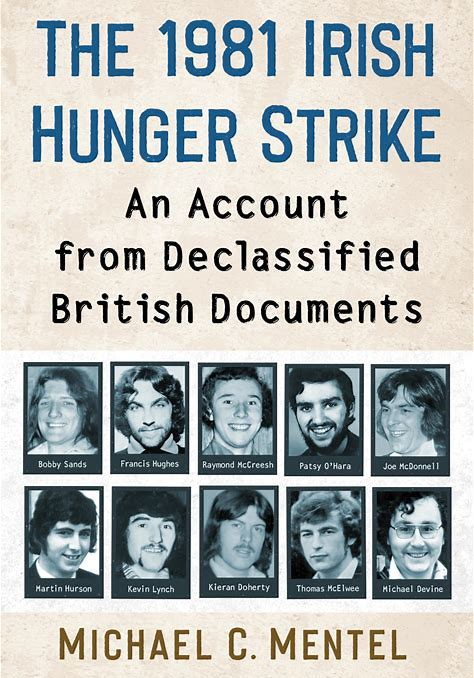
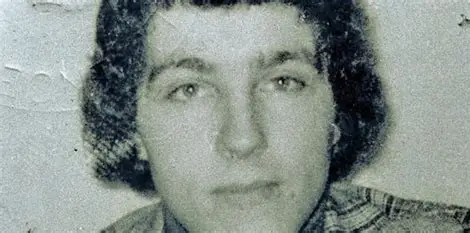
Raymond Peter McCreesh, the seventh in a family of eight children, was born in St Malachy’s Park, Camlough, on 25 February 1957.[6] He was born into a strong Irish republican family, and was active in the republican movement from the age of 16. McCreesh attended the local primary school in Camlough, St Malachy’s, and later attended St Colman’s College in Newry.[6] Raymond first joined Fianna Éireann, the IRA’s youth wing, in 1973, and later that year he progressed to join the Provisional IRA South Armagh Brigade.[6] McCreesh had worked for a short time as steelworker in a predominantly Protestant factory in Lisburn. However, as sectarian threats and violence escalated, he switched professions to work as a milk roundsman in his local area of South Armagh: an occupation which greatly increased his knowledge of the surrounding countryside, as well as enabling him to observe the movements of British Army patrols in the area.[6]
Arrest
On 25 June 1976, McCreesh (aged 19) and three other IRA volunteers attempted to ambush a British Army observation post (OP) in South Armagh.[6] It lay opposite the Mountain House Inn, on the Newry–Newtonhamilton Road.[6] As the armed, masked and uniformed IRA volunteers approached the OP, they were spotted by British paratroopers on a hillside. The paratroopers opened fire on the volunteers, who scattered. Two of them, McCreesh and Paddy Quinn, took cover in a nearby farmhouse. The paratroopers surrounded the house and fired a number of shots into the building.[6][7] After some time, McCreesh and Quinn surrendered and were taken to Bessbrook British Army base.[6] The third volunteer, Danny McGuinness, had taken cover in a disused quarry outhouse but was captured the next day.[6] The fourth member of the unit managed to escape despite being shot in the leg, arm and chest. Local Catholic priests facilitated their surrender.[6][8][9][10][11]
Imprisonment and hunger strike
On 2 March 1977, McCreesh and Quinn were sentenced to fourteen years in prison for the attempted murder of British soldiers, possession of a rifle and ammunition, and a further five years for IRA membership.[3][4] The rifle that McCreesh had in his possession when captured was one of those used in the Kingsmill massacre on 5 January 1976, when 10 Protestant civilians were shot dead.[12]
One of the soldiers who captured McCreesh, Lance Corporal David Jones, was later killed by Francis Hughes, who died during the same hunger strike.[6] Another Irish Republican Volunteer Patsy O’Hara died on the same day (21 May 1981) as McCreesh while on hunger strike in Maze Prison (Long Kesh).
Francis Hughes, born on 28 February 1956 in Bellaghy, County Londonderry, Northern Ireland, was a prominent Provisional IRA volunteer and one of the most wanted men in the region Wikipedia. He joined the IRA in the 1970s, initially with the Official IRA before moving to the Provisional IRA’s South Derry Brigade in 1973. Hughes was known for his guerrilla tactics, often moving up to 20 miles in a single night and carrying multiple weapons Wikipedia.
He became a fugitive after a gun battle on 16 March 1978 in which an undercover British soldier was killed. Hughes was seriously wounded and captured shortly after. He was sentenced to a total of 83 years’ imprisonment in February 1980 An Phoblacht.
On 12 May 1981, Hughes died after 59 days on hunger strike in HM Prison Maze (Long Kesh) An Phoblacht+1. His death came just seven days after Bobby Sands, marking the second fatality in the 1981 hunger strike campaign. Hughes’ sisters Noreen, Maria, Vera, and brother Roger were by his bedside when he passed away An Phoblacht.
His republican colleagues and political leaders, including Sinn Féin’s Gerry Adams, hailed him as one of the bravest soldiers of the armed struggle, while British authorities described him as “an absolute fanatic” An Phoblacht+1. His death was met with public mourning in Catholic areas of Northern Ireland, with protests and vigils marking the loss BBC News.
Hughes’ legacy endures in Bellaghy, where commemorations and memorials honor his life and sacrifice, and in the broader republican movement, where he is remembered for his courage and commitment to the cause
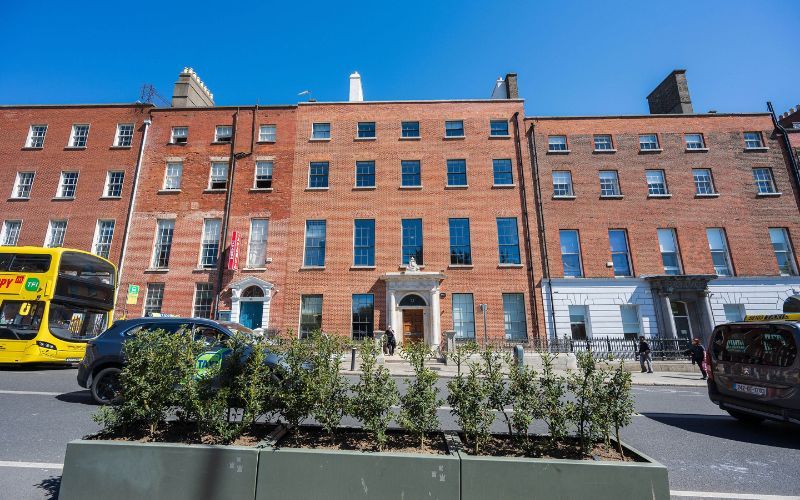
The restored Georgian landmark in Dublin now houses Poetry Ireland and the Irish Heritage Trust, along with the Seamus Heaney Poetry Library.
IrishCentral Staff
May 07, 2026
Inside No. 11 Parnell Square in Dublin. Ste Murray
Ireland’s President, Catherine Connolly, has officially opened No. 11 Parnell Square in Dublin, unveiling a newly restored cultural home for poetry, heritage, and public engagement in the heart of the city. The Georgian building, long steeped in Irish history, has been transformed through a €5.5 million conservation and restoration program that aims to secure its future while honoring its past.
The reopening marks a major milestone for Poetry Ireland and the Irish Heritage Trust, which now share the building with the Irish Landmark Trust. Backed by State support, philanthropy, and careful conservation work led by McCullough Mulvin Architects, the project has brought new life to one of Dublin’s most storied addresses.
Among the most significant additions is the Seamus Heaney Poetry Library, which will house the late poet’s private collection from his study, generously bequeathed by his family to Poetry Ireland. It will also include the Austin Clarke Poetry Collection and a broader contemporary poetry library gathered over the past five decades, creating a space intended for reading, study, inspiration, and connection.
No. 11 Parnell Square in Dublin.
Speaking at the opening, President Connolly said, “It is an honour to officially open Number 11 Parnell Square as it becomes Ireland’s home for poetry and heritage.
As President of Ireland, I warmly welcome the new life which the Irish Heritage Trust and Poetry Ireland/Éigse Éireann will breathe into this beautifully restored Georgian building, one which already holds almost three centuries of history.
Arts and cultural organisations have so often in the past been marginalised and forced into peripheral and sometimes inaccessible spaces. I am particularly pleased that the newly restored building will over the decades to come be an inclusive space where local communities are welcomed, where stories are shared, and where our past and heritage are woven thoughtfully into the present and the future.”
The redevelopment was funded in large part through the Urban Regeneration and Development Fund under Project Ireland 2040, which contributed €3.9 million. An additional €1.55 million came from philanthropy and other sources. The work was completed within budget and included a full replacement of the roof, conservation of the Georgian façade, structural and safety upgrades, accessibility improvements, and energy efficiency measures that helped achieve an A3 Building Energy Rating.
James Browne TD, Minister for Housing, Local Government and Heritage, said the building sits at the center of Dublin’s Georgian core and described the project as a valuable addition to the city’s cultural and built heritage. “No. 11 Parnell Square East is at the heart of Dublin’s Georgian core, and I am proud that this redevelopment and refurbishment has been made possible through funding from my Department’s Urban Regeneration and Development Fund. This building’s conservation and the preservation of its architectural heritage represent a significant addition to the built and cultural heritage of this part of Dublin City. No 11 Parnell Square East has a storied past and through this renovation, it can now continue on with a renewed purpose. State support for this building through URDF funding is now also a part of its story, and I hope that No 11 Parnell Square East will serve as an exemplar to future projects under this scheme.”
Patrick O’Donovan TD, Minister for Culture, Communications and Sport, also welcomed the opening, calling the conservation of the building a meaningful investment in Ireland’s cultural infrastructure. He said the project would strengthen the cultural quarter around Parnell Square and praised the organizations behind it for their work on behalf of the public.
The Irish Heritage Trust said the restoration returns the property to the heart of Dublin’s north inner city and secures its long-term future. Its chair, Ger Aherne, said the organization was honored to serve as custodian of the building and thanked Fingal County Council for entrusting it with the site’s future.
For Poetry Ireland, the opening represents both a homecoming and a new beginning. John O’Donnell, chairperson of Poetry Ireland, said, “The opening of Ireland’s Home for Poetry and Heritage, No. 11 Parnell Square, marks a deeply significant moment for poetry in Ireland. This remarkable building, with its rich, layered past, is now transformed into a living, breathing home for poetry on this island. In partnership with the Irish Heritage Trust, we are proud to have shaped this space that brings poetry into the heart of civic life and will help us in our mission to connect poetry and people. With the establishment of The Seamus Heaney Poetry Library, we honour one of Ireland’s greatest poets, while creating a lasting resource for future generations of readers and writers.”
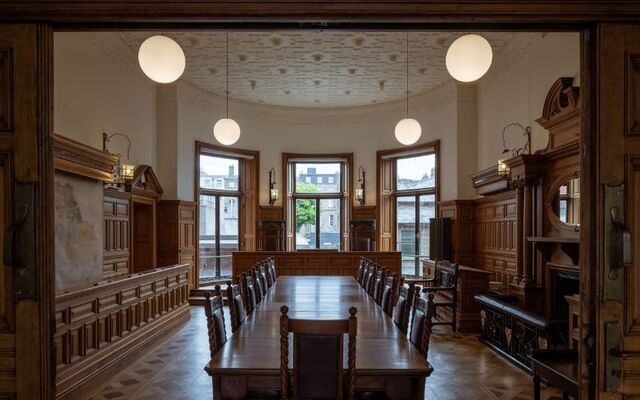
The building itself carries a layered past. Once leased by Richard Steele and later remodeled by John Butler MP, it became part of Dublin County Council’s civic history in the 20th century and was also the setting for James Joyce’s “Ivy Day in the Committee Room” in Dubliners. Its restored Council Chamber now holds archival maps and carefully conserved interiors, including parquet floors, ornate plasterwork, and period details that reflect the building’s changing life over more than 300 years.