In 1996, Frank McCourt, a retired high school English teacher who was born in Brooklyn but raised in Limerick, became a literary sensation with the publication of his memoir, “Angela’s Ashes.” The book begins with these lines: “My father and mother should have stayed in New York where they met and married and where I was born. Instead, they returned to Ireland…”
The year before “Angela’s Ashes” was published, Brendan Loonam, a high school English teacher who was born in Banagher, Co. Offaly, but raised in the Bronx, made his literary debut when the late, lamented Thomas Davis Irish Players produced his autobiographical play, “Gone Away with a Sailor.” The play begins with these lines: “I was on my second ramble through Jane Eyre, languishing, you might say, when I got the word about the job.” The allusion to a novel whose plot includes a marriage that began happily on one side of the Atlantic before descending into rancor and madness on the other side subtly, almost imperceptibly, foreshadows the tale to come. For the theme of Loonam’s play could be summarized by inverting McCourt’s opening lines: Loonam’s mother and father should have stayed in Ireland where they met and married and where the playwright was born. Instead they emigrated to America.
No other work of Irish-American literature I know uses the painful process of chain migration as its dramatic core. Through a lyrical set of intertwined monologues of the mother (“She”) and father (“He”), the play narrates the Larkin family gradually disintegrating and struggling to regenerate itself in the new environs of the Bronx. This narrative reveals the terrible costs of a particular piecemeal approach to emigration: first to depart are the father, Tom, and the oldest son, Sean; then the only daughter, Annie; then the next son, Peter; then the next son, Tosh; and finally, the mother, Kitty, and the youngest son, Kieran.
Both Loonam’s play and McCourt’s book end in New York. In “Angela’s Ashes,” that ending is framed as Frank’s escape from the poverty of Limerick and the dysfunction of his own family; he has returned to the promised land of America, a birthright his parent’s reverse immigration stole from him. As such, “Angela’s Ashes” is ultimately a comedy, whereas “Gone Away with Sailor” offer the audience no such happy ending. In his penultimate lines, He/ the father/ Tom Larkin confesses: “Sure what’s the use? The bed could be as wide as the Atlantic Ocean for all the space that’s between us now, and there’s no boat I’ve ever seen that could cross it.” Following this, in one of the plays most touching lines, She/the mother/Kitty explains to Kieran: “We started down a wrong road; a long time ago, for all the right reasons, and, sure, we’re stuck on it now and we have to make the best of it.” Clearly, the audience has witnessed a kind of tragedy unfold.
The Iago-like villain of this tragic plot is the unseen but constantly discussed Babby, the sister of He who sets the whole painful process in motion. At first, her actions call to mind the well-meaning Aunt Lizzie from Brian Friel’s “Philadelphia Here I Come!” –the yank aunt trying to do right for her kin left behind in backward Ireland. But as the story progresses, Babby spins scheme after scheme, becoming ever more controlling, constantly whispering counterproductive advice into the ear of her brother, who, under her tutelage, becomes a dour disciplinarian obsessed with reputation and respectability, more sinning than sinned against for sure.
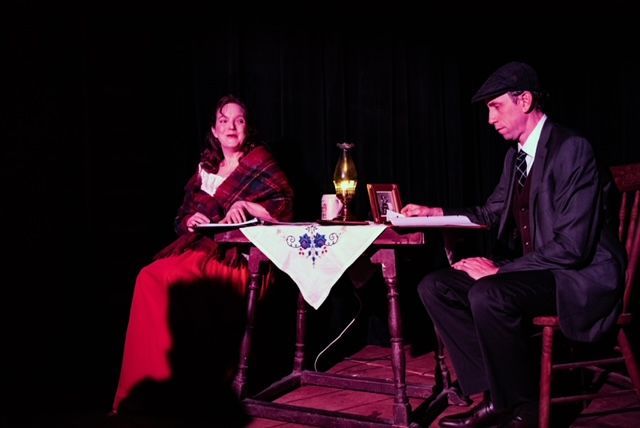
Last Thursday and Friday evening the Amateur Comedy Club, under the able direction and elegant set design of Stephen Butler (no relation to the author of this review!), presented a staged reading that brought this tragic play back to life on the New York stage for the first time in 30 years. Jeannie Dalton as “She” epitomized the full emotional range of a dutiful wife and loving mother struggling and suffering to hold a family together. And Kevin Gregory as “He” embodied the stiff, awkward carriage of a tall man whose stubborn pride and small, suspicious mind wreck the family’s chances of a happy reunion. This performance was all the more poignant given that Brendan Loonam was not there to witness it, having passed in 2019.
Though much less well-known and more compact in form than “Angela’s Ashes,” “Gone Away with a Sailor” is just as powerful a work of art. A dramatic rendering of one family’s resilience in the face of rupture, it offers important insights into the emotional toll of emigration, family separation and reunification. It can help us to think more about the complicated relationships at the root of our own Irish family trees. It could also help us to think more about the experiences of friends and neighbors whose families may have journeyed from other countries to America under similar patterns of chain migration.
For all these reasons, one can only hope that this two-night table reading is just the beginning of the play’s renaissance.
February 5th: In a statement republican prisoners warned there could be further hunger strikes unless they were awarded special category status by the British government.
March 1st: Bobby Sands, the Commanding Officer of IRA prisoners in the Long Kesh/Maze Prison, refused food and so began a new hunger strike.
March 2nd: Republican prisoners call off the blanket and no wash protests as to not detract attention away from the hunger strike.
March 3rd: Then Secretary of State Humphrey Atkins reads a statement in the House of Commons reiterating their would be no political status for the prisoners, hunger strike or not.
March 5th: Frank Maguire, the Independent MP for Fermanagh/South Tyrone died suddenly.
March 15th: Francis Hughes joined Sands on hunger strike.
March 22nd: Raymond McCreesh joined the hunger strike.
March 26th: Sands was nominated as a candidate for the by-election in Fermanagh/South Tyrone. Other nationalist candidates will withdraw their applications for candidacy in the following days.
April 9th: Sands was elected MP for Fermanagh/South Tyrone following a final count on April 11th. Sands obtained 30,492 votes and Harry West, the Unionist candidate, obtained 29,046 votes.
April 20th: Three TDs visit Sands in the prison, after which the TDs called for urgent talks with the British government.
April 21st: At a press conference in Saudi Arabia, prime minister Margaret Thatcher declared the British government would not meet the three TDs. Further, she stated: “We are not prepared to consider special category status for certain groups of people serving sentences for crime. Crime is crime is crime, it is not political.”
April 23rd: Marcella Sands, Bobby’s sister, made an application to the European Commission on Human Rights, claiming the British government violated articles of the European Convention on Human Rights with their treatment of republican prisoners.
April 28th: A private secretary of Pope John Paul II, Fr John Magee (later Bishop of Cloyne), visited Sands in prison to ask him to end his strike. The next day, Magee met Humphrey Atkins in an effort to create negotiations between the British government and the hunger strikers, before seeing Sands again. Magee also gave Sands a gold cross as a gift from the Pope.
May 4th: European Commission on Human Rights announced it had no power to proceed with the case brought by Marcella Sands against the British government.
May 5th: Bobby Sands died after 66 days on hunger strike. He was 27 years old.
May 7th: An estimated 100,000 people attended Sands’ funeral in Belfast.
May 8th: Joe McConnell joined the hunger strike to replace Sands.
May 12th: Francis Hughes died after 59 days on hunger strike. He was 25 years old.
May 14th: Brendan McLaughlin joined the hunger strike to replace Hughes.
May 21st: Raymond McCreesh and Patsy O’Hara died after 61 days on hunger strike. They were 24 and 23 years old respectively. Cardinal Tomás Ó Fiaich, the Catholic Primate of All Ireland, criticised the British government’s attitude toward the strike.
May 22nd: Kieran Doherty joined the hunger strike.
May 26th: McLaughlin, who had joined the strike 12 days before, is taken off the strike after he experiences internal bleeding.
May 28th: Martin Hurson joined the hunger strike to replace McLaughlin. Thatcher visited Northern Ireland and called the strike the “last card” of the IRA.
May 29th: The names of four hunger strikers, as well as five other republican prisoners, were put forward as candidates in the Irish general election.
June 3rd: The Irish Commission for Justice and Peace (ICJP) issued a statement on the hunger strike. The organisation, established by the Catholic Bishops’ Conference, asked for improvements in the prisons but denied political status.
June 8th: Tom McElwee joined the hunger strike.
June 11th: Ireland held a general election. Hunger striker Kieran Doherty was elected as an Anti H-Block TD for Cavan–Monaghan, and fellow prisoner Paddy Agnew was elected in Louth, ddenying Charles Haughey the chance to form a government, and enabling Fine Gael and Labour to form a government with Garret FitzGerald as taoiseach. The following day the British government published proposals to change the Representation of the People Act, disallowing prisoners to stand as candidates in elections.
June 15th: Sinn Féin issued a statement declaring a new prisoner would join the hunger strike each week. Paddy Quinn joined the hunger strike.
June 22nd: Michael Devine joined the hunger strike.
June 29th: Laurence McKeown joined the hunger strike. The following day the British government released a statement declaring once again that it would not grant special category status to republican prisoners.
July 4th: The hunger strikers released a statement
July 5th: A deal was possibly on the table between Sinn Féin and the British government, giving the hunger strikers most of their demands. Sinn Féin rejected this deal. However, this is contested. Controversy surrounds this event, as some republicans claimed to have a document from the British government setting out proposals to meet many of these demands.
July 8th: Joe McDonnell died after 61 days on hunger strike. He was 30 years old. The following day Patrick McGeown joined the hunger strike to replace McDonnell.
July 10th: Funeral of Joe McDonnell took place. The British government moved to arrest an IRA firing party at the funeral and seized a number of weapons. Rioting ensued.
July 13th: Martin Hurson died after 46 days on hunger strike. He was 29 years old. The following day Matt Devlin joined the hunger strike to replace Huston.
July 15th: Secretary of state Humphrey Atkins announced that the British government had invited representatives of the International Committee of the Red Cross to review prison conditions in Northern Ireland. Over the following days the representatives toured the prisons and met Atkins. The hunger strikers rejected attempts by the Red Cross to act as mediators between them and the British government.
July 18th: Clashes with republican demonstrators and gardaí following a demonstration outside the British embassy in Dublin. An estimated 200 people were injured.
July 29th: Representatives of Sinn Féin and the Irish Republican Socialist Party (IRSP) visited the hunger strikers, with the political groups suggesting the hunger strikers suspend their efforts for three months to allow a review of prison reforms. The strikers rejected this idea.
July 31st: The parents of Paddy Quinn asked for medical intervention to stop their son’s strike.
August 1st: Kevin Lynch died after 71 days on hunger strike. He was 25 years old.
August 2nd: Kieran Doherty died after 73 days on hunger strike. He was 25 years old. The following day Liam McCloskey joined the strike.
August 8th: Thomas McElwee died after 62 days on hunger strike. He was 23 years old. The following day outside the prison riots continued and two Catholic men were shot dead.
August 10th: Patrick Sheehan joined the hunger strike.
August 17th: Jackie McMullan joined the hunger strike.
August 20th: Michael Devine died after 60 days on hunger strike. He was 27 years old. Devine was the last prisoner to die as part of these protests. The family of Patrick McGeown agreed to medically intervene to save his life after 42 days on hunger strike. Owen Carron, Bobby Sands campaign manager for the Fermanagh-South Tyrone MP seat, won the by-election. A few days later Sinn Féin announced it would contest all Northern Irish elections in the future.
August 24th: Bernard Fox joined the hunger strike.
August 31st: Hugh Carville joined the hunger strike.
September 4th: The family of Matt Devlin asked to medically intervene to save his life after 52 days on hunger strike.
September 6th: The family of Lawrence McKeown asked to medically intervene to save his life after 70 days on hunger strike. The INLA announced it would no longer replace men on hunger strike at the same rate as before. John Pickering joined the strike the next day.
September 13th: James Prior replaced Atkins as secretary of state for Northern Ireland. The following day Gerard Hodgkins joined the strike.
September 21st: James Devine joined the hunger strike. The SDLP openly condemned the strike.
September 24th: Bernard Fox ended his strike on the 32nd day of his fast as his health deteriorated rapidly. Two days later, Liam McCloskey ended his strike on his 55th day after his family stated they would call for medical intervention to save him when he became unconscious.
Participants with the family name of O’Sullivan and Sullivan broke the world record for the largest gathering of people with the same surname, in Castletownbere
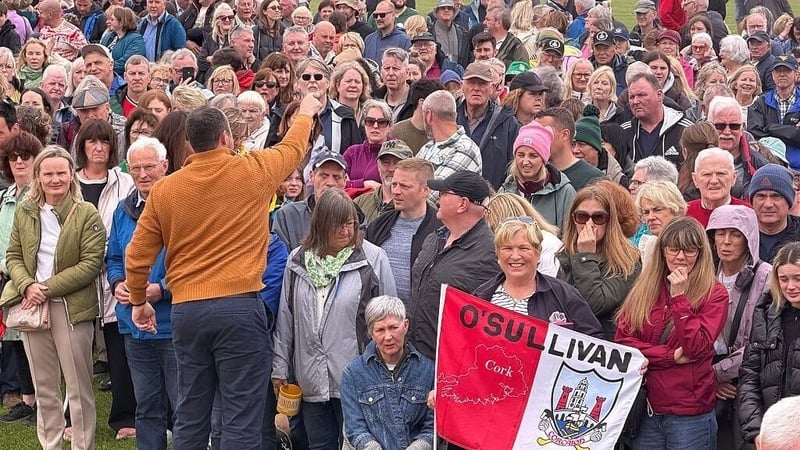
Almost 2,000 people with the last names O’Sullivan and Sullivan travelled from around Ireland and the world to meet in Co Cork, in the largest ever recorded gathering of people with the same surname.
Guinness World Records representatives verified the milestone at the event in Castletownbere.
“With a total of 1,848 the O’Sullivan clan are the new Guinness World Record holders, congratulations,” an official told a cheering crowd.
The feat knocked another common Irish family name – Gallagher – off the top spot won in 2007 with a gathering of 1,488 participants in Co Donegal.
The surnames O’Sullivan and Sullivan are commonplace in Cork and in southwestern Ireland.
Many from the large international Irish diaspora also arrived to bolster the numbers, presenting passports as proof of their name.
“Where I come from in Boston, there’s plenty of us Sullivans, but this is unbelievable,” said Kevin Sullivan, aged 75, looking around at the crowds filing through a primary school where the event was coordinated.
“Everyone I look at here I know is a Sullivan or an O’Sullivan, so it’s an incredible feeling,” the retired IT executive said.
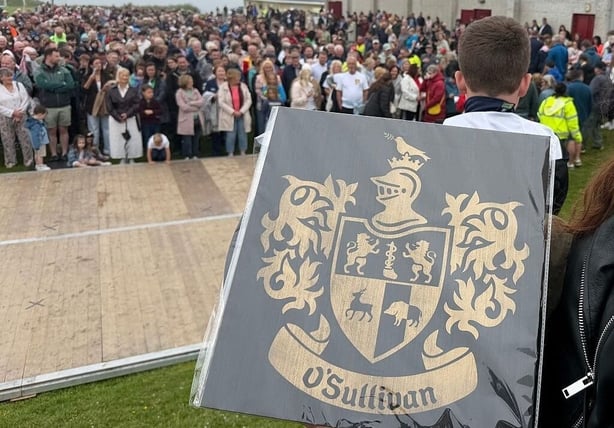
The O’Sullivan clan family crest is held by a participant during the world record-breaking feat
Participants passed through turnstiles to provide a preliminary tally before officials circulated through the assembled groups on the school’s football pitch for a final count.
Mary Sullivan, one of many Americans of Irish ancestry who attended, said she had “travelled over 3,000 miles to join the record attempt”.
The gathering was hosted by the chieftain of the clan, Kelly Sullivan, who was presented with the chain of office in Boston in 2023.
“I feel blessed to have grown up as part of the wider Sullivan-O’Sullivan family, we make a team that can’t be beat,” she told the crowd.
The world record bid organiser Jim O’Sullivan from Castletownbere said wet weather early in the day raised doubts about whether enough namesakes would show up.
“But people turned out in their numbers, and we did it. So, we’re asking the Gallaghers, back on your shoulders now. Next time up, you’ll beat us!” he said.
Among the participants who travelled the farthest was Michel Sanchez O’Sullivan who said his grandfather was an O’Sullivan from New York who later settled in Mexico.
“As far as we know, we’re the only O’Sullivans in Mexico, it’s great to be here to get to explore my Irish roots and meet the rest of the family,” the 35-year-old said, speaking on Castletownbere’s main street, holding his daughter Olivia on his shoulders.
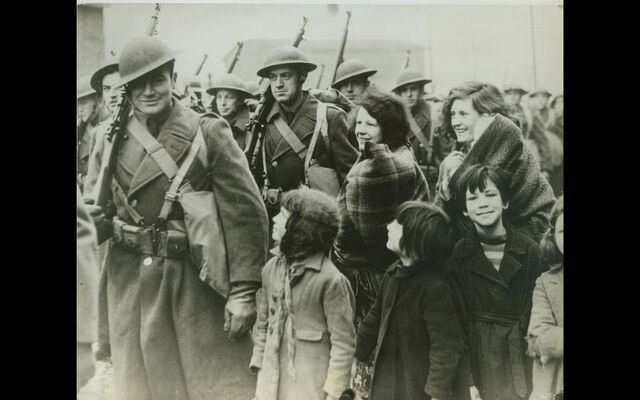
February 8, 1942: Women and children in a port “somewhere in Northern Ireland” as they greeted troops of the American Expeditionary Force, on its arrival. ACME / Allison Collection Photos
Not infrequently do we discuss the role of Irish immigrants in the American military, starting in the early days of the Revolutionary War and spanning across numerous civil and global conflicts.
Throughout this history are many examples of Irish political ties impacting the move of American wars. For instance, we’ve spoken in the past on the role of the Sixty-Ninth Regiment, a Union Army brigade in New York that was founded by Irish immigrants and abolitionists.
In our exhibit earlier this year, we looked at the way 18th-century United Irishmen and their partnerships with French revolutionaries supported the cause of American independence.
But when we approach the 20th century and the rise of large-scale global conflict, we see a new wave of interaction between Ireland and America through the movement of soldiers. Not only were Irish immigrants changing war in the United States, but American soldiers changed the landscape of Ireland.
Sign up to IrishCentral’s newsletter to stay up-to-date with everything Irish!Subscribe to IrishCentral
The United States and Ireland both were not the central focus at the start of World War II. Like many smaller nations, Ireland has frequently remained neutral during external wars and been hesitant to risk its safety.
In the first half of the 20th century, Ireland would be putting its rocky nationhood to considerable risk if entering a global battle.
Though a much larger nation, the United States had similar concerns and did not officially enter the war until December 1941, after the Japanese attack on Pearl Harbour.
Once the war became more explicitly global in the 1940s, both Irish and American soldiers found their roles in somewhat surprising stations. From the Irish side, a number of Irish nationals traveled to the United States and Canada to enlist and fight, echoing the earlier practices of the Revolutionary War. From America, the opposite occurred.
In January of 1942, President Franklin D. Roosevelt announced an agreement with Prime Minister Winston Churchill for American troops to be stationed in the United Kingdom. On paper, this seemed to be a simple move towards Allied troops in London or other English stations. However, a mere 21 years after the Anglo-Irish Treaty, borders and land control made the decision a bit more complicated.
Rather than sending Americans to London, the troops were scheduled to be stationed in Belfast, under English control. This sparked controversy, as American Catholics with Irish heritage were viewed as a liability to British control in Ireland.
According to Simon Topping’s 2022 article in The Irish Times, Belfast Prime Minister J.M. Andrews stated his concern outright, saying he was, “most anxious that no impression should be given that we were handing over responsibility for the defence of Northern Ireland to the United States. Irresponsible or wrong-minded people might misinterpret this as the first step to handing Northern Ireland over to Éire.” This concern extended even to individual soldiers, with the question of who should be placed in charge of an American garrison carefully controlled by the English with the goal of preventing further Irish uprisings.
The significance of placing Irish Americans in English-controlled Ireland was not noted only in Europe and the UK. In his 2014 article in “New York Irish History,” historian John T. Ridge explored the complex feelings of New Yorkers with Irish heritage on the question of Irish neutrality. He explains that the New York Irish were initially very supportive of the Irish neutral stance on WW2, with the American Friends of Irish Neutrality garnering many members with a rapid pace. However, after the events of Pearl Harbour, the tides quickly shifted, and Irish New Yorkers widely and openly supported the war, even purchasing defense bonds to fund the cause.
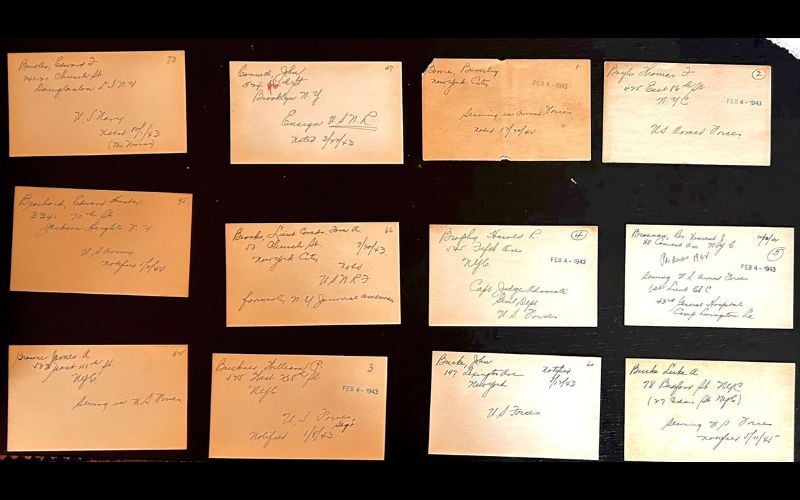
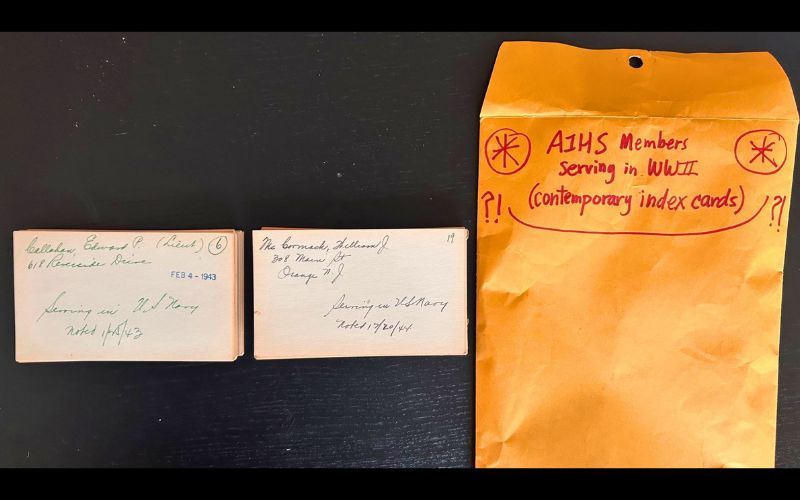
In our collections at AIHS, we hold a number of cards (pictured below) of our members who served in WW2. Naturally, the majority of these members were Irish Americans who enlisted after 1942. Among these names included are Harold R. Brophy (a lawyer and judge advocate) and Reverend Vincent J. Brosnan (a Catholic Chaplain, 43rd Gen. Hospital).
While the cards in our collections focus on our members only, the number of Americans with Irish ancestry during WW2 was significant throughout the country.
4
(AIHS)
4
(AIHS)
Whereas Irish neutrality had previously been a safeguard for a cautious nationhood, it shifted after Irish Americans joined the war. From county association meetings to public posters, the fight for WW2 became a point of national pride for both American and Irish identity. Symbols like the shamrock and battle cries like those taken from the early days of the 69th regiment regained popularity with the armed forces.
4
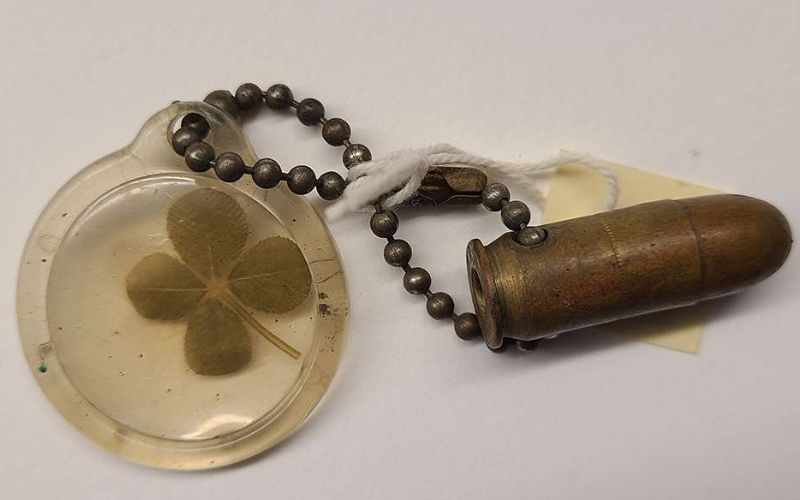
Four-leaf clover lucky charm of Pfc. Joseph Robert Wallner, attached to a .45 caliber bullet. Gift of Sonja Wallner, 2012.034.029. (Image and description courtesy of the National World War II Museum / AIHS)
Back in Belfast, American soldiers reconnected with Ireland on somewhat shaky grounds. African American soldiers were surprised to be welcomed and respected, seen as equals more so than they were at home. Others, however, found that they needed greater time to adjust to Northern Irish customs.
American soldiers were given pamphlets explaining the cultural differences between Ireland and America, with a particular emphasis on manners and politeness. However, contrary to the fear of Irish uprising, the result was a strengthened relationship between the United Kingdom and the United States.
In the south, de Valera and others opposed this placement of American soldiers and saw it as a risk to the blossoming Irish nation. The challenges of waning nationalism in the north saw an opportunity for its growth in Dublin and in the United States itself. New York and Boston in particular saw a rise in Irish pride in soldiers whose parents or grandparents had immigrated. Societies like our own made records of the Irish heritage found in American soldiers to promote this national identity as unique and significant.
Rather than serving as another American soldier, the Irish-Americans of WW2 held true to their hyphenated identity and remembered the legacy before them. As the war approached its end, soldiers with Irish heritage came to the beaches of Normandy from both Ireland and the United States.
While the numbers cannot be exact, we know that the Irish identity held strong throughout the world, continuing to be remembered as unique and true.
On this Memorial Day, we look at the story of WW2 soldiers not as an Irish one nor an American one, but something strong that comes from that place in between.
This column is adapted from the blog of the American Irish Historical Society (AIHS). Read the full stories at AIHSNY.org/blog.
Founded in 1897 and located on Museum Mile in New York City, the American Irish Historical Society (AIHS) preserves and promotes the history and cultural legacy of the Irish in America through its archives, art collections, and public programs. Learn more at AIHSNY.org.