On the anniversary of the murder of four men in County Tyrone 30 years ago this week, new information has emerged which appears to confirm long-held suspicions that British-trained soldiers were involved in the ambush.IRA Volunteers Malcolm Nugent, Dwayne O’Donnell and John Quinn were shot dead along with civilian Thomas Armstrong at Boyle’s Bar in Cappagh on March 3, 1991.
The three were killed after they drove into the pub car park as a loyalist death squad lay in wait. Although wounded, a fourth man who was travelling in the vehicle escaped with his life.
The attack was later claimed by the UVF, but in December 1991 three part-time members of the British Army’s UDR (Ulster Defence Regiment) were among four suspects arrested. A fourth man, a relative of one of the UDR men, was also detained.
However, all those arrested were later released without charge.
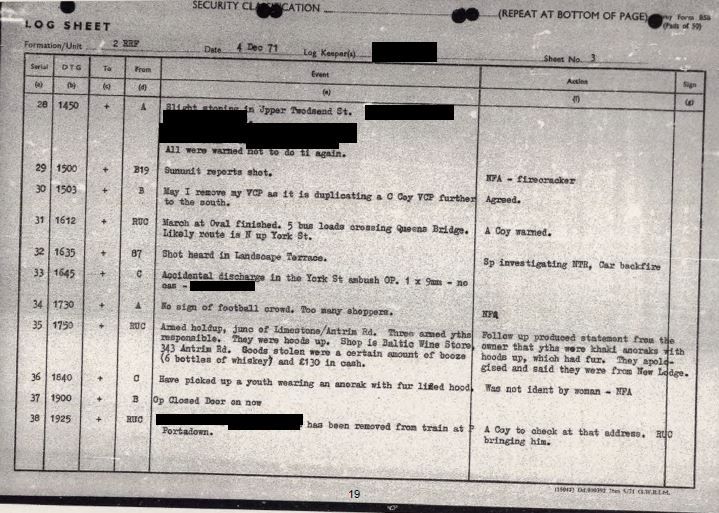
Now a document, believed to have been produced by the British Army’s ‘Weapon Intelligence’ section, dated seven days after the murders, provides details of how the gun attack was carried out and the weapons used.
According to the document unearthed by the Irish News, military chiefs described the killings as “professionally carried out” and dissimilar to other loyalist actions.
They wrote: “From investigation of the scene it was found that the groupings of the bursts of fire were quiet exceptional for a PPM shoot and the targets had been well acquired.”
The reference to PPM is believed to be military shorthand for Protestant Paramilitaries.
The report also suggests “a lot of ground recce must have occurred before this shoot as the perpetrators struck deep at the heart of a republican area”.
It suggests that John Quinn, who was driving, had only recently bought the car the victims were travelling in.
“It must also be assumed that ‘dickers’ [lookouts] were used to confirm the impending arrival of Quinn and his vehicle, supporting theories that he was an intended target,” it states.
Lawyer Gavin Booth, of Phoenix Law, said: “It’s wholly inadequate for families to find that information is available in the public domain about their loved ones but has never been provided to them.”
Briege O’Donnell, mother of Dwayne O’Donnell, said her family has been failed by the state.
“We are now seeking a full independent investigation and have issued civil proceedings to achieve this to get justice for our loved ones and we will continue to do that in their memory,” she said.
Malcolm Nugent’s sister Siobhan Nugent said the families of those killed in Cappagh “have always suspected collusion” in the case.
“Now on the 30th anniversary of the murders each one of the families remain as determined as ever to discover exactly what happened that night,” she said.
“We will not be found wanting, either now or in the future, in our pursuit of the truth.”
Loyalists paramilitaries are acting in concert with hardline Brexiteers to try to intimidate the European Union with the potential of violence in the north of Ireland.The Loyalist Communities Council, which represents the UVF and UDA paramilitary groups, wrote to British Prime Minister Boris Johnson this week to announce that they were “withdrawing their support” for the 1998 Good Friday Agreement and its political institutions.
The UDA/UVF letter to Johnson said they were withdrawing their support for the peace deal “until our rights under the Agreement are restored”.
That is understood to be a reference to their claimed “right” to veto political change, including new safety inspections of meat and other Brexit-related checks on trade at ports in Larne and Belfast.
It comes amid increasing tension over a loyalist campaign against those deemed to be behind the new regulations on trade across the Irish Sea. More loyalist graffiti and banners denouncing the ‘Irish Sea Border’ have appeared across the North, many of which are threatening.
The letter argues the Irish protocol of the Brexit deal “gives effect to the Irish nationalist position at the expense of the unionist position” and warned that this “undermines the basis on which the Combined Loyalist Military Command agreed their 1994 ceasefire”.
It adds, ominously: “If the EU is not prepared to honour the entirety of the [Good Friday Agreement] then it will be responsible for the permanent destruction of the agreement.”
In practical terms, the threat to end UDA/UVF support for the peace process means little in the context of their ongoing and indiscriminate violence.
More disturbing is the fact that the letter was accorded the status of a diplomatic intervention by the British establishment.
The British Direct Ruler Brandon Lewis himself treated the UDA and UVF paramilitaries as virtual dignitaries, describing a recent meeting with their representatives as “important” and a chance to “talk to people across communities”.
His officials met with the group less than a fortnight after its drug-dealing gangs shot up two homes and a mob invaded an estate to intimidate the family of a murdered rival.
The sympathetic nature of media coverage accorded to the loyalist umbrella group also contrasted sharply with the treatment of moderate republican parties and organisations.
One young loyalist paramilitary was gently interviewed and thanked on Newstalks’s Pat Kenny Show after he made direct threats against nationalist politicians, including Tánaiste Leo Varadkar. He described a range of political parties as “legitimate targets” because of their support for the Protocol, without criticism from the interviewer.
Few in the British political establishment have challenged the statements of the LCC group, and they were even defended by the PSNI police chief Simon Byrne who branded their statement a “political move”.
Instead, the implied threat of violence should have raised questions about revoking the release licence of the former UDA and UVF prisoners who are still active within those organisations.
But Byrne, who has presided over the intense oppression of the nationalist community and has previously vowed to ‘go after’ the families of republican activists and remove their children, said the PSNI were “prudently looking at an assessment of what [the letter] means in terms of a policing response”.
Sinn Féin’s response was cautious but critical. The party’s deputy First Minister Michelle O’Neill questioned the ongoing existence of the loyalist groupings.
“I think the question that needs to be answered is, 23 years after the Good Friday Agreement, why loyalist paramilitary groups still exist, way they’re still carrying out organised crime, racketeering and extortion, holding communities to ransom,” she said.
“I think everybody in political leadership has a responsibility to encourage and to tell these groups to leave the stage. There is no place for them in today’s society.”
Objectivity in historical essays is difficult; in a historical analysis of the Civil War, virtually impossible. To concentrate on the facts leads only to improbabilities while to ignore the facts indicates bias. Perhaps the Civil War is just too recent. Who was neutral at the time and who can be neutral even now? So many people took sides, so much havoc was caused, so many lost their lives, so much bitterness, in the nature of things, will linger on and on. The debate on the Treaty took place in January, 1922, but it could be said that the debate continues.
It is not intended to attempt to give the inside story of the negotiations which ended in the signing of the midnight Treaty on 6th December. The agreement which the Irish delegation signed surrendered the sovereignty of the Irish Nation and accepted British domination. It was signed under duress and without referring back to the Cabinet in Dublin, although they had explicit instructions three days previously not to sign anything which entailed Partition or allegiance to the Crown until they had consulted with the President and their Cabinet colleagues. Nevertheless, Dail Eireann ratified the Treaty and so this compromise solution to the Irish problem, already divisive, triggered off a series of events which pitted Irishmen against Irishmen. The drift towards Civil War continued. From the moment that the Four Courts was occupied by that section of the Irish Republican Army which opposed the Treaty it was clear that men would die to maintain the Treaty Settlement and men would die to maintain the Republic. Between March and June several conferences were held for the express purpose of preventing any outbreak of hostilities between brother Irishmen. There had already been shooting incidents in Limerick and elsewhere between the opposing sections of the Army but these had been settled very quickly and a truce arranged in every instance. Throughout the South and in a large section of the West, all military barracks evacuated by the British Army were occupied by anti-Treaty I.R.A. men. A Pact was made. The Pact was broken. With grim determination and certainly with utter frustration, the opposing factions finally blasted away at each other across the River Liffey. The standard for the enforcement of ideals was set. Throughout the country it was Pro-Treaty against Anti-Treaty, the I.R.A. against the Free State Army, family against family, brother against brother, and dare we say, father against son. There was to be no middle course. At the very outset of hostilities this statement was issued. It was an attempt to cut through to the heart of the matter. It was an attempt to explain why so many Irishmen were to die in 1922 and in the years to follow:
“At the last meeting of Dail Eireann an agreement was ratified which if faithfully observed would have given us an opportunity of working for internal peace and of taking steps which would make this nation strong against the only enemy it had to fear — the enemy from outside.
At the bidding of the English this agreement was broken and at the bidding of the English Irishmen are today shooting down on the streets of our capital brother Irishmen — old comrades in arms—companions of the recent struggle for Ireland’s independence and its embodiment — the Republic. English propaganda will strive to lay the blame for this war on an Irishman but the world outside must not be deceived. England’s threat of war, that, and that alone, is responsible for the present situation.
In the face of England’s threat of war some of our countrymen yielded. The men who are now being attacked by the forces of the Provisional Government are those who refuse to obey the order to yield, preferring to die. They are the best and bravest of our nation, and would most loyally have obeyed the will of the Irish people freely expressed, but are not willing that Ireland’s independence should be abandoned under the lash of an alien government.”
FDNY – WTC Health Program Wellness and Research Updates
INCREASED COVID-19 VACCINE APPOINTMENTS NOW AVAILABLE TO FDNY MEMBERS (active & retired) SIGN UP IMMEDIATELY. INCREASED AVAILABILITY MAY NOT LAST LONG.FDNY is able to offer COVID-19 vaccination to ALL FDNY members (all ages, active or retired, even retirees not in our WTC Health Program).Retirees under age 65 must have a NYS qualifying physical health condition (ex. respiratory, cardiac, hypertension, diabetes, stroke, neuro, autoimmune disease such as rheumatoid arthritis, kidney or liver disease, obesity, or cancer).FDNY active members (including civilians) are essential workers and can be vaccinated even without a physical health condition.You can be vaccinated even if you declined in the past or had COVID-19 illness in the past.FDNY has vaccinated over 35,000 people (FDNY and non-FDNY city employees) without any serious side effects.Please use the link www.fdnycampus.org to schedule an appointment at one of our 4 POD locations for the Moderna Vaccine.FDNY Headquarters, 9 Metrotech CenterEMS Academy, Fort TottenFire Academy, Randall’s IslandSusan E. Wagner High School, Staten IslandInstructions for making this appointment are attached for retirees. If you have any questions, please call either number below.WTC Health Program Help Desk (718-999-1365 – Monday through Friday)FDNY Help Desk (718-999-2611)Please note that all appointments are dependent on vaccine shipments meeting demand. Getting vaccinated is critical to protecting yourself, your loved ones, our FDNY family, and those we serve. This vaccine is 94% effective in preventing the COVID-19 infection after both doses. Even if you have recovered from COVID-19 and have antibodies, you still need the vaccine to prevent re-infection.You can find more information here about the COVID-19 vaccine from the Centers for Disease Control and Prevention (CDC). On behalf of the staff at the FDNY WTC Health Program and the Bureau of Health Services, thank you for your continued participation in the WTC Health Program. Your commitment helps support our efforts to improve our medical monitoring/treatment services and meet the health needs of all rescue/recovery workers and their families.
Please do not reply to this email, this inbox is not monitored. If you have questions and/or need assistance regarding the WTC Health Program, please use the phone number below or visit our webpage for more information: https://www.fdnywtcprogram.org/