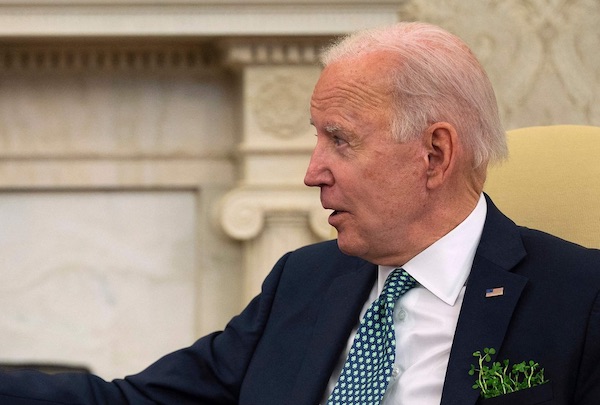
US President Joe Biden has responded to continuing unionist and British efforts to use Brexit to reinforce the partition of Ireland with a warning that the Good Friday Agreement “cannot change”.Appearing at the traditional St Patrick’s Day shamrock ceremony in the White House, Mr Biden said the outcome of the peace process must be protected from continued wrangling over post-Brexit arrangements for the north of Ireland.
Speaking about the relationship between the two countries, the US President said: “Our nations both are deeply committed to protecting the hard-won gains of peace in Northern Ireland. The Good Friday Agreement has been the foundation of peace and prosperity in Northern Ireland for nearly 25 years. It cannot change.”
In a speech which was well received in Irish American circles, Mr Biden said his administration “look forward to supporting the next Northern Ireland Executive after the upcoming Assembly elections, which are on their way.”
However, DUP leader Jeffrey Donaldson has continued to insist he will not permit a return of power-sharing in Belfast unless his demands for extensive changes to the Protocol are met.
Under the Protocol, goods traded at ports in the north of Ireland are subject to customs and safety checks, which prevents a hard border through Ireland and allows businesses in the Six Counties to have access to both the EU and British markets.
Unionists have sought to use grandstanding opposition to the protocol to fuel their election campaigns, but with little success.
Their efforts to reverse the Protocol suffered a further setback last week when appeals to a ruling against legal challenges to the lawfulness of the Brexit deal were dismissed. The action was pursued in the names of a variety of unionists and far-right British politicians.
Ulster Unionist peer, Reg Empey, a former leader of his party, said the DUP’s position was an “admission of total failure”.
Empey said he was alarmed by Donaldson’s statement that the “only leverage we have is our participation in those institutions – that is the reality, and if we continue to do business as usual we will be taken for granted”.
“We all remember the picture of Sir Jeffrey signing the ‘confidence and supply’ deal which led to the DUP supporting both the Theresa May and Boris Johnson governments,” he said, adding: “If this is all he’s got after 25 years, what does it say about the strategy and tactics that he and his party have adopted?”
The Ladies Ancient Order of Hibernians have launched an appeal for the people of Ukraine.
The LAOH, in a release, said that throughout its history it had assisted those in need and that many members had asked how the LAOH could help the Ukrainian people. As a result, an appeal was initiated by LAOH Catholic Action Officer Peggy Cornish of California with the approval of National President Karen Keane of New York.
Stated the release: “The need is great with 2.9 million people affected in Ukraine and the bordering countries. The LAOH is an Irish American Catholic Organization with Christian Charity as an integral part of the motto.
“Individual members, Divisions, County and State Boards of the Organization are requested to assist in this Appeal. The suggested donation is $50 per Division. Any amount both large or small is greatly appreciated.
“You do not have to be a Hibernian to make a donation. We welcome donations from all those who want to help those affected by this war in the Ukraine. All LAOH donations will be sent to Catholic Relief Services to be distributed to those in need. Please make out the checks to: Ladies Ancient Order of Hibernians, Inc. with Ukraine in the memo Mail to: Peggy Cornish LAOH Catholic Action Officer 141 N. Kinsella Ave. Covina, CA 91724.
“The LAOH is united in solidarity with the people of Ukraine through our prayers and monetary support. As much as the Ukrainian people need the physical necessities of life they also need our prayers. We ask all our members to say three Hail Marys every day for peace in the world. We know what it means to come from a war-torn land; let us not forget our sisters and brothers in the Ukraine,” added the release.
Our help is needed in Ukraine and their bordering countries where there are already 2.9 million people in need of aid. LAOH members are asking how they can help. We have always been very generous in times of trouble; the corporal works of mercy tell us what to do. We are asking all members, Divisions, Counties and States Boards to help our sisters and brothers in the Ukraine. The L.A.O.H. is taking a collection that is going to be distributed to Catholic Relief Services. They are on the ground in Ukraine, Poland, and all surrounding countries. The suggested donation is $50.00 per division. We will thankfully accept all donations both large and small from our individual members as well as from our divisions, counties, and state boards.Make checks out to: LAOH Inc with Ukraine in Memo.Mail to: Peggy Cornish, 141 N Kinsella Ave., Covina CA, 91724.
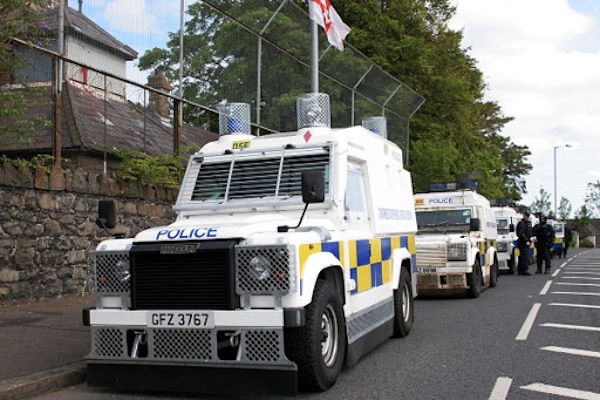
The irony of British Imperialism pontificating about ‘illegal Occupations’ of Sovereign Nations can not be lost on many.For more then 850 years, British Imperialism and principally English Imperialism has maintained an illegal occupation of Ireland. Today, Britain maintains its illegal stranglehold on Ireland through a direct and colonial military occupation of 6 Irish Counties and a semi colonial rule over 26 Irish Counties.
You won’t hear much about this ongoing occupation in the compliant mainstream media, or from the subservient free state administration that is but a puppet of Britain in Ireland.
But the truth today is that there are 5,000 full combat British Troops in Ireland, 9000 members of a paramilitary police, thousands of MI5 spooks and many thousands of members of loyalist death squads controlled by British Imperialism. The head of the Free State Police is an MI5 agent meaning that British Military Intelligence controls policing across Ireland. The British Navy are responsible for policing Irish costal waters and the British Airforce are responsible for policing Irish Skies, with the full compliance of Leinster House. Many of the shops in the towns and cities in Ireland are English and English feudal lords still own vast tracts of land in Ireland.
Yet where is the talk of sanctions against British Imperialism for its ongoing illegal occupation and partition in Ireland?
Dean Swift once had a tactic to deal with English Imperialism in Ireland, he advocated that the people should ‘Burn Everything English, But their Coal!’. An economic boycott of English goods in Ireland is a tactic that can hit the occupation and imperialism where it hurts and is worth being considered by all opposed to the British presence in Ireland.
The Irish People want no part in an imperialist war with the people of the Donbas or Russia. Our fight is against British Imperialism and the Occupation of our country as the primary contradiction, along with the fight against North American and European Imperialist Interference in Ireland.
Our people should not be misled by Anglo-American propaganda and warmongering. Our enemies remain those that hold our country in chains and oppress and exploit our people. Our struggle is to drive the British Occupation and its imperialist allies out of Ireland.
As western imperialism marches ever closer to war, the focus in Ireland must be on rebuilding the struggle for National Liberation and Socialist Revolution into a mass movement across the country, a movement that will not accept Ireland being used as an imperialist pawn.
All Republicans should rally to the cause to drive Britain out of Ireland once again. It is only by addressing the primary contradiction that all other contradictions in Ireland can be resolved
For National Liberation and Socialist Revolution- Break the Connection with Imperialism- Brits Out Now!
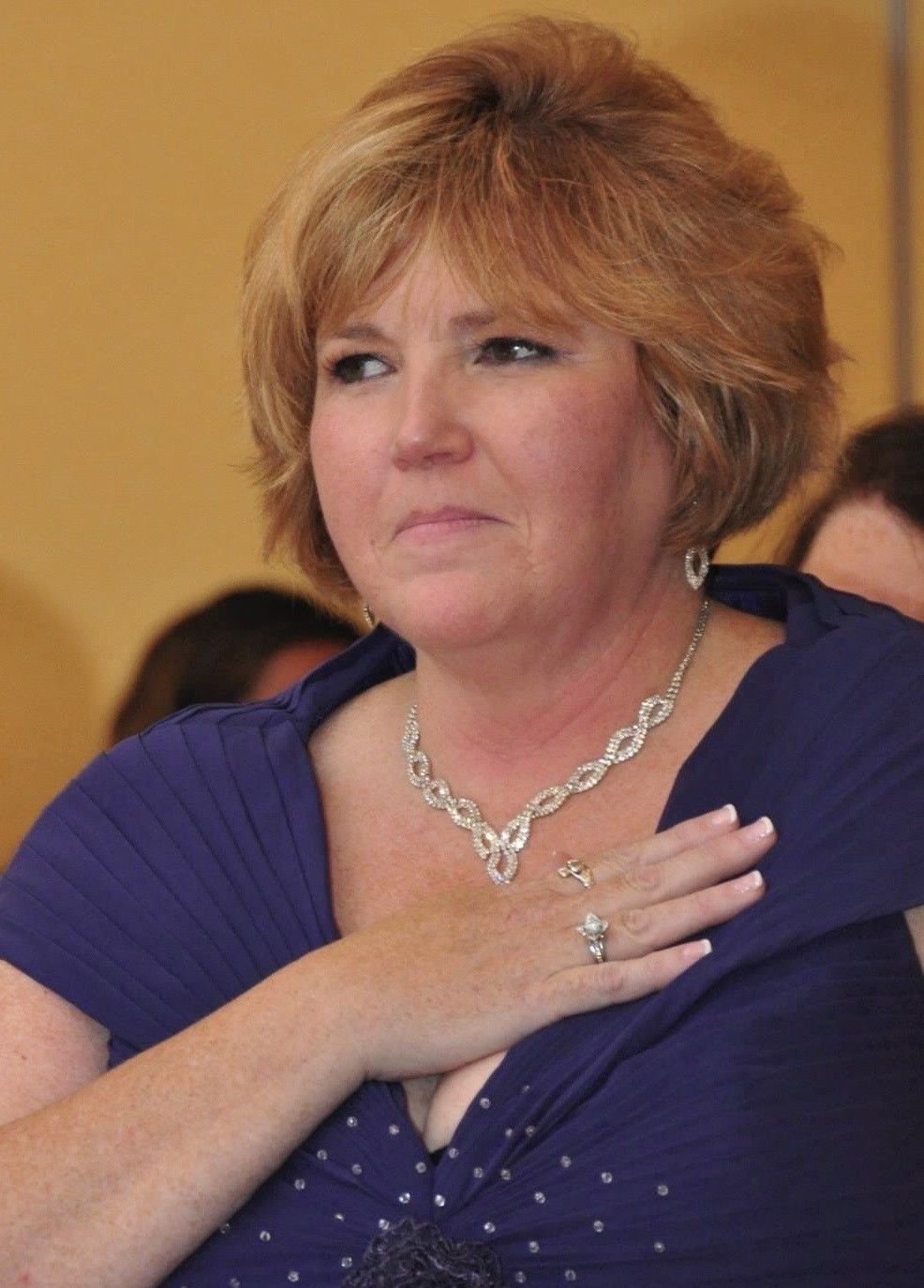 LAOH National President Karen Keane