Before There Was Rugby… Before There Was Football… There Was Hurling
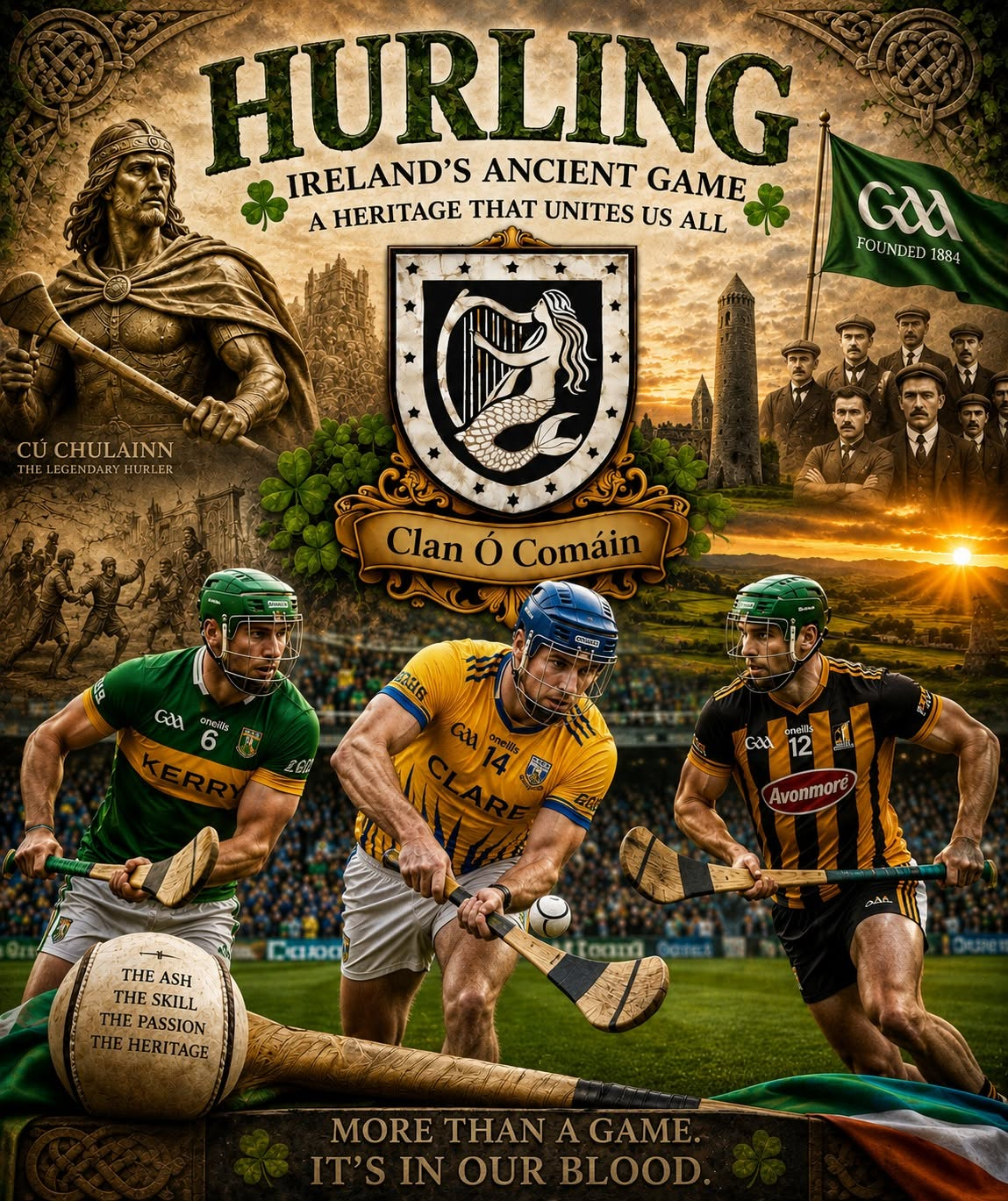
Long before packed stadiums and All-Ireland finals, the sound of ash striking sliotar echoed across the hills of Ireland.
Hurling is believed to be over 3,000 years old, making it one of the oldest field games still played anywhere in the world.
But this was never just a game.
It was the sport of warriors.
Legends tell us that the mighty Cú Chulainn was a master hurler long before he became Ireland’s greatest hero. As a boy, he is said to have single-handedly defeated the youth of Emain Macha with nothing more than his hurl, his sliotar, and extraordinary skill.
In ancient Ireland, hurling was used to build speed, strength, courage and battle instincts. Young men honed the very skills they would one day need to defend their clan and their homeland.
The game became so fierce that medieval kings occasionally tried to ban it because entire villages would abandon work to play… and the matches sometimes ended in broken bones, black eyes, and the odd family feud!
Yet nothing could stop it.
Even through centuries of hardship, when so much of Irish culture came under pressure, hurling survived in fields, villages and parishes across the country.
Then, in 1884, the newly formed Gaelic Athletic Association (GAA) helped revive and protect Ireland’s native games. Hurling became more than a sport—it became a symbol of Irish identity, pride, and resilience.
Today, every swing of a hurley carries thousands of years of history.
Every match honours the generations who refused to let one of Ireland’s oldest traditions disappear.
Because when you watch a game of hurling, you’re not just watching sport…
You’re witnessing a living piece of Ireland’s soul.
Have you ever played hurling—or watched a match that you’ll never forget? Which county will always have your heart? Tell us below!
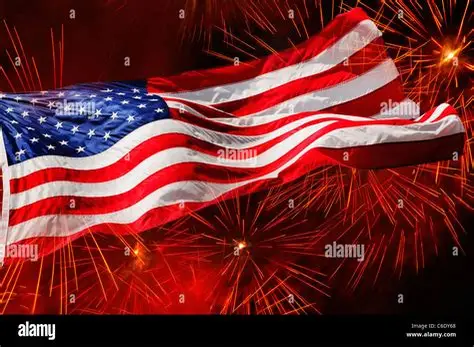
By Shane Greer on 4 July 2026I don’t know what caused me to fall in love with America: Old Glory, the bunting, the cowboy hats or the country music sung by Mel Tarner. But I do know where and when it was: early 90s, aged eight or nine, at a working men’s club in East Belfast. Cigarette smoke filled the air, and women ate prawn cocktails served in wine glasses. Every day, people dressed like extras in a spaghetti western. Men with six-shooters on their hips, their wives looking like they just stepped off a wagon on the Oregon Trail. An ever-changing group is square dancing the night away in front of the stage. Then my mum bundling me into the car while my dad, Mel, stayed behind to pack up the equipment.In 2009, I married an American. In 2013, I immigrated to America. In 2021, I took the oath and became a citizen. Five years on, writing this essay from Capitol Hill as we prepare to celebrate our 250th anniversary, I’m reflecting on how far the reality of America in 2026 has fallen short of the one I fell in love with. In many ways, it’s a place that has more in common with the Northern Ireland I left than the place I ran toward. It is a country of political tribes whose symbols project every bit as much contempt for their rivals as a flag flying from a lamppost in Northern Ireland. Our discourse is shaped by the legions of voices that make Northern Ireland’s loudest seem measured. Political violence has become unremarkable.But I had it backwards. I didn’t fall in love with a description of America: I fell in love with the destination. We are a nation whose founders declared all men to be created equal while enslaving Black people. But we have taken enormous strides since then, on the shoulders of marchers, Freedom Riders, lunch-counter sitters, and so many more. They weren’t protesting the promise. They were collecting on it. The people in that working men’s club understood this before I did. They weren’t pretending to be American any more than they believed Mel Tarner was from Nashville. They were embracing an idea of America and understood inherently what it took me thirty plus years to figure out: the dream was never about the facts.This July 4th, the streets around my home will fill with flags and bunting, and I will notice, as I do every year, that I have traded one flag-heavy July for another. But there the similarity ends. Because what we are about to celebrate is strange: a 250th anniversary not of arrival but of travel. The founders didn’t describe what America was. They declared what it must become. Every immigrant understands this in their bones, because emigration is the same act: choosing a destination you haven’t reached and setting out anyway. Which means I didn’t become American in 2021, when I raised my right hand and took the oath. I became American in that club in East Belfast, the moment I started facing toward a place I had never seen.My father sang toward America. I moved toward it. My daughter was born a citizen. She will grow up without an imagined America to lose, but already she’s starting to see gaps between the country and its promise. That’s what it is to be American. That is the machine working. My hope for her is not that the gap closes. It is that she keeps wanting it to. That she stands in whatever America exists in 2076 and still measures it against the one in a working men’s club she’s never seen. Until then, we do what my father did at the end of the night, after the hats came off and the lights came up: pack up the equipment, go home, and come back to do it all again.
Industry insider blows the lid on multi-million pound scale of bonfire pallet crime.
Staff Reporter
June 26, 2026 09:01
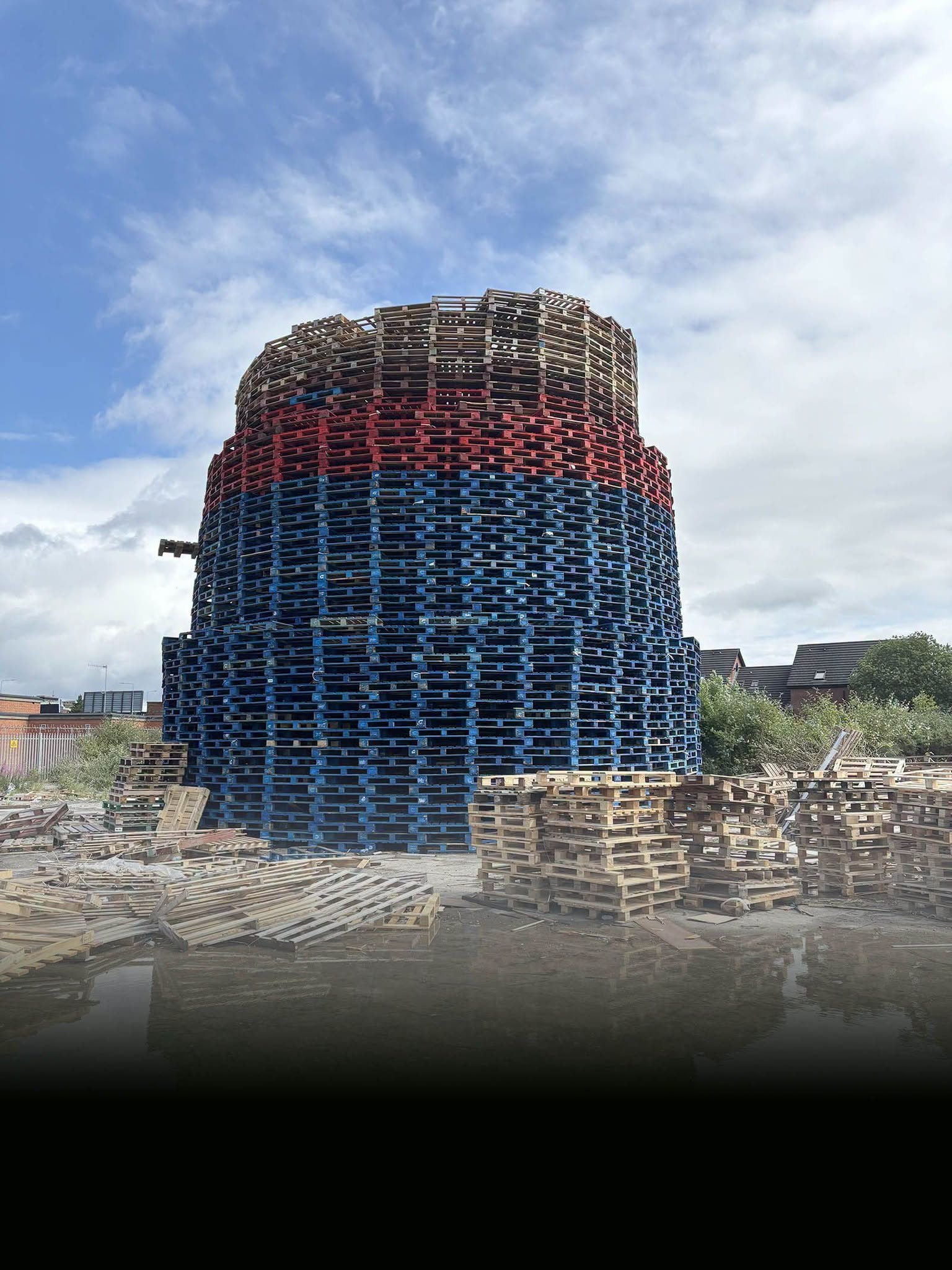
CRIME ON AN INDUSTRIAL SCALE: Our source says a steady annual supply of pallets is ensured by threats from the UDA and UVF to burn premises.
THE theft of pallets from businesses for Eleventh Night bonfires is an “industrialised crime” backed up by paramilitary threats and intimidation.
That’s the claim of a 40-year veteran of the local freight industry who has blown the lid on the scale and extent of spring and summer pallet theft across the North – and in Belfast in particular.
Our source says a steady annual supply of pallets is ensured by threats from the UDA and UVF to burn premises, lorries and goods of manufacturing and retail businesses in loyalist and mixed areas that don’t play ball.
And it’s the fear of violent retribution that means local industry not only continues to allow thieves to enter their premises and take what they want with impunity – but also ensures their silence.
The West Belfast man says that while the perception of bonfire collectors remains that of schoolkids wheeling pallets on a trolley through the streets, the truth is that in the new era of monster bonfires the theft of pallets is carried out by gangs of adults using lorries, vans and trailers.
Large manufacturing and retail businesses turn a blind eye as vehicles – sometimes as large as tractor units with 40-foot trailers – enter yards and depots and simply help themselves. And with the penalty charge for companies failing to return leased ‘blue’ pallets standing at just under £30 per unit, it’s crime on an endemic scale that is costing industry across the North millions of pounds every spring and summer.
“It’s cheaper for companies to lose thousands of pounds worth of pallets every summer than for their lorries or yards to be burnt,” our source said. “So they allow the pallets to be taken and they say absolutely nothing about it.”
He added that pallet theft takes place so brazenly and on such a huge scale that the police are fully aware of it. But, said our source, “It’s handier all round for everybody to pretend it’s not happening – and that includes the police.”
He added: “Try picking just one of those blue pallets up – and then ask yourself how thousands and thousands of them make it from yards and depots to bonfires. Because these pallets aren’t left out in the open. They are stored in secure premises alongside goods and lorries. That’s not kids. That’s organised gangs.”
In a special feature today, we report with the help of the industry veteran on the reality of the scale of pallet theft and the cost to industry of companies and the police doing precisely nothing about it.
“If you stole a bar of chocolate that’s delivered to a shop on a pallet you’re more likely to get arrested and charged than if you stole tens of thousands of pounds worth of pallets in a van or lorry,” our source said.
“There is a total failure to understand the cost involved.”
It’s a cost, says our source, that’s being paid by the manufacturing, retail and freight industries – and it’s a cost that’s ultimately being picked up by the shopper.
One of the biggest impediments to progress on reunification is the tension between party politics
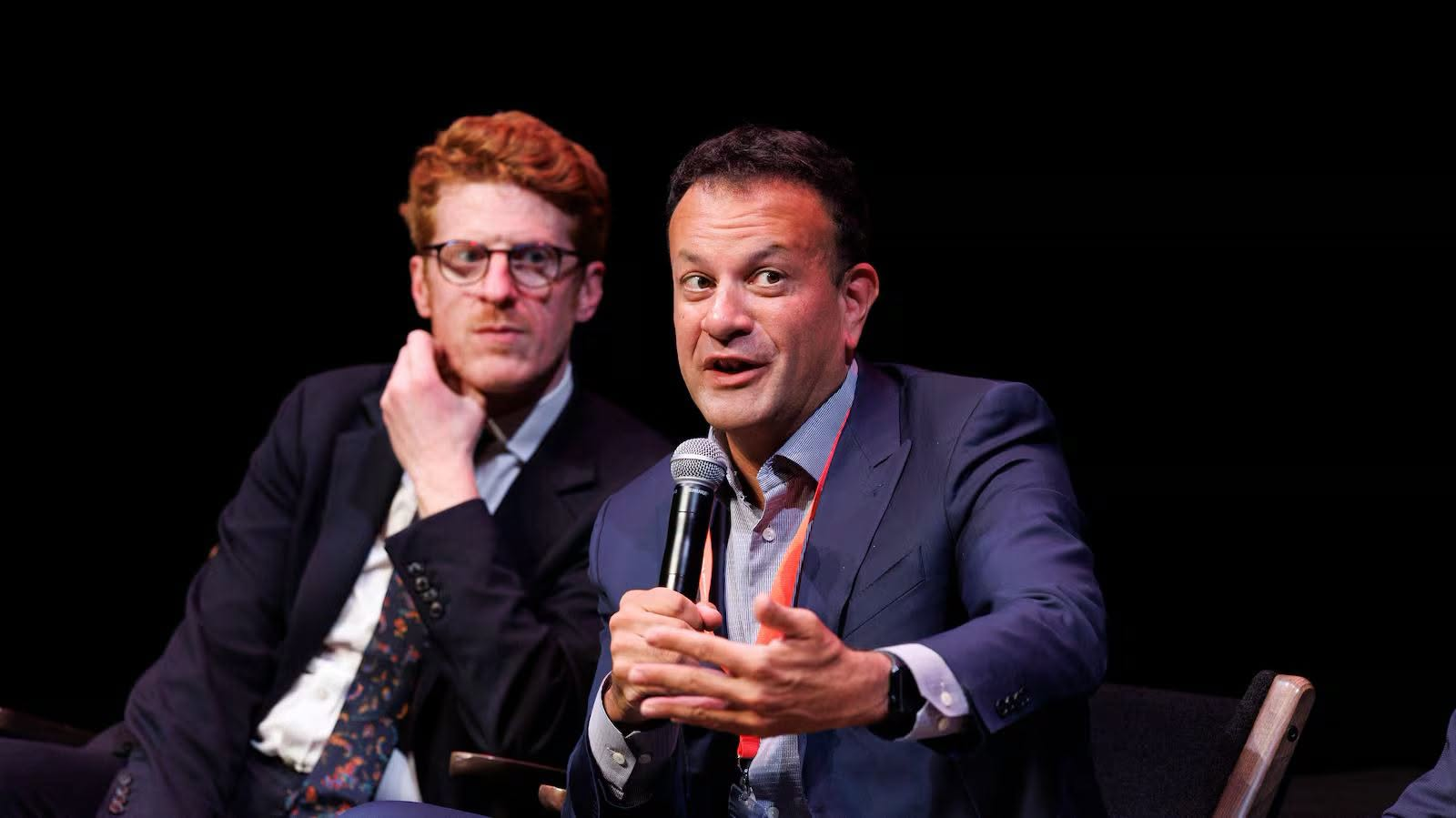
The SDLP’s Matthew O’Toole with former taoiseach Leo Varadkar during the conference The Future of These Islands: Preparing for Change.
By Tom Collins
June 30, 2026 at 6:00am BST
IN one room my wife was watching a documentary on the American War of Independence, while in another I was listening to Christy Moore singing his version of ‘Only Our Rivers Run Free’.
There must have been something in the ether – it was a night for contemplating self-determination.
Sensitised to the struggle for freedom, all I needed was a glass of whiskey and I’d be crying. There’s nothing as self-indulgent as a maudlin Saturday night.
But the whiskey stayed in its bottle as I needed to stay sober. I had to pick up my daughter later that evening, as she was returning broken but unbowed from three weeks in America with her football-mad Scottish boyfriend.
Like the Irish, the Scots are conditioned to having their hopes dashed on fields of dreams.
As readers will know, Moore has a way of loading songs with emotion.
The hyper-poetic opening of Michael McConnell’s lament softens you up.
But the line that strikes home is in the remarkable observation of Ireland’s political and cultural predicament. He sings of: “A land that has never known freedom, only her rivers run free.”
It shouldn’t have come as a surprise, I’ve been writing about the cause of Irish unity for decades, but it was the word ‘never’ that hit home.
We’ve allowed ourselves to be conditioned to believe that Irish sovereignty became a reality with our own War of Independence, and the establishment of the Irish Republic. But that is a faux reality.
The juxtaposition of TV documentary and folk song was striking. Two hundred and fifty years ago this week, the American colonies achieved their freedom; yet Britain’s broken empire still retains its grip on its nearest neighbour.
Ireland has never been free. Never. That’s a powerful word.
The consequences are clear to see. They are primarily economic – too many children in poverty, too many young people let down by educational underachievement, too many people denied proper healthcare, too many old people left lonely and isolated because the social care system is broken.
For much of the 20th century, Westminster failed to live up to its responsibilities for this place, turning a blind eye to gross abuses of human rights, allowing sectarianism to flourish – even at the heart of government – and forcing generations to emigrate in search of work which was denied to them back home.
My mother was among them, as were her father, two sisters and countless cousins.
For unionists, the uncomfortable truth is that while their political leaders were responsible in large part for the decline and fall of Northern Ireland, unionist voters were among those who suffered.
The collapse of manufacturing exposed appalling levels of educational underachievement in unionist areas, while the blind eye turned to loyalist paramilitaries by the RUC left whole communities vulnerable to the predations of gangsters.
Reunification – note, not unification – offers real benefits for all traditions here; not least by replacing a government in London which is essentially the equivalent of a 19th century absentee landlord with an Irish government focused on bettering the lives of everyone within this island.
Nobody, not even the most die-hard unionist, can pretend that the current dispensation is working in the interests of people here.
If anything, the evidence suggests that the psychodrama of English politics is having a negative impact on our ability to survive in an increasingly fractured world.
One of the biggest impediments to progress on reunification is the tension between party politics – the fighting for position between individual parties – and the cause of reunification.
Last week’s conference on The Future of These Islands was an encouraging sign that pro-reunification parties recognise that the imperative to build a new Ireland transcends party politics.
Putting country before party is easier said than done, particularly for politicians conditioned to look no further than the next election.
But ‘country before party’ is the only approach that will secure the outcome they all crave: the ability to effect real change that will better the lives of those they are elected to serve.
In that context, there is an obligation on the two governments to begin the urgent work needed to prepare the way for a border poll (an inevitability) which will allow the Irish people to make an informed choice about the future shape of a reunited Ireland.
An Ireland at peace with its neighbour, an Ireland which is an integral part of the European Union, and an Ireland which takes its place as a truly sovereign nation among the nations of the world.
In short, an Ireland where more than just the rivers run free
 Before There Was Rugby… Before There Was Football… There Was Hurling
 Have you ever played hurling—or watched a match that you’ll never forget? Which county will always have your heart? Tell us below!
 By Shane Greer on 4 July 2026I don’t know what caused me to fall in love with America: Old Glory, the bunting, the cowboy hats or the country music sung by Mel Tarner. But I do know where and when it was: early 90s, aged eight or nine, at a working men’s club in East Belfast. Cigarette smoke filled the air, and women ate prawn cocktails served in wine glasses. Every day, people dressed like extras in a spaghetti western. Men with six-shooters on their hips, their wives looking like they just stepped off a wagon on the Oregon Trail. An ever-changing group is square dancing the night away in front of the stage. Then my mum bundling me into the car while my dad, Mel, stayed behind to pack up the equipment.In 2009, I married an American. In 2013, I immigrated to America. In 2021, I took the oath and became a citizen. Five years on, writing this essay from Capitol Hill as we prepare to celebrate our 250th anniversary, I’m reflecting on how far the reality of America in 2026 has fallen short of the one I fell in love with. In many ways, it’s a place that has more in common with the Northern Ireland I left than the place I ran toward. It is a country of political tribes whose symbols project every bit as much contempt for their rivals as a flag flying from a lamppost in Northern Ireland. Our discourse is shaped by the legions of voices that make Northern Ireland’s loudest seem measured. Political violence has become unremarkable.But I had it backwards. I didn’t fall in love with a description of America: I fell in love with the destination. We are a nation whose founders declared all men to be created equal while enslaving Black people. But we have taken enormous strides since then, on the shoulders of marchers, Freedom Riders, lunch-counter sitters, and so many more. They weren’t protesting the promise. They were collecting on it. The people in that working men’s club understood this before I did. They weren’t pretending to be American any more than they believed Mel Tarner was from Nashville. They were embracing an idea of America and understood inherently what it took me thirty plus years to figure out: the dream was never about the facts.This July 4th, the streets around my home will fill with flags and bunting, and I will notice, as I do every year, that I have traded one flag-heavy July for another. But there the similarity ends. Because what we are about to celebrate is strange: a 250th anniversary not of arrival but of travel. The founders didn’t describe what America was. They declared what it must become. Every immigrant understands this in their bones, because emigration is the same act: choosing a destination you haven’t reached and setting out anyway. Which means I didn’t become American in 2021, when I raised my right hand and took the oath. I became American in that club in East Belfast, the moment I started facing toward a place I had never seen.My father sang toward America. I moved toward it. My daughter was born a citizen. She will grow up without an imagined America to lose, but already she’s starting to see gaps between the country and its promise. That’s what it is to be American. That is the machine working. My hope for her is not that the gap closes. It is that she keeps wanting it to. That she stands in whatever America exists in 2076 and still measures it against the one in a working men’s club she’s never seen. Until then, we do what my father did at the end of the night, after the hats came off and the lights came up: pack up the equipment, go home, and come back to do it all again.