Posted by Jim on December 1, 2023

AOH Home of the Brooklyn Irish
Baile na nGael
Thursday, August 27, 2026
Posted by Jim on
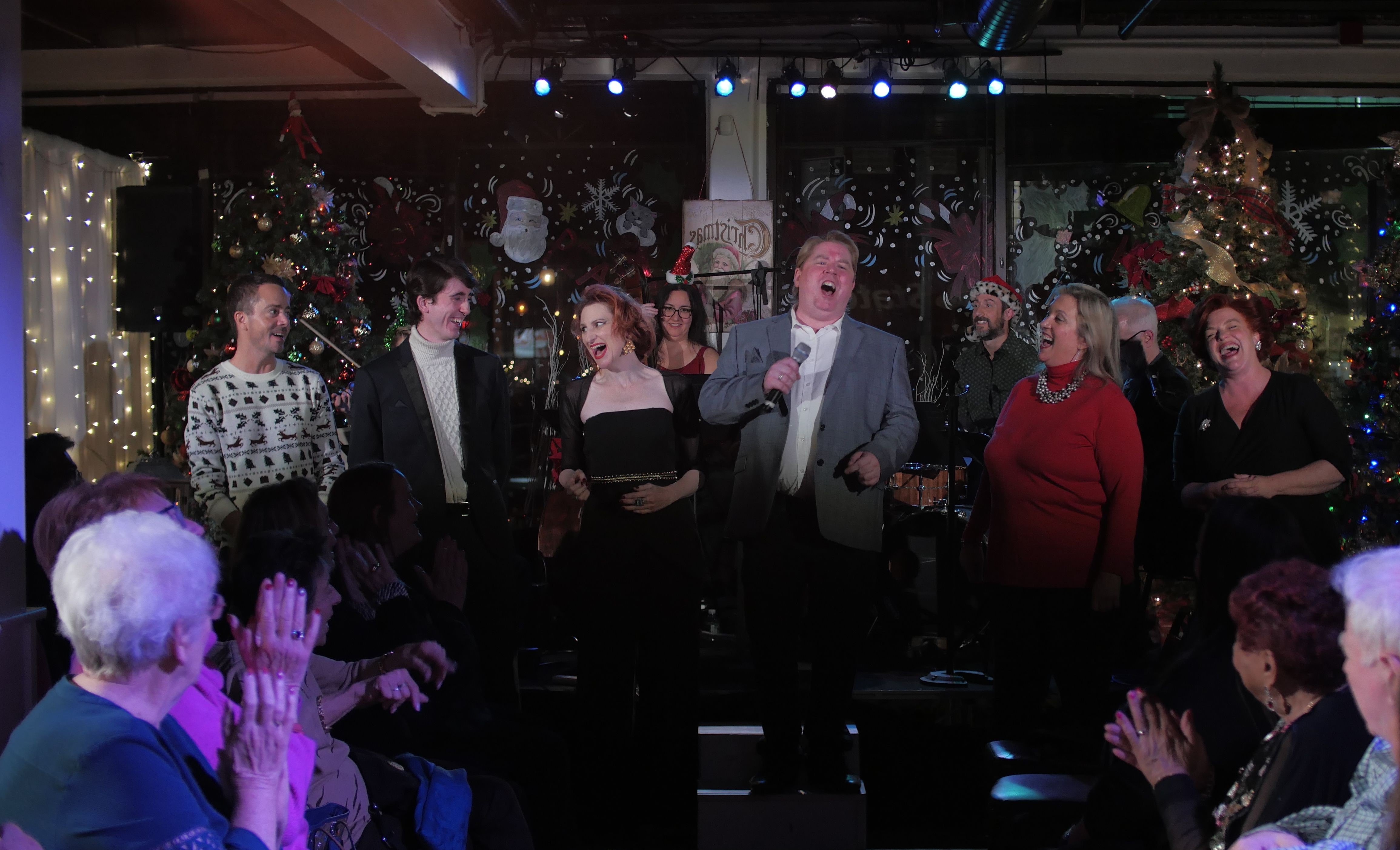
“New York Croons for Christmas” will take place on Friday, Dec. 8. [Photo by Rory Duffy].
November 30, 2023 by Irish Echo Staff
The New York Irish Center presents its annual holiday concert, “New York Croons for Christmas,” on Friday, Dec. 8 at 7pm.
The event — a fundraiser to support all the cultural and social programs of the Center – is staged immersively in the storefront theater Reilly Room.
Tickets, which are $60 (includes complimentary holiday refreshments starting at 6pm), can be purchased at www.newyorkirishcenter.org. The NYIC is located at 1040 Jackson Ave. in Long Island City (just three minutes on the 7 train from Grand Central).
Hosted by Colm Reilly, “New York Croons for Christmas,” feature Carolyn Montgomery, Wendy Lane Bailey and Kathy Kaefer; singer-songwriter Jeanne MacDonald; and the guitarist Sean Harkness leading the Life of Reilly Band. Bandmembers include Jennifer Vincent (bass), Rob Mitzner (percussion), Sara Caswell (violin/fiddle), and Sean Harkness (guitar).
A two-time MAC Award-winner, host Colm Reilly is a frequent performer and host at the Center, who has also appeared and headlined at The Town Hall, Symphony Space, The Iridium Jazz Club, Birdland, Feinstein’s/54 Below and at Carnegie Hall. He has also toured with the Cross Border Orchestra of Ireland, and in theatre productions across the U.S., including “Forever Plaid, “Brigadoon, and “Hello Dolly!” One of his two MAC Awards was for Best Male Vocalist. The Reilly Room is named for his father, the NYIC’s late co-founder Paddy Reilly.

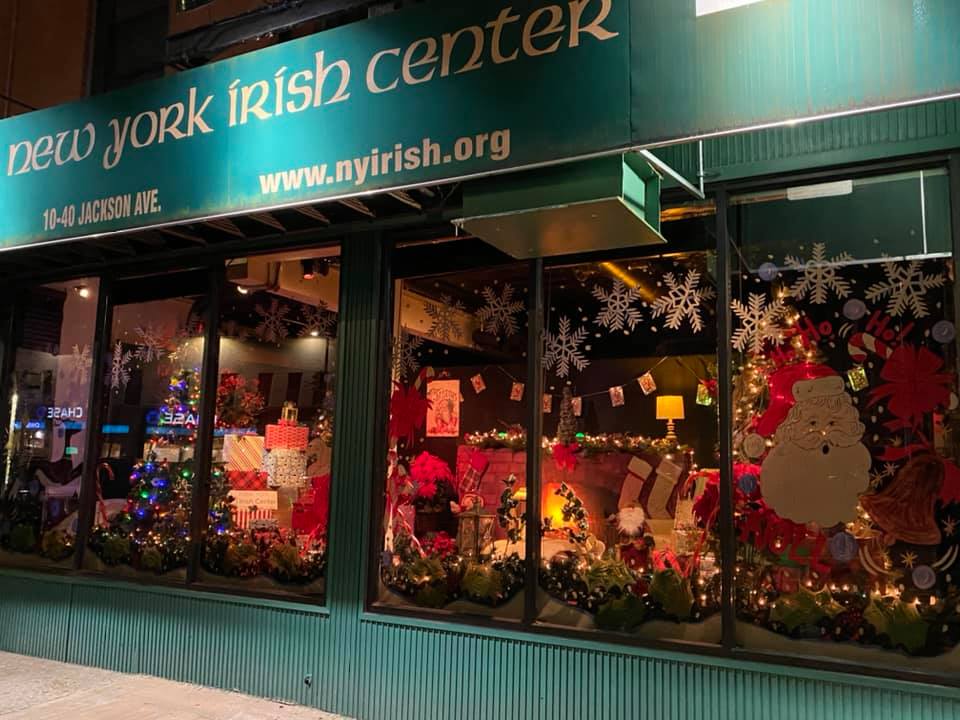
And there are two other notable Christmas and holiday-related events at NYIC
Annual Toy Drive (Saturday, Dec. 2, 1 p.m.)
As the annual Holiday Toy Drive returns for its 11th year, NYIC invites you to support our drive to deliver 500 gifts to 500 children across our communities. On Saturday, December 2 dozens of volunteer elves transform the Center into a gift-wrapping workshop, with the goal of wrapping over 500 individual gifts! This year we are supporting local charities Hour Children, Woodside on the Move, and Habitat for Humanity, among others.
Santa Visits from the North Pole (Sunday, Dec. 10, 2 p.m. $5, please register ahead)
On this special day, the Center opens its doors to welcome local children from across our diverse community, and throughout the five boroughs, for a chance to meet Santa Claus ahead of the Big Day. Friends from all over marvel at St Nick’s distinctly Irish brogue. Who knew? Tea, coffee, and snacks will be on hand! Plus: each child who walks through the door receives a free gift!
Posted by Jim on November 9, 2023

Sir Declan Morgan.
Opinion November 08, 2023 by By Lord Johnathan Caine
It was a great pleasure to represent the UK Government on a visit to the United States last month. I was delighted to catch up with many friends and acquaintances established over 25 visits in the past twelve years.
Even when we disagree, I always welcome dialogue with all those in the United States who take a deep, and in many cases, longstanding, interest in the affairs of Northern Ireland. My visit came against the backdrop of the Northern Ireland Troubles (Legacy & Reconciliation) Act having just become UK law.
Naturally, therefore, this was a major focus of discussion, including with the National Committee on American Foreign Policy, the Ancient Order of Hibernians, at the conference I attended in the Edward Kennedy Institute in Boston, and with Congressman Richard Neal.
It is also an issue with which I have grappled for many years. Over a period of three decades I have spoken to countless victims and survivors, hearing many harrowing and deeply moving stories from people on all sides of the community in Northern Ireland who suffered, and for whom the grief and emotion is as raw today as it ever was. The Troubles touched me personally.
One of my first jobs in politics was to support the Conservative Party’s Parliamentary Northern Ireland Committee, chaired by the MP, Ian Gow. I last saw Ian a few short weeks before he was blown up by an IRA car bomb in July 1990. I am not, therefore, immune to the feelings of those who lost colleagues, friends and loved ones during the so-called Troubles.
I have also been intimately involved in previous unsuccessful attempts to address the past since the 1998 Agreement, most notably the Stormont House Agreement in December 2014. Alas, the degree of consensus we thought had been reached proved to be somewhat illusory.
After five years of unsuccessfully trying to implement Stormont House, it was understandable that, in early 2020, the Government looked afresh at legacy issues. In approaching legacy, the starting point has to be a realistic assessment of what any government can reasonably expect to deliver a quarter of a century after the 1998 Agreement, nearly thirty years after the paramilitary ceasefires, and well over fifty years since the actual start of the Troubles.
We also need to appreciate the fact, difficult as it can be, that current mechanisms for addressing legacy, such as inquests, work only for a very few of those affected.
Established criminal justice processes are increasingly unlikely to produce outcomes for the overwhelming majority of victims and survivors. Through the Legacy Act, the UK Government is, therefore, first and foremost determined to deliver better outcomes for those most affected by the Troubles, with the aim of helping society to look forward.

In our view, the Act puts in place a robust framework to deliver far more information to many more victims and survivors in a far more timely manner than existing legacy mechanisms. It does so, crucially, in full compliance with our international obligations, something that I sought to strengthen further during its passage through Parliament.
Moreover, It also does so in a way that reflects the significant precedent set by previous measures taken in order to secure peace as part of the 1998 Agreement, including the early release of prisoners, an amnesty for the process of decommissioning paramilitary weapons, and immunity to those who provide information relating to the so-called “disappeared.”
All of these represented significant departures from usual, established criminal justice processes. The Independent Commission for Reconciliation and Information Recovery (ICRIR) established by the Act will conduct reviews into Troubles-related deaths and serious injury, with the primary objective of establishing the truth and providing information to victims and survivors. The independent Commission will, crucially, have all the necessary powers to conduct criminal investigations as part of any review.
The Commissioner for Investigations will have the full powers of a police constable and be able to compel witnesses. State bodies are under a legal obligation to provide whatever material is reasonably requested by the Commission.
This included records held by the police, the Armed Forces and intelligence services. To help facilitate the provision of information the independent Commission will be able to offer immunity from prosecution to individuals who cooperate with its inquiries. This is not a “blanket amnesty,” as some have claimed.
The Act ensures that individuals can only be granted immunity from prosecution in relation to a specific incident, and only where the independent Commission – having robustly tested the truthfulness of an account – is satisfied that it is true to the best of that individual’s knowledge and belief.
Individuals who do not tell the truth, or who do not cooperate with the independent Commission, will not be granted immunity from prosecution, and will, should sufficient evidence exist, be prosecuted in the usual way. At the conclusion of its investigations, the Commission will publish a family report, setting out as far as can be determined the full facts of what happened in each case.
Families will be able to submit a victim’s impact statement similar to those that are heard in court proceedings before sentencing.
The only restrictions on what can be disclosed will be the usual ones of not divulging information that might put an individual at risk. While carrying out its duties within the framework of the legislation, the ICRIR will, like the police and the judiciary, be wholly independent of government.
No politician will be able to direct the Commission in its work. Now that the legislation has become law, however, it is crucial that the independent Commission, led by Sir Declan Morgan KC as Chief Commissioner, is allowed time to establish itself.
Sir Declan is a man of impeccable integrity and experience. I am convinced that under his stewardship, the independent Commission will deliver on our shared objective of providing better outcomes for victims and families.
I am the first to recognize the legislation contains finely balanced political and moral choices. As I have said publicly many times, it is legislation that I have found personally challenging.
Yet it is necessary if we are to effectively provide greater information and answers to victims and survivors many decades after the initial incidents occurred.
The alternative is that we risk, once again, delivering very little in the way of positive outcomes for those who have already waited decades. It is the job of politicians and governments to take difficult, often uncomfortable, decisions, rooted in the world as it is, not always how we might like it to be constituted. In taking forward this legislation, the UK Government has done exactly that.
We are confident that it can work and help to deliver for victims and survivors in ways that have proved largely elusive since 1998. All we ask is that it is given the chance to succeed.
Lord Jonathan Caine is the Parliamentary Under-Secretary of State at the Northern Ireland Office. He has been an advisor to six Northern Ireland Secretaries of State.

Posted by Jim on November 7, 2023
Nov 07, 2023
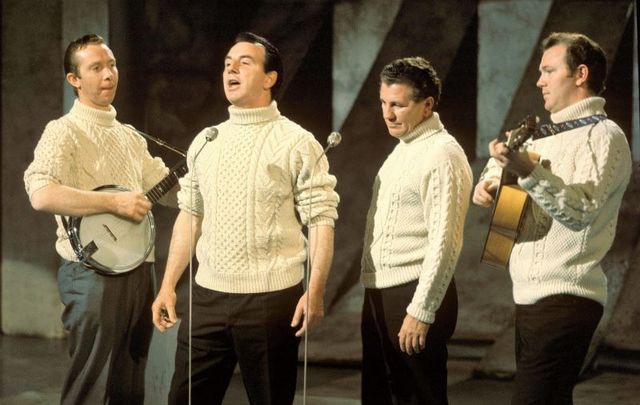
From left to right: Tommy Makem, Pat Clancy, Tom Clancy, and Liam Clancy. GETTY IMAGES
On November 7, 1990, the world lost Tom Clancy to stomach cancer, aged 66. Clancy left behind a wife, son, and five daughters, the youngest of whom was just two years old.
The traditional music world was shaken by the loss of one of the Clancy siblings, who strode to fame Aran-sweater-clad during the 1960s, alongside their friend Tommy Macken.
In tribute to Tom and to his brothers Paddy (died 1998, aged 76), Bobby (died 2001, aged 76) and Liam (died 2009, aged 74) we look back on the magic of the Clancy Brothers and their influence on music in America with this article republished courtesy of our sister publication, Irish America magazine.
As Liam Clancy remembers it, being asked to perform on “The Ed Sullivan Show” did not seem like a big deal.
“We just did not understand the significance,” he told Irish America in a recent interview, during a publicity tour to promote a brilliant re-release of The Clancy Brothers and Tommy Makem performing live at New York City’s Carnegie Hall in 1963.
Two years before that historic performance, as Clancy recalls, they were a group of slightly shady characters best known in that bohemian redoubt, Greenwich Village.
“Irish Americans weren’t really interested in us,” said Liam, the youngest of the Clancy brothers. “Pete Seeger played with us. A lot of people said: ‘They’ve got a Communist up there.’ So most of our audience were folkies and liberal Jews.”
That all changed in March of 1961. The Clancys and Makem had already moved uptown to the Blue Angel on East 55th Street, a more respectable establishment frequented by TV talent scouts.
Sure enough, the Irish musicians impressed one of Ed Sullivan’s scouts. The quartet later showed up at the Sullivan show studio for a Sunday rehearsal, only to be told that the evening’s scheduled headliner, Pearl Bailey, had bowed out.
Could the Irish men perhaps substitute?
That night, 80 million Americans from Boston to L.A. heard the revolutionary sounds of The Clancy Brothers and Tommy Makem – the performance lasted a record-breaking 16 minutes.
“It was like getting a blessing from the Pope,” recalled Liam with a laugh. Two years later came the historic concert at Carnegie Hall, where they cracked jokes about the new Irish Catholic president and earned loud applause simply by mentioning the IRA.
Clearly, something momentous had changed in Irish America. With their Aran sweaters, tin whistles, and banjos, The Clancy Brothers and Tommy Makem might seem to be the quintessential Irish trad artists. But they were, in many ways, a radical departure, who then went on to change the Irish American culture.
How did they arrive at their unique musical sound? Why did some Irish Americans consider them threatening? And how did they fit into an extraordinary moment in musical history, crossing paths with the likes of Bob Dylan?
The Clancy brothers – Paddy, Tom, Bobby, and Liam – were born into a musical family of nine children in Carrick-on-Suir, Co Tipperary.
Paddy and Tom served in Britain’s Royal Air Force during World War II before immigrating to Toronto, Canada. After crossing the border and living in Cleveland for a spell, the duo moved to New York City, where they planned to work as actors.
They had some success on the stage and screen but also felt the need to raise a little money. So they turned to an art form that came so naturally to them: music. Particularly memorable were some of their “midnight special” performances in the early 1950s at the Cherry Lane Theatre, where they were joined by their brother Bobby, who had also served in the RAF and traveled widely in Europe before ending up in New York.
As luck (or fate) would have it, New York in the mid-1950s was turning into a breeding ground for a new kind of folk movement.
It was in the mid-1950s that Liam, the youngest brother, joined Tom and Paddy in New York when Bobby returned home to Ireland to take over his father’s insurance business. Liam too wanted to act, but he had also spent time performing, as well as studying and collecting the traditional music of Ireland.
During his travels, Liam had become familiar with a particularly talented musician from Armagh — Tommy Makem. Many members of the Makem family had made their way to the US, to work in the textile mills of Dover, NH. Tommy did the same. He was injured on the job, however, and so joined the three Clancy brothers in New York.
When it was time to record their first album, “The Rising of the Moon,” in the Bronx apartment of a young folklorist with the fine Irish name of Kenny Goldstein, they turned to a reliable formula: songs about drinking and Irish rebels. But it was clear from the beginning they were also breaking from the past.
Not only did the quartet avoid sentimental ballads, they also infused traditional Irish songs of rebellion and revelry with strands of fast-paced American folk, the improvisational feel of jazz, and even the banter of cutting-edge beat poets and comedians.
The result was something familiar, yet very different. As the 1960s dawned, the group had a following, but nothing like mainstream success.
Maybe it was the unique style of The Clancy Brothers and Tommy Makem. Maybe, with one of their own in the White House, Irish Americans were ready for a new kind of Irish music.
Or maybe it was the sweaters.
As legend has it, the Clancys’ mother Johanna sent over four, thick, white Aran sweaters so the boys could stave off New York’s winter chill. Now, Makem and the Clancys may not have been willing to play the stage Irish card, but their manager, Marty Erlichman, knew that if this act was going to hit the big time, they would have to appeal to some degree to Irish American traditionalists.
Either way, when the quartet hit the stage on “The Ed Sullivan Show,” they became at least as well known for their sweaters as for their tunes.
But on the recently released recording “The Clancy Brothers and Tommy Makem In Person at Carnegie Hall: The Complete 1963 Concert,” something more than fashion or even music shines through. This recording captures the boys at the top of their game, but it also captures a unique moment in American history.
Between tunes, Makem gleefully cracks jokes about JFK – “big bad John in the White House” – as well as the American establishment.
“Hail Mary, full of grace – the Masons are in second place!” Makem cracks. Then there is the hilarious tune, “Mr. Moses Ri – Tooral – I Ay,” about a Jewish-Irish merchant who is arrested for posting a sign with his name written in Hebrew – which is swiftly mistaken for Irish Gaelic by an ambitious British police officer.
“The song was written not so much to show the love between the Irish and the Jews so much as to show the stupidity of the British,” Makem cracks.
Finally, introducing the rebel ballad, “The Patriot Game,” a mention of the Irish Republican Army – which, in 1963, had not yet earned the mythic status it later would when the Troubles heated up in the late 1960s – earns lusty applause. Loud applause for a guerilla army defined as terroristic by the British? This is not exactly what you’d expect at Carnegie Hall. But this is the new world the Clancy Brothers and Tommy Makem helped create.
Following Ed Sullivan and Carnegie Hall, it might seem as if The Clancys and Tommy Makem were suddenly famous. They even performed for JFK himself in 1963. But they were overnight sensations well over a decade in the making.
Along the way, they became famous in Greenwich Village pubs such as The White Horse as well as their “home away from home” (as Liam puts it) The Lion’s Head. Pete Hamill, Frank McCourt, and so many others made The Lion’s Head the famous “bar for drinkers with writing problems.”
Along the way, Bob Dylan became a huge admirer of the Clancys, particularly Liam. At The White Horse, Dylan and Liam would imitate the other’s, uh, unique singing style. It’s great to have this Carnegie Hall recording, but a real treasure would be to hear Dylan imitating Liam, and vice versa, on “Eileen Aroon.”
In the end, the Clancys found a way to both change and absorb American musical styles. Thus, their work is truly Irish and American.
Meanwhile, it was not just Irish Americans who were initially surprised by their work. As Liam told Irish America: “Irish people in Ireland were surprised. They’d never heard these songs this way.”
When rock ’n’ roll eclipsed folk music in the late 1960s, the Clancys often went their separate ways. After a year’s notice, Tommy Makem left the group in 1969 to pursue a solo career. Bobby Clancy came back to fill his spot for a while and the four Clancy Brothers, sometimes with the addition of the two Furey Brothers, performed together on and off for the next couple of years. Tom found a lucrative career acting on TV, and Paddy devoted more time to his farm back in Ireland.
In 1975, Liam and Tommy Makem reunited to form Makem and Clancy, performing in numerous concerts and recording several albums as a duo, until 1988. The other three brothers united with their sister’s son Robbie O’Connell and went on to perform as The Clancy Brothers and Robbie O’Connell, spending several months in America each year.
In 1984, Makem and Clancy’s manager, Maurice Cassidy, brought the original foursome together for a concert at Avery Fisher Hall in New York City – the show sold out all 3,000 seats in a week.
In May of 1990, Tom Clancy died at the age of 66; his brother Paddy died eight years later. Tommy Makem passed away in 2007.
But the Clancy Brothers’ legacy is alive and well in the 21st century. Liam not only has the Carnegie Hall show to promote. He also has a documentary film, “The Life and Times of Liam Clancy,” as well as an album, “The Wheels of Life.” He continues to tour the world, with no thoughts of retiring.
“You can’t retire from living,” says the 74-year-old with a laugh.
Posted by Jim on November 1, 2023
Oct 30, 2023
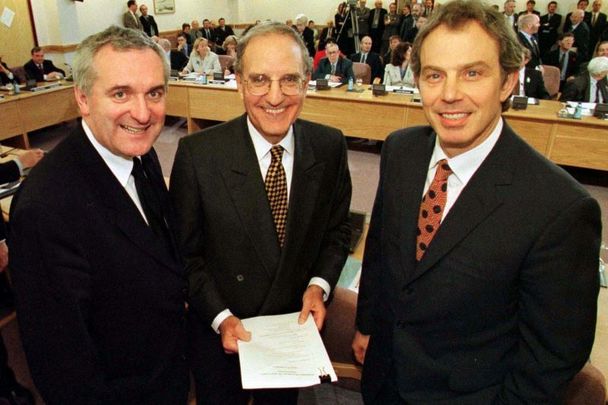
April 10, 1998: Taoiseach Bertie Ahern, US Senator George Mitchell and British Prime Minister Tony Blair at Castle Buildings Belfast, after they signed the Good Friday Agreement. ROLLINGNEWS.IE
The one constant of the troubles in Ireland, Israel, and Palestine is that the more a security solution is sought, the less secure the parties in the region become.
In Ireland, it was not until the parties engaged fully, under American eyes, that the breakthroughs of the peace process became evident.
The success of the Irish peace process was also predicated on the fact that a military solution was impossible. At various times in the 30-year war, the IRA thought it had the British on the ropes and, likewise, the British military talked up the notion that it had the IRA defeated and just one final push was needed. Such a recognition would transform Middle East thinking.
Both sides in Ireland came to recognize the error of their thinking and created a space for political negotiations.
Sign up to IrishCentral’s newsletter to stay up-to-date with everything Irish!Subscribe to IrishCentral
Some of the lessons of the Irish peace process could be helpful here. US Senator George Mitchell, who chaired the peace talks in Northern Ireland, has emphasized that the implementation of historic agreements “is as difficult and as important as reaching them.” Yet in Northern Ireland and the Middle East, the signing of the Good Friday Agreement and the Israeli-Palestinian Declaration of Principles were seen by many on both sides as an end in themselves.
Mitchell was later appointed as the US Special Envoy for Middle East Peace but was never granted the authority by President Obama to command the stage and drive change as he did in Ireland under Clinton. There were simply too many other peace negotiators.
In both peace processes, the American role was and is critical as is the work of the various diasporas. Irish Americans were successful in creating a scenario where an American president took an active interest in seeking a negotiated settlement in Ireland and introduced a powerful new player. The US visa for Gerry Adams was a transforming moment as was delivering the August 31, 1994 ceasefire.
Clinton would often remark that if it had been Adams, not Arafat, dealing with the Oslo peace initiative, it could have been delivered, making the point that Arafat was never in full control of his faction as Adams was within the Republican movement.
Clinton’s impact on the Irish peace process was enormous, but he insisted on one crucial detail. He remained scrupulously neutral and was equally approachable to both sides. This allowed him to carry enormous moral persuasion at key points, such as the appointment of Senator Mitchell to chair the all-party talks in 1996 and convincing reluctant party leaders on both sides to sign up to the Good Friday Agreement.
The Biden tilt toward Israel was the President’s only option given the savagery of the Hamas assault on civilians.
But that is coming under great pressure. The Israel lobby in the US is where a major battle is looming. The Israeli lobby AIPAC remains fixed on maintaining the US government’s pro-Israel tilt. Far more valuable would be a questioning American constituency, not afraid to query what the leaders back in the homeland are doing.
That scenario is not impossible. There are new faces on the block, young progressive activists, many moderate Jews who seek to ensure a more balanced Palestinian line. If they succeed, they will be a very important outside-the-box player going forward as Irish America was.