Former Irish Republican Army Soldier Self-Deports, Afraid He’d Die in an ICE Holding Cell
The Clinton administration once used Matthew Morrison’s U.S. immigration case to help solidify peace in Northern Ireland.
Filed 6:00 a.m. EDT 08.04.2025 A person’s hand holds a framed photo of a White man with a mustache, who is wearing glasses, a green jacket and a light blue button-down shirt.
Matt Morrison holds a framed picture of his father, Matthew, in St. Louis on July 22, 2025. Matthew Morrison, an Irish immigrant who resided in the U.S. for 40 years, self-deported to Ireland on July 21, 2025. Katie Moore/The Marshall Project
By Jesse Bogan
Republish
This story is part of “Trump Two: Six Months In,” our series taking stock of the administration’s efforts to reshape immigration enforcement and criminal justice.Trump administration officials aim to pressure some noncitizens into self-deporting. It worked on Matthew Morrison. In mid-July, the 69-year-old former psychiatric nurse supervisor quietly fled the United States.Morrison had been threatened by an aggressive government before. When he was a teenager, he fought against what he and others in the Irish Republican Army saw as an occupying British government that discriminated against marginalized Catholics in Northern Ireland.For his efforts then, Morrison said he was beaten by interrogators and wound up in prison, where some of his comrades died in a hunger strike protesting the revocation of their political status.Upon his release in 1985, he feared for his safety. He came to St. Louis, married his American pen pal and had two children. Eventually, he overstayed his tourist visa, divorced his pen pal and remarried. He’s had the spectre of deportation hanging over him for decades. His family has endured the highs and lows of his battle along the way.Now, Morrison leans on a cane. He’s had several strokes. He said that the fear and uncertainty that he might be picked up by U.S. Immigration and Customs Enforcement was more than he could bear.
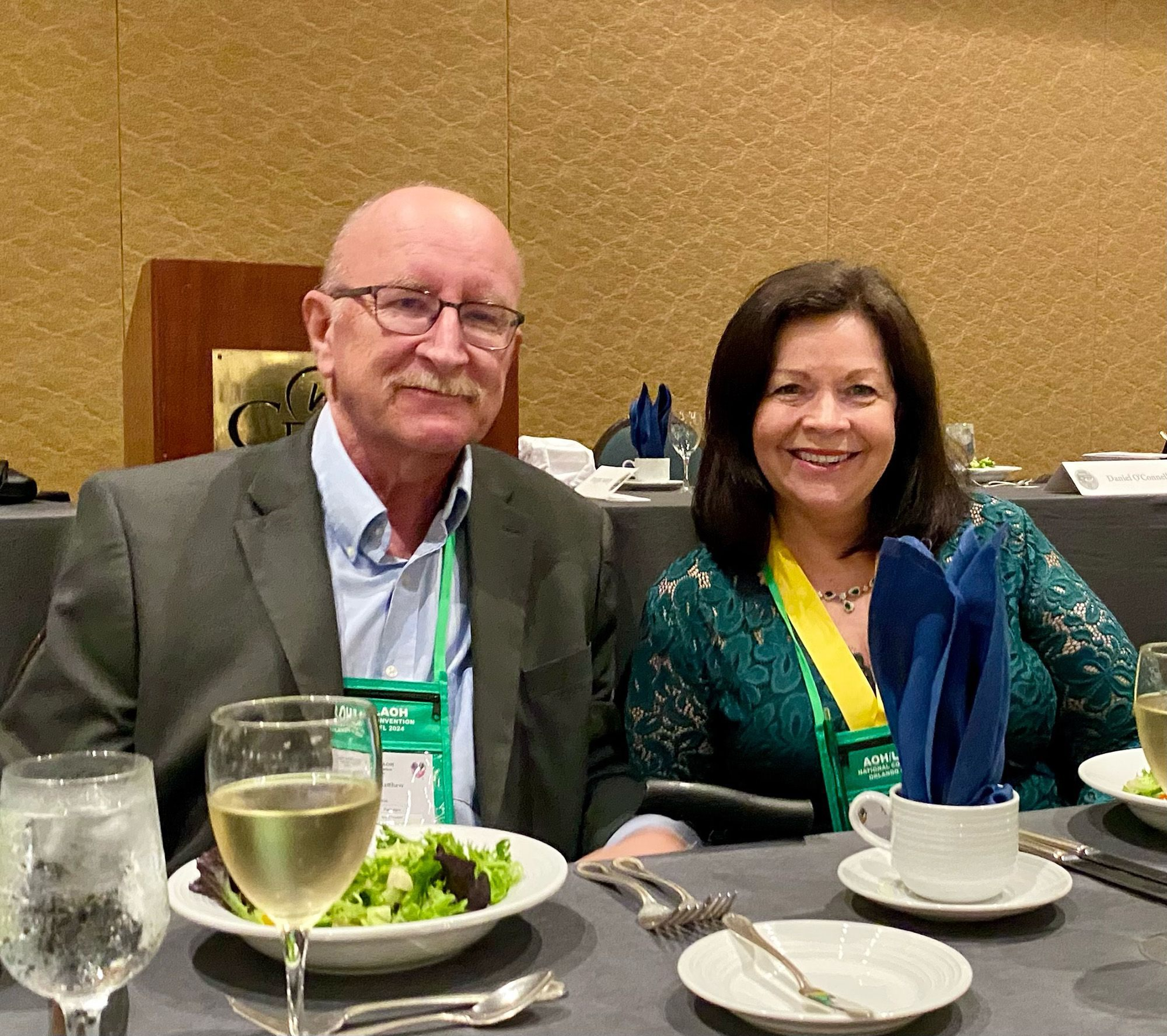
A elderly White man with a mustache, who is wearing glasses, a light blue button-down shirt, and a gray blazer, poses for a picture with his wife, a White woman with dark brown hair, who is wearing a green dress and a yellow ribbon.
Matthew Morrison, with his wife Sandra Riley Swift, in 2025. Courtesy of Morrison Family
“I would bite the dust in an ICE holding cell,” Morrison told The Marshall Project – St. Louis before he left the U.S. “There is nothing to stop them from deporting me to Ecuador, South Sudan or whatever. It’s really gotten insane here. It’s crazy what they are doing now, the Trump administration. You know what I mean?”Many noncitizens have faced similar unknowns in hiding. Morrison has been in the public eye for a long time. He’s been in and out of the news since the 1990s. He was even the grand marshal of a parade. But the U.S. government denied his petition for an adjustment in immigration status because of crimes he was convicted of during “The Troubles” conflict in Northern Ireland. Morrison had omitted those from his original tourist visa application.In 2000, the Clinton administration terminated the deportation process against Morrison and five other named “deportees,” as the group of former Irish Republican Army prisoners was called, after the American spouses of the Irish men testified before Congress. The president himself weighed in on the issue.”While in no way approving or condoning their past criminal acts,” Bill Clinton said then, according to a Washington Post story at the time, “I believe that removing the threat of deportation for these individuals will contribute to the peace process in Northern Ireland.”The deportees were momentarily relieved. But because they weren’t on a path to citizenship, the six men still had to live with restrictions and regularly check in with the government.In May, Noel Gaynor, who had a heart condition, died at home in Olean, New York. Waiting months without annual work authorization approval, his Medicare and Social Security benefits were cut off, according to a video of statements made at his wake. In June, Gabriel Megahey received a letter from the U.S. Department of Homeland Security that The Marshall Project – St. Louis reviewed. It began: “It’s time for you to leave the United States.”Morrison expected a similar letter. Though his work authorization expires in October, he didn’t want to sit around waiting and worrying.On July 21, he limped onto a one-way flight from Cleveland to Dublin, Ireland, with his wife, leaving behind a life that he’d built in the St. Louis area, including grown children, grandchildren and many friends.“I’ve come full circle,” Morrison said while still in the United States. “I came here as an immigrant and I am leaving as an immigrant, despite everything in between. The whole thing is a crazy, stressful situation.”
Welcome to our community!
Thanks for trusting us to be your source for urgent investigations and compelling narratives about criminal justice. Readers like you help to make our work possible. Please consider taking the next step and become a member today.
Donate
There’s a city in Northern Ireland with two names. Protestants call it Londonderry. Catholics, like Morrison, call it Derry.Catholics felt discriminated against there. Without better options, Morrison said his childhood home didn’t have an indoor bathroom or hot water. He said the cramped home was raided by British soldiers stationed there to keep the peace between Protestants and Catholics and to ensure Northern Ireland remained part of the United Kingdom.To resist, he helped build barricades around his neighborhood. On Jan. 30, 1972, 16-year-old Morrison and his father joined thousands of others in the streets of their city. The march for Catholic civil rights became known as Bloody Sunday after British troops fatally shot 14 unarmed people and injured others.To fight back, Morrison said he joined the Irish Republican Army.“There was no way to be indifferent,” he said.Three years later, while in college, he said he was arrested with two others for trying to gun down a Royal Ulster Constabulary officer. Again, there were two ways to look at it. To Morrison, it was an act of war. Others saw it as terrorism.
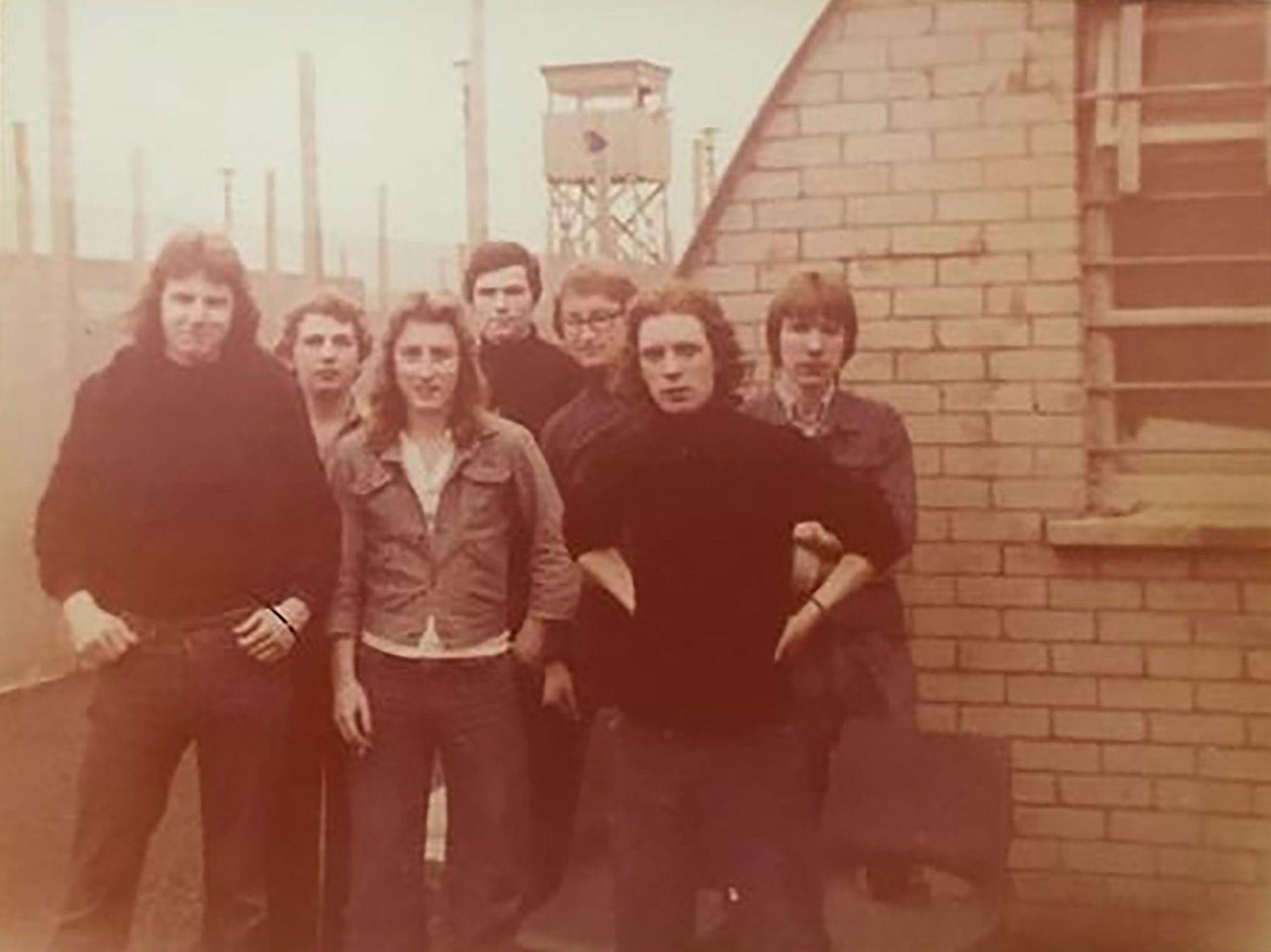
A sepia-toned photo shows a group of young adults, wearing black and gray clothes, standing in front of a brick building. There are several poles and a watchtower in the background.
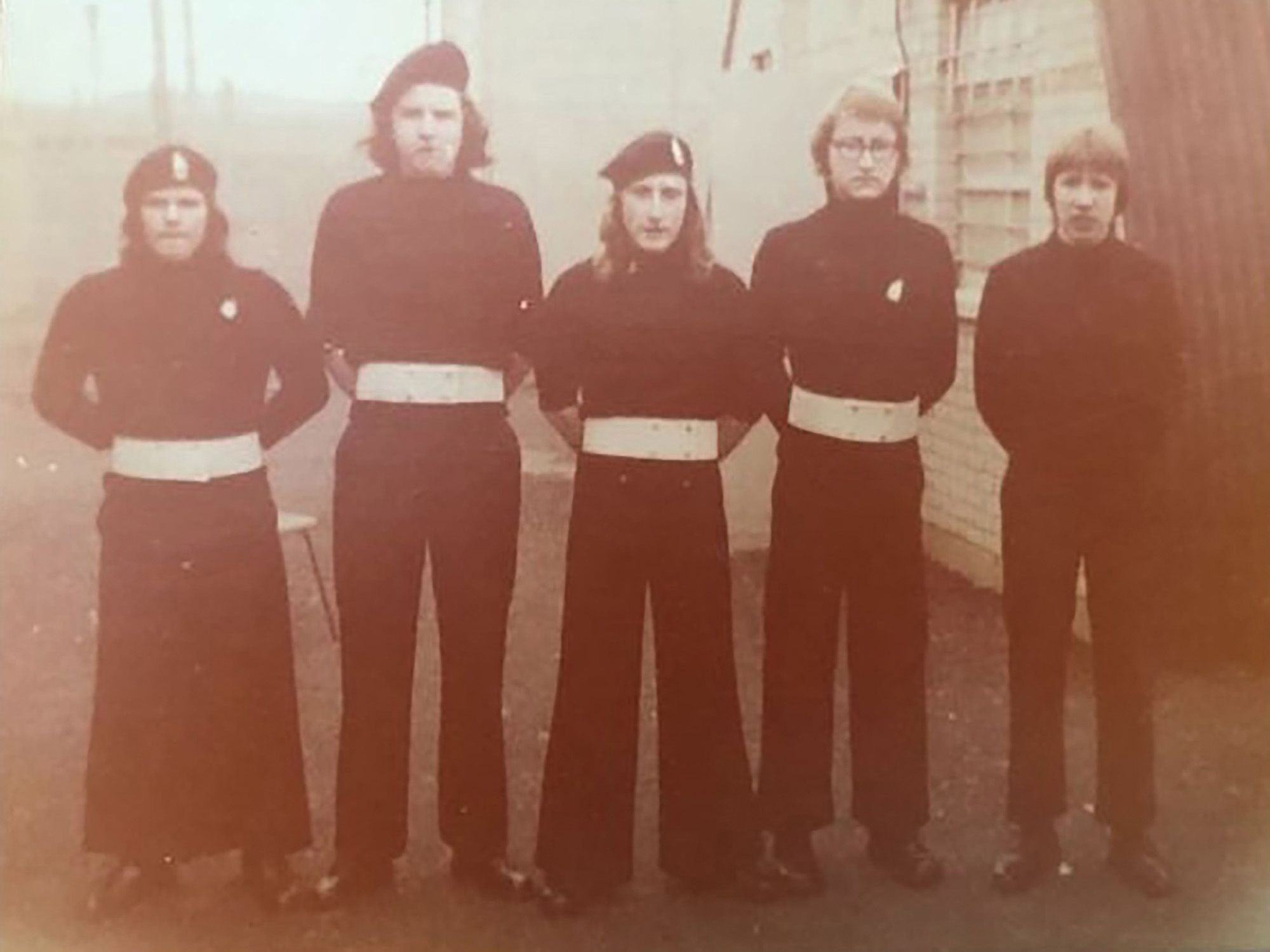
A sepia-toned photo shows a group of young adults wearing black and white uniforms while standing in one line.
Matthew Morrison, third from the right, poses for a photograph with fellow Irish Republican Army soldiers inside a Northern Ireland prison in 1976. Courtesy of Morrison Family
Matthew Morrison, second from the right, stands with incarcerated Irish Republican Army soldiers in 1975. Courtesy of Morrison Family
Later, he’d claim he was choked and beaten during police interrogations, which left him deaf in one ear. Convicted of attempted murder, he was sent to a prison outside Belfast that became widely known for a hunger strike where 10 people died.Released in 1985, Morrison fled to St. Louis, where he soon married Francie Broderick, an American pen pal who’d protested in Northern Ireland. They had a son, Matt, then a daughter, Katie. For years, the family and their supporters rallied to bring awareness to their own troubles with immigration authorities.In 1998, CBS featured the Morrison family in a documentary titled “Before Your Eyes: Don’t Take My Daddy.”“I always felt that our campaign was an extension of the hunger strike,” said Broderick, now 77.
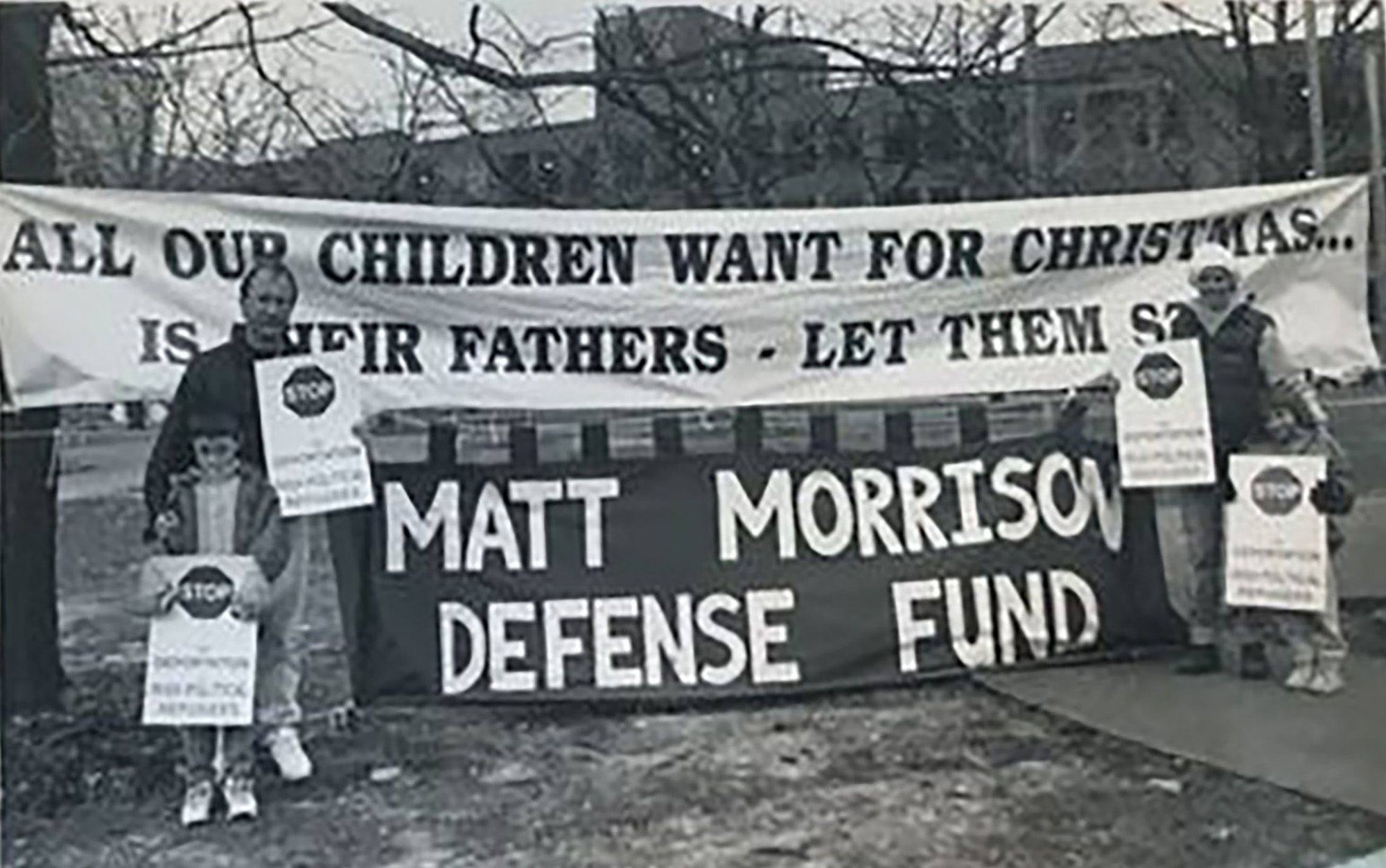
A black-and-white photo shows a man, a woman and two young children holding signs. They stand in front of two big signs that read, “All our children want for Christmas is their fathers — let them stay,” and “Matt Morrison defense fund.”
Matthew Morrison, with Francie Broderick and their children, at a 24-hour vigil in downtown St. Louis in 1996. Courtesy of Morrison Family
They had a major breakthrough in 2000 when then-Attorney General Janet Reno said in a prepared statement that she had been advised by Secretary of State Madeleine Albright to drop deportation proceedings against the deportees to “support and promote the process of reconciliation that has begun in Northern Ireland.”The men could stay, but they still couldn’t apply for a green card, let alone U.S. citizenship, because of their deferred immigration status.“People don’t realize how much of a minefield U.S. immigration law is,” Morrison said.Over the years, delayed work authorizations sidelined him from his job for months at a time, he said. He worked about 20 years as a nurse in Missouri, including stints at a children’s hospital and several state mental health facilities. He said he presented at the St. Louis County Police Academy on topics including mental health and deescalation tactics.“It doesn’t matter what I did, Immigration gave me no credit for it,” Morrison said.Homeland Security and ICE officials didn’t respond to requests for comment.In June, before Morrison self-deported, a scheduled check-in with U.S. Citizenship and Immigration Services in St. Louis put him and his family on edge. Their fears were heightened by stories about immigrants being detained at routine appointments, regardless of legal status. At the appointment, authorities took a photo of Morrison and he was free to go.“We were terrified that they were just going to take him right there,” said his son, Matt, 37.
A White man with a beard wears glasses, a red and navy blue cap, a navy shirt and light blue jeans while sitting next to a White woman who is wearing a red long-sleeved shirt.
Matthew Morrison’s children, Matt, 37, and Katie, 34, on July 22, 2025, the day after he self-deported. Katie Moore/The Marshall Project
He said the uncertainty weighed on his father more than he’d ever seen.“He has to live under that fear of somebody knocking on the door and dragging him out of the house, just like they did in Derry when he was young,” Matt said. “I hate it. I am just worried about him. Until recently, I hadn’t heard him cry about it.”He has mixed feelings about his father’s departure.“He’s got brothers and sisters over there, but we are all here — and his grandkids,” Matt said. “He spends a lot of time with his grandkids.”Morrison’s daughter, Katie Bradley, 34, said a recent farewell gathering, held in a backyard, felt like a funeral. She panicked because her U.S. passport had expired.“Even though he’s still alive, I feel like I am grieving,” she said. “It’s a huge loss for me and my children.”Morrison’s wife, Sandra Riley Swift, has a house in St. Charles, Missouri, as well as her mother and many grandchildren. After helping Morrison transition into an apartment in the town where he grew up, she said in a social media post that she’s going to straddle both countries for a while.“This was not an easy choice, but a necessary one for his health and safety,” she wrote a few days after they left the U.S.
British state put safety of ‘touts’ before ‘preservation of life’
Sister of Eugene Simons speaks out
Eugene Simons (26) disappeared in 1981
By Connla Young, Crime and Security Correspondent
August 09, 2025 at 6:00am BST
The sister of a man shot dead and secretly buried by the IRA has said the state put the safety of informers before “the preservation of life”.
Moira Todd was speaking after it emerged the RUC made no attempt to save the life of her brother Eugene Simons while he was being held captive by the Provisional IRA.
A father-of-three, Mr Simons was one of ‘The Disappeared’ – a group of people abducted, killed and secretly buried by republicans during the recent conflict.
Originally from the Castlewellan area of Co Down, the 26-year-old was taken across the border by the IRA after going missing on New Year’s Day 1981.
His remains were accidently discovered buried in a bog near Dundalk, Co Louth, in May 1984, by a man walking a dog.
New details about the circumstances of his death have emerged in a private report recently provided to the Simons family by Operation Kenova.
It was set up in 2016 to investigate the activities of the British agent known as Stakeknife – identified as Belfast man Freddie Scappaticci in 2003.
A former commander of the IRA’s Internal Security Unit (ISU), Scappaticci has been linked to 14 murders and 15 abductions.
Also known as the ‘Nutting Squad’, the ISU was responsible for hunting down and killing informers during the Troubles.
The report has revealed that authorities in the south of Ireland lost Mr Simons’ skull, which was recovered when his remains were found more than 40 years ago.
The IRA has never claimed responsibility or provided an explanation for why Mr Simons, who was also questioned by the republican group in 1980, was killed and secretly buried.
Operation Kenova has now confirmed “the role of the agent known as Stakeknife in the interrogation of Eugene in August 1980 and the planning of his abduction/murder on New Year’s Day 1981”.
The report says information was received that the IRA was investigating the possibility that there was two “touts” in its south Down unit after the arrests of four suspects, including Mr Simons, in May 1980.
It has now been revealed that after being ‘lifted’ by the IRA in 1981, Mr Simons was taken to a farmyard in Co Cavan for interrogation.
In its new report, Operation Kenova confirms that no intelligence has been recovered to suggest that the RUC or British army had prior knowledge that Mr Simons was to be taken away by the ISU.
The report also states that “despite the reliable information being received by the security sources, Kenova has found no evidence of any attempts being made by the Security Forces to try and locate Eugene”.
“It was the responsibility of the RUC to instigate such an operation,” the report states.
“We have also found no evidence of any liaison with the AGS (An Garda Síochána) by the RUC.”
Ms Todd was scathing of the RUC response to the disappearance of her brother.
“It’s unbelievable, it’s the state putting their intelligence and their touts before the preservation of life,” she said.
“Again, I say, Eugene was charged with nothing, ever, never claimed by the IRA, nothing, and yet they (RUC) had him in Castlereagh four times.
“One of those times he was taken out of the custody suite for something like three hours – what happened in those three hours?”
Despite having intelligence that Mr Simons was dead, this information was not passed on to his family by police, which continued to treat his disappearance as a missing persons case.
Ms Todd said the recent report shows “how little was done” for her brother by the RUC.
“No forensics, no nothing,” she said.
“And they kept up the pretence that he was still alive.”
Operation Kenova also highlights the RUC’s failure to tell the Simons family that their loved one had been killed.
“The most shocking element of our findings is that the family of Eugene were not officially informed by the RUC of the reliable information that Eugene had been abducted and murdered by PIRA,” the report said.
Kenova said there is evidence Mr Simons was “warned about his safety by the RUC” after he was interrogated by the IRA in 1980.
Ms Todd is not convinced her brother was warned that he was at risk.
“These were just standard (warnings), it’s a box ticked, if they did it at all,” she said.
Ms Todd has concerns about how police approached several suspects in the case, highlighting why some were “arrested, declined to speak (and) released”.
“Why were the main suspects handled with velvet gloves…they seem to have been?”
Several suspects were personally known to Mr Simons and his wider family.
The Kenova report reveals how his father Walter, who died in 2019, made his own enquiries “including approaching Suspect D in bars to ask them directly what had happened to Eugene”.
“Walter was met by silence,” the report said.
Ms Todd said her family knows the identities of several people connected with the disappearance of her brother.
“Although we don’t have their names formally given to us, we have identified quite a few of them and we know who they are,” she said.
She said her family has lost trust in the police and while Kenova has provided fresh information, the contents of the report also raises new questions.
“No, how can we trust them anymore?
“We have been lied to for so long and then finally the Kenova family reports come out and it does not give us the information we had hoped for.
“It’s another big disappointment.
“I will say Kenova has given us much more information than we had ever had, but I was hoping for something more in the report.”
She also paid tribute to her mother Mary, who pre-deceased her father.
“I just feel for my mother, who never spoke out, who just held Eugene in her heart but who suffered desperately because of this, suffered in silence,” she said.
“You (IRA) kept us going for three and a half years, you would have kept us going for longer only Eugene’s bones were found, and the suffering that caused the family, my mother in particular, it’s hard to come to terms with.”
On Friday, The Irish News revealed that the Simons case featured in a “sensitive investigation” into the leaking of information by an RUC officer to the Provisional IRA.
Operation Kenova has confirmed the case was considered by an probe headed by an assistant chief constable “from a force outside the RUC”.
Solicitor Kevin Winters, of KRW Law, has now contacted the PSNI.
“The revelation about RUC leaks to PIRA allied to the delay in letting the Simons family know Eugene was dead takes this investigation to another level altogether,” he said.
“We have contacted PSNI for more details on the original inquiry into internal leaks to see if this was a systemic issue.
“Standing back from it, this latest Kenova report, whilst helping the family, actually raises more questions than answers.”
Videos posted to social media this week show more than a dozen men patrolling areas in the east of the city while stopping and questioning foreign nationals on their behavior.
Footage from a social media video which purports to show a group patrolling the streets of east Belfast
By Conor Coyle
August 09, 2025 at 8:33am BST
Vigilante groups patrolling streets and public spaces in east Belfast nightly while targeting migrants is “greatly concerning”, a member of the Policing Board has said.
The issue is to be raised with Chief Constable Jon Boutcher.
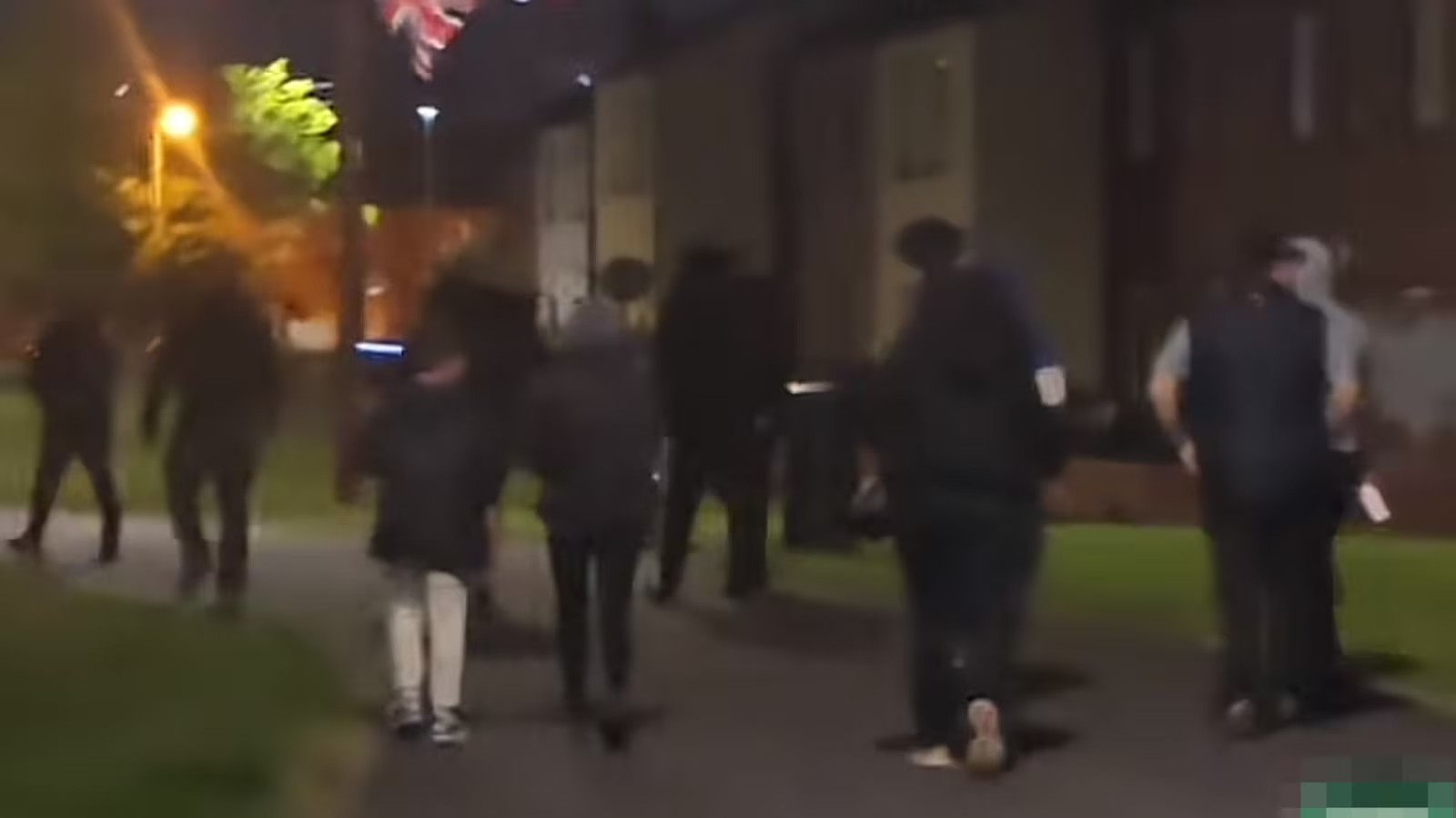
Videos posted to social media show more than a dozen men patrolling areas in the east of the city.
They are stopping and questioning foreign nationals on their behaviour while asking for proof of their right to live in the north.
Some videos have also shown children taking part.
A member of the Policing Board and MLA for the area said he will raise the issue with the chief constable at the “earliest opportunity”.
One video posted online of a man approaching another man in a public park says the group represents “concerned parents” in the area.
Another video sees the poster telling a Syrian man “no more hanging about east Belfast, you have no reason to be there”.
In another encounter on the street, a migrant is told “too many of you are running around here and you’re stealing. There are women that are scared to leave their houses”.
Other videos make reference to there being “too many undocumented men” living in the area and comment on a lack of social housing due to the number of migrants that have moved in.
A social media page uploading videos of the confrontations claims to have set up a “rapid response team” to attend reports of suspicious behaviour within five minutes.
Alliance East Belfast MLA and Policing Board spokesperson Peter McReynolds said it was “greatly concerning”.
“There is absolutely no place for vigilantism in our society, or anyone taking the law into their own hands,” Mr McReynolds said.
“Reports of intimidation and harassment are greatly concerning. It’s never acceptable, and we must be unequivocal as a community in condemning such actions.
“I have been engaging with the PSNI about these matters as they have developed and will be raising it at the earliest opportunity with the chief constable at the Policing Board.”
The patrols come after two summers of violence in the north sparked by anti-migration protests which saw the businesses and homes of immigrants attacked and disorder on the streets of Belfast, Ballymena and other areas.
New figures this week reported by The Detail show that almost half of those arrested in connection with race-related disorder that broke out in Belfast last summer had previously been reported to police for domestic abuse.
The PSNI says it is aware of videos circulating on social media and that it “does not tolerate any type of vigilante activity”.
It added it “would caution any individual or group against taking the law into their own hands”.
“It is the responsibility of the police service to enforce the law in Northern Ireland and we are committed to supporting the needs of all of our diverse communities.
“We will robustly review and deal with any offences reported to us.”
A spokesperson for the Department of Justice said “a range of measures are in place to support vulnerable groups from threatening and violent behaviour”.
“The minister has always been very clear there is no place for hate in any part of our society,” the spokesperson said.
“The Department of Justice, together with the Northern Ireland Policing Board, provides annual funding to Policing and Community Safety Partnerships to address local community safety issues, including hate crime, in each of the council areas.
“In addition, the Department of Justice jointly fund the Hate Crime Advocacy Service with the PSNI, to assist reporting of hate incidents to the police and provide support to victims throughout the investigative/criminal justice system process.
“If any individual suspects that a crime has been committed, I would encourage them to report it to the PSNI.”
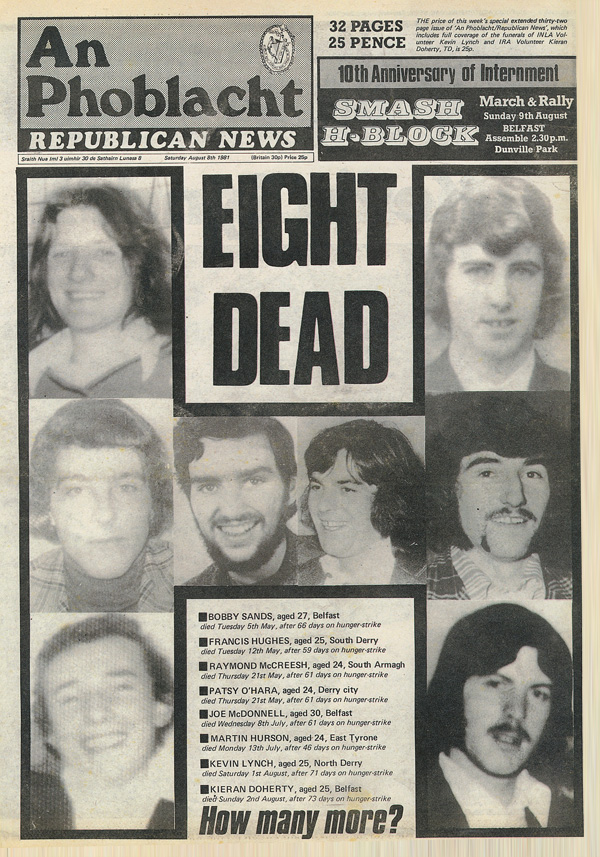
Thomas McElwee – Died on 8 August 1981 after 62 days on hunger strike in the H-Blocks of Long Kesh
THOMAS McELWEE, aged 23, was born in Bellaghy, south Derry, on 30 November 1957.
Thomas was arrested following a premature explosion in an IRA operation in October 1976 in which he lost the sight of one eye. His younger brother, Benedict, was arrested in the same incident. Thomas received a 20-year sentence in September 1977.
He spent 62 days on hunger strike from 8 June. He died on 8 August 1981.
The death of Thomas McElwee
09-McElwee-2
• Thomas McElwee’s eight sisters – Kathleen, Mary, Bernadette, Annie, Enda, Nora, Pauline and Majella – carry the coffin of their brother
Thomas McElwee, at the age of 23, was the tenth man to join the 1981 Hunger Strike. From Bellaghy in south Derry, he was imprisoned in 1976 after a premature bomb explosion in which he lost an eye.
Thomas was a cousin of another hunger striker, Francis Hughes, also from Bellaghy. They had been boyhood friends, both going on to join the IRA. On 10 August 1981, for the second time, Bellaghy was visited by thousands of mourners gathered to pay their respects to a deceased Hunger Striker.
McElwee died on 8 August on the 62nd day of his fast. Francis Hughes had died three months earlier, on 12 May.
The RUC and British Army converged on the roads around Bellaghy and six British Army helicopters hovered overhead. Thomas’s brother, Benedict, had been denied a visit with his brother the previous week and was then callously asked to identify the body when he died.
IRA and Cumann na mBan guards of honor lined the path to the McElwee home as the coffin was carried out by his eight sisters. A volley of shots was fired as the cortege reached the road. The crowd in the fields and hillsides cheered as the firing party disappeared out of range of the British crown forces.
Two pipers led the cortege along the five-mile route to the church for Requiem Mass. Thomas’s brother, Benedict, was allowed 10 hours parole for the funeral. In another instance of church interference in the Hunger Strike, the priest at the Mass in Bellaghy Parish Church criticised the Hunger Strikers and called for an end to the fast. Some women in the congregation got up and walked out, disgusted that the priest would use the pulpit on such a tragic occasion to deliver an insulting political speech.
Thomas McElwee’s dying wish was to be buried beside Francis Hughes.
The graveside oration was given by Danny Morrison, then Sinn Féin Director of Publicity.
Thomas McElwee has been described by friends as being “sincere, easy-going and full of fun”. He was also intelligent and determined, something Morrison captured in his remarks on the young Volunteer:
“I know that the McElwee family will understand, just as the families of other dead Hunger Strikers will know what I mean, when I say that their son was invincible from beginning to end, in life as well as in death.”
09-McElwee-4
• IRA Volunteers prepare to fire a volley of shots over the coffin of Thomas McElwee
Morrison went on to criticise the Catholic Church and the SDLP for cultivating defeatism throughout the Hunger Strike rather than pressurising the British Government to come to a just resolution of the protest. He referred back to the sermon delivered earlier at Thomas’s Requiem Mass.
“Those of you who were able to hear Fr Flanagan’s sermon today will have been struck by what is wrong with the Church’s politics. We were asked to pray for an end to the Hunger Strike, for an end to violence and for peace,” he remarked, adding that certainly people should pray for those things. “But there is a bigger prayer which we have to make, and that is a prayer for an end to the cause of violence: the British occupation of our country. It is time the Church prayed and called for that.”
In his oration, Morrison also called for decisive and effective action at ambassadorial and international levels on the part of the Irish Government, who, he said “like many other influential bodies in Ireland which represent the vested interests, have not got the welfare of the prisoners at heart and would quite frankly like to see the hunger strike collapse”.
Morrison also noted and condemned the increasing tendency at the time to blame the republican leadership for the crisis.
“For some time now it has been open season for apportioning blame for the continuation of the Hunger Strike on the leadership of the Republican Movement.” This was, he said, just a variation of former Secretary of State Roy Mason’s theme in 1976 and 1977, in which the implication was that those on the outside had forced the prisoners onto the Blanket Protest.
09-McElwee-6
Identifying the real cause of the problem, Morrison said:
“The roots of the Hunger Strike were built into the British H-Blocks, into the British policy of criminalisation which forced the men on the Blanket five years ago and which led ultimately to republicans resorting to the traditional weapon of hunger strike as the ultimate means of gaining their demands.”
Nor was Danny in any doubt as to the continued determination of the republican POWs in the H-Blocks.
“Their determination has not waned,” he said, stressing that neither should their supporters on the outside lose resolve. “Despair is easy, our enemies want us to despair; to struggle on is a harder task but the reward is there at the end of the road – and Thomas McElwee will be proud of us, as we are proud of him, if we play our full part in winning this prison struggle, in winning, as he set out to win, Irish freedom from the ruins of British rule.”
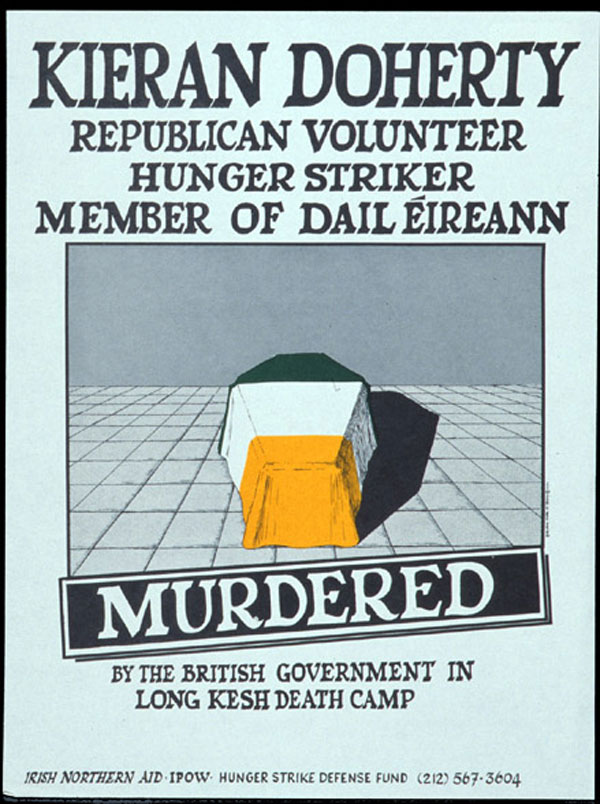
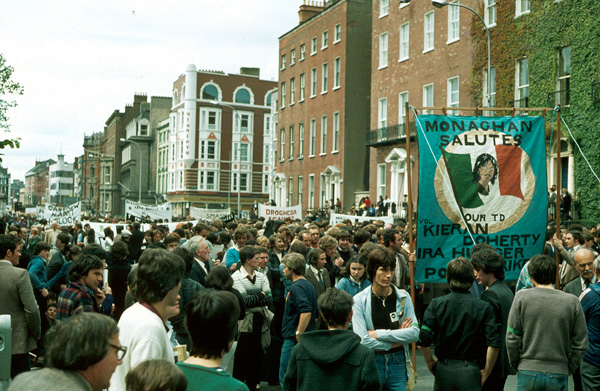
KIERAN DOHERTY, aged 25, was born in Andersonstown, west
Belfast, on 16 October 1955.
Kieran was a teenage internee between February 1973 and
November 1975. On his release he was an extremely active IRA Volunteer and was
finally captured in August 1976. Kieran received an 18-year sentence in January
1978 for possession of weapons.
On 11 June 1981, Kieran was elected as TD for the
Cavan/Monaghan constituency in the Dáil general election, receiving over 9,000
first-preference votes.
He spent 73 days on hunger strike from 22 May. He died on
2 August 1981.
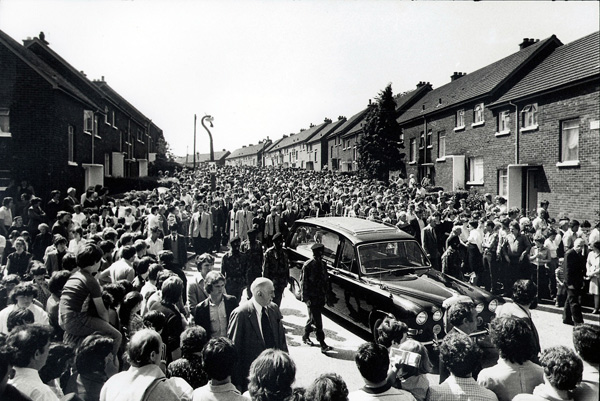
Big Doc’s final journey
• The funeral of Kieran Doherty TD passes through
west Belfast
IRA Volunteer Kieran Doherty, TD for Cavan/Monaghan, died
at 7:15pm on Sunday 2 August 1981, the day after Kevin Lynch’s death. Kieran
had joined the hunger strike one day before Kevin Lynch and survived one day
longer.
Kieran Doherty embarked on his fast upon the death of
Raymond McCreesh. He managed, with difficulty, to speak to his family almost to
the end though his sight had almost completely gone. Kieran (or ‘Big Doc’ as
his comrades affectionately called him) had a strong spirit of survival which
kept him conscious for most of his 73 days on hunger strike.
Kieran’s body was brought out of Long Kesh and through
Andersonstown to his parents’ home in Commedagh Drive at two o’clock in the
morning. About a thousand mourners accompanied the coffin and even larger
crowds came out on Monday morning to pay their respects. The next day, hundreds
of stewards took position on the funeral route as Kieran’s coffin was carried
out of his parents’ house, escorted by an IRA guard of honour. An IRA firing
party came out of the crowd and, lining the side of the coffin, fired a volley
of shots. As British Army helicopters hovered overhead, the crowd cheered at
the Brits’ inability to prevent the firing party from honouring their dead
comrade.
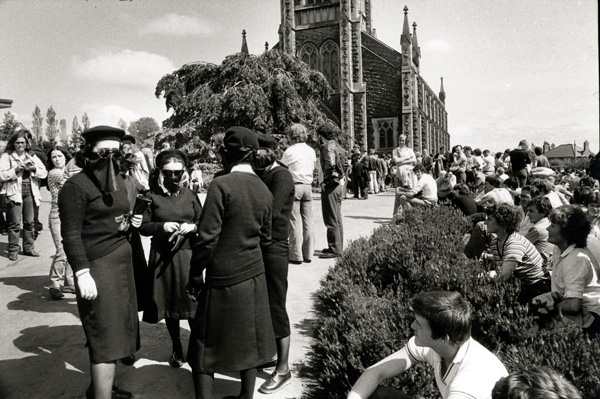
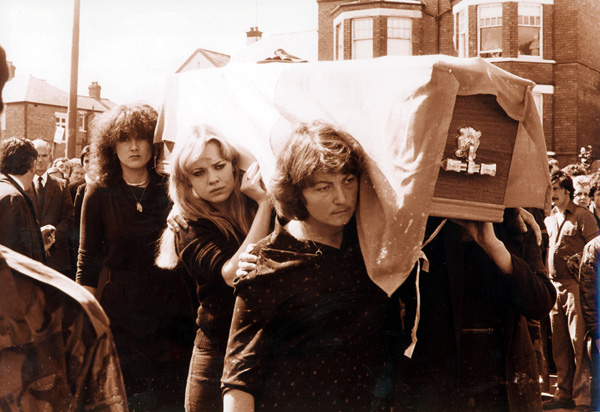
• Scene during the funeral Mass at St Theresa’s
Church; (below) Kieran Doherty’s coffin is carried by his sister Mairéad (left)
a family friend Siobhán McKenna (centre) and sister-in-law Betty Doherty
(right)
The cortege then moved through Andersonstown, led by two
pipers. It may be recalled that during the Hunger Strike some of the clergy had
set out to undermine the prisoners’ protest. In contrast to the attitude of the
priest celebrating Mass at Kevin Lynch’s funeral, Fr Hansen’s sermon
demonstrated a fundamental understanding of the issues at the core of the
Hunger Strikers’ protest. While the presiding priest at the Lynch funeral
refused to wear his vestments at the graveside because of the presence of a
firing party, the priest at Kieran’s funeral recalled having visited Doherty on
the 13th day of his fast and remembered it to be a cheerful event. He went on
to recount Kieran’s words when he asked him if he would consider coming off the
hunger strike. Kieran replied:
“Look, Father, I could not give up. If I did I would go
back to criminal status. I am not a criminal. I never was and never will be
one.”
Recalling those words at the funeral of Kieran Doherty,
the priest said:
“Basically, I had to agree with him.”
He finished off by saying:
“Kieran was very much his own man. He died quietly and
very determined, serene and dignified.”
Fr Toner, who was criticised by Bobby Sands in his diary,
was in the congregation, listening but apparently unmoved by Fr Hansen’s words.
It was estimated that a crowd of about 20,000 attended
Kieran’s funeral.
Chairing the event, Sinn Féin member Jimmy Drumm referred
to the ongoing pursuit of the prisoners’ ‘Five Demands’.
“The British Government needs to be moved on the issues
of work, association and segregation.” He finished by saying that with the
basis of a just settlement “then we and the families will be spared the anguish
and suffering of such funerals as this, and the prisoners who have suffered so
much will be able to live in tolerable conditions.” Kieran Doherty was the
eighth man to die on hunger strike in 1981 and two more would follow.
The oration at Volunteer Doherty’s funeral was given by
Caoimhghín Ó Caoláin, Kieran’s Director of Elections during the 1981 general
election in the 26 Counties.
Ó Caoláin said that the people of Cavan/Monaghan had
taken the 26-year-old to their hearts and that they were proud to elect him as
their public representative. Ó Caoláin criticised the Irish Government’s
handling of the Hunger Strike, saying:
“Their gamesmanship for petty political scores has been a
major factor in the continuing deaths in Long Kesh. The people of
Cavan/Monaghan hold the present coalition government directly responsible,
through firstly their inactivity and afterwards their open support for pressure
to be placed on the Hunger Strikers and their families.”
Ó Caoláin recalled all the other Irish hunger strikers
who had died as a result of British intransigence, three of them elected
representatives: Terence MacSwiney, Bobby Sands and Kieran Doherty. Again of
Doherty, he added that Kieran had taken his place amongst all those who fought
for the three tenets of republicanism: “Equality, as embodied by James
Connolly, who struggled to achieve a classless society; liberty, the liberty of
Patrick Pearse; and the fraternity of Wolfe Tone.”