I’ve been invited to speak at mass… but I’m not sure if I can accept it.
Out of nowhere came an invitation to speak at mass
Frank Mitchell
Today at 07:30
I’ve pinned badges on scouts. I’ve placed sashes on winners and rosettes on losers. I’ve picked roses for Tralee and Marys for Dungloe. I’ve switched on lights, cut ribbons, unveiled plaques, abseiled off buildings and walked on hot coals. I’ve named the shortlisted and crowned the champions.
Throughout my career the invitations have been regular and varied and I thought I had done everything possible — that is, up until this week.
Out of nowhere came an invitation to speak at mass. This wasn’t from my local priest or any priest I know. Instead, the headed note paper belonged to a successful Ulster businessman with a great passion for the Pioneer Total Abstinence Association.
He is encouraging people in his community to stay off what the Reverend Ian Paisley used to call “the devil’s buttermilk”. Some Irish Catholics and Free Presbyterians are united in their dislike of alcohol and can be equally vocal on the dangers and impurities.
Quite early in the letter, the businessman reassured me I would not be expected to preach. Rather, he is hoping I can talk openly about life free from alcohol and how I managed to live some 60 years without it ever crossing my lips.
To be honest, I’m not sure if I can do this. I never had any desire to drink. Growing up, I was slightly afraid of people who were drunk. Neither of my parents were drinkers and there was never any alcohol in our house. When I did see people drinking at community events, they seemed loud and clumsy. For a child looking in, this was quite unnerving.
By the time I was old enough to be in the company of the underage drinkers, it never crossed my mind to join them. I was always able to have plenty of fun without any artificial stimulant, and I’m still like that today. Maybe it’s because I like to be in control of situations. Or am I possibly too afraid to start drinking in case I’m a latent alcoholic? I have no idea. I don’t need drink to boost my confidence, but I seem to be lacking the necessary self-belief to accept the invitation to speak at the mass where the pioneer members will be honoured with the special lapel pins which once were a common sight in Catholic Ireland but are now something of a rarity.
The Total Abstinence Association was a strong organization when I was a child. It was a genuine effort aimed at stopping Irish people from drinking themselves to death. Sadly, at that time, many were.
In more recent years, there has been a culture of social drinking with a continental sophistication adopted by many families. But sometimes that hides the demons of addiction and the health problems connected to alcohol.
Is it my job to encourage people to take the pledge and be teetotal? I don’t think so. Moderation is the best approach, but it’s not the approach of the Pioneer Total Abstinence Association. Is it possible to admire the moderate drinker and still applaud those who refrain completely from the temptation?
At some point the priest will interrupt the mass. I will be called forward and, from a marble lectern, deliver my testimony.
It is an honor to be invited, but will large swathes of the congregation feel uneasy, or even queasy, after a late night on the tiles? I can’t make up my mind. Should I accept or not? It’s a tough decision. There are times I think the pressure of choosing the right thing to do is enough to drive me to drink!
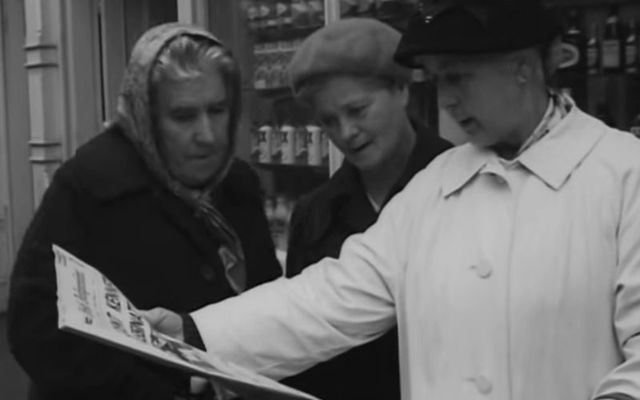
Three local New Ross women read the Irish Independent the day after President John F. Kennedy was assassinated. British Pathé YouTube
Locals in New Ross, Co. Wexford, were in a state of mourning the day after US President John F. Kennedy was assassinated in Dallas, Texas, on November 22, 1963.
President Kennedy was assassinated while driving through Dallas, just five months after visiting his ancestral homeland in New Ross, Co. Wexford.
Archive footage from British Pathé shows locals in New Ross as they react to the news of Kennedy’s death on November 23, 1963.
Sign up to IrishCentral’s newsletter to stay up-to-date with everything Irish!Subscribe to IrishCentral
Three women can be seen reading the Irish Independent bearing the headline “President Kennedy Assassinated – Shot While Driving,” while the flags of the Royal Hotel in the town are at half-mast as a mark of respect for the Irish American US President.
A separate headline notes that Kennedy’s death has caused “Shock to the Irish Nation.”
The footage also shows local children walking up the steps that Kennedy’s great-grandfather used to walk on his way to school before emigrating to the United States in the 1800s.
Just months before his assassination that shocked the world, John F. Kennedy became the first sitting US President to visit Ireland.
In June 1963, the Irish American US President spent four days in Ireland, visiting Dublin, Cork, Galway, and Limerick, as well as his ancestral home in New Ross.
As the first Roman Catholic President of the US and a proud Irish American, Kennedy was jubilantly received by the Irish people, particularly in New Ross.
On his last night in Ireland, Kennedy was the guest of President de Valera and his wife, Sinéad, an accomplished Irish writer, folklorist, and poet.
During the evening, she recited a poem of exile for the young president, who was so impressed that he wrote it down on his place card.
Over breakfast the next day, JFK memorized the poem and recited it in his last speech at Shannon as he departed.
On This Day: JFK, first Irish American Catholic President of the US, assassinated in Dallas
President John F. Kennedy was assassinated in Dallas, Texas on November 22, 1963. Here is a look at the life of the Irish American President that was tragically cut short.
On November 22, 1963, John F. Kennedy, the first Irish American Catholic President of the United States, was assassinated in Dallas, Texas.
John Fitzgerald Kennedy once said: “There are three things in life: God, human folly, and laughter. The first two are beyond our comprehension, we must make the best of the third.”
On November 22, 1963, the laughter died, not only for JFK but also for the United States of America.
For most baby boomers, there are two dates that stick out in their minds -November 22, 1963, and September 11, 2001. Both moments of unbelievable national tragedy.
But maybe 11/22/63 was a little tougher because all Americans knew the man. He barely won the 1960 election – although the following year over 60% of Americans said they voted for him – but, he brought something special to the White House – a beautiful young family, laughter, culture, and class.
Whatever you feel about John F. Kennedy, the rest of the world saw this man who represented the United States of America and what they felt was simple – hope.
3
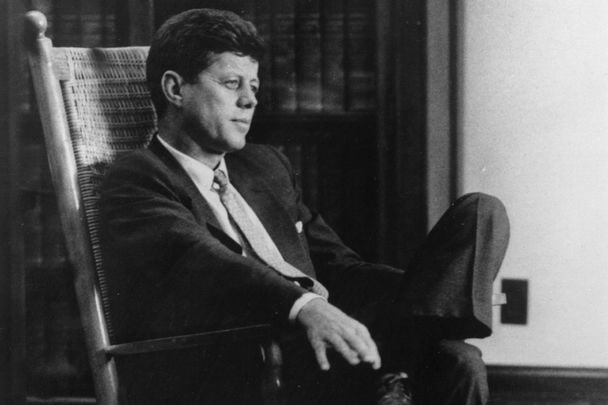
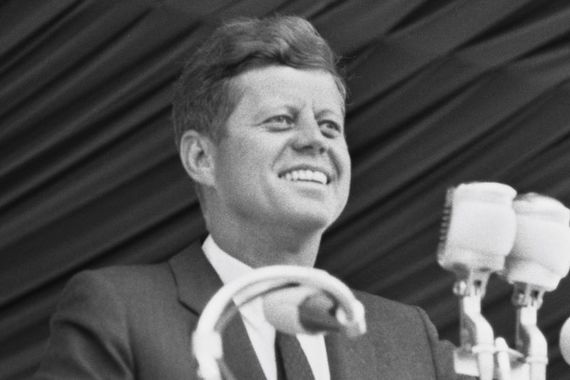
John F. Kennedy in 1960. (Getty Images)
Sign up to IrishCentral’s newsletter to stay up-to-date with everything Irish!Subscribe to IrishCentral
Uniquely Irish
Kennedy was uniquely Irish. He was the great-grandchild of immigrants from Co Wexford. Thanks to his family’s great wealth he never suffered poverty or hard discrimination—save for those Boston Brahmins who thought him “Shanty Irish”—but in his gut, he was a Fenian.
In this day of draft-dodging political cowards—“Chickenhawk” is the perfect description—Kennedy used his father’s influence to get into the United States Navy during World War II.
As the skipper of the PT-109 in the hotly contested Solomon Islands, his plywood boat was cut in half by a Japanese destroyer during night action and he was violently flung back on the bridge, ruining his back for the rest of his life. He gathered his crew around him, saving a badly burnt crewmate by slipping a belt under his arms, putting the belt in his teeth, and towing the man to an island. For his valor, he was awarded the Navy and Marine Corps Medal and the Purple Heart.
That’s a far cry from recent presidents who were outright draft dodgers or hiding out in safe places like the Texas National Guard.
3
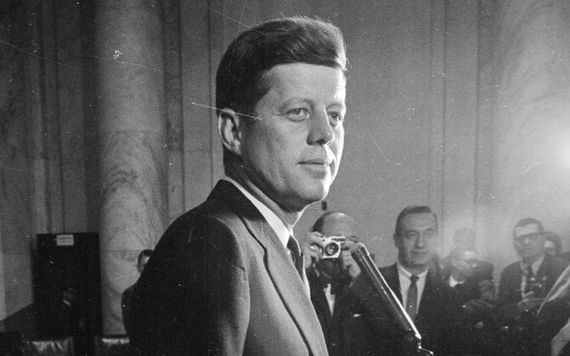
June 1963: President John F. Kennedy in Co Limerick, Ireland. (Getty Images)
A triumphant year
The last year of Kennedy’s life was a whirlwind. In October 1962, he faced down the Russians over missiles in Cuba. The generals wanted war, but the President, who knew war firsthand, managed a negotiated settlement which the world saw as a win for the young President.
The first half of 1963 brought unparalleled success to Kennedy. On June 11, 1963, he gave a nationally televised speech about Civil Rights where he called upon Americans to give equal rights to their fellow Negro citizens because “We are confronted primarily with a moral issue. It is as old as the Scriptures and is as clear as the American Constitution.”
In 1964, Lyndon B. Johnson would pass JFK’s Civil Rights Bill just as it was written by Kennedy.
On June 26, 1963, Kennedy gave his famous “Ich bin ein Berliner” speech in Berlin which built up the hopes of the population of Berlin while warning the Russians that their time would come.
Home to Ireland
Immediately after Berlin, Kennedy flew to Ireland, where he was greeted on the tarmac at Dublin Airport by President Éamon de Valera.
The RTE feed is one of unabashed pride as it reads: “Welcome Mr. President.”
Kennedy went on to address the Irish Parliament, the Dáil, but the thing that stands out on that Dublin visit is that he took the time to visit Arbour Hill where 14 of the 16 martyrs of the Easter Rebellion are buried in a mass grave.
It is poignant to see him reading the names of the patriots on the side of the grave as Taoiseach (Irish Prime Minister) Seán Lemass, who knew many of these men, walks at the President’s side.
Kennedy took pride in his Irishness as one can see from this clip when the Clancy Brothers and Tommy Makem sang “We Want No Irish Here” for the President. Liam Clancy’s cheeky introduction manages to elicit a huge smile out of the President.
JFK said goodbye to Ireland at Shannon Airport in County Clare, but promised “I’ll come back in the spring,” but he had already lived his last spring.
Tragedy strikes, then Dallas
August was to prove a momentous month for Kennedy. On August 5, 1963, he signed the Nuclear Test Ban Treaty, which made the world safer for every human being, but just four days later tragedy struck when his infant son, Patrick Bouvier Kennedy, died two days after his birth.
Jackie Kennedy disappeared for months but reemerged in November for a two-day political tour of the Texas cities of San Antonio, Houston, Fort Worth, and Dallas.
The President was greeted by fantastic crowds in the supposedly hostile territory. You can see the President obviously enjoying himself as he and the First Lady work the crowds. In his last speech, he issued a prescient warning saying we live in “a very dangerous and uncertain world.”
On the arrival of Air Force One at the ironically named Love Field in Dallas, the President and Mrs. Kennedy again worked the crowd, but, in the background there can be seen a Confederate flag stubbornly flying, reminding the world that not everyone approved of his Civil Rights agenda.
20 minutes later, the President was shot and a shocked nation listened to Walter Cronkite, in tears, give the terrible news of the assassination of the nation’s 35th president.
John F. Kennedy was President for less than three years, but in that short span of time, he pointed the nation toward the 21st century. He steered the nation to outer space and the moon explaining that “We do these things not because they are easy, but because they are hard.”
JFK set about fulfilling President Lincoln’s promise to the slaves at home and promoting peace abroad, sending American volunteers around the world to serve in the Peace Corps.
He was not without his faults. He was a man with a weakness for the flesh, but he did not blatantly brag about it. He tried to lift a nation and push it forward—and he succeeded. That’s why now, decades after his death, he is still fondly remembered around the world, especially in the small island nation that gave the world his family.
*Dermot McEvoy is the author of the “The 13th Apostle: A Novel of a Dublin Family, Michael Collins, and the Irish Uprising” and “Our Lady of Greenwich Village,” now available in paperback from Skyhorse Publishing. He may be reached at dermotmcevoy50@gmail.com. Follow him on his website or on Facebook.
*Originally published in 2016. Updated in November 2025.
Chris Donnelly: Irish unity offers the best route to reconciliation and stability.
By any objective analysis, it is the conduct of unionism’s political leadership which continues to cause the greatest source of political and community upheaval.
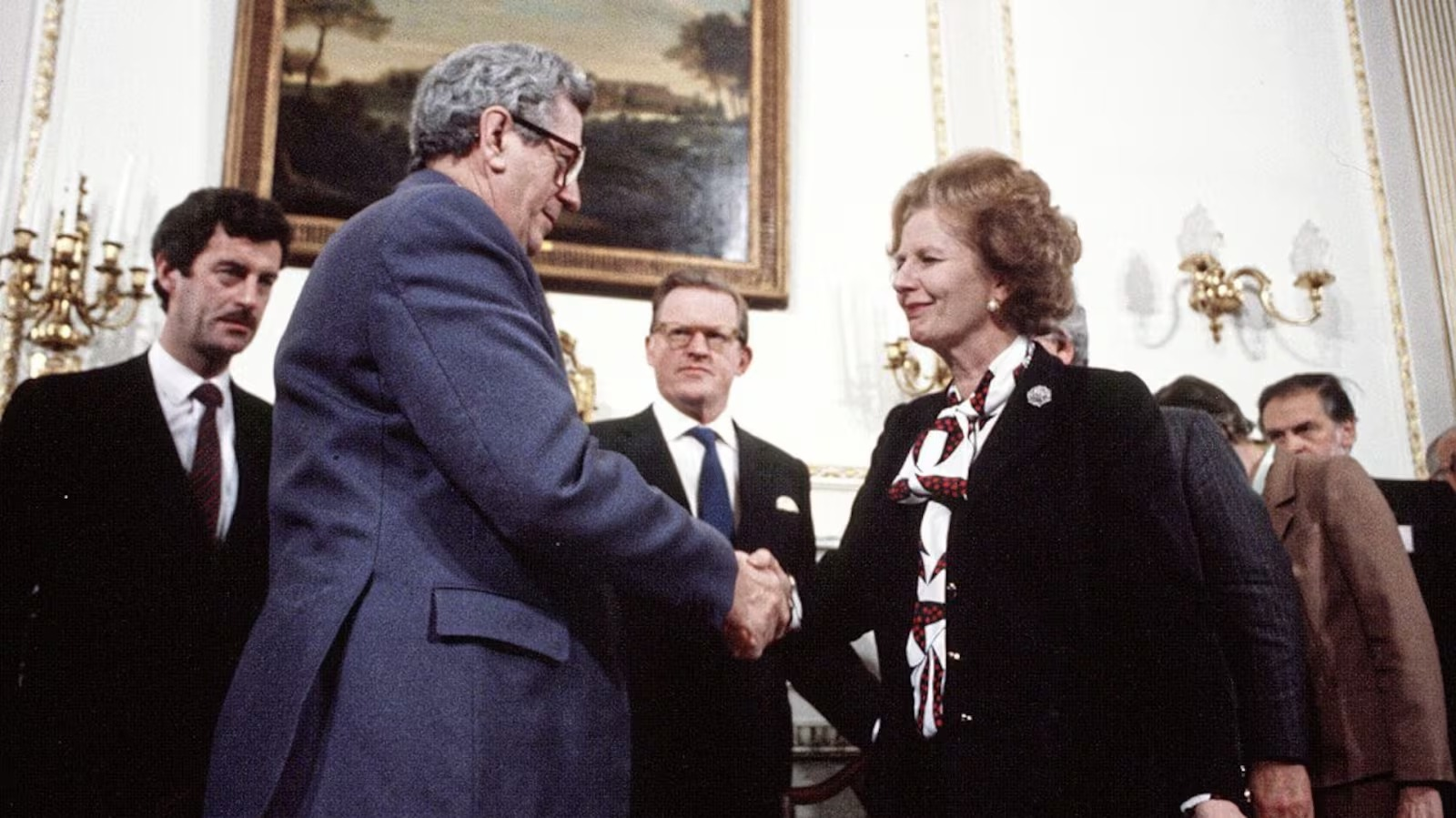
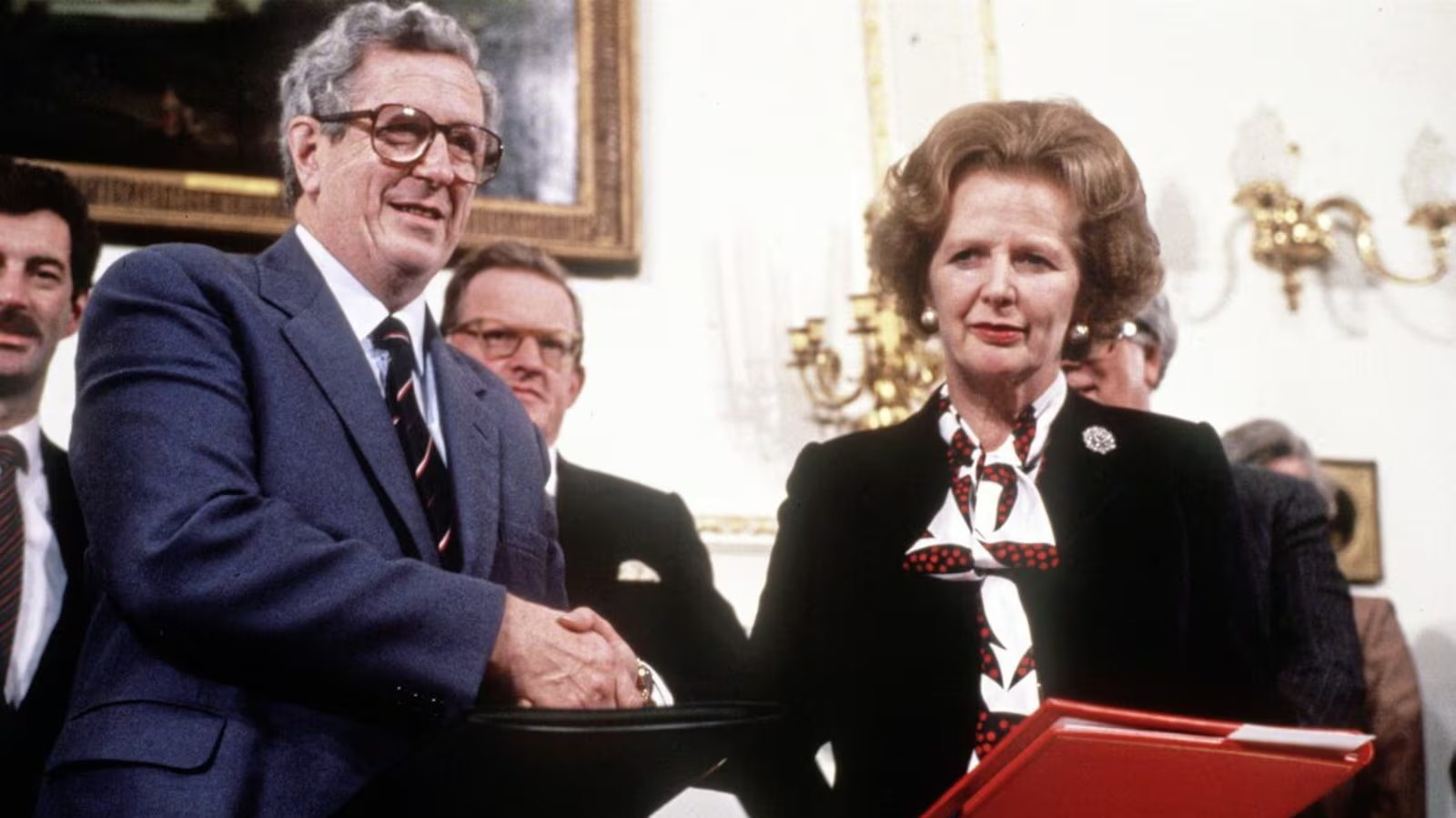
Tánaiste Dick Spring and Secretary of State Tom King (centre) look on as Margaret Thatcher and Garrett Fitzgerald sign the Anglo-Irish Agreement 40 years ago in November 1985
By Chris Donnelly
November 17, 2025 at 6:00am GMT
During her inauguration speech last week, the new Uachtarán na hÉireann, Catherine Connolly, appropriately referenced Article 3 of the Irish Constitution and its explicit commitment on behalf of the Irish people to work towards a united Ireland, consistent with the principle of consent as enshrined in the Good Friday Agreement.
As conversations continue and indeed expand on the prospect of Irish unification, it has become obvious that we need a cold, hard public discussion on how media framing, north and south, continues to betray a residual bias in favour of the unionist position, in spite of the change that has dropped slowly yet decisively over the past 30 years.
As I outlined in my last column, it is apparent in the manner in which the permanent veto against a Catholic ever becoming the British head of state is not deemed an issue worthy of discussion – and certainly of no significance regarding the constitutional position – yet sectarian comments attributed to online trolls during the Irish presidential campaign were elevated to a matter which allegedly indicated how unionists would not be welcome in a united Ireland.
At no point during coverage of the decision by the DUP to not attend the presidential inauguration in Dublin were senior DUP politicians challenged about what message their non-attendance sent to ordinary nationalists regarding respect for their identity and community whilst continuing to live in the United Kingdom today.
It is apparent in the oft-cited expectation that Irish unity must lead to a change of the national flag and national anthem, yet no such measures would even be countenanced regarding the union flag and God Save The King in order to maintain the union at present.
That is not to say such changes are not without merit and serious consideration by nationalists, but rather as an act of generosity as opposed to an expectation rooted in an unwarranted sense of entitlement.
It is apparent in the fact that no nationalist would consider compelling a unionist TD to swear an oath of loyalty to the Irish Republic in order to simply attend the Dáil in a united Ireland, yet nationalist MPs wishing to attend Westminster today continue to be publicly humiliated by swearing an oath of loyalty to the British monarch, without ever meriting discussion on the message that is sent to the Irish nationalist population in this place.
In an exchange with the presenter during the most recent episode of the BBC NI Borderlands podcast series, an interviewee commented regarding the prospect of a united Ireland that “you need to unite Belfast first”.
That is, of course, utter nonsense.
The city’s sectarian divisions have been evident and resulted in sporadic episodes of violence for more than 150 years. At no point has the fact that these have always happened whilst the city was under British jurisdiction meant that the existing constitutional status of the north of Ireland has been deemed null and void.
The very fact the continuation of the north of Ireland as a part of the United Kingdom has abjectly failed to both decisively address matters of reconciliation and to provide a stable political environment only adds credence to the belief that only Irish unity can provide a framework within which communities can better be reconciled and political stability achieved over time.
By any objective analysis, it is the conduct of unionism’s political leadership which continues to cause the greatest source of political and community upheaval.
The former tánaiste Dick Spring foolishly commented in 1993 that unionists should have the freedom to “withhold their consent” from constitutional change “unless and until they are persuaded by democratic means only”.
The context of his speech was amidst a particularly dreadful spate of killings across the north of Ireland and as background talks were clearly intensifying to clear a path to ceasefires that would come the following summer.
But it was careless talk nonetheless as it supported the undemocratic notion that unionism in itself had a veto on constitutional change, an affirmation (even if unintentional) of the Orange card manufactured and sustained by British brute force throughout centuries of Irish history to the detriment of all calling this place home.
As if to prove that some people never learn, the one-time Labour Party leader resurfaced last week to declare that Ireland was not “ready” for a unification referendum.
Instead, Mr Spring suggested it would be better for the north to simply “develop relationships with the south, economic relationships in particular”.
As the DUP’s non-attendance at Catherine Connolly’s inauguration illustrates, opposing partnership and greater co-operation is a central tenet of political unionism’s strategy.
It is also why Emma Little-Pengelly had the temerity to believe she should vocally oppose the notion of Irish citizens in the north being able to vote in future Irish presidential elections.
Only those blinded by ignorance, naivete or a lack of genuine experience of northern affairs would maintain that propping up a unionist veto or setting wildly unrealistic demands as a condition for Irish unity are appropriate at this time.
The problems besetting this society will not disappear in advance of Irish unity.
Enduring reconciliation and political stability will best be served by constitutional change. The sooner that is realised, the better.
If you have an opinion on the issues raised in this article and would like to submit a Letter to the Editor to be considered for publication
Unionists should learn the lessons from history and the AIA – The Irish News view
The Anglo-Irish Agreement is signed in 1985 at Hillsborough Castle by then prime minister Margaret Thatcher and taoiseach Garret FitzGerald
By The Irish News
November 17, 2025 at 6:00am GMT
The Anglo-Irish Agreement (AIA), which was signed 40 years ago at the weekend by British prime minister Margaret Thatcher and taoiseach Garret FitzGerald, was a major development in its own right, with two direct consequences which were arguably of greater significance.
They were that it paved the way for the Good Friday Agreement 13 years later, and also that it demonstrated starkly how placing faith in the British government brings even more risks for unionists than it does for nationalists.
The AIA established an intergovernmental conference which was headed by the north’s secretary of state, Tom King, and the Irish foreign minister, Peter Barry, with the British government officially accepting for the first time that it was prepared to facilitate a united Ireland if it was backed by a majority of voters.
Closer cooperation between Dublin and London, and a full acceptance of democratic principles on both sides, during a period of appalling violence across the board, should have been regarded as a positive development but unionist leaders were beside themselves with anger.
They portrayed the AIA as a shocking betrayal, but they consistently failed to acknowledge that they had entirely failed to anticipate the scale of the accord which was ratified in a ceremony at Hillsborough Castle, with James Molyneaux, the then Ulster Unionist leader, among those who were convinced that a new political initiative involving all-Ireland links was simply not going to happen.
When the AIA was nonetheless unveiled, there was also a completely misplaced belief among many unionists that they could force its abandonment by staging a repeat of the Ulster Workers Council strike which had brought down the first power-sharing executive in 1974.
The Ulster Says No campaign did bring large numbers on to the streets, starting with a massive rally at Belfast City Hall eight days after the Hillsborough ceremony, but it failed to shake the resolve of Downing Street, and it ultimately faded away as the violence surrounding the subsequent protests alienated many mainstream unionists.
Unionists failed to learn the lessons of history when in the post-Brexit period they enthusiastically supported another Conservative prime minister, Boris Johnson, in 2019, only to find that he deceived them over the Northern Ireland Protocol and the subsequent Windsor Framework.
It is verging on the astonishing that some senior unionists are now openly expressing admiration for Nigel Farage, and hoping that his Reform party heads the next British administration, even though he is at least as unreliable a figure as Mr Johnson.
The message for unionists should be that their best interests lie in working closely with nationalists at Stormont rather than engaging again in the kind of fundamental misjudgements which surrounded both Brexit and the AIA.
If you have an opinion on the issues raised in this article and would like to submit a Letter to the Editor to be considered for publication