Senior judge rejects legal applications to have case against several people charged with dissident terrorist offences dismissed…
Voting Rights for Citizens
A Letter from Ireland
a Chara,
Later this year, I will be able to vote for a new Irish President. My brother in Belfast can stand to become President, but cannot vote in the election. My daughters, who lived most of their lives, were educated, attended university, and worked in Dublin, but recently moved abroad also cannot vote in the election. Yet we are all Irish Citizens and described in the Constitution as part of the Irish nation.
US and Canadian citizens living in Ireland can vote in their respective domestic elections. A right denied to Irish citizens living in the north of Ireland or abroad.
This is not a new revelation. The denial of rights was written into Bunreacht na hÉireann (the Irish Constitution) in 1937. This was 15 years after the imposition of partition. The constitution provided for citizenship to all born on the island, but not the means to play a valued role in the political life of the nation. It was written with the full knowledge of the extent of immigration, a deliberate exclusion of a section of our nation and citizens.
For the parties in Dublin; Fianna Fáil, Fine Gael, and Labour, which did not organise in the North, the denial of voting rights was self-serving.
Platitudes could be paid to Irish citizens in the North, but God (or rather De Valera) forbid that they would ever be given a voice in the life of the nation. It has always struck me that Irish Citizens in the North and our exiled children across the globe laid waste to the myth of a successful nation state. We were a reminder of a nation divided by Britain, and of successive Irish governments that could not provide for generations who were forced into immigration.
In November 2013, the Convention on the Constitution recommended that citizens resident outside the State should have the right to vote in Presidential elections. It looked like this historic injustice would be addressed. Enda Kenny, the then Fine Gael Taoiseach, speaking in Philadelphia, promised a referendum to bring the Constitution into line with the recommendation of the Convention. This was too late for the 2018 Presidential Election, but it was promised that it would be in effect for the 2025 election. And then…nothing.
Earlier this year, Sinn Féin brought a motion to the Stormont Assembly (the parliament in the North of Ireland) to support the extension of voting rights in the Irish Presidential election to Irish Citizens living in that jurisdiction. The motion was passed by the Assembly.
This week in the Dáil (Irish Parliament), Sinn Féin leader Mary Lou McDonald pushed for moving the relevant legislation on voting rights to the next stage of Committee scrutiny and proposed a motion calling for the implementation of the 2013 proposals. The Government of Fianna Fáil and Fine Gael did not oppose either proposal. However, there is a difference between not opposing and actively progressing.
The dead hand of Fine Gael and Fianna Fáil cannot be allowed to continue to undermine the voting rights of Irish Citizens in the North or living abroad. Rights that are extended to citizens of other nations.
Have a great weekend.
Is mise,
Ciarán
Ciarán Quinn is the Sinn Féin Representative to North America
Noel Doran: A quarter of a century on, the PSNI risks losing what made it work.
Scrapping 50/50 recruitment was a mistake that still haunts the PSNI
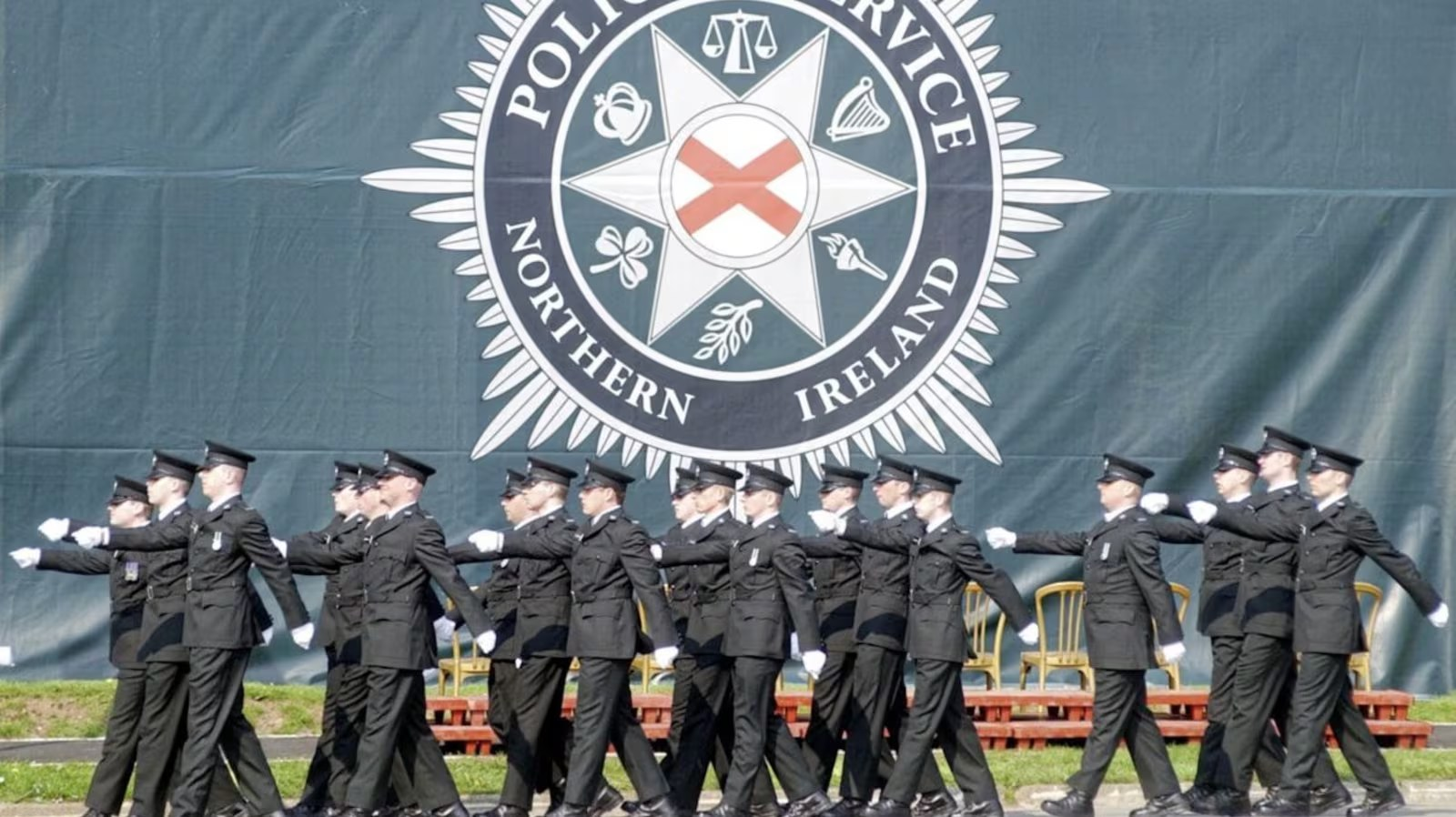
New recruits of the Police Service of Northern Ireland march past the new PSNI logo during the first ever graduation ceremony in Belfast.
By Noel Doran
June 30, 2025 at 6:00am BST
It is hugely disappointing that the PSNI, instead of preparing to celebrate the 25th anniversary of its launch next year as a heartening success story, is having to address fundamental questions about its religious balance.
Past and present flawed political interventions mean that developments which are entirely contrary to the spirit of the new era so painstakingly constructed a quarter of a century ago are growing in seriousness.
It was always envisaged that the PSNI would eventually contain as close to an even number of perceived Catholics and Protestants as possible, with those from other or no faith backgrounds equally welcome.
There were plainly a number of reasons for the fact that its predecessor, the RUC, was overwhelmingly Protestant, but it was agreed on all sides that change must follow as part of the breakthroughs associated with the 1998 Good Friday Agreement.
The GFA established the Patten Commission on policing under the direction of the former British cabinet minister Chris Patten, and, as soon as Maurice Hayes was named as one of its members, I was sure that its work would be transformational.
I had known him since I was a child, as he was a good friend of my late father, and I do not think that I ever met a more accomplished figure who had a sharper insight into all aspects of Irish life, north and south.
Hayes, who died in 2017, and his colleagues produced their visionary report in 1999, recommending the establishment of the PSNI, under the supervision of policing boards and an ombudsman, with a new code of ethics and crucially a policy of 50/50 recruitment for Catholics and Protestants remaining for at least a decade.
It also proposed an emphasis on community policing and normalisation which would include the removal of the GAA’s Rule 21, preventing northern police officers and British soldiers from joining the association.
The attitude of Catholics and nationalists to policing needed to change if a lasting new dispensation was to be achieved, and, as previously noted in this column, The Irish News found itself increasingly close to the sharp end of the debate.
Our initial suggestion that the time had come for the two main nationalist parties to take their seats on the policing boards caused something of a stir, while our repeated calls on the GAA to finally drop Rule 21 were probably even more contentious.
It led to threats of a boycott of the paper from some quarters, but it transpired that both the PSNI arrival and the GAA’s ban departed with much less upheaval than might have been anticipated in the course of November, 2001.
The number of Catholics in the new service rose dramatically from eight per cent at its inception up to almost 30 per cent within less than 10 years, and was heading steadily toward a figure which fairly represented our divided population.
Unfortunately, the then Conservative secretary of state Owen Paterson, who was only in his post for just over two years and shortly afterwards left the British cabinet to become a Brexit campaigner, caved in to unionist pressure and made the disastrous decision to end the 50/50 recruitment policy in 2011.
The most recent figures indicate that the number of Catholic officers who were born in the north, as opposed to moving from across the border or Britain, is roughly 26 per cent, or barely one in four.
It is even more alarming that, according to the result of a Freedom of Information request by this paper last week, Catholics made up just 17.1 per cent of new hires to the PSNI in 2024, representing an unmistakeably negative trend.
While the dreadful attempts to intimidate and target Catholic officers by small but aggressive republican splinter groups are very much a factor, the perception that the PSNI is becoming an institution which is increasingly and disproportionately linked to the Protestant tradition is deeply unhelpful.
The reality that there have always been more applications to the service from Protestants than Catholics means that a 50/50 recruitment policy does not provide equality of opportunity, but wider considerations are involved.
Although the multiple scandals surrounding the investigation into the 1997 murder of the GAA official Sean Brown were initially down to shocking conduct on the part of the RUC, the refusal by the present Labour secretary of state Hilary Benn to allow the public inquiry which the courts have ruled as a necessity has inflicted further reputational damage on the PSNI.
Mr Benn can undo at least some of the harm which this and other cases have caused to the image of policing through starting a review process which would allow the return of 50/50 selection in the short term.
THE Sunday World had a fascinating, super, soaraway exclusive on recently deceased Portadown loyalist Muriel Gibson. Which meant that the Belfast Telegraph had a fascinating, super, soaraway exclusive on her too, because the BelTel website on Monday is a parking space for the most click-friendly content from its Sunday tabloid sisters, the Sunday World and Sunday Life.
It seems Muriel wasn’t actually called Muriel by her chums in the fashionable loyalist literary salons of north Armagh. It seems her pals called her ‘Madame Defarge’, the revenge-crazed anti-hero of the Dickens novel, A Tale of Two Cities.
Squinter’s going to be honest here and say that he didn’t know that in the citadel of Loyal Ulster they are in the habit of giving each other nicknames taken from the literary classics. But every day’s a school day and the knowledge that when the LVF in Portadown, Lurgan, Craigavon and Tandragee weren’t killing Catholics they spent their down time immersed in the pursuit of intellectual insight only increases his admiration for that fine loyal yeomanry.
So Squinter called a few friends in the Markethill area and asked, “Can this be true?” And came the answer, “Yes.”
It appears the quartermaster of the LVF in the early 90s was called ‘Moby-Dick’, and while that made him popular with the ladies in the Flag and Flute, it was in fact unconnected to the dimensions of his loyal lanyard.
“He was a man who had been guilty of many heinous crimes,” a pal told Squinter. “And the knowledge of those horrors led him to question the nature of fate and free will, just like the author of Moby-Dick, Herman Melville. It so happens that he was indeed hung like a donkey, but that was just a coincidence.”
Meanwhile, LVF leader Billy Wright may have been known by the media as ‘King Rat’, but away from the public glare his paramilitary colleagues called him ‘Jay Gatsby’.
Squinter was told by a loyalist source: “Like Gatsby, Billy earned a fortune from shady activities and he also loved to throw wild parties. Okay, nobody at Gatsby’s parties ended up with one behind the ear in a lime pit, but the similarities remain. LVF members were all massive fans of F. Scott Fitzgerald, of course, so it was kind of inevitable that Billy would get the Gatsby nickname. As with Gatsby, Billy was beset by class anxiety and crowd isolation. Gatsby exorcised his demons by frantic social climbing. Billy just killed Catholics.”
Meanwhile, a cymbal-player in the Richhill Rising Sons of Swinger Fulton’s Mad Mate has been telling Squinter of the fascinating nickname given to his former commander in the LVF/UDR.
“They guy never went anywhere without a copy of Homer’s ‘Iliad’ in his back pocket. We’d be taking a break from digging a hole for a dead Taig and while the rest of us would be sitting around smoking and talking about Albert Camus and irrationality or Cormac McCarthy’s debt to Hemingway, he’d have his head in the Iliad. He once told me he was fascinated by the poem’s epic themes of conflict, fate, honour and whacking people. All of us in the mid-Ulster LVF and 2 UDR had read the Iliad, of course, and so while his friends and family called him Ratface, we started calling him Agamemnon. There was something about the contradiction of his selfishness and raw courage that reminded everybody in the Mahon Barracks mess of the Mycenaean warrior-king. Incredibly, while Agamemnon was famously murdered by his wife and her lover, he got bumped off by his fancy woman and her dealer.”
Next week in the Sunday World/BelTel:
• Johnny ‘Mad Dog’ Adair on studying the Classics as a mature student.
• How will the UVF’s Ballysillan Book Club survive without Winkie Irvine?
How the DUP joined the Ballymena rubber chicken circuit
Gather ye round and a story I’ll tell
Of how the brave DUP rang the race warning bell.
How they saved Ballymena from the outsider threat
And how Loyal Ulster is e’er in their debt.
In the Year of Our Lord Twenty and twenty five
The once-proud wee town had become a grim dive.
Once packed with flute bands and Protestant kirks,
It was now full of Romas and barber-shop Turks.
And the newcomers didn’t know how to behave,
No ‘Great mornin’, hi’, no warm, cheery wave.
And in no time at all the place was a mess
And where it would stop was anyone’s guess.
Robbers and rapists and criminals various,
Milking the state with schemes most nefarious.
Taking our jobs while lazing at home,
Worshipping voodoo, Islam and Rome.
And thoughts of the past saddened ordinary folk,
The days of cheap heroin and talcum-free coke.
Good times when community brightened the day,
With weed on the slate from the bold UDA.
So the DUP hollered ‘Enough is enough!’
It’s time to get serious, time to get tough.
No more Romanians destroying the town,
No more Filipinos dragging us down.
It’s the end of the influx of military-aged blokes
And we don’t care how much libtard anger it stokes.
But though we’re about to step up to the mark.
Can we just say a word on our mates in Moy Park?
They need lots of people to do things with chicken,
But some of those jobs tend to gross out and sicken.
And we see when it’s smoke break time at Moy Park,
Those jobs are best done by folk who are dark.
So we’ll say no to migrants while welcoming guests
Handy at cutting up wings, legs and breasts.
We’ll keep out the Bulgarian, Indian and Turk,
Except for the ones game for slaughterhouse
work.
And if our position remains somewhat murky,
At Christmas the factory will send us a turkey.
And they’ll pluck it and dress it and gut out the gore
From an XXL bird that won’t fit through the door.
And while we continue to keep out foreign vermin,
We’ll ring up the Moy Park HR to determine
How many brown workers they need for their shifts,
And then we’ll be smothered with chicken-based gifts.
As the tired workers yawn and head home to their billets,
We’ll fill up our freezers with southern fried fillets.
And for every 10 Roma our lobbying brings,
We’ll get chilli goujons and barbecue wings.
And of course we’ll keep saying we’re doing our best,
To keep out the thugs who have shit on our nest,
But we’ll keep making space for the brown factory guys,
So we can keep on enjoying the garlic-herb thighs.
Reaffirming the Many and Deep Ties Between Ireland and America.
News June 06, 2025 by Irish Echo Staff
As I undertake my first official visit to the United States as the Minister of State for Diaspora and International Development this week to engage with Ireland’s diaspora, I am reminded of the rich foundation of ancestral ties and close economic, diplomatic and political links that have developed between Ireland and America.
These links predate the foundation of both countries. For centuries, Irish immigrants have come to the U.S., making this country their home, and contributing to every aspect of life, work and society. It is amazing to note that over half of all U.S. Presidents have ancestry rooted in the island of Ireland.
In turn, events in the U.S. had a huge influence on Ireland. The ideals of the American Revolution inspired Irish independence movements. Political support from the U.S. was instrumental in the foundation of Ireland. The role of the Irish diaspora here is recognized in the 1916 proclamation of independence and Ireland sent its first ever Ambassador to Washington D.C. following the formal establishment of diplomatic relations in 1924.
The United States’ deep and sustained engagement with Northern Ireland has been one of the most significant success stories in American foreign policy. The signing of the Good Friday Agreement, which brought peace to Northern Ireland, could not have happened without American support and perseverance. As a result, we have seen a whole generation grow to adulthood outside of the shadow of violence.
The depth of our bilateral relationship goes beyond peace and politics, as important as these strands are.
Over the last number of decades we have seen a deeply integrated and mutually beneficial economic relationship develop between Ireland and America; one that is now valued at over one trillion dollars, creating prosperity and jobs for large numbers of people on both sides of the Atlantic.
Ireland is now one of the world’s most prosperous, creative and dynamic economies, with the U.S. our most significant trading and investment partner. Our companies invest more than $350 billion in America, delivering over 200,000 jobs located across all 50 states. In return, more than 900 US-owned firms have their European headquarters in Ireland, providing 180,000 jobs.
A rising tide lifts all boats and the Irish Government is determined to protect and deepen this relationship, which delivers significant benefits for both countries and peoples.
We do not want to see disruption with tariffs and uncertainty. Tariffs are counter-productive; they drive inflation, hurting consumers on all sides. Now is the time to get into a substantive, calm, measured and comprehensive dialogue with the United States. This is also the position of the EU. I welcome the pause in further threatened U.S. tariffs of 50% until July 9 to allow negotiations to take place.
The EU-U.S. trade and investment relationship is the biggest in the world. More than €4.2 billion worth of goods and services are traded between the EU and U.S. daily. Disrupting this deeply integrated relationship will have serious consequences for all concerned.
The EU has outlined its willingness to negotiate a zero-for-zero tariff agreement with the U.S. and remains committed to constructive negotiations with the goal of achieving frictionless and mutually beneficial trade. Ireland supports this position and will continue to advocate for such an outcome.
The current uncertainty does not define our relationship however. Regardless of the outcome, our ambition remains to strengthen our political, cultural, economic and trade relationship with the U.S. at all levels.
We have a valued diaspora in America. Over 31.5 million people claim Irish ancestry here. The main purpose of my visit this week is to hear from this community and to ensure our relationship with Irish America is a dynamic one that meets their needs and can adapt to evolving circumstances. This will be the first of many consultations in the United States this year as the Government develops its new Diaspora Strategy to support our Irish community overseas.
We are also committed to supporting our communities and strengthening ties through an increased presence in America. So far this year, Ireland has appointed our three newest Honorary Consuls – in Detroit, Michigan, Orlando, Florida and Buffalo, New York. This brings our total number of Honorary Consuls to 14; each playing a vital role in promoting Ireland, supporting Irish communities and strengthening the bonds between those communities and Ireland.
The growth of our Honorary Consul network is just one element of the Irish Government’s commitment to enhance our presence across the United States.
The openings of our new Ireland House in New York last September and another in Chicago in March, is another expression of this commitment and has facilitated even greater engagement with our diaspora in those regions as well as promoting our business links through our excellent State Agencies, IDA Ireland, Enterprise Ireland, Tourism Ireland, and Bord Bia.
Next year America will celebrate 250 years of independence. It will be a great occasion that will provide an opportunity for reflection
on the significant contribution of Irish America as we mark such an important anniversary.
We are living in turbulent times, but one thing that remains true and continues to hold is the strong bond of friendship that exists between Ireland and the United States of America. Ireland has played a significant role in the story of America, a role we wish to continue long into the future.
Neale Richmond TD is Minister of State at Ireland’s Department of Foreign Affairs with special responsibility for Diaspora and International Development.