Participants with the family name of O’Sullivan and Sullivan broke the world record for the largest gathering of people with the same surname, in Castletownbere
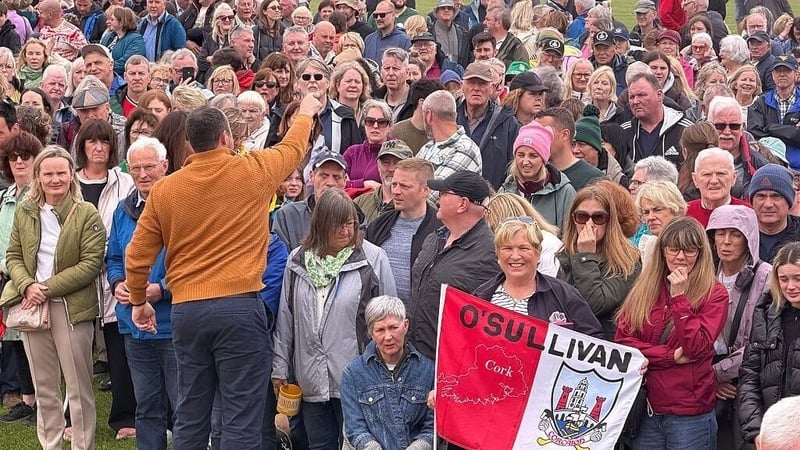
Almost 2,000 people with the last names O’Sullivan and Sullivan travelled from around Ireland and the world to meet in Co Cork, in the largest ever recorded gathering of people with the same surname.
Guinness World Records representatives verified the milestone at the event in Castletownbere.
“With a total of 1,848 the O’Sullivan clan are the new Guinness World Record holders, congratulations,” an official told a cheering crowd.
The feat knocked another common Irish family name – Gallagher – off the top spot won in 2007 with a gathering of 1,488 participants in Co Donegal.
The surnames O’Sullivan and Sullivan are commonplace in Cork and in southwestern Ireland.
Many from the large international Irish diaspora also arrived to bolster the numbers, presenting passports as proof of their name.
“Where I come from in Boston, there’s plenty of us Sullivans, but this is unbelievable,” said Kevin Sullivan, aged 75, looking around at the crowds filing through a primary school where the event was coordinated.
“Everyone I look at here I know is a Sullivan or an O’Sullivan, so it’s an incredible feeling,” the retired IT executive said.
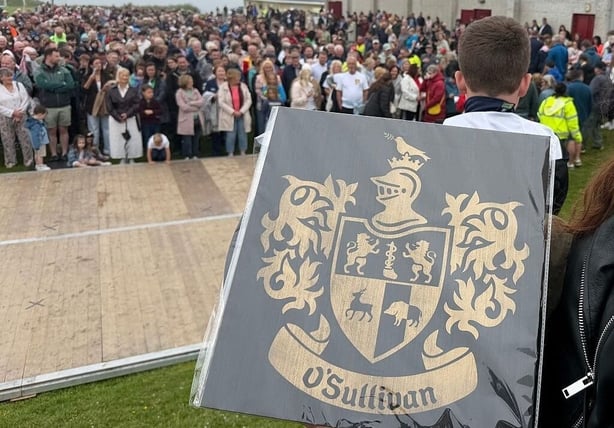
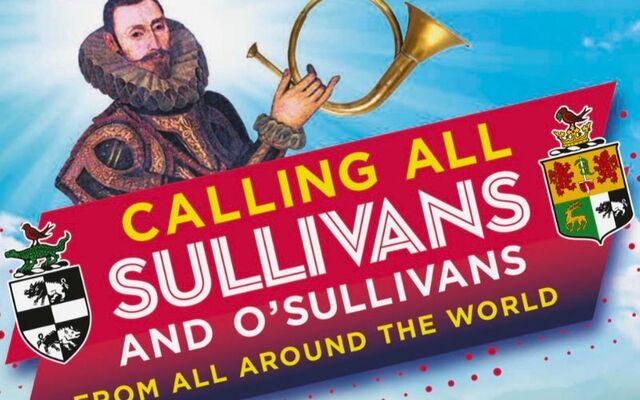
The O’Sullivan clan family crest is held by a participant during the world record-breaking feat
Participants passed through turnstiles to provide a preliminary tally before officials circulated through the assembled groups on the school’s football pitch for a final count.
Mary Sullivan, one of many Americans of Irish ancestry who attended, said she had “travelled over 3,000 miles to join the record attempt”.
The gathering was hosted by the chieftain of the clan, Kelly Sullivan, who was presented with the chain of office in Boston in 2023.
“I feel blessed to have grown up as part of the wider Sullivan-O’Sullivan family, we make a team that can’t be beat,” she told the crowd.
The world record bid organiser Jim O’Sullivan from Castletownbere said wet weather early in the day raised doubts about whether enough namesakes would show up.
“But people turned out in their numbers, and we did it. So, we’re asking the Gallaghers, back on your shoulders now. Next time up, you’ll beat us!” he said.
Among the participants who travelled the farthest was Michel Sanchez O’Sullivan who said his grandfather was an O’Sullivan from New York who later settled in Mexico.
“As far as we know, we’re the only O’Sullivans in Mexico, it’s great to be here to get to explore my Irish roots and meet the rest of the family,” the 35-year-old said, speaking on Castletownbere’s main street, holding his daughter Olivia on his shoulders.
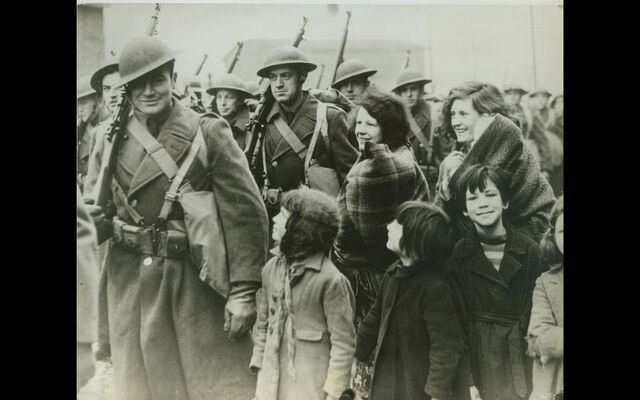
February 8, 1942: Women and children in a port “somewhere in Northern Ireland” as they greeted troops of the American Expeditionary Force, on its arrival. ACME / Allison Collection Photos
Not infrequently do we discuss the role of Irish immigrants in the American military, starting in the early days of the Revolutionary War and spanning across numerous civil and global conflicts.
Throughout this history are many examples of Irish political ties impacting the move of American wars. For instance, we’ve spoken in the past on the role of the Sixty-Ninth Regiment, a Union Army brigade in New York that was founded by Irish immigrants and abolitionists.
In our exhibit earlier this year, we looked at the way 18th-century United Irishmen and their partnerships with French revolutionaries supported the cause of American independence.
But when we approach the 20th century and the rise of large-scale global conflict, we see a new wave of interaction between Ireland and America through the movement of soldiers. Not only were Irish immigrants changing war in the United States, but American soldiers changed the landscape of Ireland.
Sign up to IrishCentral’s newsletter to stay up-to-date with everything Irish!Subscribe to IrishCentral
The United States and Ireland both were not the central focus at the start of World War II. Like many smaller nations, Ireland has frequently remained neutral during external wars and been hesitant to risk its safety.
In the first half of the 20th century, Ireland would be putting its rocky nationhood to considerable risk if entering a global battle.
Though a much larger nation, the United States had similar concerns and did not officially enter the war until December 1941, after the Japanese attack on Pearl Harbour.
Once the war became more explicitly global in the 1940s, both Irish and American soldiers found their roles in somewhat surprising stations. From the Irish side, a number of Irish nationals traveled to the United States and Canada to enlist and fight, echoing the earlier practices of the Revolutionary War. From America, the opposite occurred.
In January of 1942, President Franklin D. Roosevelt announced an agreement with Prime Minister Winston Churchill for American troops to be stationed in the United Kingdom. On paper, this seemed to be a simple move towards Allied troops in London or other English stations. However, a mere 21 years after the Anglo-Irish Treaty, borders and land control made the decision a bit more complicated.
Rather than sending Americans to London, the troops were scheduled to be stationed in Belfast, under English control. This sparked controversy, as American Catholics with Irish heritage were viewed as a liability to British control in Ireland.
According to Simon Topping’s 2022 article in The Irish Times, Belfast Prime Minister J.M. Andrews stated his concern outright, saying he was, “most anxious that no impression should be given that we were handing over responsibility for the defence of Northern Ireland to the United States. Irresponsible or wrong-minded people might misinterpret this as the first step to handing Northern Ireland over to Éire.” This concern extended even to individual soldiers, with the question of who should be placed in charge of an American garrison carefully controlled by the English with the goal of preventing further Irish uprisings.
The significance of placing Irish Americans in English-controlled Ireland was not noted only in Europe and the UK. In his 2014 article in “New York Irish History,” historian John T. Ridge explored the complex feelings of New Yorkers with Irish heritage on the question of Irish neutrality. He explains that the New York Irish were initially very supportive of the Irish neutral stance on WW2, with the American Friends of Irish Neutrality garnering many members with a rapid pace. However, after the events of Pearl Harbour, the tides quickly shifted, and Irish New Yorkers widely and openly supported the war, even purchasing defense bonds to fund the cause.
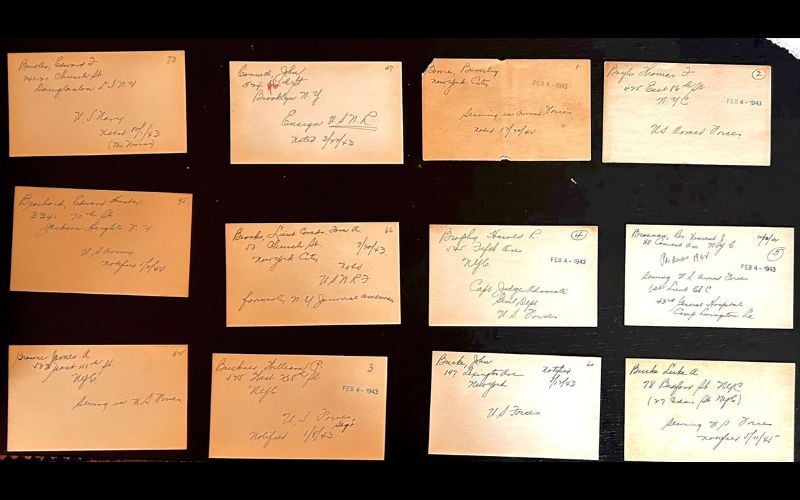
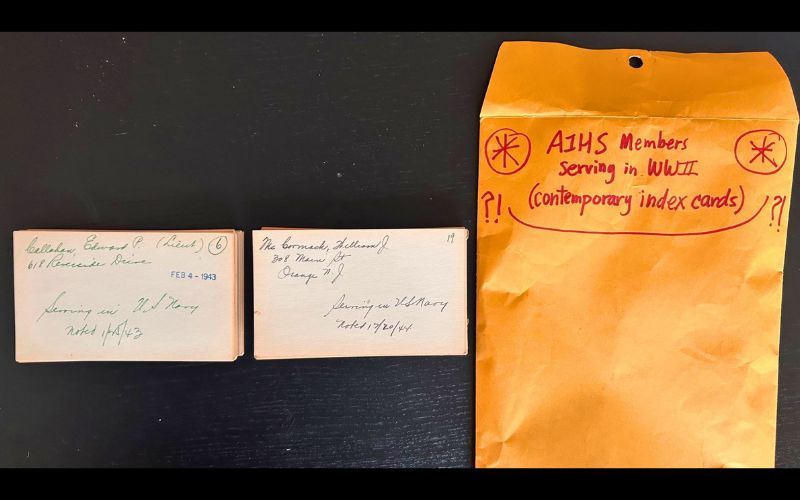
In our collections at AIHS, we hold a number of cards (pictured below) of our members who served in WW2. Naturally, the majority of these members were Irish Americans who enlisted after 1942. Among these names included are Harold R. Brophy (a lawyer and judge advocate) and Reverend Vincent J. Brosnan (a Catholic Chaplain, 43rd Gen. Hospital).
While the cards in our collections focus on our members only, the number of Americans with Irish ancestry during WW2 was significant throughout the country.
4
(AIHS)
4
(AIHS)
Whereas Irish neutrality had previously been a safeguard for a cautious nationhood, it shifted after Irish Americans joined the war. From county association meetings to public posters, the fight for WW2 became a point of national pride for both American and Irish identity. Symbols like the shamrock and battle cries like those taken from the early days of the 69th regiment regained popularity with the armed forces.
4
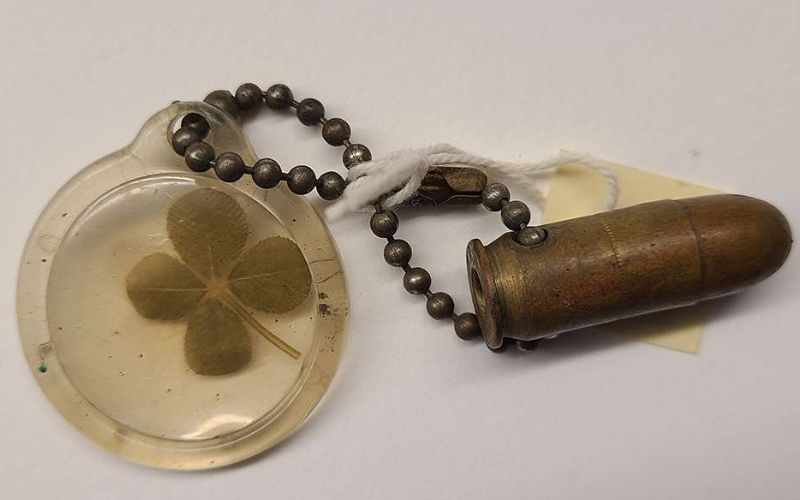
Four-leaf clover lucky charm of Pfc. Joseph Robert Wallner, attached to a .45 caliber bullet. Gift of Sonja Wallner, 2012.034.029. (Image and description courtesy of the National World War II Museum / AIHS)
Back in Belfast, American soldiers reconnected with Ireland on somewhat shaky grounds. African American soldiers were surprised to be welcomed and respected, seen as equals more so than they were at home. Others, however, found that they needed greater time to adjust to Northern Irish customs.
American soldiers were given pamphlets explaining the cultural differences between Ireland and America, with a particular emphasis on manners and politeness. However, contrary to the fear of Irish uprising, the result was a strengthened relationship between the United Kingdom and the United States.
In the south, de Valera and others opposed this placement of American soldiers and saw it as a risk to the blossoming Irish nation. The challenges of waning nationalism in the north saw an opportunity for its growth in Dublin and in the United States itself. New York and Boston in particular saw a rise in Irish pride in soldiers whose parents or grandparents had immigrated. Societies like our own made records of the Irish heritage found in American soldiers to promote this national identity as unique and significant.
Rather than serving as another American soldier, the Irish-Americans of WW2 held true to their hyphenated identity and remembered the legacy before them. As the war approached its end, soldiers with Irish heritage came to the beaches of Normandy from both Ireland and the United States.
While the numbers cannot be exact, we know that the Irish identity held strong throughout the world, continuing to be remembered as unique and true.
On this Memorial Day, we look at the story of WW2 soldiers not as an Irish one nor an American one, but something strong that comes from that place in between.
This column is adapted from the blog of the American Irish Historical Society (AIHS). Read the full stories at AIHSNY.org/blog.
Founded in 1897 and located on Museum Mile in New York City, the American Irish Historical Society (AIHS) preserves and promotes the history and cultural legacy of the Irish in America through its archives, art collections, and public programs. Learn more at AIHSNY.org.
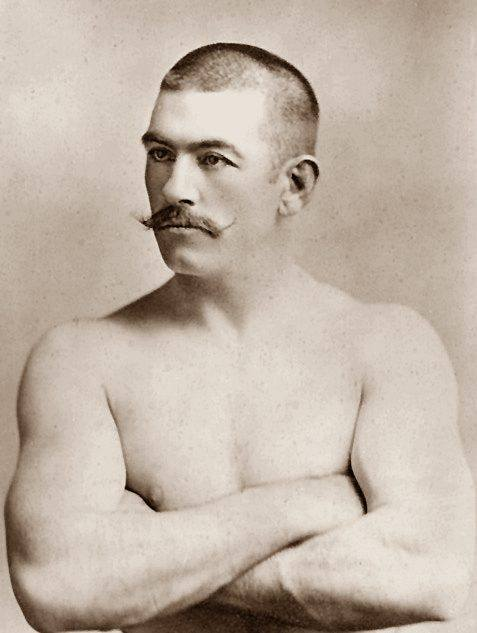
John Lawrence Sullivan, born to Irish immigrants on October 15, 1858, in Roxbury, Massachusetts, grew into an embodiment of the American Dream for many Irish Americans. His parents, survivors of the Great Hunger in Ireland, instilled in him a profound sense of identity and resilience. Though he was an excellent student and his parents aspired for him to attend Boston College and become a priest, destiny had a different plan for Sullivan. Lured by the raw appeal of professional sports, Sullivan found his true calling in boxing, a sport then shadowed by legal ambiguities and often relegated to “exhibitions” or clandestine bouts.
Sullivan’s rise from local fame to national celebrity was meteoric. In one fight, his opponent failed to show, and to quell the restless crowd, Sullivan issued a challenge that became his trademark, “I can lick any man in the house.” This became not just Sullivan’s trademark but a symbol of Irish-American defiance and determination. Through a series of exhibition matches and high-profile bouts, including a legendary encounter with Paddy Ryan in Mississippi, Sullivan’s fists wrote chapters of boxing history. His victory over Ryan, witnessed by figures as diverse as Oscar Wilde and Jessie and Frank James, cemented his status as a champion of the people.
Sullivan’s reign as the Heavyweight Champion brought boxing to the forefront of American sports, making him the nation’s first sports superstar. Leveraging his “I can lick any man in the house” boast, he made a whirlwind of 200 stops across the United States, showcasing his unparalleled strength and skill, endearing him further to an adoring public. Boxing historian Nate Fleisher has observed, “For the first time in their lives, Americans living in the sticks — nearly four hundred thousand American farmers, miners, lumberjacks, artisans, and clerks — laid down their hard-earned cash to see a real boxer in action. They loved it, and the effect of their gratification on the growth and spread of boxing is beyond calculation today.”
Yet, Sullivan was more than a mere athlete; he was a cultural icon, reflecting the grit and determination of the Irish American community still struggling to overcome prejudice and find their place in American society. Such was his fame that to be able to say, “Shake the hand of the man who shook the hand of John L. Sullivan,” brought its own notoriety.
Sullivan never forgot where he came from. In a story that further enhanced his renown in the Irish community, it was said that he refused to stand for the traditional toast to Queen Victoria while attending a dinner in his honor in Victoria, British Columbia. Sullivan stated he “hadn’t been brought up to seeing Irishmen drinking to the health of English monarchs,” he informed the shocked dinner guests.
However, time and age give athletes no special consideration. Add to this that in a phenomenon we see repeated among many modern athletes, Sullivan liked to party, and it became increasingly difficult for him to get in shape. The fight against “Gentleman Jim” Corbett in 1892 highlighted the end of an era and showcased how far boxing had developed under Corbett. No longer were fights held secretly in the dark backroom of a saloon; this fight was held under the glare of the new electric light and the eyes of over 10,000 spectators and reported worldwide. The aging champion and brute strength brawler Sullivan met his match in the younger, more agile, more scientific Corbett. While clearly past his prime and suffering a broken nose in an early round that constrained his breathing, Sullivan persevered until the last of the 21 scheduled rounds where he was knocked out.
However, even in defeat, Sullivan added to his legacy for the graciousness he accepted, “Gentlemen, all I have to say is that I came into the ring once too often, and if I had to get licked, I’m glad it was by an American.” Sullivan’s grace in defeat, acknowledging Corbett’s victory as a passing of the torch to a fellow American, exemplified his character.
John L. Sullivan’s legacy is not merely confined to his boxing achievements; it is interwoven with the narrative of Irish-American struggle, perseverance, and success. His life story, from the streets of Roxbury to the heights of boxing fame, resonates with the spirit of a community that literally and metaphorically fought to carve out a place in America. Sullivan’s journey embodies the complexities of the American Dream, reminding us that heroes are not defined by their victories alone but by their ability to inspire, persevere, and stand with dignity and pride regardless of the outcome.
Thousands of Sullivans / O’Sullivans descending on West Cork for world record attempt
Will the Sullivans beat the Gallaghers? A Guinness World Record attempt will be made on Saturday, May 30 in West Cork as part of a massive clan gathering.
May 29, 2026
More than 3,350 people with the surname Sullivan or O’Sullivan have registered to take part in a world record attempt in Castletownbere, Co Cork, this Saturday, May 30.
The record? The largest gathering of people with the same surname.
Perhaps not surprisingly, the current Guinness World Record was set in Ireland when 1,488 Gallaghers gathered in Letterkenny, Co Donegal in 2007.
Sign up to IrishCentral’s newsletter to stay up-to-date with everything Irish!Subscribe to IrishCentral
On Saturday, registration for the world record attempt will be held from 1:30 pm at Beara Community School, though registration is also open online. Participants will need to show their birth certificate, passport, or driver’s license. Married names and maiden names are both acceptable.
At 3 pm, two pipers will lead participants to the Beara Community School pitch for the final count.
After a few short speeches, celebrations will get underway with music and Irish dance performances, and letters will be presented for a time capsule, which is set to be opened in 25 years. Dancing at the Sports Hall will follow.
Last weekend, the votes were counted in two by-elections (special elections). One in Dublin Central, an urban constituency, and the other in Galway West, comprising Galway City and a vast tract of rural Gaeltacht.
It was a disappointing election, as Sinn Féin finished second in Dublin to the Social Democrats and down the field in Galway, with the seat going to one of the government parties, Fine Gael.
Two different constituencies returning Centre-Left and Centre-Right candidates. I say disappointing, as I believe neither will deliver the kind of new and united Ireland that the people so desperately need and desire. But that is democracy.
I am always mindful of President Clinton’s words: “The American people have spoken—but it’s going to take a little while to determine exactly what they said.”
While it is always interesting to try to guess, it is dangerous to draw conclusions from two vastly different constituencies, where hyper-local candidates and issues can skew results but not have an impact on a national scale. It would be like comparing a district in Massachusetts to one in New Mexico or a riding in Quebec to one in Alberta.
Elections in Ireland use proportional representation. A voter ranks their candidates in order of preference. In these elections, Sinn Féin sought to win seats and also support other left-wing parties. A first preference for Sinn Féin, then encouraging voters to give preferences to other left-wing candidates.
In the Galway election, when the Sinn Féin candidate was eliminated, 75% of his transferable votes went to parties and independent candidates on the left, and 25% to a rural party. The battle for the seat was between a centre-right candidate of Fine Gael and the rural party candidate of Independent Ireland.
In the final round of vote counting, it was the left-leaning parties’ votes that elected the centre-right candidate. This was not a surprise, as the Irish Labour Party had supported Fine Gael in previous Governments.
In Dublin, the election battle was between left-wing parties, with the Sinn Féin candidate taking second place to the Social Democrats after nine rounds of transfers.
This result meant that, for the first time in history, the constituency has no representative from the government parties, Fianna Fáil and Fine Gael.
The votes across both constituencies vary dramatically. Looking at the winning parties, Fine Gael got 20% in Galway and 10.7% in Dublin, while the Social Democrats got 19.7% in Dublin and 7% in Galway. Independent Ireland did not contest the election in Dublin.
However, over time, trends become a little more clear. In 2007, Fianna Fail got 44% of the vote in Dublin and is now at 4%. In Galway, over the same period, their vote has collapsed from 37% to 9%. Sinn Féin’s vote has more than doubled, returning TDs in both constituencies.
Until very recently, Fianna Fáil and Fine Gael controlled both government and opposition, and they could rely on smaller left parties to make up the numbers. That is no longer the case. Across the state, polls indicate that Sinn Féin has made up ground and is now the largest party, while support for Fianna Fáil and Fine Gael has fallen.
The by-election results offer an important snapshot of opinion in two very different constituencies and two very different sets of results. The analysis of what the people have said will take some time to work out.
Have a great weekend.
Is mise,
Ciarán
Ciarán Quinn is the Sinn Féin Representative to North America