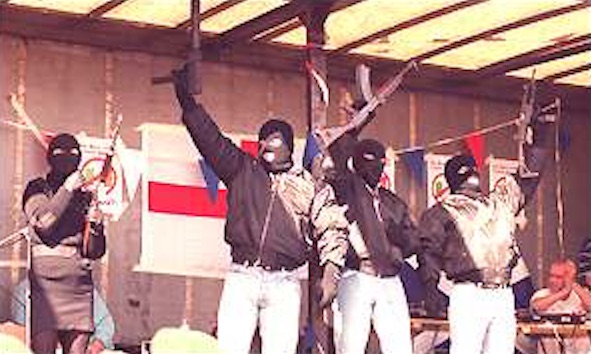
In the dock: Winston Churchill Rea (aka Winkie Rea), at the opening of his trial at Belfast Crown Court on Monday
Michael Donnelly
November 25 2020 07:27 PM
Innocent Catholics were considered legitimate targets by roving loyalist gunmen because they had supposedly contributed to the coffers of the IRA, a loyalist paramilitary leader allegedly confessed on tape.
The tape, one of seven, was allegedly made by one-time Red Hand Commando head Winston Churchill Rea, for the so-called ‘Belfast Project’.
The project saw former loyalist and republicans allowing themselves to be interviewed by the Boston College about their terrorist past.
At one stage the 69-year-old also allegedly claimed there was a time when “buck-shee” Army privates handed over their SLR weapons to loyalist gunmen to fire into Catholic estates, as long as they provided their own ammunition.
The tapes, which were supposedly to remain confidential until his death, form the backbone of the prosecution case against the pensioner and the 19 offences he faces, allegedly committed between 1973 and 1996, including involvement in murder.ADVERTISING
The prosecution at his Belfast Crown Court Diplock-style, non-jury trial claim that Mr Rea, who alluded on tape to his identity as “Winston Winkie Rea”, is the person designated as “Interviewee L” and who confessed to the terrorist crimes he denies.
On Wednesday, during one tape section, ‘L’ was asked about the strategies of the RHC in the opening days of the Troubles between 1971 and 1972, to which he replied it was “his belief, if there hadn’t been a Protestant/loyalist backlash”, they would have been “driven into a United Ireland”.
He said “back in them days” the RHC, who were “prepared to enter enemy territory”, regarded ordinary Catholics as legitimate targets because they were seen almost every day, putting money into the “wooden collection boxes” of the IRA at the chapel gates as they left Mass.
Loyalists felt those monies were used to buy guns and bullets and the “Red Hand viewed those people contributing … were just as guilty as those who pulled the trigger”.
‘L’ went on to explain that while they much preferred to target and kill actual republicans because of the publicity from their IRA televised funerals, which provided “a moral-boost”, to the RHC leadership “the killing of ordinary Catholics was very much viewed as still part of the strategy”.
And with regard to the loyalist community, to ‘L’, they were “very much 100% behind us … no doubt about that”. The speaker said that doors in loyalist areas were always “left open for you”, and that “without the support of the community, you didn’t stand a chance”.
Later in that first interview, ‘L’ confided that when troops were initially deployed, “obviously the soldiers would have been favourable to loyalists”. He further claimed “so much so” soldiers had “no hesitation” in handing over their SLR weapons to loyalist gunmen to fire into Catholic housing estates.
The soldiers, who had to account for their ammunition, only handed over their rifles if the gunman could provide the correct ammo and ‘L’ even claimed to have witnessed it with his “own eyes”.
However, the speaker said this happened only between individual soldiers and loyalist gunmen, and that it was “just something” that came from privates themselves, “from the buck-shee privates”, it was “nothing orchestrated, it was just something, not from the top”.
Things changed, however, when that particular unnamed regiment was moved to be replaced by 2nd Para, and while there was still “a bit of a relationship” it was not the same.
‘L’ explained that 2nd Para operated a more “neutral” policy whereby “if loyalist broke the law they would come down hard on them and if republicans broke the law they would come down hard on them”.
The trail, of Mr Rea, AKA ‘Winkie Rea’, from the Springwell Road, in Groomsport, Co Down, continues.
The charges he denies include aiding and abetting, and conspiring to murder Catholic men John Devine in July 1989 and John O’Hara in April 1991.
Membership of the Red Hand Commando, aiding, abetting and conspiring to murder Catholics and conspiring to threaten to kill LVF leader Billy Wright in August 1996.
He has also pleaded not guilty to attempted murder and other terror-related charges, including conspiring to possess firearms secured from the Ulster Resistance paramilitary group on dates between November 1986 and October 1994.
London’s ‘deliberate decision’ not to launch independent inquiry ‘is a public breach of faith,’ says congressman.
Britain’s Secretary of State for Northern Ireland Brandon Lewis is due to make a decision on whether to launch an inquiry into Finucane’s murder by the end of the month | Andy Rain/EFE via EPA
U.S. lawmakers called on the U.K. to establish an independent inquiry into the 1989 murder of human rights lawyer Patrick Finucane, in a letter sent to Prime Minister Boris Johnson.
“The British government’s deliberate decision not to proceed with an independent, judicial inquiry into the Finucane murder — an unfulfilled commitment of the peace process — is a public breach of faith,” said Republican Congressman Chris Smith in a statement that accompanied the letter, signed by 24 bipartisan members of Congress.
Finucane, a Catholic solicitor, was murdered during the Troubles, the three decades of violence that left more than 3,500 dead. Finucane’s clients included suspected Irish Republican Army members, and there have long been allegations that some in the U.K. security forces colluded in the killing.ADVERTISEMENT FROM EVERBRIDGEabout:blankSCROLL TO CONTINUE WITH CONTENT
According to recent reports, Britain’s Secretary of State for Northern Ireland Brandon Lewis is due to make a decision on whether to launch an inquiry into Finucane’s murder by the end of the month.
The letter states: “U.S. legislation urging your government to recognize the overwhelming public interest in a ‘true,’ independent, judicial inquiry has been enacted and/or passed the House of Representatives on four separate occasions … Several years after former Prime Minister David Cameron acknowledged ‘shocking levels of collusion’ — and issued an apology to the Finucane family — we remain astounded that the British government has refused to live up to its responsibility, and is violating its commitments to establish the inquiry.”
Democratic Representative Richard Neal, another of the signatories of the letter, said in a statement: “I continue to believe the Finucane family has a right to truth and justice … They deserve to know what happened in February of 1989 and the level of state collusion into the murder of their husband and father. This letter is calling on the British government to be accountable.”
The letter comes amid mounting pressure for an inquiry. Wednesday, Amnesty International U.K. wrote to Lewis to ask him to open an independent investigation. Micheál Martin, the Irish prime minister, said on Tuesday that the British government “should and must” conduct a public inquiry.
To support the empowerment of the bereaved and injured of the conflict to realise improved health and wellbeing, and full and equal participation at every level of our post-conflict society
Relatives for Justice Mission
Building and providing access to safe, integrated and professional services and programmes of support for the bereaved and injured of the conflict
Contributing to the health and wellbeing of victims and survivors
Realising empowerment through building skills, confidence and self-awareness
Encouraging the bereaved and injured to realise their role in peace building and processes designed to deal with the past
Investing in Relatives for Justice through training and sustainable partnerships
Relatives for Justice Aims
To provide a safe space for the bereaved and injured of the conflict
To provide professional, appropriate and development based individual, family and group support for the bereaved and injured in an holistic, integrated fashion
To develop and deliver said support in partnership with other professional organisations where appropriate
To support the bereaved and injured to tell their story and document their experiences
To build awareness and foster an understanding of the specific experiences and needs of the bereaved and injured of the conflict in a transitional context
To contribute to the search for truth, highlight injustice and contribute to a culture of human rights
To support families engaging with relevant processes to deal with the past including legal processes
To liaise with domestic and international human rights NGOs, government bodies and other international organisations in the furtherance of the realisation of the rights of victims and survivors of the conflict
Relatives for Justice Core Values
An active commitment to universal human rights and social justice
The promotion of equality and respect for the background, diversity and experience of all those bereaved and injured by the conflict
The application and development of the highest standards of professional support programmes for victims and survivors of the conflict
The promotion of recognition and remedy for the specific gender harms and experiences of the bereaved and injured of the conflict
Eligibility
Relatives for Justice only supports victims and survivors of the conflict in its work. Eligibility for services is determined at initial contact and evidence retained.The Work of Relatives For JusticeRelatives for Justice (RFJ) was founded in April 1991 when a number of bereaved families affected by the conflict came together to support one another. Instrumental in the formation of the organization were key figures that had, on a voluntary basis, been active for the previous 2 decades such as Monsignor Raymond Murray, Clara Reilly, Peter Madden, the law practice partner of the late Pat Finucane, and the late human rights lawyer Rosemary Nelson both subsequently murdered. RFJ is one of only a few organizations operating on a regional basis across the North and on an all island basis.Relatives for Justice is a world recognised NGO working with and providing support to relatives of people bereaved, and injured, by the conflict across the North of Ireland including border regions in the 26 counties.We assist and support families coping with the effects of bereavement through violence and the resulting trauma. We have offices in Belfast, Dungannon and 5 regional outreach centres.RFJ identifies and attempts to address the needs of those who have suffered loss and injury; this is achieved through one to one contacts, self-help, group support, outreach and befriending, counselling support and therapy work, welfare and legal advocacy.As relatives and survivors we all need to have our experiences heard and valued. In terms of conflict resolution this will also allow those most marginalised to realise the pivotal role and vital contribution that they bring to the creation of a new society based upon equality, respect and above all where human rights are secured.This work highlights and attempts to address outstanding human rights abuses. Our primary objective in this area of work is to assist in the bringing about of a more human rights-based culture in order to safeguard and protect human rights for all.
Tipperary will wear replicas of the original green and white jerseys worn on November 21, 1920, when British forces opened fire during a challenge match between Dublin and Tipperary.
Shane O’Brien@shamob96 Nov 09, 2020Orignal jersey worn by Tipperary (right) on Bloody Sunday, 1920.
Tipperary’s Gaelic footballers will wear special commemorative jerseys marking the centenary of Bloody Sunday in their Munster final clash with Cork on November 22.
The Tipperary County Board confirmed that Tipperary’s footballers will wear a special replica of the original green and white jersey worn on November 21, 1920, when British forces opened fire during an exhibition match between Dublin and Tipperary, fatally wounding Tipperary player Michael Hogan and 13 others.
The Tipperary County Board had initially planned to use the jerseys in a special commemorative match between Dublin and Tipperary that would only last 48 minutes and start from the 12th minute; when the shooting started on that fateful day.
However, the COVID-19 pandemic halted the GAA calendar, meaning that games that would normally take place over summer were rescheduled for winter and Tipperary will now instead mark the 100th anniversary of Bloody Sunday in a Munster football final.
In a statement, the Tipperary County Board said: “It is only fitting that the Tipperary team will wear the official replica green and white jersey as worn by Tipperary on that eventful day as a mark of respect to all of the fallen.”
The statement added: “The Tipperary players and management of 2020 are honoured to wear the official replica green and white jersey in this year’s Munster Final and play their part in marking this historic anniversary event.”
Teneo, the county’s shirt sponsors, has agreed to forego their name on the front of the commemorative jersey to add authenticity, while the replica jerseys will also feature an image of Michael Hogan along the sleeve.
Teneo Chairman and CEO Declan Kelly said that he was honored that his company was associated with the Tipperary Senior Football team as it marks the centenary of one of the darkest days in Irish history.
Kelly also said that he was proud of the Tipperary team for making their first Munster final since 2016.
The Premier County narrowly beat Clare and Limerick to book a place in the provincial decider later this month, where they will attempt to clinch their first Munster title since 1935.
Dear Member of the Family of the Archdiocese: It is time for me to give you another update on the Archdiocese of New York and its response during this coronavirus pandemic, and let you know what’s been happening regarding our efforts to combat the sin and crime of the sexual abuse of minors. I did a similar update a number of months ago, and you let me know you found it helpful. Let me begin by recognizing our parishes and priests who did an outstanding job meeting the pastoral and spiritual needs of the people, even while public celebrations of the Mass were put on hold. Many began livestreaming their parish Masses, so that people could join together in prayer. While the livestream from Saint Patrick’s Cathedral was very popular – the Easter Sunday Mass livestream and broadcast reached over 2 million people! – many people have told me that they preferred to tune in to their local parish, because that, to them, is “home.” Since public celebrations of Mass and the sacraments have resumed, our churches are carefully following all health and safety guidelines, and Mass continues without any virus outbreaks. Our pastors tell us that attendance is increasing weekly. Our Catholic schools deserve praise as well. When the pandemic hit last March, our teachers, principals, pastors, staff, and students all quickly pivoted to on-line learning, and finished the school year in remarkable fashion. That was impressive, and those involved had certainly earned a restful summer break. Instead, everyone buckled down, and began to prepare for a September return to the classroom. Rather than beaches and pool-sides, our wonderful faculty and administrators began to formulate plans for safe, smart, and creative ways to teach in this age of Covid-19. After more than two months, the results have been remarkable, and could easily serve as a role model for other school systems. That we were back with schools safe and open right off the bat was a big plus, and enrollment has even risen since September. We mustn’t forget the tremendous work done by Catholic Charities of the archdiocese in finding new and innovative ways to respond during this pandemic. Residences for those with disabilities remained open, and staff were provided with PPE. In addition to regular food programs, pop-up pantries provided nutritious food in the New York City and Hudson Valley neighborhoods, often at parishes. Over 1 million meals have been distributed since March. Calls for help, more than 22,000, were answered remotely by dedicated Catholic Charities staff. Generous private donors enabled more than $4.5 million in emergency cash assistance to be distributed to families ineligible for other forms of assistance. Other services for children and youth needed to be adjusted, to allow for social distancing, but tens of thousands of New Yorkers continue to receive assistance amidst the pandemic. ArchCare, the health care ministry of the archdiocese, has been a leader in the community with its response to the pandemic. Initially, the lack of testing and PPE impeded its response. But those issues have long been resolved and the system made many enhancements that demonstrate how well they can prevent the spread of the virus. Through a program called “Protect,” ArchCare has been increasing its infection control staff and training, enhancing its protocols and policies and invested in new equipment and technologies. Although it has been difficult to make such investments during an economically challenging time, ArchCare is committed to be well prepared in case of a resurgence of the virus. Improvements and reliability in testing have ensured the safety of limited visits to the facilitates and support the well-being of families and residents during this difficult time. Special attention and care of the system’s 4,300 dedicated employees has also been a priority in ensuring their safety and well-being. The quality care and services ArchCare is privileged to deliver because of its Catholic mission is needed today more than ever. Let me now update you on the ongoing efforts to respond to sexual abuse. Sorry to bring it up, but, again, you tell me you would rather hear it from me. In September, 2019, Judge Barbara Jones and I held a press conference to release her findings and recommendations on how well this archdiocese was living up to its promises in responding to the nauseating horror that is sexual abuse. You may recall that Judge Jones and her firm, Bracewell, spent a year carefully examining our priest files, studying our policies, procedures, and protocols, and interviewing archdiocesan staff, and concluded that, thankfully, the archdiocese, “faithfully followed its policies and procedures and responded appropriately to abuse complaints, and is committed to supporting victims-survivors of abuse.” She also made some helpful recommendations on how the archdiocese might do even better. We have made good progress on implementing Judge Jones’s recommendations. Highlights include:
An Administrator has been appointed for our Archdiocesan Review Board, Kevin Reynolds, an attorney who most recently served as senior vice president, human resources and chief legal officer of a major life insurance company
A new, outside, professional, firm with a more diverse background and investigative experience has been retained to investigate allegations of abuse.
New members have been added to our Lay Review Board, including a psychiatrist who is board certified in both child and adolescent psychiatry and adult psychiatry, and a federal judge.
An electronic case management system has been installed, to track every sexual abuse complaint from first report through final resolution.
In addition, we have further delineated the responsibilities for our Safe Environment Director, Victim Assistance Coordinator, and Administrator of the Review Board, to avoid the possibility of something “slipping through the cracks.” I have asked Judge Jones to give us a check-up to assess our progress on following through on her recommendations, and I will keep you posted on her findings. Our commitment to transparency, accountability, and action continues. Following our annual audit conducted by StoneBridge Partners, the archdiocese was once again found to be in compliance with the Charter for the Protection of Children and Young People of the United States Conference of Catholic Bishops, as we have every year since the first audit in 2003/2004. As has been the case for quite some time, the claims of abuse that are being filed against the archdiocese, mainly through cases filed under the Child Victims Act (CVA), deal with actions that allegedly took place many years, often decades ago. There have been no substantiated claims of abuse concerning acts alleged to have occurred recently. There is no priest or deacon of the Archdiocese of New York currently serving in public ministry who has a credible and substantiated claim of abuse against him. And, our Independent Reconciliation and Compensation Program, begun in 2016, continues to offer a compassionate response to those who seek it out, having come to resolution with more than 300 cases thus far. While this is reassuring, we must continue to be vigilant in meeting this scourge head-on. We must also recognize that the road ahead will continue to be challenging as the remaining Child Victims Act cases are filed. John Cahill, our Chancellor, has provided me a snapshot of where we stand with the CVA cases. It’s sobering. Here is how he summed it up:
On February 14, 2019, Governor Cuomo signed the Child Victims Act into law. The CVA enlarged the statute of limitations for civil litigation related to claims of child sexual abuse, and created a limited “look back” window suspending the applicable statute of limitations.
The CVA “look back” window was initially set to last one year, from August 14, 2019 to August 14, 2020. In May 2020, the legislature voted to extend the window for an additional 1-year period, and Governor Cuomo signed the 1-year extension into law in August 2020. The window is now set to close on August 14, 2021.
This law will have a major impact on our archdiocese as we move forward.
Like many other secular and religious institutions, we have been served with hundreds of suits related to CVA claims, some going as far back as the 1940s.
The Archdiocese and its parishes, schools, and charities has selected strong legal counsel to represent them in these cases.
The Archdiocese purchased comprehensive insurance coverage over most of the alleged time period, with Chubb being the primary insurance carrier from 1956 – 1996.
For victim-survivors who have waited for justice, the Archdiocese is committed to assisting the courts with the prompt resolution of claims which are meritorious under the law and to the litigation of other claims to determine their validity.
Please bear in mind that these lawsuits are not limited to priests, as a number of lay people – foster parents, coaches, or teachers, for instance – are identified as alleged abusers and that some individuals are named in multiple lawsuits, including claims against alleged abusers over whom the archdiocese had no control or no prior claims.Regardless of who the accused was, though, the archdiocese remains committed to responding with compassion, respect, and understanding. We are also still waiting for the release of the so-called “McCarrick Report” by the Holy See, detailing the damning story of former-cardinal Theodore McCarrick. That could be another black-eye for the Church. But, better that the story come out, in all its awful detail, to both bring some measure of peace to the victim-survivors, as well as serve as a lesson on how to prevent a similar recurrence in the future. We can thank Pope Francis for keeping his promise to undertake and release this report. Let me conclude with a word about archdiocesan finances. As I’ve mentioned in previous letters, the archdiocese faces some significant financial challenges. Thanks be to God, your generosity to your parishes continues to be strong, and almost all of our parishes now have ways for people to give electronically through We Share – online giving, which has been a big help; if you haven’t yet signed up to support your parish in this way, please give it serious consideration. Still, parish income continues to be less than it was a year ago, and our Cardinal’s Annual Stewardship Appeal and other fundraising efforts will all likely fall short of last year’s total. Add to that increased need from our parishes, schools, and charities, along with other mounting expenses, and it is not difficult to understand the uphill climb ahead of us. I’ll continue to keep you informed. Might I ask for your prayers, for those continuing to suffer the effects of the coronavirus that they may have a return to health, those victim-survivors of sexual abuse that they might find peace and reconciliation, those of the archdiocese, particularly its clergy, who work every day to serve you well and faithfully, and, finally, during this month of all souls, all those faithful departed still in purgatory, that through God’s mercy they might soon be with Him for all eternity in Heaven. With gratitude to you, and prayerful best wishes, I am, Faithfully in Christ,
Timothy Michael Cardinal Dolan Archbishop of New York