With the Tories’ new Brexit negotiator David Frost adopting what some see as a wrecking-ball approach, European frustration with an increasingly intransigent UK is being shared by Dublin
Aiden Corkery. Sunday Business Post. Dublin. Sunday, March 7, 2021
Two short months ago, Brandon Lewis appeared as a guest on BBC Radio Ulster with a positive New Year’s message.
Despite the Northern Ireland protocol being implemented on January 1, Britain’s Secretary of State insisted that any talk of there now being a border in the Irish Sea was misleading and that goods were flowing freely between Britain and Northern Ireland.
“I think people will see, as things settle down, that things will flow as they did in 2020,” he said.
On Friday, Lewis struck a markedly different tone in an opinion piece in the Daily Telegraph. From his discussions with Northern Irish businesses, it was increasingly clear that steps needed to be taken now to avoid “significant” and immediate disruption to everyday life in the North, he wrote.
“These are serious issues, like the availability and cost of products in Northern Ireland supermarkets and the ability of people of Northern Ireland to receive online deliveries, which have become so crucial to us all during the pandemic,” he added.
So serious had the situation become, in London’s view, that it had left the British government with no option but to unilaterally announce that it was extending the grace period for checks on agri-food products entering the North to October 1, far beyond the deadline previously agreed with the EU of April 1.
The government also signaled that it would be announcing similar extensions to the requirement for customs declarations on parcels traveling to the North, as well as an extension of the waiver on goods with soil attached, such as plants, seeds, bulbs, vegetables, and agricultural machinery.
For Maroš Šefčovič, the vice-president of the European Commission, who leads the EU’s negotiations on the Northern Ireland protocol, the announcement was a serious affront.
The experienced Slovak had been lobbying EU member states and influential MEPs to agree to some sort of relaxation of the onerous additional checks that were soon to be applied to goods crossing the Irish Sea.
Many were dubious. Britain has been regarded as less than enthusiastic in meeting all of its requirements under the Northern Ireland protocol, such as giving EU customs officials access to its IT systems for Belfast and Larne ports and hiring veterinary staff to sign export health certificates for animal products.
Over the course of countless phone calls, sources say Šefčovič had succeeded in assuring an often skeptical audience that the British could be trusted to do what was required. “They were on board,” a Commission source told the Business Post.
It was even suggested that had London not acted so hastily, it would have got Brussels to agree to much of the leeway it was looking for on the protocol.
“It’s being seen as a big two fingers [i.e. the Middle Finger] to the EU. Now the parliament and member states are up in arms and want us to go ahead with legal action. The goodwill is gone,” the source added.
This frustration with London is also shared in Dublin. Just like Šefčovič, Simon Coveney, the Foreign Affairs Minister, and Irish diplomats had been attempting to reassure their counterparts that extensions should be given.
Given that the mood music coming from Brussels was positive, many are now asking why Britain would antagonize the EU and Ireland so spectacularly and sully its own reputation by going it alone.
And some are blaming David Frost, Britain’s former chief Brexit negotiator, who was recently parachuted into the House of Lords so that he could take up a position as a cabinet minister in charge of implementing the EU-UK trade deal.
The change in atmosphere since Frost’s appointment has been stark. While his predecessor in the role, Michael Gove, was a fervent Brexiteer, he was also considered a pragmatist who had struck up a warm working relationship with Šefčovič.
The contrast in the two men‘s approaches is manifested in how the change in British policy was announced before Frost had even picked up the phone to Šefčovič for the first time in his new role. This was not, it is being privately suggested, the opening gambit of someone intent on a diplomatic approach.
Some in Brussels and Dublin see a repeat of the wrecking-ball approach adopted by Britain when Frost led the Brexit talks last autumn, during which Britain also threatened to break international law with its Internal Market Bill.
Rather than announce a shared breakthrough with Brussels, the suspicion is that the British decided to claim the victory for itself while being lauded by the Tory press for standing up to Brussels, while also easing unionist concerns in the North.
Neale Richmond, Fine Gael’s spokesman on European Affairs, said it was easy to recognize Frost’s approach.
“If you look back at Frost’s track record through September, October, November, it’s kind of a carbon copy of the chaos theory, blow-it-up approach,” he said.
While businesses in the North are currently relieved that the ratcheting-up of customs checks has been averted past April 1, Richmond said the medium and long-term consequences will be far more damaging.
Many years of tough negotiations are due to take place between the EU and UK but the people of Northern Ireland could be caught in the crossfire, he said.
London, naturally, insists that the EU and Ireland’s take on what happened last week is wrong. Sources have told the Business Post that it had been doing its best to follow the terms of the protocol, including doubling the number of veterinarians to complete export health certificates.
Suggestions that a deal was close to being agreed with the EU were far from accurate, they added, leaving the UK being left with no choice but to unilaterally announce an extension of the grace period on Wednesday so that Northern Irish businesses and British exporters would have time to prepare.
The British also point to the tensions that were building among the unionist community, which had ramped up significantly in the wake of the EU‘s brief invoking of Article 16 last month in a bid to block Covid-19 vaccine exports.
Taking action now to ease unionist concerns was important before they threatened to spiral out of control, the British have insisted, something which could have had very real consequences for next year’s Assembly elections in Northern Ireland as well as the vote to continue with the protocol in 2024.
Potentially damaging
Some in the Commission are doubtful about whether the parliament would take such a potentially damaging step as to vote down the Brexit deal, given how long and torturous its negotiation was and how costly it would be for both sides if it fell apart.
There is a sense, however, that the EU is determined to push ahead with taking legal action against Britain, with the expectation that this could happen as soon as this week. “We’re not going to sit on this for ages,” the Commission source said.
As part of this process, the EU will send a letter of formal notice to Britain outlining how it believes it has breached the protocol. The British will be given two months to act – if the EU is unhappy with its response, it will issue London with a “reasoned opinion” as to why it believes it has broken the law and will give it a further two months to rectify the situation.
If Britain still hasn‘t made amends by this point, the Commission will almost certainly refer the matter to the European Court of Justice, which has the power to impose a substantial fine on London.
Should Britain ignore the court‘s ruling, the matter can be passed to an arbitration panel as outlined under the terms of the Withdrawal Agreement signed by the EU and UK in 2019. It can also impose fines or ultimately allow the EU to impose tariffs on British imports, a nightmarish scenario for Ireland which still trades a significant amount of goods with the UK.
Although the Irish government would still like to see this latest resolved through dialogue, there is a sense of resignation that legal proceedings are now inevitable given the EU‘s deep frustration with Boris Johnson’s government.
With both the EU and UK showing no sides of stepping back, the Irish know they will have to get firmly behind Brussels.
“We are like the child of a divorce here, but ultimately Ireland can‘t be seen to be offside with the EU,” a government source said.
The pressure is also being increased on Britain from across the Atlantic, with Joe Biden’s spokeswoman Jen Psaki reiterating his warning that nothing should be done to undermine the Good Friday Agreement.
The sentiment is shared on nearby Capitol Hill. On the same night, Brendan Boyle, the Irish-American congressman, told BBC’s Newsnight that as a member of the Ways and Means Committee, he would not rubber-stamp any future trade deal with UK that threatened the peace process.
Boyle is a leading member of the Friends of Ireland caucus, which is made up of members of the US senate and house of representatives. The founder and president of the caucus, Fr Sean McManus, was clear in his view that Britain should not think it can renege on its commitments.
“It’s time the British government realized the empire no longer exists and they can not keep being perfidious Albion, reneging on and retreating from agreements as they have done historically,” he told the Business Post.
Not only has President Biden put the British government on notice, but Nancy Pelosi, the speaker of the House of Representatives, and Richard Neal, the chairman of the Ways and Means Committee, have also done so.
Fr McManus added that in the wake of the storming of the US Capitol on January 6, the American public, in general, had become more hostile to the sort of English nationalism espoused by Boris Johnson.
“People are beginning to understand right-wing nationalism because they’ve seen it happen here with Trump,” he told the Business Post. “They’re very aware that Brexit is all about English nationalism.”
Hockey Fights Cancer Night: Virtual Chat with Eddie Olczyk Presented by Northwell HealthOn behalf of the New York Rangers, Madison Square Garden and the Garden of Dreams Foundation invites members to attend the Rangers virtual Hockey Fights Cancer Webinar on Tuesday, March 16, 2021 from 5:00 PM – 5:30 PM. If you would like to participate in this virtual event, please register in advance of the event at the link listed below and choose ‘Garden of Dreams’ from the Affiliation list. https://msg-wmzqo.formstack.com/forms/chat_with_eddie_olczyk About the Webinar:Four years ago, Eddie Olczyk was in a fight for his life. He was diagnosed with Stage 3 Colon Cancer in 2017 and went under heavy chemotherapy immediately. With support of family, doctors, the hockey community and NHL fans, the commentator and member of the Rangers ‘94 Stanley Cup Team beat the disease. Helping those who are fighting cancer is now a big part of Olczyk’s life and he’s helping the NHL with their “Hockey Fights Cancer” initiative. Join Eddie, the New York Rangers and Northwell Health to hear his story about beating the odds.
Burning Issues: Online Support Group for FDNY Virtual meetings every Monday from 10:00 AM – 11:00 AMBurning Issues is a confidential, firefighter-led drop-in support group serving active and retired New York City firefighters. The group meets every Monday from 10:00-11:00 AM. At the helm is Victor D’Aquino, a 26-year veteran of the New York City Fire Department. Burning Issues is supported by the Center for Human Development and free of charge for active and retired FDNY firefighters. For more information and to receive the Zoom link, please contact Friends of Firefighters at 718-643-0980 or email info@friendsoffirefighters.org.
On the 40th anniversary of the 1981 hunger-strike, John McNally from California tells the remarkable story of Dr Frank Forster who was persecuted in the United States for supporting the Irish prison struggle
AN Irish-born physician in Southern California was arrested as an alleged felon on the eve of Queen Elizabeth’s visit to Santa Barbara in 1983. Dr. Frank Forster was singled out because US President Ronald Reagan had invited the Queen to his Western White House, and it was feared the outspoken Irish Nationalist had planned a protest.
Using methods deemed illegal today, law enforcement went to extremes to entrap the doctor. His medical offices were bugged, and undercover officers posing as patients attempted to trick the doctor into illegally prescribing drugs. Dr. Frank Forster was charged with 18 felonies in a chilling case of persecution and injustice, bureaucratic bungling, and malice.
Born in 1928 in Tipperary, Ireland, Francis John Patrick Forster won a scholarship to University College Dublin in 1947 and graduated in 1954 with a Doctoratus in Medcina (MD). After working for several years in a hospital in London, England, and three years as a captain in the Royal Army Medical Corps with the British Army in Germany, he emigrated to the United States in 1965 and became a US citizen. Frank settled in Santa Barbara with his wife Maidie and three children, where he was a popular and well-respected physician of internal medicine.
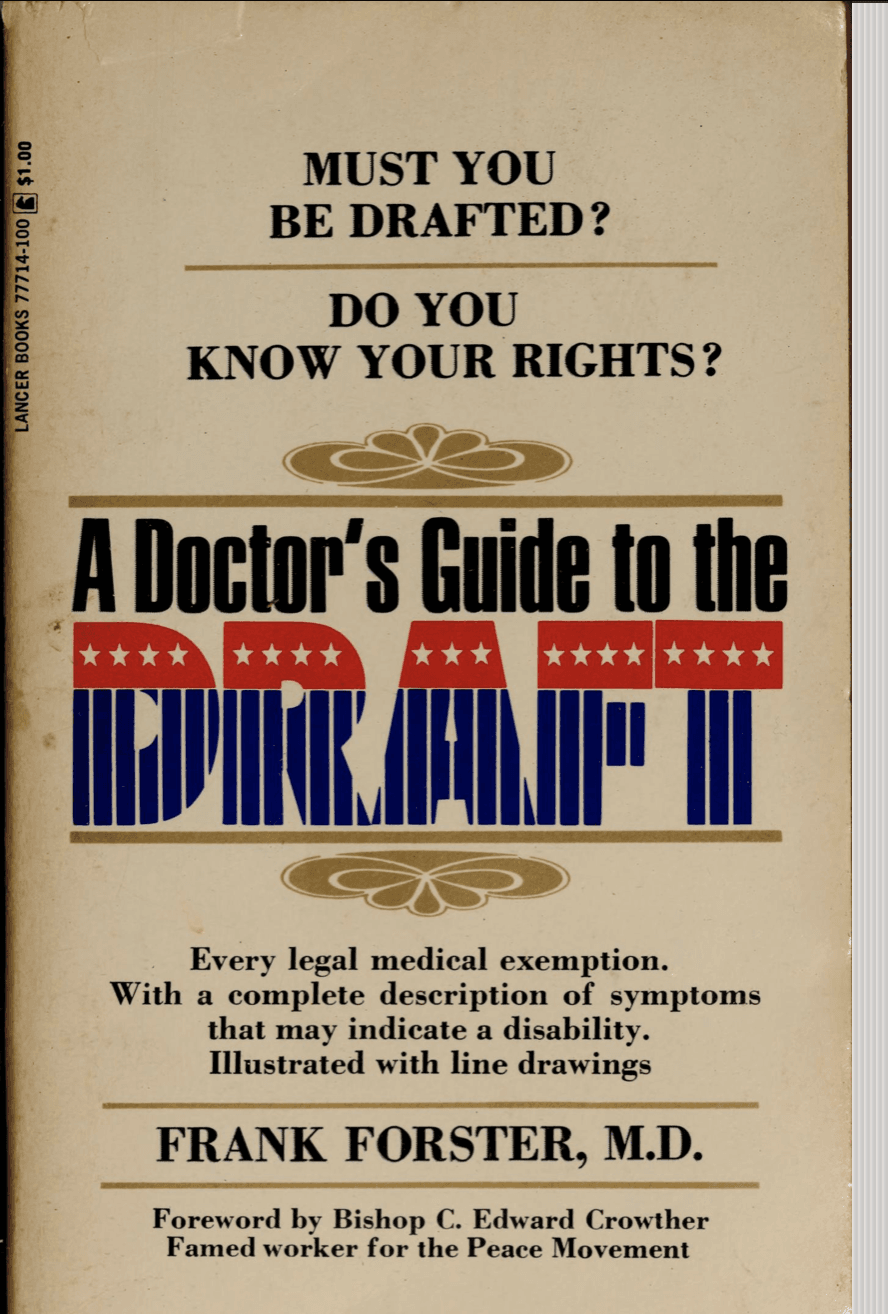
During the Vietnam War, Frank observed young men being drafted who could have received medical deferments. So, in 1970, he published A DOCTOR’S GUIDE TO THE DRAFT explaining the legal, medical exceptions to the Selective Service in easy-to-understand language, which he claimed saved thousands of young men’s lives. This made Frank unpopular with the conservative ruling class that cities like Santa Barbara have under their facade of liberal politics.
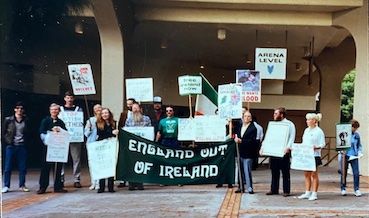
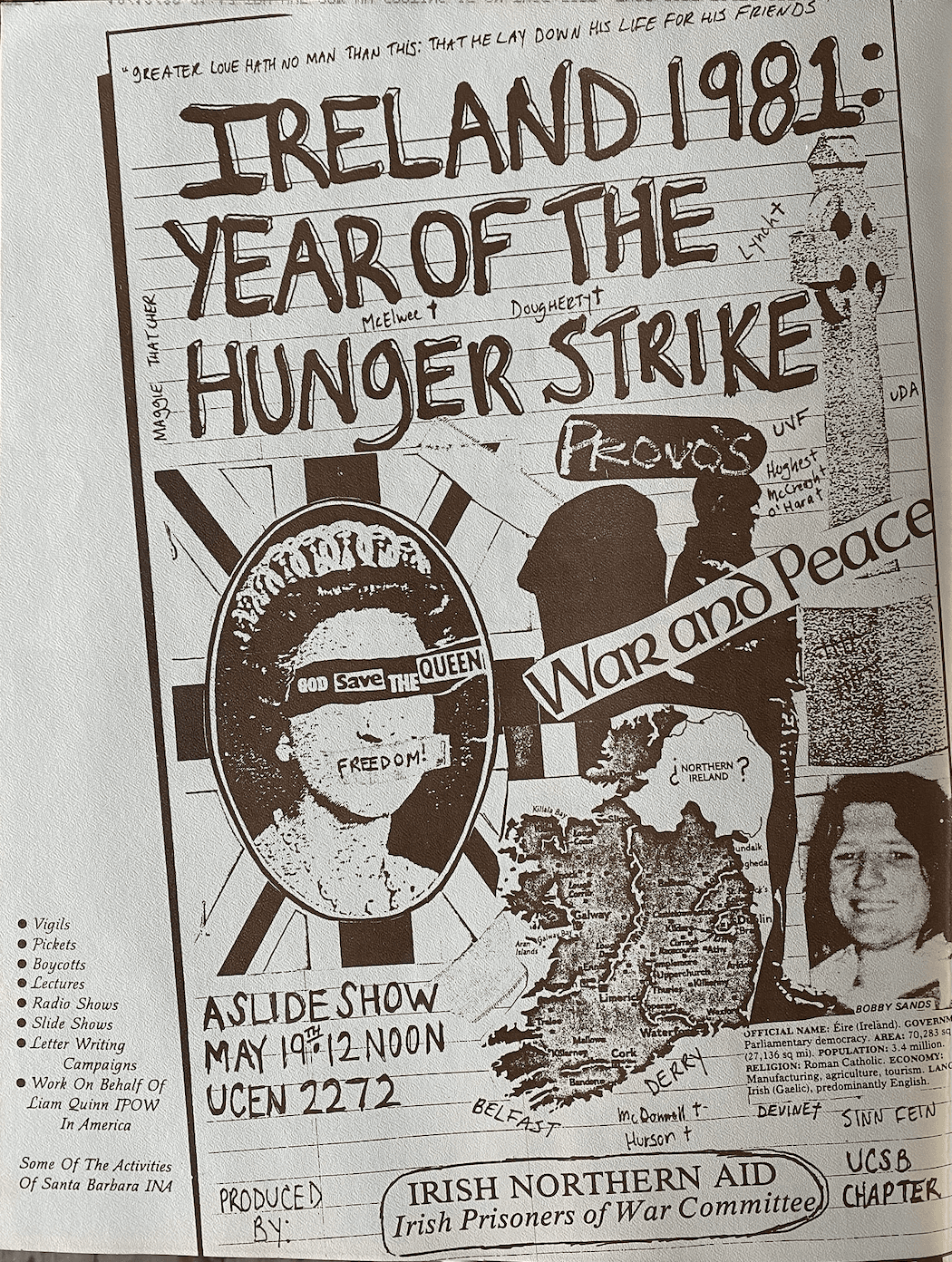
After Bobby Sands died on hunger strike, Frank started an Irish Northern Aid chapter in Santa Barbara to counter British propaganda by informing his fellow Americans of the true nature of the Anglo-Irish conflict and Irish political prisoners’ suffering. He ran an ad in the local paper using ‘Captain Moonlight’ as his nom de guerre and quickly had over 100 members and supporters. Dr. Forster was an effective writer and compelling speaker, holding numerous public talks, promoting letter-writing campaigns, guest spots on local radio shows, and led protests outside British-owned businesses. On Tuesday evenings, he hosted Irish language classes at his Junipero Street home.
Frank was most pleased with his Irish Northern Aid Saint Patrick’s Day blood donation drive in 1982, netting 27 pints of blood and the party that night at his house, which attracted scores of guests. During Frank’s initial legal proceedings, as many as 200 supporters crowded into Santa Barbara’s courthouse to whom Forster, wearing his Easter Lily pin, would address in Irish.
Ronald Reagan’s election in 1980 as president saw Santa Barbara teeming with Secret Service agents. Frank was at the top of the list of security risks whenever President Reagan was in town, and it wasn’t unusual to discover the guy next to me at the bar was an agent.
After one of many letters to the editor penned by Frank condemning the British injustices in the North of Ireland, he was warned by a writer for the SB News-Press that someone at the Sherriff’s office was out to get him. The police and courts, the real levers of power, were staunch conservatives who targeted Forster for his liberal politics but claimed their investigations of the doctor were merely coincidental. Years later, I asked a senior Santa Barbara police official why they went after Frank Forster. He said the word on the street was the doctor gave narcotics to anyone in a response typical of upholding the police blue line. The primary local orchestrator of the conspiracy against Frank was Santa Barbara County Sherriff John Carpenter, whose obituary states, “one of the highlights of his career was the time he spent getting to know Former President Ronald Reagan while providing security at the Reagan Ranch.” Forster had been under investigation for over two years before the Queen’s visit, so although the catalyst for his arrest, they were already out to get Frank who had long been a vocal supporter of liberal causes. In 1980 the Sherriff and the Medical Quality Assurance Board repeatedly sent undercover agents into Dr. Forster’s medical office posing as patients attempting to trick the doctor into illegally prescribing drugs using deceptive undercover tactics that today are expressly illegal. The unsubstantiated arrest warrant was signed by one of California’s worst Judges, according to an investigative magazine California in 1984.
And District Attorney Tom Sneddon (who also failed to convict Michael Jackson) was relentless. The case against Dr. Forster was so weak his defense attorney used the undercover agent’s own recordings to prove his innocence. Frank won each case, but the District Attorney appealed, sending the doctor to three courts for over two years. After his arrest, Frank hired an electronics expert to sweep his offices for bugs, and two sophisticated devices were found of the type not generally used by local law enforcement, the expert told him. These were the ones the CIA and FBI employ.
The Medical Board took Dr. Forster’s name off the list of doctors who receive referrals and put him on a list of doctors who had “Accusations” against them, making his career in medicine tenuous. An Irish-speaking spy infiltrated his Irish Northern Aid Chapter. The Immigration and Naturalization Service questioned his son Peter’s citizenship status, and a car tried to run Frank down when leaving his office one evening. His private practice closed because he had to spend so much time in court. He used up his retirement savings and had to sell his house to pay attorney’s fees, and the only job he could find was at a prison hospital over 100 miles from Santa Barbara. But still, the DA and Medical Board hadn’t completely cleared Forster, possibly to frustrate Forster’s counter lawsuit.
The winter of 1983 was one of the worst on record, and Santa Barbara’s harbor silted up, preventing the Queen’s yacht Britannia from entering. Low clouds full of rain minimized visibility to where she couldn’t see the lovely coastal mountains for which Santa Barbara is famous. Nevertheless, Reagan insisted she makes the harrowing drive up a windy road in the middle of a downpour to his Rancho del Cielo (Ranch in the Sky).
Although under investigation for years, Frank’s arrest a few weeks before the Queen’s scheduled visit in 1983 was probably to thwart any embarrassment to President Reagan from protesting Irish radicals.
No protests were planned for the Queen in Santa Barbara anyway, Frank organized a vigil outside the Sheraton Hotel where the press were staying to demonstrate to the news media the bias of the reporting on the Anglo-Irish conflict. But this, too, was pretty much a wash-out because of the torrential rain. Helen Thomas from UPI felt sorry for Frank and invited him in for a cup of coffee.
Forster sued the US Government for $10,000,000, was offered a $50,000 settlement which he turned down, and in the end, lost his case because he missed a filing date, according to his son Peter.
Soured by the experience, Frank left public politics but continued to show support for the Irish people. In 1992 he took out a full-page ad in the Irish American Unity Conference’s program for our annual convention in which Bruce Morrison was a keynote speaker. Morrison played an integral part in President Clinton’s involvement in the Irish Peace Process, and we hope President Biden selects him to be our US Special Envoy to Ireland.
As a lifelong member of Alcoholics Anonymous, he helped hundreds of others obtain sobriety, but Frank was, unfortunately, a smoker, dying of emphysema at his home in Ojai, California, in 2004. His family spread his ashes in his favorite place in Ireland, Miltown Malbay’s Spanish Point.
By Sean Bresnahan (seanbres.wordpress.com)In South Armagh Republican folklore, the lives and tragic deaths of two young Irishmen will be forever intertwined, with the names of Brendan Moley and Brendan Burns — ‘The Two Brendans’ as they are popularly remembered — writ large into the story of the struggle for a sovereign and free Ireland.
On February 29th 1988, they were killed on Active Service with the South Armagh Brigade, Óglaigh na hÉireann, in preparation for an impending attack on the forces of British occupation. Lifelong friends and comrades, they died for Irish Freedom. We who remain salute their courage and pay tribute to their sacrifice.
Brendan Burns is fondly remembered as a determined IRA Volunteer, whose commitment to his country was total. Growing up in Cregganduff, not far from the town of Crossmaglen, he joined Óglaigh na hEireann at 16, going on to engage British enemy forces in a series of daring and well-planned attacks throughout the South Armagh area. By 1984 he was on the run, using his intimate knowledge of the Border to evade capture. Arrested by Gardaí on foot of an extradition warrant, he spent two years in Portlaoise before eventually beating the case. He returned to the armed struggle, seeing his family where and when he could while committing himself full time to the IRA.
Brendan Moley from Dorsey, just outside Cullyhanna, was likewise considered a steadfast Volunteer who would not shirk in the face of adversity. Strong and resilient in his determination to force the British state from Ireland, he played a central role in the many attacks carried out by his local Brigade. Brendan was an experienced Volunteer whose field craft and soldiery were second-to-none, respected by all who knew him. For men like Brendan Moley, the armed struggle offered only reward — be it in an end to British rule or in a Martyrs’ death in pursuit of that noble objective.
‘The Two Brendans’ fell victim to an accidental explosion, when the bomb they were preparing exploded prematurely as they loaded it into a van in border country, near Crossmaglen. Plans to mount an attack on the infrastructure of Britain’s military occupation, of a kind long-seen in South Armagh down through the years, were at an advanced stage but sadly resulted in the tragic passing of these young men — a terrible loss to the fight for freedom.
We’re a special kind of people here, we breed defiance never fear And we’ll still be here when the tide ‘gainst England turns. For in our hearts we know we’re right, and never will give up the fight; We owe that much to Moley and to Burns
Brendan Moley and Brendan Burns — born only weeks apart, growing up only a stone’s throw from the other — were buried on the same day, 3rd March 1988, their funerals bearing witness to a savage display of brutality by state forces, in line with a longstanding policy of violently intimidating Republican funerals. Riot-clad officers and soldiers attacked the processions, threatening and insulting family members while physically assaulting mourners, all in a futile effort to trample on the dignity of the South Armagh Republican community. They did not succeed. Both were laid to rest by their families, friends and comrades, as thousands of people from near and far stood in support and solidarity.
History will recall their courage. The tremendous sacrifice of Brendan Moley and Brendan Burns — a source of inspiration and pride — demands that we work for a full British withdrawal from our country, that the Irish Republic, for which they gave their lives, be restored. They have lit a path for us to follow, a path to that Republic — a path to freedom and peace. We will be the generation that rebuilds the Republic. We owe that much to Moley and to Burns.
On the anniversary of the murder of four men in County Tyrone 30 years ago this week, new information has emerged which appears to confirm long-held suspicions that British-trained soldiers were involved in the ambush.IRA Volunteers Malcolm Nugent, Dwayne O’Donnell and John Quinn were shot dead along with civilian Thomas Armstrong at Boyle’s Bar in Cappagh on March 3, 1991.
The three were killed after they drove into the pub car park as a loyalist death squad lay in wait. Although wounded, a fourth man who was travelling in the vehicle escaped with his life.
The attack was later claimed by the UVF, but in December 1991 three part-time members of the British Army’s UDR (Ulster Defence Regiment) were among four suspects arrested. A fourth man, a relative of one of the UDR men, was also detained.
However, all those arrested were later released without charge.
Now a document, believed to have been produced by the British Army’s ‘Weapon Intelligence’ section, dated seven days after the murders, provides details of how the gun attack was carried out and the weapons used.
According to the document unearthed by the Irish News, military chiefs described the killings as “professionally carried out” and dissimilar to other loyalist actions.
They wrote: “From investigation of the scene it was found that the groupings of the bursts of fire were quiet exceptional for a PPM shoot and the targets had been well acquired.”
The reference to PPM is believed to be military shorthand for Protestant Paramilitaries.
The report also suggests “a lot of ground recce must have occurred before this shoot as the perpetrators struck deep at the heart of a republican area”.
It suggests that John Quinn, who was driving, had only recently bought the car the victims were travelling in.
“It must also be assumed that ‘dickers’ [lookouts] were used to confirm the impending arrival of Quinn and his vehicle, supporting theories that he was an intended target,” it states.
Lawyer Gavin Booth, of Phoenix Law, said: “It’s wholly inadequate for families to find that information is available in the public domain about their loved ones but has never been provided to them.”
Briege O’Donnell, mother of Dwayne O’Donnell, said her family has been failed by the state.
“We are now seeking a full independent investigation and have issued civil proceedings to achieve this to get justice for our loved ones and we will continue to do that in their memory,” she said.
Malcolm Nugent’s sister Siobhan Nugent said the families of those killed in Cappagh “have always suspected collusion” in the case.
“Now on the 30th anniversary of the murders each one of the families remain as determined as ever to discover exactly what happened that night,” she said.
“We will not be found wanting, either now or in the future, in our pursuit of the truth.”


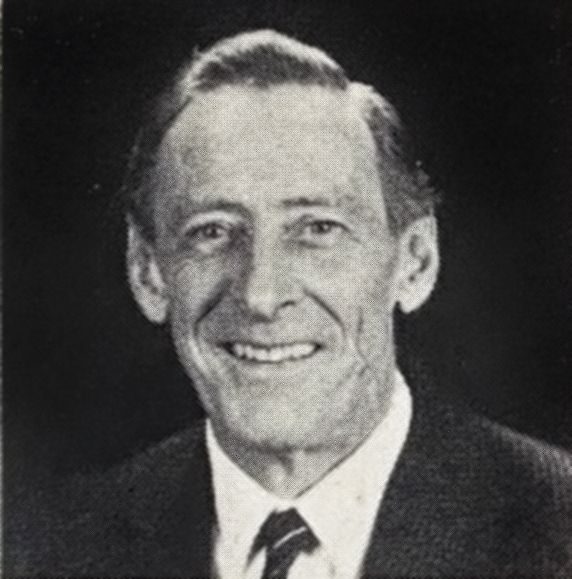 TARGETED BY FEDS: Dr. Frank Forster