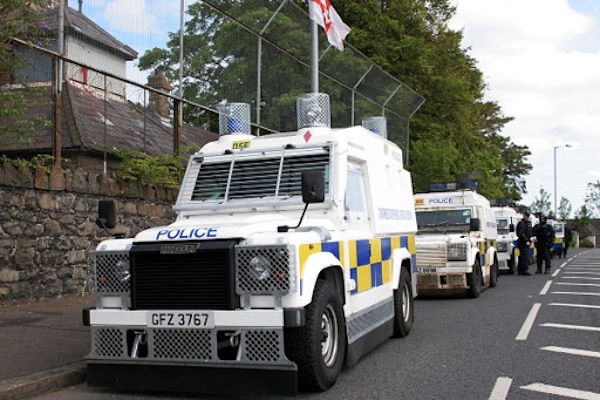
The irony of British Imperialism pontificating about ‘illegal Occupations’ of Sovereign Nations can not be lost on many.For more then 850 years, British Imperialism and principally English Imperialism has maintained an illegal occupation of Ireland. Today, Britain maintains its illegal stranglehold on Ireland through a direct and colonial military occupation of 6 Irish Counties and a semi colonial rule over 26 Irish Counties.
You won’t hear much about this ongoing occupation in the compliant mainstream media, or from the subservient free state administration that is but a puppet of Britain in Ireland.
But the truth today is that there are 5,000 full combat British Troops in Ireland, 9000 members of a paramilitary police, thousands of MI5 spooks and many thousands of members of loyalist death squads controlled by British Imperialism. The head of the Free State Police is an MI5 agent meaning that British Military Intelligence controls policing across Ireland. The British Navy are responsible for policing Irish costal waters and the British Airforce are responsible for policing Irish Skies, with the full compliance of Leinster House. Many of the shops in the towns and cities in Ireland are English and English feudal lords still own vast tracts of land in Ireland.
Yet where is the talk of sanctions against British Imperialism for its ongoing illegal occupation and partition in Ireland?
Dean Swift once had a tactic to deal with English Imperialism in Ireland, he advocated that the people should ‘Burn Everything English, But their Coal!’. An economic boycott of English goods in Ireland is a tactic that can hit the occupation and imperialism where it hurts and is worth being considered by all opposed to the British presence in Ireland.
The Irish People want no part in an imperialist war with the people of the Donbas or Russia. Our fight is against British Imperialism and the Occupation of our country as the primary contradiction, along with the fight against North American and European Imperialist Interference in Ireland.
Our people should not be misled by Anglo-American propaganda and warmongering. Our enemies remain those that hold our country in chains and oppress and exploit our people. Our struggle is to drive the British Occupation and its imperialist allies out of Ireland.
As western imperialism marches ever closer to war, the focus in Ireland must be on rebuilding the struggle for National Liberation and Socialist Revolution into a mass movement across the country, a movement that will not accept Ireland being used as an imperialist pawn.
All Republicans should rally to the cause to drive Britain out of Ireland once again. It is only by addressing the primary contradiction that all other contradictions in Ireland can be resolved
For National Liberation and Socialist Revolution- Break the Connection with Imperialism- Brits Out Now!
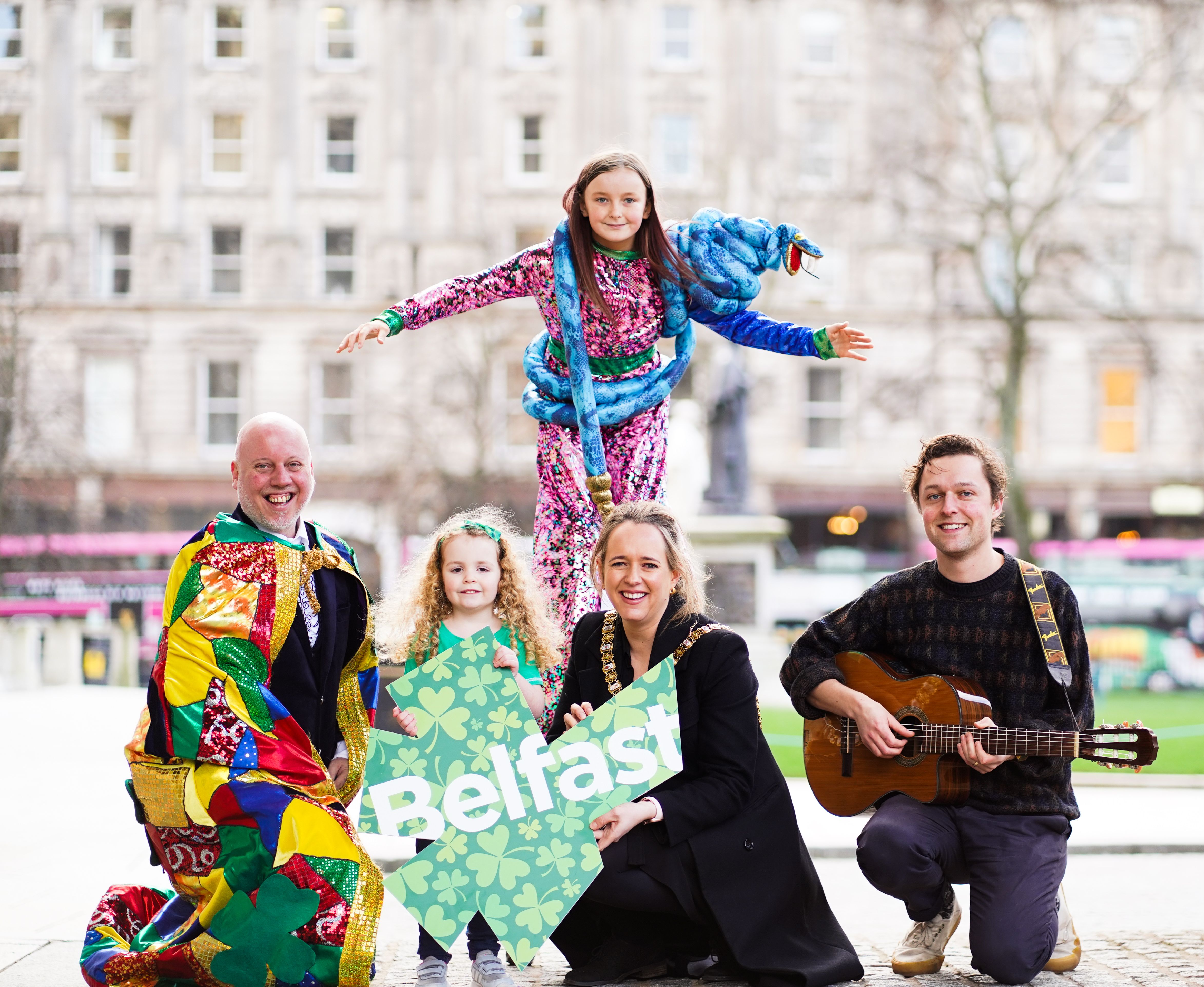
Conor McParland March 02, 2022 ST PATRICK’S DAY: Hugh Brown (Ambassador and Creative Performance Director with Beat Carnival), Amy Weir (Suffolk Circus) and musician Joshua Burnside with Harper McCleary (3) and Lord Mayor of Belfast, Councillor Kate Nicholl
BELFAST’Spopular St Patrick’s Day event will make a welcome return this year – but this time, with a reimagined 11-day citywide celebration from 10-20 March.
Belfast City Council awarded creative development funding to four organisations to deliver a new-look celebration that is fun and welcoming, and offers a creative line-up of family activity, including a live concert on March 16, a St Patrick’s Day carnival pageant, a trad music trail and a community showcase event.
Lord Mayor of Belfast, Councillor Kate Nicholl said: “After two years of not being able to host our usual St Patrick’s Day event, I am really thrilled that it is back this year, bigger and better than ever.
“It’s great to have the input of community organisations too to help make this a city-wide celebration that will appeal to a wide range of people, young and old, from all corners of our city, with plenty of free activities happening day and night across the 11 days.
“As a UNESCO City of Music, music will play a major role this year with a Féile Trad Trail running from March 10 and a St Patrick’s Eve concert at Custom House Square. The concert promises to be a real family-friendly affair this year featuring authentic homegrown talent.
“And, on St Patrick’s Day itself, I’m excited to be leading Beat Carnival’s pageant parade and am really looking forward to seeing the city come alive with colour and performances.”
A free family-friendly concert will take place on Wednesday, March 16 at Custom House Square, 5pm-9pm, delivered by The Duncairn Centre, supported by the Arts Council NI.
The concert will feature some of the Island’s brightest voices with music from beloved duo Mick Flannery and Susan O’Neill, rising-star Tolü Makay and experimental folk artist Joshua Burnside. There will also be special performances from trailblazing flute and whistle player Brian Finnegan and The Duncairn Creative Collective, which brings together over 20 independent Irish musicians from different backgrounds and genres.
Barry O’Kane from The Duncairn Centre said: “We have been champions of independent Irish music since opening in 2014, so to give these artists a platform in Belfast’s city centre is a dream come true.
“We look forward to representing the authentic, modern and diverse society we live in, while providing an inclusive and family-friendly atmosphere where all shades of Irishness, and none, are welcome.”
This year’s new look St Patrick’s Day parade by Beat Carnival will be a colourful, carnival pageant of costume, music, dance, circus and theatrical performance.
David Boyd, Director of Beat Carnival, said: “We want to involve and inspire people of all backgrounds and abilities, to entertain and captivate audiences and to promote an inclusive and forward-looking experience of St Patrick’s Day in Belfast. The new parade will be a spectacle of creativity, fun and challenge proclaiming that ‘we are all Patrick’.”
Féile an Phobail will also be delivering a series of events as part of this year’s St Patrick’s Day programme of activity.
Kevin Gamble, Director at Féile an Phobail, said: “We’ll be bringing an array of music sessions, gigs, illuminations, workshops and more over 10 days across the city. Some of the highlights include a Féile Trad Trail – which will see popular bars, restaurants, hotels and visitor spots throughout the Gaeltacht Quarter and city centre come alive with traditional Irish music – plus St Patrick’s Day music at the Spar Craic 10k and inside 2 Royal Avenue.”
St George’s Market will also be getting in on the craic, with traditional music performances at the market each day from 18-20 March.
Tickets for the St Patrick’s Eve concert are free and will be available here from 10am on Thursday 3 March (limited to four per person). Terms and conditions apply.
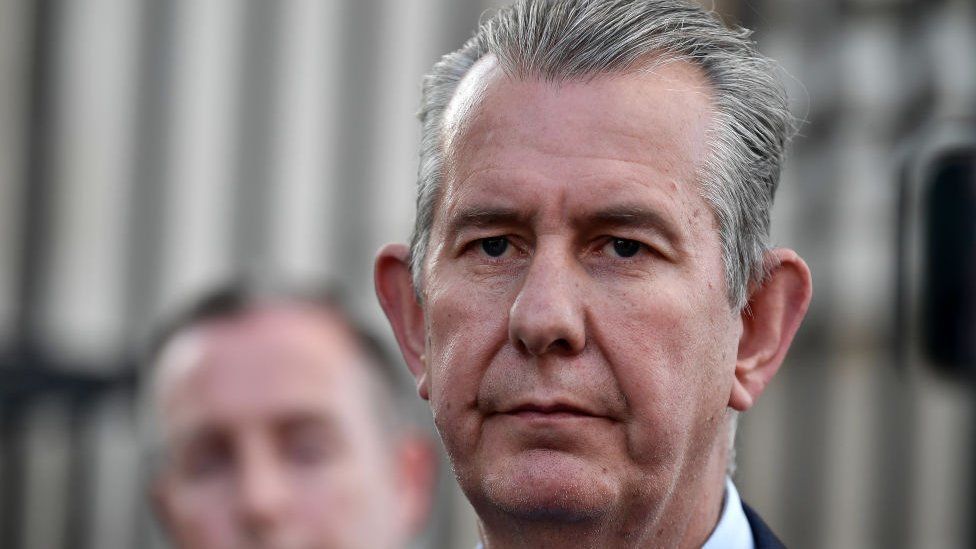
On Tuesday, Mr Poots said in a tweet that the media should “desist from using sources to spread myths which have zero substance on behalf of people seeking to cause division within the DUP “.
Image caption,Doug Beattie and Sir Jeffrey Donaldson have given different accounts of their conversation
Sir Jeffrey and Mr Beattie have given differeing accounts of the meeting.
The UUP leader also rejected Sir Jeffrey’s claim that their meeting had focused on improving unionist co-operation.
Edwin Poots was the other big player at the time and now he too has had his say on the talks- if only to deny he was the source of the leak about the Beattie-Donaldson meeting.
Mr Poots says his name was mentioned a number of times but doesn’t say by whom.
But his intervention serves another purpose as it underlines how he, as leader at the time, was in the dark about the engagement.
He also attacks those seeking to cause division within the party, perhaps mindful of the potentially divisive forthcoming DUP executive meeting, which could decide his political future.
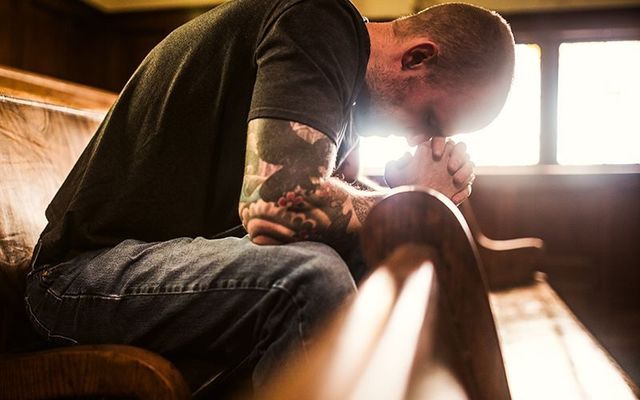
Take a minute out from celebrating to share a St. Patrick’s Day blessing with your loved ones.
IrishCentral Staff@IrishCentralMar 01, 2022Have a blessed St. Patrick’s Day! Take a minute out from celebrating to share a St. Patrick’s Day blessing with your loved ones. GETTY
Happy St. Patrick’s Day to all our IrishCentral readers! We hope that you have an incredible St. Patrick’s Day full of fun, friendship and lots and lots of Irish music, dance, literature, drama, food and so much more.
While we enjoy all the celebrations, we must remember, of course, that St. Patrick’s Day is a Catholic feast day and so in that spirit, we’ve compiled a collection of prayers and blessings specifically related to St. Patrick and to St. Patrick’s Day with which to bless your loved ones this year.
you sent Saint Patrick to preach your glory to the people of Ireland.
By the help of his prayers,
may all Christians proclaim your love to all men.
Grant this through our Lord Jesus Christ, your Son,
who lives and reigns with you and the Holy Spirit,
one God, for ever and ever.
Thanks for St. Patrick
O God, Who didst vouchsafe to send Thy Confessor and Bishop, Blessed Patrick, to preach Thy glory to the nations, grant, through his merits and intercession, that what Thou dost command us to do, we may, by Thy mercy, be enabled to perform. Through our Lord Jesus Christ, Thy Son, Who liveth and reigneth with Thee in the unity of the Holy Ghost, God, world without end. Amen.
St Patrick’s Breastplate
2
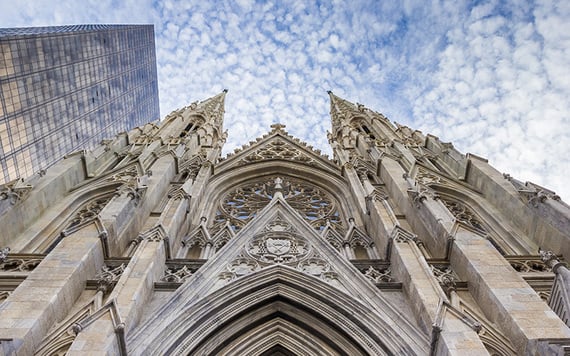
St. Patrick’s Cathedral in New York.
Christ be with me, Christ within me
Christ behind me, Christ before me
Christ beside me, Christ to win meADVERTISING
Christ to comfort me and restore me.
Christ beneath me, Christ above me
Christ in quiet, Christ in danger
Christ in hearts of all that love me
Christ in mouth of friend or stranger.
(390-461 A.D.)
The Prayer of St. Patrick
I arise today
Through the strength of heaven;
Light of the sun,
Splendor of fire,
Speed of lightning,
Swiftness of the wind,
Depth of the sea,
Stability of the earth,
Firmness of the rock.
I arise today
Through God’s strength to pilot me;
God’s might to uphold me,
God’s wisdom to guide me,
God’s eye to look before me,
God’s ear to hear me,
God’s word to speak for me,
God’s hand to guard me,
God’s way to lie before me,
God’s shield to protect me,
God’s hosts to save me
Afar and anear,
Alone or in a multitude.
Christ shield me today
Against wounding
Christ with me, Christ before me, Christ behind me,
President Biden “calls upon all Americans to celebrate the achievements and contributions of Irish Americans to our Nation” in his Irish-American Heritage Month Proclamation 2022.
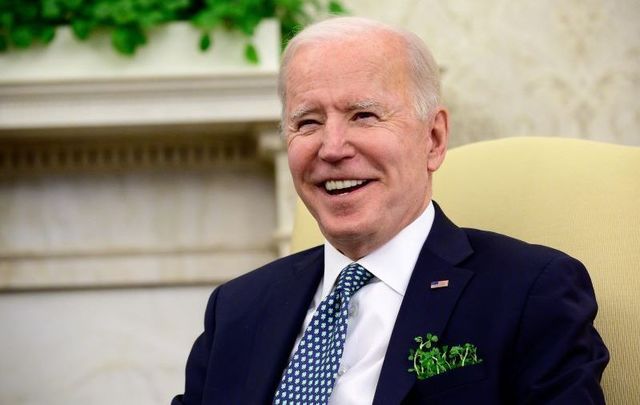
IrishCentral Staff@IrishCentralMar 01, 2022March 17, 2021: US President Joe Biden speaks during a virtual meeting with Taoiseach Micheál Martin in the Oval Office of the White House in Washington, DC. GETTY IMAGES
Every March since 1991 has been designated as Irish American Heritage Month in the US.
US President Joe Biden has issued a proclamation designating March 2022 as Irish-American Heritage Month in the US.
In his proclamation, Biden makes special note of his own Irish roots which can be traced back to the Blewitts of Co Mayo and the Finnegans of Co Louth.
Traditionally on St. Patrick’s Day, the US President meets with the Taoiseach in Washington, DC. Last year, the meeting was held virtually due to public health concerns, but Taoiseach Micheál Martin will be traveling to Washington, DC this year for St. Patrick’s Day.
President Biden’s Proclamation on Irish-American Heritage Month, 2022
For centuries, Irish Americans have played a crucial role in helping define the soul of our Nation, and today, nearly 1 in 10 Americans proudly trace their roots back to the Emerald Isle. With hope and faith in their hearts, the first immigrants from Ireland crossed the Atlantic in search of liberty and opportunity. It was the dream of a better life that brought my ancestors — the Blewitts of County Mayo and the Finnegans of County Louth — and countless other Irish immigrants.
Like so many Irish American families, my grandparents carried the spirit and memory of Ireland in their hearts — a pride and passion they instilled in their home in Scranton, Pennsylvania. Through the journeys of their own mothers and fathers and in the lessons they passed on to my mother, Catherine Eugenia Finnegan Biden, they joined Irish Americans in every corner of America in helping to write the next chapter of the American story.ADVERTISING
The story of Irish Americans has always been one of strength and perseverance through adversity. Many Irish immigrants arrived on America’s shores to escape the Great Famine, only to face discrimination, prejudice, and poverty. Despite these hard times, they embraced their new homes in every corner of America — from the Atlantic to the Pacific, across the Midwest and through the Rocky Mountains — and helped build and fortify our Nation into what it is today.
Irish Americans expanded the American middle class, building ladders of opportunity that future generations could climb. They became teachers, firefighters, police officers, labor leaders, farmers, business owners, and more. Along the way, Irish Americans contributed enormously to the American labor movement — championing safe working conditions, advocating for children’s rights, and fighting racism, prejudice, and income inequality. They bravely answered the call to serve, defending our Union and its values in every battle. They continue to work on behalf of the American people as public servants — serving in the Congress, the Supreme Court, Federal agencies, the White House, and in State and local offices across the country. Irish Americans have enriched our culture and nourished our hearts and souls through the arts and humanities, earning recognition as Nobel and Pulitzer prize-winning poets and authors, award-winning musicians, storytellers, and dancers, and critically acclaimed actors. They have blessed our Nation with their indomitable spirit, faith, and love for family that has been passed down through the generations. This sense of community, hospitality, resilience, and passion are integral pieces of America’s cultural tapestry.
The United States and Ireland are deeply and forever intertwined: linked in memory and imagination — in joy, sorrow, and resilience — by our common love and common dreams. We share, in every heart, an unrelenting optimism — a flicker of hope that guides us through even the darkest of nights.
As we celebrate Irish-American Heritage Month, let us honor the journey and contributions of Irish Americans who helped shape this land of opportunity and define what it means to be American. Let us reaffirm the legacy of friendship and strong family ties between the United States of America and Ireland — united by our common purpose, by our histories, and by our futures.ADVERTISING
NOW, THEREFORE, I, JOSEPH R. BIDEN JR., President of the United States of America, by virtue of the authority vested in me by the Constitution and the laws of the United States, do hereby proclaim March 2022 as Irish-American Heritage Month. I call upon all Americans to celebrate the achievements and contributions of Irish Americans to our Nation with appropriate ceremonies, activities, and programs.
IN WITNESS WHEREOF, I have hereunto set my hand this twenty-eighth day of February, in the year of our Lord two thousand twenty-two, and of the Independence of the United States of America the two hundred and forty-sixth.
 ST PATRICK’S DAY: Hugh Brown (Ambassador and Creative Performance Director with Beat Carnival), Amy Weir (Suffolk Circus) and musician Joshua Burnside with Harper McCleary (3) and Lord Mayor of Belfast, Councillor Kate Nicholl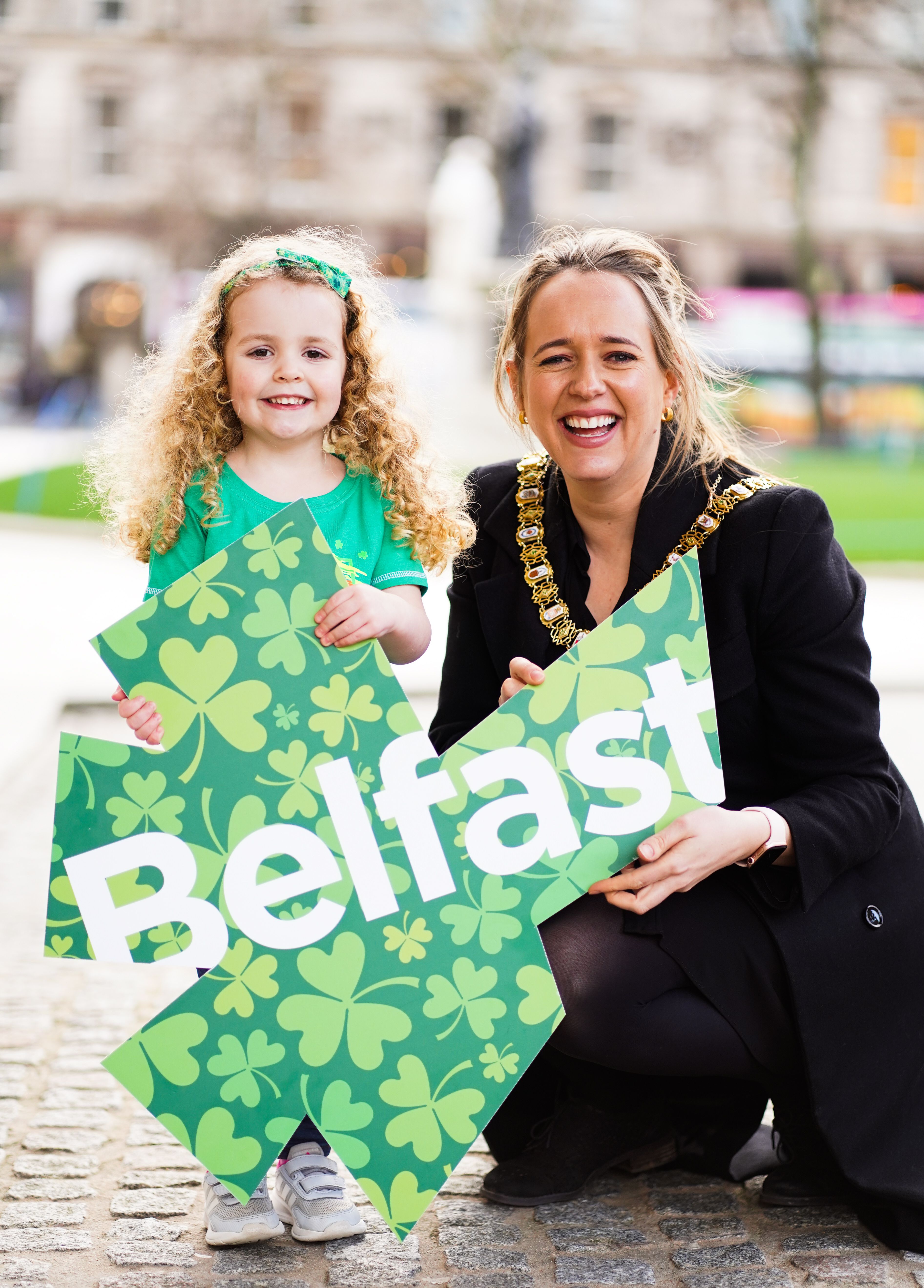

 Have a blessed St. Patrick’s Day! Take a minute out from celebrating to share a St. Patrick’s Day blessing with your loved ones. GETTY
 2
2
 March 17, 2021: US President Joe Biden speaks during a virtual meeting with Taoiseach Micheál Martin in the Oval Office of the White House in Washington, DC. GETTY IMAGES