Been meaning to share this from Jon Tonge in the Belfast Telegraph but the combination of shortage of time during mid term break and my hurry to get my Twitter valedictory finished meant I didn’t get around to it.Surely it is time to change the rules of the political institutions. Several parties say they are in favour. Alliance produced a treatise on reform for its election manifesto. But change never happens. As the lyrics of the UK number one single at the time of the Good Friday Agreement put it, “It’s like that, and that’s the way it is”.Westminster either fiddles with reform or steamrollers devolution. This year’s tinkering made a petition of concern require support from two parties, rather than 30 signatures from one. That was despite any sentient human noting that no party would reach 30 seats at the election, making a petition impossible under the old rules anyway.Now, without sounding a bit dim given there’s no democratic version of Stormont, why does any of this matter? The Northern Ireland economy is currently doing very well in the absence of those meddling politicians.The answer isn’t just that the health system is ag titim as a cheile (literally “falling from togetherness”), because it’s doing this in spite of the fact that we have had an administration for 65% of the time since 1998.It’s that this rigid system (where almost all shall have prizes) has been captured by the most ideological rigid parties who do now have the leeway or inclination build a suffiicient consensus in doing anything.It hasn’t been like that the whole way. In one Liverpool survey people named the 2011-16 Robinson/McGuinness administration as the most successful. But 2016 was SF’s least successful election.Getting on with the oul enemy in government is bad for party business. I’ve argued that any parliament should be able to air controversy and be capable of allowing people to “kick the bums out” (as they say in the US).The question is how to change the system without endangering the safeguards and the enabling structure of the Belfast Agreement? How to kick away the ‘ugly scaffolding’ as Mark Durkan called it, to let demos breathe?Jon has two suggestions. One, scrap the unionist and nationalist and other designations. Because he reasons:Voters are the ones who can self-designate as unionist or nationalist — on border poll day. Until then, there is non-constitutional work for MLAs to do.Assembly responsibilities do not include constitutional futures, protocol contents, hard borders that no one will ever build anyway, or expressions of identity such as parades and flags.You don’t need to declare yourself a nationalist or unionist to determine whether you support a Stormont plan for increasing charges for plastic bags in shops.The other important part of the plan is to demand that laws need a weighted majority to pass in the Assembly.Now, I don’t know if this will work, but it would have the immediate effect of breaking the poisonous duopoly that’s been at the heart of Stormont since 2007. He also suggests having just one first minister.I don’t know what the unintended consequences of such changes might be. It would require someone giving up leverage they’ve held on to for a long time now, but there’s surely merit in having a conversation around it?What changes would you like to see (that are compliant with the Belfast Agreement)?
There is much to admire about the United States of America. The dollar dictatorship of US politician Richard Neal, Chairman of the Friends of Ireland, is not one of them.Apart from his persistent but poorly informed belief that the United States is a co-guarantor of the Good Friday/Belfast Agreement, his approach to the internal politics of Northern Ireland exemplifies denial of the historical stains of armalite politics; a circular exchange of ideas with those sharing similar sentiment and a synthesis of the mostly republican ‘England get out of Ireland’ credo.Embracing the strains of ‘Ireland Unfree’ may garner support from within the traditional ‘Anglophobe’ constituency in Massachusetts but is not a solid foundation for meaningful or transformative discourse with those who aspire to a different future.However, anyone who has spent time in the USA recently or has relatives residing there will know that whilst politicians like Richard Neal and Speaker of the House, Nancy Explosi, as some have taken to naming her, hold influential positions in Washington, the vast majority of Americans invest limited interest and time into the politics of the Republic of Ireland and Northern Ireland.There are too many other pressing issues which US society prioritises and the faux offended response of Unionism to the clumsy politicking of Richard Neal serves only to afford the Irish Caucus too great an importance.When it comes to visits by politicians, they are in the long term a sideshow with lasting solutions to our problems resting in our own hands. This is no truer than in the case of political unionism currently under the leadership of the DUP.Having got rid of political liabilities, like former MLA Jim Wells, the DUP personifies the truism that you cannot stop a ship sinking by tossing baggage overboard; you merely slow the speed at which you go under.Political Unionism will in all likelihood reject the suggestion but a growing number of those who are pro-Union are beginning to question if Unionist parties are the most effective means and Unionism the best term through which to promote the Union.The election results don’t lie and, in its response, Unionism is lending weight to the charge that it is not designed for democracy.As if in a tag-team partnership with Sinn Féin, replicating opportunistic stand-off tactics designed to sustain diminishing influence is serving only to deepen the growing toxicity and antipathy which evidence shows, is growing within Unionism and the wider communityIt presents as a race to the bottom, discredits Stormont and is destructive of citizenship and the values to which, at its best, Unionism should aspire.Turning every political issue into a proxy constitutional battle is running out of road. Along with rutted confrontational politics which prevent decision-making and impede the transition out of post-pandemic and global social economic chaos, it leaves the promise of the Good Friday Agreement unfulfilled.It sees Unionism bending to a binary orthodoxy to create a contradiction in terms.As a result, no less than political parties which in the past stalled politics over the Irish Language, in prolonging its ‘leverage’ on the problems arising from the Ireland/ Northern Ireland Protocol, the DUP is cherry-picking the Agreement process to block rather than embed its core purpose and principles.Urgent review and re-assessment of current strategy is an imperative if confidence in the current political structures is to be restored and devolved decision-making mobilised to meet the challenges that confront the community.Substantive socio-economic, health and educational outcomes will do more in the long-term for ‘consent’ and acceptance of a constitutional status quo, than lightweight populism with a short shelf-life.The alternative cannot be a smallness in vision for nostalgic Unionism that seems to come from within; that seeks to appeal only to a narrow constituency which time and distance from the worst years of 30 plus years of conflict is eroding.The leverage which the DUP feels it has is building to a point of over-reach. The United Kingdom is unlikely to risk a trade war with the EU. The Foreign Secretary Liz Truss has stated that an amended Ireland/NI Protocol will remain.The EU is sending signals of a willingness to table and discuss amendments that can, if sensible, deliver proportionality within a newly agreed Protocol.Whilst some businesses find the Protocol cumbersome and having a negative impact on commerce, others are benefitting. The aim, for now, must be to achieve unfettered trade within the internal market as well as the Single Market, so that the economy of Northern Ireland grows faster than now and brings financial and political stability.It is the nature of the processes that flow from Brexit and the Protocol that there will be further issues which emerge as ‘grace periods’ end, new rules emerge within the EU and trade deals are agreed by the United Kingdom.VAT arrangements and the subsidies will be challenging but there are opportunities within the Good Friday Agreement as yet, for some reason, not yet fully explored which may offer solutions.This situation is one which many in the pro-Union foresaw but the DUP and other political Unionists chose to ignore. In so doing, they risked the balance within the Good Friday Agreement and the stability of the Union.The current impasse points to a lesson ‘unlearned.’Observers in Great Britain look at the heavily funded political stagnation and, whilst professing some understanding of the difficulties which Unionism has with the EU-designed Protocol, are less likely to identify with the refusal of the DUP to facilitate the kick-start of devolved governance, now that all sides acknowledge the need for significant alterations to an ill-conceived agreement.This grows a gap already apparent in attitudes to social justice issues which may in the long term prove more of a threat than an amended Irish Sea regulatory trading zone.Within Northern Ireland there are those who do not identify as pro-Union or Unionists. They are content with the constitutional status quo for now but grow uneasy with the contribution which political Unionism too often makes to framing decision-making along tribal and sectarian lines instead of addressing everyday issues.The Union is not solely about territory it is about hearts and minds, well-being, dynamic and inclusive governance.In forgetting this, present tactics may ensure that in seeking to save the Union, political Unionism destroys it.The passing visit by an American politician will be the least it has to worry about.
Orange Order Grand Secretary, the Rev Mervyn Gibson, rejected any change to Northern Ireland’s position within the UK.
Centennial parade: Tens of thousands in Belfast for Orange Order march
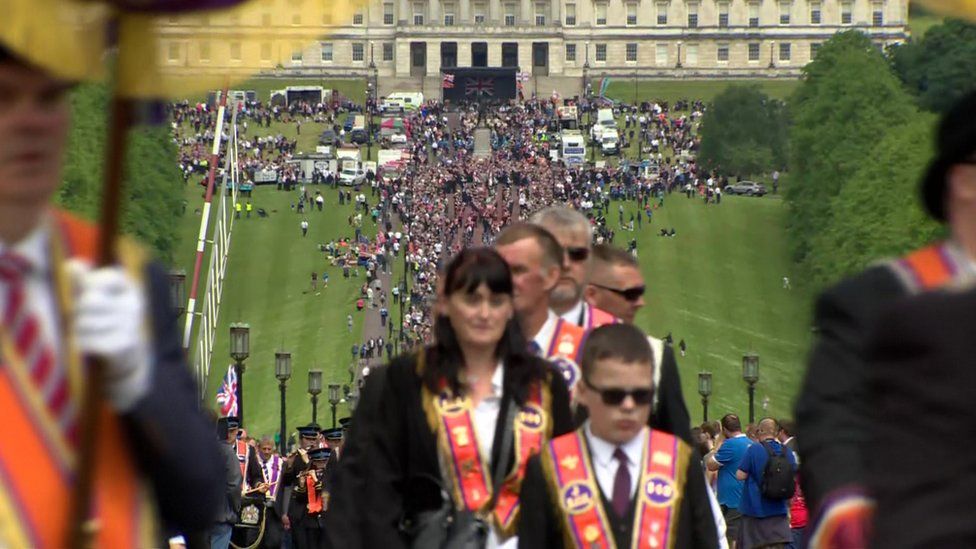
Image caption,The parade leaves the grounds of Stormont, heading for the city centre
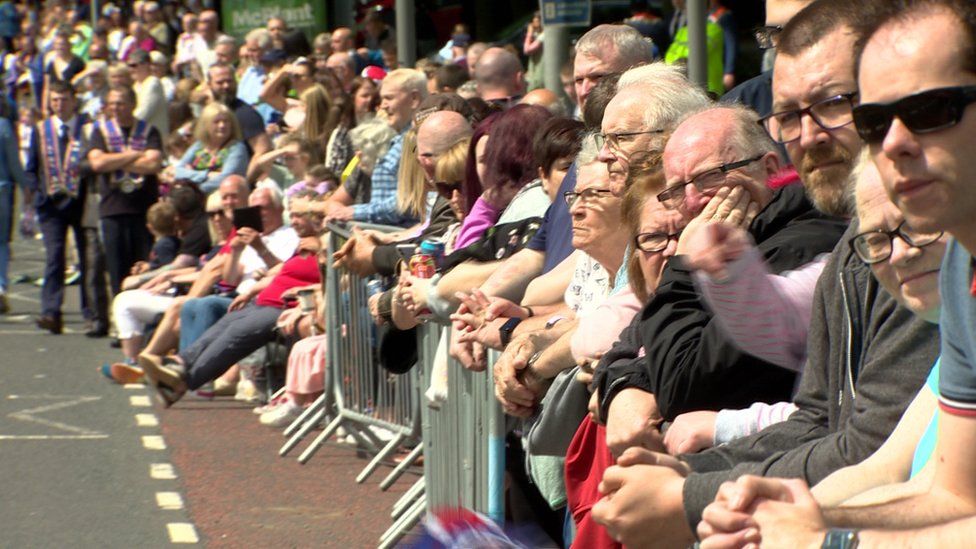
About 100,000 people have watched an Orange Order parade to mark the centenary of Northern Ireland, the chief constable has said.
Some 25,000 people took part, amid a huge policing operation in Belfast.
Before the parade started, Orange Order Grand Secretary, the Rev Mervyn Gibson, rejected any change to Northern Ireland’s position within the UK.
He said Northern Ireland has “no interest in becoming part of an all-Ireland – save your breath”.
The parade, which led to traffic restrictions in many areas of the city, ended on Saturday evening.
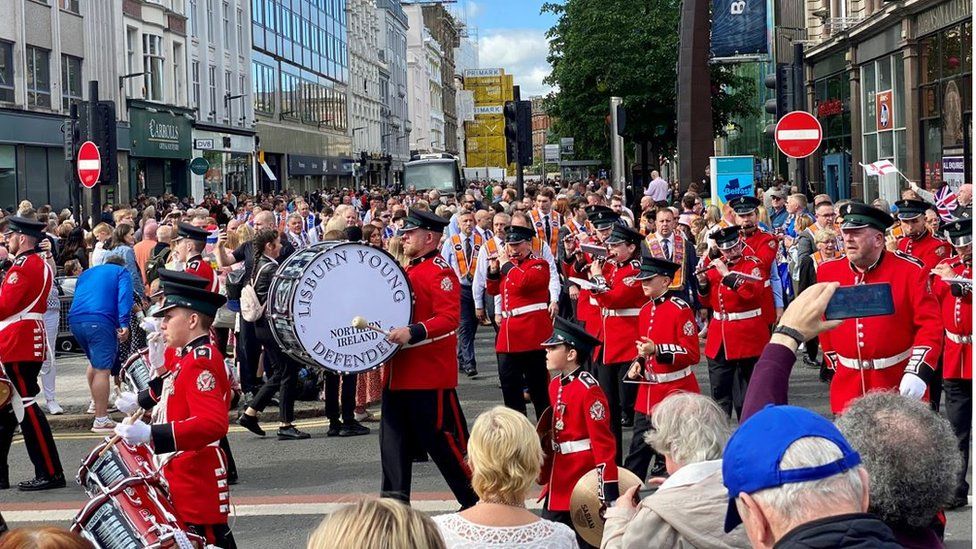
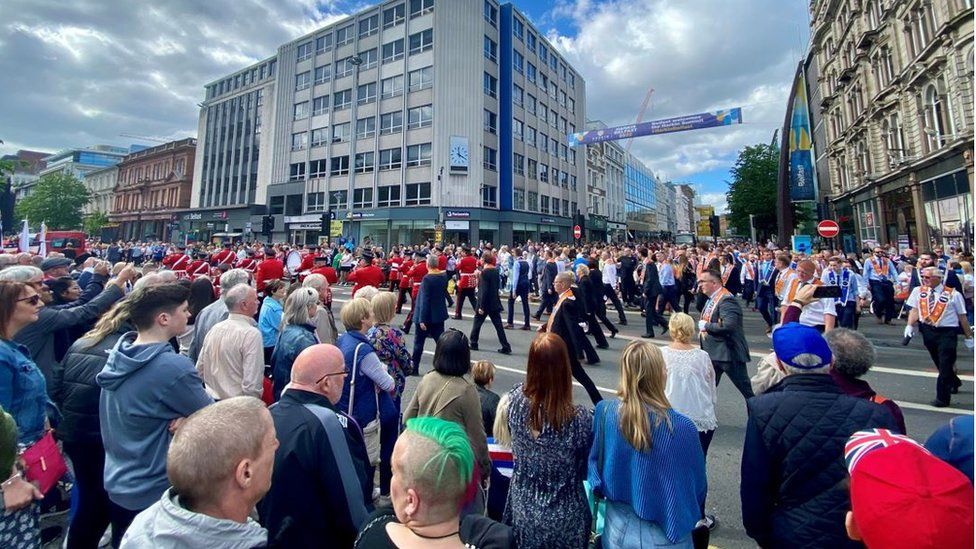
Image caption,Bands converged in the city centre on Saturday afternoon
The march from Stormont to Belfast City Hall was postponed last year because of the Covid-19 pandemic.
It started at Stormont at 13:00 BST before heading down the Newtownards Road, over Queen’s Bridge and on to City Hall.
Police Service of Northern Ireland (PSNI) Chief Constable Simon Byrne said months of planning had gone into Saturday’s operation with 500 officers on duty, mostly across Belfast.
“This is quite a significant policing operation,” he said.
‘British we are and British we’ll stay’ – centennial parade is told
“This is slightly unique because of the traffic disruption over the length of journey, but what we see here today is a blueprint for what could be a busy summer.
“But we’re really optimistic about a family fun day and a celebration of the past.”
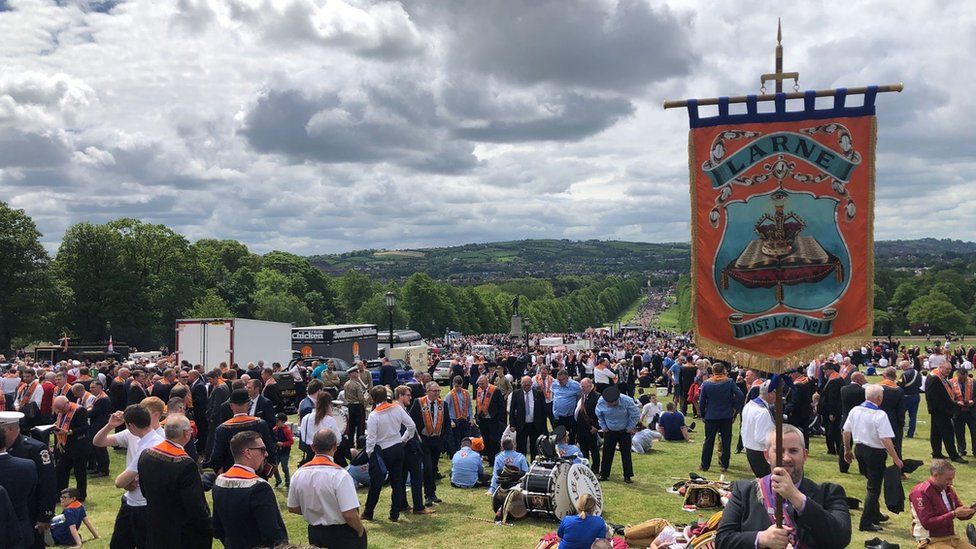
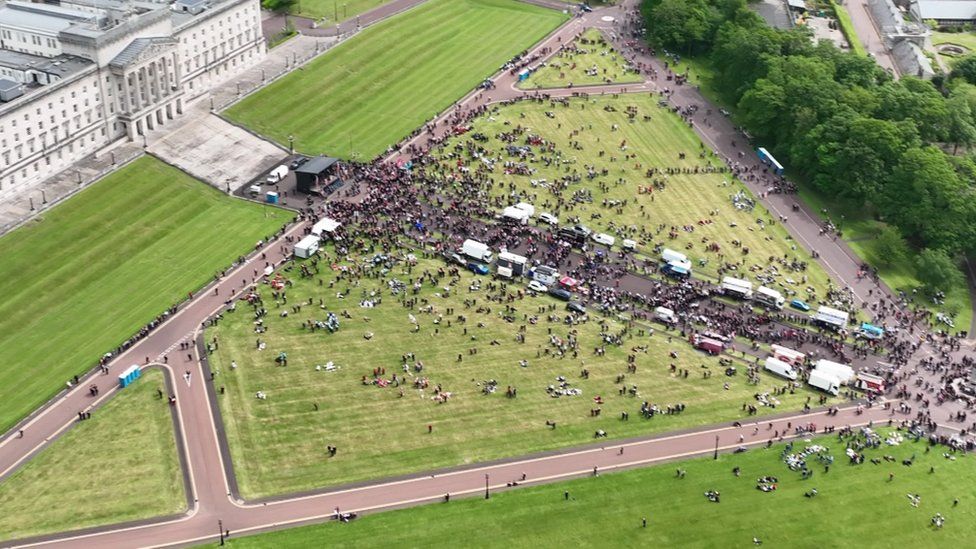
Image caption,People gathered to listen to speeches and music on the lawn at Stormont
People started gathering at Stormont from about 10:00 with speeches beginning at noon in front of Parliament Buildings.
Addressing the crowd at Stormont, the Rev Gibson said that “it doesn’t matter what you promise or offer [in a united Ireland], it doesn’t matter if every day was the 12th of July”.
“If it’s not under the Union Jack then count us out,” he said.
The Rev Gibson ended his speech by saying: “And the cry to those who seek to persuade us or push us into a united Ireland is still the same: ‘no surrender’.”
He added that he wants to see a Northern Ireland that is “financially stable, where there is truly equality of opportunity for all, equality in education, an effective and efficient health service, where culture and heritage are celebrated and respected”.
Grand Master Edward Stevenson said that unionists “are fully justified in not only commemorating, but proudly celebrating, this anniversary”.
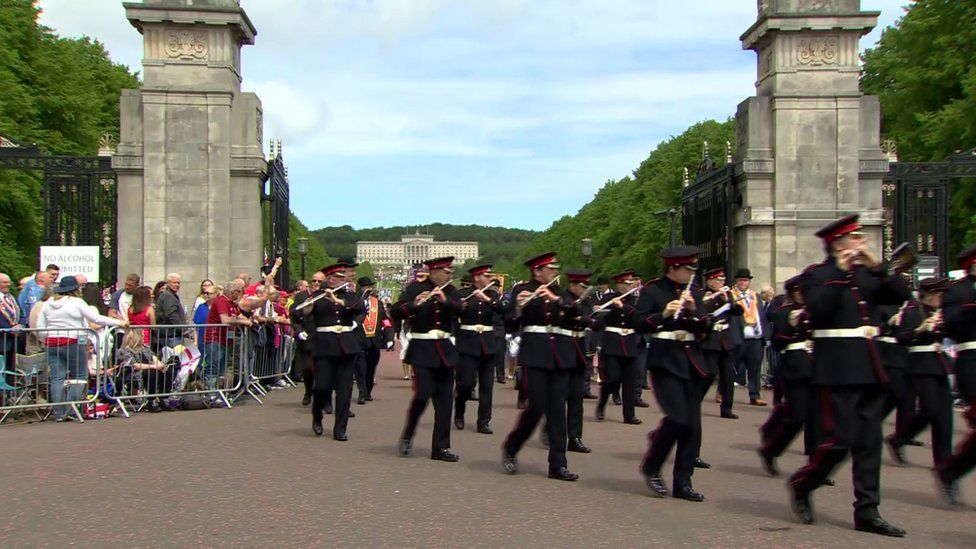
Image caption,About 25,000 are thought to be taking part in the parade
He added that “disappointingly but predictably, throughout 2021 there were those who told us that there is nothing to celebrate”.
“Rather than a celebration they repeatedly downplayed the anniversary and all it stood for,” he added.
“Regrettably, even our own UK government did little – despite much encouragement by this organisation and others – to ensure that the centenary was marked in a fitting way.”
About 130 bands were involved in the parade from the Orange Order, the Royal Black Institution, the Apprentice Boys of Derry, and the Independent Orange Order.
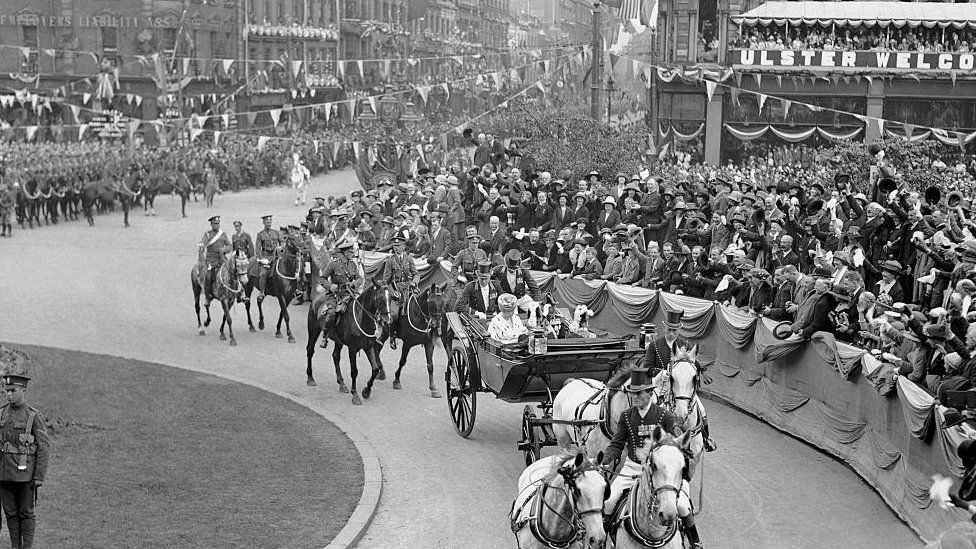
Image caption,The new parliament was officially opened by King George V on 22 June 1921
Analysis: BBC News correspondent Mark Simpson
It was warmer than expected, and took much longer than anticipated, but the parade organisers went home content.
There was plenty of heat too from the platform at Stormont.
As expected, a united Ireland was rejected, in robust terms.
However, it was said in front of Parliament Buildings, where Sinn Féin is now the largest party, for the first time in Northern Ireland’s 101 year history.
Overall, unionists still have more seats, but only two more.
Just like in 1921, politics in Belfast has entered an important phase.
Translink had advised travellers to allow extra time for their journeys with road closures and diversions in place.
Castle Court shopping centre closed two hours early at 16:00 and Victoria Square’s opening hours on Saturday were 09:00 to 14:00, although individual retailers may have had different opening hours.
Image caption,Drone footage shows the participants in the grounds of Stormont
Kieran Sloan, the owner of Sawers deli on College Street, told BBC News NI that staff getting home was his key consideration for remaining closed all day on Saturday.
The Ancient Order of Hibernians was originally established to defend Irish Catholic immigrants in the US before the famine. Photograph: Chris Maddaloni/Roll Call/Getty
After nearly 200 years, one of the main Irish organisations in the United States is considering proposals to open its doors to women.
The Ancient Order of Hibernians, which was originally established to defend Irish Catholic immigrants in the US before the famine, will decide on whether to end its male-only membership rules at a conference in Pennsylvania this July.
However, the plan to admit women are being opposed by the leadership of the Ladies Ancient Order of Hibernians (LAOH) which, although having a largely shared history and goals, is completely separate and runs in parallel to the men’s organisation.
Essentially the leadership of the LAOH sees allowing women into the AOH as being detrimental to its own organisation. It also argues women who joined the AOH would not be treated as equal members.
It told the AOH by letter last September it viewed the sudden dropping of that organisation’s gender requirement “as an act of sabotage on the LAOH’s recruitment and ongoing growth”.
Disappointed
The AOH has about 30,000 members across the United States. However, membership is ageing and numbers have fallen by about 20 per cent over the last decade. In addition, it has seen some politicians reluctant to engage with an organisation that permits only men to join.
Danny O’Connell, AOH current national president, said he was disappointed at the reaction of the women’s organisation. He told The Irish Times: “I can confirm the AOH are evaluating removing the male gender restriction from our membership requirements. I was disappointed by the reaction from the leadership of the LAOH and the apparent campaign to undermine this effort.
“I’m hopeful the LAOH leadership and membership moving forward will embrace a proposal that would give women residing in America another opportunity to embrace their Irish heritage”.
Supporters of the new initiative believe allowing women to join would not only increase membership but also reduce the age profile which is now believed to be over 50 on average. They believe younger men are also reluctant in some cases to be associated with an organisation that does not admit women.
Mr O’Connell is scheduled to be in Ireland this week where it is expected he will meet senior politicians including Tánaiste Leo Varadkar today.
Former Fine Gael TD John Deasy is head of government affairs with the AOH. He said the decision on whether or not to allow women to join the organisation would be made by the AOH’s membership.
“However, there’s no getting away from the fact that male or female-only restrictions are viewed as outdated and unacceptable in Ireland today.”
The AOH traces its history to 1836 when it was established in New York and later in Philadelphia as a Catholic immigrant organisation. Originally it had two objectives; to protect the clergy and those who had arrived from Ireland into a hostile environment for Irish Catholics in the United States at the time.
Its constitution stipulates applicants for membership must be male, be able to prove Irish ancestry and be a practising Catholic.
It also has broader political objectives urging the introduction of “an equitable US immigration law for Ireland” and played a central role in drawing up a bi-partisan resolution adopted by the US House of Representatives in March urging the British government to scrap plans to grant an amnesty for all Troubles-era killings in Northern Ireland.
Some close to the AOH maintain that at the time of its foundation virtually all organisations were dominated by men. As it was a secret society there are not many records available setting out the background to the rule.
In the mid-1890s an AOH women’s auxiliary was established. This title was dropped in the 1980s and the men’s and women’s organisations formally separated in 2012.
LAOH national president Karen Keane told The Irish Times the “divorce” came about following a tax audit by US revenue authorities. She said at the time the AOH leadership argued that the women’s organisation had nothing to do with it.
Similar
The constitution of the women’s organisation is broadly similar to that of the AOH. Its membership is also confined to practising Catholic women of Irish birth or ancestry as well as to the wife or mother of an AOH member. It aims to “foster and sustain loyalty to the Roman Catholic Church and foster and sustain loyalty to the United States of America among its members”.
Keane said the LAOH membership, which had been declining up to the end of 2019, had turned around. It has just over 10,000 members, an increase of five per cent over the last year or so.
The LAOH was more of a “boots on the ground” organisation, she said, and it did not spend its money on lobbying politicians but in local areas, for example assisting women to keep their babies.
“We talk about universal day care, universal child care so women who keep their children can afford to keep them in education.”
Ms Keane said her organisation was against the AOH admitting women members “because in all honesty women will not be treated . . . equal members if they join the AOH.”
 Mick Fealty
 Terry Wright