THE IRISH NEWS:
Posted by Jim on June 8, 2026
Opinion
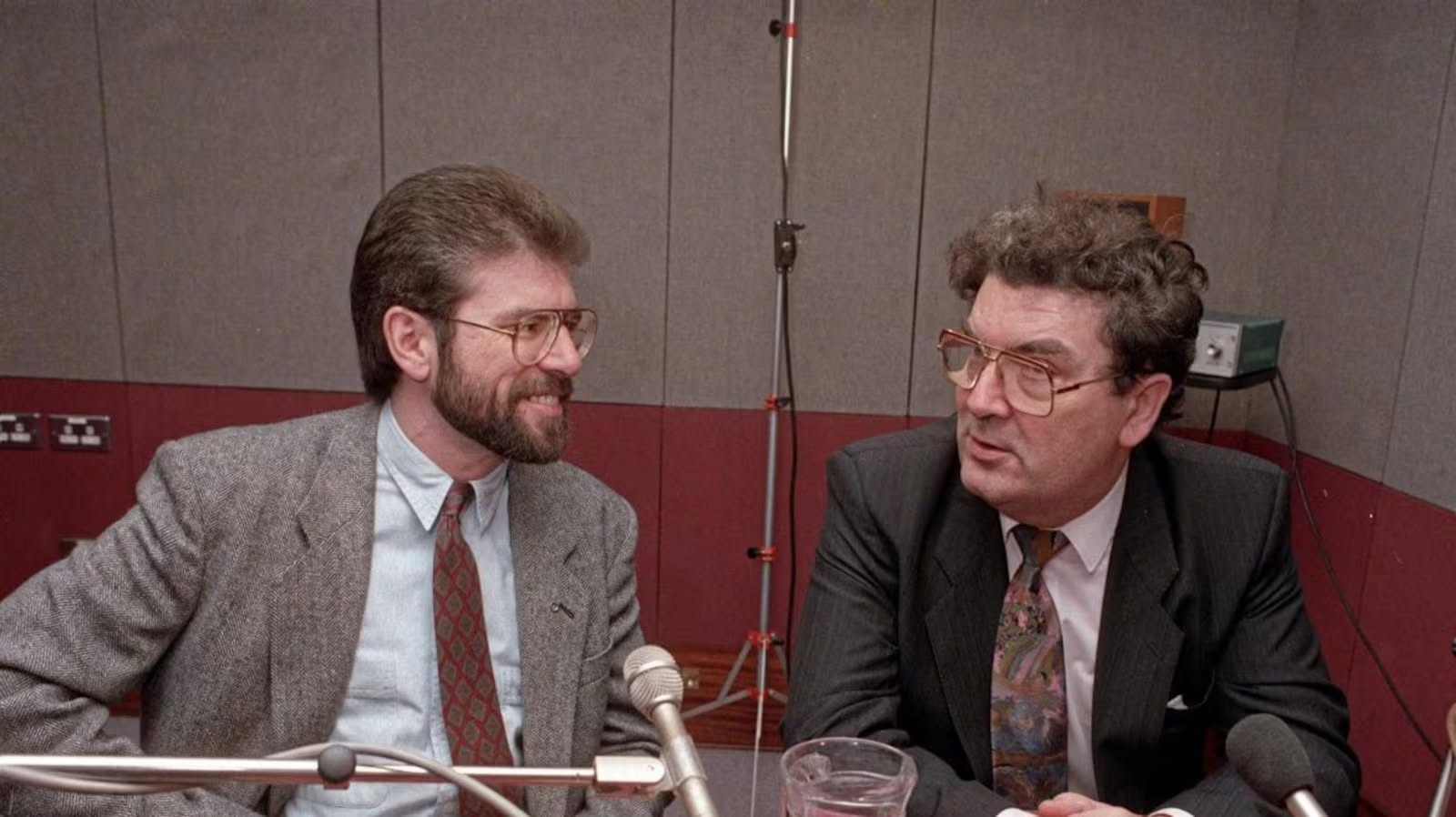
Noel Doran: John Hume, Gerry Adams and the day that reshaped northern nationalism.
John Hume’s career as the pre-eminent Irish public figure of the last century was not supposed to end in the way it effectively did 25 years ago today.
Gerry Adams’s Sinn Féin overtook John Hume’s SDLP for the first time as an electoral force 25 years ago today
By Noel Doran
June 08, 2026 at 6:00am BST
IT was on this day a quarter of a century ago that a profound change took place in northern nationalism, with the UK general election count establishing that Sinn Féin had overtaken the SDLP for the first time ever.
Although Sinn Féin had been growing steadily since the Good Friday Agreement (GFA), many commentators had felt that the opportunity for the republican party to secure an overall lead among nationalists had yet to arrive.
Some, but not all, of the SDLP front bench believed they would maintain their advantage as long as John Hume was at the helm, with tensions kept largely in the background until a new reality emerged as the ballot boxes were opened on the morning of June 8 2001, after the Westminster poll of the previous day.
While the margins were initially very tight, with Sinn Féin on 21.7 per cent (175,392 votes) and the SDLP on 21.0 per cent (169,865), the ramifications were enormous and in the following years the gap widened dramatically.
Reflections after the count focussed on Hume, the Nobel laureate who was completely justifiably regarded as the main architect of the peace process and later voted by RTÉ viewers as Ireland’s greatest ever citizen
Although almost his entire adult life had been selflessly dedicated to permanently ending violence – including his crucial but highly pressurised initiative with Gerry Adams – as the GFA breakthrough finally arrived in 1998, when he was 61, the relentless stress had taken almost a Shakespearean toll and his health was in serious decline.
Hume was not just leader of the SDLP, but, in the days when double and even triple mandates were permitted, he was simultaneously an MLA, an MP and an MEP, a workload which he insisted on undertaking but was plainly excessive.
I had known him reasonably well since I worked as a reporter in Derry 14 years previously, when he was a towering presence, but it later became clear during our occasional encounters on the fringes of the Stormont negotiations that his exceptional powers were waning significantly, as also sensitively indicated in Stephen Walker’s 2023 biography ‘John Hume The Persuader’.
The Sinn Féin leaders Gerry Adams and Martin McGuinness, who were both still in their 40s when the GFA was signed, looked sharp and focused in comparison, with a particular appeal to younger voters, and were routinely available for discussions about the latest developments.
Hume was an increasingly distant figure, as I found after becoming editor of The Irish News in April 1999, and immediately attempted to arrange a short, informal chat with him about a range of matters, proposing that I should drive to Derry on a suitable date which, despite repeated approaches, proved impossible to confirm.
I was only one journalist among many seeking his time, although The Irish News was by any standards an important outlet for him, but from my appointment to the announcement of his resignation as SDLP leader just over 30 months later, he was never available to sit down with me.
Hume was also often reluctant to engage with senior party colleagues, as an extraordinary episode from Seamus Mallon’s 2019 memoir ‘A Shared Home Place’ demonstrated.
The pair met almost by accident at an SDLP gathering at the Wellington Park hotel in Belfast, in the weeks after the overwhelming ratification of the GFA through a referendum in both parts of Ireland, when Hume said abruptly, and with no other consultation, that on medical advice he could not be deputy first minister, and Mallon would instead have to immediately take on the newly-created joint ruling office at Stormont.
That would have been an obvious stage for Hume to retire from all active politics, and perhaps become SDLP president, but he retained his post as leader, and his three other elected roles, throughout the introduction of devolution as events moved on decisively.
The SDLP had other capable representatives, but Hume was still very much the public face of the party, and his involvement in the intense debate over major issues like decommissioning and policing in the run-up to the 2001 general election was noticeably limited.
Hume had received a massive personal endorsement of his overall contribution in the 1999 European election, with over 190,000 votes, but it was in many ways a Pyrrhic victory and, the next time round, Sinn Féin comfortably captured the same seat during its wider advance.
He remained at the head of the SDLP until November 2001, as the party’s internal restructuring proved ineffective and Sinn Féin gained ground exponentially.
The legacy of Hume, who died in 2020, remains secure, but his career as the pre-eminent Irish public figure of the last century was not supposed to end in the way it effectively did 25 years ago today.