When nothing is quite sacred any more
Posted by Jim on May 1, 2026
Opinion
Fr Dominic McGrattan:
When nothing is quite sacred any more
Christian symbols and beliefs are increasing being treated with a contempt that would be unthinkable if directed elsewhere
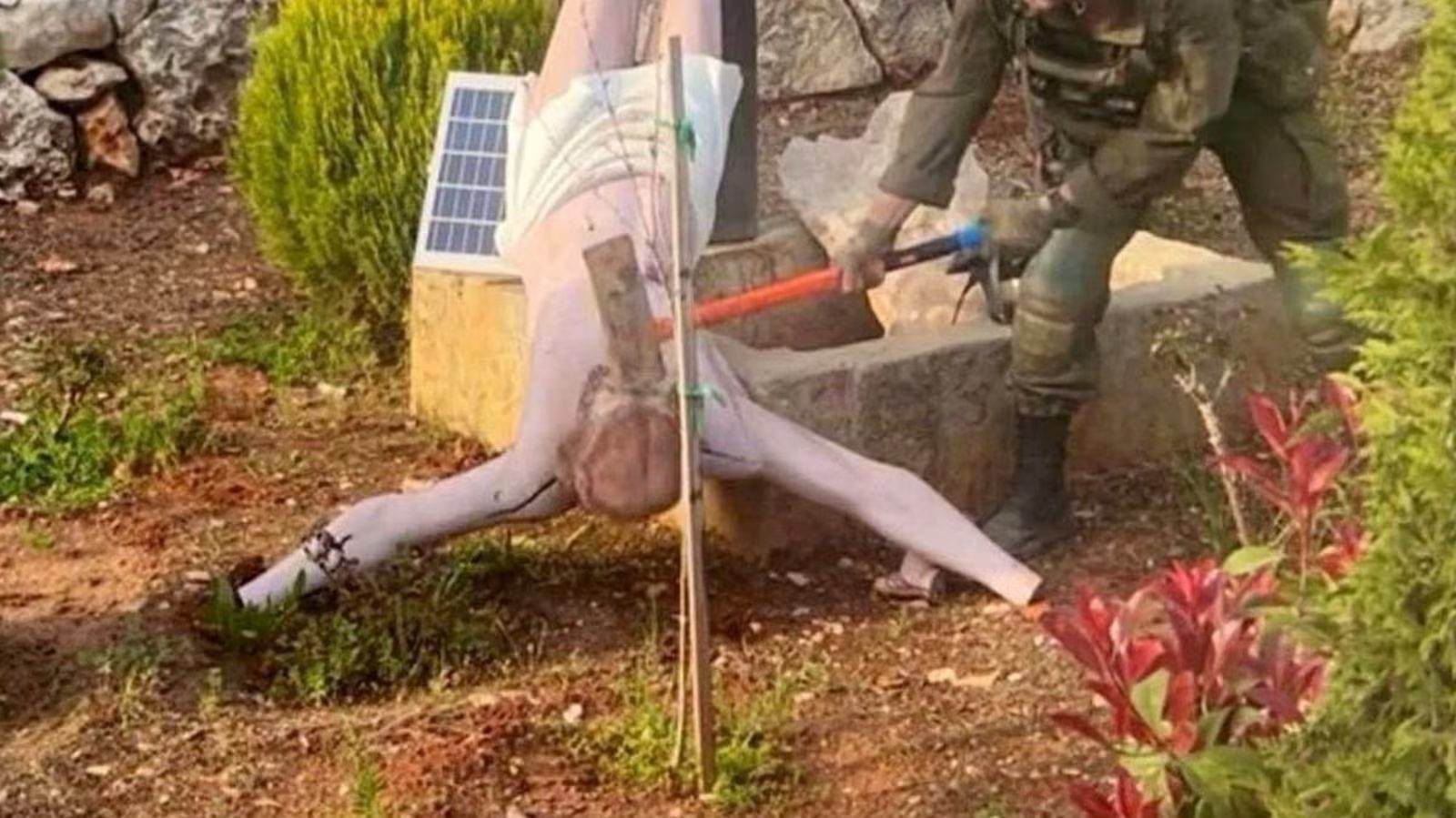
Two Israeli soldiers were sentenced to 30 days in jail after one used a sledgehammer to smash a statue of the crucifixion in southern Lebanon
May 01, 2026 at 10:18am BST
THERE is something both shocking and strangely familiar about recent images from southern Lebanon: an Israeli soldier, sledgehammer in hand, smashing a crucifix and striking the figure of Christ.
It invites outrage, and rightly so. Not simply because it targets a sacred image, but because it echoes – however faintly – the humiliation the image represents.
The crucifix is not decorative. It is the sign of a man publicly stripped, mocked, and killed. To desecrate it is, in a sense, to repeat the act.
In a very different register, recent weeks have also seen the circulation of AI-generated images of Donald Trump depicted as Christ the healer – images that, while not violent, draw on the same readiness to appropriate what is sacred without any clear sense of its meaning or limits.
The two are not equivalent. But they are not unrelated. If one is physical desecration, the other points to a cultural one – less visible, but no less telling.
It is in that light that the incident in Lebanon should be seen. Condemnation has been swift in some quarters. Yet, writing in The Spectator, Melanie McDonagh points to something more unsettling: such incidents rarely stand alone.
Her account of harassment of clergy, obstruction of worship, and hostility in and around the Holy Land suggests something less accidental and more ambient. Not systemic in a formal sense, perhaps, but certainly not isolated.
Even so, perspective matters. As grotesque as the smashed crucifix is, it remains an attack on an image – symbolic violence set against a world in which the desecration of human life has become almost routine.
The 2025 Religious Freedom in the World report by respected charity Aid to the Church in Need found that around 5.4 billion people – nearly two-thirds of the world’s population – live in countries where religious freedom is seriously violated. The figure applies across all faiths, but Christians remain among the most widely affected.
Other datasets, including those cited in UK parliamentary briefings, estimate that several thousand Christians are killed each year for faith-related reasons, with over 4,400 deaths recorded in 2024, alongside thousands of attacks on churches and Christian communities.
Churches destroyed, clergy abducted, women targeted, entire populations displaced: this is not exaggeration but fact. The smashed crucifix must be set alongside these realities—not to diminish it, but to see it clearly.
And yet, to leave it there would be to miss something important.
What makes such incidents troubling is not only their offensiveness, but what they reveal: a growing permission, in certain contexts, to treat Christian symbols – and Christian belief – with a contempt that would be unthinkable if directed elsewhere.
What makes such incidents troubling is not only their offensiveness, but what they reveal: a growing permission, in certain contexts, to treat Christian symbols – and Christian belief – with a contempt that would be unthinkable if directed elsewhere
That was illustrated clearly in Belgium. A popular breakfast programme on the national broadcaster VRT aired a ‘Blue Monday’ sketch in which presenters smashed statues of Jesus and Mary for comic effect. The broadcaster later apologised, acknowledging it had “misjudged” the segment.
What proved more revealing came afterwards, when Irish journalist Colm Flynn – well known across both religious and mainstream media – pressed those involved on their reasoning. Why was it acceptable to treat Christian imagery in this way? Would the same be done with Jewish or Muslim sacred objects?
The response faltered. There were appeals to humour, context, and Christianity’s majority status. But when the comparison was pressed, the hesitation was unmistakable. What they would not do to Jewish or Muslim symbols, they felt free to do with Christian ones.
That, in turn, rests on a familiar premise: that Christianity is treated less as a living faith than as a cultural inheritance – something to draw on, reinterpret, or disregard.
The crucifix becomes not a sign of devotion, but a prop. Once that shift takes hold, a licence follows.
That licence is visible closer to home. A recent report by a Vienna-based research and advocacy group monitoring discrimination against Christians in Europe recorded over 2,400 anti-Christian hate incidents in a single year, including vandalism, arson, and physical assault. The United Kingdom features consistently among the countries where such incidents are documented.
Survey data also suggests that more than half of Christians in some studies report hostility or ridicule in public or professional life, with younger Christians particularly likely to self-censor.
This is not persecution in the sense experienced in parts of Africa, Asia, or the Middle East. No serious observer would claim equivalence. But neither is it negligible. It represents a different register of the same reality: a narrowing of the space in which Christian belief can be expressed without penalty, distortion, or dismissal.
The danger lies in normalisation.
When a crucifix is smashed in Lebanon, it is recognised – at least by some – as an outrage. When Christian belief is marginalised or caricatured in Western public life, it is more likely to be framed as progress, or as the cost of pluralism. The language differs, but the underlying dynamic is not unrelated.
In both cases, there is a failure to recognise what is at stake as something that carries meaning for real people – something that deserves, at the very least, respect.
None of this requires a defensive posture. Christianity is not fragile. The figure on the cross is not diminished by the blows of a hammer, nor by the derision of a culture uneasy with its inheritance. If anything, the crucifix already anticipates such responses: a God who enters into humiliation rather than evading it.
But theological resilience should not be mistaken for cultural indifference. A society comfortable with disparaging one tradition while carefully insulating others from offence is not neutral. It is making a judgment – one that deserves to be named.
The more difficult task is to hold together two truths. The desecration of symbols matters, because symbols mediate meaning, memory, and identity. To attack them is, in a small but real way, to wound the communities for whom they carry weight.
But the desecration of human life matters more. Infinitely more. Any discussion of religious offence that loses sight of that hierarchy risks distortion.
The temptation is to choose between these truths: to fixate on symbolic slights, or to dismiss them in the face of greater horrors. The more honest position is to refuse that choice: to say the smashing of a crucifix is wrong while recognising that it is a sign, not the substance, of a deeper disorder.
A disorder in which reverence itself is becoming harder to sustain – seen not only in acts of vandalism or careless satire, but in the growing ease with which what is sacred is drawn into cultural or political projects and reshaped to fit them.
The recent images of Donald Trump depicted as Christ the healer belong to that same pattern: many were rightly appalled, yet others defended them, revealing how readily the language and imagery of faith can be pressed into service for ends far removed from its own claims.
And that, perhaps, is where the desecration of Christian imagery in Lebanon, Belgium, Britain – and, in a different register, the United States – intersect. Not in a single narrative of persecution, but in a shared erosion of the instinct to treat what others hold sacred with care.
It is a small instinct, easily dismissed – but once lost, not easily regained.
:: Fr Dominic McGrattan is a priest in the Down and Connor diocese and Chaplain at Queen’s University Belfast