Motorists advised of possible traffic disruption in Derry this weekend due to march
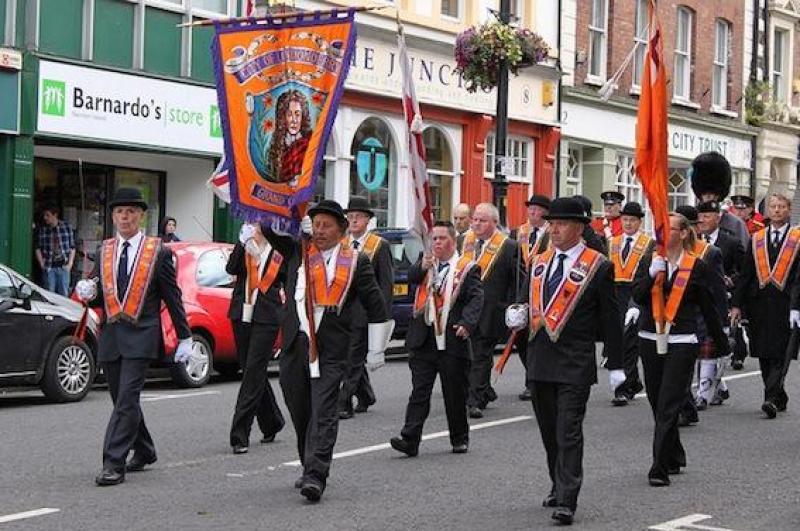
Up 300 people are expected to take part in an Orange Order march through the city centre on Sunday, July 7
Orangemen taking part in a previous march in Derry
Staff Reporter
01 Jul 2024 3:23 PM
Behind the scenes: Sky News election…
The PSNI said officers will be on duty to assist with any traffic issues, and accommodate the flow of traffic. Road users may wish to seek another route, if not attending a parade.
Up 300 people are expected to take part in an Orange Order march through the city centre on Sunday, July 7.
The parade will assemble at 1.15pm, and leaves at 1.45pm with participants moving along Bond Street in The Waterside, making its way along Clooney Terrace, Spencer Road, across Craigavon Bridge, towards The Diamond and back towards Clooney Terrace for 3.15pm
At 4.25pm, parade participants make their way from Clooney Terrace, via Glendermott Road and Bond Street, Spencer Road, Craigavon Bridge, Carlisle Road Ferryquay Street, The Diamond, Bishop Street, Palace Street and Society Street for dispersal at 5pm.
The army were searching for IRA weaponsA large number of guns, mostly belonging to the Official IRAThe killing of civilians, the use of CS gas and widescale destruction turned the population against the army
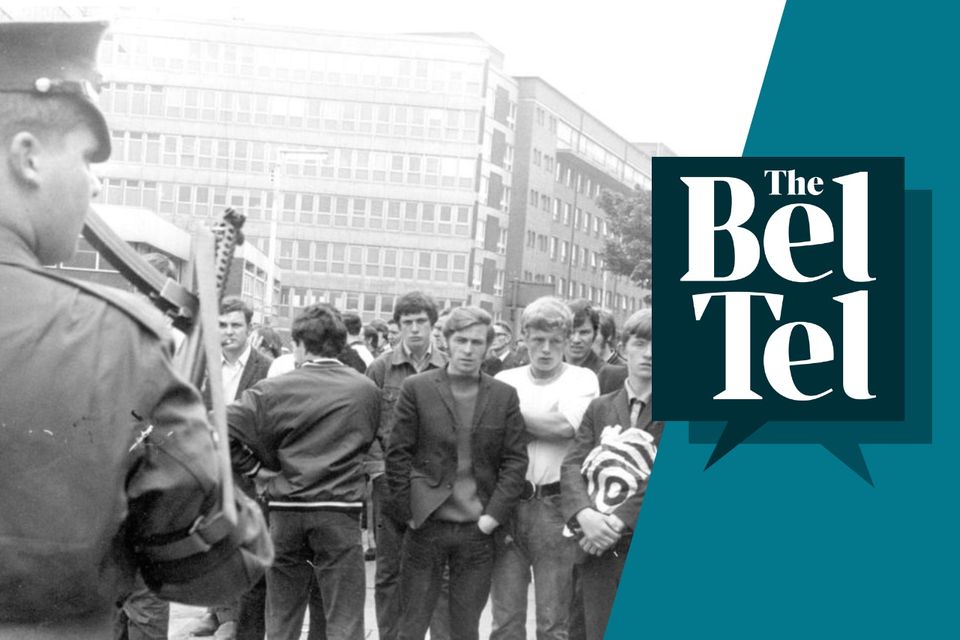
Military Police stand guard at checkpoint on the Falls Road in 1970
Today at 02:18
On the 3rd of July 1970, a Friday, the British Army seals off the lower Falls area of west Belfast.
A ‘curfew’ is announced, although without a legal basis.
Troops go in, searching from house to house, looking for IRA weapons.
But the use of CS gas, houses being wrecked, looted even, turns the population against them.
Hundreds, maybe thousands of rounds were fired – four people died – all victims of the army.
The Official IRA decided since they couldn’t get their guns out – they should fight the army in what they called ‘The Battle of the Falls.
In the end the army did seize a considerable number of weapons though many were smuggled out.
However, the standing of the British Army in west Belfast had been completely changed.
To hear the story of the Falls Curfew and its impact, Ciarán Dunbar is joined by historian Brian Hanley, and by Belfast Telegraph columnist and author Malachi O’Doherty.
The Falls Road Curfew: The raid on the Official IRA which turned west Belfast against British Army
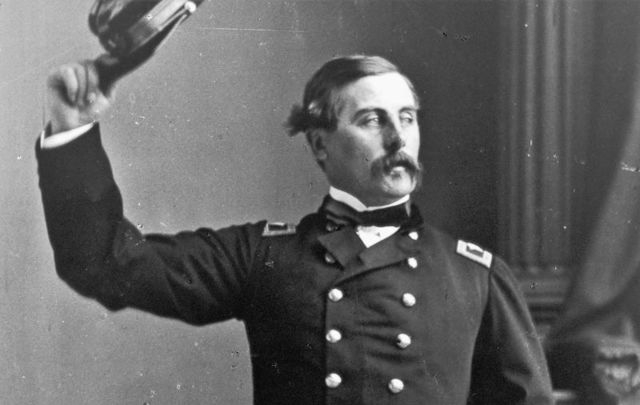
Although he lived only 44 years, Thomas Francis Meagher played a pivotal part in Irish and US history. GETTY
On this day, July 1, 1867, General Brigadier Thomas Francis Meagher died after falling overboard on the Missouri River. In honor of his anniversary, we look at the astounding biography of the American Civil War hero and leader of the Irish Brigade.
Although he lived only a short 44 years, Thomas Francis Meagher, who was born in Waterford in 1823, played a pivotal part in two of the most important movements in the histories of Ireland and the United States.
Yet today, to many Americans and Irish alike, Meagher is a distant landmark of history, the Civil War hero who, early in the war, guided the “Fightin’ 69th” and following their success was asked to form the famed Irish Brigade.
But the story of Meagher starts long before the American Civil War. It begins in Waterford, Ireland where he was born into privilege in 1823. Well educated in both Ireland and England by his politically-connected father, Meagher was appalled at what he saw the English doing to Ireland.
On the first page of the “The Immortal Irishman,” Egan writes: “You would not think in Irish, so the logic went if you were not allowed to speak in Irish.” The English stripped the Irish of their culture—then introduced famine. “Today,” said Egan, “we would call it ethnic cleansing. It’s also close to apartheid. Basically, the English did everything they could to strip away the basic dignity of a people. They took religion, language, sport, property, even music. And all it did was make the Irish more defiant. They clung to their religion, they made the harp a national symbol, they even started a hurling club in the first British colony, in Newfoundland—all as a way for a conquered people to remain Irish.”
Meagher grew up during one of the most interesting periods in Irish history. One of the treats of “The Immortal Irishman” is Egan’s wonderful description of the Young Ireland movement of the 1840s. First, there was O’Connell’s emancipation of the Catholics; then the Young Ireland movement with Thomas Davis, John Mitchel, William Smith O’Brien, and Oscar Wilde’s mother, Speranza—and Meagher knew all of them personally (Meagher and Speranza were even thought to be lovers).
Love Irish history? Share your favorite stories with other history buffs in the IrishCentral History Facebook group.
IrishCentral asked Egan how great was the influence of the Young Irelanders, not only on Meagher but on the Fenians of 1867 and the rebels of 1916? “Meagher and Young Ireland influenced both the Fenians and the Easter Rising rebels,” replied Egan. “You can see his influence in a book Arthur Griffith wrote about the time of the Rising, praising Meagher, and resurrecting his words. The Young Ireland slogan—Ireland for the Irish—was basically the same as the young rebels used in 1916.”
The thing that galvanized Meagher and the Young Irelanders was the Famine, which devastated Ireland during the 1840s, cutting the island’s population almost in half. Egan takes a good look at Charles Trevelyan, the man put in charge of famine relief. Trevelyan, a fine Christian man, thought the famine was sent from God, as a means of ridding the English of the lazy Irish—a “selfish, perverse and turbulent people” according to Trevelyan—always looking for a handout. “Being altogether beyond the power of man,” Trevelyan said, “the cure has been applied by the direct stroke of an all-wise Providence.”
When reminded that we still hear this type of stuff out of American politicians during election cycles as they cite the need to cut food stamps to the poor—pitting the “givers” against the “takers”—Egan said, “Yeah, I actually wrote a New York Times column on this. I was in the middle of researching the famine and Paul Ryan’s comments came to mind. It started a pretty vigorous discussion in Irish America magazine as well.”
2
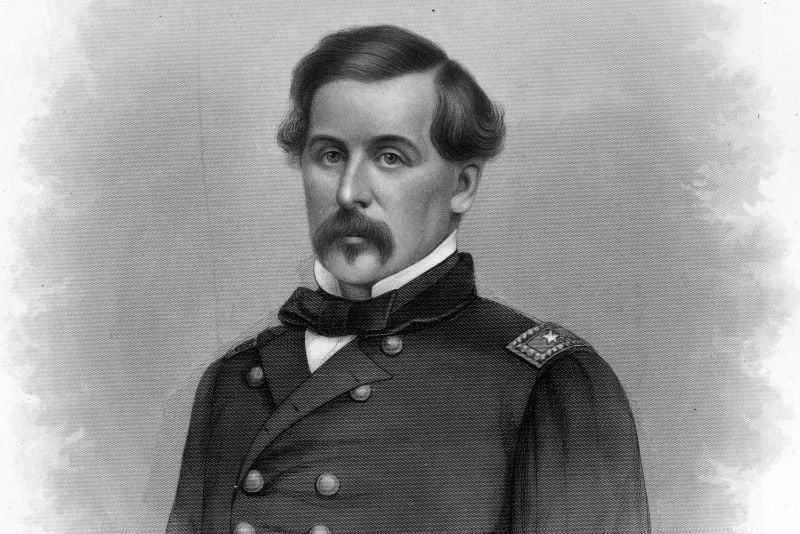
General Brigadier Thomas Francis Meagher.
Meagher also was close to John Mitchel, one of the weirdest Irish nationalists to ever breathe—a true political schizophrenic. In Ireland he was for freedom; in America, he was for slavery, and against blacks, and, especially, against President Lincoln. (Mitchel considered the slaves “an innately inferior people.” He also described President Lincoln as “an ignoramus and a boor.”)
Meagher was fiercely anti-slavery and a personal friend of Lincoln. “A very strange relationship,” said Egan of the Meagher-Mitchel friendship. “They were very tight in Ireland; Mitchel had Meagher’s back. Meagher was the voice; Mitchel the pen. Then they reunited in both Tasmania and America. But things got dicey in the U.S. Mitchel was a white supremacist, and he ended up losing (I think) two sons, who fought on the side of the slaveholding Confederacy. As I recall, one of the Mitchel boys was on the other side of Marye’s Heights wall when Meagher’s Irish Brigade charged.”
The “Rebellion of 1848” was really a skirmish in County Tipperary, but it was cited by Patrick Pearse (“six times during the past three hundred years they have asserted it in arms” Pearse wrote in the 1916 Proclamation) as one of the times that the Irish had risen up in arms against the British. Betrayed by an informer, it also cost Meagher his freedom when he was convicted of sedition, although he wasn’t even present at the “Battle of Ballingarry.” His death sentence was commuted and he was exiled to Tasmania.
Sign up to IrishCentral’s newsletter to stay up-to-date with everything Irish!Subscribe to IrishCentral
Life down-under wasn’t too bad for Meagher because his family had money. He lived well and found a wife. (They were to have one child, which Meagher would never meet because of his banishment from Ireland.) But he longed for freedom. As other convicts had done, under harrowing circumstance, he escaped to America. “America was a fascinating mess” his friend Richard O’Gorman told Meagher on Meagher’s arrival in New York. There was the problem of all the new immigrants and the nativist backlash of the “Know-Nothings.”
Things haven’t changed a lot in over 150 years, have they? If you exchanged the Irish for the Latinos it’s just about the same policy. “So true,” agrees Egan. “A point I try to make. It shows that, even though we’re a nation of immigrants, this anti-immigrant nativist streak comes and goes; it’s never far from the surface.”
The “Know-Nothings” went after Irish Catholics with a ferocity that America would not see until the civil rights battles of the 1960s. They terrorized the Irish in such cities as Philadelphia and Boston, burning churches to the ground, but did not succeed in New York principally because of the stand taken by “Dagger” John Hughes, the County Tyrone-born, toupee-wearing archbishop, the man who started building St. Patrick’s Cathedral.
Yet as the Civil War and the military draft took center stage the moral compass of Hughes was compromised and in the case of John Mitchel, utterly destroyed. Meagher stood strong, backing the Union and remaining strongly anti-slavery. “Meagher originally was an agnostic on slavery,” says Egan. “But he changed his view, and changed rather dramatically, after all the sacrifices the Irish Brigade made on behalf of the Union cause—which was, after all, the cause for liberation of black men. Once he came to that conclusion he was all in. And you saw, in the draft riots, that it would have cost him his life at the hands of fellow Irish had he been in New York when the rioting broke out.”
The heroics—and sacrifices—of Meagher’s men at places like Bull Run, Richmond, Antietam and Fredericksburg was instrumental in allowing the Irish to be accepted as Americans. “They were amazing warriors,” says Egan, “and no one thought they’d be able to fight at the start of the war. But they also kept their cultural traditions intact; they essentially took them to war—the horse races, the feasts, the masses, the plays, the poetry readings, and music.”
“The Immortal Irishman” is Egan’s seventh book and took him three years to write. His previous books include “The Big Burn,” “Short Nights of the Shadow Catcher” and “The Worst Hard Time,” for which he won a National Book Award. There are many colorful characters—Meagher himself, O’Connell, Thomas Davis, Mitchel, Smith O’Brien, Dagger John, General Sherman, Lincoln, etc. in “The Immortal Irishman.”
Did Egan ever think of making the book a novel? “No,” he replies definitively. “Here was a case where truth was much better than fiction. If you made up the dozen lives of the period no one would believe you.”
Meagher received his general’s commission directly from President Lincoln. “Lincoln liked Meagher and vice versa,” says Egan, “even though they were in different political parties. Lincoln made time to see Meagher even when he saw no one else. Lincoln shrewdly named Meagher a general as a way to win over the Irish masses to the Union cause.”
Love Irish history? Share your favorite stories with other history buffs in the IrishCentral History Facebook group.
After his first wife’s death, Meagher remarried in New York and after the Civil War, the couple were sent to the Montana territory by President Andrew Johnson where Meagher soon found himself the Acting Governor. There was a lot of lawlessness out there and Meagher fought the battle on the side of the angels. It may have caused his death because Egan believes, Meagher was murdered by his opponents. “I do. And I think that’s the emerging consensus view of historians in Montana who’ve looked at him in the last ten years or so. The earlier story of his death was bullshit.”
One of the things that strikes the reader of “The Immortal Irishman” is the similarity between Meagher and another Irishman—John F. Kennedy. Both were born into privilege; Meagher came from Waterford and Kennedy’s people came from the next county north, Wexford; both were extraordinarily handsome with keen intellects; both were the greatest orators of their day; both were war heroes; both were heroes of the civil rights movements of their time; and both were murdered in their middle-40s.
Did these similarities occur to Egan? “They did. And I’m glad you noticed. I only picked this up when I was looking for an ending and starting going through stories of JFK’s family, and the trip to Ireland. Many, many similarities—the charisma, the speechifying gift, the warrior heroism, the love of verse.”
Thomas Francis Meagher, a man not only for his time, but an Irishman for all time.
The Irish Republican Army (IRA) made an audacious raid on Gough Barracks in Armagh town on June 12, 1954, sixty years ago this week. It marked the reawakening of IRA activity in Ireland and a re-arming that leads eventually to the 1956-1962 Border Campaign.
In January 1954, Leo McCormick, the Training Officer for the Dublin Brigade of the IRA, is on a visit to Armagh. As he passes Gough Barracks, the home of the Royal Irish Fusiliers, he notices that the guard on duty outside the barracks is armed with a Sten gun without a magazine. He concludes rightly that Gough Barracks is in effect being guarded by an unarmed guard.
On his return to Dublin, McCormick informs the Dublin Brigade of his chance observation. Alas, he does not see the end result of his information, as he is arrested soon after and receives four years for possession of a document.
By April, the General Head Quarters decides that they will raid Gough Barracks for arms. But first, they need more information. Eamonn Boyce, the Intelligence Officer of the Dublin Brigade, is asked to travel to Armagh and check out the barracks. He makes several trips to Armagh and soon has a detailed account of life outside the barracks. But GHQ wants more inside details. Charlie Murphy gets over this problem by asking Seán Garland to go to Armagh and enlist in the British Army. Not long after Garland’s enlistment, a stream of maps, documents, time schedules and photographs flow into GHQ for processing.
Finally, a last intelligence coup is arranged. Using Garland’s information, the IRA gets inside the barracks to have a look around. On a Saturday night in May, Boyce and Murphy slip into the barracks as “guests” at a weekly dance. With them they bring a girl, Mae Smith, who is later to become chairperson of Sinn Féin. After a few dances, Garland takes Mae outside for what his fellow soldiers assume is an hour of light passion but is in fact a detailed tour of the entire barracks.
The operation is launched on June 12, 1954, from a farm just outside Dundalk. A large red cattle truck is commandeered at the last moment and nineteen IRA men, about half of the Dublin Brigade, climb in and are informed as to what their target is. It is almost 3:00 on a busy Saturday afternoon when the cattle truck and a car drive into Armagh.
Paddy Ford gets out of the car and walks over to the sentry and asks him about enlisting in the British Army. While the sentry is dissuading Ford of what he considers a foolish course of action, he looks down into the barrel of a .45 caliber Colt revolver in the perspective recruit’s hand. As the sentry is held at gunpoint, three IRA men pass him into the guardhouse. The sentry is then brought in after them. While the sentry is being tied up, a new IRA sentry, complete with British uniform, white webbing belt, regimental cap and sten gun with magazine steps out to stand guard over Gough Barracks.
As soon as the IRA sentry appears, the cattle truck drives through the gate and comes to a halt outside the arsenal door. After fumbling through 200 keys, Eamonn Boyce finds the right one and opens the armoury. Murphy races up the stairs and in the first room two British soldiers demand to know what a civilian wants inside the barracks. Murphy has some trouble getting his revolver out of his pocket and is further embarrassed when the two soldiers refuse to put up their hands. However, another IRA man arrives carrying a Thompson submachine gun, which quickly convinces them to do as they are told. Posting a Bren gun at the armoury window to command the barracks square, the IRA begins stripping the armoury.
During the course of the raid a woman, noticing something is wrong, stops a British officer in the street and urges him into the barracks to investigate. Once inside the gate the officer is taken under control and, protesting that he is an officer and a gentleman, refuses to be tied until a gun is put to his head.
An NCO then notices what is happening, gets into a lorry and drives for the gate, intending to block the exit. An IRA man stands at the gate brandishing a revolver and shouts “Back.” He forces the NCO to reverse the lorry. The NCO is placed under arrest in the guard room. By the end of the raid, the IRA has tied up 19 British soldiers and one civilian.
In less than 20 minutes the job is done. The truck carrying 340 rifles, 50 Sten guns, 12 Bren guns, and a number of small arms drives out of the barrack gates and rumbles through Armagh in the direction of the border. Eamonn Boyce and the group in the car follow after locking every gate and door for which they can find keys. At 3:25 PM the first alarm in the barracks is given but it is not until 5:00 that the general alarm is given and by that time the big red truck is long gone.
The raid for arms in Gough Barracks gains international attention. The IRA, which has been described by some as moribund since the ’40s campaign, has once more risen from its slumber to strike a blow against the forces of occupation. The raid awakes a calling in many to join the IRA and take part in the Border Campaign, which keeps alive the flame of republicanism through to the present time.