Posted by Jim on March 22, 2014
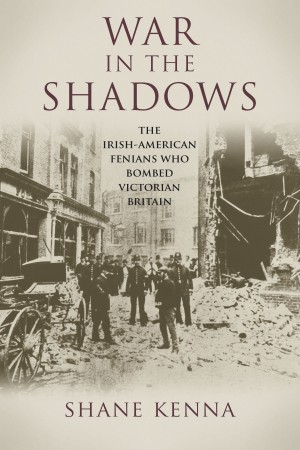 War in the Shadows: The Irish-American Fenians Who Bombed Victorian…
By Shane Kenna
Merrion Press
Available from Amazon.com
Reviewed By Sandy Boyer
“Now there is an Irish nation in the United States, equally hostile with plenty of money, absolutely beyond our reach, and within ten days’ sail of our shores.” — British Home Secretary William Vernon Harcourt
Shane Kenna has written the definitive history of the bombing campaign by U.S.-based Fenians that produced more than 20 explosions in British cities between 1881 and 1885. It is a fascinating and highly readable account of a too often neglected phase of Irish nationalism in the U.S.
War in the Shadows recounts the parallel history of the Fenians in the United States out to take dynamite to British cities and Britain’s secret intelligence service determined to infiltrate and destroy them. The most devoted students of Fenians may already know at least a little about what Kenna reveals about the U.S.-based dynamite plots but his information about the British secret policing is available for very first time.
Almost a century after the American Fenians, the Provisional IRA launched its own bombing campaign in Britain supported by arms and money from America. But the contrasts between the two campaigns on each side of the Atlantic were at last as important as the similarities.
For the Provos, bombing Britain was an extension of the ongoing war in Ireland. The Fenian bombing campaign was very much made in America.
It was explicitly a substitute for building an organization in Ireland, born out of frustration that the time for action in Ireland never seemed to be right. The men leading the U.S.-forged bombing campaign were often actively hostile to the Irish Republican Brotherhood in Ireland, feeling that it was ineffective and wasting time and money.
Although the IRA’s war received critical arms and money from America, NORAID (Irish Northern Aid) firmly denied that it ever sent money for guns, insisting that all its funds were used to sustain prisoners’ families. When NORAID founder Michael Flannery was tried for gun running, he proudly acknowledged that he had accepted contributions to arm the IRA. But he insisted that these were totally separate from the contributions he received for Irish Northern Aid.
The Irish-American Fenians shouted their intention to wage war against Britain from the rooftops. Jeremiah O’Donovan Rossa used the pages of The Irish World, the most popular Irish-American newspaper of the time, to launch a “skirmishing fund” to finance action against Britain.
Pledging $20, Thomas J. Kavanagh wrote that “there must be some blood spilt.” “Rory of the Hill” was even more explicit: “In case you at any time soon deem it expedient to fit and equip a detachment of secret service whose object will be by the aid of explosives … for the purpose of blowing up the Parliament in London and some other forts and castles throughout England and Ireland – if such is mediated by you I am at your service.”
For a period of five years that was just what the Irish dynamiters in America set out to do. They bombed the House of Commons, the Tower of London, and the Westminster Crypt on the same day, January 24, 1885. They also set off explosions at Scotland Yard, London Bridge, the London Underground and at police and army barracks. These bombings were carried out by men the American Fenians organized, armed, financed and often dispatched from the U.S.
The British government had a contradictory, perhaps hypocritical, attitude toward secret policing. It was perfectly acceptable to recruit informers and agents provocateur in Ireland. In Britain the Victorians wanted their policing done exclusively by uniformed constables.
‘Not a cent for blatherskite but every dollar for dynamite’
The Fenian bombers made that impossible. The government reluctantly set up a secret policing operation reporting to the Home Secretary. Such were the prejudices of the age that the Home Secretary had to maintain what would now be called deniability.
Just as MI5 infiltrated the Provisional IRA in the 20th century, the British Home Office planted informers and agents provocateur at high levels in the Fenian dynamite organization.
‘Red’ Jim McDermott of Dublin posed as the most militant Fenian dynamiter. He electrified the founding convention of the United Irishmen of America by saying their policy would be “not a cent for blatherskite but every dollar for dynamite.” McDermott was in fact on the British payroll the entire time.
Moving to London and Cork he infiltrated a Fenian cell, providing them with money and nitroglycerin. The men he was supposed to be helping to bomb London were captured and sentenced to penal servitude for life when Red Jim testified against them in secret.
After he was exposed, the government arranged for McDermott to move first to Germany and then Denmark. He settled in Paris, married a wealthy woman and lived in luxury, styling himself the Count de Neonlier.
Dr. Henri Le Caron, actually Thomas Breech from Colchester in England, may have been the most successful British agent in the American Fenians. He gained the total confidence of Alexander Sullivan, the leader of the dynamite wing writing that “For a period of twenty years I used this man as my dupe…no man in the whole course of my career in the secret service proved a more valuable, albeit an unconscious, ally than he.”
Le Caron had access to all the Fenian plans and turned them over to the Home Office. The American organization sent him to London and Paris where he successfully infiltrated the Fenian organization and was even introduced to Parnell in the House of Commons.
He wound up testifying in London that Charles Stewart Parnell and the Home Rule Party he led were secret supporters of the Fenian dynamite campaign. He was a key part of a British government effort to libel and politically destroy Parnell.
Before he testified Le Caron made sure that he was well taken care of asking for “either a lump sum of ten thousand pounds or an annuity for life of four hundred pounds a year.” – an immense amount at the time. But Kenna makes it clear that unlike McDermott, a total opportunist, Le Caron (Breech) was never motivated primarily by money — he was an Englishman serving his country.
Kenna demonstrates that British intelligence “could only contain rather than defeat Fenian conspiracy.” As in the 20th century, an armed campaign could only be ended by a political arrangement. The Fenian dynamite campaign ultimately succumbed to the perception that Parnell was going to deliver home rule, not to Britain’s long campaign of infiltration and disruption.
War in the Shadowsshould be read by everyone with an interest in Fenianism and Irish nationalism in America. The story Kenna has to tell and the characters he introduces make it fascinating in its own right. The many parallels to the history of the Provisional IRA and MI5 make it still more compelling.
From The Wild Geese
Posted by admin on March 20, 2014
Sorry, Helen, but I very much disagree with you. I supported the decision to invite the PSNI and believe that it is measures such as this that will help us to advance the peace process in the North.
PSNI officers are drawn from Catholic ranks and serve all citizens in the North with impartial and fair policing services. At the AOH parade in Cookstown, County Tyrone on Monday, three PSNI offic…ers placed themselves in front of a group of young men who came to the parade looking to cause trouble. You can thank the good work of the PSNI for ensuring that the AOH parade went off well and that no one was threatened.
I caution against any characterization of the PSNI as just a latter-day version of the RUC. There is a substantial effort ongoing in the North to build a modern-day police force that is fair, impartial and fit for purpose. For those in the RUC that colluded with the UDF (and for those in the Gardai that did the same with the IRA), they will have to answer for their own sins.
Finally, I remind you of PSNI Officer Ronan Kerr, a Catholic who who gave his life in order to build fair and effective community policing to Northern Ireland in 2011. In my mind, his service and sacrifice is all the reason one needs to justify the decision to allow PSNI officers to march in the New York City parade honouring the Saint of all-Ireland with respect and dignity.
My reply to John 3/19/14
John, first I would like to commend you on your honesty and openness, but with all due respect, I don’t see how inviting the PSNI/RUC/B-Specials to march in the St. Patrick’s Day parade will advance the peace process along? I find that a very far stretch of the imagination and wishful thinking.
As for the “PSNI serving all citizens in the North with impartial and fair policing services,” Please tell that to the McGeough family. Marian Price, Martin Corey, Stephen Murney and the list goes on and on and on John as they continue to arrest and intern republicans without trial.
“As for the three PSNI offices placing themselves in front of a group of young men who came to the parade looking to cause trouble. You can thank the good work of the PSNI for ensuring that the AOH parade went off well and that no one was threatened.”
Odd statement to make in lieu of the fact the PSNI/RUC can’t seem to control the Orangemen when they march through Catholic enclaves every July 12th.
“I caution against any characterization of the PSNI as just a latter-day version of the RUC”
Their continued adversarial behavior toward Irish republicans who do not support the status-quo imply nothing has changed. A rose by any other name is still a rose. John, they still call those who served in the IRA “terrorists” and they label anyone who thinks outside the box “dissidents”. So what’s good for the goose is good for the gander.
“For those in the RUC that colluded with the UDF, they will have to answer for their own sins”.
That’s all well and good John, in the hereafter, but republicans who speak out against the misdeeds of the PSNI/RUC or don’t agree with some of Sinn Fein’s policies pay for their “sins” in this life. They are harassed, arrested and incarcerated. Some held for two or more years without trial and then released.
While I can understand the priority to move forward and leave the past in the past, justice has to be served first and the PSNI/RUC marching in the St. Patrick’s Day parade is not the answer. It was a slap in the face. It appears that since the Good Friday Agreement, it has been the Nationalist community who has done all of the “advancing” while Sinn Fein does the dancing to the tune of whatever the British government and the Unionist want.
John. You may have “justified in your mind the decision to allow the PSNI/RUC to march in the New York City parade because of the death of PSNI Ronan Kerr”, which to me was a tragic and useless murder, but I protested the PSNI/RUC invite because of all of the tragic and useless murders of innocent Irish Catholics at the hands of the security forces in the North and the continued internment of Irish republicans.
And finally, instead of praising the PSNI/RUC and forcing acceptance of them on the Nationalist community, wouldn’t it be more constructive to see to it that the Diplock courts be abolished in the North. They only serve to incarcerate republicans anyway. To ensure that anyone who committed an “offense” during the troubles, and prior to the Good Friday Agreement, no longer be pursued by the PSNI/RUC and those who did time have their convictions overturned. To ensure that all of the OTRs receive amnesty. And those, who like Gerry McGeough, the first Irish republican to be tried and incarcerated after the Good Friday Agreement, have their prohibitively restrictive probation (license), revoked. To me those would be the key issues for advancing the peace process forward not the PSNI marching in a parade.
Respectfully,
Helen
Posted by Jim on March 18, 2014
Now that the brits have breached the wall and sullied one of our most sacred institutions, The Saint Patrick’s Day Parade with the presence of the PSNI and created a fair amount of dissension amongst the ranks, I wanted to share this recent interview (below) with Stephen Murney an Irish Republican community activist who spent 14 months interned in Maghaberry on trumped up charges by none other than our New York parade guests. Stephen’s 14 month internment by remand was preceded by an Orwellian style invasion of his home by the PSNI at 6am in the morning which traumatized his young son. All of this for telling the truth about PSNI abuse of power and harassment of the nationalist community in Newry.
Also, in light of recent developments along the many parade routes, it should be noted that not every Freedom For ALL Ireland Committee is created equally, nor do we all tow the ‘party’ line.
I ask those that are willing, to please distribute.
Beannachtaí na Féile Pádraig oraibh
Gerry McHale
PA AOH FFAI Committee
*
An Bhreatain amach as Éirinn
“Everyone Republican or otherwise has their own particular part to play. No part is too great or too small; no one is too old or too young to do something.” – Bobby Sands
*
Stephen, could you recount for members of the Irish-American community the background to your arrest and imprisonment?
First of all, I think it’s important to set this all in a proper context.
Despite the claims to the contrary by members of both constitutional nationalist parties in the Six Counties and by the establishment parties in the Free State, very little substantial change has occurred in respect of policing in the North.
The name of the police force may have changed, but let’s not forget that the PSNI is a fully armed force with access to the most modern weaponry. It still operates under a whole raft of very draconian and far-reaching so-called ‘anti-terror’ legislation.
While the titles of the police force and the legislation that force has access to may have changed over the years, there is little to differentiate between supposedly modern, reformed policing and that which took place under the RUC and the legislation available to that force in previous decades.
Let’s not forget that two key demands of nationalists in the Six Counties for decades were for a totally unarmed police force and an end to all repressive legislation.
Neither of those two demands has been met.
As is the case across the Six Counties, in the Newry area where I live, harassment of political activists and their families and friends has continued unabated. Stop and searches occur on an almost daily basis, house raids are a regular occurrence.
My own home had been raided by the PSNI several times over the years under legislation such as the Terror Act 2000. I was also subjected to dozens of stop-and searches.
I and other members of the party had started to record and collate all those incidents of PSNI harassment of activists and members of the general public in the Newry area. It is true that I did photograph members of the PSNI when they were carrying out stop and searches or when they were harassing people in general. I also photographed and recorded the PSNI’s heavy-handed response to various pickets and public protests in Newry.
Indeed, it’s also worth pointing out that on one occasion the photos I had taken were used by a defence solicitor to totally repudiate and discredit statements made by PSNI personnel during the trial of a local man accused of assault on the PSNI.
I mainly used those various photographs to accompany press releases which were sent to local newspapers or to the éirígí website to highlight the abuse of powers by the PSNI.
I was also documenting and recording these cases, as well as PSNI harassment of myself, for the Committee for the Administration of Justice (CAJ) based in Belfast. CAJ is an independent human rights organisation with a cross-community membership established in 1981 and it lobbies and campaigns on a broad range of human rights issues. It regularly submits report to the UN and other international bodies.
Indeed, a CAJ report called
‘Still Part Of Life Here?’ was published in November 2012, just before my arrest. It may seem ironic now, but that report included details of oppressive policing in the Newry area that I had submitted to them.
So it’s against that backdrop that one needs to view my arrest.
Quite obviously, the PSNI in the Newry area took exception to the frequent adverse coverage of their actions in the local papers which I was securing through my role as PRO for the party in the town.
Added to that was the fact that, through my reporting of incidents to CAJ, the PSNI’s actions were coming under the spotlight of a far wider, international audience.
When I was charged, the charges mainly related to those photographs. The other charges regarding my old band uniforms and my son’s toy guns, which the PSNI claimed to be ‘items for use in terrorist purposes’, were added as ‘window-dressing’ to make their case appear stronger than it actually was.
You initially were granted bail, which you refused to accept: can you explain why?
While the High Court in Belfast granted bail, it should be remembered that the conditions were very draconian. Those conditions included:
- A ban on living with my partner and child at our home in Newry
- A requirement that I reside at a location vetted by the PSNI at least five miles from Newry
- A ban on entering the city of Newry for any purpose including visits to the doctor – even if advanced notice of such visits were supplied to the PSNI.
- A ban on attending any meetings or other events of a political nature.
- A strict curfew that would require me to remain within the specified address between the hours of 7pm and 10am.
- A requirement that I wear an electronic tagging device at all times.
- A requirement that I reported daily to Newtownhamilton PSNI barracks which is located a further twelve miles from my bail address.
Neither I nor my partner drives so even seeing each other would have been difficult under those conditions. We certainly could not have had anything that came close to the normal family life we had been used to.
The extreme bail conditions which the court sought to impose upon me amounted to a form of collective punishment for my partner, children and wider family.
They were also clearly designed to ‘criminalise’ and punish me for legitimate political activism.
I have no doubt that, had I accepted those bail conditions, I would have breached them through no fault of my own as the conditions, as a whole, were designed in such a way to make it impossible for me to avoid breaking them.
For example, I receive regular medical treatment. If I had to see my doctor urgently and went to his surgery in Newry, I would have been classed as having breached the bail conditions.
You have a young family. How did they handle the whole situation of seeing you in prison?
The impact was far greater upon my family than any effect it had on me.
My partner was left at home with the children to raise and look after.
My youngest son, who was 6 at the time of my arrest, was very visibly shaken and terrified when heavily armed PSNI personnel smashed in the front door of our home at 6am, handcuffed me and took me away that morning. On visits to the gaol, he would become very stressed when it was time to leave. Experiences like can have far-reaching effects for any young child.
Additionally, and although my partner, parents and the rest of my family knew there was no substance to the PSNI charges, they had no idea how long I would be held for. That simple fact alone caused them a lot of stress and anxiety.
You were obviously aware of the campaign for your release on the outside. What was your reaction to that?
Members of my family, party comrades in éirígí and friends would visit me frequently so I was kept up to date with events on the outside. I certainly hadn’t expected a campaign to be organised on my behalf but it is good to know that others also knew that I was totally innocent and that they were continuously prepared to say so publicly.
I believe that the campaign played a great part in keeping up the spirits and morale of my family. It gave them strength and encouragement and it ensured that they did not feel isolated.
Of course, when there were successful public events and protests on the outside it raised spirits and boosted morale for everyone.
I remember we were out in the exercise yard in August 2013 and we received word that several thousand people were taking part in a massive Anti-Internment march in Belfast which had been organised jointly by several organisations including éirígí. I’ll never forget the feeling on the wing when we heard about the turnout.
In the run-up to and during your trial, how did you feel? Were you confident that you would be released?
My comrades in éirígí had been regularly liaising with my legal team on the outside and were repeatedly stressing to them their view that the charges against me were designed as a test-case which, if the PSNI and prosecution were successful, would have had far-reaching implications for many political and other activists. They also pointed out that the charges against me were at variance with the European Convention of Human Rights.
Article 10 of the Convention states that, “Everyone has the right to freedom of expression. This right shall include freedom to hold opinions and to receive and impart information and ideas without interference by public authority.”
As local PRO for éirígí in Newry, I had clearly held opinions and political views, and the photographs which I had used to accompany press releases were clearly meant to impart information and to allow others to receive that information.
However, at the time of my initial arrest, I had no idea as to how far-reaching the charges against me could be in terms of possible future prosecutions of others.
Certainly, that whole crux of the case was made clear by my legal team and by those party members liaising with them in the run-up to and during the trial, and was very ably articulated by my barrister – much to the repeated frustration of the prosecuting counsel!
Of the 107 photographs which the prosecution had based their case upon, every one had either been used to accompany press releases to local media outlets, articles on the party website, or were used to confirm misuse of powers by the PSNI during stop and searches.
The PSNI/prosecution argument was that even if a political activist or other member of the public believes he or she is being harassed by police, anti-terrorism legislation should be construed in a way to make it unjustifiable for such a person to publish or even to take photographs of those PSNI personnel. They even argued that while it was acceptable (to them) for press photographers to take and possess pictures of PSNI personnel, it was not justifiable for others to do so.
As my defence argued, it is difficult to see how such an interpretation could be compatible with the Article 10 of the ECHR.
To be honest, I had no idea what way the judge was going to decide.
The court eventually ruled, after several days of deliberation, that the PSNI and prosecution service cannot apply one different standard of law to press or media photographers and another standard to political activists when it comes to recording and documenting the conduct of the PSNI.
According to my legal team and party members, that is a very important and significant decision which will prevent the PSNI taking possible similar actions against other people in the future. Apparently, my case will be cited as case-law.
For me, the decision was complete vindication that I had been acting totally within my rights to photograph and record oppressive policing.
I was declared innocent. That is exactly what I, my family, party comrades and supporters had all been saying since the day I was first arrested. But it took 14 months of my life for a court to say the same thing.
How did it feel to hear you were free to go from the court?
It was obviously a relief and I was happy that I was going home to my family and community for good.
However I couldn’t help but feel angry at essentially being interned by remand in Maghaberry for 14 months despite being innocent the whole time.
Was it strange for you to see your face and name on walls since your release?
Shortly after my release, I was walking through Newry and on almost every wall there was a poster with my face on it. I was also walking down the Falls Road in Belfast and there was a mural of me on the International Wall. I have to say it was a bit strange to see those things but I recognise it was all part of the campaign carried on by my party comrades and friends who all did some great work for me and my family.
What’s your plans for the future and has the whole experience reinforced your resolve as a republican?
I intend to continue with my political activism and I have already re-involved myself with éirígí.
The past 14/15 months have, if anything, reinforced my view that the supposed changes which have taken place in the Six Counties during the last decade and a half have been largely cosmetic.
Peel back that cosmetic veneer and you will find a state that still is under British control, where people’s lives are still subjected to repressive policing and draconian laws; a state that is a failure both politically and economically.
It has helped me learn a lot about Republican prison struggle and what prison life for Republicans entails, particularly when faced with an oppressive and restrictive regime such as the one in place in Maghaberry where the brutal and inhumane practice of strip-searching of prisoners still take place as a matter of routine.
It is also important to emphasise that I am not the only victim of malicious persecution and prosecution by the PSNI.
There are other cases of injustice which are still ongoing and it’s very important that they are also publicly highlighted and supported. I would intend to assist in that.
Posted by Jim on March 17, 2014
Brothers, I am sending this message out to our National Board and State Presidents because perhaps some of you (especially in the NY metro area) have been receiving calls/emails regarding the decision of the St. Patrick’s Day Parade Committee to permit six members of the PSNI (Police Service of Northern Ireland) to march on Monday as part of a Garda police unit from the Republic. At first I was surprised at the PSNI request and wondered if their participating might be seen as an omen/vision of a future single policing body within the context of a united Ireland. Similarly, I wondered if the PSNI folks could possibly be aware that the only message permitted and seen continuously throughout the parade they seek to participate in consists of merely five words:”England Get Out of Ireland.” Indeed, life is full of ironies!!
You should understand that the AOH here in New York does not sponsor or manage this parade, and has not done so for 12 years.
Having served as National Freedom For All Ireland Chairman for fourteen years during some of the worst periods in the Six Counties, I remain an unapologetic Irish Republican. Some feel that the AOH should now refuse to march as a form of protest. If that is the conviction of some of our Brothers, then that is their decision.
In the bad old days, Ian Paisley used to bark, “No surrender…Not one inch!” as his response to the aspirations of Irish Nationalists.
I have been a participant in the 5th Avenue Parade for well more than half of my life. I have no intention of surrendering the AOH’s position on 5th Avenue-“Not one inch!”
All the best,
Brendan