Posted by Jim on
Michael Collins (Irish: Mícheál Ó Coileáin;[2][3] 16 October 1890 – 22 August 1922) was a soldier and politician who was a leading figure in the struggle for Irish independence in the early 20th century. Collins was an Irish revolutionary leader, politician, Minister for Finance, Director of Information, and Teachta Dála (TD) for Cork South in the First Dáil of 1919, Adjutant General, Director of Intelligence, and Director of Organisation and Arms Procurement for the IRA, President of the Irish Republican Brotherhood from November 1920 until his death, and member of the Irish delegation during the Anglo-Irish Treaty negotiations. Subsequently, he was both Chairman of the Provisional Government and Commander-in-chief of the National Army.[1] Collins was shot and killed in an ambush in August 1922 during the Irish Civil War.
Born in Sam’s Cross, near Clonakilty, County Cork, Collins was the third son and youngest of eight children. Most biographies give his date of birth as 16 October 1890, but his tombstone cites 12 October 1890. Referred to in a British secret service report as “brainy”, the Collins family were part of an ancient clan, widely spread over County Cork. They had republican connections that can be traced back to the 1798 rebellion.[4]
Collins’ father, Michael John (1816–1896), was a farmer by profession. A mathematician in his spare time, he had been a member of the Irish Republican Brotherhood (IRB) movement. The elder Collins was 60[5] years old when he married Mary Anne O’Brien, then 23,[6] in 1876.[7] The marriage was apparently happy. They brought up eight children on a 90-acre (36 ha) farm called Woodfield, which the Collins had held as tenants for several generations.
On his death bed, his father (who was the seventh son of a seventh son) predicted that his daughter Helena (one of Michael’s elder sisters) would become a nun. She later did, known as Sister Mary Celestine, based in Whitby.[8] He then turned to the family and told them to take care of Michael, because “One day he’ll be a great man. He’ll do great work for Ireland.” Michael was six years old when his father died.[9]
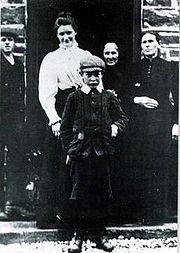
Michael Collins at the age of 8 with his family.
Collins was a bright and precocious child with a fiery temper and a passionate feeling of Irish nationalism. He named a local blacksmith, James Santry, and his headmaster at Lisavaird National School, Denis Lyons, as the first nationalists to personally inspire his “pride of Irishness.” Lyons was a member of the IRB, while Santry’s family had participated in, and forged arms for, the rebellions of 1798, 1848 and 1867.[4][10]
There are a number of anecdotal explanations for the origin of his nickname, “The Big Fellow”. The most authoritative comes from his family, stating that he was so called by them while still a child. It had been a term of endearment for their youngest brother, who was always keen to take on tasks beyond his years. It was certainly already established by his teens, long before he emerged as a political or military leader.[11]
At the age of thirteen he boarded at Clonakilty National School. During the week he stayed with his sister Margaret Collins-O’Driscoll and her husband Patrick O’Driscoll, while at weekends he returned to the family farm. Patrick O’Driscoll founded the newspaper The West Cork People and Collins helped out with general reporting jobs and preparing the issues of the newspaper.[12]

Collins as a young recruit.
After leaving school at fifteen, Collins took the British Civil Service examination in Cork in February 1906,[13] and was then employed by the Royal Mail.[14] In 1906, he moved to the home of his elder sister Hannie (Johanna) in London where he became a messenger at a London firm of stockbrokers, Horne and Company.[13] While living in London he studied law at King’s College London.[15] He joined the London GAA and, through this, the IRB. Sam Maguire, a republican from Dunmanway, County Cork, introduced the 19-year-old Collins to the IRB.[16] In 1915 he moved to the Guaranty Trust Company of New York where he remained until his return to Ireland the following year[17] joining part-time Craig Gardiner & Co, a firm of accountants in Dawson Street, Dublin.[18]
Easter Rising
The struggle for Home Rule, along with labour unrest, had led to the formation in 1913 of two major nationalist paramilitary groups who would launch the Easter Rising: the Irish Citizen Army was established by James Connolly and the Irish Transport and General Workers Union (ITGWU), to protect strikers from the Dublin Metropolitan Police during the 1913 Dublin Lockout. The Irish Volunteers were created in the same year by the IRB and other nationalists in response to the formation of the Ulster Volunteers (UVF), an Ulster loyalist body pledged to oppose Home Rule by force.
An organiser of considerable intelligence, Collins had become highly respected in the IRB. This led to his appointment as financial advisor to Count Plunkett, father of one of the Easter Rising‘s organisers, Joseph Mary Plunkett. Collins took part in preparing arms and drilling troops for the insurrection.
The Rising would be Collins’ first appearance in national events. When it commenced on Easter Monday 1916, Collins served as Plunkett’s aide-de-camp at the rebellion’s headquarters in the General Post Office (GPO) in Dublin. There he fought alongside Patrick Pearse, James Connolly, and other members of the Rising leadership. The Rising is generally acknowledged to have been a military disaster, yet the insurgents achieved their goal of holding their positions for the minimum time required to justify a claim to independence under international criteria.[19]

Captured Irish soldiers in Stafford Gaol after the failed Easter Rising. Collins is fifth from the right with an ‘x’ over his head.
Arrested along with thousands of other participants, Collins was subsequently imprisoned at Frongoch internment camp in Wales.
Collins first began to emerge as a major figure in the vacuum created by the executions of the 1916 leadership. He began hatching plans for “next time” even before the prison ships left Dublin.[20]
At Frongoch he was one of the organisers of a program of protest and non-cooperation with authorities, similar to that later carried on by IRA internees of the 1980s. The camp proved an excellent opportunity for networking with physical-force republicans from all over the country, of which he became a key organiser.[21][22]
While some celebrated the fact that a rising had happened at all, believing in Pearse’s theory of “blood sacrifice” (namely that the deaths of the Rising’s leaders would inspire others), Collins railed against the military blunders made, such as the seizure of indefensible and very vulnerable positions like St Stephen’s Green, which were impossible to escape from and difficult to supply. Public outcry placed pressure on the British government to end the internment. In December 1916, the Frongoch prisoners were sent home.
1917–1918
Before his death, Tom Clarke, first signatory of the 1916 Proclamation and widely considered the Rising’s foremost organiser, had designated his wife Kathleen (Daly) Clarke as the official caretaker of Rising official business, in the event that the leadership did not survive. By June 1916, Mrs. Clarke had sent out the first post-Rising communiqué to the IRB, declaring the Rising to be only the beginning and directing nationalists to prepare for “the next blow.” Soon after his release Mrs Clarke appointed Collins Secretary to the National Aid and Volunteers Dependents Fund (NAVDF) and subsequently passed on to him the secret organisational information and contacts which she had held in trust for the independence movement.
Collins became one of the leading figures in the post-Rising independence movement spearheaded by Arthur Griffith, editor/publisher of the main nationalist newspaper The United Irishman, (which Collins had read avidly as a boy.) [21] Griffith’s organisation Sinn Féin had been founded in 1905 as an umbrella group to unify all the various factions within the nationalist movement.
Under Griffith’s policy, Collins and other advocates of the “physical-force” approach to independence gained the cooperation of non-violent Sinn Féin, while agreeing to disagree with Griffith’s moderate ideas of a dual monarchy solution based on the Hungarian model.[23] The British government and mainstream Irish media had wrongly blamed Sinn Féin for the Rising. This attracted Rising participants to join the organisation in order to exploit the reputation with which such British propaganda had imbued the organisation. By October 1917 Collins had risen to become a member of the executive of Sinn Féin and director of organisation for the Irish Volunteers. Éamon de Valera, another veteran of 1916, stood for the presidency of Sinn Féin against Griffith, who stepped aside and supported de Valera’s presidency.[23]
First Dáil

Members of the First Dáil
First row, left to right: Laurence Ginnell, Michael Collins, Cathal Brugha, Arthur Griffith, Éamon de Valera, Count Plunkett, Eoin MacNeill, W. T. Cosgrave, Kevin O’Higgins (third row, right)
In the 1918 general election Sinn Féin swept the polls throughout much of Ireland, with many seats uncontested, and formed an overwhelming parliamentary majority in Ireland. Like many senior Sinn Féin representatives Collins was elected as an MP (for Cork South) with the right to sit in the House of Commons of the United Kingdom in London. Unlike their rivals in the Irish Parliamentary Party (IPP), Sinn Féin MPs had announced that they would not take their seats in Westminster but instead would set up an Irish Parliament in Dublin.[24]
Before the new body’s first meeting, Collins, tipped off by his network of spies, warned his colleagues of plans to arrest all its members in overnight raids. De Valera and others ignored the warnings on the argument that, if the arrests happened, they would constitute a propaganda coup. The intelligence proved accurate and de Valera, along with Sinn Féin MPs who followed his advice, were arrested; Collins and others evaded incarceration.
The new parliament, called Dáil Éireann (meaning “Assembly of Ireland”, see First Dáil) met in the Mansion House, Dublin in January 1919. In de Valera’s absence, Cathal Brugha was elected Príomh Aire (‘First’ or ‘Prime’ Minister but often translated as ‘President of Dáil Éireann’). The following April, Collins engineered de Valera’s escape from Lincoln Prison in England, after which Brugha was replaced by de Valera.
No state gave diplomatic recognition to the 1919 Republic, despite sustained lobbying in Washington by de Valera and prominent Irish-Americans and at the Paris peace conference. In January 1919 the Dáil ratified the Irish Republican Army‘s (IRA) claim to be the army of the Irish Republic. The IRA had begun a military campaign coincidentally on the same day as the Dáil’s first sitting with the Soloheadbeg Ambush, and the IRA’s respect for the Dáil’s authority was highly conditional. (The Irish Volunteers began to be referred to as the IRA since their internment at Frongach. Up until the Civil War, the two terms were used interchangeably.)
Minister for Finance
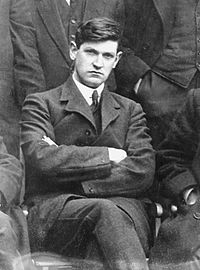
Michael Collins as Minister for Finance.
In 1919 the already busy Collins received yet another responsibility when de Valera appointed him to the Aireacht (ministry) as Minister for Finance.[25] Most of the ministries existed only on paper or as one or two people working in a room of a private house, given the circumstances of a brutal war in which ministers were liable to be arrested or killed by the Royal Irish Constabulary, British Army, Black and Tans or the Auxiliaries at a moment’s notice.
Despite that, Collins managed to produce a Finance Ministry that was able to organise a large bond issue in the form of a “National Loan” to fund the new Irish Republic.[26] According to Batt O’Connor, the Dáil Loan raised almost £400,000, of which £25,000 was in gold. The loan, which was declared illegal by the British, was lodged in the individual bank accounts of the trustees. The gold was kept under the floor of O’Connor’s house until 1922.[27] The Russian Republic, in the midst of its own civil war, ordered Ludwig Martens the head of the Soviet Bureau in New York City to acquire a “national loan” from the Irish Republic through Harry Boland, offering some jewels as collateral. The jewels remained in a Dublin safe, forgotten by all sides, until the 1930s, when they were found by chance.
War of Independence
The Irish War of Independence in effect began on the day that the First Dáil convened, 21 January 1919. On that date, an ambush party of IRA volunteers from the 3rd Tipperary Brigade including Séamus Robinson, Dan Breen, Seán Treacy and Seán Hogan, attacked a pair of Royal Irish Constabulary (RIC) men who were escorting a consignment of gelignite to a quarry in Soloheadbeg, County Tipperary. The two policemen were shot dead during the engagement. This ambush is considered the first action in the Irish War of Independence.[28] The engagement had no advance authorisation from the nascent government. However, Collins in Dáil discussion of the incident implicitly accepted responsibility on behalf of the IRB. The legislature’s support for the armed struggle soon after became official.[21][29]
From that time Collins filled a number of roles in addition to his legislative duties. That summer he was elected president of the IRB (and therefore, in the doctrine of that organisation, de jure President of the Irish Republic). In September, he was made Director of Intelligence for the Irish Republican Army which now had a mandate to pursue an armed campaign, as the official military of the Irish nation. With Cathal Brugha as Minister of Defense, Collins became Director of Organisation and Adjutant General of the Volunteers.
Collins had spent much of this period helping to organise the volunteers as an effective military force, concentrating particularly on driving the RIC out of isolated barracks and seizing their weapons. In the early 20th century this permanently armed police force was, in effect, the principal representation of the British state in large parts of rural Munster and Connaught and with their withdrawal, republicans felt able to establish their own institutions. In turn, though, the retreat of the RIC drove the British towards more radical and violent responses: simultaneously alienating already weak support for British rule in the populace but also increasing the military pressure on the volunteers.
Collins was determined to avoid the massive destruction, military and civilian losses for merely symbolic victories that had characterised the 1916 Rising. Instead he directed a guerrilla war against the British, suddenly attacking then just as quickly withdrawing, minimising losses and maximising effectiveness.[30][31]
As the war began in earnest, de Valera travelled to the United States for an extended speaking tour to raise funds for the outlawed Republican government. It was in publicity for this tour that de Valera (who had been elected Príomh Aire by the Dáil) was first referred to as “President”. While financially successful, grave political conflicts followed in de Valera’s wake there which threatened the unity of Irish-American support for the rebels. Some members of the IRB also objected to the use of the presidential title because their organisation’s constitution had a different definition of that title.[21][23][32]
Back in Ireland, Collins arranged the “National Loan”, organised the IRA, effectively led the government, and managed arms-smuggling operations. Local guerrilla units received supplies, training and had largely a free hand to develop the war in their own region. These were the “flying columns” who comprised the bulk of the War of Independence rank and file in the south-west. Collins, Dick McKee and regional commanders such as Dan Breen and Tom Barry oversaw tactics and general strategy. There were also regional organisers, such as Ernie O’Malley and Liam Mellows, who reported directly to Collins at St Ita’s secret basement GHQ in central Dublin.[33] They were supported by a vast intelligence network of men and women in all walks of life that reached deep into the British administration in Ireland.[34][35]

Collins inspects a soldier.
It was at this time that Collins created a special assassination unit called The Squad expressly to kill British agents and informers. Collins was criticised for these tactics but cited the universal war-time practice of executing enemy spies who were, in his words, “hunting victims for execution.” Campaigning for Irish independence, even non-violently, was still targeted both by prosecutions under British law entailing the death penalty and also by extrajudicial killings such as that of Tomas MacCurtain, nationalist mayor of Cork City.
In 1920 the British offered a bounty of £10,000 (equivalent to GB£300,000 / €360,000 in 2010) for information leading to Collins’ capture or death. He and the national forces continued to evade capture and carried out strikes against British forces, frequently operating out of safe-houses in the vicinity of government buildings, such as Vaughan’s and An Stad.
The Crown responded with escalation of the war, with the importation of special forces such as the “Auxiliaries“, the “Black and Tans“, the “Cairo Gang“, and others. Officially or unofficially, many of these groups were given a free hand to institute a reign of terror, shooting Irish people indiscriminately, invading homes, looting and burning.[21][36]
In 1920, following Westminster’s prominent announcements that it had the Irish insurgents on the run, Collins and his Squad killed several British secret service agents in a series of coordinated raids. In retaliation, members of the Royal Irish Constabulary went to Croke Park, where a G.A.A. football match was taking place between Dublin and Tipperary. The police officers opened fire on the crowd and as a result, killed twelve and injured sixty. This event became known as Bloody Sunday. A stampede of panicking British operatives sought the shelter of Dublin Castle next day. About the same time, Tom Barry’s 3rd Cork Brigade took no prisoners in a bitter battle with British forces at Kilmichael. In many regions, the RIC and other crown forces became all but confined to the strongest barracks in the larger towns as rural areas came increasingly under rebel control.[37][38]
These republican victories would have been impossible without widespread support from the Irish population, which included every level of society and reached deep into the British administration in Ireland. This pattern of guerrilla success against sophisticated imperialist powers would be repeated around the world in the early 20th century.[39]
At the time of the ceasefire in July 1921 a major operation was allegedly in planning to execute every British secret service agent in Dublin, while a major ambush involving eighty officers and men was also planned for Templeglantine, County Limerick.[21][40]
Truce
In 1921 General Macready, commander of British forces in Ireland, reported to his government that the Empire’s only hope of holding Ireland was by martial law, including the suspension of “all normal life.”[41]
Political considerations regarding Westminster’s global foreign policy ruled out this option: Irish-American public opinion was important to US support for British agendas in Asia. Closer to home, Britain’s efforts at a military solution had already spawned a powerful peace movement, demanding an end to the slaughter in Ireland. Prominent voices calling for negotiations included the Labour Party, the London Times and other leading periodicals, members of the House of Lords, English Catholics, and famous authors such as George Bernard Shaw.[42][43]
Still it was not the British government which initiated negotiations. Individual English activists, including clergy, made private overtures which reached Arthur Griffith. Griffith expressed his welcome for dialogue. The British MP Brigadier General Cockerill sent an open letter to Prime Minister Lloyd George that was printed in the Times, outlining how a peace conference with the Irish should be organised. The Pope made an urgent public appeal for a negotiated end to the violence. Whether or not Lloyd George welcomed such advisors, he could no longer hold out against this tide.[21]
In July, Lloyd George’s government offered a truce. Arrangements were made for a conference between British government and the leaders of the yet-unrecognised Republic.
There remains considerable controversy as to the two sides’ capability to have carried on the conflict much longer. Collins told Hamar Greenwood after signing the Anglo-Irish Treaty: “You had us dead beat. We could not have lasted another three weeks. When we were told of the offer of a truce we were astonished. We thought you must have gone mad”.[44] However he stated on the record that “there will be no compromise and no negotiations with any British Government until Ireland is recognised as an independent republic. The same effort that would get us Dominion Home Rule will get us a republic.”[45] At no time had the Dáil or the IRA asked for a conference or a truce.[46]
However the Dáil as a whole was less uncompromising. It decided to proceed to a peace conference, although it was ascertained in the preliminary stages that a fully independent republic would not be on the table and that the loss of some northeastern counties was a foregone conclusion.[47]
Many of the rebel forces on the ground first heard of the Truce when it was announced in the newspapers and this gave rise to the first fissures in nationalist unity, which were to have serious consequences later on. They felt they had not been included in consultations regarding its terms.[48][49]
De Valera was widely acknowledged as the most skillful negotiator on the Dáil government side and he participated in the initial parlays, agreeing the basis on which talks could begin. The first meetings were held in strict secrecy soon after the Customs House battle, with Andrew Cope representing Dublin Castle’s British authorities. Later, de Valera travelled to London for the first official contact with Lloyd George. The two met one-on-one in a private meeting, the proceedings of which have never been revealed.[21][50]
During this Truce period, de Valera sued for official designation as President of the Irish Republic and obtained it from the Dáil in August 1921.[51] Not long after, the Cabinet was obliged to select the delegation that would travel to the London peace conference and negotiate a treaty. In an extraordinary departure from his usual role, de Valera adamantly declined to attend, insisting instead that Collins should take his place there, along with Arthur Griffith.[52][53]
Collins strenuously resisted this appointment, protesting that he was “a soldier, not a politician” and that his exposure to the London authorities would reduce his effectiveness as a guerrilla leader should hostilities resume. (He had kept his public visibility to a minimum during the conduct of the war; up to this time the British still had very few reliable photographs of him.)[54]
The Cabinet of seven split on the issue, with de Valera casting the deciding vote. Many of Collins’s associates warned him not to go, that he was being set up as a political scapegoat. Following intense soul-searching and all-night consultations with his most trusted advisors, he resolved to attend “in the spirit of a soldier obeying orders.” In private correspondence he foresaw the catastrophe ahead: “Let them make a scapegoat or whatever they like of me. Someone must go.”
Anglo-Irish Treaty
The Irish delegates to London were, upon de Valera’s insistence, designated as “plenipotentiaries”, meaning that they had full authority to sign an agreement on behalf of the Dáil government. The Treaty would then be subject to approval by a vote of the full Dáil.
The majority of the Irish Treaty delegates, including Arthur Griffith (leader), Robert Barton and Eamonn Duggan (with Robert Erskine Childers as Secretary General to the delegation) set up headquarters at 22 Hans Place in Knightsbridge on 11 October 1921 and resided there until conclusion of the negotiations in December. Collins shared quarters at 15 Cadogan Gardens with the delegation’s publicity department, secretary Diarmuid O’Hegarty, Joseph McGrath as well as substantial intelligence and bodyguard personnel including Liam Tobin, Tom Cullen, Ned Broy, Emmet Dalton and Joseph Dolan of The Squad.[55]
The British side was represented by PM Lloyd George, Colonial Secretary Winston Churchill and F. E. Smith, among others. Two months of arduous wrangling ensued. The Irish delegation made frequent crossings back to Dublin to make progress reports and confer with their Dáil colleagues. However, Collins in his correspondence and subsequent Dáil debates expressed the delegates’ frustration at being unable to obtain clear instructions as to whether or not they should accept the terms on offer and sign the Treaty.[21][56]
In November, with the London peace talks still in progress, Collins attended a large meeting of regional IRA commanders at Parnell Place in Dublin. In a private conference he informed Liam Deasy, Florence O’Donoghue and Liam Lynch that “there would have to be some compromise in the current negotiations in London. There was no question of our getting all the demands we were making.” He was advised by Lynch not to bring this out in the full assembly. Reviewing subsequent events, Deasy later doubted the wisdom of that advice.[57]
The negotiations ultimately resulted in the Anglo-Irish Treaty which was signed on 6 December 1921. The agreement provided for a Dominion status “Irish Free State“, whose relationship to the British Commonwealth would be modelled after Canada’s. This was a compromise, half-way between an independent republic and a province of the Empire.
The settlement essentially vacated the Treaty of Limerick of 1688 and overturned the Act of Union by recognising the native Irish legislature’s independence. Under a bicameral parliament, executive authority would remain vested in the king but exercised by an Irish government elected by Dáil Éireann as a “lower house“. British forces would depart the Free State forthwith and be replaced by an Irish army. Along with an independent courts system, the Treaty granted a level of internal independence that far exceeded any Home Rule which had been sought by Charles Stewart Parnell or by his Irish Parliamentary Party successors John Redmond and John Dillon.
It was agreed that counties with a large unionist population, concentrated in a relatively small area in eastern Ulster, would have a chance to opt out of the Free State and remain under the Crown. An Irish Boundary Commission was to be established to draw a border (which ultimately came to encompass a six-county region.) Inclusion in the Free State was to be subject to a vote of the majority population in each county. Collins anticipated no more than four counties would join the northeastern statelet, making it economically un-viable, and that this would facilitate the reunification of all 32 counties in the foreseeable future.[58]
While it fell short of the republic that he’d fought to create, Collins concluded that the Treaty offered Ireland “the freedom to achieve freedom.” It essentially offered a chance to remove the gun from Irish politics and to seek further independence through a native government and legislature.[59] Nonetheless, he knew that elements of the Treaty would cause controversy in Ireland. Upon signing the treaty, Birkenhead remarked “I may have signed my political death warrant tonight”. Collins replied “I may have signed my actual death warrant”.[40]
Treaty debates
This remark encapsulated his acknowledgement that the Treaty was a compromise that would be vulnerable to charges of “sell-out” from purist Republicans. It did not establish the fully independent republic that Collins himself had shortly before demanded as a non-negotiable condition. The “physical force republicans” who made up the bulk of the army which had fought the British to a draw would be loath to accept dominion status within the British Empire or an Oath of Allegiance that mentioned the King. Also controversial was the British retention of Treaty Ports on the south coast of Ireland for the Royal Navy. These factors diminished Irish sovereignty and threatened to allow British interference in Ireland’s foreign policy.
Collins and Griffith were well aware of these issues and strove tenaciously, against British resistance, to achieve language which could be accepted by all constituents. They succeeded in obtaining an oath to the Irish Free State, with a subsidiary oath of fidelity to the King, rather than to the king unilaterally.
It is now generally believed that had the nationalist leadership united in support of the Treaty, there would have been no split in the army such as to precipitate civil war. However immediately on the delegation’s return from London, de Valera led a vocal charge against the delegates, whom he called “traitors”.
This was despite the fact that de Valera, the nationalists’ most able negotiator, who had refused strenuous pleas from Collins, Griffith and others to lead the London negotiations in person, had been fully informed of the process at each stage. He had also refused the delegates’ continual requests for instruction, and in fact had been at the centre of the original decision to enter negotiations without the possibility of an independent republic on the table.[21][60]
However, there remains a school of thought which considers de Valera’s protests to have been reasonable and motivated by deep moral objections, and which sees Collins in a negative light, as having irresponsibly signed away the nation’s interests due to incompetence or a self-serving agenda. The Treaty controversy split the entire nationalist movement. Sinn Féin, the Dáil, the IRB and the army each divided into pro- and anti-Treaty factions. The Supreme Council of the IRB had been informed in detail about every facet of the Treaty negotiations and had approved many of its provisions, and they voted unanimously to accept the Treaty with the single notable exception of Liam Lynch, later COS of the anti-Treaty IRA.[61]
The Dáil debated the Treaty bitterly for ten days until it was approved by a vote of 64 to 57.[62] Having lost this vote, de Valera announced his intent to withdraw his participation from the Dáil and called on all deputies who had voted against the Treaty to follow him. A substantial number did so, officially splitting the government. This set the stage for civil war.
A large part of the Irish Republican Army opposed the Treaty. Some followed the political lead of anti-Treaty TDs, others acted on their own convictions, with more or less equal suspicion of politicians in general. Anti-Treaty IRA units began to seize buildings and take other guerrilla actions against the Provisional Government. On 14 April 1922, a group of 200 anti-Treaty IRA men occupied the Four Courts in Dublin under Rory O’Connor, a hero of the War of Independence. The Four Courts was the centre of the Irish courts system, originally under the British and then the Free State. Collins was charged by his Free State colleagues with putting down these insurgents, however he resisted firing on former comrades and staved off a shooting war throughout this period.[63][64]
While the country teetered on the edge of civil war, continuous meetings were carried on among the various factions from January to June 1922. In these discussions the nationalists strove to resolve the issue without armed conflict. Collins and his close associate, TD Harry Boland were among those who worked desperately to heal the rift.[21][65]
To foster military unity, Collins and the IRB established an “army re-unification committee”, including delegates from pro- and anti-Treaty factions. The still-secret Irish Republican Brotherhood continued to meet, fostering dialogue between pro- and anti-Treaty IRA officers. In the IRB’s stormy debates on the subject, Collins held out the Constitution of the new Free State as a possible solution. Collins was then in the process of co-writing that document and was striving to make it a republican constitution that included provisions that would allow anti-Treaty TDs to take their seats in good conscience, without any oath concerning the Crown.[66]
Northern Ireland
After the Treaty was signed, loyalist conservatives combined to wage a violent campaign against Irish nationalist insurgency in the northeastern counties comprising Northern Ireland. The Royal Ulster Constabulary (RUC) was created at this time, along with the notorious “Specials”: a force of amateur and retired soldiers, who some have claimed were given a free hand to terrorise and kill Catholics.[67][68]
In Northern Ireland there were continual breaches of the Truce by “unauthorised loyalist paramilitary forces”. The predominantly Protestant, Unionists government of Northern Ireland supported policies which discriminated against Catholics in, which, along with violence against Catholics, led many to suggest the presence of an agenda by an Anglo-ascendancy to drive those of indigenous Irish descent out of the northeast counties.[21][69]
At the same time London was stepping up pressure on the Provisional Government to take aggressive military action against anti-Treaty units in the south.
In March, Collins met Sir James Craig, Prime Minister for Northern Ireland, in London. They signed an agreement declaring peace in the north which promised cooperation between Catholics and Protestants in policing and security, a generous budget for restoring Catholics to homes which had been destroyed, and many other measures.[70]
The day after the agreement was published, violence erupted again. A policeman was shot dead in Belfast and in reprisal, police entered Catholic homes nearby and shot residents in their beds, including children. There was no response to Collins’s demands for an inquiry. He and his Cabinet warned that they would deem the agreement broken unless Craig took action.[71]
In his continual correspondence with Churchill over violence in the north, Collins protested repeatedly that such breaches of the Truce threatened to invalidate the Treaty entirely.[72] The prospect of a renewal of the war with England was imminent. The prospect was real enough that on 3 June 1922 Churchill presented to the Committee of Imperial Defense his plans “to protect Ulster from invasion by the South.” [73]
Throughout the early months of 1922, Collins had been sending IRA units to the border and sending arms and money to the northern units of the IRA. Collins joined other IRB and IRA leadership in developing secret plans to launch a clandestine guerrilla war in the northeast. Some British arms that had been surrendered to the Provisional government in Dublin were turned over by Collins to IRA units in the north. In May–June 1922 Collins and IRA Chief of Staff Liam Lynch organised an offensive including both pro- and anti-Treaty IRA units along the border area. Because of this, most northern IRA units supported Collins and 524 individual volunteers came south to join the National Army in the Irish Civil War.
Collins, with the support of Griffith and the Cabinet, kept up a “three-tier strategy of public, political and military pressure” regarding northern outrages.[21] Negotiations with the London and Belfast governments continued, with numerous promises made and broken along the lines of the March 1922 Agreement. Within days of a public commitment by Dublin not to send troops into the northeast, Churchill sent 1000 British troops into a village called Pettigo that straddled the border between the Irish Free State and Northern Ireland. The troops shelled the village and fired on Free State troops, killing three. On 5 June a group of B-Specials sprayed the Mater Hospital in Belfast with machine gun fire. Collins’s demands for a full, joint inquiry were flatly refused by Churchill.[74]
In the midst of all this, Civil War in the south broke out and put Collins’s plans for the north on hold. He was killed before he could pursue them any further.
Provisional government
De Valera resigned the presidency and sought re-election but Arthur Griffith replaced him after a close vote on 9 January 1922. Griffith chose as his title “President of Dáil Éireann” (rather than “President of the Republic” as de Valera had favoured.) [75]
The Dáil Éireann government still had no legal status in British constitutional law. The provisions of the Treaty required the formation of a new government, which would be recognised by Westminster as pertaining to the Free State dominion that had established by the Treaty.
Despite the abdication of a large part of the Dáil, the Provisional Government (Rialtas Sealadach na hÉireann) of the new Free State was formed with Arthur Griffith as President of the Dáil and Michael Collins as Chairman of the Provisional Government Cabinet (effectively Prime Minister). Collins also retained his position as Minister for Finance.[76]
In British legal theory Collins was now a Crown-appointed prime minister of a Commonwealth state, installed under the Royal Prerogative. To be so installed he had to formally meet the Lord Lieutenant of Ireland Viscount FitzAlan the head of the British administration in Ireland. The republican view of the same meeting is that Collins met FitzAlan to accept the surrender of Dublin Castle, the official seat of British government in Ireland. Having surrendered, FitzAlan still remained in place as viceroy until December 1922.
The Provisional Government’s first obligation was to create a Constitution for the Free State. This was undertaken by Collins and a team of solicitors. The outcome of their work became the Irish Constitution of 1922.[77] Although revised in the 1930s, the present Constitution of Ireland (Bunreacht na hÉireann [78]) remains largely Collins’s work.
Collins drew up a republican constitution which, without repudiating the Treaty, would include no mention of the British king. His object was that the Constitution would allow participation in the Dáil by dissenting TDs who opposed the Treaty and refused to take any oath mentioning the Crown.
Under the Treaty, the Free State was obliged to submit its new Constitution to Westminster for approval. Upon doing so, in June 1922, Collins and Griffith found Lloyd George determined to veto the provisions they had fashioned to prevent civil war.[79]
These meetings with Lloyd George and Churchill were bitterly contentious. Collins, although less diplomatic than Griffith or de Valera, had no less penetrating comprehension of political issues. He complained that he was being manipulated into “doing Churchill’s dirty work”, in a potential civil war with his own former troops.[80][81]
Pact elections
Negotiations to prevent civil war resulted in, among others, “The Army Document” published in May 1922 which was signed by an equal number of pro- and anti-Treaty IRA officers including Collins, Dan Breen, and Gearóid O’Sullivan. This manifesto declared that “a closing of ranks all round is necessary” to prevent “the greatest catastrophe in Irish history.” It called for new elections, to be followed by the re-unification of the government and army, whatever the result.
In this spirit and with the organising efforts of moderates on both sides the Collins-de Valera “Pact” was created. This pact agreed that new elections to the Dáil would be held with each candidate running as explicitly pro- or anti-Treaty and that, regardless of which side obtained a majority, the two factions would then join to form a coalition government of national unity.
A referendum on the Treaty was also planned but it never took place. The Pact elections on 16 June 1922 therefore comprise the best quantitative record of the Irish public’s direct response to the Treaty. The results were pro-Treaty 58 seats, anti-Treaty 35, Labour Party 17, Independents 7, Farmers party 7, plus 4 Unionists from Trinity College, Dublin.[82]
Assassination of Sir Henry Wilson
Six days after the Pact elections, Sir Henry Wilson was assassinated on 22 June 1922 in broad daylight on the steps of his London home by a pair of London IRA men. A British Army field marshal, Wilson had recently resigned his commission and been elected an MP for Northern Ireland. He had a long history as one of the chief British leaders opposing Collins in the Irish conflict. At that time Wilson had served as military advisor to the Northern Ireland government led by James Craig, in which role he was seen to be responsible for the B-Specials and for other sources of loyalist violence in the north.
The order to shoot Wilson has been attributed to Irish leaders including Collins and Rory O’Connor, but with dubious authority. Although unquestionably killed by the two IRA men—who were captured and confessed—no one has ever taken responsibility for ordering the shooting. While Wilson had certainly been a potential target for Collins’s “Squad” during the War of Independence, all outstanding orders had been summarily cancelled when those forces stood down at the Truce. O’Connor explicitly denied any involvement, as did the IRB on behalf of Collins and Arthur Griffith on behalf of the Provisional Government. No direct statement appears to have been made on the subject by Collins in the two months that he survived Wilson.
The debate concerning Collins’s involvement continued in the 1950s, when a number of statements and rebuttals on the subject were published in periodicals. These were re-printed with additions in Rex Taylor’s 1961 book Assassination: the death of Sir Henry Wilson and the tragedy of Ireland. Participants in that discussion were Joe Dolan, Florence O’Donoghue, Denis P. Kelleher, Patrick O’Sullivan and others.[83][84]
Civil War

Michael Collins gave the order to bombard the Four Courts with artillery shells in an attempt to remove Anti-treaty IRA. This was to be the start of the Irish Civil War.
The death of Sir Henry Wilson caused a furor in London. Powerful conservative voices who had opposed any settlement with the Irish rebels drowned out moderates, with calls for a violent response. Under this pressure, Churchill issued an ultimatum demanding that the Provisional Government end the anti-Treaty occupation of the Four Courts or face a full-scale military invasion.[85]
A few days later, anti-Treaty IRA men kidnapped J.J. “Ginger” O’Connell, a Free State general. These two developments led to the Provisional Government’s 27 June 1922 order serving notice on the Four Courts garrison to surrender the building that night or face military action “at once”.[86]
Collins’ position in this conflict was extraordinary indeed. “A majority perhaps” of the army he’d led in the War of Independence were now ranged against the Free State, which he represented. In addition the force which by the will of the electorate he was obliged to lead had been re-organised since the Truce. Formed from a nucleus of pro-Treaty IRA men, it had evolved into a more formal, structured, uniformed National Army that was armed and funded by Britain. Many of the new members were World War I veterans and others who had not fought on the nationalist side before. It was now ten times the size of the force which had won independence, yet heavily populated with former British Army personnel. Collins’s profoundly mixed feelings about this situation are recorded in his private and official correspondence.[87][88][88][89][90][91]
Artillery was provided to Mulcahy and the Free State Army by the British in anticipation of a siege. Emmet Dalton, a former British officer of Irish origin who was now a leading Free State commander and close associate of Collins, was placed in charge of it.
There is no definite record as to who gave the order to begin shelling the Four Courts. Historians have only presumed that it was Collins. There is only anecdotal evidence as to how and when the ultimatum was served on the anti-Treaty garrison, whether adequate time was allowed the Four Courts men to surrender, or whether shelling began precipitately while the garrison was loading up their arms to leave the building. Further study remains to be done on this most critical event of 1922, which actually started the Civil War in earnest.[91][92]
Fierce fighting broke out in Dublin between the anti-Treaty IRA and the Free State troops. Much of O’Connell Street suffered heavy damage, the Gresham Hotel was burned and the Four Courts reduced to a ruin. Still, under Collins’ direction, the Free State rapidly took control of the capital. By July 1922 anti-Treaty forces held much of the southern province of Munster and several other areas of the country. At the height of their success they administered local government and policing in large regions.[93] Collins, Richard Mulcahy, and Eoin O’Duffy decided on a series of seaborne landings into republican held areas, which re-took Munster and the west in July–August.
Also in July, Collins set aside his title as Chairman of the Provisional Government to become Commander-in-Chief of the National Army.[94] There is controversy about this change, especially in view of subsequent events: what, if anything, it said about his relationship with the Cabinet; what role, if any, others in the government may have played in it; what connection it had, if any, with the tragedy which followed.[91][92]
Civil War peace moves
There is considerable evidence that Collins’s journey to Cork in August 1922 was made in order to meet republican leaders with a view to ending the war.[95][96][97] If so, it would explain a good deal that remains mysterious about the journey.
The question of his involvement in peace negotiations is hotly debated by historians. It has ramifications for opposing political viewpoints about him and especially about his death. If this was a peace mission, it was without any record of official involvement and sanction from the Provisional Government Cabinet. However this is not necessarily out of keeping with the general nature of peace negotiations in wartime. The first contacts with British negotiators had been “a dead secret,” even from many of his associates.[98] Nor was it unknown for Collins to make bold, controversial moves on his own initiative. Private and personal correspondence indicates that there was less than perfect trust and cordiality between Collins and some members of the Dáil. There was considerable friction between ministers on the conduct of the war and the treatment of anti-Treaty combatants.[99]
A remarkable number of meetings that included leading figures on both sides took place in Cork on 21–22 August 1922.[100] In Cork city, Collins met with neutral IRA men Seán O’Hegarty and Florence O’Donoghue with a view to contacting Anti-Treaty IRA leaders Tom Barry and Tom Hales to propose a truce. The anti-Treaty side had called a major convocation of officers to Béal na Bláth, a remote crossroads, with ending the war on the agenda.[101]
De Valera was present there, and his assistant reported that a meeting between him and Collins was planned. The People’s Rights Association, a local initiative in Cork City, had been mediating a discussion of terms between the Provisional Government and the anti-Treaty side for some weeks.[21][102]
Peace terms were detailed in Collins’s correspondence and diary. Republicans would be obliged to “accept the people’s verdict” on the Treaty but could then “go home without their arms. We don’t ask for any surrender of their principles.” This indicates that Collins favoured a policy of amnesty, without sanctions. It is alleged that anti-Treaty veterans of the War of Independence might be offered a choice of taking their place either in Free State Army, in the civil service, or even in clandestine operations against para-militaries in the north.[103]
This is significant in view of the draconian policies, including execution without trial, that were pursued by the Free State government following on the deaths of Collins and Arthur Griffith within days of each other. The deaths of Collins and Griffith marked the end of Free State efforts to reunite the victorious War of Independence forces via a negotiated settlement.[104]
Death

Michael Collins body lying in hospital after he was shot dead at Béal na Bláth.
Collins’s death remains a mystery for a number of reasons. The only witnesses were Free State Army members of his convoy and the anti-Treaty ambushers. As all of these were participants, their accounts may not be objective. No two witnesses’ statements match and many are contradictory.[105] There is no complete record of the people involved and none of the witnesses were ever questioned by the authorities. Their accounts have been handed down through newspapers, biographers, private documents and personal contacts. One version suggests Collins was to meet with De Valera and discuss ways to end the conflicts.[citation needed]
The remainder of this section lists only those facts most generally agreed. Even some of these are disputed in some sources.
In August 1922, the Civil War seemed to be winding down. The Free State had regained control of most of the country and Collins was making frequent trips to inspect areas recently recovered from anti-Treaty forces.[106]
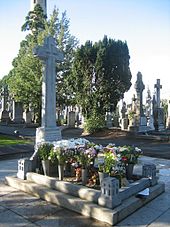
Collins’s grave, Glasnevin Cemetery, Dublin
His plan to travel to his native Cork on 20 August was considered particularly dangerous and he was strenuously advised against it by several trusted associates. County Cork was an IRA stronghold, much of it still held by anti-Treaty forces. Yet he seemed determined to make the trip without delay. He had fended off a number of attempts on his life in the preceding weeks and had acknowledged more than once, in private conversation, that the Civil War might end his life at any moment. On several occasions Collins assured his advisors “they won’t shoot me in my own county,” or words to that effect.
On 22 August 1922 Collins set out from Cork City on a circuitous tour of West Cork. He passed first through Macroom then took the Bandon road via Crookstown. This led through Béal na Bláth, an isolated crossroads. There they stopped at a local pub, now known as the The Diamond Bar,[107] to ask a question of a man standing at the crossroad. The man turned out to be an anti-Treaty sentry. He and an associate recognised Collins in the back of the open-top car.[108]
As a result, an ambush was laid by an anti-Treaty column at that point, on the chance that the convoy might come through again on their return journey.[109]
Between 7:30 and 8PM, Collins’ convoy approached Béal na Bláth for the second time. By then most of the ambush party had dispersed and gone for the day, leaving just five or six men on the scene. Two were disarming a mine in the road, while three on a laneway overlooking them, provided cover. A dray cart, placed across the road, remained at the far end of the ambush site.
Shots were exchanged. Collins, who suffered a head wound, was the only fatality. Almost every other detail of what happened is uncertain, due to conflicting reports from participants and other flaws in the record.

A replica of the Crossley Tender in Collins’ convoy on the day of his death in a replica of the road where it happened on display at the Michael Collins Centre, Clonakilty[110]
Some of the details most disputed among the witnesses are: how the shooting started, what kind of fire the convoy came under, where the ambushers’ first shots struck, where Collins was and what he was doing when he was hit, whether anyone else was wounded, whether the armoured car‘s machine gun was fully functional throughout the engagement, who moved Collins’ body, and who was nearby when Collins fell.
Many questions have been raised concerning the handling of Collins’s remains immediately following his death. Among them are the inordinately long time the convoy took to cover the twenty miles back to Cork City, who searched his clothes, and what became of documents he was known to have been carrying on his person (such as his field diary, which did not turn up until decades afterward).
The medical evidence is also lacking. There are imperfect records as to which doctor examined the body; whether an autopsy was performed, and, if so, by whom; which hospital his body was taken to, and why; and, most importantly, what was the precise number and nature of his wounds.
Writers on the subject such as J. Feehan and S.M. Sigerson have called for a full forensic examination of Collins’s remains in order to attempt to settle at least some of these controversies concerning his end.[111][112]
Aftermath

Sean Collins behind the coffin of his brother Michael.
Collins’s body was transported by sea from Cork to Dublin. He lay in state for three days in Dublin City Hall where tens of thousands of mourners filed past his coffin to pay their respects, including many British soldiers departing Ireland who had fought against him. His funeral mass took place at Dublin’s Pro Cathedral where a number of foreign and Irish dignitaries were in attendance. Some 500,000 people attended his funeral, almost one fifth of the country’s population at that time.[21]
No official inquiry was ever undertaken into Collins’s death and consequently there is no official version of what happened, nor are there any authoritative, detailed contemporary records.[113]
In this vacuum, independent investigations and conspiracy theorists have put forward a number of suspects as having executed or ordered his death, including an anti-Treaty sharpshooter, members of his own escort, the British secret service, or de Valera himself.
De Valera is alleged to have declared in 1966, “It is my considered opinion that in the fullness of time history will record the greatness of Michael Collins; and it will be recorded at my expense.”[114]
A number of books have been devoted entirely to the study of Collins’ death (in chronological order): The Day Michael Was Shot by Meda Ryan, The Shooting of Michael Collins: Murder or Accident? by John M Feehan, The Dark Secret of Béal na mBláth by Patrick Twohig, and The Assassination of Michael Collins: What Happened at Béal na mBláth? by S.M. Sigerson.
Personal life
Collins’s elderly father inspired his fondness and respect for older people. His mother, who had spent her youth caring for her own invalid mother and raising her own brothers and sisters, was a powerful influence. The entire management of the Collins farm fell to her, as her husband succumbed to old age and died. In a society which honoured hospitality as a prime virtue, Mrs Collins was eulogised as “a hostess in ten thousand.” Her five daughters avowedly doted on their youngest brother.[9][21]
The Collins home’s spirit of self-sacrifice, welcome and inclusiveness later proved key in his capacity to unify people of all genders and walks of life and orchestrate them in an effective, enthusiastic, cooperative force for Irish self-determination.[115] Collins’s revolution was also a family affair. He continued to work closely with his brothers throughout the independence struggle and with cousins such as Nancy O’Brien, one of his most important moles in the British administration.[21]
He was very much a “man’s man”, fond of rough-housing and outdoor sports. Having won a local wrestling championship while still a boy, he is said to have made a pastime of challenging larger, older opponents, with frequent success. A very fit, active man throughout life, in the most stressful times he continued to enjoy wrestling as a form of relaxation and valued friendships which afforded opportunities to share athletic pursuits.[21]
Intensely hard-working, Collins could be abrasive, demanding, and sometimes inconsiderate of those around him. Yet he frequently apologised for his own temperament, with gestures such as confectionery and other small gifts, sometimes delivered at great personal risk in Dublin’s wartime environment.[116][117]
Unlike some of his political opponents, he was characterised by many close personal friendships within the movement. It has been justly said that while some were devoted to “the idea of Ireland”, Collins was a people person whose patriotism was rooted in affection and respect for the people of Ireland around him. Among his famous last words is the final entry in his pocket diary, written on the journey which ended his life, “The people are splendid.”[118][119][120]
His personal warmth and charm were combined with an uncanny ability to inspire confidence in a wide range of people. No other Irish leader of the time matched his remarkable ability to recruit people of every kind to the movement, win their trust and loyalty, pinpoint their capacities and unite them in coordinated action that was of maximum value to the cause.[121]
Collins was a complex man whose character abounded in contradictions. Although Minister of Finance and an accountant by pre-war profession, he seems never to have pursued personal profit; indeed was sometimes during the war all but homeless. While clearly fond of command and keen to take charge, he had an equal appetite for input and advice from people at every level of the organisation, prompting the comment that “he took advice from his chauffeur.” [122] Although acknowledged by friends and foes as “head centre” of the movement, he continually chose a title just short of actual head of state; becoming Chairman of the Provisional Government only after the abdication of half the Dáil forced him to do so. While his official and personal correspondence records his solicitous care for the wants of insurgents in need, during the war he showed no hesitation in ordering the death of opponents who threatened nationalist lives.[123]
Certainly a man of fierce pride, his pride was tempered by a sense of humour that included a keen sense of the absurd in his own situation.[124] While mastermind of a clandestine military, he remained a public figure. When official head of the Free State government, he continued to cooperate in the IRA’s secret operations. He was capable of bold, decisive actions on his own authority, which caused friction with his colleagues, his falling out with Cathal Brugha, for example; but at critical junctures he could also bow to majority decisions which were profoundly disadvantageous and dangerous to his own interests (such as his appointment to the Treaty negotiating team.)
These may constitute contradictions in his character. Yet they are also contradictions of the unique position he occupied, in a time of social upheaval, when the usual parameters and paradigms of society are in a state of flux.
Relationships with women
The formative role of the many strong, competent, loving women around him produced a man who deeply respected women and thrived on female company of all ages. It manifested also in sensitive, nurturing care toward those he was responsible for. His appointment as aide-de-camp to 1916 Rising organiser Joseph Plunkett, whose chronic health problems were a challenge to his presence at the GPO HQ, is indicative of these qualities. Both his official correspondence and countless personal memoires record empathy and sensitivity in his personal attention to the needs and hardships of Volunteers and their families.[21]
Collins’ lifetime exactly coincided with a period of aggressive, mass agitation for women’s rights. The female suffrage movement was in Ireland often closely linked with the campaign for Irish independence. Many proponents belonged to both camps. Full enfranchisement for women became enshrined in the 1916 Proclamation, the legal founding document of the Republic of Ireland. This was the political climate Collins grew up and prospered in. Yet he remained one of the few orators of the time who used gender-inclusive language in his speeches and explicitly acknowledged women’s contributions and concerns on a regular basis therein.[125][126]
Collins’s predecessor in the independence movement, Charles Stuart Parnell, was defeated by a sexual scandal. Collins’s detractors have occasionally attempted to raise similar issues. He was reported to have sown some wild oats during his teen career in London [127] (albeit while living under the roof of an older sister) but no scandal concerning his sexual life has ever been substantiated.
Collins’ intimate connections appear to have been no less healthy, vigorous, and well-conducted than other aspects of his life. His relations with women were affectionate and provided no evidence either of inexperience, excess or aberration.[128][129]
At the same time, he may be said to never have been without female companionship. He carried on relationships and written correspondence with a number of women such as Susan Killeen and “Dilly” Dicker, who also worked with him in positions of great trust during the struggle for independence. Their correspondence shows that they remained on friendly terms until the end of his life.
In 1921-22, he became engaged to Kitty Kiernan and made plans for a normal family life after the war. 241 letters of their voluminous correspondence survive. These provide an important record not only of their intimacy, but also of his daily life.[130]
Their letters detail his exhausting schedule during the concurrent national crisis and also document the challenges the couple faced in finding time together under the circumstances. In so doing they make it quite doubtful that he could have simultaneously devoted much attention to additional liaisons. Allegations of affair(s) with English society women at this same time are unsubstantiated, and fraught with suspicious political connotations. Those concerning Hazel Lavery originate chiefly with that lady herself, and are unsupported by evidence.[131]
Commemoration

Memorial cross at Béal na Bláth.
An annual commemoration ceremony takes place each year in August at the ambush site at Béal na Bláth, County Cork, organised by The Béal na mBláth Commemoration Committee. In 2009, former President of Ireland Mary Robinson gave the oration. In 2010 the Minister for Finance Brian Lenihan, Jnr became the first Fianna Fáil person to give the oration. In 2012 on the 90th anniversary of the death of Collins, the Taoiseach Enda Kenny gave the oration, the first serving head of government to do so.
There is also a remembrance ceremony in Glasnevin Cemetery at Collins’s grave on the anniversary of his death.
The Central Bank of Ireland released gold and silver commemorative coins on 15 August 2012 which feature a portrait of Michael Collins designed by Thomas Ryan based on a photograph taken not long before his death.[132]
Legacy
Collins bequeathed to posterity a considerable body of writing: essays, speeches and tracts, articles and official documents in which he outlined plans for Ireland’s economic and cultural revival, as well as a voluminous correspondence, both official and personal. Selections have been published in The Path to Freedom (Mercier, 1968) and in Michael Collins in His Own Words (Gill & Macmillan, 1997). In the 1960s, Taoiseach Seán Lemass, himself a veteran of the 1916 Rising and War of Independence, credited Collins’s ideas as the basis for his successes in revitalizing Ireland’s economy.
Societies
The Collins 22 Society established in 2002 is an international organisation dedicated to keeping the name and legacy of Michael Collins in living memory. The patron of the society is Ireland’s former Minister for Justice and TD Nora Owen, grand-niece of Michael Collins.
In popular culture
Films

Bust of Michael Collins at Merrion Square Park, Dublin, Ireland.
The 1936 movie Beloved Enemy is a fictionalised account of Collins’s life. Unlike the real Michael Collins, the fictionalised “Dennis Riordan” (played by Brian Aherne) is shot, but recovers. Hang Up Your Brightest Colours, a British documentary by Kenneth Griffith, was made for ITV in 1973, but refused transmission. It was eventually screened by the BBC in Wales in 1993 and across the United Kingdom the following year.
In 1969, Dominic Behan wrote an episode of the UK television series Play for today entitled ‘Michael Collins’. The play dealt with Collins’ attempt to take the gun out of Irish politics and took the perspective of the Republican argument. At the time of writing the script, the troubles had just begun in Northern Ireland and the BBC were reluctant to broadcast the production. An appeal by the author to David Attenborough (Director of Programming for the BBC at that time) resulted in the play eventually being broadcast; Attenborough took the view that the imperatives of free speech could not be compromised in the cause of political expediency.
An Irish documentary made by Colm Connolly for RTÉ Television in 1989 called The Shadow of Béal na Bláth covered Collins’s death. A made-for-TV film, The Treaty, was produced in 1991 and starred Brendan Gleeson as Collins and Ian Bannen as David Lloyd George. In 2007, RTÉ produced a documentary entitled Get Collins, about the intelligence war which took place in Dublin.[133][134]
Collins was the subject of director Neil Jordan‘s 1996 film Michael Collins, with Liam Neeson in the title role. Collins’s great-grandnephew, Aengus O’Malley, played a student in a scene filmed in Marsh’s Library.
In 2005 Cork Opera House commissioned a musical drama about Collins.[135] “Michael Collins” by Brian Flynn had a successful run in 2009 at Cork opera house and later in the Olympia Theatre in Dublin.
Infamous Assassinations, a 2007 British documentary television series, devoted its third episode to the death of Collins.
Songs

Wax figure of Michael Collins at the National Wax Plus Museum, Dublin, Ireland.
Irish-American folk rock band Black 47 recorded a song entitled “The Big Fellah” which was the first track on their 1994 album Home of the Brave. It details Collins’s career, from the Easter Rising to his death at Béal na Bláth. Irish folk band the Wolfe Tones recorded a song titled “Michael Collins” about Collins’s life and death, although it begins when he was about 16 and took a job in London. Celtic metal band Cruachan recorded a song also titled “Michael Collins” on their 2004 album Pagan which dealt with his role in the Civil War, the treaty and his eventual death. Also a song by Johnny McEvoy, simply named “Michael”, depicts Collins’s death and the sadness surrounding his funeral.
The poem “The laughing boy” by Brendan Behan lamenting the death of Collins was translated into Greek in 1961 by Vasilis Rotas. In October of the same year, Mikis Theodorakis composed the song “Tο γελαστό παιδί” (“The laughing boy”) using Rotas’ translation. The song was recorded by Maria Farantouri in 1966 on the album “Ένας όμηρος” (“The hostage”) and became an instant success. It was the soundtrack of the movie Z (1969). “The laughing boy” became the song of protest against the dictatorship in Greece (1967–1974) and remains to date one of the most popular songs in Greek popular culture.
Play
Michael Collins (Irish: Mícheál Ó Coileáin;[2][3] 16 October 1890 – 22 August 1922) was a soldier and politician who was a leading figure in the struggle for Irish independence in the early 20th century. Collins was an Irish revolutionary leader, politician, Minister for Finance, Director of Information, and Teachta Dála (TD) for Cork South in the First Dáil of 1919, Adjutant General, Director of Intelligence, and Director of Organisation and Arms Procurement for the IRA, President of the Irish Republican Brotherhood from November 1920 until his death, and member of the Irish delegation during the Anglo-Irish Treaty negotiations. Subsequently, he was both Chairman of the Provisional Government and Commander-in-chief of the National Army.[1] Collins was shot and killed in an ambush in August 1922 during the Irish Civil War.
Born in Sam’s Cross, near Clonakilty, County Cork, Collins was the third son and youngest of eight children. Most biographies give his date of birth as 16 October 1890, but his tombstone cites 12 October 1890. Referred to in a British secret service report as “brainy”, the Collins family were part of an ancient clan, widely spread over County Cork. They had republican connections that can be traced back to the 1798 rebellion.[4]
Collins’ father, Michael John (1816–1896), was a farmer by profession. A mathematician in his spare time, he had been a member of the Irish Republican Brotherhood (IRB) movement. The elder Collins was 60[5] years old when he married Mary Anne O’Brien, then 23,[6] in 1876.[7] The marriage was apparently happy. They brought up eight children on a 90-acre (36 ha) farm called Woodfield, which the Collins had held as tenants for several generations.
On his death bed, his father (who was the seventh son of a seventh son) predicted that his daughter Helena (one of Michael’s elder sisters) would become a nun. She later did, known as Sister Mary Celestine, based in Whitby.[8] He then turned to the family and told them to take care of Michael, because “One day he’ll be a great man. He’ll do great work for Ireland.” Michael was six years old when his father died.[9]
Michael Collins at the age of 8 with his family.
Collins was a bright and precocious child with a fiery temper and a passionate feeling of Irish nationalism. He named a local blacksmith, James Santry, and his headmaster at Lisavaird National School, Denis Lyons, as the first nationalists to personally inspire his “pride of Irishness.” Lyons was a member of the IRB, while Santry’s family had participated in, and forged arms for, the rebellions of 1798, 1848 and 1867.[4][10]
There are a number of anecdotal explanations for the origin of his nickname, “The Big Fellow”. The most authoritative comes from his family, stating that he was so called by them while still a child. It had been a term of endearment for their youngest brother, who was always keen to take on tasks beyond his years. It was certainly already established by his teens, long before he emerged as a political or military leader.[11]
At the age of thirteen he boarded at Clonakilty National School. During the week he stayed with his sister Margaret Collins-O’Driscoll and her husband Patrick O’Driscoll, while at weekends he returned to the family farm. Patrick O’Driscoll founded the newspaper The West Cork People and Collins helped out with general reporting jobs and preparing the issues of the newspaper.[12]
Collins as a young recruit.
After leaving school at fifteen, Collins took the British Civil Service examination in Cork in February 1906,[13] and was then employed by the Royal Mail.[14] In 1906, he moved to the home of his elder sister Hannie (Johanna) in London where he became a messenger at a London firm of stockbrokers, Horne and Company.[13] While living in London he studied law at King’s College London.[15] He joined the London GAA and, through this, the IRB. Sam Maguire, a republican from Dunmanway, County Cork, introduced the 19-year-old Collins to the IRB.[16] In 1915 he moved to the Guaranty Trust Company of New York where he remained until his return to Ireland the following year[17] joining part-time Craig Gardiner & Co, a firm of accountants in Dawson Street, Dublin.[18]
Easter Rising
The struggle for Home Rule, along with labour unrest, had led to the formation in 1913 of two major nationalist paramilitary groups who would launch the Easter Rising: the Irish Citizen Army was established by James Connolly and the Irish Transport and General Workers Union (ITGWU), to protect strikers from the Dublin Metropolitan Police during the 1913 Dublin Lockout. The Irish Volunteers were created in the same year by the IRB and other nationalists in response to the formation of the Ulster Volunteers (UVF), an Ulster loyalist body pledged to oppose Home Rule by force.
An organiser of considerable intelligence, Collins had become highly respected in the IRB. This led to his appointment as financial advisor to Count Plunkett, father of one of the Easter Rising‘s organisers, Joseph Mary Plunkett. Collins took part in preparing arms and drilling troops for the insurrection.
The Rising would be Collins’ first appearance in national events. When it commenced on Easter Monday 1916, Collins served as Plunkett’s aide-de-camp at the rebellion’s headquarters in the General Post Office (GPO) in Dublin. There he fought alongside Patrick Pearse, James Connolly, and other members of the Rising leadership. The Rising is generally acknowledged to have been a military disaster, yet the insurgents achieved their goal of holding their positions for the minimum time required to justify a claim to independence under international criteria.[19]
Captured Irish soldiers in Stafford Gaol after the failed Easter Rising. Collins is fifth from the right with an ‘x’ over his head.
Arrested along with thousands of other participants, Collins was subsequently imprisoned at Frongoch internment camp in Wales.
Collins first began to emerge as a major figure in the vacuum created by the executions of the 1916 leadership. He began hatching plans for “next time” even before the prison ships left Dublin.[20]
At Frongoch he was one of the organisers of a program of protest and non-cooperation with authorities, similar to that later carried on by IRA internees of the 1980s. The camp proved an excellent opportunity for networking with physical-force republicans from all over the country, of which he became a key organiser.[21][22]
While some celebrated the fact that a rising had happened at all, believing in Pearse’s theory of “blood sacrifice” (namely that the deaths of the Rising’s leaders would inspire others), Collins railed against the military blunders made, such as the seizure of indefensible and very vulnerable positions like St Stephen’s Green, which were impossible to escape from and difficult to supply. Public outcry placed pressure on the British government to end the internment. In December 1916, the Frongoch prisoners were sent home.
1917–1918
Before his death, Tom Clarke, first signatory of the 1916 Proclamation and widely considered the Rising’s foremost organiser, had designated his wife Kathleen (Daly) Clarke as the official caretaker of Rising official business, in the event that the leadership did not survive. By June 1916, Mrs. Clarke had sent out the first post-Rising communiqué to the IRB, declaring the Rising to be only the beginning and directing nationalists to prepare for “the next blow.” Soon after his release Mrs Clarke appointed Collins Secretary to the National Aid and Volunteers Dependents Fund (NAVDF) and subsequently passed on to him the secret organisational information and contacts which she had held in trust for the independence movement.
Collins became one of the leading figures in the post-Rising independence movement spearheaded by Arthur Griffith, editor/publisher of the main nationalist newspaper The United Irishman, (which Collins had read avidly as a boy.) [21] Griffith’s organisation Sinn Féin had been founded in 1905 as an umbrella group to unify all the various factions within the nationalist movement.
Under Griffith’s policy, Collins and other advocates of the “physical-force” approach to independence gained the cooperation of non-violent Sinn Féin, while agreeing to disagree with Griffith’s moderate ideas of a dual monarchy solution based on the Hungarian model.[23] The British government and mainstream Irish media had wrongly blamed Sinn Féin for the Rising. This attracted Rising participants to join the organisation in order to exploit the reputation with which such British propaganda had imbued the organisation. By October 1917 Collins had risen to become a member of the executive of Sinn Féin and director of organisation for the Irish Volunteers. Éamon de Valera, another veteran of 1916, stood for the presidency of Sinn Féin against Griffith, who stepped aside and supported de Valera’s presidency.[23]
First Dáil
Members of the First Dáil
First row, left to right: Laurence Ginnell, Michael Collins, Cathal Brugha, Arthur Griffith, Éamon de Valera, Count Plunkett, Eoin MacNeill, W. T. Cosgrave, Kevin O’Higgins (third row, right)
In the 1918 general election Sinn Féin swept the polls throughout much of Ireland, with many seats uncontested, and formed an overwhelming parliamentary majority in Ireland. Like many senior Sinn Féin representatives Collins was elected as an MP (for Cork South) with the right to sit in the House of Commons of the United Kingdom in London. Unlike their rivals in the Irish Parliamentary Party (IPP), Sinn Féin MPs had announced that they would not take their seats in Westminster but instead would set up an Irish Parliament in Dublin.[24]
Before the new body’s first meeting, Collins, tipped off by his network of spies, warned his colleagues of plans to arrest all its members in overnight raids. De Valera and others ignored the warnings on the argument that, if the arrests happened, they would constitute a propaganda coup. The intelligence proved accurate and de Valera, along with Sinn Féin MPs who followed his advice, were arrested; Collins and others evaded incarceration.
The new parliament, called Dáil Éireann (meaning “Assembly of Ireland”, see First Dáil) met in the Mansion House, Dublin in January 1919. In de Valera’s absence, Cathal Brugha was elected Príomh Aire (‘First’ or ‘Prime’ Minister but often translated as ‘President of Dáil Éireann’). The following April, Collins engineered de Valera’s escape from Lincoln Prison in England, after which Brugha was replaced by de Valera.
No state gave diplomatic recognition to the 1919 Republic, despite sustained lobbying in Washington by de Valera and prominent Irish-Americans and at the Paris peace conference. In January 1919 the Dáil ratified the Irish Republican Army‘s (IRA) claim to be the army of the Irish Republic. The IRA had begun a military campaign coincidentally on the same day as the Dáil’s first sitting with the Soloheadbeg Ambush, and the IRA’s respect for the Dáil’s authority was highly conditional. (The Irish Volunteers began to be referred to as the IRA since their internment at Frongach. Up until the Civil War, the two terms were used interchangeably.)
Minister for Finance
Michael Collins as Minister for Finance.
In 1919 the already busy Collins received yet another responsibility when de Valera appointed him to the Aireacht (ministry) as Minister for Finance.[25] Most of the ministries existed only on paper or as one or two people working in a room of a private house, given the circumstances of a brutal war in which ministers were liable to be arrested or killed by the Royal Irish Constabulary, British Army, Black and Tans or the Auxiliaries at a moment’s notice.
Despite that, Collins managed to produce a Finance Ministry that was able to organise a large bond issue in the form of a “National Loan” to fund the new Irish Republic.[26] According to Batt O’Connor, the Dáil Loan raised almost £400,000, of which £25,000 was in gold. The loan, which was declared illegal by the British, was lodged in the individual bank accounts of the trustees. The gold was kept under the floor of O’Connor’s house until 1922.[27] The Russian Republic, in the midst of its own civil war, ordered Ludwig Martens the head of the Soviet Bureau in New York City to acquire a “national loan” from the Irish Republic through Harry Boland, offering some jewels as collateral. The jewels remained in a Dublin safe, forgotten by all sides, until the 1930s, when they were found by chance.
War of Independence
The Irish War of Independence in effect began on the day that the First Dáil convened, 21 January 1919. On that date, an ambush party of IRA volunteers from the 3rd Tipperary Brigade including Séamus Robinson, Dan Breen, Seán Treacy and Seán Hogan, attacked a pair of Royal Irish Constabulary (RIC) men who were escorting a consignment of gelignite to a quarry in Soloheadbeg, County Tipperary. The two policemen were shot dead during the engagement. This ambush is considered the first action in the Irish War of Independence.[28] The engagement had no advance authorisation from the nascent government. However, Collins in Dáil discussion of the incident implicitly accepted responsibility on behalf of the IRB. The legislature’s support for the armed struggle soon after became official.[21][29]
From that time Collins filled a number of roles in addition to his legislative duties. That summer he was elected president of the IRB (and therefore, in the doctrine of that organisation, de jure President of the Irish Republic). In September, he was made Director of Intelligence for the Irish Republican Army which now had a mandate to pursue an armed campaign, as the official military of the Irish nation. With Cathal Brugha as Minister of Defense, Collins became Director of Organisation and Adjutant General of the Volunteers.
Collins had spent much of this period helping to organise the volunteers as an effective military force, concentrating particularly on driving the RIC out of isolated barracks and seizing their weapons. In the early 20th century this permanently armed police force was, in effect, the principal representation of the British state in large parts of rural Munster and Connaught and with their withdrawal, republicans felt able to establish their own institutions. In turn, though, the retreat of the RIC drove the British towards more radical and violent responses: simultaneously alienating already weak support for British rule in the populace but also increasing the military pressure on the volunteers.
Collins was determined to avoid the massive destruction, military and civilian losses for merely symbolic victories that had characterised the 1916 Rising. Instead he directed a guerrilla war against the British, suddenly attacking then just as quickly withdrawing, minimising losses and maximising effectiveness.[30][31]
As the war began in earnest, de Valera travelled to the United States for an extended speaking tour to raise funds for the outlawed Republican government. It was in publicity for this tour that de Valera (who had been elected Príomh Aire by the Dáil) was first referred to as “President”. While financially successful, grave political conflicts followed in de Valera’s wake there which threatened the unity of Irish-American support for the rebels. Some members of the IRB also objected to the use of the presidential title because their organisation’s constitution had a different definition of that title.[21][23][32]
Back in Ireland, Collins arranged the “National Loan”, organised the IRA, effectively led the government, and managed arms-smuggling operations. Local guerrilla units received supplies, training and had largely a free hand to develop the war in their own region. These were the “flying columns” who comprised the bulk of the War of Independence rank and file in the south-west. Collins, Dick McKee and regional commanders such as Dan Breen and Tom Barry oversaw tactics and general strategy. There were also regional organisers, such as Ernie O’Malley and Liam Mellows, who reported directly to Collins at St Ita’s secret basement GHQ in central Dublin.[33] They were supported by a vast intelligence network of men and women in all walks of life that reached deep into the British administration in Ireland.[34][35]
Collins inspects a soldier.
It was at this time that Collins created a special assassination unit called The Squad expressly to kill British agents and informers. Collins was criticised for these tactics but cited the universal war-time practice of executing enemy spies who were, in his words, “hunting victims for execution.” Campaigning for Irish independence, even non-violently, was still targeted both by prosecutions under British law entailing the death penalty and also by extrajudicial killings such as that of Tomas MacCurtain, nationalist mayor of Cork City.
In 1920 the British offered a bounty of £10,000 (equivalent to GB£300,000 / €360,000 in 2010) for information leading to Collins’ capture or death. He and the national forces continued to evade capture and carried out strikes against British forces, frequently operating out of safe-houses in the vicinity of government buildings, such as Vaughan’s and An Stad.
The Crown responded with escalation of the war, with the importation of special forces such as the “Auxiliaries“, the “Black and Tans“, the “Cairo Gang“, and others. Officially or unofficially, many of these groups were given a free hand to institute a reign of terror, shooting Irish people indiscriminately, invading homes, looting and burning.[21][36]
In 1920, following Westminster’s prominent announcements that it had the Irish insurgents on the run, Collins and his Squad killed several British secret service agents in a series of coordinated raids. In retaliation, members of the Royal Irish Constabulary went to Croke Park, where a G.A.A. football match was taking place between Dublin and Tipperary. The police officers opened fire on the crowd and as a result, killed twelve and injured sixty. This event became known as Bloody Sunday. A stampede of panicking British operatives sought the shelter of Dublin Castle next day. About the same time, Tom Barry’s 3rd Cork Brigade took no prisoners in a bitter battle with British forces at Kilmichael. In many regions, the RIC and other crown forces became all but confined to the strongest barracks in the larger towns as rural areas came increasingly under rebel control.[37][38]
These republican victories would have been impossible without widespread support from the Irish population, which included every level of society and reached deep into the British administration in Ireland. This pattern of guerrilla success against sophisticated imperialist powers would be repeated around the world in the early 20th century.[39]
At the time of the ceasefire in July 1921 a major operation was allegedly in planning to execute every British secret service agent in Dublin, while a major ambush involving eighty officers and men was also planned for Templeglantine, County Limerick.[21][40]
Truce
In 1921 General Macready, commander of British forces in Ireland, reported to his government that the Empire’s only hope of holding Ireland was by martial law, including the suspension of “all normal life.”[41]
Political considerations regarding Westminster’s global foreign policy ruled out this option: Irish-American public opinion was important to US support for British agendas in Asia. Closer to home, Britain’s efforts at a military solution had already spawned a powerful peace movement, demanding an end to the slaughter in Ireland. Prominent voices calling for negotiations included the Labour Party, the London Times and other leading periodicals, members of the House of Lords, English Catholics, and famous authors such as George Bernard Shaw.[42][43]
Still it was not the British government which initiated negotiations. Individual English activists, including clergy, made private overtures which reached Arthur Griffith. Griffith expressed his welcome for dialogue. The British MP Brigadier General Cockerill sent an open letter to Prime Minister Lloyd George that was printed in the Times, outlining how a peace conference with the Irish should be organised. The Pope made an urgent public appeal for a negotiated end to the violence. Whether or not Lloyd George welcomed such advisors, he could no longer hold out against this tide.[21]
In July, Lloyd George’s government offered a truce. Arrangements were made for a conference between British government and the leaders of the yet-unrecognised Republic.
There remains considerable controversy as to the two sides’ capability to have carried on the conflict much longer. Collins told Hamar Greenwood after signing the Anglo-Irish Treaty: “You had us dead beat. We could not have lasted another three weeks. When we were told of the offer of a truce we were astonished. We thought you must have gone mad”.[44] However he stated on the record that “there will be no compromise and no negotiations with any British Government until Ireland is recognised as an independent republic. The same effort that would get us Dominion Home Rule will get us a republic.”[45] At no time had the Dáil or the IRA asked for a conference or a truce.[46]
However the Dáil as a whole was less uncompromising. It decided to proceed to a peace conference, although it was ascertained in the preliminary stages that a fully independent republic would not be on the table and that the loss of some northeastern counties was a foregone conclusion.[47]
Many of the rebel forces on the ground first heard of the Truce when it was announced in the newspapers and this gave rise to the first fissures in nationalist unity, which were to have serious consequences later on. They felt they had not been included in consultations regarding its terms.[48][49]
De Valera was widely acknowledged as the most skillful negotiator on the Dáil government side and he participated in the initial parlays, agreeing the basis on which talks could begin. The first meetings were held in strict secrecy soon after the Customs House battle, with Andrew Cope representing Dublin Castle’s British authorities. Later, de Valera travelled to London for the first official contact with Lloyd George. The two met one-on-one in a private meeting, the proceedings of which have never been revealed.[21][50]
During this Truce period, de Valera sued for official designation as President of the Irish Republic and obtained it from the Dáil in August 1921.[51] Not long after, the Cabinet was obliged to select the delegation that would travel to the London peace conference and negotiate a treaty. In an extraordinary departure from his usual role, de Valera adamantly declined to attend, insisting instead that Collins should take his place there, along with Arthur Griffith.[52][53]
Collins strenuously resisted this appointment, protesting that he was “a soldier, not a politician” and that his exposure to the London authorities would reduce his effectiveness as a guerrilla leader should hostilities resume. (He had kept his public visibility to a minimum during the conduct of the war; up to this time the British still had very few reliable photographs of him.)[54]
The Cabinet of seven split on the issue, with de Valera casting the deciding vote. Many of Collins’s associates warned him not to go, that he was being set up as a political scapegoat. Following intense soul-searching and all-night consultations with his most trusted advisors, he resolved to attend “in the spirit of a soldier obeying orders.” In private correspondence he foresaw the catastrophe ahead: “Let them make a scapegoat or whatever they like of me. Someone must go.”
Anglo-Irish Treaty
The Irish delegates to London were, upon de Valera’s insistence, designated as “plenipotentiaries”, meaning that they had full authority to sign an agreement on behalf of the Dáil government. The Treaty would then be subject to approval by a vote of the full Dáil.
The majority of the Irish Treaty delegates, including Arthur Griffith (leader), Robert Barton and Eamonn Duggan (with Robert Erskine Childers as Secretary General to the delegation) set up headquarters at 22 Hans Place in Knightsbridge on 11 October 1921 and resided there until conclusion of the negotiations in December. Collins shared quarters at 15 Cadogan Gardens with the delegation’s publicity department, secretary Diarmuid O’Hegarty, Joseph McGrath as well as substantial intelligence and bodyguard personnel including Liam Tobin, Tom Cullen, Ned Broy, Emmet Dalton and Joseph Dolan of The Squad.[55]
The British side was represented by PM Lloyd George, Colonial Secretary Winston Churchill and F. E. Smith, among others. Two months of arduous wrangling ensued. The Irish delegation made frequent crossings back to Dublin to make progress reports and confer with their Dáil colleagues. However, Collins in his correspondence and subsequent Dáil debates expressed the delegates’ frustration at being unable to obtain clear instructions as to whether or not they should accept the terms on offer and sign the Treaty.[21][56]
In November, with the London peace talks still in progress, Collins attended a large meeting of regional IRA commanders at Parnell Place in Dublin. In a private conference he informed Liam Deasy, Florence O’Donoghue and Liam Lynch that “there would have to be some compromise in the current negotiations in London. There was no question of our getting all the demands we were making.” He was advised by Lynch not to bring this out in the full assembly. Reviewing subsequent events, Deasy later doubted the wisdom of that advice.[57]
The negotiations ultimately resulted in the Anglo-Irish Treaty which was signed on 6 December 1921. The agreement provided for a Dominion status “Irish Free State“, whose relationship to the British Commonwealth would be modelled after Canada’s. This was a compromise, half-way between an independent republic and a province of the Empire.
The settlement essentially vacated the Treaty of Limerick of 1688 and overturned the Act of Union by recognising the native Irish legislature’s independence. Under a bicameral parliament, executive authority would remain vested in the king but exercised by an Irish government elected by Dáil Éireann as a “lower house“. British forces would depart the Free State forthwith and be replaced by an Irish army. Along with an independent courts system, the Treaty granted a level of internal independence that far exceeded any Home Rule which had been sought by Charles Stewart Parnell or by his Irish Parliamentary Party successors John Redmond and John Dillon.
It was agreed that counties with a large unionist population, concentrated in a relatively small area in eastern Ulster, would have a chance to opt out of the Free State and remain under the Crown. An Irish Boundary Commission was to be established to draw a border (which ultimately came to encompass a six-county region.) Inclusion in the Free State was to be subject to a vote of the majority population in each county. Collins anticipated no more than four counties would join the northeastern statelet, making it economically un-viable, and that this would facilitate the reunification of all 32 counties in the foreseeable future.[58]
While it fell short of the republic that he’d fought to create, Collins concluded that the Treaty offered Ireland “the freedom to achieve freedom.” It essentially offered a chance to remove the gun from Irish politics and to seek further independence through a native government and legislature.[59] Nonetheless, he knew that elements of the Treaty would cause controversy in Ireland. Upon signing the treaty, Birkenhead remarked “I may have signed my political death warrant tonight”. Collins replied “I may have signed my actual death warrant”.[40]
Treaty debates
This remark encapsulated his acknowledgement that the Treaty was a compromise that would be vulnerable to charges of “sell-out” from purist Republicans. It did not establish the fully independent republic that Collins himself had shortly before demanded as a non-negotiable condition. The “physical force republicans” who made up the bulk of the army which had fought the British to a draw would be loath to accept dominion status within the British Empire or an Oath of Allegiance that mentioned the King. Also controversial was the British retention of Treaty Ports on the south coast of Ireland for the Royal Navy. These factors diminished Irish sovereignty and threatened to allow British interference in Ireland’s foreign policy.
Collins and Griffith were well aware of these issues and strove tenaciously, against British resistance, to achieve language which could be accepted by all constituents. They succeeded in obtaining an oath to the Irish Free State, with a subsidiary oath of fidelity to the King, rather than to the king unilaterally.
It is now generally believed that had the nationalist leadership united in support of the Treaty, there would have been no split in the army such as to precipitate civil war. However immediately on the delegation’s return from London, de Valera led a vocal charge against the delegates, whom he called “traitors”.
This was despite the fact that de Valera, the nationalists’ most able negotiator, who had refused strenuous pleas from Collins, Griffith and others to lead the London negotiations in person, had been fully informed of the process at each stage. He had also refused the delegates’ continual requests for instruction, and in fact had been at the centre of the original decision to enter negotiations without the possibility of an independent republic on the table.[21][60]
However, there remains a school of thought which considers de Valera’s protests to have been reasonable and motivated by deep moral objections, and which sees Collins in a negative light, as having irresponsibly signed away the nation’s interests due to incompetence or a self-serving agenda. The Treaty controversy split the entire nationalist movement. Sinn Féin, the Dáil, the IRB and the army each divided into pro- and anti-Treaty factions. The Supreme Council of the IRB had been informed in detail about every facet of the Treaty negotiations and had approved many of its provisions, and they voted unanimously to accept the Treaty with the single notable exception of Liam Lynch, later COS of the anti-Treaty IRA.[61]
The Dáil debated the Treaty bitterly for ten days until it was approved by a vote of 64 to 57.[62] Having lost this vote, de Valera announced his intent to withdraw his participation from the Dáil and called on all deputies who had voted against the Treaty to follow him. A substantial number did so, officially splitting the government. This set the stage for civil war.
A large part of the Irish Republican Army opposed the Treaty. Some followed the political lead of anti-Treaty TDs, others acted on their own convictions, with more or less equal suspicion of politicians in general. Anti-Treaty IRA units began to seize buildings and take other guerrilla actions against the Provisional Government. On 14 April 1922, a group of 200 anti-Treaty IRA men occupied the Four Courts in Dublin under Rory O’Connor, a hero of the War of Independence. The Four Courts was the centre of the Irish courts system, originally under the British and then the Free State. Collins was charged by his Free State colleagues with putting down these insurgents, however he resisted firing on former comrades and staved off a shooting war throughout this period.[63][64]
While the country teetered on the edge of civil war, continuous meetings were carried on among the various factions from January to June 1922. In these discussions the nationalists strove to resolve the issue without armed conflict. Collins and his close associate, TD Harry Boland were among those who worked desperately to heal the rift.[21][65]
To foster military unity, Collins and the IRB established an “army re-unification committee”, including delegates from pro- and anti-Treaty factions. The still-secret Irish Republican Brotherhood continued to meet, fostering dialogue between pro- and anti-Treaty IRA officers. In the IRB’s stormy debates on the subject, Collins held out the Constitution of the new Free State as a possible solution. Collins was then in the process of co-writing that document and was striving to make it a republican constitution that included provisions that would allow anti-Treaty TDs to take their seats in good conscience, without any oath concerning the Crown.[66]
Northern Ireland
After the Treaty was signed, loyalist conservatives combined to wage a violent campaign against Irish nationalist insurgency in the northeastern counties comprising Northern Ireland. The Royal Ulster Constabulary (RUC) was created at this time, along with the notorious “Specials”: a force of amateur and retired soldiers, who some have claimed were given a free hand to terrorise and kill Catholics.[67][68]
In Northern Ireland there were continual breaches of the Truce by “unauthorised loyalist paramilitary forces”. The predominantly Protestant, Unionists government of Northern Ireland supported policies which discriminated against Catholics in, which, along with violence against Catholics, led many to suggest the presence of an agenda by an Anglo-ascendancy to drive those of indigenous Irish descent out of the northeast counties.[21][69]
At the same time London was stepping up pressure on the Provisional Government to take aggressive military action against anti-Treaty units in the south.
In March, Collins met Sir James Craig, Prime Minister for Northern Ireland, in London. They signed an agreement declaring peace in the north which promised cooperation between Catholics and Protestants in policing and security, a generous budget for restoring Catholics to homes which had been destroyed, and many other measures.[70]
The day after the agreement was published, violence erupted again. A policeman was shot dead in Belfast and in reprisal, police entered Catholic homes nearby and shot residents in their beds, including children. There was no response to Collins’s demands for an inquiry. He and his Cabinet warned that they would deem the agreement broken unless Craig took action.[71]
In his continual correspondence with Churchill over violence in the north, Collins protested repeatedly that such breaches of the Truce threatened to invalidate the Treaty entirely.[72] The prospect of a renewal of the war with England was imminent. The prospect was real enough that on 3 June 1922 Churchill presented to the Committee of Imperial Defense his plans “to protect Ulster from invasion by the South.” [73]
Throughout the early months of 1922, Collins had been sending IRA units to the border and sending arms and money to the northern units of the IRA. Collins joined other IRB and IRA leadership in developing secret plans to launch a clandestine guerrilla war in the northeast. Some British arms that had been surrendered to the Provisional government in Dublin were turned over by Collins to IRA units in the north. In May–June 1922 Collins and IRA Chief of Staff Liam Lynch organised an offensive including both pro- and anti-Treaty IRA units along the border area. Because of this, most northern IRA units supported Collins and 524 individual volunteers came south to join the National Army in the Irish Civil War.
Collins, with the support of Griffith and the Cabinet, kept up a “three-tier strategy of public, political and military pressure” regarding northern outrages.[21] Negotiations with the London and Belfast governments continued, with numerous promises made and broken along the lines of the March 1922 Agreement. Within days of a public commitment by Dublin not to send troops into the northeast, Churchill sent 1000 British troops into a village called Pettigo that straddled the border between the Irish Free State and Northern Ireland. The troops shelled the village and fired on Free State troops, killing three. On 5 June a group of B-Specials sprayed the Mater Hospital in Belfast with machine gun fire. Collins’s demands for a full, joint inquiry were flatly refused by Churchill.[74]
In the midst of all this, Civil War in the south broke out and put Collins’s plans for the north on hold. He was killed before he could pursue them any further.
Provisional government
De Valera resigned the presidency and sought re-election but Arthur Griffith replaced him after a close vote on 9 January 1922. Griffith chose as his title “President of Dáil Éireann” (rather than “President of the Republic” as de Valera had favoured.) [75]
The Dáil Éireann government still had no legal status in British constitutional law. The provisions of the Treaty required the formation of a new government, which would be recognised by Westminster as pertaining to the Free State dominion that had established by the Treaty.
Despite the abdication of a large part of the Dáil, the Provisional Government (Rialtas Sealadach na hÉireann) of the new Free State was formed with Arthur Griffith as President of the Dáil and Michael Collins as Chairman of the Provisional Government Cabinet (effectively Prime Minister). Collins also retained his position as Minister for Finance.[76]
In British legal theory Collins was now a Crown-appointed prime minister of a Commonwealth state, installed under the Royal Prerogative. To be so installed he had to formally meet the Lord Lieutenant of Ireland Viscount FitzAlan the head of the British administration in Ireland. The republican view of the same meeting is that Collins met FitzAlan to accept the surrender of Dublin Castle, the official seat of British government in Ireland. Having surrendered, FitzAlan still remained in place as viceroy until December 1922.
The Provisional Government’s first obligation was to create a Constitution for the Free State. This was undertaken by Collins and a team of solicitors. The outcome of their work became the Irish Constitution of 1922.[77] Although revised in the 1930s, the present Constitution of Ireland (Bunreacht na hÉireann [78]) remains largely Collins’s work.
Collins drew up a republican constitution which, without repudiating the Treaty, would include no mention of the British king. His object was that the Constitution would allow participation in the Dáil by dissenting TDs who opposed the Treaty and refused to take any oath mentioning the Crown.
Under the Treaty, the Free State was obliged to submit its new Constitution to Westminster for approval. Upon doing so, in June 1922, Collins and Griffith found Lloyd George determined to veto the provisions they had fashioned to prevent civil war.[79]
These meetings with Lloyd George and Churchill were bitterly contentious. Collins, although less diplomatic than Griffith or de Valera, had no less penetrating comprehension of political issues. He complained that he was being manipulated into “doing Churchill’s dirty work”, in a potential civil war with his own former troops.[80][81]
Pact elections
Negotiations to prevent civil war resulted in, among others, “The Army Document” published in May 1922 which was signed by an equal number of pro- and anti-Treaty IRA officers including Collins, Dan Breen, and Gearóid O’Sullivan. This manifesto declared that “a closing of ranks all round is necessary” to prevent “the greatest catastrophe in Irish history.” It called for new elections, to be followed by the re-unification of the government and army, whatever the result.
In this spirit and with the organising efforts of moderates on both sides the Collins-de Valera “Pact” was created. This pact agreed that new elections to the Dáil would be held with each candidate running as explicitly pro- or anti-Treaty and that, regardless of which side obtained a majority, the two factions would then join to form a coalition government of national unity.
A referendum on the Treaty was also planned but it never took place. The Pact elections on 16 June 1922 therefore comprise the best quantitative record of the Irish public’s direct response to the Treaty. The results were pro-Treaty 58 seats, anti-Treaty 35, Labour Party 17, Independents 7, Farmers party 7, plus 4 Unionists from Trinity College, Dublin.[82]
Assassination of Sir Henry Wilson
Six days after the Pact elections, Sir Henry Wilson was assassinated on 22 June 1922 in broad daylight on the steps of his London home by a pair of London IRA men. A British Army field marshal, Wilson had recently resigned his commission and been elected an MP for Northern Ireland. He had a long history as one of the chief British leaders opposing Collins in the Irish conflict. At that time Wilson had served as military advisor to the Northern Ireland government led by James Craig, in which role he was seen to be responsible for the B-Specials and for other sources of loyalist violence in the north.
The order to shoot Wilson has been attributed to Irish leaders including Collins and Rory O’Connor, but with dubious authority. Although unquestionably killed by the two IRA men—who were captured and confessed—no one has ever taken responsibility for ordering the shooting. While Wilson had certainly been a potential target for Collins’s “Squad” during the War of Independence, all outstanding orders had been summarily cancelled when those forces stood down at the Truce. O’Connor explicitly denied any involvement, as did the IRB on behalf of Collins and Arthur Griffith on behalf of the Provisional Government. No direct statement appears to have been made on the subject by Collins in the two months that he survived Wilson.
The debate concerning Collins’s involvement continued in the 1950s, when a number of statements and rebuttals on the subject were published in periodicals. These were re-printed with additions in Rex Taylor’s 1961 book Assassination: the death of Sir Henry Wilson and the tragedy of Ireland. Participants in that discussion were Joe Dolan, Florence O’Donoghue, Denis P. Kelleher, Patrick O’Sullivan and others.[83][84]
Civil War
Michael Collins gave the order to bombard the Four Courts with artillery shells in an attempt to remove Anti-treaty IRA. This was to be the start of the Irish Civil War.
The death of Sir Henry Wilson caused a furor in London. Powerful conservative voices who had opposed any settlement with the Irish rebels drowned out moderates, with calls for a violent response. Under this pressure, Churchill issued an ultimatum demanding that the Provisional Government end the anti-Treaty occupation of the Four Courts or face a full-scale military invasion.[85]
A few days later, anti-Treaty IRA men kidnapped J.J. “Ginger” O’Connell, a Free State general. These two developments led to the Provisional Government’s 27 June 1922 order serving notice on the Four Courts garrison to surrender the building that night or face military action “at once”.[86]
Collins’ position in this conflict was extraordinary indeed. “A majority perhaps” of the army he’d led in the War of Independence were now ranged against the Free State, which he represented. In addition the force which by the will of the electorate he was obliged to lead had been re-organised since the Truce. Formed from a nucleus of pro-Treaty IRA men, it had evolved into a more formal, structured, uniformed National Army that was armed and funded by Britain. Many of the new members were World War I veterans and others who had not fought on the nationalist side before. It was now ten times the size of the force which had won independence, yet heavily populated with former British Army personnel. Collins’s profoundly mixed feelings about this situation are recorded in his private and official correspondence.[87][88][88][89][90][91]
Artillery was provided to Mulcahy and the Free State Army by the British in anticipation of a siege. Emmet Dalton, a former British officer of Irish origin who was now a leading Free State commander and close associate of Collins, was placed in charge of it.
There is no definite record as to who gave the order to begin shelling the Four Courts. Historians have only presumed that it was Collins. There is only anecdotal evidence as to how and when the ultimatum was served on the anti-Treaty garrison, whether adequate time was allowed the Four Courts men to surrender, or whether shelling began precipitately while the garrison was loading up their arms to leave the building. Further study remains to be done on this most critical event of 1922, which actually started the Civil War in earnest.[91][92]
Fierce fighting broke out in Dublin between the anti-Treaty IRA and the Free State troops. Much of O’Connell Street suffered heavy damage, the Gresham Hotel was burned and the Four Courts reduced to a ruin. Still, under Collins’ direction, the Free State rapidly took control of the capital. By July 1922 anti-Treaty forces held much of the southern province of Munster and several other areas of the country. At the height of their success they administered local government and policing in large regions.[93] Collins, Richard Mulcahy, and Eoin O’Duffy decided on a series of seaborne landings into republican held areas, which re-took Munster and the west in July–August.
Also in July, Collins set aside his title as Chairman of the Provisional Government to become Commander-in-Chief of the National Army.[94] There is controversy about this change, especially in view of subsequent events: what, if anything, it said about his relationship with the Cabinet; what role, if any, others in the government may have played in it; what connection it had, if any, with the tragedy which followed.[91][92]
Civil War peace move
There is considerable evidence that Collins’s journey to Cork in August 1922 was made in order to meet republican leaders with a view to ending the war.[95][96][97] If so, it would explain a good deal that remains mysterious about the journey.
The question of his involvement in peace negotiations is hotly debated by historians. It has ramifications for opposing political viewpoints about him and especially about his death. If this was a peace mission, it was without any record of official involvement and sanction from the Provisional Government Cabinet. However this is not necessarily out of keeping with the general nature of peace negotiations in wartime. The first contacts with British negotiators had been “a dead secret,” even from many of his associates.[98] Nor was it unknown for Collins to make bold, controversial moves on his own initiative. Private and personal correspondence indicates that there was less than perfect trust and cordiality between Collins and some members of the Dáil. There was considerable friction between ministers on the conduct of the war and the treatment of anti-Treaty combatants.[99]
A remarkable number of meetings that included leading figures on both sides took place in Cork on 21–22 August 1922.[100] In Cork city, Collins met with neutral IRA men Seán O’Hegarty and Florence O’Donoghue with a view to contacting Anti-Treaty IRA leaders Tom Barry and Tom Hales to propose a truce. The anti-Treaty side had called a major convocation of officers to Béal na Bláth, a remote crossroads, with ending the war on the agenda.[101]
De Valera was present there, and his assistant reported that a meeting between him and Collins was planned. The People’s Rights Association, a local initiative in Cork City, had been mediating a discussion of terms between the Provisional Government and the anti-Treaty side for some weeks.[21][102]
Peace terms were detailed in Collins’s correspondence and diary. Republicans would be obliged to “accept the people’s verdict” on the Treaty but could then “go home without their arms. We don’t ask for any surrender of their principles.” This indicates that Collins favoured a policy of amnesty, without sanctions. It is alleged that anti-Treaty veterans of the War of Independence might be offered a choice of taking their place either in Free State Army, in the civil service, or even in clandestine operations against para-militaries in the north.[103]
This is significant in view of the draconian policies, including execution without trial, that were pursued by the Free State government following on the deaths of Collins and Arthur Griffith within days of each other. The deaths of Collins and Griffith marked the end of Free State efforts to reunite the victorious War of Independence forces via a negotiated settlement.[104]
Death
Michael Collins body lying in hospital after he was shot dead at Béal na Bláth.
Collins’s death remains a mystery for a number of reasons. The only witnesses were Free State Army members of his convoy and the anti-Treaty ambushers. As all of these were participants, their accounts may not be objective. No two witnesses’ statements match and many are contradictory.[105] There is no complete record of the people involved and none of the witnesses were ever questioned by the authorities. Their accounts have been handed down through newspapers, biographers, private documents and personal contacts. One version suggests Collins was to meet with De Valera and discuss ways to end the conflicts.[citation needed]
The remainder of this section lists only those facts most generally agreed. Even some of these are disputed in some sources.
In August 1922, the Civil War seemed to be winding down. The Free State had regained control of most of the country and Collins was making frequent trips to inspect areas recently recovered from anti-Treaty forces.[106]
Collins’s grave, Glasnevin Cemetery, Dublin
His plan to travel to his native Cork on 20 August was considered particularly dangerous and he was strenuously advised against it by several trusted associates. County Cork was an IRA stronghold, much of it still held by anti-Treaty forces. Yet he seemed determined to make the trip without delay. He had fended off a number of attempts on his life in the preceding weeks and had acknowledged more than once, in private conversation, that the Civil War might end his life at any moment. On several occasions Collins assured his advisors “they won’t shoot me in my own county,” or words to that effect.
On 22 August 1922 Collins set out from Cork City on a circuitous tour of West Cork. He passed first through Macroom then took the Bandon road via Crookstown. This led through Béal na Bláth, an isolated crossroads. There they stopped at a local pub, now known as the The Diamond Bar,[107] to ask a question of a man standing at the crossroad. The man turned out to be an anti-Treaty sentry. He and an associate recognised Collins in the back of the open-top car.[108]
As a result, an ambush was laid by an anti-Treaty column at that point, on the chance that the convoy might come through again on their return journey.[109]
Between 7:30 and 8PM, Collins’ convoy approached Béal na Bláth for the second time. By then most of the ambush party had dispersed and gone for the day, leaving just five or six men on the scene. Two were disarming a mine in the road, while three on a laneway overlooking them, provided cover. A dray cart, placed across the road, remained at the far end of the ambush site.
Shots were exchanged. Collins, who suffered a head wound, was the only fatality. Almost every other detail of what happened is uncertain, due to conflicting reports from participants and other flaws in the record.
A replica of the Crossley Tender in Collins’ convoy on the day of his death in a replica of the road where it happened on display at the Michael Collins Centre, Clonakilty[110]
Some of the details most disputed among the witnesses are: how the shooting started, what kind of fire the convoy came under, where the ambushers’ first shots struck, where Collins was and what he was doing when he was hit, whether anyone else was wounded, whether the armoured car‘s machine gun was fully functional throughout the engagement, who moved Collins’ body, and who was nearby when Collins fell.
Many questions have been raised concerning the handling of Collins’s remains immediately following his death. Among them are the inordinately long time the convoy took to cover the twenty miles back to Cork City, who searched his clothes, and what became of documents he was known to have been carrying on his person (such as his field diary, which did not turn up until decades afterward).
The medical evidence is also lacking. There are imperfect records as to which doctor examined the body; whether an autopsy was performed, and, if so, by whom; which hospital his body was taken to, and why; and, most importantly, what was the precise number and nature of his wounds.
Writers on the subject such as J. Feehan and S.M. Sigerson have called for a full forensic examination of Collins’s remains in order to attempt to settle at least some of these controversies concerning his end.[111][112]
Aftermath
Sean Collins behind the coffin of his brother Michael.
Collins’s body was transported by sea from Cork to Dublin. He lay in state for three days in Dublin City Hall where tens of thousands of mourners filed past his coffin to pay their respects, including many British soldiers departing Ireland who had fought against him. His funeral mass took place at Dublin’s Pro Cathedral where a number of foreign and Irish dignitaries were in attendance. Some 500,000 people attended his funeral, almost one fifth of the country’s population at that time.[21]
No official inquiry was ever undertaken into Collins’s death and consequently there is no official version of what happened, nor are there any authoritative, detailed contemporary records.[113]
In this vacuum, independent investigations and conspiracy theorists have put forward a number of suspects as having executed or ordered his death, including an anti-Treaty sharpshooter, members of his own escort, the British secret service, or de Valera himself.
De Valera is alleged to have declared in 1966, “It is my considered opinion that in the fullness of time history will record the greatness of Michael Collins; and it will be recorded at my expense.”[114]
A number of books have been devoted entirely to the study of Collins’ death (in chronological order): The Day Michael Was Shot by Meda Ryan, The Shooting of Michael Collins: Murder or Accident? by John M Feehan, The Dark Secret of Béal na mBláth by Patrick Twohig, and The Assassination of Michael Collins: What Happened at Béal na mBláth? by S.M. Sigerson.
Personal life
Collins’s elderly father inspired his fondness and respect for older people. His mother, who had spent her youth caring for her own invalid mother and raising her own brothers and sisters, was a powerful influence. The entire management of the Collins farm fell to her, as her husband succumbed to old age and died. In a society which honoured hospitality as a prime virtue, Mrs Collins was eulogised as “a hostess in ten thousand.” Her five daughters avowedly doted on their youngest brother.[9][21]
The Collins home’s spirit of self-sacrifice, welcome and inclusiveness later proved key in his capacity to unify people of all genders and walks of life and orchestrate them in an effective, enthusiastic, cooperative force for Irish self-determination.[115] Collins’s revolution was also a family affair. He continued to work closely with his brothers throughout the independence struggle and with cousins such as Nancy O’Brien, one of his most important moles in the British administration.[21]
He was very much a “man’s man”, fond of rough-housing and outdoor sports. Having won a local wrestling championship while still a boy, he is said to have made a pastime of challenging larger, older opponents, with frequent success. A very fit, active man throughout life, in the most stressful times he continued to enjoy wrestling as a form of relaxation and valued friendships which afforded opportunities to share athletic pursuits.[21]
Intensely hard-working, Collins could be abrasive, demanding, and sometimes inconsiderate of those around him. Yet he frequently apologised for his own temperament, with gestures such as confectionery and other small gifts, sometimes delivered at great personal risk in Dublin’s wartime environment.[116][117]
Unlike some of his political opponents, he was characterised by many close personal friendships within the movement. It has been justly said that while some were devoted to “the idea of Ireland”, Collins was a people person whose patriotism was rooted in affection and respect for the people of Ireland around him. Among his famous last words is the final entry in his pocket diary, written on the journey which ended his life, “The people are splendid.”[118][119][120]
His personal warmth and charm were combined with an uncanny ability to inspire confidence in a wide range of people. No other Irish leader of the time matched his remarkable ability to recruit people of every kind to the movement, win their trust and loyalty, pinpoint their capacities and unite them in coordinated action that was of maximum value to the cause.[121]
Collins was a complex man whose character abounded in contradictions. Although Minister of Finance and an accountant by pre-war profession, he seems never to have pursued personal profit; indeed was sometimes during the war all but homeless. While clearly fond of command and keen to take charge, he had an equal appetite for input and advice from people at every level of the organisation, prompting the comment that “he took advice from his chauffeur.” [122] Although acknowledged by friends and foes as “head centre” of the movement, he continually chose a title just short of actual head of state; becoming Chairman of the Provisional Government only after the abdication of half the Dáil forced him to do so. While his official and personal correspondence records his solicitous care for the wants of insurgents in need, during the war he showed no hesitation in ordering the death of opponents who threatened nationalist lives.[123]
Certainly a man of fierce pride, his pride was tempered by a sense of humour that included a keen sense of the absurd in his own situation.[124] While mastermind of a clandestine military, he remained a public figure. When official head of the Free State government, he continued to cooperate in the IRA’s secret operations. He was capable of bold, decisive actions on his own authority, which caused friction with his colleagues, his falling out with Cathal Brugha, for example; but at critical junctures he could also bow to majority decisions which were profoundly disadvantageous and dangerous to his own interests (such as his appointment to the Treaty negotiating team.)
These may constitute contradictions in his character. Yet they are also contradictions of the unique position he occupied, in a time of social upheaval, when the usual parameters and paradigms of society are in a state of flux.
Relationships with women
The formative role of the many strong, competent, loving women around him produced a man who deeply respected women and thrived on female company of all ages. It manifested also in sensitive, nurturing care toward those he was responsible for. His appointment as aide-de-camp to 1916 Rising organiser Joseph Plunkett, whose chronic health problems were a challenge to his presence at the GPO HQ, is indicative of these qualities. Both his official correspondence and countless personal memoires record empathy and sensitivity in his personal attention to the needs and hardships of Volunteers and their families.[21]
Collins’ lifetime exactly coincided with a period of aggressive, mass agitation for women’s rights. The female suffrage movement was in Ireland often closely linked with the campaign for Irish independence. Many proponents belonged to both camps. Full enfranchisement for women became enshrined in the 1916 Proclamation, the legal founding document of the Republic of Ireland. This was the political climate Collins grew up and prospered in. Yet he remained one of the few orators of the time who used gender-inclusive language in his speeches and explicitly acknowledged women’s contributions and concerns on a regular basis therein.[125][126]
Collins’s predecessor in the independence movement, Charles Stuart Parnell, was defeated by a sexual scandal. Collins’s detractors have occasionally attempted to raise similar issues. He was reported to have sown some wild oats during his teen career in London [127] (albeit while living under the roof of an older sister) but no scandal concerning his sexual life has ever been substantiated.
Collins’ intimate connections appear to have been no less healthy, vigorous, and well-conducted than other aspects of his life. His relations with women were affectionate and provided no evidence either of inexperience, excess or aberration.[128][129]
At the same time, he may be said to never have been without female companionship. He carried on relationships and written correspondence with a number of women such as Susan Killeen and “Dilly” Dicker, who also worked with him in positions of great trust during the struggle for independence. Their correspondence shows that they remained on friendly terms until the end of his life.
In 1921-22, he became engaged to Kitty Kiernan and made plans for a normal family life after the war. 241 letters of their voluminous correspondence survive. These provide an important record not only of their intimacy, but also of his daily life.[130]
Their letters detail his exhausting schedule during the concurrent national crisis and also document the challenges the couple faced in finding time together under the circumstances. In so doing they make it quite doubtful that he could have simultaneously devoted much attention to additional liaisons. Allegations of affair(s) with English society women at this same time are unsubstantiated, and fraught with suspicious political connotations. Those concerning Hazel Lavery originate chiefly with that lady herself, and are unsupported by evidence.[131]
Commemoration
Memorial cross at Béal na Bláth.
An annual commemoration ceremony takes place each year in August at the ambush site at Béal na Bláth, County Cork, organised by The Béal na mBláth Commemoration Committee. In 2009, former President of Ireland Mary Robinson gave the oration. In 2010 the Minister for Finance Brian Lenihan, Jnr became the first Fianna Fáil person to give the oration. In 2012 on the 90th anniversary of the death of Collins, the Taoiseach Enda Kenny gave the oration, the first serving head of government to do so.
There is also a remembrance ceremony in Glasnevin Cemetery at Collins’s grave on the anniversary of his death.
The Central Bank of Ireland released gold and silver commemorative coins on 15 August 2012 which feature a portrait of Michael Collins designed by Thomas Ryan based on a photograph taken not long before his death.[132]
Legacy
Collins bequeathed to posterity a considerable body of writing: essays, speeches and tracts, articles and official documents in which he outlined plans for Ireland’s economic and cultural revival, as well as a voluminous correspondence, both official and personal. Selections have been published in The Path to Freedom (Mercier, 1968) and in Michael Collins in His Own Words (Gill & Macmillan, 1997). In the 1960s, Taoiseach Seán Lemass, himself a veteran of the 1916 Rising and War of Independence, credited Collins’s ideas as the basis for his successes in revitalizing Ireland’s economy.
Societies
The Collins 22 Society established in 2002 is an international organisation dedicated to keeping the name and legacy of Michael Collins in living memory. The patron of the society is Ireland’s former Minister for Justice and TD Nora Owen, grand-niece of Michael Collins.
In popular culture
Films
Bust of Michael Collins at Merrion Square Park, Dublin, Ireland.
The 1936 movie Beloved Enemy is a fictionalised account of Collins’s life. Unlike the real Michael Collins, the fictionalised “Dennis Riordan” (played by Brian Aherne) is shot, but recovers. Hang Up Your Brightest Colours, a British documentary by Kenneth Griffith, was made for ITV in 1973, but refused transmission. It was eventually screened by the BBC in Wales in 1993 and across the United Kingdom the following year.
In 1969, Dominic Behan wrote an episode of the UK television series Play for today entitled ‘Michael Collins’. The play dealt with Collins’ attempt to take the gun out of Irish politics and took the perspective of the Republican argument. At the time of writing the script, the troubles had just begun in Northern Ireland and the BBC were reluctant to broadcast the production. An appeal by the author to David Attenborough (Director of Programming for the BBC at that time) resulted in the play eventually being broadcast; Attenborough took the view that the imperatives of free speech could not be compromised in the cause of political expediency.
An Irish documentary made by Colm Connolly for RTÉ Television in 1989 called The Shadow of Béal na Bláth covered Collins’s death. A made-for-TV film, The Treaty, was produced in 1991 and starred Brendan Gleeson as Collins and Ian Bannen as David Lloyd George. In 2007, RTÉ produced a documentary entitled Get Collins, about the intelligence war which took place in Dublin.[133][134]
Collins was the subject of director Neil Jordan‘s 1996 film Michael Collins, with Liam Neeson in the title role. Collins’s great-grandnephew, Aengus O’Malley, played a student in a scene filmed in Marsh’s Library.
In 2005 Cork Opera House commissioned a musical drama about Collins.[135] “Michael Collins” by Brian Flynn had a successful run in 2009 at Cork opera house and later in the Olympia Theatre in Dublin.
Infamous Assassinations, a 2007 British documentary television series, devoted its third episode to the death of Collins.
Songs
Wax figure of Michael Collins at the National Wax Plus Museum, Dublin, Ireland.
Irish-American folk rock band Black 47 recorded a song entitled “The Big Fellah” which was the first track on their 1994 album Home of the Brave. It details Collins’s career, from the Easter Rising to his death at Béal na Bláth. Irish folk band the Wolfe Tones recorded a song titled “Michael Collins” about Collins’s life and death, although it begins when he was about 16 and took a job in London. Celtic metal band Cruachan recorded a song also titled “Michael Collins” on their 2004 album Pagan which dealt with his role in the Civil War, the treaty and his eventual death. Also a song by Johnny McEvoy, simply named “Michael”, depicts Collins’s death and the sadness surrounding his funeral.
The poem “The laughing boy” by Brendan Behan lamenting the death of Collins was translated into Greek in 1961 by Vasilis Rotas. In October of the same year, Mikis Theodorakis composed the song “Tο γελαστό παιδί” (“The laughing boy”) using Rotas’ translation. The song was recorded by Maria Farantouri in 1966 on the album “Ένας όμηρος” (“The hostage”) and became an instant success. It was the soundtrack of the movie Z (1969). “The laughing boy” became the song of protest against the dictatorship in Greece (1967–1974) and remains to date one of the most popular songs in Greek popular culture.


