By Eugene Reid on 1 July 2025Matthew Syed’s writes in The Sunday Times this week and it got me thinking. He argues that the problem facing many Western democracies isn’t that politicians have stopped delivering—it’s that voters have stopped wanting reality. We demand high-quality public services but revolt at the suggestion of paying for them. We rage against deficits, but punish anyone who dares to propose a cut. In this environment, leaders survive not by solving problems, but by dressing them up in ever shinier illusions.It’s a sharp, insightful piece. And yet, reading it from Northern Ireland, I find myself asking: is that all we’re dealing with here?Because while Britain, France and the US are undoubtedly struggling under the weight of short-termism, contradiction, and electoral fantasy, Northern Ireland faces an additional—and arguably more dangerous—challenge: a political system that doesn’t function at all.It’s become fashionable to describe Stormont as dysfunctional. But that word is starting to lose its impact. The truth is starker. Dysfunction implies a system that works badly. Ours often, nay, let’s admit it, doesn’t work at all.While Westminster engages in unconvincing fiscal gymnastics and the Élysée fends off protest, Stormont is more likely to be suspended, or just “going through the motions” Civil servants—unelected, unaccountable—are left holding the reins, during the suspensions and when the institutions are up and running, the system does not function as a proper government in any way, shape or form!Budgets go unsigned. Major infrastructure projects stall, or run over budget, time and more often than not. are unfit for purpose! (Think RVH Maternity Hospital)Reform plans gather dust. The public grows more disillusioned by the day. And no manifesto pledge, no matter how fanciful, can be delivered by an Assembly that is hamstrung by the structures that were developed to ensure its very existence!Syed argues that modern voters want to be told comforting lies. He’s not wrong. But here in Northern Ireland, the crisis is more existential. When voters go to the polls, they increasingly suspect that no matter who they elect, nothing will change. That the institutions designed to serve them will be paralysed by veto, collapsed by walkout, or sunk by competing mandates before any programme for government even gets off the ground.Just this week, a friend said to me—with admirable honesty—that “we don’t do real politics here.” He explained that he would continue voting for Sinn Féin until we achieved a united Ireland, and only then, he said, would we start debating education, health, and the economy “like normal countries do.”I understood the strength of his conviction—but I was staggered by the logic. Because a united Ireland, even for those who believe in and strive for it, including yours truly, is years—likely decades—away. Oh, and by the way, it will become reality via a slow, gradual process, not with a “big bang” moment, as many seem to think!Can we really afford to wait that long to fix a health service on the verge of collapse? To rescue an education system buckling under budget pressures? To rebuild public infrastructure, address housing shortages, or tackle chronic underinvestment, and endemic public sector mismanagement!!The idea that politics can pause while we await constitutional resolution is, frankly, intolerable. The damage being done to public services right now is real, urgent, and accelerating. We cannot keep asking citizens to live in a holding pattern while our political system remains stuck in neutral.So yes, the failure of delivery is now a feature of modern democracies. But in Northern Ireland, it’s more than that. It’s a feature of our constitutionally constructed gridlock. Our politics isn’t just infected by populism or paralysed by complexity—it is shackled by a design that too often prioritises equilibrium over progress.We are not immune to the global wave of political illusionism. But we’ve added a local twist: an apparatus incapable of managing disagreement, incapable of adapting, and incapable—too often—of governing at all.We need to be honest. Voters everywhere must accept that hard choices are coming, and that grown-up government requires compromise. But in Northern Ireland, that conversation can only begin once we restore a system capable of having it.Otherwise, we risk not just poor delivery—but democratic decay of a deeper kind
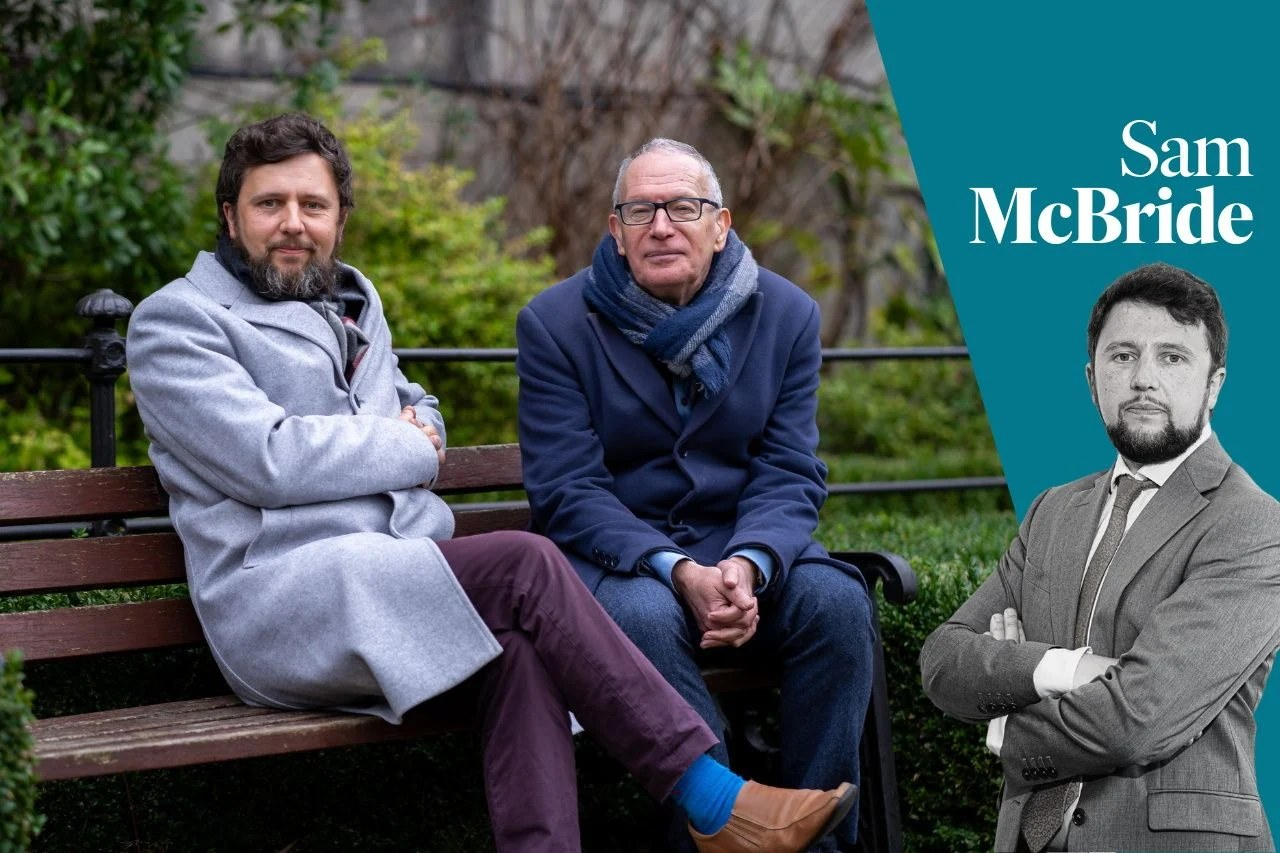
Unity or the Union? Both sides have a good argument, but rarely is it made in a sensible way.
Either case should be based on facts, not tribal thinking… our future depends on it.
The two authors each argue for, and then against, removing the Irish border
The two authors each argue for, and then against, removing the Irish border
Sam McBride
Today at 01:30
Ireland has many divides. The border might be the most controversial, but there are divisions which predated partition and have the potential to outlast it even if the border was to be removed.
Yet beyond differences of religion, of constitutional preference, of class — and even newer points of difference such as ethnicity and language — lies what is now perhaps the most important division: the split between those who want to win a border poll at all costs, and those whose respect for their neighbours outweighs their desire to get everything they want.
There is a fragility in all things. What we now have — booming prosperity (in both global and historical terms, even if we don’t think we’re rich), settled peace, and warm relations across the island and with Britain — is not normal.
Even after the turmoil of the post-Brexit years, we exist in an unusually settled period. This is both a blessing and an opportunity.
It is a chance to consider the future of the island calmly and rationally.
There’s no ticking clock against which we’re racing to make up our minds.
There’s no pike or gun pointed in our faces. There’s no pressing urgency to overcome religious discrimination or intolerable conditions.
It wasn’t always thus. Many of our ancestors lived in periods of terror and squalor.
We don’t often think of our situation in this way. Taking a longer view back to the past and ahead to the future gives context to the present.
Last year, I was approached with an idea: The Royal Irish Academy wanted to publish a book which set out the best arguments for a united Ireland, and the best arguments against a united Ireland.
Initially, the idea was that there would be two complementary books — I would write the one on Northern Ireland, and Fintan O’Toole would write the one on the Republic.
Eventually, it was decided to combine both in a single edition on the basis that while someone in Cork might not think they need to consider the same issues as someone in Coleraine, this decision inevitably impacts both.
Fintan and I each set out with equal clarity the cases for and against unity. Neither section was difficult to write because there are many strong and reasonable arguments for both sides. Yet many of them are rarely made.
The Troubles — and more recently Brexit — demonstrated how major developments on one side of the border inevitably affect the other jurisdiction.
What attracted me to the idea was that it was resolutely nonpartisan. This isn’t an attempt to tell readers what to think about a united Ireland. Rather, it is an attempt to get them to think about it in a different way.
Fintan and I each set out with equal clarity the cases for and against unity. Neither section was difficult to write because there are many strong and reasonable arguments for both sides. Yet many of them are rarely made.
For an issue which defines Northern Ireland’s politics, it is remarkable that unionist and nationalist parties spend so little time espousing the practical benefits of their ideological preference.
I’ve never had any interest in journalism which proselytises for one or other side. Readers deserve the best possible version of the truth we can establish, not the inevitable suppression of some awkward discovery because it doesn’t suit a particular cause.
At various points in my career I’ve been shunned by the DUP, Sinn Féin, and Government ministers for asking questions or reporting truths they’d rather were concealed. Not once has this caused me the slightest concern.
If the price of access to power is silence on important issues, then that access is pointless.
I accepted the invitation to write this book in the knowledge that I’d inevitably be accused of bias and that inevitably those claims would, absurdly, come from both sides.
Seeking to assuage the prejudices of such zealots is impossible, but there are a great many fair-minded people who want to be better informed about this decision, and it is those people for whom this book has been written.
It’s also for my children who are smarter than me and of whom I am immensely proud. I rarely write about them because they have the right to privacy and to be judged for who they are, rather than on my behalf.
But yesterday my daughter had her final assembly in primary school where she and her classmates were exhorted to embrace the boundless possibility before them.
Her generation, and that of her brother, will be able to judge this question freed from some of the shackles of history. But they also need to know some of the pitfalls into which past generations fell so that they can avoid repeating our mistakes and those of our ancestors.
For and Against a United Ireland is published by an academic publisher, meaning it has gone through fact-checking and peer review. But it’s not an academic book. We are journalists writing in plain language for normal people.
The book is part of the Arins project — Analysing and Researching Ireland, North and South, a joint initiative between the Royal Irish Academy and the University of Notre Dame. However, this is far too important a debate to stay within the academy. The way in which this question is decided will impact our lives and the futures of generations still unborn.
It’s not a decision to be taken flippantly or arrogantly or based on sectarian tribalism. We’ve had enough of that, and we know where it got us.
It’s not stupid to desire Irish unity or the Union’s continuation. The UK and the Republic are among the most advanced countries in the history of humanity — places where we can live comfortable lives, where there’s good medical care, and where difference is respected.
This is not an equation where the facts can be entered into a computer which can tell us how to vote. Voters will prioritise different factors and have differing tolerance of risk.
For many people, their sense of belonging is more important than simply which outcome would make them richer.
Those whose core identity is Irish or British are not inherently tribal or sectarian. National identity is wholly legitimate, and often healthy.
But what this book allows the reader to do is to not only have their own preference reinforced, but to understand and appreciate the counter-argument.
It’s not stupid to desire Irish unity or the Union’s continuation. The UK and the Republic are among the most advanced countries in the history of humanity — places where we can live comfortable lives, where there’s good medical care, and where difference is respected.
The poet John Hewitt once wrote of “this mad island crammed with bloody ghosts/And moaning memories of forgotten coasts/Our fathers steered from”. But in the lines which precede those words, he wrote: “I derive/ Sufficient joy from being here alive…”
His satisfaction at living in Northern Ireland was in an age when life was much harder and more dangerous, when sectarianism was rawer, and when for many people the world of today was unimaginable.
Some old certainties relied upon by our ancestors are now outdated. If we are to take a decision which could reshape this island for centuries to come, we need to base that decision on robust analysis of facts, not flabby tribal thinking.
In an era of disinformation, of manipulative artificial intelligence, and deceitful algorithms, a border poll is laden with peril if it is bungled.
There will be efforts to distort and deceive, and there will be those seeking to stir up murderous wrath.
Whatever our view on how this question should be answered, and whatever our view on when this question should ever be put to voters, now is the time to calmly consider the future we want for ourselves, and for our offspring.
Senior judge rejects legal applications to have case against several people charged with dissident terrorist offences dismissed…
Voting Rights for Citizens
A Letter from Ireland
a Chara,
Later this year, I will be able to vote for a new Irish President. My brother in Belfast can stand to become President, but cannot vote in the election. My daughters, who lived most of their lives, were educated, attended university, and worked in Dublin, but recently moved abroad also cannot vote in the election. Yet we are all Irish Citizens and described in the Constitution as part of the Irish nation.
US and Canadian citizens living in Ireland can vote in their respective domestic elections. A right denied to Irish citizens living in the north of Ireland or abroad.
This is not a new revelation. The denial of rights was written into Bunreacht na hÉireann (the Irish Constitution) in 1937. This was 15 years after the imposition of partition. The constitution provided for citizenship to all born on the island, but not the means to play a valued role in the political life of the nation. It was written with the full knowledge of the extent of immigration, a deliberate exclusion of a section of our nation and citizens.
For the parties in Dublin; Fianna Fáil, Fine Gael, and Labour, which did not organise in the North, the denial of voting rights was self-serving.
Platitudes could be paid to Irish citizens in the North, but God (or rather De Valera) forbid that they would ever be given a voice in the life of the nation. It has always struck me that Irish Citizens in the North and our exiled children across the globe laid waste to the myth of a successful nation state. We were a reminder of a nation divided by Britain, and of successive Irish governments that could not provide for generations who were forced into immigration.
In November 2013, the Convention on the Constitution recommended that citizens resident outside the State should have the right to vote in Presidential elections. It looked like this historic injustice would be addressed. Enda Kenny, the then Fine Gael Taoiseach, speaking in Philadelphia, promised a referendum to bring the Constitution into line with the recommendation of the Convention. This was too late for the 2018 Presidential Election, but it was promised that it would be in effect for the 2025 election. And then…nothing.
Earlier this year, Sinn Féin brought a motion to the Stormont Assembly (the parliament in the North of Ireland) to support the extension of voting rights in the Irish Presidential election to Irish Citizens living in that jurisdiction. The motion was passed by the Assembly.
This week in the Dáil (Irish Parliament), Sinn Féin leader Mary Lou McDonald pushed for moving the relevant legislation on voting rights to the next stage of Committee scrutiny and proposed a motion calling for the implementation of the 2013 proposals. The Government of Fianna Fáil and Fine Gael did not oppose either proposal. However, there is a difference between not opposing and actively progressing.
The dead hand of Fine Gael and Fianna Fáil cannot be allowed to continue to undermine the voting rights of Irish Citizens in the North or living abroad. Rights that are extended to citizens of other nations.
Have a great weekend.
Is mise,
Ciarán
Ciarán Quinn is the Sinn Féin Representative to North America
Noel Doran: A quarter of a century on, the PSNI risks losing what made it work.
Scrapping 50/50 recruitment was a mistake that still haunts the PSNI
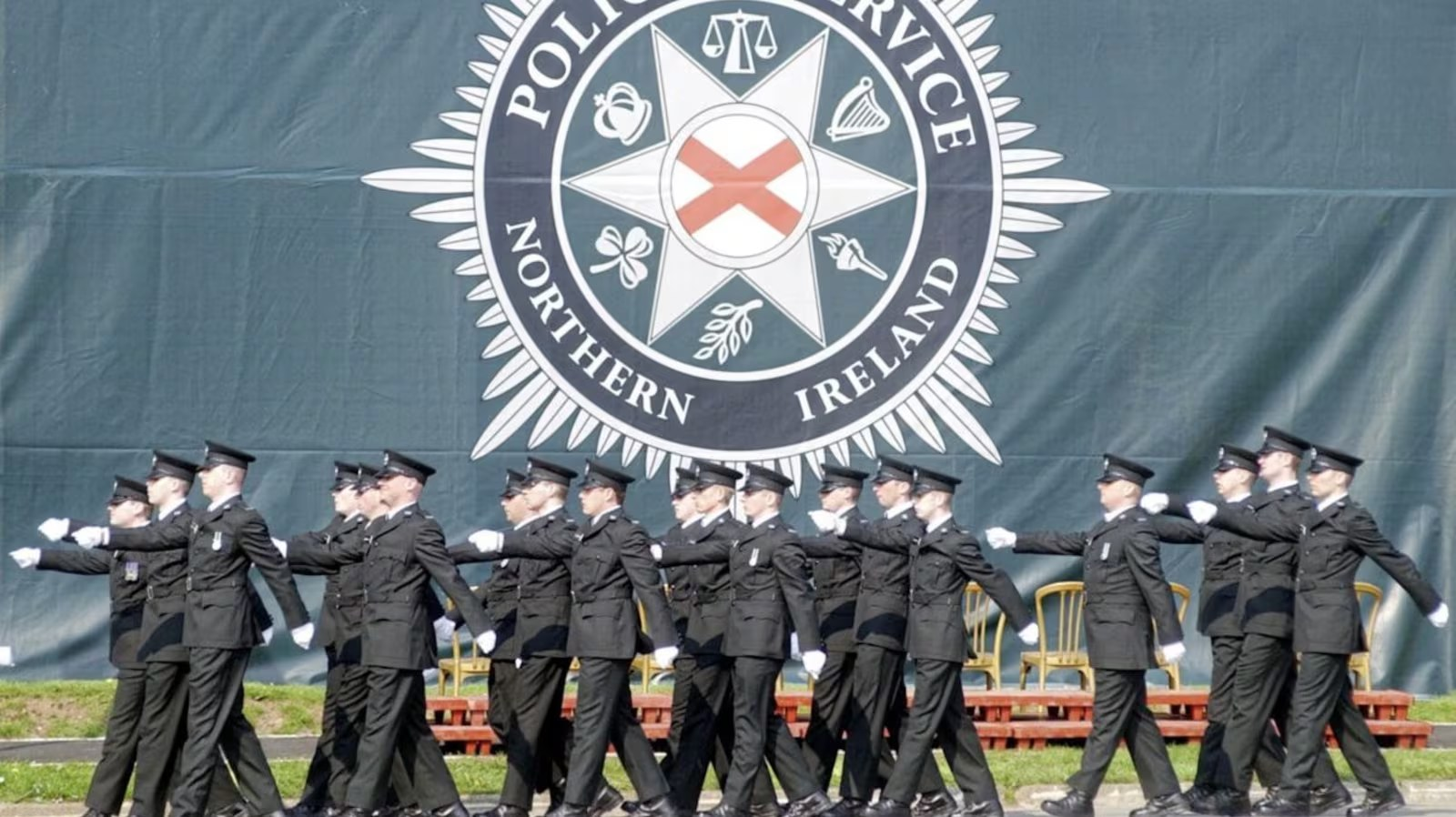
New recruits of the Police Service of Northern Ireland march past the new PSNI logo during the first ever graduation ceremony in Belfast.
By Noel Doran
June 30, 2025 at 6:00am BST
It is hugely disappointing that the PSNI, instead of preparing to celebrate the 25th anniversary of its launch next year as a heartening success story, is having to address fundamental questions about its religious balance.
Past and present flawed political interventions mean that developments which are entirely contrary to the spirit of the new era so painstakingly constructed a quarter of a century ago are growing in seriousness.
It was always envisaged that the PSNI would eventually contain as close to an even number of perceived Catholics and Protestants as possible, with those from other or no faith backgrounds equally welcome.
There were plainly a number of reasons for the fact that its predecessor, the RUC, was overwhelmingly Protestant, but it was agreed on all sides that change must follow as part of the breakthroughs associated with the 1998 Good Friday Agreement.
The GFA established the Patten Commission on policing under the direction of the former British cabinet minister Chris Patten, and, as soon as Maurice Hayes was named as one of its members, I was sure that its work would be transformational.
I had known him since I was a child, as he was a good friend of my late father, and I do not think that I ever met a more accomplished figure who had a sharper insight into all aspects of Irish life, north and south.
Hayes, who died in 2017, and his colleagues produced their visionary report in 1999, recommending the establishment of the PSNI, under the supervision of policing boards and an ombudsman, with a new code of ethics and crucially a policy of 50/50 recruitment for Catholics and Protestants remaining for at least a decade.
It also proposed an emphasis on community policing and normalisation which would include the removal of the GAA’s Rule 21, preventing northern police officers and British soldiers from joining the association.
The attitude of Catholics and nationalists to policing needed to change if a lasting new dispensation was to be achieved, and, as previously noted in this column, The Irish News found itself increasingly close to the sharp end of the debate.
Our initial suggestion that the time had come for the two main nationalist parties to take their seats on the policing boards caused something of a stir, while our repeated calls on the GAA to finally drop Rule 21 were probably even more contentious.
It led to threats of a boycott of the paper from some quarters, but it transpired that both the PSNI arrival and the GAA’s ban departed with much less upheaval than might have been anticipated in the course of November, 2001.
The number of Catholics in the new service rose dramatically from eight per cent at its inception up to almost 30 per cent within less than 10 years, and was heading steadily toward a figure which fairly represented our divided population.
Unfortunately, the then Conservative secretary of state Owen Paterson, who was only in his post for just over two years and shortly afterwards left the British cabinet to become a Brexit campaigner, caved in to unionist pressure and made the disastrous decision to end the 50/50 recruitment policy in 2011.
The most recent figures indicate that the number of Catholic officers who were born in the north, as opposed to moving from across the border or Britain, is roughly 26 per cent, or barely one in four.
It is even more alarming that, according to the result of a Freedom of Information request by this paper last week, Catholics made up just 17.1 per cent of new hires to the PSNI in 2024, representing an unmistakeably negative trend.
While the dreadful attempts to intimidate and target Catholic officers by small but aggressive republican splinter groups are very much a factor, the perception that the PSNI is becoming an institution which is increasingly and disproportionately linked to the Protestant tradition is deeply unhelpful.
The reality that there have always been more applications to the service from Protestants than Catholics means that a 50/50 recruitment policy does not provide equality of opportunity, but wider considerations are involved.
Although the multiple scandals surrounding the investigation into the 1997 murder of the GAA official Sean Brown were initially down to shocking conduct on the part of the RUC, the refusal by the present Labour secretary of state Hilary Benn to allow the public inquiry which the courts have ruled as a necessity has inflicted further reputational damage on the PSNI.
Mr Benn can undo at least some of the harm which this and other cases have caused to the image of policing through starting a review process which would allow the return of 50/50 selection in the short term.
 By Eugene Reid on 1 July 2025Matthew Syed’s writes in The Sunday Times this week and it got me thinking. He argues that the problem facing many Western democracies isn’t that politicians have stopped delivering—it’s that voters have stopped wanting reality. We demand high-quality public services but revolt at the suggestion of paying for them. We rage against deficits, but punish anyone who dares to propose a cut. In this environment, leaders survive not by solving problems, but by dressing them up in ever shinier illusions.It’s a sharp, insightful piece. And yet, reading it from Northern Ireland, I find myself asking: is that all we’re dealing with here?Because while Britain, France and the US are undoubtedly struggling under the weight of short-termism, contradiction, and electoral fantasy, Northern Ireland faces an additional—and arguably more dangerous—challenge: a political system that doesn’t function at all.It’s become fashionable to describe Stormont as dysfunctional. But that word is starting to lose its impact. The truth is starker. Dysfunction implies a system that works badly. Ours often, nay, let’s admit it, doesn’t work at all.While Westminster engages in unconvincing fiscal gymnastics and the Élysée fends off protest, Stormont is more likely to be suspended, or just “going through the motions” Civil servants—unelected, unaccountable—are left holding the reins, during the suspensions and when the institutions are up and running, the system does not function as a proper government in any way, shape or form!Budgets go unsigned. Major infrastructure projects stall, or run over budget, time and more often than not. are unfit for purpose! (Think RVH Maternity Hospital)Reform plans gather dust. The public grows more disillusioned by the day. And no manifesto pledge, no matter how fanciful, can be delivered by an Assembly that is hamstrung by the structures that were developed to ensure its very existence!Syed argues that modern voters want to be told comforting lies. He’s not wrong. But here in Northern Ireland, the crisis is more existential. When voters go to the polls, they increasingly suspect that no matter who they elect, nothing will change. That the institutions designed to serve them will be paralysed by veto, collapsed by walkout, or sunk by competing mandates before any programme for government even gets off the ground.Just this week, a friend said to me—with admirable honesty—that “we don’t do real politics here.” He explained that he would continue voting for Sinn Féin until we achieved a united Ireland, and only then, he said, would we start debating education, health, and the economy “like normal countries do.”I understood the strength of his conviction—but I was staggered by the logic. Because a united Ireland, even for those who believe in and strive for it, including yours truly, is years—likely decades—away. Oh, and by the way, it will become reality via a slow, gradual process, not with a “big bang” moment, as many seem to think!Can we really afford to wait that long to fix a health service on the verge of collapse? To rescue an education system buckling under budget pressures? To rebuild public infrastructure, address housing shortages, or tackle chronic underinvestment, and endemic public sector mismanagement!!The idea that politics can pause while we await constitutional resolution is, frankly, intolerable. The damage being done to public services right now is real, urgent, and accelerating. We cannot keep asking citizens to live in a holding pattern while our political system remains stuck in neutral.So yes, the failure of delivery is now a feature of modern democracies. But in Northern Ireland, it’s more than that. It’s a feature of our constitutionally constructed gridlock. Our politics isn’t just infected by populism or paralysed by complexity—it is shackled by a design that too often prioritises equilibrium over progress.We are not immune to the global wave of political illusionism. But we’ve added a local twist: an apparatus incapable of managing disagreement, incapable of adapting, and incapable—too often—of governing at all.We need to be honest. Voters everywhere must accept that hard choices are coming, and that grown-up government requires compromise. But in Northern Ireland, that conversation can only begin once we restore a system capable of having it.Otherwise, we risk not just poor delivery—but democratic decay of a deeper kind