Obviously I have a lot to say with regard to the Red Hand Commandoes wanting to legitimize themselves.
Like many this sounds ludicrous given the despicable acts of terror they committed against innocent Catholics during the troubles.
Many families whom lost love ones at the hands of this evil group would understandably never accept there new found position or for that matter any sort of an apology.
The Red Hand Commandoes in “Collusion” with a British intelligent agent Brain Nelson was responsible for the assassination attempt on my family in 1988.
Although no one was seriously injured in the attack I would ague that I also lost a loved one to this group albeit 16 years later.
The attack by the Red Hand Commandoes on my young family forced us to flee our homeland to seek asylum. Our struggles continue today but the unrelenting stress and threat of deportation back into the hands of our perpetrators was too much for my beloved wife Bernadette.
Brian Nelson colluded and provided the information and weapons to Red Hand Commandoes to carry out the attempted assassination and the British Government turned a blind eye. ”They stood by and watched as there agent conspired to murder there citizens”.
Nearly thirty years on I don’t think there is a judge or jury in NI that could possibly bring a sense of justice to the families who suffered at the hands of the Red Hand Commandoes.
In my case even if the courts find one of there former leaders “Winstone Winkie Rea guilty of the murder of two Catholics he is charged with and my attempted murder it won’t bring any form of justice to our respective families but the truth may bring some closure.
In light of the recent omissions made by the Red Hand Commandoes I would suggest that there leadership do what is required of murderers in the US when they come before a parole board….prove how remorseful they are, formally admit and take responsibility for the murders and the atrocities they committed during the ‘Troubles” Prove to the families that they are sincere and help bring closure and an end to the suffering of many afflicted by there actions.
Show me that they really care and ask my family for forgiveness.
It takes courage to build peace and if we are to obtain an everlasting peace for our children and our grandchildren its time for both sides to admit responsibility for there actions and that includes the British Government..!!
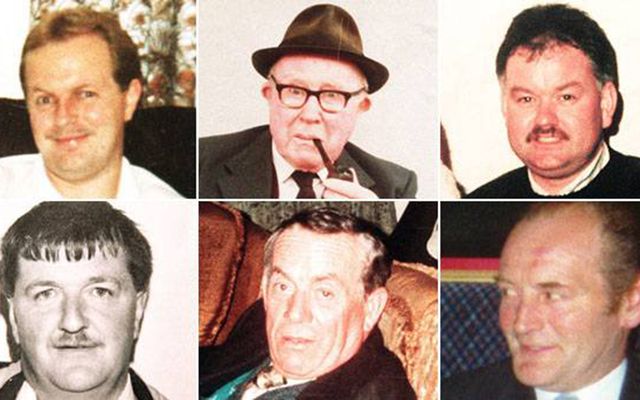
On June 18, 1994, six men were shot and killed by two masked members of the Ulster Volunteer Force in Heights bar in Loughinisland, Co Down.
A long-awaited film documentary by an Oscar-winning director is set to bring the story of the British government’s role in the infamous 1994 Loughinisland massacre to a world audience and re-open allegations of massive collusion between British security forces and Loyalist killers.
“No Stone Left Unturned” will have its world premiere on Saturday, September 30 at the New York Film Festival and will include a Q & A session with famed director Alex Gibney. Producer Trevor Birney is also expected to attend.
Efforts to have the film included in last year’s Tribeca Festival were ended due to legal reasons.
The Loughinisland massacre took place on June 18, 1994 in the small village of Loughinisland, County Down, Northern Ireland. Members of the Ulster Volunteer Force (UVF), a loyalist paramilitary group, burst into a pub with assault rifles and fired on the customers, killing six civilians and wounding five. The pub was targeted because it was frequented mainly by Catholics and was crowded with people watching the Republic of Ireland team playing in the 1994 FIFA World Cup.
The massacre occurred just as the IRA were deciding whether or not to call a ceasefire, a critical time in the Irish peace process. It was a clear attempt by elements within the British military to kill off the peace process.
The movie will tell the story in the context of the 1994 World Cup and Moira Casement, niece of victim Barney Greene, said the families hoped people would be brought to account.
“The ripples that the report caused and the media interest in that was good to see,” she said. “There wasn’t a paper you picked up that didn’t refer back to Loughinisland. It caused wider ripples.”
Alex Gibney the director, is from New York. He won an Oscar in 2008 for a documentary called “Taxi to the Dark Side, “which was about the Bush administration’s use of torture in Iraq.
This title, “No Stone Left Unturned,” comes from family member Claire Rogan’s comments about how the police assured the families there’d be no stone unturned in the investigation. Claire Rogan’s husband Adrian was murdered watching the game.
The documentary looks at the issue of how the state’s policy of protecting intelligence and informers was prioritized over the families’ rights to natural justice and bringing killers to court.
“While the Ombudsman’s report gave us much more answers we feel there are still unanswered questions there and that’s that this documentary is about.”
Niall Murphy from KRW Law said the state’s involvement in the massacre made it a story that had to be told.
“We have a circumstance where the car is delivered to a murder gang by a registered informer, he said.
“Police are aware of this within an hour and within months the car is destroyed. The RUC kept destroying the evidence. They destroyed the car after ten months. They destroyed all interview notes of any suspect who was interviewed in the first two years.
“Gough Barracks was a convenient excuse. Asbestos became the state’s convenient shredding machine. Every interview note ever taken from a suspect was destroyed and we don’t have that any more.
“Police have lost the log book of the car (car’s title) and we know now that they didn’t collect cigarette butts from the bar. They left a bullet in the bar that wasn’t discovered for almost two years.
“We also would learn from (Police Ombudsman) Al Hutchinson’s report that nine out of sixteen suspects didn’t have forensics taken properly – fingerprints, DNA, hair samples.
“The getaway car was found, three balaclavas were found, three boiler suits were found, three gloves were found – none of which were found by police. All were found by citizens and brought to the police’s attention. All that evidence would be destroyed.”
Emma Rogan, whose father Adrian was murdered that night, said for her the film will be a permanent memory to the victims and the injustice done.
“I personally feel that the film is a legacy,” she said.
“When I’m dead and gone it will be there for generations.
“My granda Rogan died. Willie O’Hare died – all the older generation are dying off, but this will be here for my children’s children to see what happened here and what was wrong.”
Tout, informer, snitch, rat, grass and I am sure there are more terms
used, all have the same meaning in Ireland, someone who gives
information to the British forces, some of these people may be involved
themselves in the acts they inform on, they may work closely with the
people they will one day see imprisoned, or worse killed. Some may be
just local snoops, 50p touts as they are known in Armagh, and they give
anything ranging from very valuable information, such as surveying the
movements of someone of interest to the Police, to informing that
someone had an argument with their wife.
Then we have what is known as the super-grass, this is an informer on
speed! The Super grass is generally someone who is involved with those
they inform on, someone who has been around a while and is trusted; they
are not your commoner garden 50p tout. What makes them “super” is the
sizable numbers of people they implicate, the trials that follow are
usually show trials, with the super grass divulging a lot of
information, some of it may be true, much of it lies. The trials
generally have major protests outside and a lot of media interest. In
Ireland being a tout makes you pond life, scum of the earth some people
will say, lower than whale shite is a term I particularly enjoy.
The term super grass came into popular use in Ireland in 1981,
Christopher Black a member of the Provisional IRA was arrested. After
securing assurances that he would have protection from prosecution,
saving his own skin like the coward that he is, Black gave statements
which led to 38 arrests of alleged IRA members. This was the first big
super grass trial. Two years later on 5th August 1983 22 members of the
Provisional IRA were sentenced to a total of more than 4,000 cumulative
years in prison, based on Black’s testimonies alone.
18 of those convicted on Black’s evidence had their conviction
subsequently overturned in 1986, such is the reliability of super-grass
tainted evidence. It is well established that Supergrasses lie, their
motivating factor being providing “evidence” to avoid prosecution.
Black, however, would not be the last big supergrass, nor would it only
affect the Republican community, in all, over 500 people from both
Loyalist and Republican backgrounds were put on trial on the word of a
super-grass, It was a corrupt system of course, supergrasses were
seduced into telling lies and implicating innocent people to save their
own skins, given large cash inducements and promises of an anonymous new
life.
By the mid-1980s, the super-grass system had collapsed, public concerns
about the credibility of the evidence could no longer be ignored and
even members of the judiciary complained they were being used as
political tools to implement government security policy.
So there we are, all ancient history, super-grass trials are proven to
be flawed, the evidence provided by these cretins is known to be
non-credible, thank God we don’t have to worry about super-grass trials
in 2017 and the prospect of innocent men and women going to jail on the
word of a fantasist…….
Uh-oh! Not the case at all, today in 2017 we have a new super-grass, and
his name is Dave Cullen.
In March 2013 Dave Cullen was arrested and remanded to Portlaoise Prison
charged in connection with the fatal shooting in Gormanstown of Peter
Butterly. Just over a year later, in June 2014 Dave Cullen offered to
turn state witness in return for the charge to be dropped, two days
later Dave Cullen was removed from Portlaoise Prison under the
protection of armed Guards, this secured Dave Cullen’s status as
Ireland’s most recent super-grass.
To date based on the statements of Dave Cullen 9 men in total have been
arrested, so far 2 of them have been convicted and are serving lengthy
sentences, the rest are either remanded in Portlaoise or on bail while
one man is currently unaccounted for (on the run).
Dave Cullen like many supergrasses before him has brazenly given
evidence to the special criminal court; the special criminal court is a
non-jury Diplock court in the 26 counties. It is believed that in return
for this Cullen has secured immunity from the murder charge, has been
assigned a new identity and has been given a cash lump sum along with a
monthly stipend. Anyone who knows anything about Irish politics knows
this is a recipe for disaster.
The arrests did not come in a flurry after Cullen turning super-grass,
the arrests have continued right up until this current month (September
2017), he has to justify his payments somehow, like all touts anything
he says should be taken with a bucket of salt. It appears that the State
has learned nothing, that so intent are they on breaking Republicanism
that they are prepared to employ the services of the most despised and
reviled creature of all, the Super-grass!
The fate of the tout is never pleasant, they generally go on to live a
desperate lonely life, the money runs out, and their usefulness expires.
They live out the rest of their lives looking over their shoulder as
they are all too aware that they are marked men.
Their state protection only goes so far because the reality of the
situation is that no one likes a tout, a deceiver, a liar, not even the
people they are touting to as they have proven they cannot be trusted.
They are a commodity for a short period of time and when they outlive
their usefulness they are thrown to the mercy of the waves by their
handlers. Touts like Martin McGartland and Kevin Fulton (real name Peter
Keeley) have been very open about their unimportance after the fact,
even going to court to try and secure money that was promised to them.
So it would seem on top of being liars and cretins we can add stupid to
the list.
As per my previous blog published in July where I spoke about the
upsurge in IRA membership charges, it is clear that the 26 County state
is intent on smashing Republicanism, if they are not using the word of a
superintendent to jail political activists, they are prepared to use the
word of an even more despicable type which is the super-grass. For our
part we must do what those before us did and protest these sham show
trials with every fibre of our being.
Loyalists planned widespread disturbances across the Six Counties in
response to council threats against their bonfires, it has been
revealed.
An idea to build bonfires “on every street corner” was considered before
authorities in Belfast backed away from a threat to remove bonfire
material there.
The ‘Grand Secretary’ of the anti-Catholic Orange Order, Mervyn Gibson,
said tensions has been raised following a Belfast City Council
injunction against four loyalist bonfires in Belfast, but that major
disorder had been narrowly averted.
“It’s how the court order is interpreted next year that worries me, in
that people will now be looking to bring this in across other parts of
the province, if that happens they’ll not stop bonfires people will just
move it off council property,” he said.
Gibson also warned that Orangemen remained angry at restrictions on
their parades, despite the relatively peaceful marching season this
year. He again called for the scrapping of the Parades Commission and
for the infamous Drumcree march in Portadown to once again pass down the
predominately Catholic Garvaghy Road.
“I think that Sinn Fein have moved on from parades politically, whereas
we’re still there and dealing with the legacy of the Parades
Commission,” he said.
Meanwhile, the issue of sectarian flags also remains a concern. Unionist
flags erected in June and are still flying in mixed areas of Belfast,
such as the Ormeau Road in south Belfast and now appear a permanent
fixture.
South Belfast resident Dominica McGowan said there is “clear community
support to remove these flags in shared spaces”.
“However, three months later and there is still no sign of these flags
coming down,” she said.
She added: “The Ormeau Road area is a diverse area and we do not feel
it’s fair to mark the territory with unionist flags, so we are asking
for support for the flags to be removed.”
Union flags and and UVF flags were erected on lamp posts at Global
Crescent and Cantrell Close – housing developments that were part of a
Stormont ‘shared communities’ strategy.
In 2014, the PSNI police said that in future the flying of loyalist
flags in the mixed Ormeau Road area would be treated as a “breach of the
peace”.
But in later years when the flags were again erected, the PSNI said they
would only remove flags if there were “substantial risks to public
safety” or a criminal offence was thought to have occurred.
Loyalists also continue to fly an apartheid era South Africa flag in a
County Down village in an apparent statement of racist hate. The flag is
one of several put up in Moneyslane over the summer and remained up this
week.
The flag, which was replaced as the flag of south Africa in 1994, was
used by the apartheid regime during the years of discrimination by the
white minority over the country’s black majority. Three flags contained
in the centre of the banner include the Union Jack.
Sinn Fein councillor Kevin Savage last night questioned the reason for
putting up the flag.
“I would like to know the rationale, what links Moneyslane has to South
Africa, it seems bizarre that this was up there?” he said. “Given its
past and the regime it represented in this day and age it should not
have been flown anywhere in the world.”
There have been protests against the planned use of a paid informer in
the non-jury trial of republican political activist Kevin Braney, the
chairperson of Saoradh in Dublin.
Mr Braney was brought before a sitting of the Special Criminal Court
last month on foot of accusations made against him by ‘supergrass’ Dave
Cullen. Cullen had a murder charge against him dropped by the state
after he agreed to give evidence against republicans.
Mr Braney has previously spent two years on remand on two previous
charges of IRA membership, which were ultimately dropped. Prosecutors
have said they are now seeking a trial before a non-jury court because
“the ordinary courts are inadequate for effective administration of
justice”.
This week, the juryless court heard that in response to being arrested
and charged by the Gardai, Mr Braney denounced the charge as
politically motivated and demanded a fair trial.
As he was being led away, he and supporters shouted “end supergrass
trials”.
Separately, republican prisoners at Portlaoise jail flew a protest flag
out of their cells in a demonstration against the judicial abuses.
In a statement released to the media, Mr Braney said the combination of
a juryless trial and a paid informer made it impossible to prove his
innocence.
He said his family and friends had endured Garda harassment, abuse,
threats, and attempts to set him up.
He also described the years he has already spent or remand as amounting
to internment. After a further six weeks behind bars on remand this
year, he was informed by his lawyer that charges were now being
prompted by the word of the ‘supergrass’ Dave Cullen.
“He [Cullen] has since entered the witness protection programme, in
doing so abandoning his children and family, and is in receipt of
monthly payments,” Mr Braney said.
“Throughout the 1980’s, the British government used ‘supergrass’
evidence extensively against republicans, but all of those cases
ultimately failed when scrutinised by international observers and human
right activists.
“Difficult and all as it is for me or any republican to prove innocence
in the non-jury ‘Special Criminal Court’, it becomes nigh on impossible
when you add a paid perjurer/supergrass to the mix.
“I call upon all republicans and anybody interested in human rights and
natural justice to publically oppose this sinister development.”
The 1916 Societies condemned the use of the “long discredited”
supergrass tactic in the 26 Counties as a means to target and imprison
Irish republicans “without meaningful evidence or due process”.
“We call on those who have set in place this reactionary policy – which
is a fundamental, grotesque violation of the right to a fair trial – to
desist at once,” they said.
“We call for all charges against those concerned to be dropped
forthwith and for those currently imprisoned on the say-so of a paid
agent of the state, Dave Cullen, to be released without further ado.
“To those effected by these reprehensible measures, we extend our
solidarity and support. We call also at this time on republicans and
progressives to join in our opposition to this frightening development,
which is a cause of concern for us all as to the future direction our
society is set toward.”