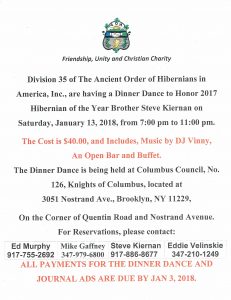
AOH Division 35 to Honor one of it’s own.
Posted by Jim on December 13, 2017
AOH Home of the Brooklyn Irish
Baile na nGael
Sunday, September 13, 2026
Posted by Jim on December 9, 2017
By Sinn Fein MP Elisha McCallion
The people in the north of Ireland voted to remain in the EU. Yet on 29
March Theresa May signalled to the European Council the British
Government’s intention to leave the EU and drag us out.
The first phase of a two-year negotiation on Brexit started in June and
prioritised the British Government’s “divorce bill”, the rights of EU
citizens and how Brexit will impact Ireland.
The EU made clear this Brexit process must safeguard the Good Friday
Agreement in all its parts, the rights of citizens and north-south
cooperation – including no hardening of the border.
When finally the British and the EU appeared to agree on a solution on
Monday, the DUP vetoed it in their own narrow sectorial interest. The
putative agreement between Theresa May and the President of the European
Commission, Jean-Claude Juncker, appears to have been derailed by them.
In effect, when attempts were made to cater for the unique position of
the north of Ireland and to protect citizens’ rights, our economy, and
the Good Friday Agreement, the DUP went out of their way to block this.
Last week the President of the European Council, Donald Tusk, visited
Dublin. He said if the British Government’s offer on the border is
unacceptable for Ireland, then it will also be unacceptable for the EU.
This is a welcome approach which needs to be maintained.
The Taoiseach Leo Varadkar, should continue to stand up for the Irish
people – north and south – against the British Government, DUP and the
right-wing press.
The DUP are Theresa May’s partners in this sorry mess. But the DUP do
not speak for the cross-community majority here who voted Remain.
They, like their Tory partners, represent only a tiny section of the
Brexit-at-any-cost British establishment.
No one, least of all the DUP, has made a credible case that the north of
Ireland will be better off outside the EU. They cannot tell us how we
will maintain essential cross-border services such as the all-Ireland
cancer centre in Derry or the freedom to travel and trade across the EU.
In Ireland, Brexit would mean economic damage on an unquantifiable scale
due to trade tariffs and regulatory divergence.
All of this is occurring against a backdrop of relentless, DUP-driven
Tory austerity, severe cuts to public services and investment.
The solution to Britain’s Brexit crisis in Ireland is clear. The north
of Ireland should have Designated Special Status within the EU, ensuring
that we remain within the customs union and the single market. That is
the only guarantee of stability and certainty which will deliver the
full protection of the Good Friday Agreement in all its parts; including
Irish citizenship and the benefits of EU citizenship.
This is a common sense, practical, and achievable proposal and does not
change the constitutional position of the north. We are told Brexit is
happening and we must accept it. Sinn Fein and citizens across the
island of Ireland reject this as an abdication of political leadership.
We are at a crucial juncture in the process. The Irish Government have
the responsibility and the leverage to ensure clarity and certainty from
the British Government.
The DUP’s determination to deliver Brexit regardless of the cost to the
people of Ireland, north and south, including large swathes of their own
electorate, is clear. But they represent a minority of people in the
north, a minority in Ireland, a tiny minority on these islands and a
minuscule minority in Europe.
The relationship between the people of Britain and the European Union is
entirely a matter for the people of Britain. But the people of Ireland
cannot be collateral damage in process that is driven by Brextremists in
the DUP and the Tory Party.
Defending the economic security and future of Ireland must be the
priority for the Taoiseach in the immediate time ahead.
Posted by Jim on
During the War of Independence, Cork was one of the main centres of
resistance to British rule. In one of the worst atrocities committed
during the War of Independence, British forces deliberately set fire to
several blocks of buildings along the east and south sides of Saint
Patrick’s Street during Saturday and Sunday 11/12 December 1920.
Five acres of the city was torched, 300 homes destroyed as well as 40
businesses, leading to the loss of 2,000 jobs. The City Hall and the
Carnegie Library were also completely destroyed by fire. A look back at
those events, 97 years ago this week.
In the aftermath of an IRA ambush at Dillon’s Cross in which one British auxiliary
was killed and a number injured, Cork City went through a period of
terror the extent of which had never before been experienced.
Some time after the ambush, a large group of Black and Tans opened fire
on civilians without the slightest warning or provocation near the corner of King
Street (now MacCurtain Street) and Summerhill North. The shooting was
totally indiscriminate. Women and children huddled in doorways or ran
for shelter. The streets soon became deserted. Some panic-stricken
people took refuge at the railway station, and could hear rifle and
revolver fire continue for more than twenty minutes.
However, the worst was yet to come. At 10 pm. Alfred J. Huston, the
Superintendent of the Cork city fire brigade, ordered the ambulance from
Grattan Street fire station to Dillon’s Cross in case there were
casualties from a fire which was raging. (A number of houses in the
vacinity of Dillon’s Cross had been set alight by irate British forces).
As the ambulance was travelling through Patrick Street the firemen came
upon a fire at Grant and Co., a department store at the southern end of
Patrick Street. The driver of the ambulance described an encounter they
then had – “On reaching the comer of Patrick Street, I, who was driving,
saw forty or fifty men walking in a body in the centre of Patrick
Street, coming towards us in very mixed dress – some with khaki coats,
some with khaki trousers, and some wore glengarry caps”.
At 10.30 pm Captain Huston received a report of the fire in Grant’s. He
found that ‘the fire had gained considerable headway and the flames were
coming through the roof’. The fire brigade was successful in containing
this fire. If it had spread to the English Market, which was located to
the rear of Grant’s, a major conflagration could have occurred. While
the fire in Grant’s was being fought, Captain Huston received word from
the town clerk that the Munster Arcade and Cash’s department store were
on fire. It was now about 11.30p.m. These two buildings were situated on
the eastern side of Patrick Street. All available units of the fire
brigade were immediately sent to fight these fires, which were spreading
rapidly.
Despite the best efforts of the fire brigade, the fires spread to
adjoining buildings and caused extensive damage. The blaze in the
Munster Arcade spread to the following establishments – Egan’s
Jewellers, Sunner’s, Forrest’s, the Dartry Dye Co., Saxone Shoe Co.,
Burton’s Tailors, Thompson’s and Cudmore’s. The fire from Cash’s spread
to the Lee Cinema, Roche’s Stores, Lee Boot Co., Connell & Co.,
Scully’s, Wolfe’s and O’Sullivan’s. All of these buildings were totally
destroyed.
Shortly before dawn, two of Cork city’s historic buildings would also be
destroyed by flames. On Sunday 12 December Captain Huston received word
that both City Hall and the nearby Carnegie Library had been put to the
torch. Seven members of the fire brigade tried in vain to fight the
flames and, like the buildings in Patrick Street, both places were
completely destroyed. As they fought the flames the members of the fire
brigade were subject to continuous harassment from crown forces, who
fired on them, turned off hydrants and slashed hoses with their
bayonets.
In his report to the Lord Mayor, Captain Huston wrote; “I have no
hesitation in stating I believe all the above fires were incendiary
fires and that a considerable amount of petrol or some such inflammable
spirit was used in one and all of them. In some cases explosives were
also used and persons were seen to go into and come out of the
structures after breaking an entrance into same, and in some cases I
have attended the people have been brought out of their houses and
detained in by-lanes until the fire gained great headway”.
Widespread looting also occurred throughout the night. A young girl who
lived at Clankittane, near Victoria Barracks, recalled seeing a
lorry-load of Auxiliaries returning to the barracks in the early hours
of Sunday, December 12th. The lorry, which was full of stolen goods,
stopped outside Hennessy’s public house. Some drunken Auxiliaries
dismounted and banged on the door of the pub, shouting for the owner.
When someone put their head out of an upstairs window, an Auxiliary made
a threatening gesture with a revolver and demanded that the doors be
opened and drink served.
As to the question of who actually started the fires, many witnesses
gave statements that groups of armed men, some in uniform, others in
civilian clothes, were responsible for the destruction wreaked upon the
city.
From his office in Victoria Barracks Major F. R. Eastwood, the brigade
major of the 17th Infantry Brigade, compiled the following report:
Official Military report on the state of Cork City for the period from
10 p.m. on Saturday, December 11, 1920, to 5.30 a.m. on Sunday, December
12, 1920, during which period the city was in complete control of the
military.
(1) Three arrests were made.
(2) At 22.00 hours, Grant & Co., Patrick Street, was found to be on
fire. Warning was sent to all fire brigades.
(3) At about 00.30 hours, Cash & Co. and the Munster Arcade were
reported on fire.
(4) At 05.30 hours the majority of the troops were withdrawn, and the
remainder at 08.00 hours.
(5) Explosions were heard at 00.15 hours, but were not located. No shots
were fired by the troops.
F. R. Eastwood,
Brigade Major, 17th Infantry Brigade. Cork.
The fact that the burning of Cork occurred while the city was, as Major
Eastwood stated, ‘in complete control of the military’ is in itself a
damning indictment of the British forces then in occupation of Victoria
Barracks.
Writing about the burning of Cork, Florence O’Donoghue, intelligence
officer of Cork No. 1 IRA Brigade at the time of the atrocity, stated; “It
is difficult to say with certainty whether or not Cork would have been
burned on that night if there had not been an ambush at Dillon’s Cross.
What appears more probable is that the ambush provided the excuse for an
act which was long premeditated and for which all arrangements had been
made. The rapidity with which the supplies of petrol and Verey lights
were brought from Cork barracks to the centre of the city, and the
deliberate manner in which the work of firing the premises was divided
amongst groups under the control of officers, gives evidence of
organisation and pre-arrangement. Moreover, the selection of certain
premises for destruction and the attempt made by an Auxiliary officer to
prevent the looting of one shop by Black and Tans: ‘You are in the wrong
shop; that man is a Loyalist,’ and the reply, ‘We don’t give a damn;
this is the shop that was pointed out to us’, is additional proof that
the matter had been carefully planned beforehand”.
The action of the British Crown forces in Cork on the night of 11/12
December brought widespread condemnation upon the officers and men who
garrisoned Victoria Barracks. Whatever remaining goodwill some citizens
of Cork may have had for the British forces was now gone.
Posted by Jim on
A decision to halt the prosecution of a former RUC man and two other on
charges linked to the loyalist mob killing of Catholic man Robert Hamill
is to be quashed, High Court judges has ruled.
They ordered a new hearing to determine if the trio should face trial
for an alleged attempt to obstruct the course of justice.
The verdict came in a legal bid by the murder victim’s mother, Jessica
Hamill, to have charges reinstated.
Her 25-year-old son was attacked in Portadown, County Armagh in 1997. He
never regained consciousness and died in hospital.
Members of the PSNI (then RUC) in the area at the time watched while the
murderous assault on Mr Hamill took place, but did not intervene.
As evidence of collusion mounted, RUC man Robert Atkinson and his wife
were charged with conspiracy to pervert the course of justice by tipping
off loyalists involved in the murder.
In September 2014 a judge at Craigavon Magistrates’ Court refused to
return the trio for trial, ruling that a key prosecution witness was
“unreliable” and “unconvincing”.
It had been alleged that a phone call was made from Atkinson’s house to
the home of a suspect in the killing, with advice given to destroy his
clothing.
Mr Atkinson denied making the call and claimed his phone was used by
another man. That man’s ex-wife, Andrea Jones, later gave evidence to
contradict this. She said she had been asked by her former partner to
make a false statement about the incident.
Jones subsequently pleaded guilty to carrying out an act tending to
pervert the course of justice.
But the prosecution against the Atkinsons and a third suspect was
stopped for a second time on the basis of insufficient evidence against
them. That decision was based solely on a district judge’s assessment of
the credibility of Jones’ evidence.
Mrs Hamill’s legal team challenged his determination, arguing that it
was irrational.
They claimed the District Judge failed to consider all of the evidence
against the defendants and neglected to take into account issues
supporting Jones’ claims of a conspiracy involving the three defendants.
The conviction of Jones should have been treated as corroborating
evidence, it was contended.
Ruling on the challenge, Justice Stephens held that there was not
insufficient evidence, and quashed the 2014 decision.
McCANN CASE REACHES COURT
Meanwhile, two former British soldiers charged with murdering an
Official IRA man in Belfast 45 years ago are mounting a legal bid to
have the case thrown out before it reaches trial.
The former paratroopers are also seeking anonymity.
The defendants, known only as Soldier A and Soldier C, are facing
prosecution for the cold-blooded killing in April 1972 of of Joe McCann.
Neither were present as proceedings got underway at Belfast Magistrates’
Court.
In a statement Joe McCann’s widow, Anne, said: “There are three
incontrovertible facts about this incident; Joe was unarmed, he as
running away, and he was shot in the back.”
Posted by Jim on
A tsunami of spin and dissembling on the Irish border has scraped the
British government into a second round of negotiations with the European
Union over its departure, but at the expense of any confidence in the
negotiations process.
The draft agreement was upended on Monday by a last minute ultimatum
issued by the hardliners of the DUP, spooked by the premature cheering
of the Dublin establishment.
In the document published on Friday, Britain conceded on the rights of EU
citizens with little protest, but the section on Ireland and the border
is an inoperable mass of contradictions. Clarification was badly
needed, and unionists extracted six strongly pro-union declarations from
the British Prime Minister Theresa May to assuage any fears of
abandonment by the Tories.
Nationalists, meanwhile, saw a promise of special status for the north
of Ireland, ‘leaked’ by Irish media last weekend, evaporate
into a guarantee only to uphold the relatively minor cross-border bodies of the
1998 Good Friday Agreement.
The glue for the deal was a promise that, in the event of no overall
deal being reached, Britain (and the north of Ireland) would maintain
“full alignment” with some elements of the European Union’s single
market and customs union. But there was no indication of how, in the
absence of an overall Brexit deal, such a promise could be implemented
through the battered and collapsed structures of the Good Friday
Agreement.
In Dublin, a new multi-million pound Department of Spin wheeled into
operation with serious effect. The Tory promise of ‘no hard border’
— still without any detail on the promised ‘frictionless’
technology — was blared out through every medium, to cheers from
establishment figures. It produced a hysterical ‘be-happy-don’t-worry’
response in both the mainstream and social media.
The result, clearly intended, is that Taoiseach Leo Varadkar and his
Fine Gael party will have extremely strong support in the event of an
early general election.
Claims that Varadkar had steered the chaotic Tory government towards a
‘soft Brexit’ – some form of membership of the European Union single
market – were particularly exaggerated, and could be exposed very
quickly. Nobody thought to tell Theresa May, as among her careening
statements was a concisely stated determination to pull out of the
European Union in its entirety, and bring the north of Ireland with it.
She has now written to the people of the Six Counties in a letter that
is to be delivered to every household. In it, she describes herself a
British Prime Minister “who hugely values Northern Ireland’s position
within our United Kingdom”. She outlines six Brexit commitments:
“First, we will always uphold and support Northern Ireland’s status as
an integral part of the United Kingdom, consistent with the principle of
consent.
“Second, we will fully protect and maintain Northern Ireland’s position
within the single market of the United Kingdom.
“Third, there will be no new borders within the United Kingdom.
“Fourth, the whole of the United Kingdom, including Northern Ireland,
will leave the EU customs union and the EU single market.
“Fifth, we will uphold the commitments and safeguards set out in the
Belfast Agreement regarding north-south cooperation. This will continue
to require cross-community support.”
Finally, she declared that people in Britain and the north of Ireland
would no longer have recourse to the European Court of Justice.
Sinn Fein’s Gerry Adams said he gave a “cautious and qualified” welcome
to the agreement, but said that many questions remained unanswered.
“Brexit is the greatest threat to the economies of this island in
generations,” he said in Dublin.
“Today’s communique does not set the final deal on Brexit.
“The communique sets out broad principles. These have been assessed by
the Irish government as sufficient progress to allow the Brexit process
to move into the next phase of negotiations on trade.
“While the communique recognises the unique and special circumstances
surrounding the issue of the Irish peace process, the Good Friday
Agreement and the border, it does not address key areas of concern for
many citizens – especially nationalists living in the north and citizens
in the border region.
“The insistence by the British that Britain and the north must leave the
customs union and the single market presents a real and live danger
which cannot be understated.
“This also contradicts the British Prime Minister’s claim that there
will not be a hard economic border.
Mr Adams said he also had concern at the statement that the Six Counties
would no longer be subject the jurisdiction of the European Court of
Justice.
He added: “While today’s communique represents some progress there are
many unanswered questions around key issues and the Irish government
must remain focused and vigilant.
“Sinn Fein is also very mindful that this Brexit process is a work in
progress. Our experience through years of agreements with Britain is
that the devil is in the detail.”
In their statement, Republican Sinn Fein said that the discussions
highlighted “once more” that those living in the Six Counties are
“little more than pawns in the game” for the English elite.
The Tories have a long history of playing the ‘orange card’ for their
own advantage, they said, and called again for a federal solution to the
Irish constitutional question, in order to protect the interests of all
four provinces.
“Unionists should be aware from the experience of history, that the
Westminster government will look after England first with jobs,
infrastructure and investment; all other areas will be well down the
pecking order,” they said.
“It is time for a mature, honest debate on how the people of all of
Ireland can move forward as a sovereign unit, with the interests of the
people being paramount. Time for a new and United Ireland.”