subscribe to the RSS Feed

Wednesday, August 12, 2026

Mark THOMPSON-Relatives for Justice- Manhattan event January 11th -FFAI

Posted by Jim on December 8, 2017


Brothers,
      Attached is a note from Brother Martin Galvin re a FFAI event taking place on January 11th in the city. He is asking the Brooklyn brothers to be listed as a co-sponsor which I believe we should. I plan on attending and I’m hopeful to get a decent turnout from Kings County.
        Please talk it up & let me know who is interested.
Jerry McCabe


——– Original message ——–
From: Martin Galvin
Date: 12/6/17 10:56 AM (GMT-05:00)
Subject: Mark THOMPSON-Relatives for Justice- Manhattan event January 11th -FFAI
 
Brothers
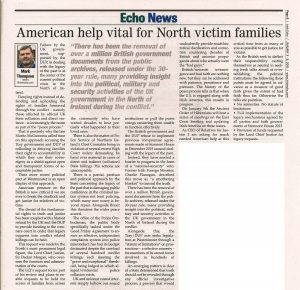
 As you know New York State AOH is bringing out Mark Thompson of Relatives for Justice for a one week tour the second week in January.Mark and RfJ are often the only hope of justice for hundreds of families who had loved ones murdered by British forces directly or in collusion with loyalists. Most recently they filed papers on Liam Ryan a Tyrone born American citizen,long time Bronx resident and Con Ed worker who was murdered after returning to Tyrone and buying a pub.
He is coming to us because he says American and especially AOH for these victims is critical as the British are making moves to end all hope of justice and truth with a Statute of Limitations.
In order to get the widest possible audience we are holding one public event in New York City on Thursday evening January 11th at the Wolfe Tone Pub on East 29th street.(Malachy McAllister is a good friend of Mark’s and they requested to hold an event there.) He will also be going to Suffolk County,Rockland,Albany and Peekskill before returning to Belfast.
Two years ago New York County booked Ruan O’Donnell.  County Chair Tom Beirne invited Brother Manning and Queens and the Bronx to be co-sponsors.
That seemed to be very positive initiative  and allowed us all to be more involved and feel more part of a very successful event.I am trying to copy Brother Beirne’s great idea.
I have spoken to a couple of you,most recently at the Parade Meeting last week but want to confirm before listing New York, Queens, Bronx and Brooklyn  as co-sponsors of this event.
This would not mean any additional work or financial obligation for  any co-sponsor-just have someone at the event to be introduced representing each co-sponsor and we may try to have county banners depending on space.
I just know the Bronx members felt more involved as a result of Brother Beirne’s initiative 2 years ago   and this would allow each county to share credit for any contributions that we would make.
-please email me back to confirm if this is ok
thanks
MARTIN GALVIN

Pro-union Brexit deal set to inflame border concerns

Posted by Jim on


As a draft deal on Britain’s withdrawal from the European Union was
being parsed today, unionists appeared to have won dramatic changes,
heavily eroding a previous commitment to no regulatory divergence along
the Irish border and adding clear guarantees of no regulatory barriers
between the north of Ireland and Britain.

All sides involved in the talks spoke of having achieved their desired
goals. DUP leader Arlene Foster said her party had won “six substantive
changes” to the text on the Irish border in overnight talks, ensuring
there would be “no red line down the Irish Sea”.

Despite major contradictions in the text, Brussels officials and the
governments in Dublin and London proclaimed themselves satisfied with
the outcome, which permits negotiations to move forward to the specifics
of trade agreements.

DUP spokesman Sammy Wilson said the agreement ensured the north of
Ireland would leave the European Union, its customs union and single
market “along with the rest of the United Kingdom”, and that there would
be no customs or trade barrier between the north of Ireland and Britain.

He also claimed his party had defeated Sinn Fein’s call for designated
special status for the north of Ireland, which would not be separated
“constitutionally, politically, economically or regulatory from the rest
of the United Kingdom”.

The text makes copious references to the “1998 [Good Friday] Agreement”
and the principle of consent — the requirement of a majority of
citizens in the Six Counties to support any future constitutional change
— even though voters in the north of Ireland soundly rejected Brexit
and, polls indicate, continue to do so.

In another apparent contradiction, Dublin said the final wording of the
agreement preserves the promise of “full regulatory alignment” between
the North and South of Ireland.

It pointed to a section of the text which declared that in the absence
of an overall agreement, “the United Kingdom will maintain full
alignment with those rules… which support North-South cooperation, the
all-island economy and the protection of the 1998 Agreement.”

However, that statement appears to be a significant dilution of the
situation earlier this week. The deal also goes on, in the next
paragraph, to spell out the opposite case — “the United Kingdom will
ensure that no new regulatory barriers develop between Northern Ireland
and the rest of the United Kingdom unless, consistent with the 1998
Agreement, the Northern Ireland Executive and Assembly agree that
distinct arrangements are appropriate for Northern Ireland.”

This appears to provide an extraordinary veto on trade deals to the
devolved Stormont Assembly and Executive, which collapsed in January,
despite there being no indication that they will return.

The agreement also specifies that a separate strand of the negotiations
in phase two will be concerned with Irish issues. It says this work will
also address issues arising from “Ireland’s unique geographical
situation”, including the transit of Irish goods through Britain and
Ireland to markets in mainland Europe.

British Prime Minister May said the deal would ensure “no hard border”
in Ireland and added the deal was a “significant improvement”.

A Dublin government spokesman said the negotiations had preserved the
Common Travel Area, the Good Friday Agreement “and crucially obtaining a
guarantee that there will be no hard border.”

Taoiseach Leo Varadkar has said it was a “significant day” for Ireland.

“We have achieved all that we set out to achieve in phase one of these
negotiations,” he told a press conference in Government Buildings in
Dublin. “I am satisfied that sufficient progress has now been made on
Irish issues, the parameters have now been set and they are good.”

He said Ireland’s focus would now move to phase two of the negotiations.
Mr Varadkar said his government would remain “fully engaged and
vigilant” throughout the process.

“This is not the end but it is the end of the beginning,” he added.

Brexit deal reached between EU and London

Posted by Jim on

The full text of a draft agreement released this morning (in reference
to Ireland) in negotiations on Britain’s withdrawal from the EU.
Ireland and Northern Ireland


42. Both Parties affirm that the achievements, benefits and commitments
of the peace process will remain of paramount importance to peace,
stability and reconciliation. They agree that the Good Friday or Belfast
Agreement reached on 10 April 1998 by the United Kingdom Government, the
Irish Government and the other participants in the multi-party
negotiations (the ‘1998 Agreement’) must be protected in all its parts,
and that this extends to the practical application of the 1998 Agreement
on the island of Ireland and to the totality of the relationships set
out in the Agreement.

43. The United Kingdom’s withdrawal from the European Union presents a
significant and unique challenge in relation to the island of Ireland.
The United Kingdom recalls its commitment to protecting the operation of
the 1998 Agreement, including its subsequent implementation agreements
and arrangements, and to the effective operation of each of the
institutions and bodies established under them. The United Kingdom also
recalls its commitment to the avoidance of a hard border, including any
physical infrastructure or related checks and controls.

44. Both Parties recognise the need to respect the provisions of the
1998 Agreement regarding the constitutional status of Northern Ireland
and the principle of consent. The commitments set out in this joint
report are and must remain fully consistent with these provisions. The
United Kingdom continues to respect and support fully Northern Ireland’s
position as an integral part of the United Kingdom, consistent with the
principle of consent.

45. The United Kingdom respects Ireland’s ongoing membership of the
European Union and all of the corresponding rights and obligations that
entails, in particular Ireland’s place in the Internal Market and the
Customs Union. The United Kingdom also recalls its commitment to
preserving the integrity of its internal market and Northern Ireland’s
place within it, as the United Kingdom leaves the European Union’s
Internal Market and Customs Union.

46. The commitments and principles outlined in this joint report will
not pre-determine the outcome of wider discussions on the future
relationship between the European Union and the United Kingdom and are,
as necessary, specific to the unique circumstances on the island of
Ireland. They are made and must be upheld in all circumstances,
irrespective of the nature of any future agreement between the European
Union and United Kingdom.

47. Cooperation between Ireland and Northern Ireland is a central part
of the 1998 Agreement and is essential for achieving reconciliation and
the normalisation of relationships on the island of Ireland. In this
regard, both Parties recall the roles, functions and safeguards of the
Northern Ireland Executive, the Northern Ireland Assembly, and the
North-South Ministerial Council (including its cross-community
provisions) as set out in the 1998 Agreement. The two Parties have
carried out a mapping exercise, which shows that North-South cooperation
relies to a significant extent on a common European Union legal and
policy framework. Therefore, the United Kingdom’s departure from the
European Union gives rise to substantial challenges to the maintenance
and development of North-South cooperation.

48. The United Kingdom remains committed to protecting and supporting
continued North-South and East-West cooperation across the full range of
political, economic, security, societal and agricultural contexts and
frameworks of cooperation, including the continued operation of the
North-South implementation bodies.

49. The United Kingdom remains committed to protecting North-South
cooperation and to its guarantee of avoiding a hard border. Any future
arrangements must be compatible with these overarching requirements. The
United Kingdom’s intention is to achieve these objectives through the
overall EU-UK relationship. Should this not be possible, the United
Kingdom will propose specific solutions to address the unique
circumstances of the island of Ireland. In the absence of agreed
solutions, the United Kingdom will maintain full alignment with those
rules of the Internal Market and the Customs Union which, now or in the
future, support North-South cooperation, the all-island economy and the
protection of the 1998 Agreement.

50. In the absence of agreed solutions, as set out in the previous
paragraph, the United Kingdom will ensure that no new regulatory
barriers develop between Northern Ireland and the rest of the United
Kingdom, unless, consistent with the 1998 Agreement, the Northern
Ireland Executive and Assembly agree that distinct arrangements are
appropriate for Northern Ireland. In all circumstances, the United
Kingdom will continue to ensure the same unfettered access for Northern
Ireland’s businesses to the whole of the United Kingdom internal market.

51. Both Parties will establish mechanisms to ensure the implementation
and oversight of any specific arrangement to safeguard the integrity of
the EU Internal Market and the Customs Union.

52. Both Parties acknowledge that the 1998 Agreement recognises the
birth right of all the people of Northern Ireland to choose to be Irish
or British or both and be accepted as such. The people of Northern
Ireland who are Irish citizens will continue to enjoy rights as EU
citizens, including where they reside in Northern Ireland. Both Parties
therefore agree that the Withdrawal Agreement should respect and be
without prejudice to the rights, opportunities and identity that come
with European Union citizenship for such people and, in the next phase
of negotiations, will examine arrangements required to give effect to
the ongoing exercise of, and access to, their EU rights, opportunities
and benefits.

53. The 1998 Agreement also includes important provisions on Rights,
Safeguards and Equality of Opportunity for which EU law and practice has
provided a supporting framework in Northern Ireland and across the
island of Ireland. The United Kingdom commits to ensuring that no
diminution of rights is caused by its departure from the European Union,
including in the area of protection against forms of discrimination
enshrined in EU law. The United Kingdom commits to facilitating the
related work of the institutions and bodies, established by the 1998
Agreement, in upholding human rights and equality standards.

54. Both Parties recognise that the United Kingdom and Ireland may
continue to make arrangements between themselves relating to the
movement of persons between their territories (Common Travel Area),
while fully respecting the rights of natural persons conferred by Union
law. The United Kingdom confirms and accepts that the Common Travel Area
and associated rights and privileges can continue to operate without
affecting Ireland’s obligations under Union law, in particular with
respect to free movement for EU citizens.

55. Both Parties will honour their commitments to the PEACE and INTERREG
funding programmes under the current multi-annual financial framework.
Possibilities for future support will be examined favourably.

56. Given the specific nature of issues related to Ireland and Northern
Ireland, and on the basis of the principles and commitments set out
above, both Parties agree that in the next phase work will continue in a
distinct strand of the negotiations on the detailed arrangements
required to give them effect. Such work will also address issues arising
from Ireland’s unique geographic situation, including the transit of
goods (to and from Ireland via the United Kingdom), in line with the
approach established by the European Council Guidelines of 29 April
2017.


Senior figures in Fine Gael and Fianna Fáil have insisted they would never enter any coalition with Sinn Féin

Posted by Jim on November 20, 2017

Martin McGuinness’s widow, Bernie; Gerry Adams; Michelle O’Neill; and Mary Lou McDonald at the Sinn Féin ardfheis. Photograph: Nick Bradshaw

Martin McGuinness’s widow, Bernie; Gerry Adams; Michelle O’Neill; and Mary Lou McDonald at the Sinn Féin ardfheis. Photograph: Nick Bradshaw

By Sarah Bardon

Sinn Féin passed a motion at its ardfheis this weekend allowing it to enter government as a minority partner, a significant shift by the party.

However Taoiseach Leo Varadkar and Fianna Fáil leader Micheál Martin ruled out doing business with Sinn Féin.

Mr Varadkar said the party “might be getting younger but their policies are the same”. His view was echoed by senior figures in the party including Minister for Justice Charlie Flanagan and Minister for Social Protection Regina Doherty.

Mr Flanagan said: “From a policing and a security point of view, Sinn Féin is not fit for government. It also engages in Paul Daniels economics,” he said, referring to the magician.

Ms Doherty said the main contender for the leadership of Sinn Féin, Mary Lou McDonald, has sought to “defend the legacy of Sinn Féin and the IRA”.

The Minister pointed to Ms McDonald’s loyalty to Gerry Adams when he was being accused of covering up sex abuse allegations.

Martin’s criticism

In a speech on Saturday night, Fianna Fáil leader Micheál Martin strongly criticised Sinn Féin for always “putting the Provisional movement first”.

He added: “They might be new leaders but they are not new faces. For one moment let’s assume that Sinn Féin will act against type and actually hold a democratic election for its next leader.

“The fact is that every one of their potential leaders joined Sinn Féin before the ceasefires and has repeatedly defended the Provisional IRA’s campaign.”

A number of Fianna Fáil TDs have spoken in favour of a coalition with Sinn Féin. However, party spokesman on housing Barry Cowen urged “such troublemakers” to remember the vote taken by the ardfheis earlier this month.

The Fianna Fáil conference agreed not to enter any coalition arrangement with Sinn Féin. Mr Cowen insisted there would be no deviation from that policy by the party.

Upheaval for Sinn Fein as Adams announces retirement

Posted by Jim on November 19, 2017

It was an emotional night for Sinn Fein supporters in the RDS last night
as Gerry Adams confirmed he was making his last Presidential Address
after more than 30 years at the head of the organisation.

The 69-year-old icon, synonymous with a party he helped to mould from a
revolutionary force into a powerful political machine, signalled the
historic transition with the words: “this is the important bit”.

He told the 1,000 delegates in Dublin on Saturday night that he and the
late Martin McGuinness had recognised the need for a new change in
leadership in the party.

“I thought I needed to tell you … I have been privileged to be part of
an amazing leadership,” said Mr Adams.

“One of our greatest achievements has been to build a peace process. I
will not be standing for the Dail; neither will Martin Ferris. This is
also my last Ard Fheis [party conference].”

He added: “Leadership means knowing when it is time for change and that
time is now.”

Charismatic and internationally renowned, Mr Adams brought Sinn Fein out
from the political margins and onto the threshold of real power. In the
face of immense and relentless opposition from the political
establishment and mainstream media, and even as bloody conflict raged in
the North, he maintained an understanding with the Irish public which
infuriated his enemies.

It is close to 50 years since Mr Adams was a barman in the Duke of York
pub in Belfast, where he first became a republican activist. From a
staunchly republican family, he carried forward the dreams of his
father, Gerry senior, who served time in prison for IRA activity during
World War II.

Since the 1981 hunger strikes, which transformed Sinn Fein into a
coherent political force, he helped to build a party which came to
dominate its sister organisation in the Provisional IRA.

After winning the West Belfast Westminster seat in 1983, Mr Adams was
elected president of Sinn Fein. It was a stunning power shift which
would ultimately split the organisation and propel his movement firmly
in a political direction. Some 34 years later, a similar change is
afoot, but with a far smoother and orchestrated transition than that
which brought him to power.

Displacing the SDLP to become the largest nationalist party in the
North, Mr Adams shifted his focus South. He left West Belfast for a seat
in Louth, and began to strengthen the organisation to reach more than
20% in the polls and 23 seats in the Dublin parliament.

Sinn Fein delegates elected Mr Adams to stay on as president until 2018.
They also agreed to hold a special conference to announce the new
leadership. It will take place within three months of Mr Adams standing
down as leader next year.

His successor will not be easy to find.  Of the two main contenders,
there are questions over Dubliner Mary Lou McDonald’s popularity and
Donegal man Pearse Doherty’s ambition.

Mr Adams paid tribute to those who travelled with him along his journey,
many of whom are now also in the process of stepping back, but he was
hopeful for the “next generation”.

In his speech Mr Adams said: “I have complete confidence in the leaders
we elected this weekend and in the next generation of leaders.”