FDNY Families with Special Needs
Posted by Jim on January 26, 2018
|
AOH Home of the Brooklyn Irish
Baile na nGael
Sunday, September 13, 2026
Posted by Jim on January 26, 2018
|
Posted by Jim on

By Irish Echo Staff
Máirtín Ó Muilleoir, a former Lord Mayor of Belfast and currently a member of the Legislative Assembly for South Belfast, will visit Manhattan College on Friday, January 26 for a presentation and discussion on the current state of affairs in the North capital.
The event will begin at 11.30 a.m. in room 5C of the Raymond W. Kelly ’63 Student Commons. It is free and open to the general public.
A tireless advocate for peacemaking and supporter of a new and resurgent Belfast, Ó Muilleoir, said a release, has launched a series of initiatives designed to showcase the best of Belfast.
Added the release: “An Irish speaker, Ó Muilleoir believes strongly in the promotion of culture as the bedrock of successful and diverse communities. A journalist and author, his books in Irish and English include Belfast’s Dome of Delight, a history of Belfast City Hall, and the Irish novella, Ceap Cuddles.
“Ó Muilleoir served as Lord Mayor of Belfast from June 2013 to June 2014. During his term, he appointed 10 chaplains, including representatives of the Jewish, Muslim, Hindu and Buddhist faiths as well as ministers from the four main Christian churches.
“He initiated a series of efforts to build bridges to political opponents, including a meeting with Queen Elizabeth. He also pioneered transatlantic links, signing a sister city agreement with the Mayor of Boston Marty Walsh and welcomed President Barack Obama to Belfast.”
In December 2017, the Manhattan College men’s basketball team participated in the inaugural Belfast Classic, becoming the first team to win a game played within the European Union.
The team and student spirit squads also traveled around Belfast and participated in community service activities during their time in Northern Ireland.
Mr. Ó Muilleoir heads Belfast Media Group, the Echo’s parent company.
Posted by Jim on January 21, 2018
Sean Bresnahan on a United Ireland.
The existing two state arrangements in Ireland are the creation of British imperialism, designed to preserve imperial power in Ireland and the continued domination of Westminster — and those allied to Westminster — over the affairs of Ireland at the expense of her people.
Britain’s partition of Ireland, under the 1920 Government of Ireland Act, backed by supporting legislation employed since, can fairly be considered the product of military… force — and indeed the continuing employment of that force.
The six and 26-county states stand in violation of Ireland’s sovereignty and are founded on the usurp of the Irish Republic, declared in law on 21st January 1919, as ratified by the Irish people through the contemporary democratic process of the time. This remains the last occasion Ireland was able to exercise genuine self-determination.
As such, their legitimacy is open to contest by those unwilling to view partition as a fair political settlement or an arrangement born of a democratic process, or indeed any process beyond the deployment of power in the form of superior military force and the threat of force — an act which itself constitutes the use of force.
Partition, and the states spawned thereof, can rightly then be held not only as illegitimate but indeed illegal and thus subject to challenge.
Posted by Jim on
At a special party conference in Dublin on February 10th the Sinn Féin party will officially elect a new leader in succession to Gerry Adams, who has held the position since 1983.
Since there is only one candidate, the result is a foregone conclusion: when nominations closed, Mary-Lou McDonald was the only name on the list, so it is as certain as anything can ever be in politics that she will become the party’s Uachtarán (pronounced “ookhtarawn”, Irish for President).
At 69, Adams is two years younger than Donald Trump and it is likely he will still have a significant role, at least on a consultative basis, in the party he has been leading for 35 years.
Comparing the results of the Irish and Middle East peace processes, Bill Clinton is reported to have told Adams once: “The difference between you and Arafat, Gerry, is that you delivered.” Given the part Adams has played in persuading the Irish Republican Army (IRA) to end its armed campaign and put its faith in normal electoral activity by its political counterpart, Sinn Féin, it is hard to believe that Adams will completely disappear from the scene although he will presumably become less visible.
But Mary Lou McDonald will be the main public face of the party and her arrival into the top job marks a process of generational change in Sinn Féin. The violence in Northern Ireland began in 1969 which was the year she was born. Adams consistently denies having been a member of the IRA but himself and his close friend Martin McGuinness, who died last year, have long been regarded as the pivotal figures in the republican movement in Ireland.
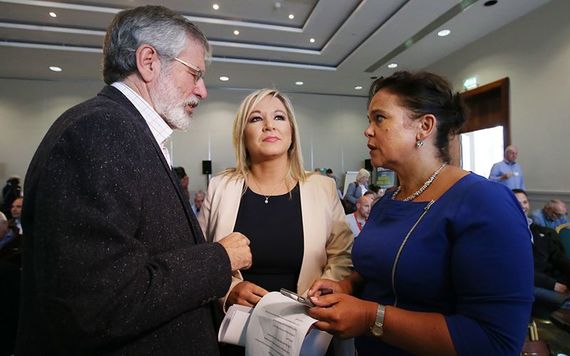
Gerry Adams, Michelle O’Neill and Mary Lou McDonald. Credit: ROLLINGNEWS
Although she has been very loyal to Adams and defended her leader to the hilt when allegations were made linking him to certain controversial episodes in the Northern Ireland conflict, McDonald herself would not be associated in the public mind with the “Troubles” as they are called.
She is best-known for her combative interventions in Dáil Éireann, the lower house of the Irish parliament, as well as her formidable debating skills in panel discussions on TV and radio. Whereas Adams also has his strengths, he can be a poor performer in the broadcast media on economi issues and a couple of “car-crash” interviews he gave in the last general election to Dáil Éireann in 2016 are thought to have damaged his party’s prospects at the time.
Adams comes across as far more comfortable in a purely Northern Ireland context and appears ill at ease and at times poorly-informed on political issues south of the border. McDonald is a more formidable opponent in Dáil debates, where she gives as good as she gets. She was a major focus of media attention in November 2014 when, after a bitter row on the controversial issue of water charges, she refused to leave the Dáil chamber and staged a four-hour “sit-in” despite being suspended from the House.
Cynics and political rivals said McDonald was simply acting to divert attention from a major controversy at the time over the manner in which the republican movement had dealt with allegations of sexual abuse by some of its activists.
How will Sinn Féin fare in electoral terms under its new leader? Her profile as a parliamentarian rather than a former participant in the northern conflict is seen as an advantage with the voters.
However ,there is a submerged element among the electorate who would have a certain, usually-discreet, admiration for Adams and his role in the Troubles. Will they turn to Mary Lou next time, or just stay at home: time will tell.
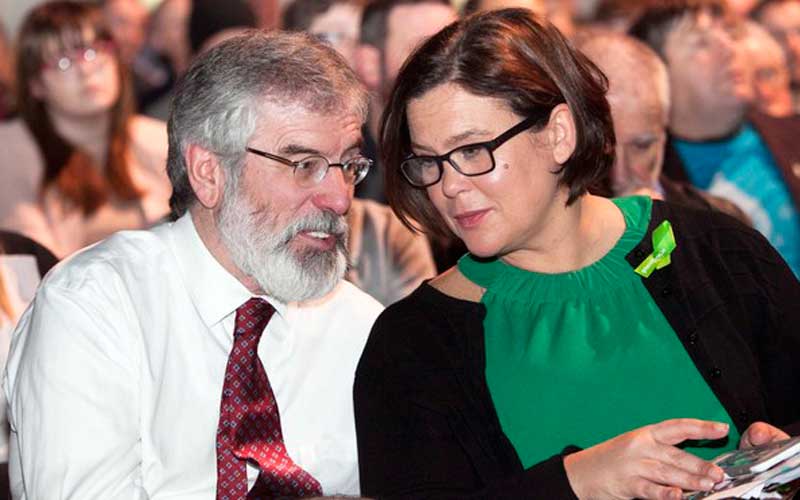
Gerry Adams and Mary Lou McDonald. Credit: RollingNews.ie
It is likely that her background in middle-class south Dublin will make Sinn Féin more acceptable as a future participant in government. Mary Lou (her birth-name is Mary Louise) comes from the leafy suburb of Rathgar and attended a private, fee-paying secondary school before going on to Trinity College Dublin where she studied English Literature.
She later took a Master’s degree in European Integration Studies at the University of Limerick and worked for a time at the Institute of international and European Affairs in Dublin. She met her future husband, Martin Lanigan, in 1990; they were married six years later and have two children, a boy and a girl. Martin works in a gas utility company and the family live on Dublin’s northside.
Her first involvement with party politics was as a member of Fianna Fáil. At the party’s ardfheis (national conference) in 1998, she made a speech on the need for police reform in Northern Ireland to ensure fairer representation of the nationalist community. F
ianna Fáil sources say her aspiration to achieve political office was blocked by the late Brian Lenihan Jr, whereas she herself insists she moved over to Sinn Féin because they were more serious about achieving social equality and a United Ireland.
She also became chair of a broad-based republican organisation called the Irish National Congress and took an active interest in the long-running Drumcree dispute north of the border between local nationalist residents and Orange Order members seeking to hold a parade on the Garvaghy Road in Portadown.
She ran unsuccessfully for the Dáil as a Sinn Féin candidate in the 2002 and 2007 general elections. In 2004, she got elected as a Member of the European Parliament for Dublin but lost her seat in the 2009 European elections. She was elected to the Dáil in the 2011 general election for the constituency of Dublin Central and has held that seat since then. In 2009 she succeeded Pat Doherty as vice-president of Sinn Féin
Sinn Féin has been involved in a stand-off with the Democratic Unionist Party in the north, leading to the suspension of the power-sharing administration, and it will be interesting to observe McDonald’s role in attempting to resolve that dispute. In the south, although the two main parties, Fine Gael and Fianna Fail, have disavowed the prospect of a coalition with Sinn Féin, the advent of Mary Lou to the position of president means their objections will carry rather less weight than in the era of Gerry Adams.
Her impeccably middle-class Dublin background and strong parliamentary record mean she cannot be ruled out on the basis of historical involvement in the Northern Ireland conflict. In the past, strong declarations of opposition to coalition with specific parties have given way to more practical considerations and this could well happen in the future.
Politics is meant to be about principles but it is also a numbers game and if Sinn Féin is needed to make up the numbers, Mary Lou McDonald could be destined for high office in a coalition government. Hello Minister Mary Lou?
Posted by Jim on January 19, 2018