subscribe to the RSS Feed

Sunday, September 13, 2026

Unionism no longer sure what it is selling

Posted by Jim on March 4, 2018


“Unionism opposed Home Rule, even to the extent of taking up arms [1912-1914], but it later settled for exactly that when Irish partition gave Unionists their own state. However, the Stormont government opted for political repression and anti-Catholic discrimination. … Its present weakened state dates from the misuse of Stormont’s one-party rule and the failure of successive Unionist leaders to move away from its overriding adherence to political dominance since then….As long as they stay there [Westminister] and not in Stormont, it looks like a continuing case of withering Unionism.”
Fr. McManus
Patrick Murphy. Irish News. Belfast. Saturday, March 3, 2018

The civil rights movement threw Unionism into confusion and the Anglo-Irish Agreement propelled it into chaos.

Stormont’s collapse last year placed it firmly in crisis and just when it thought things could not get worse, the EU this week suggested re-locating The North’s post-Brexit customs border to the Irish Sea.

In 50 years, Unionism has declined from having a monopoly in northern politics to being unsure of what it is selling, uninformed about its customer base and apparently devoid of a future business plan.

For almost a century, it has had an in-built majority, in a state specifically designed to protect that majority. If Unionism took the wrong turn when Terence O’Neill said in 1968, “Ulster stands at the cross roads”, it has taken every possible wrong road since then. Another wrong turning and it risks political insolvency.

So what exactly does modern Unionism stand for? How did it get into such a weakened position and where, if anywhere, does it go from here?

Although it is conservative in nature, Unionism is not quite a political philosophy. It tends to be more a state of mind. For centuries Ireland has been subject to various overseas influences, invasions and plantations, but in most cases the new arrivals gradually merged into the Irish way of life.

The Anglo-Normans blended seamlessly into Irish society. The Tudor plantation of Munster effectively failed and more recent arrivals from Africa will soon be among our finest GAA sportsmen and women.

The one exception was the Ulster plantation, which reflected religious rivalry from the start. Although radical Presbyterianism in the 18th century offset some of that division, it later converted to Unionism, mainly through the influence of the Orange Order.

Unionism opposed Home Rule, even to the extent of taking up arms, but it later settled for exactly that when Irish partition gave Unionists their own state. However, the Stormont government opted for political repression and anti-Catholic discrimination.

In response, the Nationalist Party sat silent in Stormont while the IRA, in Peadar O’Donnell’s words, formed fours in dark corners in fields. When the civil rights movement demanded basic democratic rights for all (including unionists) unionism came under pressure for the first time. Repression ultimately destabilized the state.

Terence O’Neill’s response was to have tea with reverend mothers in convent school parlours. Arlene Foster used the same tactic last year (although there are fewer reverend mothers these days) to show how Irish language-friendly she was. (Unionism is not good at coming up with fresh ideas.)

Its present weakened state dates from the misuse of Stormont’s one-party rule and the failure of successive Unionist leaders to move away from its overriding adherence to political dominance since then. Although it had absolute power, it combined religious elitism with a political siege mentality, encapsulated in that self-imprisoning phrase, ‘Not an inch’.

O’Neill failed to respond to the civil rights demands, because he allowed himself to become a prisoner of Paisley’s crude anti-Catholicism. Paisley was not a mainstream unionist, just a religious bigot who, because he was never faced down by a single unionist leader, distorted unionism into something resembling a quasi-religious cult, with him as leader.

When he gave an inch in his thirst for power, he was soon dumped by the party and the Church he founded – a man devoured by his own rhetoric.

In some ways the current criticism of Arlene Foster is pointless, because no previous Unionist leader has done anything differently and survived. She is a prisoner of the Unionist mind set, which states that the leader can never go faster than the slowest party member.

Already she is being outflanked by those outside her party. In a letter to the press, a ‘civic unionism’ group with more than 100 people has challenged what it says is a Nationalist assumption that qualities such as rights, truth and equality are not inherent within Unionism. They have a good point, but it is difficult to say if they can progress beyond letter-writing.

So whither Unionism from here? Home Rule in Stormont seems remote as the DUP settles for political influence at Westminster, a short-term arrangement while Theresa May is in power. That has transformed them from Ulster unionists into English conservatives.

This hardly represents the best interests of their working class Protestant support, but a bit of flag waving will soon take care of that. Unlike Scottish and Welsh unionism, the rump of Irish unionism has abandoned devolved government, settling instead for the Tory benches at Westminster.

As long as they stay there and not in Stormont, it looks like a continuing case of withering Unionism.
EU trade plan ‘could end the United Kingdom’ – May

Posted by Jim on March 3, 2018

EU trade plan ‘could end the United Kingdom’ – May

The British Prime Minister has claimed an EU proposal for a ‘common
regulatory area’ between the EU and the North of Ireland would “threaten
the constitutional integrity of the UK”.

Released in Brussels on Wednesday by the EU’s chief Brexit negotiator
Michel Barnier, the text puts into legal terms a joint report agreed by
Britain with the EU in December. It effectively codifies a proposal for
the North of Ireland to have special status with the EU as the default
measure to ensure that no ‘hard border’ across Ireland will result from
the Brexit withdrawal agreement.

On the crucial issue of the Irish border, the draft text spells out in
detail how the principle of “regulatory alignment” agreed in December
would be implemented if Britain fails to find technological or
diplomatic solutions to keeping the border open.

The EU text states that if no technological or diplomatic solutions are
found to keeping the border open, the fallback framework is that “the
territory of Northern Ireland, excluding the territorial waters of the
United Kingdom … shall be considered to be part of the customs
territory of the Union”.

It suggests that EU and British customs authorities should jointly
oversee movements between Ireland and Britain, while Europe would remain
involved in aspects of taxation and state aid in both parts of Ireland.

However, there was a strong reaction in London.

“No UK prime minster could ever agree to it,” Mrs May told MPs.

Answering questions in parliament shortly after the publication of the
text, she said: “The draft legal text the Commission have published
would, if implemented, undermine the UK common market and threaten the
constitutional integrity of the UK by creating a customs and regulatory
border down the Irish Sea.”

There was also a sharp reaction from unionists.

The proposals sparked anger from the DUP, with leader Arlene Foster
calling it “constitutionally unacceptable.” She said the North of
Ireland must have “unfettered access” to the British market.

DUP deputy leader Nigel Dodds claimed the EU was using the peace process
as an excuse to “thwart” Britain’s departure from the European Union.

Despite the majority vote two years ago by the people of the North of
Ireland to remain within the European Union, North Antrim MP Ian Paisley
hit out at what he saw as EU efforts to “annex” the area, while the
Ulster Unionist Party ironically claimed there was an attempt to
override the principle of consent of the Good Friday Agreement.

Sinn Fein president Mary Lou McDonald condemned the reaction from the
British government and the DUP to the EU legal text.

Speaking in the Dail, she said: “The Tory-DUP axis is satisfied to treat
the welfare of the people of this island as collateral damage so long as
they achieve their ‘little Englander’ vision for Brexit.

“The position of the Tory-DUP Brexiteers is that they will have their
Brexit at any cost. Except it won’t be them who foots the bill. It will
be the ordinary people of this island both north and south.

“That can’t be allowed to happen. The Tory-DUP wrecking agenda cannot
prevail.”

In a high-profile speech at London’s Mansion House on Friday, the
British prime minister subseuqently set out five “foundations” for
Britain’s negotiators, but provided scant details on the issue of the
border.

She said she believed that the border should be “as frictionless as
possible” through a “customs arrangement” and by ensuring that British
regulatory standards “remain at least as high” as those of the EU.

She also hinted at proposals to reduce delays at border crossings by
recognising “trusted traders” and by “drawing on the most advanced IT
solutions so that vehicles do not need to stop at the border”.

Sinn Fein MEP Matt Carthy said May’s response was “riddled with
contradictions” and failed to deal with the problems Brexit presents to
Ireland.

“Theresa May has failed to deal with the fact that dragging the North of
Ireland out of the European Union, against the wishes of its
inhabitants, is undemocratic.

“She has failed also to deal with the fact that the North leaving the
customs union is incompatible with avoiding a hard border in Ireland.

“Theresa May and her government are still steering a course which
undermines the Good Friday Agreement and is injurious to the political,
economic and social interests of the people of Ireland, North and
South.”

He said the only workable and democratic solution was for the North of
Ireland to be granted Special Designated Status within the European
Union and the Customs Union.

“The rights of all the people of Ireland to European citizenship must be
upheld,” he said. “The EU and the Irish Government must now stand firm
in the face of British obduracy and defend the interests of Ireland and
the Irish people.”

Ireland endures overnight blizzard

Posted by Jim on March 2, 2018

Almost 24,000 homes and businesses across Ireland are without power amid
one of the worst winter storms the country has experienced for decades.
Much of the country heeded warnings to stay indoors amid extreme weather
conditions overnight.

Sub-zero temperatures led to extremely dangerous road conditions and
virtually all public transport was cancelled, with flights at Dublin
Airport suspended until Saturday. All Dublin Bus, Luas and Irish Rail
services are suspended.

Dublin fire brigade reported trees being down, a roof collapse and poor
conditions on the roads, with their own vehicles struggling to get
through the snow drifts.

A Status Red alert will remain in place in Leinster, Munster and Galway
until 6pm today. However, a public safety notice for people around the
country to stay indoors has been withdrawn this morning.

“As expected [the storm] moved up across country and brought and is
continue to bring strong easterly winds,” Gerry Murphy of Met Eireann
told RTE radio.

“As well as that as it met the cold air it brought snow up over parts of
Leinster and Ulster.”

Cold air from the east clashed with warmer collided with strong winds
from the south east to produce snow of up to 60cm in depth, although a
meter of snow could yet fall on the country, according to forecasts.

“There will be continuation of that snowfall as we go through the day.
Leinster and Munster will continue get the bulk of that snow,” Mr Murphy
said. “The winds will continue quite strong along the coast”.

A number of people became stuck in their cars overnight when blizzards
hit making roads impassable and visibility was reduced to zero. People
remained stuck in their vehicles across Dublin.

“It seems some people may have left the city late in the day yesterday,
and judged local conditions in town as being manageable, but as they got
out of the city to where conditions were worse they got stuck,” said a
garda spokesman.

Last night a total of 115 homeless people were allocated beds in the
Extreme Cold Weather Accommodation in the sports centre in Dublin’s
South Inner City according to the Peter McVerry Trust.

Some 21 people were found to be sleeping rough despite the extreme
conditions. The team managed to persuade six to use the emergency
shelter.

Official Communication from the UFA

Posted by Jim on March 1, 2018

February 28th


PLAQUE DEDICATION

On Monday, March 12, 2018 at 1100 hours, a Plaque Dedication will be held honoring the memory of Lt Steven Sorger, E-6, who died on March 11, 2017. The dedication will take place in the quarters of E-6, located at 49 Beekman Street, New York, NY. All off-duty members and their families are invited to attend. Members are requested to attend in dress uniform.

NEVER FORGET FOUNDATION 9/11 MEMORIAL

Gene Lynch, President of the Never Forget Foundation, former member 38/51/D7, announces the unveiling and blessing of the 9/11 Memorial on Saturday, April 7, 2018. The memorial consists of a 3’ black granite stone with World Trade Center steel on top. The black granite is engraved with FDNY, NYPD, PAPD, airlines and civilian casualties numbers. The Twin Towers are also etched into the stone. Coffee will be served at 9am followed by a ceremony and blessing at 11am. The ceremony will take place at the Redwood Club, 2680 Schurz Ave., Bronx, NY 10465. All are welcome and encouraged to attend.

RAY PFEIFER FOUNDATION

The Ray Pfeifer Foundation, a 501c3 charitable organization, is dedicated to assisting September 11th first responders, firefighters and police with medical needs not covered by insurance. Many people do not realize the attacks of 9/11 are still affecting the first responders who spent months digging through debris to find the victims in hopes of giving families closure. According to the FDNY WTC Health Program, there are over 2,000 active and retired firefighters currently battling 9/11 cancers, and thousands have been diagnosed with other illnesses. With the imminent threat of mesothelioma diagnoses, a cancer which takes roughly 20 years to develop, the number of people who will need help will only continue to grow. While Zadroga covers much of their health care needs, there are gaps, as with any insurance. The RPF aims to fill those gaps for our heroes who have sacrificed so much. They purchase motorized scooters, lift systems to get out of bed, provide daily home health care aides when insurance has limits, and so much more. They are raising funds by participating in shows and events, through the support of other foundations, and by hosting their own RPF events.

Landmark Irish Hunger Memorial in New York is finally open again after major repairs

Posted by Jim on

New York's Great Hunger Memorial

New York’s Great Hunger Memorial Battery Park

New York’s Irish Hunger Memorial is open again after renovations!

  James O’Shea @IrishCentral
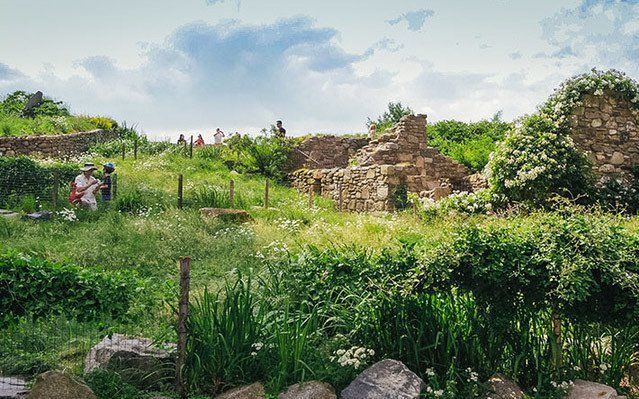
The $5.3 million renovations and waterproofing of the Irish Hunger Memorial in Battery Park in Manhattan is finally completed and the memorial is now ready for visitors. The Great Hunger Memorial depicts a ruined cottage in a rural Mayo setting smack in the middle of downtown Manhattan.

The project restored the monument to its former magnificence, while rendering it significantly less susceptible to damage from weather for years to come. It has been closed for close to two years. It opened briefly last year but other problems arose.

According to the Tribeca Trib newspaper, the renovation process was especially difficult because the landscaping, reproduced from Ireland, had to be re-assembled just as it was.

Photo by Edward Menashy

Photo by Edward Menashy

All of the stones on the memorial, which sits on a half-acre at Vesey Street and North End Avenue, “had to be removed, taken down and catalogued, and soil was removed and in some cases brought back,” Gwen Dawson of the Battery Park City Authority said.

“All of those stones got put back in the right place.  Our contractor has done a spectacular job.”

The memorial, according to its official description, “represents a rural Irish landscape with an abandoned stone cottage, stone walls, fallow potato fields and the flora on the north Connacht wetlands. It is both a metaphor for the Great Irish Famine and a reminder that hunger today is often the result of lack of access to land.”

Photo by Edward Menashy

Photo by Edward Menashy

The restoration project at the 15-year old memorial located in Battery Park City, overlooking the Hudson River, commenced after the site was closed waterproofing and drainage issues — some of which were related to Hurricane Sandy in 2012 — which caused significant decay to the tourist attraction.

The Memorial, designed by internationally renowned sculptor and public artist Brian Tolle, originally opened in 2002. It is a contemplative space devoted to honor the Great Irish Hunger and Migration of 1845-1852, while encouraging viewers to contemplate present-day hunger worldwide. Over the years, it had succumbed to water infiltration from above and subsequent water damage 

The half-acre site on the corner of Vesey Street and North End Avenue, in the Battery Park City section of downtown Manhattan, overlooks the Hudson River. Visitors to the 96′ x 170′ Memorial wind through a rural Irish landscape, with paths carved into a hill thickly lined with native Irish plants and stones imported from each of Ireland’s 32 counties.

Photo by Edward Menashy

Photo by Edward Menashy

The paths lead to a breathtaking viewing point 25 feet above street level, which boasts views of the Statue of Liberty and Ellis Island. Located centrally along the pathways is an authentic Irish Famine-era stone cottage that was donated to the Memorial by Tolle’s extended family, the Slacks of Attymass, County Mayo. It was disassembled and brought over from Ireland and reconstructed on-site, within the green “hillside” of the Memorial.

“The Irish Hunger Memorial was first dedicated over 15 years ago; it has now re-opened to stand for coming generations as a place of reflection and remembrance. And just as America has long welcomed immigrants from Ireland and beyond, we’re pleased to once again welcome Battery Park City visitors to experience this poignant tribute to the unbreakable human spirit,” said a statement from the Battery Park City Authority.

The cottage, pathways, and plant-filled meadows are cantilevered over a layered base of glass and polished fossil-bed  limestone from County Kilkenny, Ireland. Shadowy text that relates to both the Famine and reports of contemporary hunger form upon the frosted glass panels, wrapping around the exterior of the Memorial and into the passageway leading to the cottage.

Photo by Edward Menashy

Photo by Edward Menashy

This project held vital significance for CTA. According to principal Daniel J. Allen, AIA, “Many of us on the project have strong ties to Ireland, making this much more than basic renovation work to us. We were painstaking in our repairs in order to keep the artist’s vision intact.” Similarly, CTA’s project manager for the Memorial, Frank Scanlon, AIA, grew up in County Roscommon and in County Mayo. “We were thrilled to be able to provide a solution to keep the Memorial open year-round for years to come,” he said.

The project team also included The LiRoconstruction group, landscape consultant and architect SiteWorks; mechanical, electrical, and plumbing (M/E/P) engineer Collado Engineering, P.C.; and structural engineer GACE Consulting Engineers.

Soon after the Memorial was first opened to the public, Battery Park authorities noticed cracking and a leak from the cantilevered slab where the monument’s landscaping and cottage were located. Despite a temporary fix the problem continued but it has now been completely dealt with.

Photo by Edward Menashy

Photo by Edward Menashy

The New York Times raved about the memorial when it opened in 2002.  Critic Roberta Smith said it struck a “deep emotional chord” and expanded “the understanding of what a public memorial can be.”

The memorial’s cultural liaison was Adrian Flannelly, the long-time Irish radio show host. Flannelly was one of the driving forces behind the creation of the memorial, which is open every day from 11 am until 6:30 pm and is free of charge.