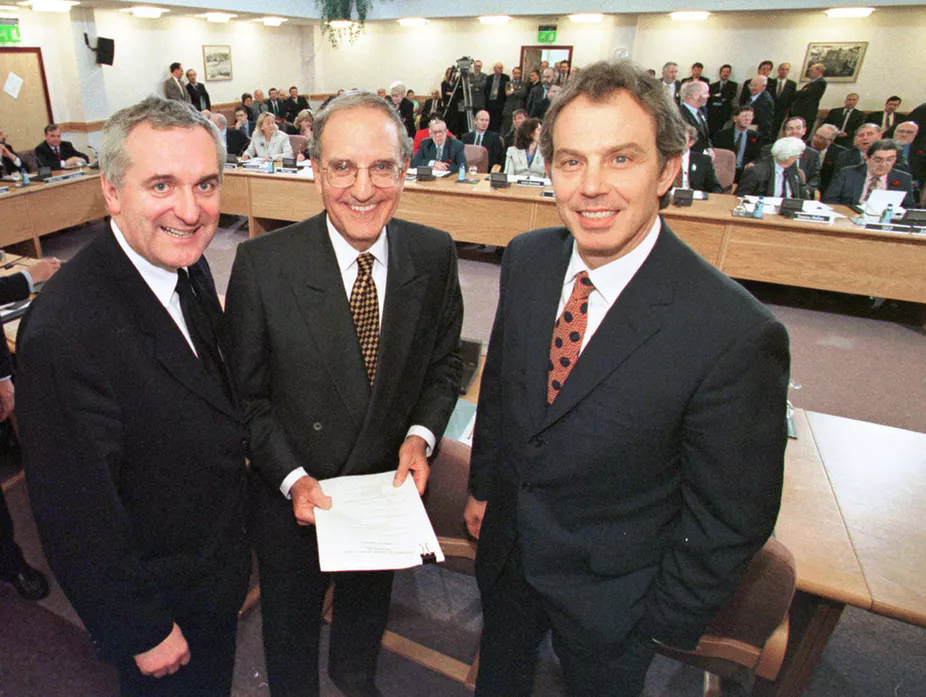
Perhaps nothing could have more vividly symbolized the bitterness and hopelessness of the Northern Ireland conflict. A few years later, as I began my academic career studying British and Irish history, possibilities for ending the violent conflict between Protestant and Catholic communities in Northern Ireland seemed remote.
One decade later, on April 10, 1998, the Irish and British governments and the major political parties in Northern Ireland signed a breakthrough accord. Known as the Good Friday Agreement, or the Belfast Agreement, it set forth a framework for sharing power among the opposing political parties in Northern Ireland. Two years of grueling negotiations, chaired by former U.S. Sen. George Mitchell, appeared to put an end to a violent 30-year period known as “The Troubles.”
As the agreement turns 20, however, the future of Northern Ireland remains unclear. Several decades of certain violence, in which 3,500 were killed, have been replaced by an uncertain peace.
Northern Ireland’s government has collapsed, leaving governing power to the British Parliament at Westminster. Meanwhile, Britain’s pending departure from the European Union — known as Brexit — threatens to re-establish a formal border between Northern Ireland and its neighbor to the south, the Republic of Ireland. This could hamper the economic interactions and symbolic partnership that open borders have provided.
From partition to Troubles
The island of Ireland, situated off the west coast of the larger island of Great Britain, came under direct British rule in 1800. At that time, the Irish Parliament was dissolved and a newly formed United Kingdom of Great Britain and Ireland governed from England.
Politics in the 19th century were unsettled, however. Ireland’s indigenous, mostly Catholic population had few political and civil rights compared to Protestant elites, many of whom were British or of British descent.
Irish nationalists of varying stripes, who opposed British rule and Protestant domination, formed political movements aimed at obtaining independence from Britain in the 19th and early 20th centuries. By 1919, an Irish war for independence was underway.
By the end of the war in 1921, nationalists had won at least a partial victory: An Irish Free State was created with 26 counties — the forerunner of the current Republic of Ireland.
However, six of the most heavily Protestant counties in the northeast of Ireland remained a part of the United Kingdom. These counties are what are known as Northern Ireland, geographically part of the island, but politically still united with Britain after the war.
The island was divided, and crucially, so was the society within Northern Ireland. Unionists or loyalists — those who wish to remain a part of the U.K. — are mostly Protestant and tend to identify as British. Nationalists or republicans, those who wish to see a fully united Ireland independent of British rule, are mostly Catholics who identify as Irish. Northern Ireland became divided between a Protestant and unionist majority, and a significant Catholic and nationalist minority.
“The Troubles” began in the late 1960s. A Catholic civil rights campaign sought to end discrimination by the Protestant-dominated government and police forces in Northern Ireland. Clashes between police and protesters led to charges of police brutality and eventually to further violence between the two communities.
Escalating violence led to the deployment of British troops, making many Catholics feel further alienated as the conflict worsened. Over the next 30 years, the people of Northern Ireland suffered through a sporadic but persistent war waged by nationalist and unionist paramilitary forces — armed groups that carried out assassinations, bombings and intimidation.
Given the prevalence of violence and seemingly irreconcilable political goals of unionists and nationalists, the Good Friday Agreement of 1998 was a major diplomatic achievement. The willingness of formerly sworn enemies to engage in negotiations paid major dividends: in 1972, the deadliest year of the Troubles, 479 people were killed.
In the 10 years following the Agreement, an average of eight people died per year in the conflict. In 2008, there were none.
Uncertainty: Brexit and beyond
The agreement’s 20th anniversary comes amid major questions about the future. Northern Ireland’s government has operated intermittently, and is currently suspended. Divisions between nationalists and unionists have been exacerbated by sharp differences over the U.K.‘s decision to leave the EU.
The decision has created questions about the border between Northern Ireland, which is part of the U.K., and the Republic of Ireland, an enthusiastic member of the EU. Because Northern Ireland is part of the U.K., it will leave the EU too.
The nature of the Brexit vote also seems reason for some concern. Religious identity proved to be a stronger predictor of Brexit votes in Northern Ireland than class: 85 percent of Catholics voted to remain, compared to only 40 percent of Protestants. A majority of working-class English and Northern Irish Protestant voters chose leave, while a majority of working-class Northern Irish Catholics voted to remain.
The U.K.’s departure from the European Union appears to give Catholics and nationalists renewed incentive to favor unification with the Republic, rather than working toward a functional, regionally self-governing Northern Ireland within the United Kingdom.
At the same time, there are reasons to be optimistic. The Good Friday Agreement brought an impressive measure of peace to Northern Ireland and offered a democratic future. But on this anniversary, as the agreement on peace remains tenuous, I believe Northern Ireland’s present and future both deserve attention from politicians in Westminster and Dublin.
On this solemn day, we mourn the loss of Barbara Bush, an outstanding and memorable woman of character. As a wife, mother, grandmother, great-grandmother, military spouse, and former First Lady, Mrs. Bush was an advocate of the American family. Mrs. Bush lived a life that reminds us always to cherish our relationships with friends, family, and all acquaintances. In the spirit of the memory of Mrs. Bush, may we always remember to be kind to one another and to put the care of others first.
As a mark of respect for the memory of Barbara Bush, I hereby order, by the authority vested in me by the Constitution and the laws of the United States of America, that the flag of the United States shall be flown at half-staff at the White House and upon all public buildings and grounds, at all military posts and naval stations, and on all naval vessels of the Federal Government in the District of Columbia and throughout the United States and its Territories and possessions until sunset, on the day of interment. I also direct that the flag shall be flown at half-staff for the same period at all United States embassies, legations, consular offices, and other facilities abroad, including all military facilities and naval vessels and stations.
IN WITNESS WHEREOF, I have hereunto set my hand this seventeenth day of April, in the year of our Lord two thousand eighteen, and of the Independence of the United States of America the two hundred and forty-second.
As a proud son of Fermanagh, I have regularly praised DUP leader, Mrs. Arlene Foster, who is also a native of Fermanagh. … Despite political differences in Northern Ireland, county solidarity is still quite strong, especially in Fermanagh. In this letter published in the Irish News of Belfast, I gently question Mrs. Foster’s recent statement that, in the event of Ireland’s re-unification, she would leave Fermanagh and Ireland. That is something which the Founder of the DUP, Reverend Ian Paisley, MP, would never have done.” —Fr. Sean McManus. Good gracious, a Fermanagh captain prepared to abandon ship Letters to the Editor. Irish News. Belfast. Published, Wednesday, April 18, 2018 Fr Sean McManus, President, Irish National Caucus.Washington DC
I had high hopes and nothing but good wishes for Arlene Foster, and was proud that a Fermanagh native had become first minister.
I had the pleasure of meeting her several times over the years, before and after she became first minister, at Washington functions. She was out-going, friendly and gracious.
This impressive lady is going to banish the unpleasant memory of the other famous Fermanagh unionist leader Basil Brooke (1888-1973), I remember thinking to myself.
And, now, I find out that Arlene on her own words would do what Basil Brooke would never have done – flee the north if she does not get her own way. She says she would abandon those whom she leads when Ireland is inevitably united.
Good gracious, a Fermanagh captain abandoning ship.
Whereas Basil Brooke (who became prime minister 1943-1963) was in 1940 even prepared to ask Churchill to offer a United Ireland as the price of defeating Hitler and thus save the British Empire.
Arlene, it appears, is prepared to do what Carson (a Dublin man) did – abandon Protestants. In the Carson case, the Protestants that were abandoned were in counties Donegal, Cavan and Monaghan.
In 1920, Carson in the British Parliament declared (backed and egged on by the top British leaders) that not only Ireland had to be partitioned but Ulster as well. Because including counties Donegal, Cavan and Monaghan would mean too many Catholics in the new artificial state of Northern Ireland:
“We have to refer in these matters to Protestants and Catholics – we should only be making the very greatest camouflage of argument if we did not treat them in that way. On the other hand, while you would leave out 70,000 [Protestants]who are in these three counties [Donegal, Cavan, and Monaghan] you would bring in from these three counties into the northern province an additional 260,000 Roman Catholics.” (Edward Carson. Westminster, May 18, 1920).
To get his own way, Carson in 1920 was prepared to sell out the Protestants of counties Donegal, Cavan and Monaghan. And, equally, the treasonous Carson in 1914 conspired with Germany to arm unionists to fight His Majesty’s forces. No wonder Teddy Roosevelt, who couldn’t abide traitors, declared Carson should have been shot by His Majesty’s government. Instead, Carson in 1915 was made attorney general in the British coalition government.
And, now, Captain Arlene Foster is going to abandon the Good Six County Ship as the currents of historical necessity and modernity ineluctably steer it closer to the rest of Ulster, Connaught, Munster and Leinster.
Would the late Dr Paisley, God rest him, ever have said he would abandon the people he led or would he have said: ‘Never, never, never’ ?
2018 GREEK INDEPENDENCE DAY PARADE
Permission is granted for off-duty members to participate in the 2018 Greek Independence Day Parade on Sunday, April 22, 2018. The FDNY Hellenic Society requests that participating members assemble on W. 63rd Street between Park and 5th Avenue, New York, NY at 1230 hours. Dress uniform shall be worn. For more information, contact Peter Constantine at FdnyGreeks@gmail.com or call 914-760-9968.
BROOKLYN WALL OF REMEMBRANCE ANNUAL SPRING CELEBRATION
The Annual Spring Interfaith Celebration and Mass will be held at The Brooklyn Wall, MCU Park, 1904 Surf Ave, Brooklyn, NY 11224, on Sunday, May 6, 2018 at 2:00 PM. This year’s Spring Celebration is held in memory of Norma Moglen. The Mass will be conducted by Bishop Octavio Cisneros, FDNY Chaplain Rabbi Joseph Potasnik, FDNY Chaplain Monsignor John Delendick, NYPD Chaplain Monsignor Robert J. Romano and special Choir. Rain or shine; in the event of rain, services will be held at Our Lady of Solace, Mermaid Ave & West 17th Street. Visit www.thebrooklynwall.org for more information.
LT. MICHAEL J. VECSI MEMORIAL SCHOLARSHIP 3-ON-3 BASKETBALL TOURNAMENT
Engine 155/Ladder 78 and Engine 220/Ladder 122 will be hosting the 1st Annual Lt. Michael J. Vecsi Memorial Scholarship 3-on-3 Basketball Tournament on June 9 at 10:00 AM at Moore Catholic High School, 100 Merrill Ave., Staten Island, NY 10314. Teams will have a minimum of 3 players to a maximum of 5 players, with a maximum of 32 teams. Players can choose from the A or B Division. Tournament entry costs $50 per player and includes a tank top, food, beverages, and prizes. There will also be attractions for all friends and family outside under the tents! Non-player admission costs $20 and includes food, beverages, and entry to all activities. There will be raffles, baskets and games for the kids as well. Teams will not be guaranteed entry until full payment is received. Contact Ken DeForest at 718-208-7690. Checks can be sent to Ken DeForest and should be made payable to E155 L78 Commissary.
The executions and deportations after the Rising fuelled popular hostility in Ireland towards Britain. They also increased sympathy for the use of force to achieve independence as well as support for an independent Irish republic. Other aspects of the British government’s policy reinforced these trends – it persisted with nationwide martial law until November 1916; it arrested prominent and articulate critics of its administration and it threatened to impose conscription, so causing deepening resentment, especially among young men. In these circumstances, the appeal of the moderate nationalist Irish Parliamentary Party declined further. It was also damaged by its continuing failure in wartime to achieve Irish self-government.
It was not until 1917 that the IPP’s 50-year domination of Irish politics was challenged. The delay was because its militant nationalist opponents were divided and split into numerous separate organisations, with their own programmes and priorities, and also because the leaders of these had been imprisoned after the Rising. The process of forming a single cohesive political force to challenge the IPP was begun with their gradual release from December 1916.
It was the Sinn Féin party which eventually displaced the IPP. Sinn Féin was not directly involved in the Rising, but benefited immensely from it. It was quite wrongly associated with the outbreak by the Irish public. This was because the role of the Irish Republican Brotherhood Military Council in planning the insurrection was not widely known. Sinn Féin was believed to be involved as it was the best-known, openly anti-English, nationalist propaganda body in Dublin. As admiration for the rebels grew, it had become by mid-1916 a ‘magic name’ in Ireland, instantly recognisable with powerful appeal. In the course of 1917, the movement was transformed. First its organisation changed: it coalesced with and absorbed other militant nationalist bodies and its party branches spread nationwide. Then, in October it elected a new leader – Eamon de Valera – and agreed a new programme, which broadly committed it to the goal of an Irish republic.
The December 1918 General Election was the Sinn Féin movement’s supreme test. Its manifesto offered voters a republic. It also stated that the party would refuse to attend Westminster and set up an Irish assembly as ‘the supreme …authority’. It would make use of ‘every means available to render impotent the power of England to hold Ireland in subjection’ and appeal to a post-war peace conference ‘for the establishment of Ireland as an independent nation’. Sinn Féin swept the polls winning 73 seats, having previously held 6 (IPP representation fell from 68 to seven). It won because it was the natural focus for the pervasive hatred many then felt towards England. Also it was well organised and led; this was vital as the Irish electorate had trebled since the previous election in 1910. Moreover, Irish voters now aspired to a greater measure of independence than the limited self-government on offer from the IPP.
Sinn Féin acted quickly to fulfil its far-reaching manifesto pledges. It summoned those elected to meet in Dublin on 21st January; 27 of them did so, all of them Sinn Féin members (most of its other successful candidates had been arrested). The occasion was historic. It was the first session of the promised assembly of Ireland (Dáil Éireann). It immediately approved a provisional Irish constitution and then ratified three statements. The first proclaimed the establishment of an Irish Republic. The second was an appeal for recognition and support addressed to all the ‘free nations of the world’. The third, the ‘Democratic Programme’ stated that Ireland would be governed by principles of ‘Liberty, Equality and Justice’, that the government’s first duty would be to the nation’s children, and that all citizens should enjoy an ‘adequate share’ of its wealth. Inevitably these aspirations were to be neglected in the struggle for Irish independence which consumed the next three years.