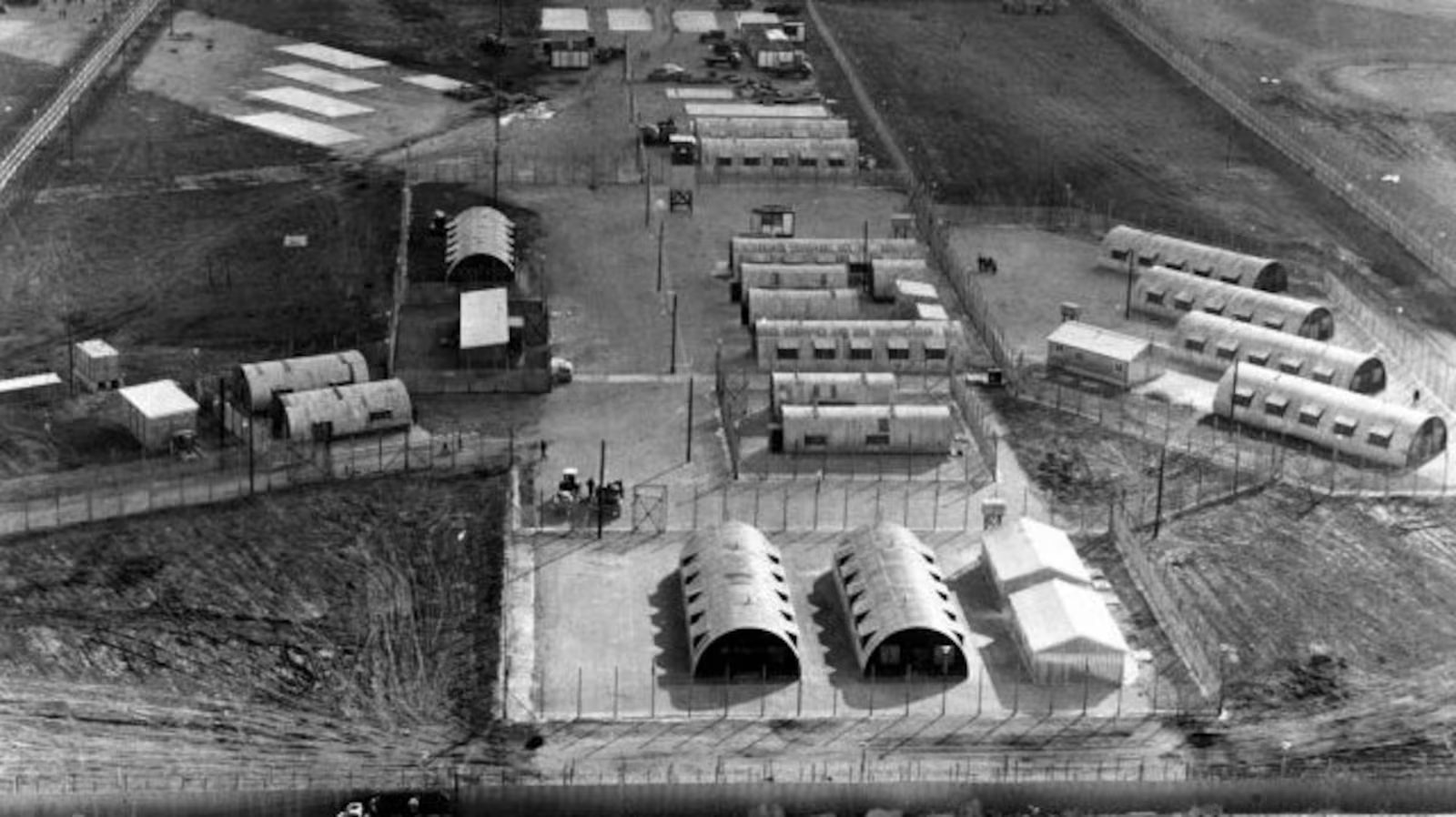
MICHAEL DEVINE, aged 27, was born in the Creggan, Derry
City, on 26 May 1954.
Michael was arrested in September 1976 following an INLA
arms raid in County Donegal. He received a 12-year sentence in June 1977.
He spent 60 days on hunger strike from 22 June. He died
on 20 August 1981.
The death of Michael Devine
On the death of INLA Volunteer Michael Devine at 12
minutes to eight on Thursday 20 August 1981, his brother-in-law, Frankie
McCauley, said:
“One thinks, ‘Ten men, how many more have to die? We have
ours now over us. Next week it will be big Laurence’s people waiting for the
same thing. Then the Devlins after that and another boy will go on hunger
strike and another. They’ll never break them.’”
Michael Devine was the last of the Hunger Strikers to die
in 1981. His funeral took place on Saturday 22 August in his native Derry City,
in a grave next to his friend and comrade, Patsy O’Hara, who died the previous
May.
The funeral went from Michael Devine’s sister’s home in
Rathkeele Way directly to the cemetery after Requiem Mass in St Mary’s Chapel.
People came from many parts of Ireland to attend and a long queue of mourners
lined up outside the house to pay their respects. Thousands gathered in the
street as the coffin was removed from the house, flanked by an INLA guard of
honour, followed by relatives and then representatives of the families of the
other Hunger Strikers.
Conversation on the day revolved around the courage and
determination of the Hunger Strikers and the wavering attitude of the Irish Government,
the SDLP and the Catholic Hierarchy. Another topic of conversation was the
election in Fermanagh/South Tyrone after the death of Bobby Sands MP of Owen
Carron, who attended the funeral. He was repeatedly mobbed by well-wishers.
Three British military helicopters flew overhead.
The cortege made its way to the top of the cemetery and
to the plot where Michael Devine’s comrade, Patsy O’Hara, was buried three
months previously. A piper playing laments was followed by a guard of honour of
eight men in uniform. The two leading Volunteers carried the Starry Plough and
Tricolour flags, followed by six more carrying semi-automatic short-arms in
their belts. Three drummers then marched silently forward. A second guard of
honour of 16 men flanked the coffin on the last few yards of its journey.
Margaret McCauley walked behind the coffin with Michael
Devine’s two children, Michael (Jnr), aged seven, and Louise, aged five, and
Michael’s aunt, Theresa Moore. The coffin was laid on trestles and the firing
party stepped forward and delivered three volleys of shots over the remains of
their comrade. This salute was greeted with loud applause. Terry Robson chaired
the ceremony and praised the deceased Hunger Striker who was the former O/C of
the INLA prisoners in the H-Blocks. Wreaths were laid on behalf of all the
Hunger Strikers’ families, the INLA, the Irish Republican Socialist Party, the
National H-Block/Armagh Committee, the IRA and many others. A girl piper played
The H-Block Song and a bugler sounded The Last Post.
• Frank McAuley, Michael Devine’s brother-in-law,
holds the hand of Michael’s seven-year-old son, also Michael, at the funeral
The flags were then removed from the coffin for
presentation to Margaret McCauley. “The colours,” Terry Robson said, “include
the Starry Plough and the national flag, the Tricolour. It will also include
his beret, his gloves and his belt – denoting his rank as an officer in the
Irish National Liberation Army.” A statement from the Army Council of the INLA
was read out. It said:
“The Army Council and Volunteers of the Irish National
Liberation Army deeply regret the death of Volunteer and Hunger Striker Michael
Devine. The Irish National Liberation Army applauds his heroism in the face of
the most extreme deprivation and horror.
“As Officer Commanding our Prisoners of War in the
concentration camp at Long Kesh, Michael relentlessly pursued an honourable
settlement for the protesting prisoners, not in any elitist disregard for the
rights of others but in the full knowledge that his struggle was merely an
extension of the same struggle for which he was incarcerated.”
The INLA statement went on to say:
“The creation of the H-Blocks, a development unseen in
the history of the sophisticated torture machinery of British imperialism,
brought a new unity amongst anti-imperialist organisations and saw a degree of
co-operation between people as our nation reacted in horror at what really was
going on inside the corrugated and barbed enclosures of Long Kesh.”
The main oration was delivered by Naomi Brennan,
Chairperson of the IRSP. She described Michael Devine as “a revolutionary, a
soldier, but above all a socialist”. She went on to say that Devine saw from
“the reality of everyday life in his native Derry what British imperialism
means in Ireland. He saw the long years without hope on the dole. He saw the
discrimination and gerrymandering from the fat cats behind the Derry walls, and
he liked none of it.”
• INLA Volunteers carry the coffin of Michael
Devine
Naomi Brennan said that Michael Devine was only a
youngster when the RUC batoned the civil rights protesters off the streets in
1969, adding that the lessons of the period were not lost on him. She said that
1969 was a time when people had at long last found their voice, learned to
stand and demand their rights and that “to stand and fight was far better than
50 years of bending the knee”.
Of Michael Devine’s socialist politics she said that
Michael “realised that to have national freedom, we must have socialism, and
that, also, to have any chance of socialism, we must have national freedom”.
She said that his dedication to the socialist cause was a well-thought-out one
and one which he put into practice.
“He realised that you had to organise the people to
struggle for themselves; that you had to organise a revolutionary party to
guide and direct that struggle; and that you had to organise military
resistance to give backbone to that struggle, because that was the only thing
that the British had ever really listened to.”
She said the prisoners’ five just demands could, and
must, be won.
“The hope we have is not in the droppings from this or
that British Government, much less from the well-oiled phrases of the SDLP
politicians and their likes. No, the hope we have is in the spirit of Michael
Devine, unquenchable even in the jaws of death itself.
“While Ireland brings forth young men and women such as
him there is hope now and for the future – a certainty that the cause for which
Michael Devine gave his young life is just, and is necessary, and we must see
it through to the end. And we will.
Irish Explorer Earnest Shackleton (second from the left) along with other members of the Southern Party. Public Domain
His name is synonymous with adventure, exploration and endurance. Ernest Shackleton was one of the most renowned Antarctic explorers of all time, leading pioneering expeditions to the furthermost corners of the planet, all the while embodying his family motto: “By endurance, we conquer”. But did you know that Shackleton was born in Ireland, and a proud Irishman through and through? It’s just one of the facets of his story that you can learn about when the Shackleton Experience reopens in October, fresh from a huge renovation.
Set in Athy, County Kildare, just a few miles from the very place where Shackleton was born, this museum is the only institution in the world dedicated to the life and work of the man himself. When the upgraded museum opens, it will showcase everything that made the Kildare man a groundbreaking force in the world of exploration.
Sign up to IrishCentral’s newsletter to stay up-to-date with everything Irish!Subscribe to IrishCentral
You’ll learn how he travelled from his birthplace, the village of Kilkea, to the outermost edges of the globe, and see some incredible artefacts from those very expeditions.
7
Shackleton’s House.
A world-class polar museum
“Athy is a beautiful heritage town steeped in history, with an incredibly passionate and supportive community,” says Aline FitzGerald, General Manager of the Shackleton Experience.
“The Shackleton Experience is destined to become one of the world’s great polar museums, and the only one dedicated to the greatest explorer of them all, Sir Ernest J. Shackleton.”
7
The Shackleton Experience.
The attraction started life as a small community museum 25 years ago, and this epic renovation combines high-tech, immersive exhibits with rare relics that would take pride of place in any museum around the world. Set in the 300-year-old Town Hall in the heart of Athy, the sensitively restored building now features a striking glass shard extension that looks just like an iceberg, with a statue of Shackleton at the entrance.
Throughout the Shackleton Experience, you’ll get great insight into the three Antarctic expeditions that he led, including the incredible story of Endurance, the ship that became trapped in the ice and later sank. Despite the great risk and danger, and against all odds, his leadership meant that all of the 27-man crew survived. However, the journey to survival was arduous, with the group forced to camp on the ice for 10 months before Shackleton and four others sailed 800 miles in a lifeboat, navigating treacherous waters in order to organize the rescue of the others. Their story of survival is one of the greatest of all time.
And in an absorbing, multi-media experience, you’ll get a deep sense of what their escape from the ice-trapped ship was like, with crashing waves and wind effects bringing the story to life. You can also see biscuit and tobacco tins from that very ship, along with the actual sledge and harness Shackleton used on the Nimrod Expedition.
One of the most extraordinary displays is the actual cabin in which Shackleton died. He passed away of a heart attack during the Shackleton-Rowett Expedition to the South Pole in 1922, on the ship named Quest. You’ll be able to see the cabin where he spent his final night. Then go to the reconstructed 1920s cinema to see archival footage and historic clips of his expeditions, to remember all of his accomplishments. There’s also an exhibit showing what the polar regions are like today, and every year the Shackleton Autumn School features a series of workshops, talks and events that delve deeper into Shackleton’s legacy.
But walk through the exhibits at any time, and you’ll get an insight into what life must really have been like for Shackleton, setting sail for a whole new world, right at the dawn of the Heroic Age of Antarctic Exploration. Imagine sailing through the unknown territory of Antarctica, seeing icebergs looming on the horizon, watching penguins totter on the snow and looking out at the wonder of the Frozen Continent.
“It is in our nature to explore, to reach out into the unknown,” said Shackleton, and that’s just what he did, with his expeditions exemplifying the spirit of endurance.
7
Athy Boat tour.
Beyond the museum, the market town of Athy is a joy to uncover. Stroll the elegant grounds of the Georgian-era Burtown House, and dine in The Green Barn there, a contemporary restaurant serving fresh produce straight from the historic gardens. Then enjoy an Athy Boat Tour aboard a charming barge, taking in local wildlife and historic landmarks along the way.
7
Sculpture of Tom Crean in Annascaul, County Kerry.
Ireland’s adventurers
Shackleton’s not the only celebrated Irish explorer. Over the years, the country has produced many an adventurous spirit, from Shackleton’s fellow Antarctic explorer Tom Crean to the pioneering travel legend Dervla Murphy. Further back in the 16th century, there was the pirate queen Grace O’Malley, a fearsome seafarer who defied gender norms and stereotypes to rule the ocean.
7
The South Pole, in Annascaul.
That spirit of adventure, endurance and exploration is still very much alive in Ireland today. All around the country, there are courageous and innovative adventurers who set out to make the most of every inch of the island, climbing the soaring mountains, swimming its waters and performing incredible feats of strength and tenacity
And it’s easy to follow in their footsteps. You could take part in one of the Gael Force Great Swims, setting out into the gloriously clear waters of Killary Fjord in Connemara or the magical Lough Derg. If you want to go beneath the ground and explore the Fermanagh underworld, you can go “wild caving” in the Marble Arch Caves, donning expert gear and clambering through elaborate passages.
7
Marble Arch Caves, in Fermanagh.
If running is more your thing, head to Donegal for the epic Seven Sisters Skyline Ireland, a 55km (or 30km) mountain running event, traversing seven peaks in the incredible Derryveagh Mountains. There are more trail running adventures in Wicklow, where the EcoTrail event sees participants running five different distances, from 10km to an astonishing 80km, over the mountains and through incredible scenery.
That’s alongside the lower octane adventures that can be found all over the island, from beautiful walking trails and cycles to wild swimming.
Whether you want to get out of your comfort zone and have the adventure of a lifetime, or simply savor the beauty of the great outdoors, Ireland is an explorer’s dream.
Where are The Big Fella’s mugshots? Dermot McEvoy believes they don’t exist because they were never taken; Collins’ survival depended on his anonymity.
Michael Collins addressing throngs of people in Cork on St. Patrick’s Day, March 17, 1922. US Library of Congress / Public Domain
A look back on the character Michael Collins – “The Big Fella” – and his incredible life story.
Where are The Big Fella’s mugshots? They don’t exist because they were never taken.
One of the great mysteries concerning the Easter Rising – and the subsequent arrest of its participants – is why didn’t the British photograph their prisoners? As someone who has written two books on Michael Collins, who was assassinated nearly 100 years ago, this has always bothered me.
“Why?” because Collins’ survival depended on his anonymity. With a £5,000 (sometimes embellished to £10,000) bounty put on his head by Winston Churchill, Collins walked about the streets of Dublin at the height of the terror in 1919-20 and almost never feared for his survival. There are many reasons for this.
Collins believed that if you didn’t look guilty you had nothing to worry about. He always dressed impeccably and carried an attaché case. He was a businessman. Why would the British bother a busy businessman?
Sign up to IrishCentral’s newsletter to stay up-to-date with everything Irish!Subscribe to IrishCentral
When he went into the Great Brunswick (now Pearse) Street Dublin Metropolitan Police Station on April Fool’s Day 1919 to read his file, he discovered that they had a poor photograph of him taken in profile. He promptly pinched it, which left them with no picture at all.
Collins was also the perfect chameleon. I have never seen someone who could change their facial appearance so dramatically. The differences between the scowling Collins and the laughing Collins are so great that they are like two different, distinct people. This is especially evident in the official photograph of the members of the First Dáil where Collins has an absolute look of disgust on his face.
2
1919: Sinn Fein leaders at the First Dail Eireann. Michael Collins is pictured front row, second from left. (Getty Images)
Collins never missed a wedding. The tradition at the time was that the entire wedding party lined up to be photographed. Collins, always the perfect guest, duly lined up with everyone else, but when the photographer said “watch the birdie” Collins always dropped or turned his head. I have seen at least five or six of these photos from different weddings.
However, the biggest mystery regarding the missing mugshot goes all the way back to the Easter Rising. After the rebels were rounded up they were taken to Richmond Barracks for processing. There they were separated into elites and non-elites. Legend has it that Collins saw that the elites were probably going to be shortly staring down the barrel of a rifle and crossed the room and lined up with the non-elites. Shortly thereafter he was shipped off to Stafford Prison in England and then Frongoch Prison Camp in Wales.
There are a few clues as to what happened at Richmond Barracks. Vinny Byrne, one of Collins’ “Twelve Apostles,” said in his witness statement that he was fingerprinted while at Richmond Barracks. Thanks to his young age he was soon sent home to his mammy – a dramatic blunder on the part of the British.
After all the research I’ve done over the years (reading many witness statements) I have come to the conclusion that the British, in their rush to execute the leaders and deport the rest, simply did not take mugshots of the participants. And this would be natural because the British would have processed thousands in the days after the Rising.
Sign up to IrishCentral’s newsletter to stay up-to-date with everything Irish!Subscribe to IrishCentral
In 2016, the Irish Times reported that rare mugshots from 1916 were going on sale. The Irish Times did not say where these mugshots have been, but one can guess that they were in someone’s attic for the last hundred years.
These mugshots are important because they contain the photographs of two of Collins’ closest associates: Liam Tobin (#4 W. Tobin) and Piaras Béaslaí (#6 P. Beazley), who was Collins’ first biographer. Tobin was one of the most important members of the IRA in Dublin in 1919-20. This is because he was the Assistant Director of Intelligence (Collins was the chief) with an office at #3 Crow Street in Dublin. The office is a mere two blocks from Dublin Castle but was never discovered by the British.
I decided to check the witness statements of both Béaslaí and Tobin. Béaslaí’s shed no light whatsoever. Tobin’s statement, however, told his 1916 story. (Surprisingly his statement ends after his incarceration and he never mentions his work for Collins.)
During the Rising, Tobin fought at the Four Courts before his unit’s surrender. He was taken to Richmond Barracks to be questioned and processed. For some reason Tobin, a regular foot soldier in the Volunteers without rank, was singled out, sent to Kilmainham Gaol, and sentenced to death, which was immediately commuted to penal servitude. (His harsh treatment may have been because he fought at the Four Courts under Commandant Ned Daly and they had given the British a brutal time.)
The Irish Times speculates that the mugshots, including those of Tobin and Béaslaí, “were taken at Richmond Barracks in Dublin – a British army facility in Inchicore where most of the rebels were taken after the Rising. It is believed that the photos were taken by the Dublin Metropolitan Police, who were called on to assist the military in processing the detainees.”
I disagree with this. Tobin was then removed to Mountjoy Gaol for a while before being deported to Britain. He makes no mention of being photographed while at either Richmond Barracks or Kilmainham Gaol. But when he moved to Mountjoy he was “received by warders, had a bath and the usual prison routine gone through.”
Could that “usual prison routine” included the taking of mugshots? I think so because both Richmond (a military facility) and Kilmainham (an antique of a prison even in 1916) were not equipped with the photographic equipment to take mug shots. Mountjoy, of course, would have had such equipment.
So where are Michael Collins’ mugshots? With a great degree of certainty, I can speculate that they don’t exist because they were never taken. Collins, like many of his fellow GPO rebels, was quickly processed at Richmond Barracks and taken to the North Wall for his voyage on the cattle boat to England.
The British, in their rush for vengeance, probably only photographed a handful of their 3,000 prisoners, mainly those few who were sent to Mountjoy Gaol like Tobin. This blunder, in less than six years, would cost them their first colony, Ireland.
*Dermot McEvoy is the author of “The 13th Apostle: A Novel of a Dublin Family,” “Michael Collins, and the Irish Uprising and Irish Miscellany” (Skyhorse Publishing). He may be reached at dermotmcevoy50@gmail.com. Follow him at dermotmcevoy.com. Follow The 13th Apostle on Facebook.
A Houston mother is one of many nationwide left with grief and unanswered questions when a loved one dies behind bars.
Filed 6:00 a.m. EDT
08.06.2025
Jacilet Griffin standing in the cemetery where her son Evan Lee is buried in the Houston suburb of Pearland, Texas. Rahim Fortune for The Marshall Project
For four days, deputies from the Harris County Sheriff’s Office barred entry to Evan Lee’s hospital room. By the time his mother, Jacilet Griffin, was allowed inside, doctors told her he was brain-dead.
It wasn’t jail officials who explained what had happened to her 31-year-old son, Griffin said. The few details she got came from hospital staff, who said Lee had arrived at Houston’s Ben Taub Hospital with a critical brain injury. Just four months earlier, he was alive and in generally good health, with his diabetes and other underlying conditions under control, his mother said. Then he was booked into the county jail.
Though the county medical examiner ruled his death a homicide due to a head injury, no public agency has ever provided a clear account of what led to his injury — and no one has been charged.
“I know God is in the midst of this,” Griffin said. “I know I’m gonna get the answers that I’m searching for.”
Lee’s case is one of thousands nationwide that reveal how the criminal justice system fails to account for deaths behind bars. Each year, about 6,000 people die in prisons and jails, and another 2,000 during encounters with police, according to estimates by government agencies and nonprofit groups — numbers that experts believe are likely undercounts. Federal law has for 25 years required local agencies to report in-custody deaths, but the mandate is not enforced. In many places, there’s no reliable public accounting of what happened or why.
Families who lose loved ones in custody are often met with silence or conflicting accounts. The authorities tasked with finding the truth — from jail officials to medical examiners to state investigators — often operate slowly, without coordination, or behind closed doors.
In Lee’s case, the agencies that could have explained what happened offered competing timelines and contradictory narratives. The burden of uncovering the truth fell not to the system — but to his grieving mother.
Evan’s father, Timothy Lee, stands with a portrait of his son in front of his home in Arcola, Texas, in January. Rahim Fortune for The Marshall Project Evan’s closet has been untouched since his death. Rahim Fortune for The Marshall Project
About a year before he died, Evan Lee called his mother from a bus stop in Houston. He’d gotten into an altercation with a man who didn’t speak English after asking for the time.
According to police, a third man at the stop said Lee had threatened him with a pocketknife. Lee told officers he pulled the knife in self-defense, after someone grabbed him. No one was hurt, but Lee was arrested and charged with aggravated assault with a deadly weapon.
He was released on bail with an ankle monitor. Eight months later, the device stopped sending a signal. Lee insisted it had malfunctioned and that he hadn’t realized it wasn’t working. Prosecutors accused him of failing to charge it. His bond was revoked, and he was sent back to jail.
To get out again, he likely would have had to pay more than $3,000, local bail companies told The Marshall Project — a sum he couldn’t afford, even with his full-time job. His attempts to get a judge to reduce his bail were not approved, court records show.
Letter from Lee to the court stating he believed that his bail amount was a mistake and pleading for a reduction so he could “get back to my family”, mailed in February. It was filed with the court in April, almost a month after Lee’s death. Harris County District Clerk
Calling from the Harris County jail, Lee told his mother that when staff didn’t provide his diabetes medication or enough food, he experienced cold sweats, panic attacks and blood sugar crashes so severe that other detainees had to wake him.
Still, in phone calls to Griffin and other friends and family, he sounded hopeful. He was using the time to read and reflect. “There’s so much to learn in these books … They’re changing the way I think,” he said in a recorded call obtained by The Marshall Project. “I ain’t gonna be the same [person] when I come home.”
Four months into his incarceration, Lee was hospitalized. Four days later, on March 22, 2022, he was dead.
Jason Spencer, senior policy and communications advisor for the sheriff’s office, declined to answer most of our questions about Lee’s case, citing pending litigation. Spencer noted that the case had been investigated, and no criminal charges had been filed.
If you’re searching for answers while mourning the loss of a loved one who died behind bars, check out this guide on how to request information from a prison or jail. If you’ve had a friend or family member die in custody, you can tell us about your experience here.
Lee was still on life support when the sheriff’s office floated the first public explanation for what might have happened. Eleven days before he died, Lee had been in a fight with another detainee, sheriff’s office spokesperson Deputy Thomas Gilliland told the media. Medical staff checked him afterward and cleared him to return to his cell, Gilliland said.
That claim later resurfaced in official accounts. But as documents emerged over the next year, they revealed conflicting timelines and differing theories about what caused Lee’s fatal injury.
About a week after his death, the sheriff’s office submitted a custodial death report stating that on the day he was hospitalized Lee had told jail staff he wasn’t feeling well. A clinician determined he had “Altered Mental Status due to possible head trauma or ingestion of an unknown substance.”
The county medical examiner conducted an autopsy shortly after his death but withheld the results for nine months. When a partial report was released, it revealed the examiner had ruled his death a homicide, caused by “blunt head trauma with subdural hemorrhage.” The autopsy never explained how Lee had been injured.
The Texas Rangers, who are required to investigate all in-custody deaths in the state, gave considerable attention to the theory about the fight, but did not appear to conclude it was the cause of Lee’s death. In their report, obtained by The Marshall Project, a jail officer said she saw Lee and another man striking each other in a cell before guards quickly broke it up. She later recalled the man approaching her and saying, “I didn’t kill Lee.” He was never named as a suspect or charged. (The Marshall Project is withholding his name.)
The lead Rangers investigator seemed unconvinced that the altercation was serious enough to cause Lee’s head trauma. In an audio recording, he confided to the jail officer: “If he really didn’t injure him, I gotta figure out what happened — what caused him to die?”
The Rangers did not report a definitive conclusion.
The final line of the full autopsy report cast further doubt on the fight, which had happened eleven days before Lee died, noting that Lee’s brain injury was “unlikely to have arisen a week or more prior to death.”
Inside the lobby of the Harris County Sheriff’s Office and Detention Facility in Houston. Rahim Fortune for The Marshall Project Barbed wire outside the facility. Rahim Fortune for The Marshall Project
Griffin decided to join a lawsuit that points the finger at how Lee was treated by jail staff from the moment he entered the facility.
Filed as part of a broader class-action suit against Harris County, the complaint alleges that the county deprived Lee of his constitutional rights when jail staff failed to protect him from violence and ignored serious medical needs that may have contributed to his death. Griffin is represented by civil rights attorney Ben Crump, who also represented George Floyd’s family after he was murdered by a Minneapolis police officer in 2020.
According to the suit, Lee entered the jail with prescriptions for mental health and diabetes medications, but staff did not provide them consistently. The resulting symptoms — mental health deterioration and serious side effects from untreated diabetes — likely affected his interactions with other detainees.
Further, the lawsuit claims that another detainee beat Lee, leaving visible facial injuries, and they were not adequately treated by the jail.
The complaint argues that systemic failures at the jail — including chronic understaffing, lack of mental health care, and a culture of violence — contributed not only to Lee’s death, but to the serious injuries or deaths of 22 people whose families are bringing the suit.
In a court filing responding to the lawsuit, Harris County officials argued the plaintiffs are unable to show that jail staff “acted with subjective deliberate indifference” and, at the most, detainees or their families had a “disagreement with their medical treatment” — which the county said does not rise to a constitutional violation.
Whether or not that fight caused Lee’s death, the incident highlighted a larger risk to detainees, experts say. The Rangers’ report revealed that the reported altercation took place in what detainees in the jail referred to as the “fight cell” — a known blind spot in the facility’s surveillance system.
To better understand what happened, The Marshall Project reviewed Lee’s jail records, autopsy report, incident summaries and court filings. We asked a group of independent experts to assess Lee’s case with information we provided from the documents. The reviewers — including doctors, researchers and former law enforcement officials — considered a range of possible explanations for Lee’s brain injury that had been suggested by officials or found in the records: trauma from a fall or fight, complications from untreated medical conditions, a diabetic crisis or exposure to a toxic substance. Some of these factors may have contributed indirectly, by impairing Lee’s behavior and making him more vulnerable to a fall or violent encounter.
According to the Rangers’ investigation, Lee frequently participated in slap-boxing — a form of open-palmed sparring common in the jail, which witnesses said was often used as a way to teach basic fighting skills. One person interviewed said he saw Lee fall during a match and hit his head on a toilet. This version of events aligned with one of the explanations the sheriff’s office floated, in 2022, that slap-boxing likely played a role in Lee’s death.
Afterward, other detainees told the Rangers investigator, Lee appeared disoriented and slurred his speech. He passed out, they said, then woke up vomiting and coughing up blood. They said officers ignored his symptoms and denied him access to the jail’s medical clinic. Several witnesses said that later that day, Lee was sent to the clinic for his scheduled insulin dose. When clinic staff there saw his symptoms, paramedics were called. Lee was taken to the hospital and never returned.
While this series of events could explain how Lee sustained his fatal injury, the details in the records were too limited to draw definitive conclusions, according to the experts who reviewed them.
UCLA professor Keel said Lee’s symptoms could also have pointed to serious complications caused by missed or improperly administered diabetes and mental health medications. “Maybe he was having a health condition or health crises as a result of low blood sugar levels, which can be interpreted as an altered state of mind,” he said.
The circumstances surrounding Lee’s death were a tangle of conflicting official statements, non-answers from agencies, and crucial gaps in the records that were released. For example, the medical examiner did not provide a narrative summary explaining their interpretation of events. None of the agencies tasked with documenting deaths in custody answered the question of how he died, or acknowledged that they didn’t know.
What remained, the experts said, was not just a mystery about one man’s death — but an indictment of a system unable to explain it.
Griffin made signs to raise awareness around her son’s death over the past three years. Rahim Fortune for The Marshall Project The congregation of Brentwood Baptist Church gathers for a Thursday service in Houston. The community has joined Griffin in her quest for information about what happened to her son. Rahim Fortune for The Marshall Project
Lee’s death is one of dozens of cases that have drawn scrutiny to the Harris County jail in recent years.
A 2024 investigation by Houston’s KHOU 11 captured detention officers repeatedly punching detainees in the head with little to no consequences. A state commission that oversees county jails has designated Harris County as non-compliant with minimum jail standards. The commission has reportedly asked the state attorney general to intervene, citing ongoing failures in medical care, deterring violence and monitoring people facing mental health crises.
Even the Texas Ranger assigned to investigate Lee’s death seemed to acknowledge a broader crisis. In audio recordings from the inquiry, he expressed frustration with the repeated violence and lack of accountability at the jail.
“All the assaults that are occurring in here is getting kind of out of control,” the Ranger said. “I get tired of doing this, ’cause this happens all the time. I don’t want to see people get away with it, either.”
Harris County Sheriff Ed Gonzalez has said many of the recent deaths in the jail stemmed from natural causes or preexisting conditions, noting that detainees often have poorer health than the general population.
“We process over 100,000 individuals that come through our doors every year, and many come with poor health,” he told local news station KPRC 2 in 2023. “They find themselves … here in the county jail, as a temporary home, and tragedy might strike.”
He also cited overcrowding, understaffing and outdated infrastructure as contributing factors. “Our condolences go out to any family that’s been impacted … by the loss of life of someone that was under our custody,” he said. ”As an agency, and me personally, I take it very hard, it’s something that we want to improve on.”
Under the federal Death in Custody Reporting Act, state and local law enforcement agencies are required to report in-custody deaths to the U.S. Department of Justice. The law, passed in 2000 and updated in 2014, was meant to help officials analyze systemic failures and prevent future deaths.
But data collection under the law remains incomplete and unreliable.
Late last year, the Justice Department published aggregated totals of deaths reported between 2019 and 2023. Due to a technical glitch, The Marshall Project was able to download the full dataset — a loophole that was quickly closed. (The department has not published unredacted death in custody datasets in the past because of privacy issues and concerns about data quality.) The records we reviewed showed widespread gaps: missing causes of death, vague entries and inconsistent details from jail to jail.
Those gaps make it nearly impossible to hold institutions accountable, experts say.
Lee’s death was included in the database. But the entry was minimal: the manner of death listed as “Unavailable, investigation pending.” It made no mention of the homicide ruling — or any of the conflicting theories that have emerged since.
Of the 72 people listed as having died in the Harris County jail during that four-year period, most entries contained little more than “pending autopsy results.”
Griffin has sought the reasons behind her son’s death for three years. Rahim Fortune for The Marshall Project
At Houston Memorial Gardens, a cemetery south of the hospital where her son died, Griffin remembers standing with him in 2020, watching George Floyd’s casket pass through the iron gates. They were masked, grieving strangers among thousands — mourning a man whose death sparked a nationwide reckoning.
Now her son rests nearby.
Floyd’s killer was convicted. Griffin said she still dreams of holding someone accountable for what happened to her child.
Since Lee’s death, she has thrown herself into advocacy — joining the class-action lawsuit, working with her state representative on jail safety legislation, and advising Houston’s public defender office on how to better support families after in-custody deaths. Joining forces with other grieving families, she has garnered significant localmediacoverage.
But the search for answers has come at a steep cost.
Griffin told The Marshall Project she tried to keep working, but the grief overwhelmed her. She had dizzy spells and other stress-related health problems, and eventually went on medical leave from her nonprofit job. Soon after, she said, she was terminated. She lost her savings and her home. Today she lives in a small apartment, relying on help from friends and family. A longtime reverend, she now depends financially on donations from her church community.
More than three years later, she said, no one from the Harris County Sheriff’s Office has officially informed her of her son’s death or explained it. “Not a postcard, or anything,” she said. “Like nothing happened.”
In 2023, Griffin traveled to Austin for a meeting of the Texas Commission on Jail Standards, where the sheriff was present. At first, she hesitated to confront him. But after hearing another advocate speak out, she did too.
“Someone murdered my son in your care,” she told the sheriff, “and nobody said anything.”
Gonzalez told Griffin that her son’s death was being investigated by an independent agency, and offered his condolences. He did not share any information about what might have led to Lee’s fatal injury.
Griffin said she saw fear in Gonzalez’s eyes. “[It was] like he just stopped breathing,” she added later, with a small smile. “I’m not gonna lie to you, that made me feel really good.”
When Lee had called her from jail, she never imagined it would be the start of a years-long fight for accountability. He spoke with optimism about his future. He told her he loved her. He believed he would be coming home.
“I’m not going to let [the jail] … take my life from me for no reason,” he said.
Former Irish Republican Army Soldier Self-Deports, Afraid He’d Die in an ICE Holding Cell
The Clinton administration once used Matthew Morrison’s U.S. immigration case to help solidify peace in Northern Ireland.
Filed 6:00 a.m. EDT 08.04.2025 A person’s hand holds a framed photo of a White man with a mustache, who is wearing glasses, a green jacket and a light blue button-down shirt.
Matt Morrison holds a framed picture of his father, Matthew, in St. Louis on July 22, 2025. Matthew Morrison, an Irish immigrant who resided in the U.S. for 40 years, self-deported to Ireland on July 21, 2025. Katie Moore/The Marshall Project
By Jesse Bogan
Republish
This story is part of “Trump Two: Six Months In,” our series taking stock of the administration’s efforts to reshape immigration enforcement and criminal justice.Trump administration officials aim to pressure some noncitizens into self-deporting. It worked on Matthew Morrison. In mid-July, the 69-year-old former psychiatric nurse supervisor quietly fled the United States.Morrison had been threatened by an aggressive government before. When he was a teenager, he fought against what he and others in the Irish Republican Army saw as an occupying British government that discriminated against marginalized Catholics in Northern Ireland.For his efforts then, Morrison said he was beaten by interrogators and wound up in prison, where some of his comrades died in a hunger strike protesting the revocation of their political status.Upon his release in 1985, he feared for his safety. He came to St. Louis, married his American pen pal and had two children. Eventually, he overstayed his tourist visa, divorced his pen pal and remarried. He’s had the spectre of deportation hanging over him for decades. His family has endured the highs and lows of his battle along the way.Now, Morrison leans on a cane. He’s had several strokes. He said that the fear and uncertainty that he might be picked up by U.S. Immigration and Customs Enforcement was more than he could bear.
A elderly White man with a mustache, who is wearing glasses, a light blue button-down shirt, and a gray blazer, poses for a picture with his wife, a White woman with dark brown hair, who is wearing a green dress and a yellow ribbon.
Matthew Morrison, with his wife Sandra Riley Swift, in 2025. Courtesy of Morrison Family
“I would bite the dust in an ICE holding cell,” Morrison told The Marshall Project – St. Louis before he left the U.S. “There is nothing to stop them from deporting me to Ecuador, South Sudan or whatever. It’s really gotten insane here. It’s crazy what they are doing now, the Trump administration. You know what I mean?”Many noncitizens have faced similar unknowns in hiding. Morrison has been in the public eye for a long time. He’s been in and out of the news since the 1990s. He was even the grand marshal of a parade. But the U.S. government denied his petition for an adjustment in immigration status because of crimes he was convicted of during “The Troubles” conflict in Northern Ireland. Morrison had omitted those from his original tourist visa application.In 2000, the Clinton administration terminated the deportation process against Morrison and five other named “deportees,” as the group of former Irish Republican Army prisoners was called, after the American spouses of the Irish men testified before Congress. The president himself weighed in on the issue.”While in no way approving or condoning their past criminal acts,” Bill Clinton said then, according to a Washington Post story at the time, “I believe that removing the threat of deportation for these individuals will contribute to the peace process in Northern Ireland.”The deportees were momentarily relieved. But because they weren’t on a path to citizenship, the six men still had to live with restrictions and regularly check in with the government.In May, Noel Gaynor, who had a heart condition, died at home in Olean, New York. Waiting months without annual work authorization approval, his Medicare and Social Security benefits were cut off, according to a video of statements made at his wake. In June, Gabriel Megahey received a letter from the U.S. Department of Homeland Security that The Marshall Project – St. Louis reviewed. It began: “It’s time for you to leave the United States.”Morrison expected a similar letter. Though his work authorization expires in October, he didn’t want to sit around waiting and worrying.On July 21, he limped onto a one-way flight from Cleveland to Dublin, Ireland, with his wife, leaving behind a life that he’d built in the St. Louis area, including grown children, grandchildren and many friends.“I’ve come full circle,” Morrison said while still in the United States. “I came here as an immigrant and I am leaving as an immigrant, despite everything in between. The whole thing is a crazy, stressful situation.”
Welcome to our community!
Thanks for trusting us to be your source for urgent investigations and compelling narratives about criminal justice. Readers like you help to make our work possible. Please consider taking the next step and become a member today.
Donate
There’s a city in Northern Ireland with two names. Protestants call it Londonderry. Catholics, like Morrison, call it Derry.Catholics felt discriminated against there. Without better options, Morrison said his childhood home didn’t have an indoor bathroom or hot water. He said the cramped home was raided by British soldiers stationed there to keep the peace between Protestants and Catholics and to ensure Northern Ireland remained part of the United Kingdom.To resist, he helped build barricades around his neighborhood. On Jan. 30, 1972, 16-year-old Morrison and his father joined thousands of others in the streets of their city. The march for Catholic civil rights became known as Bloody Sunday after British troops fatally shot 14 unarmed people and injured others.To fight back, Morrison said he joined the Irish Republican Army.“There was no way to be indifferent,” he said.Three years later, while in college, he said he was arrested with two others for trying to gun down a Royal Ulster Constabulary officer. Again, there were two ways to look at it. To Morrison, it was an act of war. Others saw it as terrorism.
A sepia-toned photo shows a group of young adults, wearing black and gray clothes, standing in front of a brick building. There are several poles and a watchtower in the background.
A sepia-toned photo shows a group of young adults wearing black and white uniforms while standing in one line.
Matthew Morrison, third from the right, poses for a photograph with fellow Irish Republican Army soldiers inside a Northern Ireland prison in 1976. Courtesy of Morrison Family
Matthew Morrison, second from the right, stands with incarcerated Irish Republican Army soldiers in 1975. Courtesy of Morrison Family
Later, he’d claim he was choked and beaten during police interrogations, which left him deaf in one ear. Convicted of attempted murder, he was sent to a prison outside Belfast that became widely known for a hunger strike where 10 people died.Released in 1985, Morrison fled to St. Louis, where he soon married Francie Broderick, an American pen pal who’d protested in Northern Ireland. They had a son, Matt, then a daughter, Katie. For years, the family and their supporters rallied to bring awareness to their own troubles with immigration authorities.In 1998, CBS featured the Morrison family in a documentary titled “Before Your Eyes: Don’t Take My Daddy.”“I always felt that our campaign was an extension of the hunger strike,” said Broderick, now 77.
A black-and-white photo shows a man, a woman and two young children holding signs. They stand in front of two big signs that read, “All our children want for Christmas is their fathers — let them stay,” and “Matt Morrison defense fund.”
Matthew Morrison, with Francie Broderick and their children, at a 24-hour vigil in downtown St. Louis in 1996. Courtesy of Morrison Family
They had a major breakthrough in 2000 when then-Attorney General Janet Reno said in a prepared statement that she had been advised by Secretary of State Madeleine Albright to drop deportation proceedings against the deportees to “support and promote the process of reconciliation that has begun in Northern Ireland.”The men could stay, but they still couldn’t apply for a green card, let alone U.S. citizenship, because of their deferred immigration status.“People don’t realize how much of a minefield U.S. immigration law is,” Morrison said.Over the years, delayed work authorizations sidelined him from his job for months at a time, he said. He worked about 20 years as a nurse in Missouri, including stints at a children’s hospital and several state mental health facilities. He said he presented at the St. Louis County Police Academy on topics including mental health and deescalation tactics.“It doesn’t matter what I did, Immigration gave me no credit for it,” Morrison said.Homeland Security and ICE officials didn’t respond to requests for comment.In June, before Morrison self-deported, a scheduled check-in with U.S. Citizenship and Immigration Services in St. Louis put him and his family on edge. Their fears were heightened by stories about immigrants being detained at routine appointments, regardless of legal status. At the appointment, authorities took a photo of Morrison and he was free to go.“We were terrified that they were just going to take him right there,” said his son, Matt, 37.
A White man with a beard wears glasses, a red and navy blue cap, a navy shirt and light blue jeans while sitting next to a White woman who is wearing a red long-sleeved shirt.
Matthew Morrison’s children, Matt, 37, and Katie, 34, on July 22, 2025, the day after he self-deported. Katie Moore/The Marshall Project
He said the uncertainty weighed on his father more than he’d ever seen.“He has to live under that fear of somebody knocking on the door and dragging him out of the house, just like they did in Derry when he was young,” Matt said. “I hate it. I am just worried about him. Until recently, I hadn’t heard him cry about it.”He has mixed feelings about his father’s departure.“He’s got brothers and sisters over there, but we are all here — and his grandkids,” Matt said. “He spends a lot of time with his grandkids.”Morrison’s daughter, Katie Bradley, 34, said a recent farewell gathering, held in a backyard, felt like a funeral. She panicked because her U.S. passport had expired.“Even though he’s still alive, I feel like I am grieving,” she said. “It’s a huge loss for me and my children.”Morrison’s wife, Sandra Riley Swift, has a house in St. Charles, Missouri, as well as her mother and many grandchildren. After helping Morrison transition into an apartment in the town where he grew up, she said in a social media post that she’s going to straddle both countries for a while.“This was not an easy choice, but a necessary one for his health and safety,” she wrote a few days after they left the U.S.